Chlor-Alkali: State of the Market 2020 - Chlorine, sodium hydroxide, vinyl chloride and the rest are made possible through the chlor-alkali ...
←
→
Page content transcription
If your browser does not render page correctly, please read the page content below
Chlor-Alkali:
State of the Market 2020

Chlorine, sodium hydroxide, vinyl chloride
and the rest are made possible through the
chlor-alkali process, a chemical reaction.

By: Dan Fisher, Business Development Manager, Dixon Boss

CONTENTS

INTRODUCTION                                  3

THE BIG FIVE                                  4

QUICK CHEMISTRY                               5

ENERGETIC CHALLENGES                          5-6

THE INDUSTRY                                  6-7

A FEW MAJOR PRODUCERS                         7

REGULATIONS AND SAFETY                        7-8

TRANSPORTATION CHALLENGES                     8

PETROCHEMICALS: A MARKET ON THE RISE          9

PETROCHEMICALS AND THE CHLOR-ALKALI PROCESS   10

CHANGES UNDERWAY                              11

OVERALL PREDICTION: GROWTH                    11

SOURCES                                       12
INTRODUCTION

For most people, the chlor-alkali process is
most closely associated with the scent of clean
pools and the chlorine found therein. But the
chlor-alkali process is so much bigger than that:
It is part of a well-established market, one of the
world’s largest chemical processing industries,
and is poised for continued growth.

Globally, the chlor-alkali market was valued
at $97 million in 2017 and is slated to grow
at a CAGR of 5.1% through 2023. 360 Market
Updates predicts that the market will increase,
reaching a value of $131.1 million by the end of
2023.(1)

At a national level, more than 20,000 Americans
are directly employed by the industry and
another 245,000 are employed by chlor-alkali
related industries.(2) As the demand for
petrochemicals continues to rise, so does the
significance of the chlor-alkali market.

                Chlor-Alkali: State of the Market in 2020 3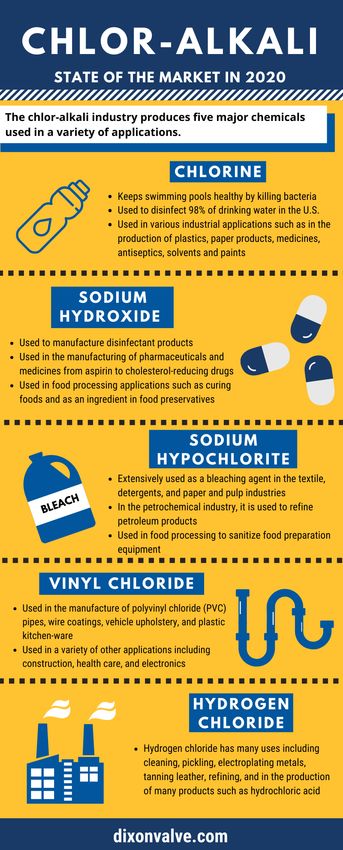
THE BIG FIVE:
WHAT’S THE BIG DEAL WITH
THE CHLOR-ALKALI PROCESS

The chlor-alkali industry is responsible for          an unstable and hazardous material that would pose
producing five major chemicals:                       a serious health risk. Instead, it is converted from a
• Chlorine                                            vinyl chloride monomer to a vinyl chloride polymer,
• Sodium hydroxide and potassium hydroxide            or polyvinyl chloride, more commonly known as PVC.
• Sodium hypochlorite                                 PVC plastic is the third-most produced synthetic
• Vinyl chloride monomer                              plastic, with roughly 40 million tons made every year.
• Hydrogen chloride
Each of these products is included in the chlor-      5. Hydrogen chloride is made when hydrogen is
alkali market, with all five chemicals used in        combined with the pure chlorine gas that is produced
various applications across the country.              during the chlor-alkali process—a feat achieved when
                                                      completing the reaction in the presence of a UV light.
1. Chlorine, arguably the most readily known          Most hydrogen chloride is used in the production of
of the five, is best celebrated for keeping pools     hydrochloric acid, an inorganic compound used in
sanitary and healthy. More importantly, it is also    industrial processes.
used to clean 98% of drinking water in the United
States.                                               Combined, these five chemicals are integral to a
                                                      staggering amount of day-to-day life. Through the
2. Sodium hydroxide and potassium hydroxide           chlor-alkali process, we are provided with clean
can be used interchangeably. The bulk of these        drinking water, paper, laundry detergent, bleach, PVC
chemicals are used to manufacture a wide range        plastics, and various other products.
of items including detergent, aluminum products,
and paper. Food-grade sodium hydroxide is used        With all this at stake, it’s easy to see why the chlor-
on German pretzels to give them a unique, crisp       alkali market is one to watch.
crust.

3. Sodium hypochlorite, more commonly known
as bleach, can be found under bathroom sinks
around the world. Before being made available
for purchase, sodium hypochlorite is diluted in a
liquid solution, resulting in the pungent household
cleaner found in a bottle of bleach.

4. Vinyl chloride, or sometimes vinyl chloride
monomer, is not a final product. On its own, it is

4 Chlor-Alkali: State of the Market in 2020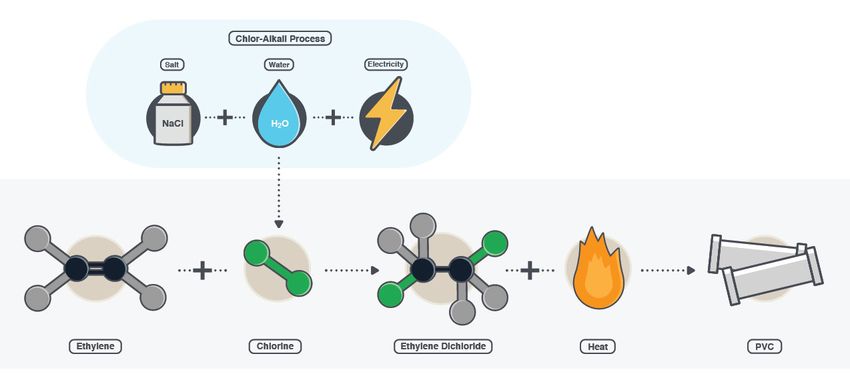
QUICK CHEMISTRY:
UNDERSTANDING THE PROCESS

Chlorine, sodium hydroxide, vinyl chloride
and the rest are made possible through the
chlor-alkali process, a chemical reaction.
The process begins with sodium chloride—or
salt, to the non-scientist—which is made into
a salt-water solution called brine. The brine
is charged with electricity, which forces the
sodium and chloride to separate, resulting in
sodium hydroxide, hydrogen, and chlorine.
Using these byproducts, manufacturers can
make sodium hydroxide, vinyl chloride, and
hydrogen chloride.

ENERGETIC CHALLENGES

The chlor-alkali process requires a great deal
of energy—the reaction itself is an electrolysis,
meaning that… Producing these chemicals
at a large scale consumes a lot of electricity,
making energy prices one of the greatest
expenses in the process, amounting to as
much as 70% of the variable cost.(3)

Consequently, changes in the cost of
electricity impact the cost of production and
influence the future of the industry. If the cost
of electricity continues to rise in Europe and
North America, the chlor-alkali market is likely
to migrate to other parts of the world where
energy is cheaper.

        Chlor-Alkali: State of the Market in 2020 5
Ironically, the chlor-alkali market plays a      THE INDUSTRY
large role in the production and efficient use
of energy. Wind turbine blades, insulation
materials, and energy-saving LEDs are all        The chlor-alkali industry is broken down into
products of the industry. Without the chlor-     three distinct business types. Each has its
alkali industry, green-energy technology         own set of data, including incident reports and
would come to a halt.                            market tracking.

                                                 • Producers are facilities that produce, ship,
Reinventing the Process                          sell, or use chlorine internally when creating
                                                 other products.
                                                 • Sodium hypochlorite manufacturers
Until recently, manufacturers struggled to       produce sodium hypochlorite by using chlorine
control the chlor-alkali process. The reaction   that was produced outside of the facility.
itself results in a byproduct of hydrogen and    • Packagers receive chlorine in bulk. Their
hydroxide ions, which need to be separated       task is to package the product into smaller
from the other elements to prevent further       containers for sale.
reactions. Historically, this has been
accomplished through challenging and             The Chlorine Institute publishes monthly
inefficient methods. In fact, the traditional
                                                 statistics and production reports on producers
methods involve either mercury or asbestos,
                                                 and sodium hypochlorite manufacturers,
making them not only inefficient, but
hazardous.                                       which is available by online subscription. Euro
                                                 Chlor has a similar program available for those
But with the help of innovative technology,      interested in the European market.
chemical plants are able to separate the
unwanted leftovers using a semi-permeable        A wide range of industries—from
fabric, or membrane, safely removing the         pharmaceuticals, to water treatment, to crop
unwanted ions. The chlor-alkali process is now   protection—depend on the chlor-alkali process,
cleaner, safer, and eco-friendlier.
                                                 making it difficult to truly value the scope
                                                 and power of the industry. A 2016 economic
Learn about the membrane from
                                                 study found that chlor-alkali chemistry saved
textechindustries.com
                                                 consumers in the U.S. and Canada more than
                                                 $421.5 billion annually.(4) For example, there
                                                 are available alternatives to the chlor-alkali

6 Chlor-Alkali: State of the Market in 2020
water treatment process, but many of these producers, packagers, and manufacturers
technologies require new systems to be in America are the Occupational Safety and
constructed and the increase in cost would Health Administration, the Environmental
be passed on to consumers. Protection Agency, and occasionally the
Food and Drug Administration. Chlorine
A FEW MAJOR PRODUCERS
The United States is home to several of the What are Euro Chlor
world’s top producers, including(5):
• Axiall Corporation, A Westlake Company, and the Chlorine
Houston, TX
• Occidental Chemical Corporation,
Institute, anyway?
Houston, TX
• Olin Corporation, Clayton, MO Euro Chlor and the Chlorine Institute are
Outside of the U.S., some of the biggest trade associations whose goal is to educate,
producers are: support, and advocate for the chlor-alkali
• AkzoNobel, Amsterdam, Netherlands industry. They work to make the chlor-alkali
• Tata Chemicals, Mumbai, India industry safe, sustainable, and successful by
self-regulating and sharing best practices.
• Solvay S.A., Brussels, Belgium
As its name suggests, Euro Chlor is located in
Europe and represents chemical companies
REGULATIONS AND SAFETY across the continent. Any European-based
chlor-alkali producer is welcome to join their
community of 39 members.
Because the chlor-alkali industry deals with
some hazardous chemicals, producers,
The Chlorine Institute is based in the United
packagers, and manufactures follow market States but welcomes members from outside
regulations created and enforced by governing its borders. Their 200 members are located in
entities. the U.S., Canada, Japan, Mexico, and additional
international locations.
Producers, Packagers, and Sodium
Hypochlorite Manufacturers Both associations are globally respected and
considered authorities on the chlor-alkali
The official governing agencies for plants, industry.(6, 7)
Chlor-Alkali: State of the Market in 2020 7process plants in the U.S. generally look TRANSPORTATION
to the Chlorine Institute’s informational
pamphlets for compliance, which list
CHALLENGES
preferred materials, construction features,
and recommended safety guidelines.
In comparison with other hazardous
chemicals, the incident rate for rail
Transporting
transportation of chlorine is low. In 2016,
chlorine made up only 0.87% of all hazardous
Because chlorine can be transported by
materials rail incidents.(9) There have been
boat, truck, pipe, or rail, transporting is
occasional train collisions and equipment
regulated by a host of governing agencies
failures that have resulted in chlorine
in North America. These agencies include:
exposure. In 2002, for example, a transfer
The U.S. Department of Transportation,
hose ruptured, releasing 48,000 pounds of
the Federal Railroad Administration, the
chlorine into the surrounding environment.
American Association of Railroads, and the
Pipeline and Hazardous Materials Safety
In 2016, a rail tank car ruptured, releasing
Administration (PHMSA).
178,400 pounds of chlorine and prompting an
investigation by the National Transportation
In Europe, the majority of chlorine is moved
Safety Board. Their inquiry concluded in
by pipeline, with rail and road amounting
February of 2019, resulting in new safety
to little more than 5% of transportation. In
recommendations for chlorine transport.
contrast, more than two-thirds of American
These recommendations include prohibiting
chlorine is used in the same manufacturing
use of tank cars not constructed of steel
plant where it was produced—no need to
that meets the highest available fracture
transport at all. Roughly 21% of liquefied
toughness specifications when transporting
chlorine is transported by truck, rail, or
hazardous materials, as well as stricter
barge.(8) There are about 22 miles of
maintenance guidelines.(10)
chlorine pipeline being regulated by PHMSA.
8 Chlor-Alkali: State of the Market in 2020PETROCHEMICALS: A MARKET
ON THE RISE
One-time-use plastics are on the way out, Dixon, A
but the same doesn’t hold true for durable
performance plastics. These plastics Transportation Ally
perform well despite withstanding hundreds
of uses and extreme conditions. They form
daily objects like mobile phones and tablets, Dixon has provided the chemical processing
but also large-scale items like airplane parts industry with reliable, high-quality connections
and heavy machinery. Anyone who has been for various chemical needs for decades,
and the chlor-alkali industry is no exception.
sick or hospitalized owes a debt of gratitude
Dixon’s angle valve for chlorine rail cars has
to performance plastics, as everything from
been trusted on North American railways for
incubators to joints for hip-replacements are more than 15 years making it an ideal choice
created with these reliable materials. for the industry. Its bellows sealed valve helps
eliminate unwanted emissions, preventing
There is also an argument for the waste and harmful atmospheric conditions.
environmental benefit of performance
plastics. Because they are made to last,
products and tools from performance
plastics have a longer lifespan than other
materials like wood or glass. They require
less maintenance and repairs, which cuts
down on carbon emissions. Additionally,
these kinds of plastics are rarely wasted, as
they can be recycled, ground up, and made
into something new.(11)
What does any of this have to do with the
chlor-alkali process?
Everything, as it turns out.
Chlor-Alkali: State of the Market in 2020 9PETROCHEMICALS AND THE CHLOR-ALKALI PROCESS Performance plastics are made from Once the ethylene and chlorine have reacted petrochemicals, which is a broad term for to form dichloroethane, or ethylene dichloride, chemicals made from petroleum, fossil fuels, the ethylene dichloride is heated in a process or sometimes renewable sources like corn or called thermal cracking. This produces vinyl sugarcane. PVC plastic—or polyvinyl, number chloride monomer (number four on the list four on our list of chlor-alkali chemicals—is a of chlor-alkali chemicals), which is then petrochemical performance plastic. polymerized to form PVC. PVC is made through a series of chemical reactions, one of which requires the chlor- alkali process. It starts with chlorine, which is reacted with ethylene. Ethylene, found in natural gas and crude oil, is what makes PVC a petrochemical. 10 Chlor-Alkali: State of the Market in 2020
CHANGES UNDERWAY                                   OVERALL PREDICTION:
                                                   GROWTH
In 2015, PVC was the fifth most-produced
plastic at 38 million tons.(12) Now, with          All signs point to continued growth for the
experts predicting a change in the oil market,     chlor-alkali market. As technology advances,
that number is expected to grow.                   so does the chlor-alkali industry: a reinvented
                                                   membrane makes the chemical process
The International Energy Association               safer and simpler, improved transportation
expects the percentage of oil being used           equipment lowers accident risk, and increased
in transportation to peak in 2025.(13) After       supply of ethylene causes more demand for
that, as more and more people switch to            chlor-alkali products.
electric energy, that number will start to drop,
and oil companies will shift their attention       Chlor-alkali seems to have technology on its
to petrochemicals. Indeed, they’ve already         side.
started.
                                                   No one can predict the future, but the chlor-
Gulf states Louisiana and Texas have been          alkali industry looks to be slated for steady
approved to build 31 new petrochemical             growth for years to come, providing jobs,
projects, and big oil companies like Shell         plastics, soaps, pharmaceuticals, clean water,
have already invested in major petrochemical
                                                   and so much more for the world.
plants.(14, 15) Through a chemical process
known as cracking, more hydrocarbons
will be used to create ethylene and other
petrochemicals instead of fuels, which
will mean direct growth for the chlor-alkali
industry—after all, you can’t make PVC
without chlorine and ethylene.

In 2019, the PVC market was estimated to be
worth $41.4 billion. Growing at a rate of 3.8
percent CAGR until 2023(15), the PVC market
shows no sign of slowing down, which is
nothing but good news for the chlor-alkali
industry.

                                                          Chlor-Alkali: State of the Market in 2020 11
SOURCES 1. https://www.360marketupdates.com/global-chlor-alkali-market-13061339 2. https://chlorine.americanchemistry.com/C2-Econ-Benefits/ 3. https://www.eurochlor.org/topics/energy/ 4. https://chlorine.americanchemistry.com/C2-Econ-Benefits/ 5. https://www.marketreportsworld.com/global-chlor-alkali-market-14406268 6. https://www.eurochlor.org/about-us/ 7. https://www.chlorineinstitute.org/about-us/ 8. https://www.phmsa.dot.gov/sites/phmsa.dot.gov/files/docs/news/55526/study-nonpetroleum- hazardous-liquids-transported-pipeline-july-13-2015.pdf 9. https://www.chlorineinstitute.org/transportation/incident-statistics/ 10. https://www.ntsb.gov/news/press-releases/Pages/mr20190214.aspx 11. https://thebossmagazine.com/performance-plastics-material-concern/ 12. http://theconversation.com/the-world-of-plastics-in-numbers-100291 13. https://thebossmagazine.com/petrochemicals-oil-industry/ 14. https://www.environmentalintegrity.org/news/31-new-or-expanded-petrochemical-plants/ 15. https://www.prnewswire.com/news-releases/global-pvc-market-to-reach-value-of-49-5-billion-by- 2023--says-beroe-inc-300942932.html 12 Chlor-Alkali: State of the Market in 2020
Dan Fisher is the Business Development         Founded in 1916, Dixon is a premier U.S.-
Manager for Dixon Boss. He has been            based worldwide manufacturer and supplier
involved in metal bellows technology for       of hose couplings, valves, dry disconnects,
process industry applications for over 15      swivels and other fluid transfer and control
years working extensively in engineering and   products. Dixon’s products and services
new product development roles applying         support a wide range of industries including
bellows to mechanical seals and valves.        chemical processing, petroleum exploration,
(dfisher@dixonvalve.com)                       refining and transportation, steelmaking,
                                               construction, mining, manufacturing and
                                               processing.

                                               dixonvalve.com • 877.963.4966

                                                    Chlor-Alkali: State of the Market in 2020 13
You can also read


