Climate Change and Democratic Representation - Can Select Committees influence a company's environmental, social and governance credentials? - The ...
←
→
Page content transcription
If your browser does not render page correctly, please read the page content below
Climate Change and Democratic
Representation
Can Select Committees influence a company’s
environmental, social and governance credentials?

Stanley Kwong
2

Executive Summary

The House of Commons Select Committees (Committees) are a group of MPs from different
political parties tasked with examining policy issues, holding the government and companies
to account, and making proposals for new laws. An area where Committee assertiveness is
particularly evident is in relation to topics concerning sustainability. This is in part driven by
large scale environmental disasters that warranted Committee investigation. For example,
inquiries concerning BP’s oil rig catastrophe (by the Energy and Climate Change Committee)
and Volkswagen’s diesel emissions scandal (by the Environmental Audit Committee) drew
widespread public and media interest. Public awareness on climate change issues has further
elevated Committee work in this area, with a particular emphasis on scrutinising companies
that hold poor sustainability practices that affect wider society. From an economic
perspective this is typical of a negative externality, with Professor Stern (2008) calling global
warming ‘the greatest market failure of all time’. However, the climate crisis may be more
pronounced than a solely economic failure. In particular, it may also highlight fundamental
deficiencies and systemic failures in the governance of liberal democracies. In this context,
the emergence of mechanisms of deliberative democracy, such as the Climate Assembly UK,
have grown in popularity as formats that aim to cultivate citizen representation and
participation. Nevertheless, the public continue to look to elected representatives for action,
particularly on the gap that remains on private sector company oversight.

This is where the Committees’ distinctive investigative approach can be a key component in
driving forward the climate dialogue, by adding a unique layer of public and investigative
pressure on companies. This paper discusses the potential role that Committees play in
providing public accountability on climate issues, with an examination of their current
capacity to influence a private sector company’s sustainability credentials. Moreover, the
paper explores how Committees can adopt industry best practice sustainability principles,
such as environmental, social and governance (ESG) frameworks, in their targeted
investigation of companies. Besides enhancing inquiry investigations, this opens up the
possibility that Committees can directly, and positively, influence a company’s ESG
credentials. The mapping of ESG factors to various Committee inquiries showed clear
overlapping objectives, and a recent EAC oral hearing has demonstrated early signs of ESG
effectiveness in company scrutiny. Just as Committees have played an important role in
3

pushing social reform historically, such as in the abolition of the slave trade, contemporary
societal demands around climate change now present an opportune time for Parliament to
demonstrate leadership.

About the author

Stanley Kwong is a sustainable finance expert, working at the forefront of responsible
investment and impact investing. He previously worked as an environmental and climate
change specialist advising the House of Commons Select Committees and the UK Civil
Service. Stanley completed a Masters in Sustainability at Cambridge University, researching
democracy, climate justice and intergenerational representation.
4

Part 1: Representation in a Climate Change Era

Select Committees and Democratic Principles
1.       ‘There is hope - I've seen it - but it does not come from the governments or
         corporations, it comes from the people. […] And that is the hope, because we have
         democracy’.1 These are not the words of a seasoned politician but from a 16-year-old
         climate activist, Greta Thunberg, at the 2019 United Nations Climate Change
         Conference in Madrid. Her presence as a young voice in the climate dialogue not only
         highlights increasing intergenerational issues of climate change, but also the current
         dearth in climate leadership. Whilst she actively advances the notion that democracy
         can help tackle climate change, others have disputed this position. James Lovelock, a
         prominent environmental scientist, said ‘Even the best democracies agree that when a
         major war approaches, democracy must be put on hold for the time being. I have a
         feeling that climate change may be an issue as severe as a war. It may be necessary to
         put democracy on hold for a while’.2 Nevertheless, the urgency of climate change
         may require the evolution of democratic institutions, such as the House of Commons
         (HoC), in order to meet these challenges.
2.       The HoC is described as a body ‘through which the people, through their
         representatives, speak to government and the body through which government speaks
         to the people’.3 Despite these principles, there is a rising public dissatisfaction
         towards how parliament has dealt with growing concerns relating to climate change.
         This frustration not only highlights deficiencies in public engagement, but also a
         fundamental gap that has emerged in society between democratic institutions, as
         representatives of the public, and modern sustainability challenges. In this context,
         Committees may have a critical role to play to ensure public engagement is
         maximized by ‘[moving] beyond simply ‘broadcasting’ to the public, to listening to
         the views of the public’.4 Within the HoC, the Committees have gained increased
         prominence due to their capacity to provide both oversight of government as well as
         company activities. These Committees are typically composed of a small group of
         MPs with responsibility for scrutinising policy and topical issues. Unlike civil society

1
  (BBC, 2019)
2
  (Guardian, 2010)
3
  (Norton, 2019)
4
  (Institute for Government, 2020)
5
bodies, they have a strong focus on public accountability, which is played out through
transparent public inquiries, a form of parliamentary investigation on specific topics.
This is unique and the UK Committee system can be described as a deviant case
amongst international parliamentary counterparts, such as Canada and Australia, due
to their purely investigative role. UK Committees are known for their specialist and
scrutiny role – attributes that have shaped their subject matter expertise on inquiry
subjects. This has evolved through progressive reforms (e.g., the 2010 Wright
Reforms) that have provided Committees greater transparency and influence.
Ultimately, these transformations gave MPs a platform through which to ‘exercise
their parliamentary, rather than party, muscles by engaging in scrutiny activity
geared towards better holding government to account’.5
3. A key principle of Committee work is to base report recommendations primarily on
evidence gathered through the inquiry process. As such, one of the main Committee
functions is to gather evidence from wide-ranging stakeholders. These are often in the
form of written or oral evidence submissions that are provided by various witness
types including academics, NGOs, think-tanks, trade associations and private sector
companies. The Committee’s ability to pool diverse witness perspectives provides a
balanced and comprehensive source of information, often leading to higher quality
inquiry recommendations. MPs from the various different parties use Committees as a
platform to collaborate on cross-governmental sustainability issues, and there is
general recognition that cross-party consensus tends to have greater impact on these
types of policies. Furthermore, oral hearings can serve the purpose of building a
stronger consensus for improving environmental policy at a systematic level, leading
to wider impacts across all the sustainability credentials of companies within a
particular sector. In theory, these Committee practices and principles make them
ideally suited for addressing cross-societal and long-term sustainability issues.
However, in reality, the multifaceted and global nature of climate change reveal a
number of insufficiencies in the current Committee system – particularly as they
pertain to private sector companies.
5
(Kelso, 2012)6
Deficiencies in Climate Change Representation
4. A growing number of commentators view climate change as a prime example of the
Tragedy of the Commons - the ‘over-grazing’ of collectively owned open lands by an
unstructured group of people.6 In a similar way, Professor Stern (2008) highlighted
that global warming is ‘the greatest market failure of all time’.7 However, the climate
crisis may be more pronounced than a solely economic failure. Commentators also
argue that it highlights fundamental deficiencies and systemic failures in liberal
democracies.8 As the physical impacts of climate change intensify, the public are
increasing looking to elected representatives for action, particularly on the gap that
remains on private sector company oversight. In this context, the Committee’s
investigative model may prove to be a critical component in engaging the public on
their concerns. Their position as a representative platform within the UK can be
harnessed to encapsulate the broader sentiments of the public in an era of increasing
climate impact. To understand this perspective, one needs to look at some of the
fundamental societal issues brought on by climate change. Whilst commonly
described as ‘a long-term change in the average weather patterns that have come to
define Earth’s local, regional and global climates’9, the catch-all term of climate
change frequently includes the plethora of negative impacts on society resulting from
these temperature changes. This myriad of impacts affects land biodiversity, marine-
based ecosystems and human civilisation (health, security and the economy), and can
be felt at global and national level. This makes efforts to reduce global emissions
from governments critical to solving this challenge. One of the pinnacle moments in
addressing this was in 2015, where an agreement was signed by 195 nations,
committing them to ‘holding the increase in the global average temperature to well
below 2°C above pre-industrial levels’.10 This is commonly known as the Paris
Climate Agreement.
5. Despite international government recognition of the scale of climate change impacts,
there remains growing public discontent regarding how individual legislatures are
responding to the urgency of the climate challenge. For example, the September 2019
environmental protests across the UK were perhaps one the largest recorded
6
(Ansari et al., 2013)
7
(Stern, 2008)
8
(Shearman, & Smith, 2007)
9
(NASA, 2020)
10
(Intergovernmental Panel on Climate Change, 2020)7
demonstrations on climate change, with an estimated 300,000 people taking part
across the country.11 This is not a solely UK phenomenon. A 2021 global poll of 1.2
million people ran by the United Nations Development Programme (UNDP) found
that around two-thirds of respondents believed climate change was a ‘global
emergency’.12 This growing public backlash not only focuses on governments but has
highlighted the large disconnect in the way private sector companies are acting on
climate change, where unsustainable business practices continued to be carried out
globally. In a recent analysis of the world’s 125 largest fossil fuel companies, the
London School of Economics’ Transition Pathway Initiative found no major oil, gas
or coal company was on track to align their business with the Paris Climate
Agreement.13 This is particularly crucial as any climate solution will require private
sector company action. For example, a report attributed over 70% of total global
emissions since 1988 were linked to just 100 fossil fuel companies.14 These findings
demonstrate that scrutiny of multinational corporations on their sustainability
practices is an important role that Committees need to actively embrace.
6. This type of public-facing scrutiny role is not new to Committees, and historically, the
Committee’s investigative model has helped pushed social boundaries through
integrating stakeholder perspectives directly into policy development. For example,
the 1789 Privy Council Committee’s inquiry into the slave trade gathered evidence
from both slave owners and slave ship operators. The latter were critical in outlining
the maltreatment of slaves, which ultimately led to the passing of the Abolition of the
Slave Trade Act. In relation to environmental challenges, the Committees underwent
multiple rounds of evidence gathering leading to the adoption of the UK Climate
Change Act 2008. In recent years, Committees have become further aligned to the
various activities of government, which have recognised the multifaceted nature of
sustainability. For example, the establishment of the Environmental Audit Committee
(EAC) in 1997 specifically recognised the overlapping sustainability challenges that
cut across government. More recently, in response in part to climate campaigners
such as the Extinction Rebellion group, Committees led the establishment of the
Climate Assembly UK (see Figure 1). This was formed based on principles associated
with deliberative democracy which emphasises the direct engagement of citizens
11
(Guardian, 2019)
12
UNPD, 2021)
13
(FT, 2021)
14
(Guardian, 2017)8
with policy issues, providing a platform for reflection and deliberation from different
stakeholders in society.15 The direct engagement of citizens in a problem-solving
manner has been argued to increase the effectiveness and accountability of
representative institutions, ultimately leading to policy development that is more
aligned with public values. Specific methods include the use of citizens’ assemblies,
where a representative group of people are brought together to learn about and discuss
climate issues and reach conclusions about what they think should happen. This
approach can also address key intergenerational issue of climate change – the idea
that policy decisions (or indecisions) made today will fundamentally impact future
generations.16
In 2019, six Committees jointly commissioned the Climate Assembly UK with the specific
task of addressing the question ‘how should the UK meet its target of net zero greenhouse
gas emissions by 2050?’. The Climate Assembly UK brought together people from all
walks of life to discuss how the UK can reduce greenhouse gas emissions. The Assembly
was composed of 108 individuals, who formed a representative sample of the population
from a gender, age, education, ethnicity and location perspective. At the Assembly,
participants learnt about climate change and how the UK can address it, took time to
discuss this with one another, and then made recommendations about what should happen.
The outcomes of their discussions were presented to the six Committees in a report in
September 2020. The Committees used them as a basis for detailed work on implementing
the Assembly’s recommendations, with the Business, Energy and Industrial Strategy
Committee launching an inquiry on the findings of the Assembly's report.
Figure 1 – The Climate Assembly UK17
Public Accountability of Private Companies
7. In upholding the HoC’s function as a representative platform for the public,
Committees should theoretically be well positioned to scrutinise companies that are
not aligned to the climate change agenda. However, the growing footloose power of
companies operating globally has highlighted potential deficiencies of Committee
work in practice. Whilst their primary responsibility is to oversee government
15
(Dryzek & Niemeyer, 2019)
16
See more details from the House of Lords Library’s Research Briefing on ‘Protecting and Representing Future
Generations in Policymaking’ - https://lordslibrary.parliament.uk/research-briefings/lln-2019-0076/
17
See more details at https://www.climateassembly.uk/9
activity, there is a growing recognition that they need further scope in investigating
private sector companies. This is highlighted by a HoC Liaison Committee report
(2012) that stated:
‘… in a growing number of cases, third parties—including private sector bodies—can
be the focus of committee inquiries. Increasingly, the private sector is involved in
delivering public services, and committees have a legitimate interest in scrutinising
how taxpayers’ money is spent. And some private sector services are of such concern
that the public expect the committee to intervene, filling the accountability gap’.18
Despite progressive reforms, the specific Committee scope and mandate remains
unclear in relation to private sector company scrutiny, engagement and influence.
This is an evolving dynamic and the Institute for Government highlighted that
‘increasingly committees are stretching the boundaries of their delegated role, for
example, by investigating the behaviour of private companies beyond the public
policy implications of what they have done’.19 In addition, the Hansard Society
highlighted Committees increasingly act as ‘an instrument of accountability in
relation to concentrations of power and influence wherever that is found in the public
or private sectors’.20 Despite this, ambiguity on the Committee’s role arises from the
mismatch between the Committee’s purpose of public accountability and the current
shift towards public issues that increasingly concern the private sector. These
ambiguities can be traced back to 1979 when the HoC procedures established the
modern Committee system and their core objectives. Improving public accountability
through scrutiny was at the centre of the modern Committee’s establishment as
formulated in the HoC Standing Order Number 152 (SO No. 152), which stipulated
the Committees objectives to examine the ‘expenditure, administration and policy of
the principal government departments [...] and associated public bodies’.21 In other
words, the original conception was to mainly focus on government accountability, as
opposed to private sector oversight. This is acknowledged in a recent report by the
Liaison Committee (2019), which recommends an additional Committee task to
review ‘Matters of public concern’. It recommends paragraph (1) of Standing Order
No.152 should be amended to read as follows:
18 Liaison Committee, Second Report of Session 2012–13, Select committee effectiveness, resources and powers, HC
(2012–13) 697
19
Written evidence submitted by the Institute for Government (2019) to the HoC Liaison Committee (SCS0038)
20
Written evidence submitted by the Hansard Society (2019) to the HoC Liaison Committee (SCA0067)
21
Liaison Committee, Fourth Report of Session 2017–19, The effectiveness and influence of the select committee system,
HC (2017–19) 186010
‘Select committees shall be appointed to examine the expenditure, administration and
policy of the principal government departments and their associated public bodies as
set out in paragraph (2) of this order; together with matters of public concern falling
within the area of competence of those departments and bodies.’
8. Challenges also arise from the various forms of Committee scrutiny, along with the
flexibility for individual Committee interpretation of their mandate. For example,
Evans (2019) outlined 8 forms of Committee scrutiny including, audit, inquest,
research, engagement, career choice, campaigning, performance, and holding to
account.22 To add further complexity, Committees are also made up of various
political party representatives and motives, with Geddes (2019) outlining 6 forms of
scrutiny based on individual MP scrutiny styles.23 These include specialists, lone
wolves, constituency champions, party helpers, learners, and absentees. Without a
consistent approach, there will inevitably be challenges in applying a broad sweeping
definition of Committee scrutiny to the private sector. Further complications can arise
when applied to climate change accountability, where issues are not easily attributed
to either government or company responsibility. These are explored in the next
section.
22
(Evans, 2019)
23
(Geddes, 2019)11
Part 2: A Unique Sustainability Perspective
Shining a Light on Corporate Controversies
9. One of the most visible formats for witness evidence provision is through oral
evidence sessions. These involve the Committee putting questions to witnesses in a
live verbal format. An important feature of oral evidence hearings is the ability to
broker multiple witnesses from different organisations to appear before the
Committee simultaneously. For example, the EAC’s approach to investigating cross-
cutting sustainability issues means they regularly scrutinise Ministers alongside
officials from associated public bodies. This brokering ability is also applied to
companies and has proven particularly effective in addressing systemic sustainability
issues. It provides instant cross-company comparability, which promotes consistency
across the industry. For example, the Energy and Climate Change Committee’s
(2013) oral evidence session into energy prices scrutinised representatives from all the
major utility companies simultaneously including, E.ON, SSE, Npower, Ovo Energy,
ScottishPower, British Gas, EDF Energy, and Co-operative Energy.24 Another
example include the Environmental Audit Committee’s oral evidence session into
microplastics with major cosmetic brands including Procter & Gamble’s, L’Oréal and
Unilever, which ultimately led to the government adopting the Committee’s
recommendations to ban microbeads.25
10. Despite the successes in hosting oral evidence sessions, there remains limited studies
specifically measuring sustainability impacts arising from Committee work.26 This is
despite increasing high-profile inquiries relating to sustainability issues, such as the
phone-hacking scandal (e.g., Culture, Media and Sports Committee hearing with
News of the World in 2011), data privacy by technology companies (e.g., Public
Accounts Committee hearing with Google in 2016) and banking governance culture
(e.g., Treasury Committee hearing with Barclays in 2012). In relation to UK
environmental policy impact, one of the earlier studies by Hawes (1993) applied a
case study approach to government responses which found interventions leading to
24
(Energy and Climate Change Committee, 2013)
25
(Environmental Audit Committee, 2016)
26
See other reports that cover wider Committee impact including the Liaison Committee’s (2019) ‘The effectiveness and
influence of the select committee system’ report and Russell and Benton’s (2011) ‘Selective Influence: The Policy Impact of
House of Commons Select Committees’ report12
environmental policy improvements. Whilst he concluded that 60% of
recommendations were accepted by government, there was a host of influences which
were ‘indirect, invisible and long term’. A more recent study by Russel et al., (2013)
specifically looked at the EAC, and found their influence were crucial as ‘ex post
mechanisms’, in other words, only to monitor existing policy. The longer timeframes
involved in assessing sustainability impact, particularly in relation to climate change,
make it challenging to accurately measure inquiry success. Furthermore, the level of
acceptance of recommendations depends on the significance of the recommendation
and environment-related improvements can be difficult to implement in a short time
frame. Whilst existing studies measuring Committee impact on environmental policy
have been limited, there are even less which have sought to measure the sustainability
impact on companies. This may be attributed to the unclear formal remit for
Committees to directly investigate companies, apart from through various instances of
oral hearings. Despite this, the public are increasingly demanding that companies be
fully accountable to stakeholders and society on sustainability issues. 27 In this context,
the unique ability of Committees to hold transparent investigations of multiple
companies simultaneously can help address long-term climate issues that go beyond a
single company.
Contemporary Climate Issues and Committee Powers
11. In 2018, the Culture, Media and Sport Committee failed to summon Mark
Zuckerberg, CEO of Facebook.28 This highly publicised case highlighted a growing
challenge for Committees in fully investigating private sector companies which
choose not to attend oral evidence sessions. Despite this, Committees are given the
power to send for papers, persons and records (PPR), which in theory should provide
adequate powers to engage companies. PPR gives Committees the ability to summon
a witness to attend an oral evidence session or to provide documents relating to an
inquiry. However, complexities of enforcement have meant PPR has been limited in
its application to private sector companies. Whilst rarely applied, it was recently used
to compel the founder of a US-based software company (Six4Three) to provide
documents relating to Facebook during his business trip to London.29 This was
27
(McKinsey, 2020)
28
(BBC, 2018)
29
(Guardian, 2018)13
controversial and there remains uncertainty around how PPR can be used on the
private sector.30 There are also inadequate penalties available where a company
chooses not to comply with a PPR summons. In theory, penalties are enforced through
Contempt of Parliament, which is a fine or imprisonment related to an obstruction of
parliament’s duties. However, this has limited contemporary use as the last
imprisonment on parliamentary grounds was in 1880, whilst the last parliamentary
fine was in 1666.31
12. The ability to summon a company witness may be particularly challenging where
Committees lack the power to successfully invoke this request on overseas
multinational corporations. The issues of gathering appropriate oral evidence from
companies has material implications in relation to generating effective scrutiny in the
field of sustainability. The growing number of companies which operate
internationally may increasingly require the reach of Committees to be extended. This
creates a mismatch between Committees’ objective to scrutinise matters of public
concern, such as sustainability issues, and their ability to gather appropriate oral
evidence from the correct companies. Inquiry recommendations may also have
reduced influence due to inadequate recognition of the Committees’ role beyond the
UK. For example, in an inquiry on microplastics, the EAC success in influencing a
ban on microbeads was limited to the UK, whilst the companies that manufactured
this unsustainable product operated globally. 32 Nevertheless, there are promising
signs of Committee collaboration with overseas partners to address these global
issues. For example, the Committee on Culture, Media and Sport conducted an
inquiry into data privacy and Facebook by hosting one of the first International
Grand Committees, inviting parliamentarians from nine different countries.33 More
recently, nine Committees came together to jointly scrutinise preparations for the UN
COP26 climate summit hosted by the UK.34 As sustainability issues become more
pertinent for companies worldwide, it will be equally important that overseas
30
Note the HoCs Liaison Committee’s report on The effectiveness and influence of the select committee system, highlights
the use of legislation to enforce a parliament’s powers via the courts is seen in Scotland and Wales. Both the Scottish
Parliament and the National Assembly for Wales have powers to order the attendance of a witness or the production of
documents and make it an offence to refuse to comply with an order. However, these powers have never been invoked.
31
(White, 2016)
32
(Environmental Audit Committee, 2016)
33
Parliamentarians from Argentina, Belgium, Brazil, Canada, France, Ireland, Latvia, Singapore and UK (Digital, Culture,
Media and Sport Committee, 2018)
34
Business, Energy and Industrial Strategy; Environment, Food and Rural Affairs; Environmental Audit; Foreign Affairs;
International Development; Science and Technology; Scottish Affairs; Transport; and Treasury14
parliaments are able to use their Committee systems (or equivalent) to scrutinise
effectively on climate change issues.
13. In the absence of adequate powers to request company evidence, indirect media
influence has played a critical role in the Committees’ application of pressure on
companies. This was evident in the inquiry into the collapse of BHS, where a
combination of Committee and media pressure forced Sir Philip Green to attend the
oral hearing. In addition, the Business, Innovation and Skills Committee’s inquiry
into working conditions showed that media influences were more important than a
formal summons to pressure Mike Ashley, the CEO of Sports Direct, to attend over
staff employment practices. These cases show the power of the media in supporting
Committee scrutiny, particularly in the case of topical issues where the public have a
strong interest. However, having a media driven approach can limit the effectiveness
to focus on the subject matter, particularly in the case of environmental policy
development. Committee questioning may inadvertently be guided more by media
interests. As one former MP once said, ‘MPs know that a sound-bite dressed up as a
question gets coverage, whereas detailed probing often does not. The flourish usually
comes at the expense of the forensic’.35 As such, the use of media can be a double-
edged sword as too much focus on the media can undermine both the quality and
reputation of Committee work.36 Whilst the media can help publicly elevate a
Committee’s investigation of a company, there may be additional levers that can be
deployed in the field of sustainability. These are explored in the next section.
35
(Schonhardt-Bailey, 2015)
36
(Kubala, 2011)15
Part 3: Elevating Committee Influence on Climate Change
Embracing Environmental, Social and Governance Frameworks
14. ‘Companies have traditionally treated sustainability as a peripheral issue, focusing
narrowly on the way they manage their impact on the environment. We don’t have the
luxury of that limited perspective any more. The evidence of climate change is
clear’.37 These are not the words of an environmental activist, but come from David
Solomon, CEO of Goldman Sachs – one of the largest investment banks in the world.
Solomon’s message is not uncommon, with a growing number of companies pushing
forward their positive sustainability messages. In only 12 years since the 2008
financial crisis, companies, often from traditionally ‘unsustainable’ industries, have
transformed their public image. This perhaps highlights a wider awakening of
‘corporate purpose’ and ‘stakeholder capitalism’, but can also be viewed sceptically
as corporate ‘greenwashing’38. This is where companies use unsubstantiated
information to enhance the perception of their sustainability profile. In this context,
Committees that wish to remain effective, with targeted sustainability questions, will
need to be provided with accurate and objective information on a company’s true
sustainability credentials. The inclusion of sustainability standards, such as
environmental, social and governance (ESG) ratings, may provide Committees with a
route to having a measurable approach to engaging, and potentially influencing, a
company. This can support the function of the Committee’s as a representative of
society, providing effective scrutiny on sustainability issues of companies where
effective oversight has so-far been lacking.
15. Besides media influences, Committees need to ensure they are adequately equipped to
tackle the complex and multifaceted nature of contemporary sustainability issues,
such as climate change. The Committee role, as prescribed in SO No. 152., has
conventionally been to scrutinise government as opposed to the private sector. Whilst
their remit has begun to include investigation of company sustainability issues, they
have principally relied on informal media influences to exercise this power. However,
the perception of this changing, and Committees are increasingly recognised to
perform a dynamic role through their evolving interpretation of public accountability.
37
(FT, 2019)
38
(WEF, 2021)16
This is particularly the case in relation to sustainability issues, which are often related
to factors that cut across both the public and private sector. Committees provide a
distinctive angle on sustainability issues, one that is fundamentally driven through
representation of broader societal views. As such, they act as a unique source of
pressure, alongside other stakeholders, in the scrutiny of corporate sustainability
controversies. This differs from the sustainability engagement adopted by other
stakeholders (e.g., NGOs or investors), where there may be other financial or thematic
components driving stewardship. Despite this, the Committee’s role in sustainability
investigation is yet to be clearly defined.
16. Nevertheless, Committees can seek to draw on best practice sustainability principles
and information to improve the effectiveness of inquiries. This will help Committees
directly investigate companies, and act as an additional indirect influence beyond the
media. One of the growing industry-adopted sustainability classifications are
environmental, social and governance (ESG) factors. These ESG factors provide a
framework to objectively measure sustainability, and in-turn allow consistent scoring
of companies on their non-financial business practices. Whilst still early in its
industry adoption, ESG factors have proven increasingly popular as a means to
engage private sector companies on a range of issues including climate change. The
United Nations Principles for Responsible Investment (2021) highlights typical ESG
categories that fall within these three pillars (see figure 2).
Figure 2 - Typical ESG Categories
Unlike previous metrics to measure corporate sustainability, ESG ratings are
consolidated and measured by third-party rating agencies instead of self-reported by
companies. This provides transparency and external validity. For example, the17
Thomson Reuters ESG Rating is a publicly accessible dataset which scores all
companies publicly listed based on their sustainability credentials.39 This provides
objectivity for stakeholders looking to compare between the sustainability credentials
of different companies. Applying ESG information to existing Committee
investigative approaches could be an important addition to oral hearings sessons,
particularly in cases where evidence is provided by multiple companies
simultaneously. Moreover, these ESG factors are shown to be highly similar to the
types of investigative inquiries conducted by Committees. In the table below, various
Committee oral hearings on sustainability-related issues are mapped to these ESG
factors, showing clear similarities in various sectors. Adopting industry ESG
frameworks can potentially provide additional information on a company’s
sustainability credentials, which can support more effective scrutiny of companies. As
Committees seek to strengthen their role in scrutinising companies on their
sustainability credentials, it is critical that they are equipped with up-to-date, robust
and accurate information.
Select Committee Company Sustainability ESG Categorisation
Issue Mapping
Retail Sector
Environmental Audit ASOS Fast Fashion Labour standards (Social)
Environmental Audit Boohoo Fast Fashion Labour standards (Social)
Group
Environmental Audit Procter & Plastic Pollution Air and water pollution
Gamble (Environmental)
Environmental Audit L’Oréal Plastic Pollution Air and water pollution
(Environmental)
Food and Drinks Sector
Environment, Food and Rural Affairs Coca Cola Plastic Waste management
Packaging (Environmental)
Environment, Food and Rural Affairs Tesco Horsemeat Supply chain issues
Scandal (social)
Business, Innovation and Skills Sports Workers’ rights Labour standards (social)
Direct
39
See more details at - https://www.refinitiv.com/en/sustainable-finance/esg-scores18
Work and Pensions BHS Poor company Employment practices
management (governance)
Technology and Media Sectors
Digital, Culture, Media and Sport Facebook Data Privacy Date protection and
privacy (social)
Public Accounts Google Poor Business Tax contributions
Practices (Tax) (governance)
Public Accounts Amazon Poor Business Tax contributions
Practices (Tax) (governance)
Culture, Media and Sport News Phone Hacking Bribery and corruption
International (governance)
Financial Sector
Treasury Barclays Banking Culture Executive compensation
(governance)
Business, Innovation and Skills Goldman Poor Business Employment practices
Sachs Practices (governance)
Construction and Transport Sectors
Energy and Climate Change BP Oil Spill Waste management
(environmental)
Home Affairs G4S Poor company Employment practices
management (governance)
Work and Pensions Carillion Poor company Employment practices
management (governance)
Transport Volkswagen Emissions Climate change
Scandal (environmental)
Business, Energy and Industrial Strategy Thomas Poor company Employment practices
Cook management (governance)
Figure 3 - Committee Oral Hearings Mapped to ESG Categories
Active Stewardship for Society
17. The implications for including ESG factors into a Committee’s approach is
particularly profound when considering the potential impact on companies that can
arise. Numerous studies have highlighted that targeting improvement in ESG factors
can directly lead to beneficial financial and non-financial performance.40 For
40
See more details at - https://www.unpri.org/academic-research/top-academic-resources-on-responsible-
investment/4417.article19
example, Flammer (2013) found that the financial markets punish companies that
have negative environmental behaviour, whilst rewarding companies with eco-
friendly practices. Similarly, Chava (2014) found that environmental factors have a
material impact on the cost of equity and debt capital of companies. Extending this to
potential Committee integration of ESG factors can open up a new avenue for public
accountability – one which provides a direct role for Committees to be active
stewards of society.
18. This paper seeks to open up the possibility that company sustainability engagement
and influence may extend to wider stakeholders, such as Committees. This supports
existing literature which point to the Committees’ role in influencing direction as
‘agents of change’ albeit with a specific focus on company engagement. 41 This also
adds to the growing literature that argues that engagement with companies on ESG
factors can positively influence a company’s sustainability credentials. This is set to
be a growing trend and Committees, such as the EAC, have already begun to integrate
ESG questioning into their company scrutiny. In the EAC’s 2020 Fixing Fashion
inquiry that investigated sustainability issues within the fashion industry, the Chair
directly referenced ESG in their questioning of Boohoo Group’s Chairman, Mahmud
Kamani.42 In particular, he asked the company if they would be prepared to link ESG
targets and performance with executive remuneration. If adopted, this would also
have profound implications in terms of the influence of a Committee on a company’s
share price, which is increasingly linked to sustainability performance. This is shown
in the oral evidence transcript extract below (figure 4). This case is unique in two
ways. First, it highlights how a Committee can embrace an ESG framework to
effectively target a company’s poor sustainability credentials. Second, it demonstrates
a Committee’s capacity to directly influence a company’s sustainability performance
by suggesting executive remuneration to be linked to ESG improvements.
41
(Mellow-Facer et al, 2019)
42 Oral evidence to the Environmental Audit Committee, Fixing Fashion: follow-up, HC 874, Session 2019-21, Q127-13220
Question Question (Philip Dunne MP, Chair of Response (Mahmud Kamani, Chair of
Number EAC) Boohoo Group)
Q128 Chair: [...] Would you be prepared to link Mahmud Kamani: What I would say is:
your remuneration structures to it is performance-related, the bonuses, and
measurable improvements in this Agenda for Change. […]. We are
sustainability of your products and your committed to making good. That is what I
ESG improvements? would like to say, thank you.
Q129 Chair: That is a no, then, in relation to Mahmud Kamani: That is not correct.
improving sustainability or ESG. That is not a no.
Q130 Chair: You referred to the change in Mahmud Kamani: That is one of the
share price as the criteria. criteria. There are lots of performance
criteria.
Q131 Chair: Does that include either Mahmud Kamani: We will discuss it at
sustainability or ESG improvement? the next Board meeting. That is what I
would like to say.
Figure 4 - EAC’s Oral Evidence Session with Boohoo Group Chairman43
19. ESG frameworks have also provided wider stakeholders the ability to examine
sustainability impact through a measurable lens. Part of this adoption has been driven
through a need by investors, with responsible investment strategies, to understand
major corporate environmental scandals. This is because of the detrimental business
performance and shareholder return impact that followed these controversies.
However, the far-reaching societal impact of these company scandals also provided
critical junctures for Committees to be involved. This has played out in certain oral
evidence sessions, where the sustainability credentials of companies were explicitly
examined. This was seen in the cases of Volkswagen’s emissions cheating scandal
and BP’s oil spill catastrophe, where the oral hearings were targeted at scrutinising
their environmental performance. For BP, the Energy and Climate Change
Committee’s oral evidence with the CEO (Tony Hayward) in 2010 directly related to
the Deepwater Horizon oil spill in Mexico, and the resulting environmental and
biodiversity impact. For Volkswagen, the Environmental Audit Committee’s oral
evidence session with the UK CEO (Paul Willis) in 2015 related to emissions test
rigging, with resulting air quality and carbon emissions impact. In both cases,
Committee scrutiny of company senior management followed on shortly from the
environmental scandals (see timeline of key events below: figure 6). These cases
again highlight the significant overlap between a Committee’s existing work and the
principles of the ESG factors.
43 Ibid21 Date Description Apr’ An explosion on the Deepwater Horizon drilling rig in the Gulf of Mexico 2010 Apr’ Deepwater Horizon sinks 2010 Jun’ US launches criminal inquiry into BP oil spill 2010 Jun’ BP announces $20bn fund to compensate victims 2010 Jun’ BP CEO (Tony Hayward) appears before US Congress’ House Committee on Energy 2010 and Commerce Jul’ BP confirms CEO (Tony Hayward) will leave his post in October 2010 2010 Sep’ BP CEO (Tony Hayward) appears before the UK Energy and Climate Change Select 2010 Committee Figure 5 - Timeline of key events on BP’s oil spill controversy Date Description Sep’ VW is told to recall 482,000 cars in the US after it is caught deploying sophisticated 2015 software to cheat emissions tests Sep’ VW CEO (Martin Winterkorn) apologises for cheating 2015 Sep’ £11bn is wiped off VW’s share price on Frankfurt stock exchange 2015 Sep’ VW admits 11 million cars globally fitted with cheat devices 2015 Sep’ 1.2 million VW vehicles with cheat devices were confirmed to be in the UK 2015 Oct’ French and Italian authorities launch investigation into VW 2015 Oct’ VW UK CEO (Paul Willis) appears before the UK Environmental Audit Select 2015 Committee Figure 6 - Timeline of key events on Volkswagen’s emissions cheating controversy
22

20.      It is clear there is an overlap between Committee scrutiny areas and the ESG
         considerations adopted by the industry. This commonality can provide an opportunity
         for enhanced scrutiny by Committees, particularly when conducting oral hearings
         with companies. In particular, it can provide Committees with an additional source of
         information to inform the questions posed to private sector witnesses during oral
         evidence sessions. The ESG frameworks can help identify areas of weakness on a
         company’s sustainability credentials, offering targeted areas for engagement. For
         example, applying a well-known industry ESG tool (e.g., MSCI) to the two
         Committee cases concerning BP and Volkswagen would have yielded useful
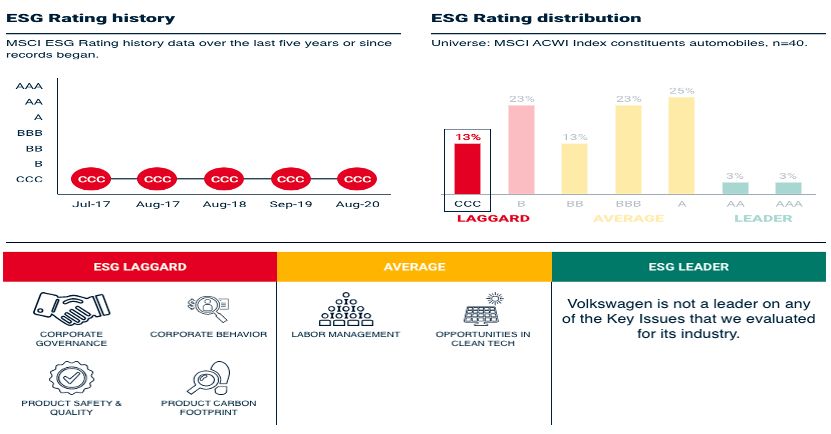
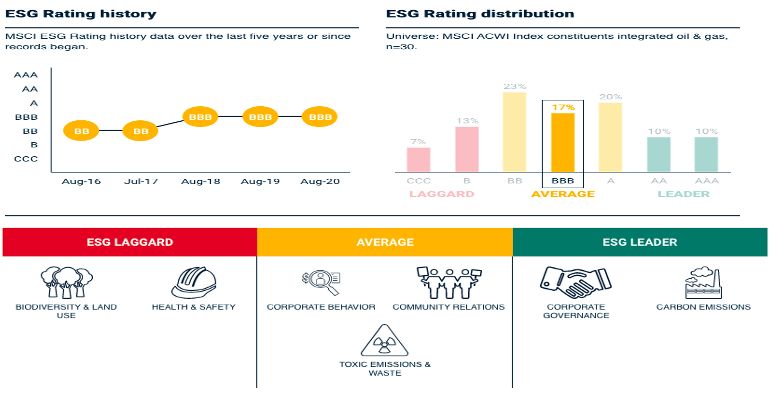
         information that could have supported the oral hearings (see figures 7 and 8).44 The
         ESG information not only provides high-level snapshots on a company’s
         sustainability track record, but also reveals areas where the companies are considered
         industry laggards. For example, BP is poorly performing in areas relating to
         ‘biodiversity & land use’ and ‘health & safety’, whilst Volkswagen’s ‘product safety
         and quality’ and ‘product carbon footprint’ are considered significant issues. This
         ESG information provides Committees with an additional lens to assess a company’s
         sustainability credentials, drawing on real-time environmental, social and governance
         data.

44
  The MSCI ESG Ratings Corporate Search Tool is a public tool that searches over 2,800 companies on sustainability
factors. See more details at - https://www.msci.com/our-solutions/esg-investing/esg-ratings/esg-ratings-corporate-search-tool
23
Figure 7 - BP ESG Rating45
Figure 8 - Volkswagen ESG Rating46
45
(MSCI, 2021)
46
(MSCI, 2021)24
References
Ansari, S., Wijen, F., & Gray, B. (2013). Constructing a climate change logic: An
institutional perspective on the “tragedy of the commons”. Organization Science,
24(4), 1014-1040.
BBC. (2018). MPs' fury over Mark Zuckerberg 'no-show'
[accessed March 2021]
BBC. (2019). Climate change: What did Greta Thunberg say at COP25?
[accessed March 2021]
Benton, M., & Russell, M. (2011). Selective influence: The policy impact of House of
Commons select committees. London: Constitution Unit.
Chava, S. (2014). Environmental externalities and cost of capital. Management Science,
60(9), 2223-2247.
Dryzek, J. S., & Niemeyer, S. (2019). Deliberative democracy and climate governance.
Nature human behaviour, 3(5), 411-413.
Energy and Climate Change Committee (2013) ‘House of Commons, Fifth Report of Session
2013–14, Energy Prices, Profits and Poverty, (HC 108),
[accessed March 2021]
Environmental Audit Committee. (2016). ‘House of Commons, Fourth Report of Session
2016–17, Environmental impact of microplastics, (HC 179),
[accessed March 2021]
Evans, P. (2019). Conclusion: So, What Is Good Scrutiny Good For?. Parliamentary Affairs,
72(4), 987-995.
Flammer, C. (2013). Corporate social responsibility and shareholder reaction: The
environmental awareness of investors. Academy of Management Journal, 56(3), 758-
781.
FT. (2019). Goldman Sachs’ commercially driven plan for sustainability
[accessed
March 2021]
FT. (2020). Big fossil fuel groups all failing climate goals, study shows
[accessed
March 2021]25
Geddes, M. (2019). Performing scrutiny along the committee corridor of the UK House of
Commons. Parliamentary Affairs, 72(4), 821-840.
Guardian. (2010). James Lovelock: Humans are too stupid to prevent climate change
[accessed March 2021]
Guardian. (2017). Just 100 companies responsible for 71% of global emissions, study says
[accessed March 2021]
Guardian. (2018). Parliament seizes cache of Facebook internal papers
[accessed March 2021]
Guardian. (2019). 'Enough is enough’: biggest-ever climate protest sweeps UK
[accessed March 2021]
Hawes, D. (1993). Power on the back benches?: the growth of select committee influence
House of Commons Liaison Committee. (2019). The effectiveness and influence of the select
committee system. 9th September 2019. HC, 1960, 2017-2019.
Institute for Government. (2020). Parliament and the public.
https://www.instituteforgovernment.org.uk/publication/parliamentary-monitor-
2020/parliament-and-public> [accessed March 2021]
Intergovernmental Panel on Climate Change. (2020). Why are we talking about 1.5°C?
[accessed March 2021]
Kelso, A. (2012). Backbench rights and reform in the UK House of Commons departmental
select committee system.
Kubala, M. (2011). Select Committees in the House of Commons and the Media.
Parliamentary Affairs, 64(4), 694-713.
Mellows-Facer, A., Challender, C., & Evans, P. (2019). Select committees: Agents of
change. Parliamentary Affairs, 72(4), 903-922.
McKinsey. (2020). Purpose: Shifting from why to how
[accessed March 2021]26
MSCI. (2021). ESG Ratings Corporate Search Tool [accessed
March 2021]
NASA. (2020). Overview: Weather, Global Warming and Climate Change
[accessed
March 2021]
Norton, P. (2019). Departmental Select Committees: The Reform of the Century?.
Parliamentary Affairs, 72(4), 727-741.
Russel, D., Turnpenny, J., & Rayner, T. (2013). Reining in the executive? Delegation,
evidence, and parliamentary influence on environmental public policy. Environment
and Planning C: Government and Policy, 31(4), 619-632.
Schonhardt-Bailey, C. (2015). Explanations and accountability: Deliberation in UK select
committees. In Conference on the Political Development of Parties and Legislatures
in Canada, Britain, and the United States.
Shearman, D. J., & Smith, J. W. (2007). The climate change challenge and the failure of
democracy. greenwood Publishing group.
Stern, N. (2008). The economics of climate change. American Economic Review, 98(2), 1-
37.
UNDP. (2021). The Peoples' Climate Vote
[accessed March 2021]
United Nations Principles for Responsible Investment. (2021). Principles for Responsible
Investment. [accessed March 2021]
WEF. (2021). What is stakeholder capitalism?
https://www.weforum.org/agenda/2021/01/klaus-schwab-on-what-is-stakeholder-
capitalism-history-relevance [accessed March 2021]
White, H. (2016). In contempt? Witnesses before select committees. Institute for
Government.You can also read


