Closing the Deal Amidst Falling Customer Satisfaction - Eric
←
→
Page content transcription
If your browser does not render page correctly, please read the page content below
Information Systems Education Journal (ISEDJ)                                                        17 (2)
ISSN: 1545-679X                                                                                  April 2019

Teaching Case

                          Closing the Deal Amidst
                       Falling Customer Satisfaction

                                 Biswadip Ghosh
                             bghosh@msudenver.edu
               Computer Information Systems and Business Analytics
                     Metropolitan State University of Denver
                          Denver, Colorado 80217, USA.

                                               Abstract
The board of Fiserv (an investment management company) has already decided to close the business
no matter what. Agile Financials has agreed to buyout Fiserv and retain part of the Fiserv staff if the
purchase deal closes. However, if too many of Fiserv’s clients left with their accounts or if the customer
satisfaction index (CSI) continued to fall, the sale of Fiserv to Agile Financials would break apart. Should
the deal break apart, everyone at Fiserv would be out of a job and clients would be left high and dry.
Could a new CRM system be the answer to retain clients and raise customer satisfaction during the
interim period as the buyout deal closes? This case places the reader in the shoes of the Fiserv’s CIO,
Mark Bennett, who has to decide and justify, if a new CRM system is necessary to address falling
customer satisfaction.     After this decision, the next challenge is to implement the CRM (or any
alternative system) to help Fiserv retain the maximum number of its clients and achieve the stipulated
level of customer satisfaction as the acquisition is completed. Business process reengineering and
employee training are crucial when companies implement new mission critical enterprise systems like
CRM. If the implementation forces a third order of change, then major challenges could be faced. Fiserv’s
resources are very limited before the acquisition deal is completed and it might be better in the short
term to limit the project scope to a first order change.

Keywords: IT Infrastructure, Change Management, Project Management, Merger and Acquisition,
Customer Relationship Management

              1. INTRODUCTION                           now at a 7 out of 10. Many clients had threatened
                                                        to leave and few had left. On top of that
   Mark Bennett, CIO of Fiserv ISS, relived the         employees had been leaving to pursue other
conversation in his mind again. Mr. Rogers, the         opportunities and the company was short staffed.
president of Fiserv ISS, had just informed him          Now that the company had been sold, hiring
that the company had been sold. This information        replacements seemed less likely. Mr. Rogers told
had not been announced yet so Mark was not able         Mark, the impending deal could take up to a year
to tell anyone of this development. Being a             to close and hinged on the retention and
publicly traded company, this information was of        improved satisfaction of their current clients. The
top secret. Mr. Rogers informed Mark that the           lower the satisfaction of the clients, the lower the
deal had been in process for several years and the      price tag for the sale (See Table 1).
terms had finally been agreed upon. It was
important that the clients of Fiserv continued to       The situation was dire. If too many of the
receive the same level of care and were satisfied       investment management company’s clients left
with the service that they received and when            with their accounts or if the customer satisfaction
surveyed with the Customer Satisfaction Index,          index (CSI) continued to fall, the sale would break
continued to give 9s and 10s. Unfortunately,            apart. The parent company, Fiserv, had decided
customer satisfaction had been slipping and was         to close the business no matter what. They felt

©2019 ISCAP (Information Systems & Computing Academic Professionals)                               Page 12
http://iscap.info
Information Systems Education Journal (ISEDJ) 17 (2)
ISSN: 1545-679X April 2019
that Fiserv ISS was going to start costing more Microsoft Access, while not a perfect system, was
money than it was worth. The purchasing integrated in everyday use and several financial
company, Agile Financials had reviewed the processes at Fiserv ISS. Each different
business practices and decided to keep part of the department at Fiserv ISS needed to use Access in
staff on after the deal had closed. Should the deal one way or another. Access inked the necessary
break apart, everyone would be out of a job. The rows and columns stored in Xcel spreadsheets in
realization washed over Mark. He was being individual departments and allowed the creation
charged with finding a way to bring customer of consolidated views across the four trust
satisfaction up without using a large amount of companies. It was also used to synchronize asset
funds. If he failed, the deal would break apart, values and ownership. The Access database was
those clients that stayed would be left without a used by most team members several times a day
custodian and everyone he worked with would be and for multiple reasons. Some of the reasons
out of a job. were to view data from outside of their
department, while other reasons were to upload
CSI Score Fiserv Company Valuation and organize client account statements as their
10-9 $600,000,000 accounts were brought into trust management.
8-7 $475,000,000 As Fiserv ISS continued to grow, the largest
6 $350,000,000 growth continued to be in Datalynx and Trustlynx.
5 and under Deal is broken Unfortunately, those were the systems that were
Table 1: Relationship between Customer most dependent on the Access databases. They
Satisfaction and Valuation were also the departments that were most
dependent on nonstandard assets, stock clearing
2. BACKGROUND INFORMATION and compliance. To make the situation more
complicated, they were the departments that
Fiserv ISS had started in 2001 with the merger Agile Financials was interested in acquiring and
of four small trust companies. Each trust whose customer satisfaction would make or break
company offered different services and products, the sale of Fiserv.
but all were focused on low cost custodian fees
while providing high and specialized client service
for those investing in the financial markets. The
four companies that were brought together were
Datalynx, specializing in individual advisor
clientele, Trustlynx specializing in 401k third
party administration accounts, Lincoln Trust and
Resources Trust both focusing on retail client
accounts.
IT Infrastructure Issues at Fiserv
While each of these four trust companies had
brought their own specific software that helped to
service their specific group of accounts, the goal
was always to get all the different departments
on one software system. However, even after
seven years, the different departments were still
on their own specific systems. All four different
departments shared several common financial
management functions such as nonstandard
assets, stock clearing and compliance. To make
the system cohesive to the processes/functions
that interacted with all departments, a software
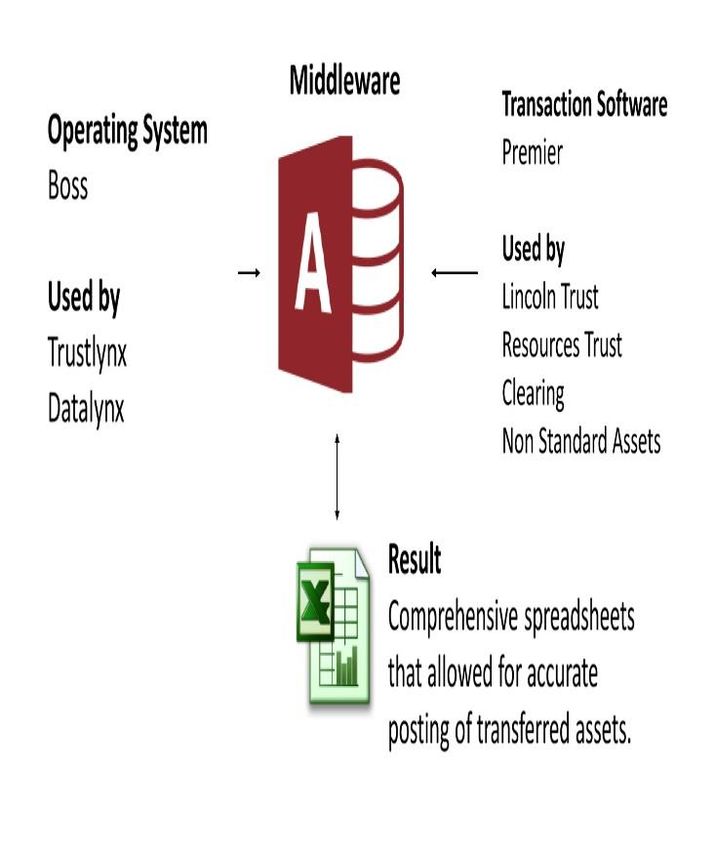
developer had used the middleware Microsoft
Access to allow data exchange between the four
disparate systems. Users could create queries in
Access to pull data from each needed system Figure 1: Fiserv IT Infrastructure
without having to go into each individual actual
database.
©2019 ISCAP (Information Systems & Computing Academic Professionals) Page 13
http://iscap.infoInformation Systems Education Journal (ISEDJ) 17 (2)
ISSN: 1545-679X April 2019
3. CURRENT SITUATION create the request, track and follow-up with the
non standard assets team.”
Mark Bennett needed to assess the situation first
hand and decided to start by calling a few clients Mark moved on to the final piece in the puzzle,
from both Trustlynx and Datalynx to see if he the nonstandard asset team. When asked about
could find out why their customer satisfaction had the problem, the manager Lisa Walk was quick to
dipped. He called several clients of those two the defense. “I have lost five people this year. I
departments and found that the complaints were cannot hire anyone else. I have temps working
always some variation of delayed processing. One for me and while they can book the assets, I am
client he called, named Ron Gage, was on the the only one that knows how to use the Access
Datalynx platform and expressed serious database. I have email upon email from the
concerns over the Information systems platform: temps asking me to run the reports on Access.
“My business is growing at an incredible pace. I The assets are not always there the first time I
work with a lot of nonstandard assets. A non- check and I need to follow up again and again. I
standard asset is one that cannot be accurately am trying to create calendar reminders to follow
and fairly valued and cannot be sold or up on these assets a few days later, but I forget.
transferred at a non-detrimental value within 30 Then I am working on the new emails that have
days. In times past, I knew that transferring not transferred and I should create reminders but
these assets would not be a problem. I was I forget. It is a vicious cycle.”
confident that the asset would be booked into the
account as soon as it had changed ownership. It Mark had an idea. He asked Lisa, “Would it help if
would have monthly price updates as Fiserv ISS you had a program that listed your daily tasks and
received statements. Now I am seeing assets assigned priorities based on the importance of the
booked two to three weeks after they have originating clients, so that you could either decide
transferred into your company. The asset prices to complete or snooze the task in favor of other
are rarely updated and clients are complaining more important tasks?”
that their statements do not reflect the asset
values that I am showing on my website.” “Greatly!” Lisa replied. “If only it had a way to
access the system or at the very least Microsoft
Ron Gage continued to describe his frustrations Access”.
with the Datalynx client support team, “I have to
make multiple calls and each time describe my “You’re in luck”, thought Mark. The answer
requests from scratch. Then the wait, the endless became clear to Mark. He needed to get the
wait as the issue is verified and assigned and company on a Customer Relationship
worked internally in your team.” Management system (CRM) to help with the tasks
that were building up. CRM is a management
Mark Bennett began to consider this and talked to approach that seeks to create, develop, and
the Customer Account Relationship Manager in enhance relationships with carefully targeted
charge of Datalynx. The relationship manager, customers to maximize customer value and
Dan Donnelly: “Listen, I am doing the best I can. corporate profitability. However, Mark knew that
I follow up with the nonstandard asset implementing an Enterprise system (ES) of that
department every other day. Every time I call magnitude needed careful analysis and planning
down there I get someone unfamiliar with the of organizational impacts. Although companies
account I am talking about. They have no way to can spend a large amount of their IT budgets on
track my request history and I have to explain the ES projects, a significant proportion of ES projects
whole situation again and again. I now have a do not succeed (Nguyen and Mutum, 2012).
formatted email that I am sending to the
department each week, but I get no response. I 4. CRM PLATFORM ALTERNATIVES
can’t do it myself. I have escalated it to
management. They ask me to forward all my Mark needed to decide which CRM system he
communications with the nonstandard asset would pursue and how much would he have to
department and after a few weeks after the asset spend. In years past, Fiserv ISS would have
is transferred, it gets booked.” worked on building their own system. This took
years to get done and unlike in years past, Mark
Dan Donnelly continued: “My time is always did not have the time or resources to do so. He
wasted getting status updates instead of trying to knew that he was going to have to buy an off the
get new trust accounts. I want to get out of being shelf product. Confident that he had found the
the middle man and allow my clients to directly answer Mark began to look around for different
CRM products. Because Agile Financials was
©2019 ISCAP (Information Systems & Computing Academic Professionals) Page 14
http://iscap.infoInformation Systems Education Journal (ISEDJ) 17 (2)
ISSN: 1545-679X April 2019
buying the business, his first thought was to document the changes that would be faced by his
consider what they used for a CRM. They used the staff in performing their client management
giant of the CRM world - Salesforce. Salesforce tasks. In many cases, the changes would affect
was by far the CRM that Mark had heard the most running instances of long-running business
about. It had a variety of offerings that could help processes by modifying the workflow of his client
with the management of tasks. Mark had seen support agents. Mark realized that he would need
Agile Financial’s version of Salesforce and knew to estimate the magnitude of the change and,
that in addition to monitoring tasks, Salesforce possibly, the effort required for its
also had the ability to monitor the client’s implementation and the potential cost for the
satisfaction index score on a weekly basis. This organization. A change that is very complex to
would help to monitor the clients that were implement because, for instance, it requires
dissatisfied and make sure that special attention complex ad hoc modification of the CRM source
was paid to them to improve their scores. In code, should be accommodated only if its impact
addition to this, Agile Financials confirmed that is sufficiently large in size. Would this rule out
they would help with the setup, implementation the selection of Salesforce? Without the ability to
and training of Fiserv employees. If the fields integrate the Fiserv Access Database with the
were identical to how Salesforce looked at Agile new CRM, it would take many hours for Fiserv and
Financials, porting the data into Agile Financial’s Agile Financials to input the client’s data and
Salesforce implementation would be much easier historical information. Also, he would have to wait
and would be a cost saver to them and in training until the merger was announced before he could
the employees that were to be hired on Salesforce receive help from their computer engineers,
now, they would be saving time once the which would put the burden of transitioning to the
transition occurred in a years time. new CRM on Fiserv’s limited IT resources.
However, Salesforce was expensive. The cost Trying to compile a more comprehensive list Mark
ranged anywhere between $300-500 a month per turned to research another CRM. The next CRM
user per month. With all the features, he needed that he looked into was Microsoft Dynamics. They
the best enterprise package which was the most covered 6% of the market for CRMs but were
likely came in at $325 a month for each user. growing quickly. Fiserv ISS used Microsoft
Quickly doing some math of $325 times the 45 products exclusively. Mark was confident that
users he needed to give access to he was looking Microsoft Access, which much of the company
at a price tag of $14625.00 a month with a full was dependent on, would be more easily
price tag of $175,500 to be paid before the integrated with this Dynamics system. With his
merger was complete. Mark saw that different prior research Mark knew that customers often
programs could also be used with Salesforce. He communicated with their Fiserv ISS
looked to find if Microsoft Access was one of them representatives by email. Fiserv ISS used Outlook
and but couldn’t find it on the Salesforce website. and this would allow for the integration of those
Calling Salesforce, the representative for the emails with the Dynamics CRM system. Part of the
company responded, “Who still uses Access? other issue with the Fiserv ISS system was the
That seems like a terrible way to run a business.” way that client information was stored in the
Access database. It was the responsibility of each
Mark did not feel confident in that answer at all. relationship manager to update their individual
Mark knew that even with the implementation of advisor or third party administrator information.
the new CRM system, he would not be able to The records in the database were outdated and
retire the Access database. Drawing upon the often wrong, Mark learned that contact
extant published CRM literature, Mark found information in Dynamics was imported directly
many organizational factors, technical factors and from Outlook. This would ensure that these
economic factors that would impact how records could be updated more frequently.
successfully he could integrate the CRM system Finally he thought of Lisa with her Access
with his existing systems. Mark would need to database dilemma. Tasks could be created and
perform impact analysis to evaluate the ripple completed directly on the CRM. This was a huge
effects of the proposed change and identify the benefit for the different departments. He was
organizational stakeholders (both internal and confident that the process would be more
external) who might be impacted by the new automated. He would be able to get the Dynamics
system (Nguyen and Mutum, 2012). This list of CRM up and running much quicker than the
stakeholders needed to be built analyzing the Salesforce CRM. Researching further he found
dependencies of the component(s) involved in the Microsoft Dynamics was cheaper for the package
Fiserv client management processes. Mark knew that Mark needed at only $165.00 per person per
that the dependency model would also help month. Coming in at $7425 a month, for a total
©2019 ISCAP (Information Systems & Computing Academic Professionals) Page 15
http://iscap.infoInformation Systems Education Journal (ISEDJ) 17 (2)
ISSN: 1545-679X April 2019
of $89,100. The Dynamics CRM program had a lot total of $29,700. This was a number that would
of benefits and seemed like a better deal. look great when presenting the need for a CRM to
the Fiserv board.
However, in doing research Mark found out that
Microsoft Dynamics was set up as an “on premise” Like other cloud based products, there were
software that required dedicated storage. The downsides to Infor (Marston, Li, Bandyopadhyay,
Dynamics product was not as highly rated as Zhang and Ghalsasi, 2011). They included
Salesforce and complaints said that some difficulties with formatting tasks. Tasks created
features of the Dynamic software did not live up had to be associated with an account. That would
to what was offered before implementations. be difficult if you were trying to check the
Another complaint about Dynamics CRM is that it purchase availability of a certain product. Making
is set up for dynamic sales operations. With changes to a client profile can get complicated
smaller companies, the system does not work as and may not be able to be completed by the end
well. Microsoft has suggested that if this is the users and searching for situations on the system
case before Dynamics can be used that a can be complicated. Mark realized that among the
predefined process should be created. That would three CRM systems, he would need the most help
take longer for Mark and may not translate well with implementing this one. The available
when the business is taken over later by Agile companies that can help with the implementation
Financials. The longer that this process and training of Infor is a much smaller pool than
reengineering takes to implement, the longer for Microsoft Dynamics. These rates usually ran
things fall through the cracks and the angrier the close to $250 an hour and would be even greater
clients would became. Unlike with Salesforce, for the relationship managers using it so training
Mark could not rely on Agile Financials to help would need to be more in depth and would most
train the staff. In fact, Agile Financials had scoffed likely take longer. Mark thought that would make
at the idea of using Dynamics. Mark knew he the needed hours for a company to help
would be unable to take the training on by implement the new CRM creep up to around 150
himself. He would need to hire a company to hour at a cost of $37,500. That would bring the
come in and help with set up and training. Those total cost of training and the Infor CRM program
companies charged close to $200 an hour. Mark to $67,200.
was not sure how many hours the total time
would take but he figured it would take at least Comparing CRM Platforms
80 hours for the build out and the training Mark could not believe it. Each of the three CRM
sessions. That would cost around $16,000. This systems had benefits and drawbacks that
brings the total cost of this product to $105,100. differentiated each other (Table 2).
This would cut down on his savings from
Salesforce. CRM Cost Design & Notes
System per Training
The last CRM that Mark looked at was Infor. Infor User Effort
CRM had many of the same characteristics that (45)
the other two products offered but at a fraction of Salesforce $325 Covered Compatible
the cost. Like Salesforce, Infor was cloud based. by Agile Tong term
However, like Salesforce it started online and did Financials
not have some of the downside that Dynamics Dynamics $165 80 hrs @
Premise
had in reviews. It could integrate with Microsoft $200/hr
Storage in
outlook. Infor has great analytical tools that Access
would track and monitor KPIs (Key Performance Infor $55 150 hrs @ Cloud
Indicators) like customer satisfaction and clear $250/hr based
ways to assign tasks to different departments to Table 2: CRM System Comparisons
make sure items are taken care of. All of the
reviews Mark could find were positive. He had a Salesforce was going to create a lot of work for
hard time finding a negative opinion. Mark Mark and he needed the help of Agile Financials.
realized that this may be because the product was The Dynamics platform seemed a good short term
so great that users fell in love with it once they fit, but he would not get any help from Agile
started using it, but it may also be that the Financials with Dynamics and this would create
market share was so small for Infor that the significant rework after the merger was
clients that used it were clients that had completed. The CRM was desperately needed to
researched it and felt that it would be the perfect help complete tasks during this one year
fit for their company. The cost was $55 per user transition period. Any delay in rollout would affect
per month. That would be $2475 per month for a customer satisfaction even more. Microsoft
©2019 ISCAP (Information Systems & Computing Academic Professionals) Page 16
http://iscap.infoInformation Systems Education Journal (ISEDJ) 17 (2)
ISSN: 1545-679X April 2019
Dynamics would be the easiest for the data to be complete conversion over to the new CRM
imported but Agile Financials was not happy platform (Davenport, 1998). Mark felt confident
about using Dynamics instead of the program this was possible only if a phased approach was
they were used to (Nolan and McFarlan, 2005). used and client data for more the profitable and
On top of that the learning curve would require important clients converted first. They figured
outside help to come in and train the staff. It they would eventually be able to convert a certain
would require staff to be away from the phone number of clients every week. Since the firm held
and may decrease the level of customer service well over 500 clients this means that some
that clients depended on. Finally, Infor would be “waves” would be bigger than others. They would
the cheapest. Only by a few thousand dollars but also have to prioritize so that the more “sensitive”
for Fiserv’s board, every penny may count. The clients, ones with more assets and financial
learning curve and implementation cost were transactional demands would convert first
higher for the Infor product, but it seemed to therefore giving more time for the other clients to
have only positive reviews. Mark had not asked convert. This also allows them to find bugs and
Agile Financials of their opinion but was fairly make adjustments as needed.
certain that a decision to use Dynamics would not
be met with praise. Mark had a lot of factors to Fiserv also had to worry about training phone
consider for his decision, but had very little time representatives on the new platform. This
to do so. He hoped he could choose the CRM that included the call center staff that handled
would have the most success for Fiserv in its final customer service. Mark knew that this is where a
days. “We need to thrive and not just survive in lot of trouble was going to originate during the
this interim period”, Mark thought. system change. Many seasoned veteran reps
were reluctant to switch, while others knew the
5. SYSTEMS CHANGE MANAGEMENT inevitability of a system switch and could almost
predict what the biggest complaints from plan
In addition to the technology selection, the participants was going to be. “These participants
organization dimensions are very important for are so used to the things offered before, a lot of
capturing the complexity of CRM implementations them are going to be more then confused, they
(Pozza, Goetz and Sahut, 2018). When are going to be upset.” was one complaint heard
companies need to adopt a new mission critical in different variations. But some of the
enterprise system like CRM, they need to identify representatives were taking more optimistic
and speak with numerous stakeholders to not approaches, addressing certain things that the
only discern pricing, but to determine what can new software is capable of that the previous one
and cannot be done within the established couldn’t do before.
systems implementation plan (Wagner and
Piccoli, 2007). Stakeholders will come up with Orders of Change Management
ideas about what options they need in the CRM Assessing the orders of change revolve around
system to be able to accomplish their plans and impacts caused to the basic structure of the
business processes. The CRM implementation company (O’Hara, Watson and Kavan, 1999). A
team needs to figure out how best to manage first order change leverages a new software to
these stakeholder’s needs and try and make sure maintain the basic structure and culture of a
the software allows for it. Procedures for certain company. An example of this would be changing
business process transactions can vary from out an account management system, which
company to company based on what the software utilizes paper or electronic interface, to a fully
programs allows for, so no two transactions can digital environment which utilizes and leverages
look the same. This is certainly the case here Network or Cloud storage. This change does not
where transactions that once required inherently require users to change the way they
manual/paper based processes, must now be do work, but does require them to change how
done as paperless. Fiserv was using a Microsoft they interface with the work. It is realistic that a
Access database software that was fairly generic, user could maintain most of the same way of
but got the job done. It was also a slow and doing business.
manual program that was primarily setup to allow
data transfer between lines of business. Most of However, a second order change incorporates a
the bugs had been worked out, but Mark knew more disruptive effect to the company. This sort
that trying to convert older data onto any new of change requires users to not only change the
system platform was going to take time. On “how” of their work behavior but also the more
average it took a “typical” company just over a immediate “why”. One example of a second order
year to finalize their conversion plan, and the change would be automation and online book
timeline they had was at most 6 months for a sales. Previously the skillset for book- sellers was
©2019 ISCAP (Information Systems & Computing Academic Professionals) Page 17
http://iscap.infoInformation Systems Education Journal (ISEDJ) 17 (2)
ISSN: 1545-679X April 2019
to be knowledgeable of where and what a book 7. CASE STUDY QUESTIONS
was. But with an automation of that scale, the
sales person becomes not only a sales individual, While the decision to implement a CRM may seem
whose knowledge of the book or location is useful, simple, Mark knew that there would be issues
but further they have to become a facilitator of when the new software allowed things that his
the new system to the customer as their current system doesn’t support and vice versa
knowledge of the product is not so important as (Hammer, 2004). Compromise is going to be
their ability to find and access the data about the needed from multiple stakeholders for this project
product. In this way their job description goes to happen. And in some cases, things are going
from “retail sales” to “retail sales and facilitator”. to change in business processes and these
changes need to happen very quickly to keep the
Finally a third order change incorporates the most Fiserv-Agile Financials deal moving forward and
disruptive behaviors to affect a company’s closing. Mark is going to be tested on what his
structure. The nature of this change is that company’s software is capable of.
employees and the company both alter their
viewpoint. An example of third order change is After analyzing the situation posed in the case
Kodak and their change from a one-dimensional study, answer the following questions.
producer of film to a digital producer of film and
content. In the "old" version of Kodak they 1. List the major problems facing Fiserv.
produced film, which was used by multiple media 2. Was Fiserv being realistic in attempting to
houses for various formats of media - film, B&W, implement a new CRM system rather than
color, art, practical. At no point however did incremental changes to their existing
Kodak engage in the content on anything other systems to fix customer service in the
than a method to provide it to the end- short term?
user/customer. During its relatively failed 3. What additional benefits would a CRM
attempt to make a third order change from paper System have over some other less
to digital there were growing pains and rejection expensive ways of using IT to fix the
- many employees saw little need of a "soul-less" customer service problems?
digital media and fought the change, while those 4. If a CRM product is chosen, which one
who embraced the cutting edge considered these would you chose and why?
people Luddites. 5. What order change would be required to
implement the CRM system?
6. CONCLUSIONS 6. What order change would be required if
an incremental approach was used (from
Mark realized that if the appropriate order of Question #2)
change was not recognized, planned and 7. As the CIO, Mark Bennett, how would you
addressed during the CRM system approach the Fiserv board to ask for
implementation, problems would quickly mount funding for the CRM system
as the client data conversions kicked in. Finally implementation?
there was a big discrepancy between what service
representatives had recorded on paper forms and
was not recorded in the Access database. 8. REFERENCES
Employees and customers started to report issues
Comuzzi, M. and Parhizkar, M. (2017). A
with accounts being shown on their reports but
Methodology for Enterprise Systems post-
the asset prices were not updated online. After
implementation change management.
reviewing a few client dashboard results, Mark
Industrial Management & Data
noticed some key items missing from the reports.
Systems, 117(10), 2241-2262.
This was just the beginning of the customer
complaints. There was no consistency for clients Davenport, T.H. (1998). Putting the Enterprise
and how they were handled across the four into Enterprise Systems. Harvard Business
smaller companies. The content team, which is Review, July/Augustl, 121-131.
responsible for the data integrity online, had price
Hammer, M. (2004). Deep Change: How
discrepancies that caused major clients to get
operational innovation can transform your
upset and claim that Fiserv had violated contract
company. Harvard Business Review, April,
agreements. There were now four disjoint trust
84-93.
companies with their own nuanced processes
instead of the omni-channel accounts model that Marston, S., Li, Z., Bandyopadhyay, S., Zhang, J.
Fiserv and Agile Financials were trying to achieve. and Ghalsasi, A. (2011). Cloud Computing:
©2019 ISCAP (Information Systems & Computing Academic Professionals) Page 18
http://iscap.infoInformation Systems Education Journal (ISEDJ) 17 (2)
ISSN: 1545-679X April 2019
The business perspective. Decision Support Thakur, R. & Workman, L. (2016). Customer
Systems, 51(1), 176-189. portfolio management (CPM) for improved
customer relationship management (CRM):
Nolan, R. & McFarlan, F.W. (2005). Information
Are your customers platinum, gold, silver, or
Technology and the Board of Directors.
bronze? Journal of Business Research 69(3),
Harvard Business Review, 83(10), 9-24.
4095-4102.
Nguyen, B. and Mutum, D.S. (2012). A review
Wagner, E. & Piccoli, G. (2007). A call to
of customer relationship management:
engagement: Moving beyond user
successes, advances, pitfalls and futures.
involvement in order to achieve successful
Business Process Management Journal 18(3),
information systems
400-419.
design. Communications of the ACM, 50(12),
O’Hara, M.T., Watson, R.T., & Kavan, C.B. 51-55.
(1999). Managing the three levels of change.
Information Systems Management Journal,
16(3), 63-70.
Pozza, I.D., Goetz, O. and Sahut, J.M. (2018). Editor Notes: Teaching Notes are available for
Implementation effects in the relationship this case, please contact the author directly.
between CRM and its Performance. Journal
of Business Research 89(8), 391-403.
©2019 ISCAP (Information Systems & Computing Academic Professionals) Page 19
http://iscap.infoYou can also read


