Combined Color and Texture Tracking for Video Post-Editing
←
→
Page content transcription
If your browser does not render page correctly, please read the page content below
Combined Color and Texture Tracking
                         for Video Post-Editing
                               Işık Barış Fidaner                                        Lale Akarun
                             Boğaziçi University                                    Boğaziçi University
                            Computer Engineering                                     Computer Engineering
                           Email: fidaner@gmail.com                                 Email: akarun@boun.edu.tr

     Abstract— Tracking a human head in a complicated scene              reality.
 with changing object pose, illumination conditions, and many               Some methods are developed to track only a single object,
 occluding objects, is the subject of this paper. We present             whereas others can handle multiple objects. If the objects are
 a general tracking algorithm, which uses a combination of
 object color statistics and object texture features with motion         known to be constantly visible, occlusion detection may not
 estimation. The object is defined by an ellipse window that is          be necessary. If only a certain type of object is going to be
 initially selected by the user. Color statistics are obtained by        tracked, such as a colored ball or a human body, a hard-
 calculating object color histogram in the YCrCb space, with more        coded object model can simplify the problem considerably. If
 resolution reserved for chroma components. In addition to the           the objects have known behaviour patterns, prior assumptions
 conventional discrete color histogram, a novel method, Uniform
 Fuzzy Color Histogram (UFCH) is proposed. The object texture            can be made and application-dependent motion estimators can
 is represented by lower frequency components of the object’s            help the tracking. Some methods are supposed to run in real-
 discrete cosine transform (DCT), and local binary patterns (LBP).       time, and some do not have a time limitation. For constant
 By using the tracker, performances of different features and            camera applications, background difference methods are used.
 their combinations are tested. The tracking procedure is based          Tracking via a surveillance camera requires a very different
 on constant velocity motion estimation by condensation particle
 filter, in which the sample set is obtained by the translation of the   approach than tracking in a movie.
 object window. Histogram comparison is based on Bhattacharyya              As we initially have RGB images, the first thing we could
 coefficient, and DCT comparison is calculated by sum of squared         do is calculate the statistical color distribution of object pixels,
 differences (SSD). Similarity measures are joined by combining          the color histogram, as in [1], [2] and many other tracking
 their independent likelihoods. As the combined tracker follows          methods. However, the background may contain some object
 different features of the same object, it is an improvement over
 a tracker that makes use of only color statistics or texture            colors, and the object region may have some background
 information. The algorithm is tested and optimized on the               color. If the object color distribution is not taken as absolute,
 specific application of embedding interactive object information        but relative to the background, a larger region around the
 to movies.                                                              object, or the whole image, we can improve distinction of the
                                                                         object. In [3], Swain and Ballard explained a method called
                          I NTRODUCTION
                                                                         Histogram Backprojection. This method is based on a ratio
    Tracking a moving object in a complicated scene is a                 histogram, that is calculated by dividing each value in the
 difficult problem. If objects as well as the camera are moving,         object histogram into the corresponding value in the image
 the resulting motion may get more complicated. As objects               histogram, and trimming if the ratio is larger than 1. This
 change pose, the surface geometry changes, causing drastic              calculation gives a strengthened distinction of the object from
 changes in surface illumination; and thus, the object ap-               the background.
 pearance. Occluding objects and deformations in the object                 The conventional definition of the color histogram bears
 present further challenges. Particle-filter based approaches are        some problems. In a discrete color histogram (DCH), a pixel
 employed to model the complicated tracking problem. Special             falls into only a single bin. The distance information between
 object models that can descibe the object deformation and               the colors that fall in the same bin is lost, and close colors may
 motion, such as a skeletal model for a human, simplify the              fall in different bins. The inherent problems of discrete color
 problem. However, a general tracker that can locate and track           histograms were addressed in the context of image retrieval.
 general objects should not rely on such models.                         In 2002, Han et al. derived the fuzzy color histogram (FCH)
    A general-purpose object tracking algorithm is needed in             by modifying the mathematical definition of a histogram [4].
 many applications: There are several applications of object             In a conventional histogram, the membership function is either
 tracking including video compression, driver assistance, video          one or zero, because every color belongs to only one bin. In
 post-editing. Some other applications are surveillance via              contrast, in a fuzzy color histogram, there are cluster centers
 intelligent security cameras, perceptual user interfaces that           instead of bins. The membership function is modified to be
 can make use of user’s gestures or movements, or putting a              a fuzzy membership function that gives a real value in the
 3d tracked real object in a virtual environment in augmented            interval [0, 1] depending on the color difference between the

978-1-4244-2881-6/08/$25.00 ©2008 IEEE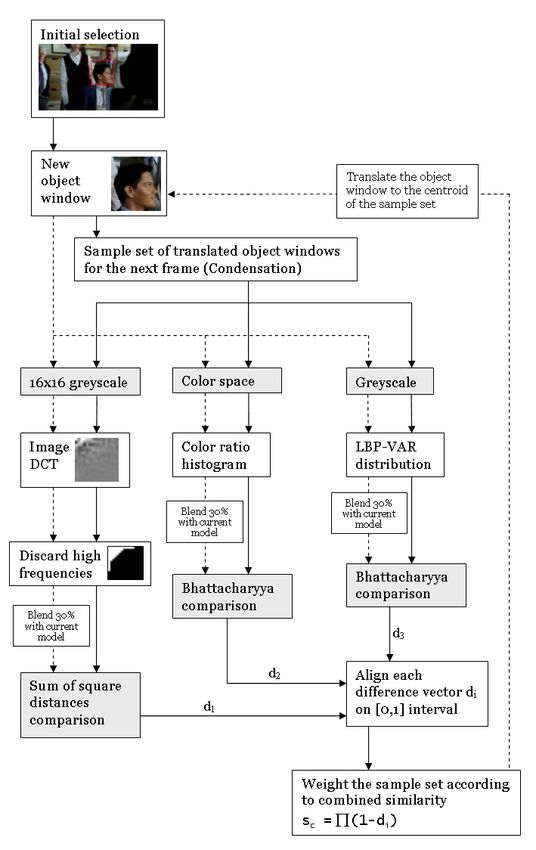
pixel and a cluster center. A recent paper [5] introduced           updating gaussian parameters, in every iteration, the sample set
triangular functions to extract fuzzy variables from image          itself is updated by a a process simulation, then weighted ac-
colors.                                                             cording to measurement probabilities at the estimated position,
    Another question is how to compare two histograms. The          and finally a new sample set is created by weighted selection.
Bhattacharyya measure as presented in [6], gives a geometrical      In their original paper, they used a curve based object model.
interpretation for this comparison. It is a similarity measure      Equal distance normals are picked on the object curve, and the
that gives the cosine of the angle between two histograms.          samples are taken along these one-dimensional normal lines.
    As a matter of fact, a histogram need not be calculated on         Another particle filter was presented in [11] that incor-
an RGB image. It may first be transformed to a different color      porates the number of objects in the process model itself.
space. YCrCb or HSI has better properties than RGB. Chroma          This particle filter involves an object model based on color
components are less affected by lighting conditions.                histogram similarity, instead of a curve model. The process
    Various image transformations can be used to amplify            model is a composition of discrete and continuous variables,
texture properties of the image, such as edge filters or DCT.       the earlier being the number of objects in the scene and the
Low frequency components of a 2D DCT give high level                latter being the positions and velocities of each object. The
structural information of an image. In some applications, the       algorithm thus joins detection and tracking in a single method.
videos are compressed and already include these structural             The application addressed in this paper is the processing
information that can help tracking. In [7], the compression         of movies for embedding extra information. In a movie,
information in MPEG videos were used for tracking purposes.         there may be multiple objects, occlusions, camera movement,
    Local Binary Patterns (LBP) are a new feature set for texture   and different types of objects moving through an arbitrary
distinction proposed in 2002 [8]. Consider equidistant pixels       trajectory. However, object movements may be assumed to be
on a circle around a point. For each pixel, a binary value is       smooth, and the scenes last only a few minutes. We develop
calculated: 0 if the pixel is darker than the center pixel, 1 if    a general tracking solution, which uses a combination of
it is not. The values around the circle are taken as a cycle,       object color statistics and object texture features with motion
in which shifted variations are not distinguished. This feature     estimation. The object is defined by an ellipse window that is
is intensity invariant, because the values are relative; contrast   initially selected by the user. Color statistics are obtained by
invariant, because the magnitude of the difference is not taken     calculating object color histogram in the YCrCb space, with
into account; rotation invariant, because the values are on a       more resolution reserved for chroma components. The object
circle, and there is no starting/ending point.                      texture is represented by lower frequency components of the
    If we know that the object follows a certain motion pattern,    object’s discrete cosine transform (DCT). A general tracking
e.g. constant velocity or constant acceleration, we can use this    procedure is based on constant velocity motion estimation by
information to minimize the error in measurements. Kalman           condensation particle filter.
Filter (KF) is the best-known solution to this problem. To             Section 2 present our general tracking approach. We desribe
apply KF, two models are formed. The first is the process           the features used, the fitness measure, and the condensation-
model, that relates actual object variables between two adja-       based tracking approach. In Section 3, we present the appli-
cent frames, through a linear function plus a gaussian error.       cation which uses the object tracker: The Interactive Content
The second is the measurement model, that relates actual            Creator (ICC). Section 4 presents the results of our experi-
variables at an instant to their measured values, again through     ments and Section 5 concludes the paper.
a linear function plus a gaussian error. For example, process
model could be a constant velocity movement with some small                       C OLOR AND T EXTURE T RACKER
error, and the measurement model could be the measuring of
the object position with a relatively high error. In this case,        In the previous section, we examined three types of features:
if the array of measured values defines a noisy line, after         DCT and LBP for extracting texture features, and the color his-
applying KF, a smoother estimate would be obtained.                 togram for color statistics. There are four types of histograms:
    A typical application of Kalman Filter is given by Melo         Conventional discrete color histogram (DCH), uniform fuzzy
et al. in [9]. They used KF as a means to find highway lane         color histogram (UFCH) and the ratio histograms derived from
curves by tracking car movements through a static camera. KF        both of them. The uniform fuzzy histogram is obtained by
process model is constant acceleration movement, including          placing cluster centers at the corners of the bins of a conven-
velocity and position, whereas the measurement model is only        tional histogram. The 3D membership function is derived from
the position of the car, both containing the noise term.            the multiplication of three 1D triangular functions in each axis.
    Condensation (Conditional Density Estimation) is a particle        In this section, we define a tracking method that can be
filter developed by Isard and Blake [10] as an alternative to the   programmed to use any subset of these features. As the method
Kalman Filter for motion estimation. In KF, measurement and         is based on object color statistics and texture, it is called the
state models are assumed to be corrupted by additive Gaussian       Color and Texture tracker. The tracker uses a Condensation-
noise. In contrast, condensation involves a sample set that         based particle filter. The motion is modelled as a constant
represents a general distribution, and every calculation is a       velocity model with a linear transformation plus gaussian
statistical approximation based on this sample set. Instead of      noise, similar to the Kalman filter. Selected variances of
the gaussian noise are 1.0 for position and 0.3 for velocity appearance model.
components. • Object texture by LBP: The object is converted to
The steps of the process are shown in Figure 1. The greyscale and 8-point LBP is calculated. Joint LBP-VAR
algorithm starts with the initial object rectangle marked by histogram with 10x16 bins is obtained.
the user. The object window is an ellipse inside a rectangle. As the tracking progresses, this initial object model is to be
Pixels in the ellipse are considered as object pixels, whereas altered to adapt to changing object appearance.
pixels outside the ellipse are considered as background pixels. After the initial selection of the object window and forming
From the initial window, an object model is formed by its of the object model, a new position for the object is to be
features. determined on the next frame. For the new frame, firstly a
sample set of possible new center positions and velocities
are generated by condensation motion estimation algorithm
as in [10]. Sample velocities are initialized with a zero mean
gaussian distribution with variance 10. Samples are translated
to positions around the user-selected object center, as if they
were at the center in the previous frame and scattered with
their current velocities in one frame’s time.
After generating the sample set, for each sample, color
statistics and texture measurements are calculated, by color
histogram, DCT and LBP. Optionally, some of these features
may not be used. In this case, the measurements for an unused
feature are assumed to yield the best match. Every sample in
the sample set is a possible movement of the object window.
Similarity of a sample to the measurements defined by the
current object model defines the likelihood of the object to
have moved to the object window defined by that sample, and
is referred to as the weight or confidence value.
Every object feature requires a comparison method. Color
and LBP histograms are compared by calculating the Bhat-
tacharyya coefficient. The coefficient gives the similarity of
two histograms in the interval (0,1]. As a geometric inter-
pretation, the output is the cosine of the angle between two
histograms in N dimensional space, where N is the histogram
dimension, in this case 4x8x8. DCT matrices are compared by
calculating sum of squared differences.
The probabilities for each sample are obtained by comparing
object features at that sample to that of the current object
model. Then, the probabilities derived from color, DCT and
LBP are combined in a single confidence value, via multi-
plication of independent probabilities. The generated sample
set is then weighted by the confidence values, obtaining a
new sample set. The object window is shifted to the centroid
Fig. 1. The processes in the method.
of this new sample set, which is considered as the tracked
position of the object. At this new position, a new object
Object features are obtained from three sources: model is calculated for all three features, and the current object
• Color statistics: YCrCb color histogram is evaluated. For model is updated by blending it with the new model with 30%
DCH, 4x8x8 bins are allocated for each color component proportion. The intent is not to forget previous object features
respectively. If UFCH is used, there are 5x9x9 cluster while adapting to changing appearance.
centers. Less resolution is given to the Y component, To sum up, the steps of the process for each frame are:
because chroma is more important than light intensity. 1) A new sample set is generated.
Optionally, the ratio histogram can be calculated by 2) Weights are calculated by comparing every sample to
dividing elements of inside/object histogram by out- current object model.
side/background histogram. This may allow to further 3) The sample set is updated by these weights,
discriminate the object from its background. 4) Object window is shifted to the center of the new sample
• Object texture by DCT: The object is resampled to 16x16, set.
outside pixels are filled with an average color, and the 5) Finally, the object model is updated by the new object
lower components of its DCT are taken as the object window.Positions are measured and corrected for every frame until
the scene ends. A tracking experiment is given in Figure 5.
In this experiment, motion estimator with color and texture is
used. Condensation algorithm uses constant velocity model.
The rectangle and the size of the ellipse is manually deter-
mined in the first frame. As observed in different frames, the
algorithm is able to track the head even when there are in-
depth rotations and complex backgrounds.
O BJECT T RACKING IN I NTERACTIVE C ONTENT C REATOR
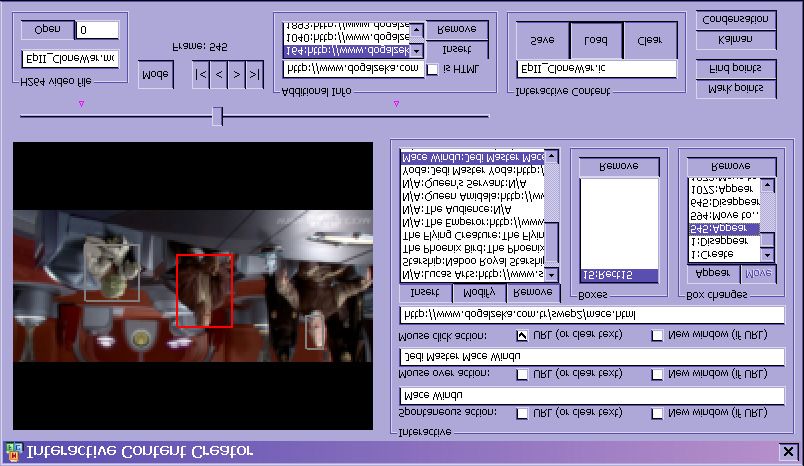
Interactive Content Creator (ICC) (Figure 2) is an applica-
tion used for embedding interactivity information into video
Fig. 2. Interactivity Content Creator is an application used for embedding
files. If one is watching a video with embedded interactivity interactivity information into video files. [12]
information, he can do a number of things. For instance, if the
user moves the cursor over objects inside the video, tooltips
appear. The user can click on video objects to load web pages This task requires a former model of the object. Maybe
about them. In an advertisement of a product, you can click the algorithm may at least detect objects already known
to buy the product. In a music channel, the listeners can click from preceding scenes.
an area on their screens to select the next music video.
In ICC, the user loads a video and defines interactive actions E XPERIMENTS
that are connected to events. These events are of three types.
Two videos from actual movies were used in the experi-
Either the action happens spontaneously, it is triggered by a
ments. For each video, a first set of four experiments was
mouse click on a region, or it is triggered when the mouse is
conducted to compare tracking results of the four types of
over a region. These regions are defined as sets of rectangles
color histograms: The conventional and fuzzy histogram, and
on the video frames. These rectangles are created by the user.
their ratio histograms (RH and FRH). We aim to find the
As the object moves, the rectangle (or multiple rectangles) of
best performing color histogram, and use this histogram in
the object should also move. Every rectangle has a history of
the following experiments. The second set of experiments is
changes through the movie frames. In a frame, a rectangle can
conducted to compare the performance of color histogram with
appear or dissappear on a frame at some coordinates, and it
other types of features, namely DCT and LBP. In the last
can move to some other coordinates.
stage, color histogram is combined with the other two types
Object Tracking Issues in ICC of features to see if the tracking performance improves.
In the original version, all these changes in rectangle coordi- In the videos, ground truth images are manually created, by
nates are marked on the video by the user manually, depending defining object region as the head of the person. Ground truth
on the object movements inside the video. Currently, color and images are only marked once every 5 frames, for example
texture-based object tracking method is implemented in ICC. in frames 3, 8, 13, 18, ... etc. At these ground truth-enabled
This method is used to improve the efficiency of this program. frames, a tracking score is calculated by comparing the object
Firstly, the scene transitions are detected while loading window of the tracking method to the true object pixels. The
the video. Scene transitions are frames where object tracking object window is an ellipse inside a rectangle. To score a
starts and ends. The program automatically determines the tracking method at a certain frame, the number of true object
frames where the scene changes instantaneously. Detecting pixels inside the ellipse is added to the number of non-object
more complex transitions such as fade in, fade out, dissolving pixels outside the ellipse, and the sum is divided by the total
and wiping is an unsolved issue. number of pixels in the rectangle. This gives a number in the
interval [0,1]. The nearer it is to 1, the better. Example scores
• At a scene beginning, the user marks the object. Then
at frame 48 for Video 1 are shown in Figure 3.
the program follows the object throughout the scene.
However, there may be in-scene partial or full occlusions.
Unseen objects can also be partly or temporarily tracked.
An object appearance model is necessary for this task.
• Usually, there are several objects in a scene. These
objects may overlap. The algorithm must have a multiple
object mechanism to avoid confusing similar overlapping
objects with each other. (a) DCT (b) Color (c) Combined (d) Ground truth
• Some objects may not appear at the beginning, but in
Fig. 3. An example frame of Video 1 in three methods using DCT,
the middle of the scene. The frames these objects appear color statistics and combination of these two. Scores are 0.77, 0.83 and 0.9
can be detected, to request the user to manually mark a respectively, and calculated by comparing pixels inside and outside the ellipse
rectangle around the new object at these particular frames. to the ground truth image (d).TABLE I
S INGLE FEATURE RESULTS FOR TWO VIDEOS
Video 1 Video 2
Color Histogram 0,3809 0,3449
Fuzzy Hist. 0,4142 0,2945 (a) Frame 2 (b) Frame 52 (c) Frame 90
Ratio Histogram 0,2092 0,3852
Fuzzy Ratio Hist. 0,2022 0,3798
DCT 0,3666 0,3688
LBP 0,2913 0,3822
TABLE II (d) Frame 118 (e) Frame 140 (f) Frame 163
C OMBINED RESULTS FOR V IDEO 1 AND 2 Fig. 5. Example frames from tracking with Fuzzy Ratio Histogram combined
with DCT and LBP in Video 1.
(a) Video 1 (b) Video 2
Video 1 Video 2
FRH 0,2022 FH 0,2945
FRH+DCT 0,1643 FH+DCT 0,2055 color ratios to help tracking, and the fuzzy histogram better
FRH+LBP 0,2559 FH+LBP 0,3562 adapts the smooth changes in color conditions.
FRH+DCT+LBP 0,1462 FH+DCT+LBP 0,2634
The next stage is shown in Figure 6(b), where the results of
FRH is compared to DCT and LBP. Apparently, color is the
best feature, and the information extracted in LBP and DCT
For each video, an initial object window is selected man- is not sufficient to track the object.
ually, and every experiment uses the same initial window. We can see the results of the last stage in Figure 6(c).
Scores are calculated at five frame intervals for each experi- Combined results appear to be more stable than either of its
ment. Typically, the tracking score starts near 0.9. The score components.
is never exactly 1.0, since the object shape is not a perfect
ellipse. A sudden decrease in the score means that the method C ONCLUSION
is failing and losing the object, whereas an increase means
that the method is catching-up with the object. In this study, an object tracking method is developed for
Video 1 is an indoor sequence with 180 frames, in which the an application that enables users to embed interactivity to
actor in the middle turns around, significantly changing both videos. The method is a general object tracker based on a
lighting conditions and object appearance. The background translating ellipse-shaped object window, whose motion is
is complex, but it is relatively stationary, because there are estimated by condensation particle filter. The improvement
no sudden movements and the camera motion is slow. Video introduced by the method is the joining of three different
2 is an outdoor sequence with 120 frames, sharing all the types of object features, namely, YCrCb color statistics, DCT
challenges mentioned with Video 1. In addition, Video 2 has and LBP representation of the object texture statistics. Due
a dynamic background that is both due to constant camera to different representations used, each performs best under
motion and dynamic objects such as the helicopter and a different circumstances.
walking person. Some frames from Video 2 are shown in The histogram comparison experiments show that the fuzzy
Figure 4. histogram represents color features better than a conventional
Overall results of the experiments are listed in Tables I and discrete histogram. Feature comparison experiments show that
II. The error values are calculated by subtracting score values color histogram is a more stable and representative feature
from one. for use with object tracking than texture (DCT, LBP), if each
feature is used alone.
A. Experiment details for Video 1 The combination experiments show that it is possible to
Example frames from two tracking experiments of Video 1 obtain a more stable tracker by combining color with texture.
are shown in Figure 5. The first set of experiments show that However, combined implementation may amplify weaknesses
the fuzzy ratio histogram performs better than all the other of these features as well as strengths. In the combined tracker,
histograms in this sequence. The stationary background allows three features are directly joined by multiplication rule for
independent probabilities. Thus, all have the same significance
and same weight on the output. There must be a mechanism
that evaluates the efficiency of every feature and decides which
features are more desirable for the moment. If feature changes
can be considered as a motion in the feature space, there could
be an appearance model similar to motion estimation, that
does not predict object movement, but changes in features. A
(a) Frame 263 (b) Frame 313 (c) Frame 388
dynamical feature estimation mechanism would help to reduce
the temporary negative effect of weak features and increase
Fig. 4. Example frames from Video 2. overall efficiency.(a) Different color histograms (b) Color histogram and other features
(c) Color histogram combined with other features.
Fig. 6. Experiments on Video 1. Fuzzy Ratio Histogram performs best in the first experiment, and the performance increases when combined with DCT and
LBP in the third experiment.
R EFERENCES IEEE Trans. Pattern Anal. Mach. Intell., vol. 24, no. 7, pp. 971–987,
2002.
[9] A. B. A. S.-V. J. Melo, J.; Naftel, “Detection and classification of high-
[1] D. Comaniciu, V. Ramesh, and P. Meer, “Kernel-based object tracking,”
way lanes using vehicle motion trajectories,” Intelligent Transportation
IEEE Trans. Pattern Anal. Mach. Intell., vol. 25, no. 5, pp. 564–575,
Systems, IEEE Transactions on, vol. 7, no. 2, pp. 188–200, June 2006.
2003.
[10] M. Isard and A. Blake, “Condensation – conditional density propagation
[2] M. Polat, E.; Ozden, “A nonparametric adaptive tracking algorithm based for visual tracking,” International Journal of Computer Vision, vol. 29,
on multiple feature distributions,” Multimedia, IEEE Transactions on, no. 1, pp. 5–28, 1998.
vol. 8, no. 6, pp. 1156–1163, Dec. 2006. [11] J. Czyz, B. Ristic, and B. Macq, “A particle filter for joint detection
[3] M. J. Swain and D. H. Ballard, “Color indexing,” Int. J. Comput. and tracking of color objects,” Image Vision Comput., vol. 25, no. 8, pp.
Vision, vol. 7, no. 1, pp. 11–32, November 1991. [Online]. Available: 1271–1281, 2007.
http://portal.acm.org/citation.cfm?id=134841 [12] DoğalZeka. [Online]. Available: http://www.dogalzeka.com.tr
[4] J. Han and K.-K. Ma, “Fuzzy color histogram and its use in color image
retrieval,” Image Processing, IEEE Transactions on, vol. 11, no. 8, pp.
944–952, Aug 2002.
[5] I. El-Feghi, H. Aboasha, M. Sid-Ahmed, and M. Ahmadi, “Content-
based image retrieval based on efficient fuzzy color signature,” in
Proceedings of the IEEE Systems, Man and Cybernetics, ISIC ’07., Oct.
2007, pp. 1118–1124.
[6] A. Bhattacharyya, “On a measure of divergence between two statistical
populations defined by their probability distributions,” Bull. Calcutta
Math. Soc., no. 35, pp. 99–110, 1943.
[7] L. Dong and S. Schwartz, “Dct-based object tracking in compressed
video,” Acoustics, Speech and Signal Processing, 2006. ICASSP 2006
Proceedings. 2006 IEEE International Conference on, vol. 2, pp. II–II,
14-19 May 2006.
[8] T. Ojala, M. Pietikäinen, and T. Mäenpää, “Multiresolution gray-scale
and rotation invariant texture classification with local binary patterns,”You can also read


