COVID-19 MANAGEMENT PLAN MARCH 2020
←
→
Page content transcription
If your browser does not render page correctly, please read the page content below
COVID-19
MANAGEMENT PLAN
MARCH 2020

     Version 1.6 | 19 March 2020
                                   Page 1 of 45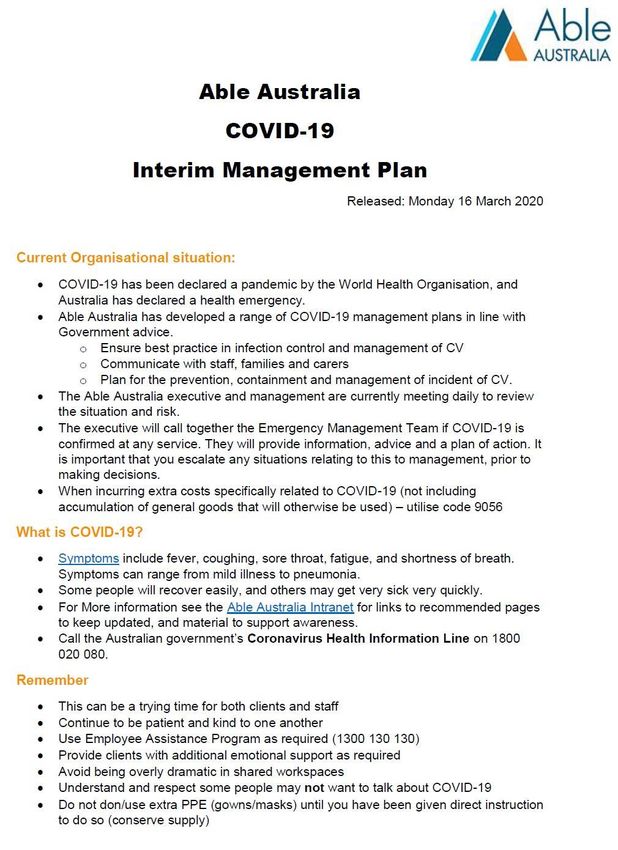
Contents

Overview and Current Context ................................................................................................................... 4
   Current Organisational Situation ............................................................................................................ 4
   What is COVID-19? .................................................................................................................................. 5
Able Australia COVID – 19 Response Priorities ........................................................................................... 5
Executive summary of current actions ....................................................................................................... 6
Communication Response Team and Channels .......................................................................................... 7
Able Australia’s COVID-19 - Response Plan ............................................................................................... 8
   What can you do for COVID-19? ............................................................................................................. 8
       Social Distancing ................................................................................................................................. 8
   Infection Management ........................................................................................................................... 9
   If the Department of Health confirms case of COVID-19........................................................................ 9
       Return to business as usual............................................................................................................... 10
Local Area Plan for COVID-19 (Residential Services) ................................................................................ 11
Local Plan .................................................................................................................................................. 17
       Plan - Scenario 1 – Day Support Service Closure .............................................................................. 17
       Plan - Scenario 2 – Critically Low Staffing Levels (e.g. school closure) ............................................. 19
       Plan - Scenario 3 – Suspected case of, or exposure to COVID-19 ..................................................... 20
Actions to contain spread ......................................................................................................................... 21
   Workplace hygiene and screening for risk ............................................................................................ 21
   Screening for risk .................................................................................................................................. 23
People presenting with symptoms ........................................................................................................... 24
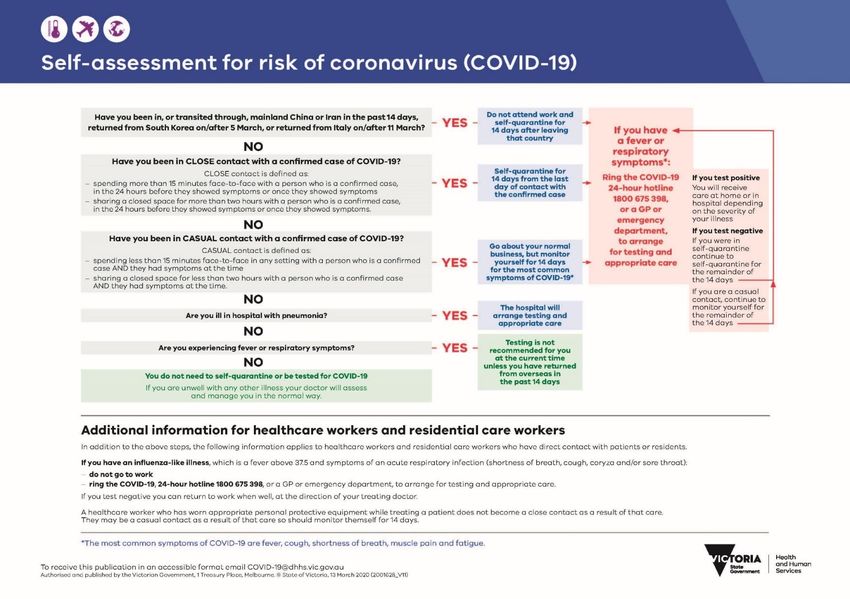
Self-Assessment risk of COVID-19 ............................................................................................................. 25
Monitor Travel .......................................................................................................................................... 26
Trigger Event School/Child care/ Institution closures .............................................................................. 27
Trigger Event: Rapid spread of virus in local area ..................................................................................... 27
Able Employee COVID-19 Advice Guide ................................................................................................... 29
   Employee returns from overseas – Self Quarantine for 14 days (home) ............................................. 29
   Employee is sick at work – develops symptoms (coughing, temperature) .......................................... 30
   Employee has Carer’s responsibilities and cannot come to work e.g. children at home because school
   has closed .............................................................................................................................................. 30
   If Able Australia cannot provide employees work because a service has shut down due to Covid-19 31
   Employee does not want to work due to fear of contracting the virus ................................................ 31
   Plan for key person/ team risks – non service delivery ........................................................................ 32
   Plan for key service delivery challenges ............................................................................................... 33

                                                         Version 1.6 | 19 March 2020
                                                                                                                                             Page 2 of 45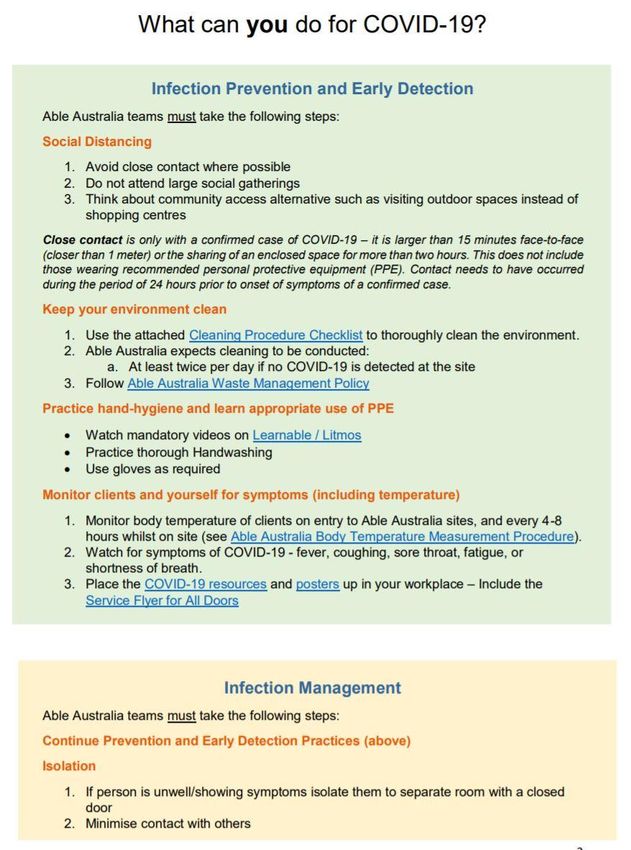
Community support considerations ..................................................................................................... 34
APPENDICES .............................................................................................................................................. 35
Appendix 1 - Able Australia’s COVID-19 - Response Plan ......................................................................... 35
Appendix 2 - Workplace Hygiene Plan ...................................................................................................... 38
Appendix 3 – Site Cleaning Procedure ...................................................................................................... 39
Appendix 4 – Temperature Procedure...................................................................................................... 41
Appendix 4 – Services Flyer....................................................................................................................... 45

                                                        Version 1.6 | 19 March 2020
                                                                                                                                         Page 3 of 45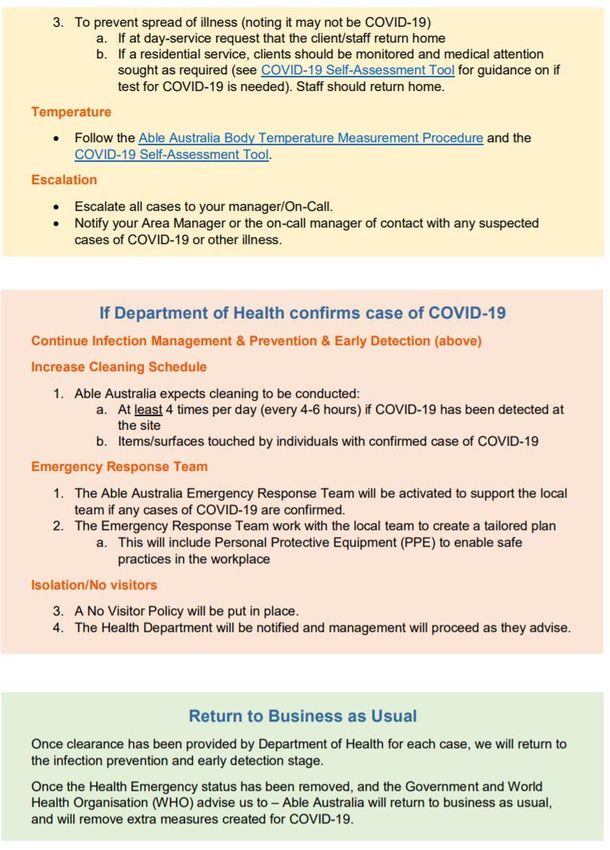
Overview and Current Context
Able Australia continues to monitor the impact and spread of COVID-19. COVID-19 has now spread to
most countries around the world. Symptoms include fever, fatigue, temperature, dry cough and runny
nose. We are closely following developments and advice from various national and international
government bodies.
Above 80% of those with COVID-19 recover without needing any special treatment. Those most at risk
from the disease are the elderly and those with pre-existing health problems. COVID-19 is thought to
be spread mainly through person – to – person contact (i.e. cough and sneezing)
At present no Able Australia employees, volunteers, clients have been confirmed to have COVID-19,
nor have any Able Australia offices been subject to known exposure.
Able Australia is preparing for the potential impact of the disease which may involve community
transmissions and state/ local government actions such as school closures and movement restrictions.
This document sets out Able Australia’s response to COVID-19, both immediate and in the event of
identified trigger events. This response will be reviewed continually by the Executive Team in light of
swiftly changing global and local developments.
Current Organisational Situation
COVID-19 has been declared a pandemic by the World Health Organisation,
and Australia has declared a health emergency.
Able Australia has developed a range of COVID-19 management plans in line
with Government advice.
o Ensure best practice in infection control and management of CV
o Communicate with staff, families and carers
o Plan for the prevention, containment and management of incident of CV.
The Able Australia executive and management are currently meeting daily to
review the situation and risk.
The executive will call together the Emergency Management Team if COVID-19 is
confirmed at any service. They will provide information, advice and a planof
action. It is important that you escalate any situations relating to this to
management, prior to making decisions.
When incurring extra costs specifically related to COVID-19 (not including accumulation
of general goods that will otherwise be used) – utilise code 9056.
Version 1.6 | 19 March 2020
Page 4 of 45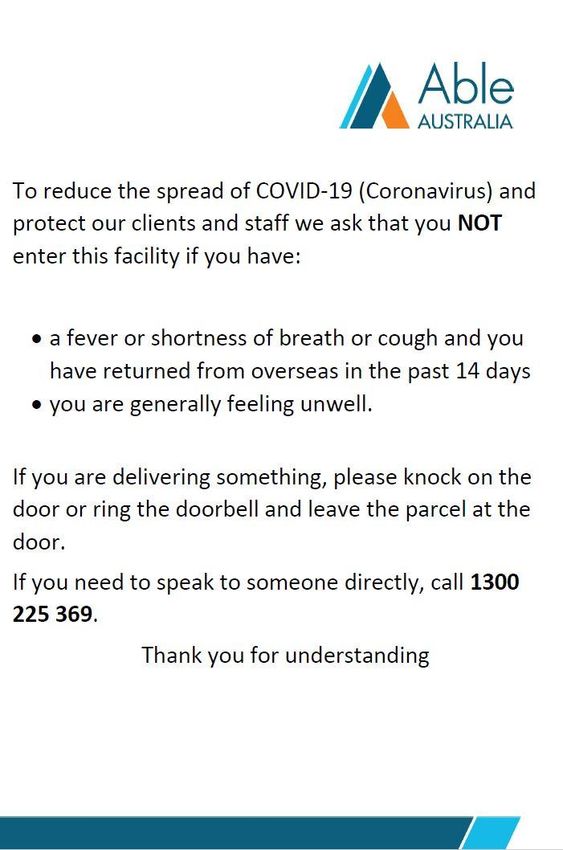
What is COVID-19?
Symptoms include fever, coughing, sore throat, fatigue, and shortness of
breath. Symptoms can range from mild illness to pneumonia.
Some people will recover easily, and others may get very sick very quickly.
For More information see the Able Australia Intranet for links to recommended
pages to keep updated, and material to support awareness.
Call the Australian government’s Coronavirus Health Information Line on 1800 020 080.
REMEMBER
This can be a trying time for both clients and staff
Continue to be patient and kind to one another
Use Employee Assistance Program as required (1300 130 130)
Provide clients with additional emotional support as required
Avoid being overly dramatic in shared workspaces
Understand and respect some people may not want to talk about COVID-19
Do not don/use extra PPE (gowns/masks) until you have been given direct
instruction to do so (conserve supply)
Able Australia COVID – 19 Response Priorities
Able Australia will continue to implement precautionary measures to help minimise the risk of COVID-
19 exposure.
1. Ensuring the health, safety and well-being of our employees, volunteers and clients.
2. Focusing on providing our clients with high quality services as far as is practicable.
3. Taking actions to support community spread of the virus.
4. Closely assess the impact of COVID-19 on our communities and identify ways to safely extend
support to those in need.
Version 1.6 | 19 March 2020
Page 5 of 45
Executive summary of current actions
What Who How By When Completed
Implement additional Exec Emails 13/3/20
hygiene measures / Leaders Posters
communications Cleaning
Schedules
Gather information Exec Altered Annual Leave form by
regarding upcoming staff Area Leave form 5/3/20
work and private travel Managers Local Plans Ongoing
plans
Identify / confirm which Exec Local plans to 5/3/20
services / clients will be Area inform
heavily impacted Managers organisational
plan
Identify which personnel/ Exec Document in 10/3/20 In progress
teams are critical to organisational
operations, make plans plan
to mitigate risk
Identify IT capacity for GM CS 5G 13/3/20
larger numbers of staff to Citrix Licences
work remotely
Nominate a central ND Document in 5/3/20
person to manage Marketing Organisational
information & Plan
Engagement
Define primary Organisational 5/3/20
organisational Plan
communication channels
regarding COVID-19
responses
Limit non-essential work Exec 5/3/20
travel
Identify which employees Exec 16/3/20
can/not work from home Area
Managers
Monitor public health Exec Ongoing
notices
Prepare messaging for ND Emails 13/3/20 ND Marketing &
families and clients Marketing Letters Engagement
&
Engagement
Version 1.6 | 19 March 2020
Page 6 of 45Communication Response Team and Channels
Name Title
Kate MacRae CEO
Peter Batsakis General Manager Corporate Services
Lynette McKeown National Director Quality & Accommodation
Chris Stallard National Director Community
Angela Politis National Director People & Culture
Chandi Piefke National Director Marketing & Engagement
Richard Nelson National Director Service Development
James Digby Internal Business Consultant
Bill Iverach Service and Operational Manager, Tasmania
Romi Tariq Area Manager
Madeleine Johnson Area Manager
Anne-Marie Wendt Area Manager
Bryce Smith Area Manager
Daniel Barry Area Manager
Frances Touber Area Manager
Jennifer Oak Area Manager
Louise Sullivan Area Manager
As needed
Quality, P&C and Support staff
The response team will meet as required to assess current status/ situation – prioritise meeting to
discuss urgent issues (Via Zoom).
COMMUNICATION CHANNELS
Email is the primary communication channel
o All email messages also placed on intranet and printed off in each workplace.
Area Managers accountable to ensure messages passed onto their team members (in cases
where people may not have access to emails).
Central information kept on SharePoint (past communications, posters links, and latest
information).
Response Team to communicate urgent emerging issues via SMS.
LEARNING AND DEVELOPMENT RESOURCES
All additional COVID19- training is accessible on LearnAble. For staff working directly with
clients, it is highly recommended to watch these videos.
Version 1.6 | 19 March 2020
Page 7 of 45Able Australia’s COVID-19 -
Response Plan
What can you do for COVID-19?
INFECTION PREVENTION AND EARLY DETECTION
Able Australia teams must take the following steps:
Social Distancing
1. Avoid close contact where possible
2. Do not attend large social gatherings
3. Think about community access alternative such as visiting outdoor spaces
insteadof shopping centres
Close contact is only with a confirmed case of COVID-19 – it is larger than 15 minutes face-to-face
(closer than 1 meter) or the sharing of an enclosed space for more than two hours. This does not
include those wearing recommended personal protective equipment (PPE). Contact needs to have
occurred during the period of 24 hours prior to onset of symptoms of a confirmed case.
KEEP YOUR ENVIRONMENT CLEAN
1. Use the attached Site cleaning Procedure Checklist to thoroughly clean the environment.
2. Able Australia expects cleaning to be conducted:
a. At least twice per day if no COVID-19 is detected at the site
3. Follow Able Australia Waste Management Policy
PRACTICE HAND-HYGIENE AND LEARN APPROPRIATE USE OF PPE
Watch mandatory videos on Learnable / Litmos
Practice thorough Handwashing
Use gloves as required
MONITOR CLIENTS AND YOURSELF FOR SYMPTOMS (INCLUDING TEMPERATURE)
1. Monitor body temperature of clients on entry to Able Australia sites, and every
4-8 hours whilst on site (see Able Australia Body Temperature Measurement
Procedure).
2. Watch for symptoms of COVID-19 - fever, coughing, sore throat,
fatigue, or shortness of breath.
3. Place the COVID-19 resources and posters up in your workplace – Include
the Service Flyer for All Doors.
Version 1.6 | 19 March 2020
Page 8 of 45Infection Management
Able Australia teams must take the following steps:
CONTINUE PREVENTION AND EARLY DETECTION PRACTICES (ABOVE)
ISOLATION
If person is unwell/showing symptoms isolate them to separate room with a closed door.
1. Minimise contact with others.
2. Prevent spread of illness (noting it may not be COVID-19)
a. If at day-service request that the client/staff return home
b. If a residential service, clients should be monitored and medical attention
sought as required (see COVID-19 Self-Assessment Tool for guidance on if
test for COVID-19 is needed). Staff should return home.
TEMPERATURE
Follow the Able Australia Body Temperature Measurement Procedure and the
COVID-19 Self-Assessment Tool.
ESCALATION
Escalate all cases to your manager/On-Call.
Notify your Area Manager or the on-call manager of contact with any suspected
cases of COVID-19 or other illness.
If the Department of Health confirms case of COVID-19
Continue Infection Management & Prevention & Early Detection (above) Increase
CLEANING SCHEDULE
1. Able Australia expects cleaning to be conducted:
a. At least 4 times per day (every 4-6 hours) if COVID-19 has been
detected at the site
b. Items/surfaces touched by individuals with confirmed case of COVID-19
EMERGENCY RESPONSE TEAM
1. The Able Australia Emergency Response Team will be activated to support the
local team if any cases of COVID-19 are confirmed.
2. The Emergency Response Team work with the local team to create a tailored plan
a. This will include Personal Protective Equipment (PPE) to enable
safe practices in the workplace
Version 1.6 | 19 March 2020
Page 9 of 45ISOLATION/NO VISITORS
1. A No Visitor Policy will be put in place.
2. The Health Department will be notified, and management will proceed as they advise.
Return to business as usual
Once clearance has been provided by Department of Health for each case, we will return to the
infection prevention and early detection stage.
Once the Health Emergency status has been removed, and the Government and World Health
Organisation (WHO) advise us to – Able Australia will return to business as usual and will
remove extra measures created for COVID-19.
Version 1.6 | 19 March 2020
Page 10 of 45Local Area Plan for COVID-19 (Residential Services)
GENERAL
Able’s Emergency Response team is accountable for assessing and managing risk associated with
COVID-19. Able’s COVID-19 Plan outlines the organisational strategies Able are taking to
prevent, detect (early) and manage COVID-19. The Local Area Plans for COVID-19 will outline the
local assessment and response.
Location
Program/Service
Team Leader /
Area Manager
Number of
Residents
Date
Version 1.6 | 19 March 2020
Page 11 of 45LOCAL ASSESSMENT
LOCAL STAFF AUDIT
It is important that we understand the local staffing profile to adequately plan for a local response to COVID-10. Collecting the following information will
identify:
1. Current staff capacity
2. Additional staff capacity
3. Emergency contact details.
Please complete the following table for all staff who work in your location. NOTE - ALL STAFF ARE TO RECORD THEIR AVAILABILITY IN CARELINK.
Staff Name Email Staff Staff Work Carer duty (Is Upcoming Willingness to Ability Comments (fitness
(personal) Home personal Status staff member AL Plan do additional to work to work with client
Address mobile / PFT, impacted by (Is staff hours/different from with COVID-19 e.g.
phone PPT, school/childcare member hours different not able to as
Casual closured) – No, willing to locations respiratory /care for
fully, Partially move AL) (Y/N) vulnerable people)
John Smith John.smith@hotmail 4 Brown 0411111111 PPT Partially 4/4 to Yes Yes
.com St, 5/6 -
Yarraville willing to
move
Version 1.6 | 19 March 2020
Page 12 of 45MINIMUM STAFFING LEVELS
We would like to model the minimum staff levels required in the event of significant staff shortages. Please assume all clients are at home due to day service/
community venue closures. It is our duty of care to ensure all clients are safe.
Shift Current staffing level (number of staff per Absolute minimum staffing level which
shift) maintains safety (number of staff per shift)
Night Shift
Time from______ to ______
Morning Shift
Time from______ to ______
Day Shift (assume clients at home)
Time from______ to ______
Afternoon Shift
Time from______ to ______
Evening Shift
Time from______ to ______
Version 1.6 | 19 March 2020
Page 13 of 45CLIENT ASSESSMENT
It is important that we understand the local client profile to adequately plan for the prevention and management of COVID-10. Collecting the following
information will help to identify and plan for:
1. Client risks
2. Client care needs
3. Identify local training requirements for staff
4. Identify potential family supports available.
Client Age Day Service Staffing High Chronic BOC Restrictive Language Family Comments
Name Supports Provider of Ratio Intensity Illness (harm to Practices (coms involved
(Day Day Supports Needs (respiratory self/othe (Nil, method) in care?
Service, (PEG, , diabetes rs, chemical, (No,
Communit Trachy, etc.) Property environm minimal,
y access, Catheter, damage, ent, a-lot).
in-home Bowel) abscondi physical, NOK
Support ng, seclusion, details
verbal mechanica
aggressi l)
on,
other)
Jack 59 Day service Day Service – 1:1 Nil Diabetes Nil Nil Non No
Smith Mon , Tue Able Australia verbal, Family,
Wed In home – uses Guardian
In home Able Australia Auslan appointe
support d for all
Thurs matters
Version 1.6 | 19 March 2020
Page 14 of 45FACILITY ASSESSMENT
A detailed assessment of the local facility and supplies will help us to formulate a plan.
FACILITY DETAILS
Facility Details Details
Number of bedrooms currently occupied
Number of bedrooms vacant
Number of Lounge room spaces
Number of dining spaces
Number of Bathrooms (client)
Number of Bathrooms (staff)
Number of separate toilets (Clients)
Number of separate toilets (staff)
Alternative rooms that could be used in the
event of isolation
Other
Version 1.6 | 19 March 2020
Page 15 of 45STOCKTAKE OF HOUSE-HOLD ITEMS
Item Details of supply
Food (1wks, 2wks, 3wks)
PPE
1. Gloves (number of boxes – how many
weeks supply)
2. Masks ( Yes / No, how many?)
3. Aprons ( Yes / No, how many?))
4. Gowns ( Yes / No, how many?))
5. Eyewear ( Yes / No, how many?))
Hand Soap (1wks, 2wks, 3wks)
Hand Sanitiser (1wks, 2wks, 3wks)
Cleaning Products (1 week, 2wks,
2+wks)
Medications (1 week, 2wks, 2+wks) Aim to have 2 week supply
Continence Products (1 week, 2wks,
2+wks)
Thermometer (Yes / No)
Clinical waste bin on site (Yes / No)
Other
Version 1.6 | 19 March 2020
Page 16 of 45Local Plan
There are three scenarios we need to plan for:
1. Day Support Service Closure
2. Critically low staffing levels (e.g. school closures)
3. Suspected case of or exposure to COVID-19
There are two levels of planning required to assess and manage risk associate with COVID-19, the organisational-wide Able Plan and local-level Plans.
Please complete your local plan using the template and steps below and send to your Area Manager. To support you in the development of this plan please
speak with your Area Manager or buddy with another team leader to complete and discuss ideas.
SUCCESSION PLAN
Position Name and Details of Person/s who can provide cover
Team Leader
Area Manager
Plan - Scenario 1 – Day Support Service Closure
Client Name Client Name Client Name Client Name Client Name
Service Type
Days of Week
Number of Hours
Timeframe for
closure (if known)
Staff Ratio
Staffing
- Number of
additional staff
required?
Version 1.6 | 19 March 2020
Page 17 of 45- Staff skill set
required?
- Alternative service
provision
identified (in-
home, community
access)
Consider options
below to fill vacant
staff rosters
Develop client
activity program
for engagement
Other
Staffing options to be considered
Maximising existing staff
- Redeploy from Day Service
- Agency staffing
- Increase permanent/part time hours – Identify
- Overtime
- Negotiate/Minimise Annual Leave
- Redeploy from other location (other house)
- National and state office staff with required skills
Employing new staff
- Volunteers (ex-students)
- Staff who recently worked for Able and resigned, retired
- Buddy Shifts
- Recruiting new staff / casuals
Version 1.6 | 19 March 2020
Page 18 of 45Plan - Scenario 2 – Critically Low Staffing Levels (e.g. school closure)
STEP 1 – Determine minimum staffing levels (as assessed above)
STEP 2 – Determine additional staff availability from existing pool of staff.
STEP 3 – Share staff from wider pool of staff (refer to staffing options) – Utilise day service staff
STEP 4 – Team Leader to escalate progress and gaps to Area Manager / Roster Coordinator
STEP 5 – Area Manager to escalate progress and gaps to Emergency Response Team to ensure business continuity and mobilise alternative staffing strategies
for new staff for the organisation.
Shift Minimum staffing level
which maintains safety
(number of staff per shift)
Night Shift
Time from______ to ______
Morning Shift
Time from______ to ______
Day Shift (assume clients at
home)
Time from______ to ______
Afternoon Shift
Time from______ to ______
Evening Shift
Time from______ to ______
Version 1.6 | 19 March 2020
Page 19 of 45Plan - Scenario 3 – Suspected case of, or exposure to COVID-19
STEP 1 – Follow the COVID-19 Interim Management Plan
STEP 2 – Escalate to Area Manager, National Director and Emergency Response Team.
STEP 3 - The Able Australia Emergency Response Team will be activated to support the local team if any cases of COVID-19 are suspected or confirmed.
STEP 4 - The Emergency Response Team will work with the local team to create a tailored plan
Version 1.6 | 19 March 2020
Page 20 of 45Actions to contain spread
Workplace hygiene and screening for risk
What Why How Who By When
Promote through This is the most Promote through: All staff/ Immediately
handwashing. effective way Hand Hygiene volunteers/
of preventing LMS Mandatory clients Some stock on
With soap and water disease spread. training back order
for at least 20 seconds Emails/ Intranet/
or use an alcohol- workplace
based hand sanitiser. Posters in toilets/
workplaces
Team Meetings
Ensure hand
washing facilities
are kept well
stocked
Alcohol sanitisers
distributed
throughout the
workplace
Promote appropriate Reduce risk of Promote through: All staff/ Now and ongoing
protocols managing spreading Definition of volunteers/
coughs/ symptoms virus. Close and Casual clients
contact
Cough into elbow. distributed
Emails/ intranet/
Do not enter Able workplace
premises if you have a Posters in
sore throat/ cough / workplace
fever Team Meetings
Social Distancing Reduce person Promote through: All staff/ Now and ongoing
to person Emails/ intranet/ volunteers/
Limit physical contact spread of virus workplace clients
/ handshakes Posters in ( where
workplace practicable)
Maintain 1 metre Team Meetings
distance from others.
Deafblind clients and
Comm Guides
require additional
education and
support.
Version 1.6 | 19 March 2020
Page 21 of 45What Why How Who By When
Increased Cleaning The virus can Email to staff. All staff/ Now and ongoing
be transferred Provision of volunteers
Employees and on hard disinfectant wipes.
volunteers asked to surfaces. All staff to wipe hard
regularly clean hard surfaces in their work
surfaces in all office / areas at least once
domestic areas with daily.
disinfectant wipes or
similar.
Cleaning in Homes
Cleaning in Day Cleaning schedule Team
Services developed and Leaders to
distributed implement
at each site
Management To maintain Management Area Now and ongoing
practices if client safety of client protocols for Managers to
needs to be isolated and staff Standard Precautions ensure Team
reiterated. Leaders are
Personal Protective
Equipment procedure
reinforced.
PPE stock identified
PPE stock ordered as
required
Increase cleaning / Products Orders to be placed National / Now and ongoing
hygiene supplies required to and stored centrally State Offices
reduce spread for distribution as
of virus required.
If no supplies, soapy
water or alternate
cleaning products to
be used.
Increased waste Increase the Contact contractor as Area Now and ongoing
collection instigated if removal of all required Manager
a home has an critical waste
identified risk to reduce risk
of infection
Version 1.6 | 19 March 2020
Page 22 of 45Screening for risk
What Why How Who By When
Twice daily To monitor for Digital thermometers Team Leader Now and ongoing
temperatures to be fever distributed
taken and recorded of Temperature charts
all residential clients to be completed and
uploaded onto
Carelink
Twice daily To monitor for Digital thermometers Support Now and ongoing
temperatures to be fever distributed Worker
taken and recorded of
all community clients
All staff who are self- To monitor for All staff and Now and ongoing
monitoring to ensure fever and volunteers
they take symptoms
temperatures twice
daily and report any
symptoms
immediately
Version 1.6 | 19 March 2020
Page 23 of 45People presenting with symptoms
Able employees, volunteers and clients need to be vigilant to identify symptoms (respiratory issues,
coughing, sneezing, shortness of breath and or fever) and take preventative action to reduce potential
spread of the virus.
What How Who By When
Employee or Stay home do not attend work Employee Now and ongoing
volunteer Seek medical advice Volunteer
experiencing Take sick leave. Line
symptoms. Inform line manager Manager
NOT AT WORK Line Manager to inform National National
Director Director
Work with line manager to identify
if there may be any infection risks-
take action appropriately.
Employee or Inform line manager Employee Now and ongoing
volunteer Leave work immediately (travel Volunteer
experiencing home by the safest route possible) Line
symptoms. Line Manager to inform National Manager
AT WORK Director National
National Director -Devise local Director
response plan identifying any
potential exposure.
National Director to ensure
appropriate staffing to maintain
safe conditions for clients.
Client or member Ensure Posters or Signage requests that Employee Now and ongoing
of the community people do not enter Able Australia sites Volunteer
presenting with if they experience symptoms Line
symptoms Employees to be vigilant for Manager
presentation of symptoms, if National
symptoms present: Director
Request that client leave premises
and return home by safest way
possible, and they seek medical
advice.
Inform clients NOK
Inform line manager
Line Manager to inform National
Director
National Director -Devise local
response plan identifying any
potential exposure.
Version 1.6 | 19 March 2020
Page 24 of 45Self-Assessment risk of COVID-19
Version 1.6 | 19 March 2020
Page 25 of 45Monitor Travel
What Why How Who By When
Reduce non urgent Potential Audit of employees to All non-client 16/3/20
work travel spread or determine who can facing staff
exposure to work remotely
the disease
reduced.
International Work The virus is Immediate ban on All 4/3/20
Travel cancelled spreading overseas travel international
faster in some travel is
locations and authorised
the number of by CEO/
impacted Board
countries is
now
worldwide.
Interstate work NDs to review All staff 4/3/20
travel to be closely upcoming travel and
monitored assess risk.
Where possible use
ZOOM
International Annual Leave form All staff 5/3/20
personal travel amended to have
monitored self-disclosure of any
Employees and international travel
volunteers to
inform line
manager of recent
or upcoming travel
plans
14-day self-
quarantine
required where
people return from
affected countries.
Active self-
monitoring for all
others.
Clients - holidays All rostered holiday Area Now and ongoing
which are support to be risk managers
supported by Able assessed and ND
employees to be
risk assessed.
Version 1.6 | 19 March 2020
Page 26 of 45Trigger Event School/Child care/ Institution closures
Should COVID-19 spread further in our communities, there is a high likelihood that schools and other
services and institutions will close. This will impact those who have childcare responsibilities.
Where child care is not available to employees:
Can the employee do their Yes Work from home and maintain contact with line
usual work from home? manager and wider team through digital
channels.
Employee can:
No - Take personal/annual leave to focus on
childcare
or
- Request undertaking alternate duties from
home (data supports etc.)
Maybe? Explore options for remote service delivery
(phone, video conferencing etc.)
Trigger Event: Rapid spread of virus in local area
We aim to support limiting the spread of COVID-19 in our communities:-
No Govt. Lock Down – Encourage people not to attend impacted workplaces, may opt to close
certain workplaces, depending on circumstances to support safety, health and wellbeing.
Govt. Lock Down – Employees will be directed not to attend work.
Can the employee do their Yes Work from home and maintain contact
usual work from home? with line manager and wider team through
digital channels.
Employee can:
- Take personal/annual leave
No or
- Request undertaking alternate duties
from home (data supports etc.)
Maybe? Explore options for remote service
delivery (phone, video conferencing etc.)
Version 1.6 | 19 March 2020
Page 27 of 45Operational Implications Working from Home (WFH)
policy and application
process (
See key personnel/team
risk mitigation plan
IT capacity to support
remote working for larger
numbers of people
Who
Action now Identify which employees Each line manager to
can/not work from home undertake a review, send
list to Lynette McKeown,
National Director Quality
& Innovation/Senior
Practitioner & Acting
Director NDIS Residential
(central contact person)
Identify training and other Learning and
work which can be done development to support
from home line manager GM Digital
Solutions
Review IT functionality and GM Digital Solutions
capacity
Trial working from home
for some roles e.g. Triage
team, HUGS? Nils? IT?
Payroll?
Version 1.6 | 19 March 2020
Page 28 of 45Able Employee COVID-19 Advice Guide
Employee returns from overseas – Self Quarantine for 14 days (home)
The government has mandated 14-day quarantine period for all international arrivals. All countries
are included and there are heavy penalties for anyone in Australia who does not abide by these laws.
Is the employee permanent Employee must stay home for 14 days and self-
full-time/part-time and sick? quarantine.
If the employee was sick during this period they
will need a doctor’s certificate and use personal
leave entitlement or
Yes Use leave entitlement – Annual Leave or
Use leave entitlement – Long Service
Leave
Leave without pay if not leave
entitlements
“Stand down” with the following options;
Use leave entitlement – Annual Leave or
No Use leave entitlement – Long Service Leave
Leave without pay if not leave entitlements
Is the employee casual and Doctors certificate before they can return to work
sick? Casual employees are paid and hired by the
hour (+25% hourly rate)
Casual employees do not have personal leave
Yes or annual leave entitlements
Casual employees will not be paid during
the period they are sick and unable to
work.
Employee does not work until the 14 day
No quarantine period is complete.
Version 1.6 | 19 March 2020
Page 29 of 45Employee is sick at work – develops symptoms (coughing, temperature)
Health and safety laws and regulations require that an employer send an employee home if they feel
that they are at risk to their own health or the health of others in the workplace.
Duty of Care:
Able Australia has the right to send an employee home if they are visibly ill and present with
symptoms that can pose a risk even if that employee disagrees. It is Able Australia’s duty of care to
all employees and our clients. Employees also have a duty to take reasonable care for their own
health and safety and to not adversely affect the health and safety of others.
a. If the employee is permanent fulltime/part time
Employee sent home – medical certificate before can return to work
Use leave entitlements – Personal Leave; or
All other Leave entitlements as above (Annual Leave, LSL)
Leave without pay if not leave entitlements
b. If the employee is casual
Employee sent home – medical certificate before can return to work
Casual employees are paid and hired by the hour (+25% hourly rate)
Casual employees do not have personal leave or annual leave entitlements
Casual employees may check with Centrelink for special government payment
In Tasmania only - casual employees may be entitled to long service leave if they have
completed 10 years of continuous employment. They are considered to be continuously
employed if they have been regularly working for 32 hours or more in each consecutive period
of four weeks
Employee has Carer’s responsibilities and cannot come to work e.g. children at home
because school has closed
If the employee is permanent Work from home and check in regularly with
fulltime/part time can Yes Manager
employee work from home?
Use carer’s leave entitlement up to 10 days.
If more than 10 days use – Annual Leave or
No If more than 10 days use – Long Service Leave
Leave without pay if not leave entitlements
Version 1.6 | 19 March 2020
Page 30 of 45If the employee is casual can Exposure to COVID-19 is a potential hazard for workers
the employee work from and other people (including children) at workplaces.
home? No Able Australia must have measures in place to protect
worker health and safety and manage these risks
If Able Australia cannot provide employees work because a service has shut down due to
Covid-19
If the employee is permanent Employee redeployed to work in another Able
fulltime/part time can the Australia service.
employee be redeployed to do Yes
other work?
Employee will be “stood down” (section 524
Fair Work Act)
No Use leave entitlement – Annual Leave or
Use leave entitlement – Long Service Leave
Leave without pay if not leave entitlements
If the employee is casual can Employee redeployed to work in another Able
the employee be redeployed Australia service.
to do other work? Yes
Employee will not be engaged to work until
Able Australia can provide work
No Casual employees are paid and hired by the
hour (+25% hourly rate)
Employee does not want to work due to fear of contracting the virus
Able Australia has a responsibility to act in accordance with government advice. If Able is acting to
government advice and the direction given to the employee is lawful and reasonable:
The employee will not be paid for staying at home.
Version 1.6 | 19 March 2020
Page 31 of 45Plan for key person/ team risks – non service delivery
Key role/ Business impact / service Impact rating Mitigating strategies/
team impact alternatives
Payroll Officer Fortnightly payments to 600 High Payroll officer work from
employees at risk, impacting home if trigger event
employees cash flow If unable to work from home
back up includes
Finance manager support to
payroll.
P&C Service partner to
support payroll
Last resort- upload previous
fortnights payroll payments
(Finance Team)
IT Support Current internal issues are Medium Increase Zoom licences and
escalated to 5 G – no change CITRIX
Property Lack of support to respond to Low Local teams have capacity to
Maintenance any facilities related issues identify and respond as
required with the
endorsement of line
leadership
Funding Crucial that invoices are High Funding coordinator can work
coordinator processed from home; there is back up
Rostering Crucial that rostering High Rostering team have back up
continues
Queensland - Food pantry High Working with local
Jimboomba Meals on wheels Queensland council to seek
Emergency relief additional support/advice.
Quality Crucial of quality are High Team is able to work from
addressed in timely manner home and have access to all
relevant systems online.
Act as a backup to each other.
Exec team & Crucial that the team an meet High Team is able to work from
AM daily to address and home and there is adequate
determine plan backup for all systems online.
Act as a backup to each other.
Version 1.6 | 19 March 2020
Page 32 of 45Plan for key service delivery challenges
While a number of Able services can be closed or even conducted remotely some services cannot be
halted or have a higher exposure to community variables
Those which are rated medium to high risk include:
At Risk Services Service impact Impact Mitigating Strategies/
Rating alternatives
Day Service Lack of community Medium Prioritise clients who most
connection and occupation require 1:1 support in their
for clients. home.
Lack of respite for families. High Day Service staff deployed to
Able Accommodation services
Community Social isolation and High Develop a plan for each client
Access for reduced access to identifying additional social
Deafblind necessary services. Safety support networks
and wellbeing may be Utilise Comm Guides to provide
greatly impacted. information/ education to DB
clients on COVID-19 and its
impact.
Consider the use of personal
alarm monitoring for
emergencies.
Check information from
vulnerable persons list.
Accommodation Clients living in Able homes High Risk assessment of all clients
Services are reliant on team Risk assessment of homes
members for the operation for cumulative risk.
of the home, including Minimum staffing levels to
personal care, meals, be determined.
medication and high Skills of other staff to be
intensity care. redeployed:
Potential of Day Service staff
to be redeployed to homes
Potential of Admin / Exec
staff to be redeployed to
homes.
2 weeks of dry goods to be
held at each home.
CHSP Travel Socially Isolated elderly will Medium/ Volunteers being utilised for
be unable to access High daily phone calls and triaging of
necessary services request for essential travel.
ALPS Most contact is through Medium/ Volunteers to be used for
organised events which High telephone contact and escalation
will be cancelled of any risk.
Following state government
advice and action plan.
Version 1.6 | 19 March 2020
Page 33 of 45Food Pantry No distribution of food for High Continue as long as food supply
those most in need continues.
Work in collaboration with local
council implementing local
action plans.
Meals on Wheels No distribution of food for High Continue as long as food supply
those most in need continues.
Work in collaboration with local
council implementing local
action plans.
Each home and day service to develop a local action plan covering the following
Monitor for staff absenteeism
Risk assessment of each resident
Home cumulative risk assessment.
Staff communication
Provision of hygiene supplies
Provision of 2 weeks of dry goods for each home
Key person list
Permanent roster impact if child care/ schools close
Minimum staffing levels
Staff coverage plan
Community support considerations
How might COVID-19 impact your local community and are there any ideas of ways that Able
Australia can safely support the local community?
What might happen? Impact on community? Ideas to safely support people?
List local resources which might be useful to support responses (partnerships/collaboration/referral
points)
Version 1.6 | 19 March 2020
Page 34 of 45APPENDICES
Appendix 1 - Able Australia’s COVID-19 - Response Plan
ABLE AUSTRALIA COVID-19 – RESPONSE PLAN
Version 1.6 | 19 March 2020
Page 35 of 45Version 1.6 | 19 March 2020
Page 36 of 45Version 1.6 | 19 March 2020
Page 37 of 45Appendix 2 - Workplace Hygiene Plan
WORKPLACE HYGIENE PLAN
To support prevention and containment of potential COVID-19 infection, we will take proactive steps
to ensure high levels of office hygiene are encouraged.
Activity How Actioned?
Promote thorough handwashing with soap and water for at Email Yes
least 20 seconds or use an alcohol based hand sanitiser Posters No
Team meetings
Promote social distancing – limiting physical contact like Email Yes
handshakes, main 1.5m distance from people Posters No
Team meetings
Promote cleaning of hard surfaces in common areas Email Yes
(receptions, counselling rooms etc.) Posters No
Conversations
Ensure sufficient supplies of hygiene products including Usual purchasing Yes
tissues, hand sanitiser, disinfectants, wipes etc. systems No
If COVID is identified being spread in the community Cleaning Yes
Increasing cleaning contract contractor No
Version 1.6 | 19 March 2020
Page 38 of 45Appendix 3 – Site Cleaning Procedure
ABLE AUSTRALIA SITE CLEANING PROCEDURE
STATEMENT
Able Australia is committed to providing the highest standard of support for clients, including
provision of a safe and healthy physical environment. Key to this is regular cleaning and
maintenance.
SCOPE
All staff are required to implement this policy when working with participants at Able Australia
sites.
DEFINITIONS AND ABBREVATIONS
Term Definition
Personal Protective Refers to equipment such as gloves, eye protection, aprons, gowns,
Equipment (PPE) waterproof shoe covering and the like which are used to prevent or
reduce the spread of infection
OVERVIEW
This procedure outlines the basic steps involved in cleaning the interior of a range of sites
including supported residential living sites and day services operated by Able Australia. It notes
that PPE must be used when undertaking cleaning activities if there is the risk of infection (e.g. if
one or more residents in the home are unwell).
PROCEDURE DETAILS
1. All Able Australia sites are to be cleaned as per the attached relevant cleaning checklist.
Local alterations can be made in line with local circumstances.
See attached documents for cleaning checklist and record
Supported independent living cleaning checklist and record
Day Services cleaning checklist and record
2. Each room/area is to have its own Cleaning Record so the frequency at which each
space is being cleaned is clear.
3. At the end of each week the Cleaning Record is to be scanned into Carelink+ under the site.
4. Adherence to cleaning schedules will be audited regularly.
Version 1.6 | 19 March 2020
Page 39 of 45Equipment
Each Able Australia site will have an appropriate set of equipment and cleaning
chemicals for undertaking cleaning. PPE will also be available at sites where required.
INFECTION CONTROL
Proper infection control is important in containing the spread of disease. When completing
cleaning according to the cleaning schedule, ensure that appropriate PPE is always worn.
Note that the Director, Area Manager or Service/Team Leader will set the frequency of the
cleaning schedule. This will be dependent on a number of factors such as the physical
environment, needs of residents/participants and staff and level of infection control risk (eg.
Cleaning might be twice daily if a resident is in the home with influenza in order to curb the spread
of the disease and revert to daily once everyone in the house is well).
REFERENCE DOCUMENTS
Infection Control and Management of Infectious Conditions Policy
Waste Management Policy
NDIS Practice Standards and Quality Indicators Version 3
CONTINUOUS IMPROVEMENT
Improvements to this policy can be made by completing an Improvement Opportunity Form,
attaching any
Version 1.6 | 19 March 2020
Page 40 of 45Appendix 4 – Temperature Procedure
ABLE AUSTRALIA TEMPERATURE PROCEDURE
STATEMENT
Able Australia is committed to providing the highest standard of care for clients, including
the early identification and management of physical sickness. A key pillar of this is the
identification, timely management and effective monitoring of clients or staff who may
have an altered body temperature.
SCOPE
All staff are required to implement this policy when working with clients who may have signs
of changes in body temperature.
DEFINITIONS AND ABBREVATIONS
Term Definition
Pyrexia Refers to a person’s elevated body temperature due to an increase in
the body temperature’s set point. This is usually caused by infection or
inflammation. Pyrexia is also known as fever or febrile response.
Some causes of fevers do not require medical treatment, whilst other
causes need to be identified and treated.
Normothermia Refers to body temperature within normal range. Exact normal
temperature ranges differ between individuals and can be influenced by
some genetic and chronic medical conditions. It is important to ascertain
the baseline for individual patients in order to identify abnormal body
temperature deviations
Hyperthermia An elevated body temperature due to failed thermoregulation. This
occurs when the body produces and/or absorbs more heat than it can
dissipate.
Low Temperature A lowered body temperature, where the body loses heat faster than it
can produce heat
Hypothermia An abnormally low body temperature, where the body temperature
drops below a safe level. Both low temperatures and hypothermia can
be caused by environmental factors, metabolic complications, disease
processes, or can be medically induced.
Antipyretics Describes medicines including paracetamol and ibuprofen which are
taken to reduce or treat fever.
Version 1.6 | 19 March 2020
Page 41 of 45OVERVIEW
This procedure outlines the basic procedure in terms of measurement of client’s body
temperature using an electronic thermometer. It also gives direction on the frequency of
monitoring, the limits of normal body temperature readings and paths for escalation.
A significant rise in body temperature, also known as pyrexia, can indicate the presence of
infection. This increase in temperature can result in increased immune functions.
A mild increase in temperature is harmless and beneficial, as it is an important immunological
defense mechanism (The Joanna Briggs Institute, 2001). However, if the body temperature
rises above 39.4oC (becoming a moderate fever) actions to reduce fever should be taken.
A significant drop in body temperature is known as hypothermia. It can be caused by a range of
medical issues, but in the community setting can be due to environmental factors such as
inadequate or wet clothing or immersion in cold water for a period of time. If you believe a
participant is suffering hypothermia, apply first aid and seek medical advice immediately.
PROCEDURE DETAILS
WHEN TO TAKE A BODY TEMPERATURE READING
Body temperature should be taken if any of the following is observed:
Client or staff noted to
• be flushed in the face
• be sweaty without having had recently exerted themselves
• look pale and their skin may feel clammy to touch
• be shivering or complaining of feeling overly cold when adequately dressed
• complain of feeling over hot or bothered
• have a cold, a runny nose or cough
• be displaying symptoms of hypothermia such as shivering, blue lips and
extremities, shock
• displaying unusual behaviours or being in pain
• generally unwell
• or other reason as per your judgement.
Client or staff is suspected or has been in close contact with a person with
suspected/confirmed:
o coronavirus – COVID-19 over the past 5-14 days
o influenza A, influenza B or similar
o measles, mumps, rubella, chicken pox or other similar infectious disease
If a Client or staff meets the above criteria or if the Client or staff are concerned you can
take a body temperature measurement providing consent is given.
EQUIPMENT
Able Australia commonly used Braun touchless and forehead thermometers. Whilst the
instructions below pertains to the Braun touchless and forehead thermometers, the general
principles outlined below can be used across a range of models.
Version 1.6 | 19 March 2020
Page 42 of 45PREPARING TO TAKE A BODY TEMPERATURE MEASUREMENT
Preparing to take a body temperature measurement you should first seek consent from the
individual. Preparing to take a body temperature measurement you should carefully follow the
instructions laid out by the thermometer’s manufacturers.
1. Clean the thermometer using alcohol wipes
2. Let the thermometer and individual being measured acclimatize to the temperature of
the room in which the measurement is being taken.
a. The thermometer needs to acclimatize to the room temperature for 10
minutes before taking a measurement
b. The individual being measured should be indoors for 30 minutes before
taking a measurement. External temperature can impact skins
temperature (eg. Hot sun or a cool wind can heat or chill the skin)
c. Please take temperature reading in an allowed operating ambient (room)
temperature – 15-40 oC.
3. Ensure the individual’s forehead is prepared for measurement. The principles below
also apply to temperature taken under the arm etc.
a. Wipe away any sweat with a dry cloth. Sweat can cool skin and give a false reading.
b. Ensure the forehead is clean. If you clean the forehead, wait 10 minutes
before taking a measurement.
c. Hair can insulate the forehead and make it slightly warmer. Make sure you
move hair away from the forehead and wait 10 minutes before taking a
measurement.
4. Positioning of the thermometer is very important when taking a ‘touchless’ measurement.
a. Hold parallel to the forehead, and within 2.5cm of the skin. Keep the
individual’s head still.
b. Hold the thermometer steady in the middle of the forehead, just above the
individual’s eyebrows. Do not ‘swipe’ the thermometer across the head.
c. Press and hold the temperature button until reading is taken.
TAKING A BODY TEMPERATURE MEASUREMENT
Once the individual is ready, take their body temperature. Ensure that you note down the
temperature reading on the Body Temperature Recording Chart (see Attachment 1). Also note
the result in a case note in Carelink.
Please see below for the temperature range for adult results via forehead reading.
Normal Body Temperature Mild Fever Fever
Adult 35.4 – 37.7oC >37.8 – 39.4oC More than 39.4oC
USING THE RESULTS OF A BODY TEMPERATURE MEASUREMENT
If the reading shows a normal body temperature and symptoms persist, then an additional
reading should be taken 30 minutes later. If that reading also shows a normal body
temperature then no fever is currently present. The Client or staff member should be
Version 1.6 | 19 March 2020
Page 43 of 45monitored and if they continue to appear unwell then medical attention can be sought. If they
cease displaying the symptoms above and reporting feeling well, no further action is required.
If the recording shows Mild Fever or Fever, then the client or staff member should be
isolated to a room, preferably with a closed door. The following steps should then be
taken:
1. The person should be made comfortable and kept calm
2. Take the person’s body temperature again in 15 minutes time to confirm the fever.
3. If the fever is confirmed, Team/Service leader must be notified immediately with
escalation to Area Manager or on-call manager.
4. Medical attention sought for the person who is unwell, with the support of the
Team/Service Leader and Area Manager.
5. Follow advice given by medical practitioner in regards to the need for ongoing isolation.
6. Thoroughly clean the areas which the person who is unwell has been in,
so to avoid inadvertently spread of the illness.
INFECTION CONTROL
Proper infection control is important in containing the spread of disease. When taking a
body temperature reading ensure you adhere to the infection control policy including:
Thorough and timely hand hygiene
Clean the thermometer before and after using it
Isolate the unwell individual if a fever is established
REFERENCE DOCUMENTS
Infection Control and Management of Infectious Conditions Policy
Incident Management Policy and Procedure
Consent Form
Client Risk Assessment form
NDIS Practice Standards and Quality Indicator Version 3
CONTINUOUS IMPROVEMENT
Improvements to this policy can be made by completing an Improvement Opportunity Form,
attaching any suggested amendments and forwarding to the Quality and Compliance Advisor
for review.
Version 1.6 | 19 March 2020
Page 44 of 45Appendix 4 – Services Flyer
Version 1.6 | 19 March 2020
Page 45 of 45You can also read


