Curl user survey 2019 analysis - "there are so many useful features" - summary and analysis by Daniel Stenberg - Haxx
←
→
Page content transcription
If your browser does not render page correctly, please read the page content below

curl user survey 2019 analysis

    “there are so many useful features”

                          summary and analysis by Daniel Stenberg

                                          version 1 - June 4, 2019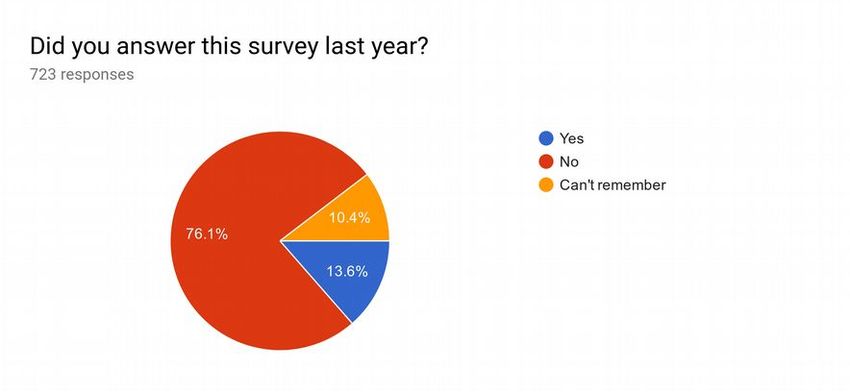
Table of Contents
About curl.............................................................................................................................................3
    Survey Background..........................................................................................................................3
Number of responses............................................................................................................................4
Returning respondents?........................................................................................................................5
Users living where?..............................................................................................................................6
What kind of users?..............................................................................................................................7
What protocols......................................................................................................................................8
Multiple platforms..............................................................................................................................10
What platforms...................................................................................................................................11
Which Windows versions...................................................................................................................13
Building curl.......................................................................................................................................14
What features are used?......................................................................................................................15
SSL backends......................................................................................................................................17
Years of curl use.................................................................................................................................18
Participating channels.........................................................................................................................19
How do you “access” libcurl..............................................................................................................20
Contributions......................................................................................................................................21
Other projects.....................................................................................................................................22
Reasons not to contribute to the project.............................................................................................23
How to get (more) contributions from you?.......................................................................................24
How good is the project to handle…..................................................................................................25
Which are the curl project’s best areas?.............................................................................................26
Which are the curl project’s worst areas?...........................................................................................27
If you couldn't use libcurl, what would be your preferred alternative?..............................................28
If you miss support for something, tell us what!................................................................................29
What would you like to see the project REMOVE?...........................................................................34
Which of these API(s) would you use if they existed?.......................................................................36
Do you wish to attend the next curl://up meeting/conference?..........................................................38
Should libcurl get rewritten in another language?..............................................................................39
What should "curl 8.0" be?.................................................................................................................40
Which question would you like to see in this survey next year?........................................................41

                                                                                                                                                      2
About curl
Curl is an old and established open source project that produces the curl tool and the libcurl library.
We are a small project, with few maintainers, with little commercial backing and yet we’re over 21
years old and we have gathered help from almost 2,000 contributors through the years. Our
products run in a vast amount of Internet connected devices, tools and services. curl is one of the
world’s most widely used software components. Possibly even the most widely used component!
See https://curl.haxx.se for everything not answered in this summary.

Survey Background
We do a user survey annually in an attempt to catch trends, view and longer running changes in the
project, its users and in how curl fits into the wider ecosystem. As usual, we only reach and get
responses from a small subset of users who voluntarily decide to fill in the questionnaire while the
vast majority of users and curl developers never get to hear about it and never get an opportunity to
respond. Self-selected respondents to a survey makes the results hard to interpret and judge.
This should make us ask ourselves: is this what our users think, or is it just the opinions of the
subset of users that we happened to reach. We simply have to work with what we have.
This year, the survey was up 14 days from May 13 to and including May 26. This year was the 6th
annual survey as the first one ran in 2014.
The survey was announced on the curl-users and curl-library mailing lists (with two reminders),
numerous times on Daniel’s twitter feed (@bagder) and on Daniel’s blog
(https://daniel.haxx.se/blog). The survey was also announced on the curl web site with an “alert
style” banner on most pages on the site that made it hard to miss for web visitors.
We used a service run by Google to perform the survey, which typically also leads to us loosing a
small share of users who refuse to use services hosted by them. We feel compelled to go with
simplicity, no cost and convenience of the service rather than trying to please everyone.

                                                                                                      3
Number of responses
This year showed a 9.2% increase in number of survey participants compared to last year, climbing
from 670 to 732 responses. Still far off from the record year 2015 when a total of 1475 entries were
collected.
Of course, a single respondent to this survey can be the author of an application that uses libcurl and
is used by a billion users. Or the respondent is the single user of curl in his basement. We just can’t
tell or know. Also, there’s no way for us to compare or judge “importance” between users. We’re all
equals here!
1600
1400
1200
1000
800
600
400
200
0
2014 2015 2016 2017 2018 2019
4Returning respondents?
To better understand the answers and the population of users who answered this year’s survey, we
again asked if the users who filled this in also did it last year. The answers showed us that the vast
majority didn’t answer last year (76.1%) or couldn’t remember (10.4%), and less than every 7th
respondent know they answered last year.
This result was also shockingly similar to the 2018 results which ended up 77% no and 10.5% can’t
remember!
The people we reach to fill in this survey are more random than we’d like, possibly because we
don’t have this large really devoted users in the community. We used the same means and
communication channels for the survey this year as every other year and still only about 98 humans
who answered last year answered this year again... In absolute numbers, that’s still up from the 83
return respondents in 2018.
Interestingly enough, even with three quarters of the respondents being new this year, some of the
answers and the distribution of them are shockingly similar to previous years. This might be a sign
that the opinions and views that are shared in these surveys are shared wider than just among the
732 that filled in the survey this year.
5Users living where?
As mentioned in the previous section, only 13.8% of the respondents were the same as 2018. But
amazingly the population distribution over the continents were almost identical!
Clearly a strong focus on Europe.
Europe 59%
North America 25%
Asia 6.5%
Oceania 3.2%
South America 2.9%
Prefer not to tell
2.1%
Africa 0.7%
The numbers from 2018 and 2019 laid out as bars clearly show their similarities:
70.00%
60.00%
50.00%
40.00%
30.00%
2018
20.00% 2019
10.00%
0.00%
e a i a a a ll ca
op ic As ni ic te ri
r er a er to Af
Eu ce
Am O Am no
t
th ut
h r
or ef
e
N So Pr
6What kind of users?
A new question this year asked the respondent to characterize themselves. This as an attempt to
better understand where the needs and desires come from.
Given the large amount of free-form write-ins to this answer, it was probably not a very well
phrased question or the alternatives were a bit weak. I suppose humans don’t like to be categorized
and lots of users seemed to want to put themselves into several ones rather than just one.
Backend developer 35.8%
Sysadmin 15.3%
App developer 14.8%
Web developer 12.1%
Shell user 8.5%
Prefer not to tell 2.8%
curl developer 1% (7 individuals)
Various free-form answers 9.7%
7What protocols
N = 727
curl and libcurl are known foremost and primarily for their HTTP(S) support and capabilities, but
the current curl version supports up to 23 different protocols. Several of them are conditioned on
build-time requirements so far from all curl installations actually have them all enabled.
2019 is the first time HTTPS is marked as the most commonly used protocol after having been
second to HTTP the five previous years. All the other protocols dwarf in comparison to these two.
FTP continued its slow decay and is on an all-time low at 29.2% (down 2.7% from last year).
Similar to last year, only five protocols are used by more than 10% of the user base. The
development of the top-7 protocols look like this:
100.0%
90.0%
80.0%
70.0% HTTPS
60.0% HTTP
FTP
50.0%
FTPS
40.0% SFTP
FILE
30.0%
SCP
20.0%
10.0%
0.0%
2014 2015 2016 2017 2018 2019
Protocol 2019
HTTPS 96.7%
The complete protocol distribution for 2019 is shown in the table on the HTTP 92.8%
FTP 29.2%
right here. FTPS 16.0%
SFTP 13.5%
FILE 9.9%
SCP 7.8%
SMTP 5.5%
LDAP 5.0%
IMAPS 4.8%
TELNET 4.8%
IMAP 4.7%
LDAPS 4.5%
SMTPS 4.5%
TFTP 4.0%
SMB 3.4%
POP3 3.2%
GOPHER 2.8%
POP3S 2.8%
RTSP 2.1%
RTMP 1.9%
SMBS 1.4%
DICT 1.0%
8Only 5.5% (40) of the users users marked they use a single protocol. Around half of the population
uses two. Three users claim they use all 23. Median 2, average 3.2.
While HTTP and HTTPS are dominant and are used by virtually every user, we can also see that
almost 50% of the population is also using one or more of the other protocols.
25
20
Number of protocols
15
10
5
0
2
48
94
0
6
2
8
4
0
6
2
8
4
0
6
2
14
18
23
27
32
37
41
46
50
55
60
64
69
Respondents
9Multiple platforms
N = 725
curl is highly portable and can be made to run on a large variety of platforms. We also know that
this is consistently mentioned as one of curl’s primary sales pitches and voted “best area”. There’s a
considerable effort being put into keeping this functionality across as many platforms as possible
and this graph shows that it is generally appreciated and used.
The distribution of users using curl on a number of different platforms remains fairly similar over
the years. Only one out of five uses curl on a single platform. One out of six uses it on 4 or more.
7% of the users marked more than 5.
100%
90%
80%
70%
60%
>5
50% 4-5
one
40% 2-3
30%
20%
10%
0%
2014 2015 2016 2017 2018 2019
One user claims using it on 15 platforms, but the average is 2.46 platforms and the median is 2.
16
14
12
Number of platforms
10
8
6
4
2
0
2 46 90 34 78 22 66 10 54 98 42 86 30 74 18 62 06
1 1 2 2 3 3 3 4 4 5 5 6 6 7
Respondents
10What platforms
N = 726
Last year Windows surpassed macOS as the curl platform number two. Linux still dominates, and
curl is used on Linux by almost every user; 93% this year. Perhaps notable is that the Android user
share increased yet again to an all-time high of 18%.
(BSD in the graph below is FreeBSD + OpenBSD + NetBSD sumed up, just because we asked
about “BSD” generically in the early years so this makes it comparable. The “BSD” label will
probably be removed in next year’s report.)
100%
90%
80% Linux
Windows
macOS
70%
Android
BSD
60%
FreeBSD
iOS
50%
OpenBSD
Solaris
40%
unix
AIX
30% NetBSD
other
20% RTOS
HPUX
10%
0%
2016 2017 2018 2019
The full distribution of platforms, compared to last year is shown in this table. The “BSD” amount
was counted and shown wrong (much too large) in last year’s analysis since I manged to add up the
wrong percentages.
11Platform 2018 2019 18 => 19
Linux 90.9% 93.0% 2.10%
Windows 49.6% 48.6% -1.00%
macOS 44.0% 47.4% 3.40%
Android 16.0% 18.0% 2.00%
BSD 14.3% 13.3% -1.00%
FreeBSD 12.9% 10.6% -2.30%
iOS 6.4% 7.2% 0.80%
OpenBSD 5.8% 4.8% -1.00%
Solaris 4.9% 4.3% -0.60%
unix 2.7% 3.9% 1.20%
AIX 1.2% 2.2% 1.00%
NetBSD 2.4% 2.1% -0.30%
other 3.0% 1.8% -1.20%
RTOS 0.4% 1.2% 0.80%
HPUX 1.3% 1.1% -0.20%
VMS 0.3% 1.0% 0.70%
IRIX 0.0% 0.6% 0.60%
Among the write-ins, we found Illumos and z/OS but also “Ubuntu” and “GNU/Linux” ...
12Which Windows versions
N = 368
(First, in the question prior to this, 353 users stated they use curl on Windows. Now, on this
question that asks what Windows version they use it on, 15 users that apparently didn’t use it on
Windows in the previous question now filled in an answer here…)
The year since last survey shows that we have fewer users on Windows 7 (43.5%) and Windows 8
(20.7%) now and even more on Windows 10 (87.0%). Among the older Windows versions there are
still a significant share of users. 9% are using curl on Windows XP, 6.5% are on Windows Vista...
Windows 10
Windows 7
Windows 8
Windows Server 2012 / 2016
Windows XP
Windows Server 2008
Windows Vista 2018
2019
Windows Server 2003
Windows 2000
Windows 95
Windows CE/Embedded
Windows 98
Windows ME
0% 10% 20% 30% 40% 50% 60% 70% 80% 90% 100%
Interesting write-ins were “Server 2019” and “Windows Subsystem for Linux”, which we probably
should consider having as choices in next year’s survey…
13Building curl
N = 725
This year, more than one user told me that this question was ambiguous. What does “typically”
mean and several users said they use several methods and different methods on different platforms.
I suppose the feedback here is that this question can be improved.
70.8% of the users don’t build curl themselves. This number remains fairly stable for this, the third
year this question was asked.
This year the cmake build system climbed even further. Now 36% (up from 31.2%) of the users
who build curl themselves say they use it, while 62.7% (down from 64.4%) use configure.
It is also notable that “something else” is the third most common build option (19.9%). Presumably
custom build solutions for users’ applications or specific environments.
Another interesting note could be that the Borland makefiles have been removed from the curl
source repository since almost a year back so the 1.4% of the users who use those to build curl are a
bit out of date...
70.00%
60.00%
50.00%
40.00%
30.00%
2018
20.00% 2019
10.00%
0.00%
e e e s il d es w es
ur ak el
s ile bu il no il
f ig
cm tf n ef k ef
n ng ec i k ’ t k
co t hi oj w
m
a
on m
a
m
e pr gw Id nd
so C in r la
SV m bo
M
14What features are used?
N = 590
To get a clue about how popular and used some of curl’s vast array of features are. It can also shed
some light on feature and protocol trends if we look at development compared to previous years.
Turns out the distribution on features are mostly like previous years, with some exceptions:
Feature 2019
HTTP/2 55.80
TLS client certificates 40.30
HTTP proxy 34.70
HTTP automatic decompression 30.20
TCP keepalive 22.50
HTTP pipelining 20.20
using libcurl multi-threaded 20.00
the internal libcurl progress meter 19.00
SOCKS proxy 18.50
curl_multi_socket API 13.20
Bandwidth rate limiting 12.90
UNIX domain sockets 11.00
NTLM auth 10.30
.netrc 8.60
DNS-over-HTTPS (DoH) 7.30
CURLOPT_FAILONERROR 6.80
the share interface 4.20
HTTP/0.9 4.10
Metalink 1.40
New feature for this year is DoH, that immediately got a 7.3% user base. Quite notable I think. I
also added Metalink as an answer option this year although the feature has been around for a long
time, but I was curious if it is actually used. At 1.4% of the users I think we can safely say that it is
barely used.
15The development over the four last years for the top-9 most used features:
50.00
45.00
40.00
35.00
HTTP/2
TLS client certificates
30.00
HTTP proxy
HTTP automatic decompression
25.00
TCP keepalive
HTTP pipelining
20.00
using libcurl multi-threaded
the internal libcurl progress meter
15.00 SOCKS proxy
10.00
5.00
0.00
2015 2016 2017 2018
16SSL backends
N = 705
OpenSSL remains the king of SSL backends in curl. At 77.9% of the users, there a loooong way
down to the second most used backend - GnuTLS at 12.9%. The trend is however that both the
OpenSSL and GnuTLS shares are shrinking slightly over time.
Redhat has dropped NSS as backend for curl and as it has traditionally been the only provider that
builds curl with NSS by default, that backend share is likely do drop further going forward. axTLS
is no longer supported and will vanish over time. In Apple’s version of curl that ships with macOS,
they’ve stopping building with Secure Transport and use libressl these days. Microsoft ships curl in
Windows 10 built with the Schannel backend.
100
90
OpenSSL
80 I don’t know
GnuTLS
70
schannel
60 libressl
User share
SecureTransport
50
NSS
40 mbedTLS
BoringSSL
30
wolfSSL
20 axTLS
gskit
10 Mesalink
0
2015 2016 2017 2018 2019
Zoomed in on the bottom part of the above graph (without Mesalink since it was new this year and
we have no trend for it). BoringSSL grows to 4.4%, larger than ever.
20
18
16
14 GnuTLS
schannel
12 libressl
SecureTransport
10 NSS
mbedTLS
8 BoringSSL
wolfSSL
6 axTLS
gskit
4
2
0
2015 2016 2017 2018 2019
17Years of curl use
N = 723
How’s the user growth of newcomers and how’s the retention of keeping old users? Turns out the
distribution of users among the different answer options is fairly stable.
One year or less 2 – 5 years 5 – 8 years 8 – 12 years 12 or more years
100%
90%
80%
70%
60%
50%
40%
30%
20%
10%
0%
2014 2015 2016 2017 2018 2019
The “12 years or more” option was added in the 2018 survey.
18Participating channels
N = 263
Notably fewer responses to this question.
In which communication channels do survey respondents participate? Here’s one of the answers
with the most fluctuating results over the years. This year seems to be the year when the curl-users
mailing list bounced back up a little bit, but the github repository is still the primary place for users
to follow the project, at 41.%. Interestingly enough the curl IRC channel grew to 13.7% - that’s also
the only official real-time chat communication channel for the project and it typically has 100-110
persons joined any given time.
The fact that less that no single option gets more than 40% is probably due to the simple fact that
the vast majority of users have no real interest or need to participate in these.
70.0%
60.0%
50.0%
github
40.0% Curl-users
Curl-library
other
30.0% stackoverflow
Curl-announce
#curl IRC
20.0%
10.0%
0.0%
2014 2015 2016 2017 2018 2019
19How do you “access” libcurl
N = 671
Basically a complicated way to ask which libcurl binding that’s used. Turns out the distribution is
almost identical to previous years and no big surprises.
binding 2019
curl 78.2
plain C 36.4
PHP/CURL 23.1
pycurl 17
curlpp 6.6
www::curl (perl) 4.6
.NET core 4.2
Ruby 4.2
Node-libcurl 3.9
Go-curl 3.6
Java 3.6
Lua 3
Rust-curl 3
R curl 1.3
Tclcurl 1.2
Common Lisp 1
Drawn in a graph, you can see how they’re virtually identically distributed over the years.
90
80
curl
plain C
70
PHP/CURL
pycurl
60 curlpp
www::curl (perl)
.NET core
50
Ruby
Node-libcurl
40 Go-curl
Java
30 Lua
Rust-curl
R curl
20
Tclcurl
Common Lisp
10 Other
0
2015 2016 2017 2018 2019
20Contributions
N= 640
73.6% of the users have not contributed yet. That’s still 26.4%, more than every forth users, who
have contributed in one way or another.
I haven’t contributed yet
I’ve filed bug reports
I’ve responded to mailing lists / forums
I’ve sent patches or pull requests
I’ve helped out in other ways
I can’t remember
Other ways
I’ve donated money
I run tests or provide infrastructure
0% 10% 20% 30% 40% 50% 60% 70% 80%
21Other projects
N = 719
69.1% of the users are involved in other open source projects. A tiny decline can possibly be noticed
year-over-year:
100
90
80
70
60
50 No
Yes
40
30
20
10
0
2014 2015 2016 2017 2018 2019
22Reasons not to contribute to the project
N = 684
It seems there are two primary “excuses” why not to contribute more to the curl project.
“Everything works to my satisfaction” (56.3%) is at an all time low but still the biggest. “I don’t
have time” (43.4%) is conversely at an all time high and all the others are sub 20%. No major
changes over time but all the reasons are used and there’s also a large creativity among the write-ins
as to why you don’t contribute (more) but usually variations of the existing options.
90
80
everything works to my satisfaction
70
I don’t have time
I don’t have the energy
60 things get fixed fast enough
Too hard to get started and figure out
50 where to tweak
I don’t know the programming
languages used
40 my work/legal reasons prohibit me
I don’t like or approve of github
30 I don’t like or use email
I can’t deal with the tools
I find it hard to work with the curl
20
developers
the project doesn’t want my changes
10
0
2014 2015 2016 2017 2018 2019
“I don’t like or use email” (2%) seems like a really strange excuse these days since most
contributions are done via github now and you can avoid using emails to a really large extent.
23How to get (more) contributions from you?
N = 101
This was 101 free form text replies and I can’t include them all here. I’ll try to sum them up. Over
all they were much in similar vein as last year.
“I don’t know”, “have more bugs”, “invent more time”, “it’s already good”
Lots of variations of these.
“More docs” and “tagged issues”
We have so much documentation already that I honestly can’t imagine that lack of docs is the
problem. Possibly lack of the exact right docs that these users would like, but without very clear and
specific feedback on this I don’t think we can do much about it. Someone suggested “provide PDF
documentation”, as if Everything curl isn’t already available with plenty of documentation in PDF
and other formats.
Tagging issues with “help wanted” is something we’ve tried for quite some time and I don’t think it
has helped – not even one single time. The idea to mark issues with “easy fix” or “newbie friendly”
is floated by several (and is in general hardly a new idea) but the problem with that is that we don’t
want bugs to linger around and if bugs are truly easy to fix then someone will fix them really
quickly. They won’t be kept around open for a fresh contributor to possibly find in a future.
Can we do more and other things to lower the bar for newcomers? I’m sure.
“Tweet about new features” and “promote features via social media/blogs”
This is already being done! I can only encourage more people to do it.
“Speak in GraphQL for POST requests instead of some bloated JSON”
Uh? Right… Some sort of feature-request I suppose but I don’t understand it!
“Don't use the haxx.se domain - managers don't let us recommend that to
customers (we are prohibited from mentioning haxx.se in our documentation,
even though our product has use cases in which a customer must download
curl on their own). They would allow curlproject.org (for example).”
I would not mind having a domain like “curl.TLD” but there is none available and there hasn’t been
for a long time. curl.haxx.se works fine and is well established. We also offer mirrors from where
curl can be downloaded and since most of the site is already available in a git repository, it would be
very easy for someone to run a full copy of the site on another domain.
Additionally, I find it so silly that some organizations would avoid a site just due to it having “haxx”
in the domain name so I consider sticking to this name also works as a tiny educational effort.
24How good is the project to handle…
These questions require some insight or at knowledge about the project itself that maybe not
everyone has. The individual scores at each of these are probably less important than the general
deltas and trends of where they’re going. They should tell us what users’ perception of the project is
in these various areas. This year we got slightly higher scores than 2018 in general.
Handling of female and other minorities remains a weak area (3.76).
5
4.8
4.6
4.4
4.2
security
giving credits
bug reports
4 patch handling
information
newcomers
3.8 female and minorities
3.6
3.4
3.2
3
2014 2015 2016 2017 2018 2019
Making the average score (4.27) better than ever:
4.40
4.30
4.20
4.10
4.00
3.90
3.80
3.70
3.60
3.50
2014 2015 2016 2017 2018 2019
25Which are the curl project’s best areas?
N = 623
Another question with very similar answers to previous years. Looking at this year and the two
previous in a graph:
2019 2018 2017
the quality of the products, curl/libcurl
its availability and functionality on many platforms
documentation
the support of many protocols
the libcurl API
standards compliance
the features of the protocol implementations
security
support of multiple SSL backends
footprint of the library/executable
project leadership
transfer speeds
bug fix rate
the user and developer community
welcoming to new users and contributors
its build environment/setup
project web site and infrastructure
test suite
0% 10% 20% 30% 40% 50% 60% 70%
Product quality (56%), our multi platform support (54.9%) and our documentation (39%) are the
top-3 qualities in the project according to our users.
26Which are the curl project’s worst areas?
N = 184
Less than a third as many users answered to this compared to the previous one about best areas.
Both questions have the exact same answer options.
This is always interesting to see how the top choice of the project’s worst area is always
“documentation”, while at the same time it is one of the top-3 best areas. It just proves that it is very
hard to get documentation right for everyone and all types of audiences.
documentation
its build environment/setup
the libcurl API
the support of many protocols
project web site and infrastructure
test suite
welcoming to new users and contributors
security
footprint of the library/executable
2019
the features of the protocol implementations 2018
bug fix rate
transfer speeds
the quality of the products, curl/libcurl
support of multiple SSL backends
the user and developer community
project leadership
standards compliance
its availability and functionality on many platforms
0% 5% 10% 15% 20% 25% 30% 35%
27If you couldn't use libcurl, what would be your
preferred alternative?
N = 618
Where’s the competition? The answers to this question are difficult to interpret in many other ways
than that libcurl has no clear or distinct competitor. If there would be no libcurl or if we would do
the wrong turn at a fork in the road somewhere in the future, it seems clear that there’s no single
backup alternative lurking in the shadows. Rather, there seems to be a wide range of choices.
Users value and treasure libcurl’s support for many platforms and many protocols (as per “best
areas” above), and yet there’s virtually no established competitor offering that.
Perhaps users in general tend to downplay the challenges of doing a solid a transfer library which
could explain why “wget – or code from wget” is the number one choice (44.7%) and homegrown is
at number three (5.7%).
Several of the write-ins stated variations of “I don’t know” and “I’d panic”.
2019 2018
50.00%
45.00%
40.00%
35.00%
30.00%
25.00%
20.00%
15.00%
10.00%
5.00%
0.00%
wget native lang lib homegrown windows native asio macos native Qt poco
28If you miss support for something, tell us what!
N = 404
websockets (42.6%) remain the number one missed feature as it has been since 2017 when it first
was added as an available answer to this question. The biggest change this year is however HTTP/3
(which formerly was labeled “QUIC” in this question) that almost doubled from 20.4% to 37.1%
this year. Presumably because people are starting to realize that HTTP/3 is coming “soon” as a real
thing. Even at the third place “curl tool parallel transfers” (30.9%) grew substantially – which is fun
since there’s already very code for this feature in a separate branch that will soon land in master to
start being available for testing and experimenting with!
45.00%
40.00%
35.00%
30.00%
25.00%
20.00%
15.00%
2018
10.00% 2019
5.00%
0.00%
) t
et
s
IC er
s
en yn
c E) rd
s Ls AP
ck U f rr rs AN co
R O
(Q ns tto
U C
bso 3 rt a bi (D r e
S:
e P/ l EC
V N
w
TT lle SR D
H ara SS
N
lp D
t oo
rl
cu
There were a significant number of “others” suggested for this question among which two even
reached >=1% levels: MQTT (1.2%) and “web mirroring” (1%). For the former one, there’s an
early pull-request available and given enough energy and focus it could certainly soon become
reality.
Many write-ins suggested new things to add support for as listed below. My comments to some of
them are added using italics within parentheses. I plan to make sure the best ones of these
(according to me) are added to our TODO document.
1. a one-line C API (I’m very curious on how that would look)
2. Ability to change tor identity in line something like curl 'newIdentityTorProxy' URL
Destination
3. AWS SigV3 auth
294. Better RTSP (this needs users of RTSP to step forward and highlight what “better” means
in this aspect)
5. Better share and multi documentation (please file bugs/issues on what’s missing, in my view
our documentation on this is already pretty complete so I need help to spot the bad parts)
6. Can't stress this enough – websockets
7. checksum validation for download scripts
8. command line tool access to the URL parser (I’ll appreciate ideas and thoughts on how
exactly this should be used as the actual implementation should be easy enough)
9. connect to all resolved Ips (I like this idea)
10. Connection keep-alive across multiple curl instances based on UNIX sockets (a “master
and slave” mode for the curl command line tool has been discussed before and it could
enable something like this)
11. dat
12. ESNI (yes!)
13. Exposing crypto stuff (what crypto stuff and how?)
14. GPG encrypted .netrc (if there’s a (defacto?) standard for this, it sounds interesting! )
15. GraphQL (please explain how we can support this better than we already do!)
16. gRPC
17. GUI support (this seems far off but do explain, what kind of GUI would that be?)
18. HTTP/2 multiplexing using cmd (that would require parallel transfers so it is bound to
come when we ship parallel transfer support. Soon!)
19. Make API more generic for different protocols like HTTP and RTSP (I need help to get this
clarified and elaborated!)
20. More examples for multi socket action (yes please!)
21. MPTCP (yes please)
22. OS integration like a browser - authentication UI (username/pass, client cert auth, ...),
system proxy settings (PAC support included)
23. plugins (plugins for what?)
24. PortableApps compatible command-line tool
25. S3, Microsoft Azure Blob Storage, other cloud file stores
26. SMB 2 (seems suitable so please join in and make it happen!)
27. SPECS to generate rpms in different linux (curl packaging is normally left to the experts
and not by the curl project itself, but if someone wants to work on this I can’t see any harm
in us hosting or providing such scripts)
3028. unicode download filenames (agreed, we should improve in this area. In particular on
Windows.)
29. Windows Integration for Internet Options (I don’t know what this means, please explain!)
30. wget-like progress bars
31. better support to input json from cli inside scripts without double escaping quotes all the
time
32. parallel execution of tests (something as easy as make check -jN) (not so easy to fix, but
we’re many who’d like this)
33. Mini curl using proprietary friendly SSL backend (e.g. mbedTLS as possible alternative to
WolfSSL)
34. I'd prefer better notification and communication regarding security problems (I’m all ears in
learning what this can mean!)
35. Callbacks for client certificate selection.
36. Ability to specify a callback to provide username/password for HTTP/Proxy auth.
37. Programmatic error handling for curl (e.g., based on response code, not just server-side
errors)
38. Protocol sanity checks for "curl" cli tool; "Warning: server sent broken HTTP header value
in response" (on by default)
39. non-silent version of --fail option
40. Mask usernames and passwords from process listing in e.g. urls and options specified on
command line (command line options for passwords are already masked)
41. Option to represent entire response including metadata (e.g. HTTP status, headers) in JSON
format like { status: 200, statusText: OK, headers: [ "Content-Length": 34567, ... ], body:
"foobar" }
42. Maybe an automatic header formatting feature? (that would allow JSON content from debug
header to be displayed nicely)
43. A libcurl-API which is independent of sockets. Meaning I provide a stream of bytes from the
outside to libcurl and libcurl gives me back a stream of bytes instead of using a socket
directly.
44. Pcap dump of cURL generated traffic
45. Don't clobber existing files when downloading a range
46. Simpler handling for REST/OAuth2.0
47. Better SSL/TLS handshake info so I didn’t have to use OpenSSL s_client and could do
everything with one tool!
3148. Main use case is for HTTP(S) support on embedded devices (Linux,
69. I simpy can't install rubyTyphoeus on Win 10 because of curl
70. Windows IOCP
71. improved CMake support
72. I sometimes need to install curl on an older or obscure platform that does not yet have any
    https client. The problem is that curl.haxx.se redirects http to https. This is a chicken-and-
    egg bootstrap problem. Because curl.haxx.se is often the best way to obtain the first ever
    https client on these machines, it is important for curl.haxx.se to support (cleartext) http
    downloads.

                                                                                                     33
What would you like to see the project REMOVE?
N = 37
1. Get rid of the banner on the cli. Or make '-Ss' the default.
2. Output to stderr when piping output without silent
3. Drop support for older windows versions like Windows 2000 and older. The documentation
is limited for those older versions and I don't think it's worth our time to work around API
limitations for much older versions. XP is old still has some usage.
4. HTTP/0.9 (support for HTTP/0.9 will become opt-in very soon)
5. CLI progress meter when trying to grep so I have to use silent and 2>&1 I would prefer to
have no progress unless I specify it (the progress goes to stderr precisely so that it won’t
interfere with grep)
6. Everything that I don't use :P But seriously, it [at least the command line tool] feels as if it's
trying to do way too much, and is burdened by the legacy decisions at this point. It's
probably no big deal in practice though.
7. making ~90% of the features into plugins would be cool (I’m not convinced of this coolness)
8. I'd like to see more secure defaults. For example, HTTP without TLS should require an
explicit flag. (An interesting suggestion but I don’t think the world is ready for such a
drastic move. I’m prepared to entertain adding a build-time option that enables this, but
which would be disabled by default.)
9. DNS over HTTP (DoH) (can be disabled at build-time already and will be even easier to
disable at build-time in the future)
10. autotools should be replaced by cmake :-) (this has been suggested many times but so far
nobody has made the cmake build even close to the autools version feature and capability
wise and as long this is true cmake will remain a less preferred build option for curl)
11. Drop support for (various combinations of) protocols (dropping support for something we
once added is sensitive and as can be seen in the beginning of this document, all protocols
curl supports have users.)
12. The OS X native ssl doesn't work well with client certificates, at least a couple of years ago.
(Secure Transport support can probably use more love in general, but note that not even
Apple themselves ship curl built that way anymore…)
13. C89 Compliance is outdated. Please consider using modern standards. (I would argue that
we’ve already paid most of that price and that there’s not a lot for us to gain by upping the
level to C99 or similar. On the contrary, we have users who are stuck on older compilers
and appreciate our dinosaur age compliance)
14. Keep everything as it is, but please provide more compile-time option flags to disable
unused features (cf. tinycurl). That way, we can enable/disable features on a case-by-case
34basis, and if we *do* need a feature later on, we can still enable it. (This is perfectly inline
with current thinking and plans going forward. We will get more knobs and more fine-
grained such options in the future)
15. Redirects from HTTP to non-HTTP protocols
16. Remove the CMake and other build files, package libcurl for distribution as an
amalgamation (see sqlite)
17. Downstream debian (ubuntu?) should build libcurl/curl with libssh2 = SFTP enabled (I’m
afraid that’s something we cannot affect or change. I’d urge you to file issues and
communicate directly with the linux distros you want to change)
18. No reported memory leaks after a https request with openssl backend, e.g. possibility to
cleanup all statics. (done! curl doesn’t leak any memory and if you just use a reasonably
modern TLS library there will be no valgrind reports at all.)
19. C (See further down in the “rewrite curl?” question)
35Which of these API(s) would you use if they existed?
N = 419
This year I removed the question about an URL parser API that were among the most frequently
chosen answers for several year since it has now been implemented and introduced in libcurl! (Even
though a fair amount of write-ins asked for a URL parser API this year anyway...)
Instead there was a new question about Content-Disposition header parsing that ended up ranked
number 5. Over all the answers got roughly the same answer distributions as they’ve gotten other
years.
The second most answered choice about read()/write() API (31.3%) is what is already offered in the
fcurl1 repository and yet that one has yet to see any particular use. And before that gets used and we
get feedback on that, I don’t think we can expect any serious effort of trying to get that merged into
libcurl proper. I think this rather shows that it is easy to select a few checkboxes in a survey but an
entirely different thing to actually use what eventually gets implemented...
JSON generation/parsing
a read()/write() style API for downloading and uploading
handling of TLS certs/keys in memory
2016
2017
2018
Server-side support library for HTTP(S) 2019
HTTP Content-Disposition header parser/helper for applications
setting up multithreaded mutexes in an agnostic way
0% 10% 20% 30% 40% 50% 60% 70% 80%
1. Parser for other HTTP headers (HTTP headers are notoriously fickle so I understand where
this is coming from, but they are also fickle for a reason so generically parsing them and
returning info from them is… complicated)
2. Websockets (again)
3. GraphQL API (how would that work?)
1 https://github.com/curl/fcurl
364. Automatic javscript authentication (I don’t know what this is. PAC?)
5. Specify HTTP headers as key, value pairs. Since I allocate memory to make a header line,
then slist_append makes another copy of it. (sounds like an alternative API that could be
easy to provide?)
6. API for URL encoding/decoding
7. IPv6/IPv4 address string validity check
37Do you wish to attend the next curl://up
meeting/conference?
N = 631
A little fewer No and Maybe but roughly the same responses as last year (which was the first time
this question was asked). Given that we ended up a little over 20-something participants on curl up
in Prague this spring after about 80 peeps said “Yes if in Europe” last year, these numbers (13.2%,
or 83 users said yes if in Europe) would indicate that we might end up the same number in curl up
2020 (date and location for that has not been decided yet).
70%
60%
50%
40%
2018
30% 2019
20%
10%
0%
Yes in Europe Yes in North America Maybe No
38Should libcurl get rewritten in another language?
N = 654
Admittedly this is not really a question that anyone off the streets should be able to answer, but
given that there are a lot of opinions anyway I still think it is interesting to learn how people view
this question. I find it comforting that most people either say outright “No” (40.5%) or “Maybe – I
leave that decision to the ones in the know” (48.3%). 11.2% said yes of some flavor, and this year
Rust (4.3%) become the most popular yes choice, passing C++ (3.8%) which was the highest Yes
answer last year. Both still decreased a little.
Yes – whatever
Yes – Go
Yes – C++
2018
Yes – Rust 2019
No
Maybe
0% 10% 20% 30% 40% 50% 60%
39What should "curl 8.0" be?
N = 552
Here’s another question that isn’t terribly important but helps us put a toe in the water and get a
sense for what sort of things our users would prefer.
Curl 8 is extremely likely to happen within a five year period and the discussion recently has been
around doing “just another release” that bumps the version number and that also happens to be what
36.4% of the users answered. It also happens to be the, by far, easiest solution. The second most
answered choice “Get rid of old cruft and barely used protocols” (30.8%) is certainly a much harder
route as that risks leading to endless discussions and debate around what exactly qualifies. One
man’s old cruft is another man’s must-have.
If there’s something these annual survey has taught us, then it is that everything and every feature in
curl is used by someone.
Rewrite in another language
Add fancy feature
Rewrite to cleanup 2018
2019
Get rid of old cruft
Just another release
0% 5% 10% 15% 20% 25% 30% 35% 40%
40Which question would you like to see in this survey
next year?
N = 49
Edited to remove most jokes, weirdos and duplicates.
1. How often do you use curl?
2. Which build system should curl use (on unix)?
3. Regarding competitors, allow more than one answer. Even with multiple competitors I'd still
be at loss.
4. A very open-ended "Is there anything else we should know?" at the end.
5. Don't you think this whole project is amazing?
6. What is the most unexpected place you've found curl? (e.g. car entertainment unit)
7. Primary use cases (what do you use it to accomplish) like checking HTTP headers,
downloading files, downloading HTML
8. conference question: Yes, location doesn't matter.
9. Option to disable insecure options such as -k, NULL ciphers
10. Licensing ecosystem in which users deploy libcurl, inferred constraints regarding licensing
(mostly of the dependencies, especially SSL backend, since curl license itself is permissive
enough) and footprint (also w.r.t dependencies)
11. what's your current curl versions? :)
12. more about UX and making sure the rarely used features are usable and documented
13. If we liked the progress made in the last year and if not if we'd be willing to help to reach
that next year
14. Make it shorter, not longer :)
15. "Should we replace autotools by CMake? [Yes]"
16. If you couldn't use 'curl' (the CLI), what would be your preferred alternative/s?
17. How likely are you to recommend curl?
18. "What supplementary utilities/documentation would you like to see installed together with
curl?" perhaps as a multi-checkbox with alternatives like "json manipulation/extraction
tool", "oauth examples/helpers", "examples how to use to access popular apis like twitter,
etc"
19. Asking for GraphQL support. If not implemented yet. The POST GraphQL query converted
to JSON is awful to see. You can see the diff using the Insomnia app.
4120. Add “Follow Curl developers on Twitter” to channels you subscribe too (it’s how I knew to
fill in this survey!). And yes that probably mostly means @bagder but probably better not to
explicitly state that (which I guess from what I know of you is why you didn't include it as a
channel!).
21. I'd like a way to be more sure old unsupported OS builds still remain a priority as a way of
keeping some security even in situations where running the old environment is itself an
insecurity.
22. "The number of security issues" and "... bugs" as options in "worst areas" question. The
dozens of bugfixes proudly announced in each release makes one wonder how many bugs
are still remaining to be found, or added with new features. Maybe I'm being harsh.
23. Should the haxx.se domain be replaced to improve the product's perception by some subsets
of non-technical stakeholders?
24. What alternative download utility do you use (wget, aria2, httpie, etc…)
25. Is there any platform you feel is under-supported?
26. What do you think of the XX language binding to curl?
27. About downstream packaging of curl/libcurl
28. possibly some consideration of QUIC
29. curl learning paths
30. "Do you only like curl because it's easier to pipe it into a file than to remember whether
wget is -o or -O"
31. I don't know about questions but I'd like to answer that I contributed to curl!
32. should curl.haxx.se allow cleartext http downloads, to support the case where the
downloading client device does not yet have https capability?
33. "would attend curl://up as long as it's NOT in the UsofA"
34. How did you get started helping this project?
42You can also read


