CYCLING PLAN toward a cycling friendly community
←
→
Page content transcription
If your browser does not render page correctly, please read the page content below
CYCLING PLAN
      toward a cycling friendly community

[1]
Toward a cycling friendly community.

[2]
CYCLING PLAN
toward a cycling friendly community
The principles and strategic objectives
    in this Plan support cycling as
  a realistic transportation choice.
CONTENTS   EXECUTIVE SUMMARY........................................................................................................................ 6

                 PART 1 CYCLING MATTERS.............................................................................................................. 10
                              1.1         Success Within Our Reach................................................................................... 14

                 PART 2 DEVELOPING THE PLAN...................................................................................................... 16
                              2.1         Who is the Surrey Cyclist?.................................................................................... 18
                              2.2         Current Cycling Activity and Facilities................................................................. 20
                              2.3         How Consultation Shaped the Plan..................................................................... 22
                              2.4         Policy Integration.................................................................................................... 24
                              2.5         Vision, Principles and Objectives......................................................................... 29

                 PART 3 SHIFTING GEARS.................................................................................................................. 32
                 		                       Principle 1 Making Connections........................................................................... 34
                 		Principle 2 Providing Door-to-Door Service....................................................... 48
                 		Principle 3 Managing and Maintaining the Network........................................ 56
                 		Principle 4 Promoting Cycling............................................................................... 68

                 PART 4 MEASURING SUCCESS........................................................................................................ 80
                              4.1         Performance Indicators......................................................................................... 84

                 APPENDIX .......................................................................................................................................... 86
                 		                       Supportive Maps..................................................................................................... 88
                 		                       Public On-line Survey Results............................................................................... 94

[5]
EXECUTIVE SUMMARY

                    EXECUTIVE SUMMARY

                    Surrey has placed sustainability at the centre of all of
                    its decision-making and the Cycling Plan recognizes
                    part of creating and shaping a healthy and sustainable        Distance to Destinations (all modes)
                    city involves supporting alternatives to the car,
                    including cycling, walking and transit. Many shorter,
                    day to day trips can easily be made by bike, whether
                    to go to work, school, shopping, recreation, or to visit                  8%
                    friends. 66% of all trips in Surrey are less than 10 km
                    long, and 45% of all trips are less than 5 km long. It is      16%
                    estimated that $11,000-14,000 a year can be saved by
                                                                                                                   34%
                    a household by owning one less vehicle. However, for
                    those who do not have access to a car, or want to use
                    their car less, getting around can be a challenge.
                                                                                   20%
                    This Cycling Plan sets out the City’s vision for the
                    expansion of cycling as a safe and convenient                                       22%
                    transportation choice for Surrey residents and visitors.
                    The Plan builds on the 2008 Transportation Strategic
                    Plan (TSP) that identified the importance of cycling in
                    achieving broader transportation and City objectives in                        1 km or less
                    the areas of safety, health, accessibility, sustainability,
                    environmental protection, and developing a successful                          1 - 3 km
                    Surrey economy. The development of a new Cycling
                                                                                                   3 - 5 km
                    Plan was identified as an important step to progress
                    the strategic objectives identified in the TSP into                            5-10 km
                    deliverable actions with clearer direction and more
                    focus on active and sustainable transportation modes.                          10 km or more
   [6]
   [6]

                                                                                         Source: 2009 Walking and Cycling Survey
It has been over fifteen years since the last               Collectively, these plans identify cycling as a realistic,

                                                                                                                                                  EXECUTIVE SUMMARY
comprehensive cycling policy document was produced.         sustainable and growing alternative to the private car
Since the adoption of the Bicycle Blueprint in 1994, much   for many trips. This in turn increases access to health
has changed in Surrey. There has been continued rapid       services, education, shopping, employment, cultural
growth, an increased recognition of the importance          events and recreation for all residents of Surrey. In
of sustainability in the services we provide, an            order to complement and integrate cycling-related
                                                                                                                              Complete
increased awareness of the relationship between car         initiatives in these other plans, the Cycling Plan delivers      connections
dependency and obesity, changing demographics, and          policies and strategies that recognize that cycling is          are important.
higher demands on our transportation system. These          about more than just building bike lanes and pathways
changes collectively require a broad based, flexible and    and, as a result, examines a broad range of policies,
innovative approach to how the City builds and promotes     practices and individual improvements that make cycling
cycling as a viable and significant transportation choice   work. While today cycling may not be a mainstream
for more people. This is evident in the number of City      mode of transportation, by continuing to invest in our
policy documents that make reference to cycling:            cycling infrastructure and expanding the programs and
                                                            initiatives identified within this Plan, large increases in
                                                            cycling will be achieved.
     XX Official Community Plan
     XX Sustainability Charter
                                                            Consultation played a key role in the Cycling Plan,           From start to finish,
                                                            through online survey, Public Open House, and meetings            the cycling
     XX Transportation Strategic Plan                       and feedback from internal and external stakeholders.
                                                                                                                             environment
     XX Walking Plan                                        The need for a comprehensive approach to cover all
                                                                                                                                matters.
     XX Greenways Plan                                      aspects of cycling was also reflected in the comments
     XX Plan for Social Well-Being                          received from the public:

     XX Parks, Recreation and
        Culture Strategic Plan
     XX Child-and-Youth-Friendly
        City Strategy

                                                                                                                          Investing in cycling
                                                                                                                             education and
                                                                                                                             awareness is
                                                                                                                                  key.               [7]
EXECUTIVE SUMMARY

                    Developing these themes and referencing the policies
                                                                                PRINCIPLES                                     STRATEGIC OBJECTIVES
                    established through other City strategies, this Plan has
                    been organized around four principles, each of which is     Making Connections                             Expand and improve the on- and off-street cycling network.
                    supported by a strategic objective:
                                                                                                                               Increase the availability, quality and variety of
                                                                                Providing Door-to-Door Service
                                                                                                                               end-of-trip facilities.

                                                                                Managing and Maintaining                       Keep the network safe, visible, and in optimum condition.
                                                                                the Network

                                                                                                                               Promote safe cycling as a healthy, fun and sustainable
                                                                                Promoting Cycling
                                                                                                                               way to travel.

                                                                               These principles and strategic objectives support the VISION for a City:

                                                                                  VISION

                                                                                       •   That is well connected with bike routes, both on- and off-street
                                                                                       •   That is safe and convenient for cyclists of all ages and abilities
                                                                                       •   That has secure bicycle parking in both commercial and residential developments
                                                                                       •   That has easily identifiable and properly maintained bike routes
                                                                                       •   That supports cycling as a realistic transportation choice
                                                                                       •   Where more and more people are cycling

    [8]
EXECUTIVE SUMMARY
Within this Plan’s four principles, over seventy       We support the vision from Translink’s Regional
Actions for Change have been identified to help        Cycling Strategy (2011) for a cycling-friendly region,
build a cycling-friendly Surrey. Many of these         where cycling is safe, convenient, comfortable, and
Actions for Change are already being done but          fun for people of all ages and abilities.
there also many new policies and initiatives. The
Plan includes shorter term work that can begin         The regional targets for Metro Vancouver
immediately; some that we are already doing            for 2040 are:
and should continue; while others are discrete            • 15% of all trips less than 8 km to be made
                                                             by bicycle;
tasks that will be accomplished over the next few
                                                          • 50% of all cycling trips made by females
years. The Plan recognizes that there is a need to
                                                          • 50% fewer people killed or seriously injured
look at cycling at all levels and at all scales and
                                                             while cycling.
it includes both small-scale solutions as well as
broader strategic changes. Big-picture issues such     The City of Surrey supports these goals and will
as budget allocation are important but we cannot       contribute to achieving the regional targets.
underestimate the importance of the more detailed
measures such as adequate signage and updated          The City’s cycling funding levels have recently
mapping. These seemingly minor interventions can       increased to approximately 3% of the capital
have a great effect on ridership, enjoyment, and       transportation budget (typical annual budget is
public satisfaction.                                   approximately $67 million). With this increase, the
                                                       large amount of cycling infrastructure delivered
To ensure the objectives of this Plan are achieved,    through the capital roads program, plus cost-
it is important that it remains relevant and adhered   sharing opportunities, along with increased
to, as well as regularly updated. As a result, the     outreach for education, encouragement and
Plan contains a number of performance indicators       awareness, we believe Surrey is positioned to
that will help us determine whether we are             achieve a greater number of trips made by cycling,
achieving our goals and if we need to adjust our       and safer cycling trips.
Actions for Change, level of resources and our
performance indicators.

                                                                                                                    [9]
CYCLING MATTERS

                   Cycling is a transportation choice that helps
                  create a modern, progressive and liveable city.

 [10]
CYCLING matters
PART 1 CYCLING matters
[11]CYCLING MATTERS
CYCLING matters
This Cycling Plan sets out the vision, goals and Surrey supports the vision from Translink’s Regional
strategies to move Surrey toward being one of the Cycling Strategy (2011) for a cycling-friendly region,
premier cycling cities in Canada. This Plan expands where cycling is safe, convenient, comfortable, and fun
on the principles identified in the 2008 Transportation for people of all ages and abilities. The regional targets
Strategic Plan that recognized the importance of for 2040 are:
cycling in achieving broader transportation and City • 15% of all trips less than 8 km to be made
objectives in the areas of safety, health, universal by bicycle;
access, sustainability, environmental protection, and • 50% of all cycling trips made by females
developing a successful Surrey economy. A new • 50% fewer people killed or seriously injured while
Cycling Plan was identified as a priority in order to cycling.
provide clear direction and give more attention to this The City of Surrey supports these goals and will
currently under-used mode of transportation in Surrey. contribute to achieving the regional targets.
It has been over 15 years since the Bicycle Blueprint,
the last bicycle plan, was adopted. Surrey has changed Today, most Surrey residents use their cars for
considerably since then, with continued rapid growth, even the shortest trips, and as the City grows, it
clear sustainability goals, increased awareness of becomes increasingly challenging to maintain road
the relationship between car dependency and health, infrastructure and provide a level of service that
changing demographics and growing demands on accommodates growth. Travel is an important part
our transportation systems. The City now needs a of most people’s lives and nearly everyone makes
higher level of attention with more flexible and broad some sort of journey every day. There is a significant
based approaches in how we build, operate and reliance on the car that is having serious implications
promote cycling as a viable transportation choice. With on congestion, our environment, safety and health.
approximately 3% of transportation funding currently For many who do not have access to a car or
dedicated toward cycling, the need for a plan to guide want to use their car less, getting around by other
and inform how best to use these resources has modes comfortably and conveniently can be more
become more and more important. challenging.
[12]With approximately 470,000 residents (2011) and
CYCLING MATTERS
growing rapidly, Surrey is expected to reach a
population of 740,000 by 2041 (Regional Growth This Cycling Plan
Strategy). Surrey has the highest percentage of youth in
the region (22% of the children and youth, in the Metro
seeks to:
Vancouver area), with over 105,000 aged 0-19.
Promote cycling as a viable, sustainable and growing
alternative to the private car, which can in turn, increase
The city welcomes approximately 12,000 new residents
access to jobs, health services, education, cultural events,
a year, which provides a great opportunity to effect
shopping, places of worship and recreation.
change in the number of people cycling through a
combination of good planning, sustained investment,
education and encouragement. Surrey is a prosperous
Deliver policies and strategies that recognize that cycling is
and dynamic city that shares many of the interests,
about more than just building pathways or painting bike lanes
values and aspirations of other world class cities and
and, as a result, look at everything that makes cycling work
cycling is a transportation choice that helps create a
from top to bottom.
modern, progressive and liveable city. Liveable cities
are where people want to be and they are better
at attracting new residents and new investments.
People increasingly value cities that offer multiple Create a culture within the City that promotes cycling within
transportation choices as well as diverse populations, both strategic and “street level” decision making and planning
cultural events and a clean, green environment. across different departments.
Individuals are more and more motivated to make
choices that respond to climate change. Choosing
Align with and support other City strategies including the Official
lower carbon lifestyles is becoming more mainstream
Community Plan (OCP), Transportation Strategic Plan, Walking
and, in Surrey, examples of this include hybrid vehicles,
Plan, Greenways Plan, Neighbourhood Concept Plans (NCPs),
community supported local agriculture and recycling.
Sustainability Charter, and Child- and Youth-Friendly Strategy.
With this bigger concern for the environment and
more focus on health by people, many cities across
the world are giving more attention to sustainability in
Expand opportunities for cycling that appeal to as many people
policy making and decision making and in this context,
as possible by providing a variety of cycling infrastructure (ge.
becoming more cycling-friendly is an important way to
bike lanes on arterial roads, off-street pathways, and local road
achieve these aims.
and neighbourhood bike routes).
[13]CYCLING MATTERS
1.1 SUCCESS WITHIN OUR REACH
Achieving significant increases in cycling in Surrey is within our reach. While today cycling may not be a mainstream
mode of transportation, by continuing to invest in our cycling infrastructure and expanding the programs and
initiatives identified within this Plan, large increases in cycling can be achieved. Other cities across the world that
have made this long term commitment to cycling, have seen a significant increase in cycling.
It is not expected that everyone is able to cycle everywhere all the time. Nevertheless, the City believes that it is
important to develop an infrastructure of cycling routes and facilities, supported by an informed and environmentally
aware public to provide more transportation options and generate more cycling trips.
Large increases
in cycling can be
achieved...
[14]
[14]CYCLING MATTERS
[15]
[15]DEVELOPING THE PLAN
It is important to get more people feeling
comfortable and cycling more often.
[16]
[16]DEVELOPING THE PLAN
PART 2 DEVELOPING THE PLAN
[17]DEVELOPING THE PLAN
2.1 WHO IS THE SURREY CYCLIST?
Market research conducted within the region by TransLink in 2010 showed that there are three broad levels of interest
in cycling: Regular Cyclist, Interested But Concerned (Potential, Infrequent and Occasional) and Not Interested.
Interested But
Concerned 41%
Potential, Cyclist
19%
Regular Cyclist
Infrequent 25%
Cyclist 9%
Occasional Cyclist
13%
Not Interested
34%
Regular Cyclist (25%)
• Usually comfortable cycling on bike lanes, and being beside traffic
• Many times simply sharing the lane with vehicles
• Most regular cyclists are looking for the fastest and most direct route to
[18]
[18] get to a destination.The research, conducted in various municipalities in Metro Vancouver, indicates that with the
DEVELOPING THE PLAN
Interested but concerned (41%) right kind of measures and investment, there is a large potential for a significant portion of the
population to take up cycling or cycle more than they do today. There is also potential for the
one third of people who expressed no interest in cycling, to express some interest in cycling in
• Includes Potential Cyclists, Infrequent
the future, once they see more infrastructure and more cyclists.
Cyclists and Occasional Cyclists
• Not always comfortable sharing space
The City needs to plan and provide facilities for the interested cyclist group who represents over
with traffic
40% of cyclists, as well as for the regular cyclist group, representing 25% of cyclists, in order to
• Prefer more separated facilities, like
see an increase in the number of people cycling, and in the frequency with which people use
pathways or separated bike lanes
their bicycles. Facilities and education are important to get more people feeling comfortable
• Moving slower, as space is sometimes shared
cycling more often.
with pedestrians, and they often need to stop
more often to cross roads One of the ways to get less confident and new cyclists more comfortable with cycling is to
• More concerned about their safety on the offer facilities more separated from traffic. Surrey’s new Greenways Plan identifies a planned
road, and they are often accompanied by network of over 350 km of greenways (multi-use pathways), which are shared with pedestrians,
their children but buffered from vehicle traffic. These facilities can be considered an “entry-level” cycling
• They often don’t mind a longer route that feels facility, as well as Neighbourhood Bike Routes, which guide cyclists through local roads and
safer and is more separated from traffic. pathways, where there is less traffic volume and speeds, even though it is usually a longer
route. For the more confident and often commuter cyclist, these facilities are often too slow, and
not the most direct route. Commuter cyclists usually prefer to be on the road, on the fastest and
most direct route, which most of the times are on arterial or collector roads, usually on a bike
Not Interested (34%)
lane or shoulder, and sometimes sharing a lane with traffic, until the roads have been widened
to their ultimate standard. It is important to provide facilities for both the confident and the more
• No matter what infrastructure or equipment insecure cyclists.
(lighter bicycles, electric bicycle, more
comfortable helmets, waterproof clothing,…) Cycling has been changing over the years, from a mode of transportation that was “for those
is available, this segment of the population is who don’t have a choice”, to a “choice” mode of transportation for many people. Research
not interested in riding a bicycle undertaken by TransLink in 2008 shows that the higher the income, the higher the percentage of
trips made by bicycle. 34% of trips made by bicycle are from households with annual income of
$100k or more, and 53% of trips are by households with annual income of $80k or more.
[19]DEVELOPING THE PLAN
2.2 CURRENT CYCLING ACTIVITY
AND FACILITIES
Cycling in Surrey as a transportation mode share is a municipal network. Regional connections are also
relatively low. According to the 2006 Census, only 0.4% important, as the BC Parkway, which is a multi-use
of trips to work are made by bicycle in the City overall, pathway that connects King George SkyTrain Station to
but in some areas of the City it can be more than 1.5%. Main Street – Science World SkyTrain Station. Most of
In 2006, the TransLink Trip Diaries showed that 6% of all the BC Parkway has already been built, but there are
trips (not just to work) made in Surrey (and Delta) were sections that still need to be constructed. There is also
made by bicycle. a continuous built corridor of greenway that connects
from King George SkyTrain Station to the Golden Ears
Surrey currently has almost 450 km of cycling routes Bridge, in Langley. On-street regional connections
in our network (equivalent to 900 km of one-way are also important, and Surrey has been working with
lane-km). Since 1993, when these facilities started White Rock, Delta and Langley (City and Township) to
being built, the average rate of construction has develop on-street bike lane continuity on arterial and
been approximately 12 km/year of on-street facility, collector roads. The BC Ministry of Transportation and
and 4 km/year of greenways (multi-use pathways). TransLink also play an important role in connecting
Some existing local roads and sidewalks are used in Surrey to municipalities north of the Fraser River
the interim to connect two routes through signage. through the Pattullo Bridge, Port Mann Bridge, and
In 2011, the first Neighbourhood Bike Route started Golden Ears Bridge.
being implemented, with the pilot connecting from
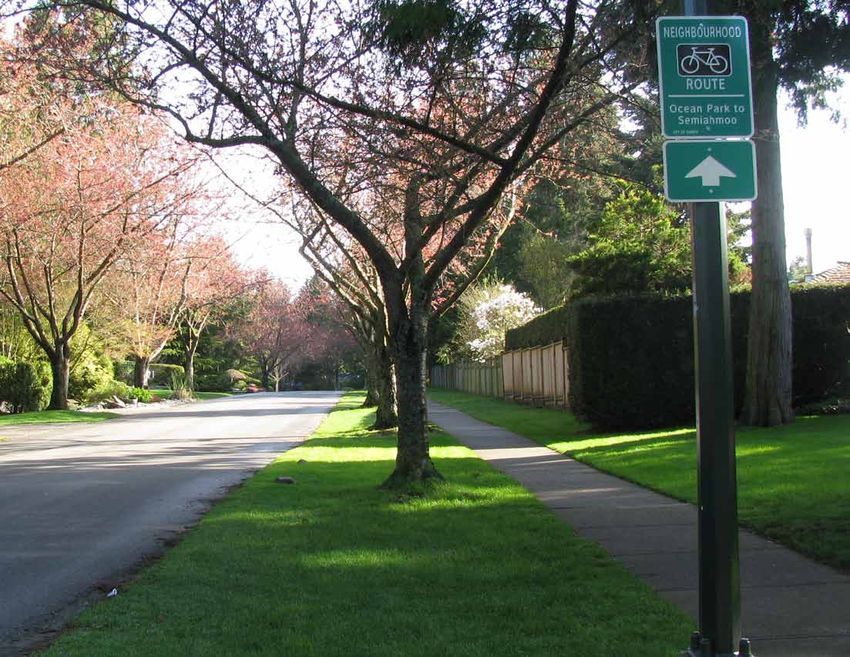
Ocean Park to Semiahmoo. These routes guide cyclists Even though Surrey has many kilometers of bike
through local roads and pathways, with signage and lanes, due to the geographical size of the City plus
pavement markings, avoiding main roads where there the projected growth in residents and employment,
is more traffic volume and speed. there remains a need for much more to be built and
improved. Many bike lanes are not continuous, or you
All collector and arterial roads are planned to have cannot always get to your destination due to missing
bike lanes once they are widened to their ultimate links. This also needs to be supported by expanded
cross-sections. Local roads usually have shared education and promotion efforts to ensure that
[20]
[20] traffic, as they have lower traffic speeds and volumes. this healthy, sustainable, enjoyable and affordable
Greenways (multi-use pathways) are planned along transportation choice is available to as many residents
certain corridors, and connect to each other forming of Surrey as possible.DEVELOPING THE PLAN
Type of facility Definition km built (April 2012)
Bike Lane / Shoulder Dedicated lane for cycling, with or without a curb 205 km
Cycling-Friendly Road Wider travel lane, sharing side-by-side with vehicles 22 km
Shared Use Traffic Lane Regular travel lane, sharing single-file with vehicles 88 km
Local Road and Sidewalk Temporary use of these facilities to connect between two routes 43 km
Greenways Multi-use pathways, usually 3 m to 4 m wide, shared with pedestrians 75 km
Neighbourhood Bike Routes Local roads (low speeds and volume) and pathways, shared with vehicles and/or pedestrians 5 km
TOTAL 438 km
Understanding the influences
Factor Challenges Opportunities
that shape whether people
cycle or not is vital to Big blocks and few direct routes (existing) discourage Growing city creates opportunity for more cycling-friendly
Connectivity
walking and cycling. linkages.
developing strategies to
respond to them. Different Many residential areas were developed in a time when
More mixed-use development, through growth of new planned
geographical areas have Land Use traditional planning placed residential areas far from
areas decreases cycling distances to destinations.
specific challenges and commercial areas.
opportunities, which are key Population is concentrated in a few areas and the gaps Most population is being concentrated in the Town Centres,
to setting targets appropriate Population
between communities usually include barriers like farm with most destinations at a comfortable cycling trip away (less
Density
to each of them. The level land, hills, and rivers/creeks. than 5km).
of cycling is a result of a
Elevation changes and many rivers and creeks create For short trips within the Town Centres, the land is mostly flat,
number of factors that have Topography
physical barriers. with the biggest changes in elevation between them
their own challenges and
opportunities (see Supportive Agricultural The ALR separates some of the hubs of population and ALR is relatively flat with few of intersections and driveways,
Maps in the Appendix). Land Reserve employment, with higher traffic speeds, and making the making it an easier ride with fewer conflicts for cyclists. There
(ALR) distances between neighbourhoods seem larger. is also opportunity for pathways along dykes through the ALR.
Due to availability of funding, permits, properties and The City has built over 400 km of cycling facilities in the past 15
Cycling
right-of-way, many cycling routes are still incomplete or years, and a complete network is planned with over 600 km of
routes
with narrow sections. on-street facilities and 350 km of greenways.
End-of-Trip Currently, there is little availability of bike parking and City and businesses to provide more bike parking at key
[21]
Facilities other end-of-trip facilities. destinations and new developments.DEVELOPING THE PLAN
2.3 HOW CONSULTATION SHAPED THE PLAN
“I believe connectivity is very important, as well as legible
routes - people need to be clear on where they are going.”
“Safety on the roads is a key issue for me
as well as driver awareness of bicycles.”
“I would cycle more if there were connection routes east-west
and north-south across Surrey utilizing parks, transmission line
corridors, etc., where possible to minimize travelling on roads
(unless bike only lanes are present).”
“For me, having a dense network of bike paths, on local roads (not
arterials), located near SkyTrain and major bus routes would be
great! And being able to bring your bike on SkyTrain during peak
hours - even better!”
“I think bicycles can solve transportation and health problems.
Invest heavily and visibly respect this activity - if you build it,
they will come!”
[22]
[22]DEVELOPING THE PLAN
This Plan needed to look at cycling in a The City consulted with numerous
comprehensive and innovative way that was stakeholders, including community
XX Complete and connected
networks of bike routes are
responsive to the issues that deter people associations, business improvement
important
from cycling. It was important that the people associations, cycling advocacy groups, groups
of Surrey and the organizations that have an interested in transportation and environmental
interest in cycling in its broadest sense were sustainability, and other agencies such as XX Availability of safe and secure
given the opportunity to provide input and the School District and Health Authority. A bicycle parking, and a place to
advice. For the Plan to have legitimacy and public online survey was also offered in 2009 shower or change when reaching
ownership by the public and stakeholders, the and the feedback received has been used a destination are key components
to a successful cycling network
consultation followed the approach established throughout this Plan to help develop broad
within the Transportation Strategic Plan of: objectives of the Plan and detailed strategies
and implementation systems. A draft of the
XX Addressing safety concerns,
plan was also presented in an Open House in
XX Seeking out a wide range of poor maintenance, and lack
December 2011.
opinions and views of wayfinding is a significant
incentive to have more people
This Plan makes regular reference to the cycling more often
XX Ensuring that all members of results of the survey as well as specific
the community with different comments and feedback. This is an important
transportation needs were part of the Plan as it shows how the specific XX Celebrating, raising awareness
represented (including youth, initiatives and strategies respond to the issues and promoting cycling are critical
seniors and people with and priorities identified by the residents of elements to get people cycling
disabilities) more
Surrey. Details of the consultation process and
results are provided within the Appendix. Here
are some of the values we heard:
XX Establishing local issues
and priorities
XX Employing a range of consultation
methods
[23]DEVELOPING THE PLAN
2.4 POLICY INTEGRATION
Surrey’s cycling achievements over the last 15 years have set the foundation for a cycling-friendly City. Much
progress has been made in policy development and planning, allocating additional resources, delivering
infrastructure and creating cycling-friendly design standards. However, this work has not, and cannot, take place
in a policy vacuum. It is hugely important that there is comprehensive integration with and support for other City
goals and objectives.
THE TRANSPORTATION STRATEGIC PLAN
This Cycling Plan supports and develops many of the policies and initiatives contained within the Transportation
Strategic Plan (TSP). In doing so, it contributes to the delivery of the overarching economic, social, health-related
and environmental objectives of the City.
[24]
[24]DEVELOPING THE PLAN
Environmental
XX Less pollution and emmissions
XX More efficient use of road space
XX Sustainable (“green”) transportation
Health-Related
XX Healthier individuals
XX More active communities
XX Less stress
XX Reduced obesity
XX Reduced risk of chronic diseases
Economic
XX Reduced fuel costs
XX Reduced road maintenance
XX Delays implementation of expensive road
improvement projects
Social
XX Child and youth-friendly transportation
XX Improved access to transportation for those
unable to use a car
XX Low cost transportation for low income
[25]
individualsDEVELOPING THE PLAN
The TSP is organized around six core principles and some of the examples of how the Cycling Plan helps deliver these are provided below:
TSP Principle cycling plan Action for Change
1. Effective and • Review cycling pavement markings and symbols throughout the city and develop a plan to upgrade them to
Efficient Network current standards.
Management: • Improve the City’s management (planning and maintenance) of our cycling assets through expanded use of GIS.
Efficiently manage, • Identify high use cycling routes, industrial frontages and other priority areas and develop an enhanced level of
maintain and improve the service for sweeping.
transportation system for
all modes.
2. More Travel • Identify barriers and connect missing links, working with interim solutions where the ultimate bike lane is not
Choice: yet achievable.
Promote alternative • Explore opportunities for separated bike lanes in appropriate locations. Separation can be barriers, curbs, parked
and sustainable travel vehicles, painted buffer, boulevard and other innovative solutions.
choice and provide better • Implement Neighbourhood Bike Routes on a number of local roads, complementing the bike lanes on arterial
accessibility to jobs, and collector roads.
education, health and
recreation for all.
3. Safer, Healthier • Investigate and pilot different solutions for intersection treatment and engineering solutions to improve cyclists’ safety.
Communities: • Under the umbrella of the Safe and Active Schools Program, continue to support and sponsor groups that provide
Improve community safety, student skills training to improve cyclist safety, comfort and confidence, as well as bicycle maintenance courses.
health and quality of life. • Work with the local community and cycling groups to identify safety concerns along cycling routes and develop
strategies to reduce the problem (e.g. improved lighting, improved sweeping regimes, vegetation clearance, etc.).
[26]DEVELOPING THE PLAN
TSP Principle cycling plan Action for Change
4. Successful • Work with the Business Improvement Associations (BIAs) to enhance bike end-of-trip facilities in the City Centre and Town
Local Economies: Centres.
Reduce congestion and • Expand the public bike rack program with a target of introducing approximately 10-20 new bike racks a year over the next
support the sustainable several years within the City Centre, Town Centres and public facilities.
economic development • Encourage businesses to provide facilities such as change rooms, showers, lockers and drying racks for employees.
and vitality of Surrey.
5. Protection • Promote complete streets by introducing 1.7-1.8 m wide bike lanes on all arterial and collector roads when widened to their
of Our Built ultimate cross-section, following the City of Surrey Design Criteria Manual and Standard Drawings.
and Natural • Develop and deliver an ongoing bicycle promotion campaign about the benefits of cycling as an enjoyable, healthy and
Environment: inexpensive way to travel.
Reduce the impacts of
transportation on the built
and natural environment.
6. Transportation • Promote cycling connectivity through the development of a finer grid road network, through Neighbourhood Concept Plans
Integration: (NCPs) and new developments.
Promote integration • Continue to partner with other City Departments to ensure cycling facilities are built and cycling is facilitated with new
between transportation developments, projects and policies.
and land use to reduce the • Undertake a comprehensive review of the Zoning By-Law parking standards and requirements for bicycles. Apply them
need to travel and support consistently for all development applications.
trips by more sustainable
modes.
[27]DEVELOPING THE PLAN
SHARED PRIORITIES
The Cycling Plan will be a guide for future investment and
preparation of capital plans, will influence programs and policies,
and will be a resource for the City, for advocacy groups and for
anyone interested in cycling. This Plan is complemented and
supported by other policies and initiatives such as the Transportation
Strategic Plan, Official Community Plan, Sustainability Charter, Child-
and Youth-Friendly City Strategy, Walking Plan, Community Energy
& Emissions Plan, Zoning By-Law and others. Each of these plans
advances cycling in Surrey, as cycling is not the exclusive domain
of one department or delivered by one activity. Implementation of
the Cycling Plan is a city-wide effort and is the responsibility of all
City staff. Collaboration among staff of different departments will
ensure the successful implementation of the policies and programs
contained within the Plan. This Plan will also help to identify where
shared priorities exist and will allow for reduced duplication of effort
as well as increased coordination and greater impact.
Although the City implements many cycling projects and programs,
there are other agencies and levels of government that also have a
role in the expansion of cycling infrastructure. The City will continue
to collaborate with our partners including the RCMP, ICBC, TransLink
and the Provincial and Federal Governments and seek to maximize
the expertise, funding opportunities and programs they provide.
[28]DEVELOPING THE PLAN
2.5 VISION, PRINCIPLES AND OBJECTIVES
Providing
Making Managing & Promoting
Door-to-Door
Connections Maintaining Cycling
Service
the Network
There are four principles in the Cycling Plan, each with three to four objectives. Each objective has its own
Actions for Change that are detailed in the following chapter. The principles and strategic objectives support
the vision for a City:
VISION
XX That is well connected with bike routes, both on- and off-street
XX That is safe and convenient for cyclists of all ages and abilities
XX That has secure bicycle parking in both commercial and residential developments
XX That has easily identifiable and properly maintained bike routes
XX That supports cycling as a realistic transportation choice
XX Where more and more people are cycling
The strategic objectives of this Plan have been developed by integrating the consultation feedback, the
principles contained within the Transportation Strategic Plan and drawing upon the experiences and successes
[29]
both within Surrey and elsewhere.DEVELOPING THE PLAN
Each of the four principles is presented here with its strategic objective, its service objectives (1a, 1b, 1c,...) and the various Actions for Change. The Actions
for Change are also categorized into “New Strategies and Initiatives” and “Ongoing Strategies and Initiatives” for each service objective.
After the summary table for each principle, there are issues and influences for each service objective (1a, 1b, 1c,...), and the background for the Actions for Change.
2. PROVIDING 3. MANAGING
4. PROMOTING
1. MAKING DOOR-TO-DOOR AND
CYCLING
CONNECTIONS SERVICE MAINTAINING
PRINCIPLE THE NETWORK Promote safe cycling
Expand and improve Increase the
as a healthy, fun and
the on-and-off-street availability, quality Keep the network
sustainable way
cycling network and variety of end-of- safe, visible, and in
to travel
trip facilities optimum condition
4.a Provide educational
1.a Develop a finer and 2.a Ensure there is 3.a Install adequate
resources and
more complete network more provision of secure signage and pavement
information to support
of on- and off-street public bike parking at markings for cycling
efficient, safe and
cycling routes popular destinations routes
enjoyable cycling
1.b Increase the 3.b Develop a
2.b Ensure 4.b Support others who
contribution of local wayfinding program for
developments are promote cycling
roads to the cycling both on- and off- street
cycling-friendly in Surrey
network cycling routes
OBJECTIVES
1.c Promote integration
of City policies and 2.c Increase bike 3.c Enhance
end-of-trip support 4.c Celebrate cycling
practices to identify and maintenance programs
at transit facilities in Surrey
deliver City-wide shared for cycling facilities
priorities
1.d Work with other
4.d Encourage safe
municipalities and 3.d Provide special
behaviour and mutual
senior governments to treatment for cyclists at
respect among drivers,
improve connectivity vulnerable locations
pedestrians and cyclists
within the region
[30]DEVELOPING THE PLAN
[31]SHIFTING GEARS: MAKING CONNECTIONS
With over 70 actions for change,
this plan looks at cycling in a
comprehensive and innovative way.
[32]
[32]SHIFTING GEARS: MAKING CONNECTIONS
[33]
PART 3 SHIFTING GEARSSHIFTING GEARS: MAKING CONNECTIONS
PRINCIPLE 1
MAKING CONNECTIONS
STRATEGIC OBJECTIVE 1: EXPAND AND IMPROVE THE
ON- AND OFF-STREET CYCLING NETWORK
Complete and
connected routes
are important...
[34]
[34]SHIFTING GEARS: MAKING CONNECTIONS
Investment
Objective Action for Change
of Resources
Identify barriers and connect missing links, working with interim solutions where the ultimate bike lane is not yet
Existing
New Strategies and Initiatives
1.a Develop a achievable.
finer and more
complete net- New Strategies Implement demonstration and pilot projects, such as weekend special events and consider temporary road closures. Additional
work of on- and and Initiatives
Conduct cycling audits of road projects to ensure safety, operation and connectivity for cyclists, and seek upgrades to
off-street cycling existing facilities within the scope of the project.
Existing
routes
Incorporate into the City of Surrey Design Criteria Manual and Standard Drawings improved cycling measures, like
Existing
bike push buttons, bike boxes, and coloured pavement.
Explore opportunities for separated bike lanes in appropriate locations. Separation can be barriers, curbs, parked
Existing
vehicles, painted buffer, boulevard and other innovative solutions.
Expand on-street cycling route network to priority destinations, using the main roads system (arterial and collector
Existing
roads).
Ongoing Strategies and Initiatives
Expand off-street cycling route network as part of the Greenways Network, using BC Hydro / FortisBC corridors
Existing
(Greenways Plan).
Ongoing Strategies
Promote complete streets by introducing 1.7-1.8 m wide bike lanes on all arterial and collector roads when widened to
and Initiatives
Existing
their ultimate cross-section, following the City of Surrey Design Criteria Manual and Standard Drawings.
Promote cycling connectivity through the development of a finer grid road network, through Neighbourhood Concept
Existing
Plans (NCPs) and new developments.
Develop a public consultation strategy regarding the implementation of cycling projects within existing neighbour-
hoods and undertake an appropriate level of public consultation prior to each construction project in the preliminary Existing
stages of project planning.
Continue to invest in off-street facilities (Greenways Network), seeking partnership and funding opportunities to
Existing
facilitate projects.
[35]SHIFTING GEARS: MAKING CONNECTIONS
Investment
Objective Action for Change
of Resources
New Strategies
and Initiatives
1.b Increase the Implement Neighbourhood Bike Routes on a number of local roads, complementing the bike lanes on arterial and
Additional
collector roads.
contribution of
local roads to the
cycling network
Provide connections between new and existing roads to improve cycling connectivity. Additional
Investment
Objective Action for Change
of Resources
New Strategies
and Initiatives
1.c Promote Promote cycling through the application of a sustainability checklist for new developments. Existing
integration of
City policies
and practices Coordinate pedestrian, cycling and transit facility budgets to maximize the efficiency of available funding and to give
Existing
to identify and added value to projects.
deliver City-wide
shared priorities
Ensure cycling is considered in new City policies and documents, and jointly implement actions and efforts. Existing
Ongoing Strategies
and Initiatives
Coordinate with the Greenways Plan and the Walking Plan to continue developing the Greenway Network, including
Additional
road crossing improvements.
Continue to partner with other City Departments to ensure cycling facilities are built and cycling is facilitated with
Existing
new developments, projects and policies.
Investment
Objective Action for Change
of Resources
New Strategies
Partner with TransLink, other organizations, and other municipalities to promote and implement the Regional Cycling
and Initiatives
1.d Work Existing
Strategy for Metro Vancouver.
with other
municipalities
and senior Advocate for TransLink to investigate ways to facilitate the bicycle-transit interaction, connecting transit facilities to
Existing
governments the Bike Network.
to improve
connectivity
and Initiatives
within the region Identify and maximize funding opportunities and grants to cost-share cycling infrastructure. Existing
Strategies
Ongoing
[36]
Collaborate and partner with various agencies to coordinate cycling connections with neighbouring municipalities. ExistingSHIFTING GEARS: MAKING CONNECTIONS
[37]SHIFTING GEARS: MAKING CONNECTIONS
OBJECTIVE 1A: Develop a finer and more complete
network of on- and off-street cycling routes
Issues and Influences
XX 73% of the public prefer / accept “bike lanes on busier streets” for the on-street Bike Network, and more than half of
them prefer not having parked cars next to the bike lane
XX 89% of the public have “off-street paths” as their preferred / accepted cycling facility
XX 85% of the public say that “more off-street paths” are likely to make them bike more
XX About 12% of the public don’t have regular access to a car
XX New road standards were adopted in 2010, and are included in the City of Surrey Design Criteria Manual and Standard
Drawings
• New Standard: 1.8 m wide bike lanes on arterial roads and 1.7 m or 1.8 m wide bike lanes
on collector roads
• Previous Standard: 1.3 m wide bike lanes on arterial roads and 1.5 m wide bike lanes on
collector roads
XX City currently cost-shares projects with TransLink, Provincial and Federal governments
XX Walking and cycling pathways are the most used and most requested park features
XX 72 km of a planned 350 km network of multi-use pathways have been constructed (approximately 20% built)
XX All Neighbourhood Concept Plans (NCPs) include a plan for cycling connectivity
XX The Transportation Association of Canada (TAC) has recently reviewed the Bikeway Traffic Control Guidelines for
Canada, which provides standards for signage and pavement markings for on-street cycling facilities.
Comments from the 2009 Walking and Cycling Survey:
XX “It feels to me that the network of bike lanes is disjointed”
XX “We need more direct routes to major destinations rather than having to zigzag around different side streets”
XX “I would cycle more if there were connected routes east-west and north-south across Surrey utilizing parks,
[38]
[38]
transmission line corridors, etc., where possible to minimize travelling on roads”Surrey’s future as a cycling-friendly City has sound In partnership with the Parks, Recreation and Work is underway to make the existing road
SHIFTING GEARS: MAKING CONNECTIONS
foundations. Cycling has great potential in Surrey Culture Department, the Engineering Department system more bicycle accessible. The City has made
as 25% of all trips are less than 3 km and 45% are plans and invests in multi-use pathways throughout significant progress with respect to street design
less than 5 km (2009 Walking and Cycling Survey). the City, as part of the Greenways Network. Over and consideration for cyclists with, for example, the
As more on- and off-street cycling improvements 70 km of the off-street network have been built over creation of new road cross-sections for arterial and
are made, it will become increasingly convenient for the last 15 years and the City has been successful collector roads to allow for wider bike lanes (1.8 m
Surrey residents to use bicycles for many more of in doubling or tripling the budget available for some for arterial roads and 1.7 m-1.8 m for collector roads).
these short trips. projects through funding partnerships. For instance, The City undertakes major construction projects
by cost-sharing with the Provincial and Federal every year including re-paving, road widenings and
Bike lanes are built as part of new and widened governments Surrey was able to build an additional new bridges that include cycling infrastructure. The
arterial and collector roads. Interim cross-sections $10.75 million worth of cycling infrastructure in planning process for new projects helps ensure full
are sometimes modified to allow for bike lanes 2010/2011 including two signature cycling and consideration is given to cycling and improvements
through restriping, interim widenings and space pedestrian crossings of Highway #1 and Highway are incorporated into the design.
realocation. While recognizing that bike lanes on #99. The new Greenways Plan explores more details
busier roads may not be preferred by all cyclists, and actions specific for greenways.
it is important to provide this infrastructure in the
context of a geographically large mixed urban /
suburban / rural municipality. The lacking of a finer
grid road network, in many locations, makes the
main road the only possible route to get across a
certain area. On-street bike lanes are also a cost-
effective way of delivering considerable expansion
to the Cycling Network. This approach gives the City
the flexibility, as cycling continues to increase, to go
back to the higher usage locations and improve the
infrastructure.
[39]For the growing network of off-street routes,
SHIFTING GEARS: MAKING CONNECTIONS
there is a need to secure significant amounts ACTION FOR CHANGE
of property which is acquired either through
Expand on-street cycling route network to priority destinations, using the main roads system (arterial and
negotiated purchase or through dedication as
collector roads).
part of new development. This often means that
a piecemeal development of the network occurs. Expand off-street cycling route network as part of the Greenways Network, using BC Hydro / FortisBC
Establishing interim routes and connections is corridors (Greenways Plan).
therefore an important part of the development of
the ultimate network. Promote complete streets by introducing 1.7-1.8 m wide bike lanes on all arterial and collector roads when
widened to their ultimate cross-section, following the City of Surrey Design Criteria Manual and Standard
New infrastructure in new neighbourhoods Drawings.
are usually well received, but on existing
neighbourhoods, there is often opposition to Identify barriers and connect missing links, working with interim solutions where the ultimate bike lane
change happening in the neighbourhood, and is not yet achievable.
public involvement and consultation in the
preliminary stages of cycling projects are important Promote cycling connectivity through the development of a finer grid road network, through Neighbourhood
to raise awareness of value and opportunity for Concept Plans (NCPs) and new developments.
cycling growth, and provides opportunity to modify
Develop a public consultation strategy regarding the implementation of cycling projects within existing
the project and address residents’ concerns.
neighbourhoods and undertake an appropriate level of public consultation prior to each construction
Temporary (seasonal) demostration projects, special
project in the preliminary stages of project planning.
events and pilot projects for innovative cycling
treatments should also be considered to enhance Continue to invest in off-street facilities (Greenways Network), seeking partnership and funding opportunities
the bike network. to facilitate projects.
Implement demonstration and pilot projects, such as weekend special events and consider
temporary road closures.
Conduct cycling audits of road projects to ensure safety, operation and connectivity for cyclists,
and seek upgrades to existing facilities within the scope of the project.
Incorporate into the City of Surrey Design Criteria Manual and Standard Drawings improved cycling
measures, like bike push buttons, bike boxes, and coloured pavement.
Explore opportunities for separated bike lanes in appropriate locations. Separation can be barriers, curbs,
parked vehicles, painted buffer, boulevard and other innovative solutions.
[40]SHIFTING GEARS: MAKING CONNECTIONS
[41]SHIFTING GEARS: MAKING CONNECTIONS
OBJECTIVE 1B: Increase the contribution
of local roads to the cycling network
Issues and Influences
XX Inconsiderate drivers and fear of traffic volume and speed are the top two cycling deterrents (online
survey, 2009)
XX Conflicts with vehicles are a concern to many cyclists when sharing the road
XX 74% of the public say that they would bike more if there were more cycling routes on local streets
XX 41% of the population are “interested in cycling, but concerned”, and they are more likely to use routes
with less vehicle traffic and lower speeds
Comments from the 2009 Walking and Cycling Survey:
XX “Try to put cycling routes on streets that follow major routes but not actually on major routes around
the neighbourhood”
[42]Local roads do not usually require a dedicated bike lane or shoulder for
SHIFTING GEARS: MAKING CONNECTIONS
cyclists, as traffic volume and speed are low enough to share the road ACTION FOR CHANGE
between drivers and cyclists. Local roads provide important connections
into neighbourhoods and also provide an alternative route for the less
Implement Neighbourhood Bike Routes on a number of local roads,
confident or inexperienced cyclist (41% of the population). Children and
complementing the bike lanes on arterial and collector roads.
seniors usually feel more comfortable cycling on the local roads, where
there is less traffic and speeds are lower. These connections can also be
considered entry-level cycling facilities, and as confidence increases, Provide connections between new and existing roads to improve cycling
cyclists are able to move to busier, and often more direct, routes. connectivity.
Walkways between roads and cul-de-sacs are an important addition to
the local road connections. They help shorten distances by providing
more direct, connected routes through the neighbourhood. Investment
in pathways and road connections will continue to be made by the City
and will be built according to funding availability and site conditions.
Information on how to get around on local roads and their connectivity
to main roads in the network will be developed through a Neighbourhood
Bike Route routes program. Other measures will include signage to help
guide cyclists through local roads, treatments to help cross busier roads,
and an education and awareness component aimed at improving mutual
respect between drivers and cyclists sharing the road on these routes.
[43]SHIFTING GEARS: MAKING CONNECTIONS
OBJECTIVE 1C: Promote integration of
City policies and practices to identify and
deliver city-wide shared priorities
Issues and Influences
XX The Transportation Strategic Plan adopted in 2008 sets the vision and goals for transportation,
including the need for a new Cycling Plan
XX City policies that influence and support cycling policies and practices: Official Community Plan (OCP),
Zoning By-Law, Sustainability Charter, Child- and Youth-Friendly City Strategy, Walking Plan, and others
XX Many advocacy groups (Hub – former VACC Vancouver Area Cycling Coalition, BEST – Better
Environmentally Sound Transportation, and others) and cycling enthusiasts are involved in cycling
planning and discussion of specific projects with the City
[44]With the completion of the Transportation Strategic Plan (TSP), the
SHIFTING GEARS: MAKING CONNECTIONS
Sustainability Charter, the Child- and Youth-Friendly City Strategy, the Official
Community Plan (OCP), a new Road Classification map, and the Walking Plan,
effort has been made to integrate this Cycling Plan with these documents, and
complement them allowing different City Departments and stakeholders to work
together to ensure cycling issues are addressed.
Regular road widening projects, development applications and repaving
projects also provide opportunities to introduce interim or permanent cycling
routes.
ACTION FOR CHANGE
Promote cycling through the application of a sustainability checklist for
new developments.
Coordinate pedestrian, cycling and transit facilities’ budgets to maximize
the efficiency of available funding and to give added value to projects.
Ensure cycling is considered in new City policies and documents, and
jointly implement actions and efforts.
Coordinate with the Greenways Plan and the Walking Plan to
continue developing the Greenway Network, including road crossing
improvements.
Continue to partner with other City Departments to ensure cycling
facilities are built and cycling is made easier with new developments,
projects and policies.
[45]SHIFTING GEARS: MAKING CONNECTIONS
OBJECTIVE 1D: Work with other
municipalities and senior governments to
improve connectivity within the region
Issues and Influences
XX The City has taken advantage of TransLink’s yearly Bicycle Infrastructure Capital Cost-Sharing (BICCS)
Program since it started in 2001
XX Other agencies (Metro Vancouver, Ministry of Transportation and Infrastructure, Ministry of Community
Development, etc.) offer programs that Surrey uses to maximize funding available for cycling
XX In 2009 the City secured funding with the Provincial and Federal governments to build $10.75 million of
cycling infrastructure
XX The City participates in the regional Bicycle Subcommittee with TransLink and other municipalities in
the region to discuss cycling. There are approximately 10 meetings a year.
[46]You can also read


