Derivatives Quarterly - May 2021 - Frontier Advisors
←
→
Page content transcription
If your browser does not render page correctly, please read the page content below

Derivatives
Quarterly

May 2021

Introduction

This quarterly publication highlights a range of derivative strategies suitable for institutional investors.
While the focus will be on equity market protection, we will also highlight other more topical ideas. For
example, in this issue we discuss a range of strategies which offer protection against higher inflation.

The strategies highlighted can be considered for a range of applications – dynamic asset allocation,
equity replacement, or downside protection. We provide an overview of each strategy and highlight key
considerations for each.

We cover three types of strategy.

Direct equity hedges… p. 2

Equity options can offer direct protection against both strength and weakness in the underlying index
and are the standard way of implementing an equity hedge.

Indirect equity hedges… p. 6

These strategies aim to protect against equity market weakness by using derivatives on related asset
classes rather than the underlying equity index.

Inflation hedges… p. 10

Loose monetary policy across the globe has ignited fears of inflation and the associated risk it presents
to real returns. We consider three potential inflation hedges: breakeven inflation swaps, interest rate
steepeners, and commodities.

We provide high level outlines of the strategies only. In some places we have included additional transactional detail, however, this is
for illustrative purposes only. Actual transaction details will vary with objectives, constraints and market conditions. The trades
discussed are not meant as recommendations.

                        Derivatives Quarterly                                1
Direct equity hedges

Equity options can offer direct protection against both a rising or falling equity market. While options are commonly used to protect against market falls they can also
be used to protect against a rising market for those investors underweight equities. Similarly, they can be used to take a directional view on equity markets without
the need to transact in the +underlying physical equity allocation.

Key considerations when determining a suitable strategy include strike/moneyness, tenor and costs. We provide an overview of three different option strategies that
may be suitable for providing portfolio protection in either a rising or falling equity market. The charts in the following pages are based on pricing as at 30/4/21.

Strategy                           Scenario                      Objective              Rationale                                Trade example

A. Replace underlying equity       Portfolio is overweight       Strategy protects      Current call pricing is attractive       Sell the underlying equity exposure and
exposure by buying equity          equities                      against an equity      relative to put pricing.                 purchase an equal notional of 105
index calls                                                      market sell off.                                                index calls

B. Buying index calls and          Portfolio is underweight      Strategy protects      The calls provide upside participation   Buy 105 calls and sell an equal notional
selling OTM index puts             equities                      against an equity      while the sold puts reduce the overall   of 85 Puts
                                                                 market rally.          cost of the structure.

C. Buying index put spreads        Portfolio is overweight or    Strategy protects      Selling shorter-dated maturities has     Buy a 95%/85% put spread or put
and selling OTM index calls        long equities                 against an equity      historically been attractive due to a    spread collar (i.e., buy a 95%/85% put
                                                                 market sell off.       higher volatility premium relative to    spread and sell a out-of-the-money
                                                                                        longer-dated maturities.                 call).

                                                                                        The long put spread cost is reduced      *For peer-aware investors, Frontier
                                                                                        by selling the upside call option.       prefers not to sell OTM calls

                       Derivatives Quarterly                              2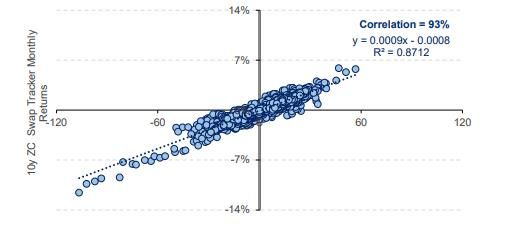
Strategy A. Replacing underlying equities by buying equity index calls
Performance of option structure which outperforms long equities for large market moves up and down

             0.7%
             0.6%
             0.5%
             0.4%
Net return

             0.3%
                                                                                                                                            Alternative strategy: Long equities
             0.2%                                                                                                                           1%
                                                                                                                                            1% less Equities, L 105C (Jul-27)
             0.1%
             0.0%                                                                                                                           1% less Equities, L 105C (Aug-26)
             -0.1%
             -0.2%
             -0.3%
                  -20%   -15%           -10%           -5%               0%          5%            10%         15%             20%
                                                               % change in S&P
Source: Frontier

Option strategy                      Time dimension                       Alternative strategy           Option payoffs                       Considerations

Reducing underlying equity           Outperforms alternative strategy     Add 1% more equity exposure.   Strategy underperforms on the        This option strategy performs
exposure and purchasing July         (keeping equity allocation                                          downside until the market has        well in a scenario where the
2021 expiry 105% SPX 500             unchanged) with larger market                                       fallen more than -7%.                market moves are more than 7%
calls.                               moves in either direction.                                                                               up/down.
                                                                                                         Strategy underperforms on the
Client wanting downside              Size of market move required for                                    upside until the market has          This strategy would suit an
protection for potential equity      outperformance is bigger for                                        rallied more than 7%.                investor that is concerned about
market sell off.                     expiries further into the future.                                                                        large market moves in either
                                                                                                         Note, the longer the expiry, the     direction, with slightly better
                                                                                                         larger the move required to          protection on the downside.
                                                                                                         outperform long 1% equities.

                         Derivatives Quarterly                                3
Strategy B. Buying index calls and selling OTM index puts*
Performance of option structure with increased upside potential relative to long equities
0.7%
0.6%
0.5%
0.4%
Net return
0.3%
Alt strategy: Long equities 1%
0.2%
Long 105C, Short 85P (Jul-27)
0.1%
Long 105C, Short 85P (Aug-26)
0.0%
Long 105C, Short 85P (Nov-24)
-0.1%
-0.2%
-0.3%
-20% -15% -10% -5% 0% 5% 10% 15% 20%
% change in S&P
Source: Frontier
Option strategy Time dimension Alternative strategy Option payoffs Considerations
Buying 105 SPX 500 calls v Performs best if market rallies in 1% increase in underlying equity Strategy underperforms on the This strategy would suit an
selling 85 SPX 500 puts. Both the near term as a smaller portfolio. downside until the market has investor that is concerned about
have August 2021 expiry market rally is required before fallen more than -14%. a near term market rally in the
option outperforms. near term. Longer-dated expiries
Client wanting upside protection Strategy underperforms on the require larger market moves to
for potential equity market rally, if Size of market move required upside until the market has outperform.
underlying portfolio already for outperformance is bigger rallied more than 7%.
positioned for a weak equity for expiries further into the future.
market
* OTM index put – Out of the money index put, i.e., An option which at the present time would not yield a return as the strike price is below the current level of the
underlying index.
Derivatives Quarterly 4Strategy C. Buying index put spreads and selling OTM index calls**
Performance of defensive option structure with lower loss potential for upside market moves
0.3%
0.2%
0.1%
Net return
Alternative strategy: Short equities
0.0% 1%
Long 9585PS, Short 115C (Jul-27)
-0.1%
Long 9585PS, Short 115C (Aug-26)
-0.2%
-0.3%
-20% -15% -10% -5% 0% 5% 10% 15% 20%
% change in S&P
Source: Frontier
Option strategy Time dimension Alternative strategy Option payoffs Considerations
95/85 put spread with cost Performs best if market Decrease equity weighting by Strategy underperformance This strategy would suit an
reduced by the sale of a 115 call, falls in the near term as a 1% to the underlying portfolio. depends on when market moves investor that is concerned about
both with Aug 2021 expiry. smaller market move is required occur. On the downside, this is a material market sell off. While
before option outperforms. not until the market has fallen the strategy will perform poorly in
Client wanting downside more than -10%. a market rally, it will outperform
protection for potential equity Size of market move relative to the alternative strategy
market sell off but with reduced required for outperformance is Strategy outperforms on the (short equities).
cost. bigger for expiries further into upside until the market has
the future. rallied more than 17%.
** OTM index call – Out of the money index call, i.e., An option which at the present time would not yield a return as the strike price is above the current level of the
underlying index.
Put spread – strategy involves buying one put spread and selling another put spread with different strikes.
Derivatives Quarterly 5Indirect equity hedges
Costs are a key consideration for any downside protection strategy. Indirect hedging – using derivatives on one asset to hedge another (e.g., equities) – is one way of
managing costs. While indirect hedges can provide more effective hedging, they also introduce a degree of basis risk.
Key considerations when determining a suitable hedge include, but are not limited to, the relationship between assets, cost, and basis risk. We consider several
indirect hedges for providing portfolio protection from a falling equity market environment.
Strategy Scenario Objective Rationale Trade example Risk
A. AUDJPY currency Portfolio is long Strategy protects Options on the Australian dollar Purchase an AUDJPY put Equities fall without a
options equities. against an equity Japanese Yen cross are priced at a option. similar move in AUDJPY.
market sell off. discount to equity options. Historically,
holding AUDJPY put options has
profited when equity markets fall.
B. Interest rate Portfolio is long Strategy protects A payer swaption is a more direct Purchase a payer Falling equities are
swaptions equities and is against an hedge for a higher interest rate swaption. caused by something
sensitive to increase in rates. environment, which could cause equity other than higher rates.
increasing interest markets to fall.
rates.
C. VIX options Portfolio is long Strategy protects Strategy profits when volatility Purchase a VIX option. Equities fall but volatility
equities. against an equity increases. is unchanged. E.g., a
market sell off. long slow equity market
decline.
Derivatives Quarterly 6Currency options
Buying ATM AUDJPY put option
AUDJPY ATMF put options premium % AUDJPY vol vs ASX 200 vol
20% 0.7
18%
0.6
16%
14% 0.5
12%
0.4
10%
8% 0.3
6% 0.2
4%
0.1
2%
0% 0
1999
2000
2001
2002
2003
2004
2005
2006
2007
2008
2009
2010
2011
2012
2013
2014
2015
2016
2017
2018
2019
2020
Source: Frontier Source: Frontier ASX vol AUDJPY vol
Indirect hedge strategy Alternative strategy Option payoffs Considerations
Buying ATM AUDJPY put option May Decrease in underlying equity portfolio Strategy begins to perform when This strategy would suit an investor
2022 expiry (ie. 12mths). or purchase an ASX 1yr put option. AUDJPY sells off from current levels. that is concerned about a near term
market sell off.
Client wanting downside protection for Strategy underperforms if currency
potential equity market sell off, if rallies, however, loss is limited to the There is basis risk between the
underlying portfolio already positioned premium cost. magnitude of the fall between
for a strong equity market. AUDJPY and ASX, ie. the ASX may
experience a large drawdown and the
AUDJPY is unchanged.
Derivatives Quarterly 7Swaptions
Buying a payer swaption and holding physical bonds
1y10y ATM payer swaption
15.00%
10.00%
5.00%
0.00%
-5.00%
-10.00%
100 150 200 250 300
1y10y Rates (bp)
Bond Bond + Carry Payer + Bond+ Carry
Source: Frontier
Indirect hedge strategy Alternative strategy Option payoffs Considerations
Buying 1y10y ATM payer swaption. Decrease in underlying equity portfolio (or Yields need to move substantially from This strategy would suit an investor that is
bond holdings). current yields before options or swaptions concerned about a near term rise in
Client wanting downside protection for breakeven, with 1y10y swaption needing a interest rate yields.
potential equity market sell off from a rise Worth noting that reducing exposure in ~32bp sell off before an at-the-money
in interest rate yields, if underlying portfolio either equity or bond holdings will forego swaption would be in-the-money. Holding the underlying bond will earn yield
already positioned for a strong equity potential returns. income and carry which is additive to any
market. potential capital gains from duration
movement (i.e. prices higher, yields lower).
This strategy would also protect the bond
holdings within a portfolio from higher This additional income can potentially
yields. insulate the portfolio from a small sell off in
interest rates (i.e. prices lower, yields
higher).
Derivatives Quarterly 8Implementation options for the VIX
The VIX is a tradable ‘fear index’ on the S&P 500 index
VIX index 3 month ATM VIX call option volatility
70 1.6
60 1.4
50 1.2
40 1
30 0.8
20 0.6
10 0.4
0 0.2
0
2010 2011 2012 2013 2014 2015 2016 2017 2018 2019 2020
Source: Frontier Source: Frontier
Indirect hedge Return profile in equity drawdown Considerations
VIX futures VIX usually rises when equities fall with material VIX can also retrace very quickly, and so active monetisation decisions should be considered.
rises observed in deep market stresses.
Futures can be an effective and efficient monetisation tool, as futures are generally more liquid than
options.
Call options on This strategy profits when the VIX rises but only The options market is becoming more liquid. As with any option, consideration needs to be given to the
the VIX loses the premium if the VIX falls. strike and maturity of the options. Roll risk can be managed by using a staggered maturity approach.
Given volatility pricing remains elevated post COVID-19, one way to cheapen the outright VIX calls is to
sell VIX puts to finance the purchase of these calls. Not only does this add to a long VIX delta profile, it
also reduces the cost of the trade at inception.
Derivatives Quarterly 9Inflation hedges
Loose monetary policy across the globe has ignited fears of inflation and the associated risk to real returns. We consider several inflation hedges that can provide
portfolio protection in a rising inflationary environment.
For a more detailed discussion of inflation hedging using inflation linked bonds and inflation linked swaps see our paper, Hedging against unexpected inflation rises.
The paper can be found at https://www.frontieradvisors.com.au/hedging-against-inflation/
Strategy Scenario Objective Rationale Trade example
A. Inflation linked Portfolio is sensitive to Strategy protects Inflation swaps are positively correlated with changes Buy a US 10y breakeven inflation
swaps higher inflation. against higher in inflation expectations with returns based on CPI swap, (pay fixed and receive
inflation. outcomes. inflation).
B. Interest rate Portfolio is sensitive to Strategy protects Long term yields can rise more than shorter term Enter a 2s10s interest rate
curve steepener higher inflation. against higher yields as the market prices in the future rate hikes steepener, (receive 2yr and pay
inflation. needed to control inflation. 10yr).
C. Long energy Portfolio is sensitive to Strategy protects Higher inflation is often associated with higher Buy a basket of energy commodities
commodities higher inflation. against higher commodity prices. A long commodity exposure can via a long only derivative structure.
basket inflation. outperform during periods of higher inflation.
Derivatives Quarterly 10Inflation linked swaps
Buy US 10yr breakeven inflation swap
Breakeven inflation swap rates US 10yr breakeven inflation correlation with inflation expectations
3.5
3
2.5
2
1.5
1
0.5
0
2011 2012 2013 2014 2015 2016 2017 2018 2019 2020
US 10yr breakeven AU 10yr breakeven
Source: Frontier Source: Citibank
Inflation hedge Return profile in rising inflation Considerations
Buy a US 10y breakeven inflation swap. A breakeven inflation swaps can provide investors with The US inflation market is considerably more liquid than
inflation protection, as the swap returns are closely the Australian inflation market, providing an alternative
A breakeven inflation swap is a derivative in which a fixed aligned with underlying inflation outcomes. implementation option for investors. While more liquid, US
rate payment on a notional amount is exchanged for a inflation swaps will create basis risk against Australian
payment at the rate of inflation, providing the buyer of the Breakeven inflation rates have been rising with the inflation expectations or outcomes.
swap with implicit inflation protection. broader recovery in risk assets, with inflation expectations
rising faster than nominal yields leading to extremely low
real yields.
Derivatives Quarterly 11Interest rate steepener
Long 2s10s swap curve steepener
AU & US interest rate swap curves US 2s10s swap curve & 10yr breakeven rates
140
3 300
120
100 2.5 250
80 200
2
60 150
1.5
40 100
20 1
50
0 0.5 0
-20
0 -50
2016 2016 2016 2017 2017 2018 2018 2019 2019 2019 2020 2020 2021
2011 2012 2013 2014 2015 2016 2017 2018 2019 2020
AUD 2Y 10Y USD 2Y 10Y
10yr US breakeven (rhs) 2s10s US swap rates (bps) (lhs)
Source: Frontier Source: Frontier
Inflation hedge Return profile in rising inflation Considerations
Enter a 2s10s interest rate steepener, where the With short term interest rates anchored by central bank This strategy has basis risk between inflation
investor receives 2yr yields and pays 10yr yields. monetary policy, interest rate curves have been expectations and central bank policy.
steepening with the broader recovery in risk assets due
Central banks have communicated that interest rates will to the positive rollout of vaccines and slowdown in new With central banks using yield curve control as a form of
remain low for several years, with the view that inflation COVID-19 cases. monetary policy, the demand of long end bonds remains
needs to overshoot before there would be any reason to strong and this could be a headwind towards longer end
raise short term interest rates because of inflationary As the market becomes more sensitive to higher inflation yields rising further from here without higher realised
concerns. expectations, longer term yields have been rising higher inflation.
than shorter term yields due to accommodative central
bank policy. If central banks become less accommodative and begin
to signal a change to monetary policy around short term
interest rates (either yield curve control or increasing
cash rates), the 2s10s yield curve could flatten
considerably.
Derivatives Quarterly 12Commodity strategy
Long a basket of energy commodities via a derivative strategy
Commodities strong correlation with rising inflation 12-month commodity return vs inflation rate change
250 6
4
5 y = 0.0371x + 0.0704
200 4 R² = 0.412 2
3
0
150
2 -150 -100 -50 0 50 100
1 -2
100
0
-4
50 -1
-2 -6
0 -3
-8
BCOM Index US CPI YOY Index -10
Source: Frontier Source: Frontier, Bloomberg Commodity Index vs US CPI YoY
Inflation hedge Return profile in rising inflation Considerations
Buy a basket of energy commodities via a long-only Energy commodities have a strong correlation with rising The strategy is positively exposed to rising energy prices. The
derivative structure. inflation environments outperforming during periods of strategy will have basis risk, however, with price movements
higher inflation. between energy commodities and inflation potentially diverging
Commodities can be a diversifier for equities and over different time horizons. i.e., Certain commodities prices
bonds during periods of higher inflation. may be impacted by demand/supply factors, which may cause
a divergence from the rate of inflation.
Derivatives Quarterly 13Alternatives and derivatives research team
Frontier has been advising clients on the use of options since 2014. We have advised defined
contribution, defined benefit and insurance clients and have worked with various option
implementation managers.
Frontier advises clients on a range of derivative issues including:
• overlay manager selection,
• strategy selection,
• structuring, and
• monetisation.
If you or your fund are interested in derivatives, particularly to manage risk, Frontier can assist.
Please reach out to a consultant or to a member of the Alternatives and Derivatives Team.
Alternatives and Derivatives Team members:
Scott Pappas – Principal Consultant
James Bulfin – Senior Consultant
Joe Clark – Senior Consultant
Iain McMahon – Senior Consultant
Claire Casucci - Consultant
Donna Davis - Associate
Derivatives Quarterly 14Level 17, 130 Lonsdale Street Melbourne, Victoria 3000 Tel: +61 3 8648 4300 frontieradvisors.com.au @frontier_adv Disclaimer: Frontier Advisors Pty Ltd ABN 21 074 287 406 AFS Licence No. 241266 The information contained in this presentation is current as at the date of preparation, but may be subject to change. The information contained in this presentation is intended as general commentary and should not be regarded as financial, legal or other advice. This presentation has been prepared without taking into account your objectives, financial situation or needs. You should consider this presentation in light of these matters. Should you require specific advice on the topics or areas discussed please contact the presenter directly or an appropriate advisor. This presentation may contain forward-looking statements. These are not facts, rather, these forward-looking statements are based on the current beliefs, assumptions, expectations, estimates, and projections of Frontier Advisors Pty Ltd about the business, the industry and the markets in which we operate. Past performance is not a reliable indicator of future performance. Frontier Advisors Pty Ltd makes no representation or warranty that any of the information contained in this presentation is accurate or complete. To the maximum extent permitted by law, Frontier Advisors Pty Ltd does not accept any liability for loss arising from any reliance placed on the use of this presentation including the information contained within it. The contents of this presentation are confidential and must not be disclosed to any third party without our written consent. This presentation must not be copied, reproduced or distributed without the written consent of Frontier Advisors Pty Ltd. Frontier Advisors Pty Ltd does not provide taxation advice and you should seek your own independent taxation advice from a registered tax agent.
You can also read


