Designing Motion Comic About Information of Indonesian's Traditional Medicine (Case Study: Djammoe)
←
→
Page content transcription
If your browser does not render page correctly, please read the page content below
Designing Motion Comic About Information of Indonesian’s
Traditional Medicine (Case Study: Djammoe)

                Y Satrio1* and A Zulkarnain2
                  Visual Communication Design Department, Faculty of Design, Universitas Pelita Harapan,
                1,2

                Jl.MH. Thamrin Boulevard Lippo Village 1100, Tangerang 15810, Indonesia

                *
                 E-mail: yasminsatrio96@gmail.com

                Abstract. Jamu is an Indonesian traditional health beverage, but among young people, it is
                deemed out-of-date and a drink for old people. These images take form because young people
                only get minimal exposure to jamu and because there are modern beverages that they prefer. In
                this project, the theme of information about jamu will be presented in the form of a digital comic,
                because the interest in reading textbooks among young people has been gradually diminishing
                and they prefer reading entertainment books, such as comic books. This project uses a literature
                study. The literature study is conducted to get information about the theme and the design theories
                that are going to help with the process of designing the project. The final product of this project
                is a motion comic. Visual research study and keywords are adjusted to the target audience of this
                project. The result of the research is used as a guide in the whole process of making the digital
                comic, from the pre-production to the post-production process. This paper focuses on discussing
                the application of several design theories in the motion comic project.

                Keywords. Health, Traditional, Jamu, Young People, Digital Comic

1. Introduction
Jamu according to the National Agency of Drug and Food Control of Indonesia is categorized as traditional
medicine. According to them, traditional medicine is an ingredient or a compound made from plants,
animals, minerals, galenic, or a mix of those ingredients that has been used for generations as a means for
remedy and can be applied according to the norm of the public [1]. DR. Ronny Martien during Festival
Jamu Internasional held by Faculty of Pharmacy of Universitas Gadjah Mada on November 14 2019 until
November 17, 2019, in Pendopo Hotel Royal Ambarrukmo Yogyakarta, said that jamu has been used by
Indonesians since ancient times as a health drink. Unfortunately, as the modern-day keeps developing, the
existence of jamu is slowly forgotten. That happened because jamu has an out-of-date image. Therefore,
so that jamu can be enjoyed by the younger generation, jamu needs to adapt or collaborate with the modern
era that is rich with high technologies in communication and information [2].
           On the other hand, while technologies keep developing, the level of interest in reading among
Indonesians is still low, especially among the younger generation [3]. The younger generation prefers
to read books that are entertaining such as novels, comic books, and magazines rather than textbooks,
newspapers, or articles [4]. Even though comic books are still viewed as reading materials for children,
it turns out that comic books are more effective in communicating information rather than texts [5]. The

                                                                             IMOVICCON 2021 Proceeding                134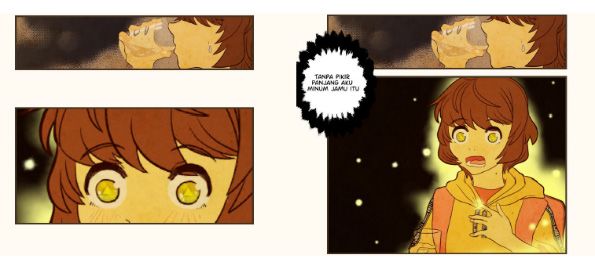
Designing Motion Comic About Information of Indonesian’s Traditional Medicine (Case Study: Djammoe)
      Y Satrio and A Zulkarnain

      advantage of comic books is that they can communicate complex ideas more effectively and concisely [6].
                  Therefore, communicating information to young people will be more effective using comic
      books. From that conclusion, making a motion comic is chosen as a way to communicate information
      about jamu to young people. The motion comic is a digital media, it fits with this modern era that mostly
      uses technology on a day-to-day basis. The motion comic is also easily accessed by everyone who wants
      to read it if it is made available for online viewing.
                  In Indonesia, there is one leading application for reading a digital comic called Line Webtoon.
      From all the official titles in the application, there is only one title that tells the theme of Indonesian culture,
      in contrast, there are one hundred and twenty-one official titles with romance as its theme. This data is as
      of September 2020.
                  From those numbers, it can be seen that people prefer romance comic books rather than comic
      books with the theme of their local culture. Therefore, this motion comic that tells the theme of jamu needs
      to be realized. The objective of this project is to relay information about jamu to young people through
      their reading medium that they enjoy using modern era gadgets. Also, to raise their awareness about jamu
      as Indonesian’s traditional drink.
                  This paper is going to discuss the adaptation of Djammoe into a motion comic, focusing on the
      application of cinematography techniques, panel personification, and applying closure in the paneling.
      Djammoe tells a story about a university student named Intan meeting her mentor named Djagapati Mawa
      Oesada who is a magical pouch, they cure various health problems using Jamu Ajaib or magical jamu.

      2. Method
      The methodology used in this paper is the qualitative analysis method through literature study. This
      study is used to help in the designing process, be it writing the story script, designing characters, and
      deciding drawing style. Literature study mostly helps in the visual aspect and interview study helps
      in deciding the target demographic group for the final product of this project. Throughout this motion
      comic, there are plenty of panel transitions and characterizing panels. To achieve an engaging experience
      and creating a cinematic experience while reading, an understanding of cinematography techniques,
      gestalt principles, and animation principles is needed. For example, the cinematography technique such
      as types of shots is used to create cuts between panels, so that the result is as if one is watching a motion
      picture. Gestalt principle such as closure is applied to create the illusion of a complete object from each
      panel that comes after one another. Finally, animation principles such as exaggeration is used to create
      over-the-top expressions or actions, not just applying it to the character but to the panel border around
      them as well. The examples presented in the paper are a mix of the final product and the production
      process of the motion comic project, but the methods still apply in both ways.

      3. Results and Discussions
      3.1 Application of Cinematography Techniques in Animating Panel Transition
      There are many means of animating in a motion comic, be it animating the objects inside the panel or
      animating the panel itself. This part will explain the application of the cinematography technique in
      animating panel transition. When animating panel transition, imagine the panel itself is a camera. That
      will create the illusion of a jump cut transition without changing the camera angle or adding a new panel
      [7]. Also, it can establish the hierarchy of the panels on the indicated page. Other than cinematography
      technique, some of the twelve principles of animation also come into play in this. The two principles
      used are timing and anticipation. These aspects are controlled by the reader according to their reading
      tempo. This kind of transition also creates space between the panels and the page. This technique can be
      achieved by changing the size of the panels. For example, panel A is an extreme close-up and wants to
      transition to panel B as a medium shot (Figure 1). First, panel A is going to be smaller while the image of

135   IMOVICCON 2021 Proceeding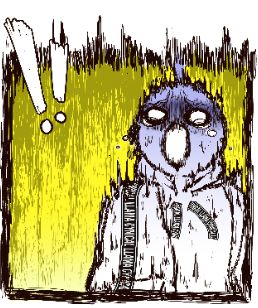
Designing Motion Comic About Information of Indonesian’s Traditional Medicine (Case Study: Djammoe)
                                                                                         Y Satrio and A Zulkarnain

focus is going to be bigger. Then, when transitioning to panel B, make the image smaller while the panel
bigger (Figure 2). This creates the before mentioned cinematic transition, a transition from extreme
close-up to medium shot without creating a new panel. Other than that, it also creates the illusion of
depth and parallax.

        Figure 1. Panel Transitioning from Extreme Close Up to Medium Shot (Author, 2021)

                 Figure 2. Animation Timeline of Panel Transitioning (Author, 2021)

3.2 Application of Panel Personification in Animating Panel
While previously the panel is imagined as a camera, in this part the panel is imagined as a character,
by giving a human characteristic to a non-human object. This can be achieved by changing the panel
border characteristic. Rather than simple straight lines, something like a squiggly line or some sharp
repetitive lines can also be used to convey a certain emotion. This is called panel personification. This
technique emphasizes the emotional condition that is being shown by the character inside the panel. For
example, the character is shocked from touching something wet from inside a pouch (Figure 3). Other
than drawing the character with an exaggerated shocked expression the panel around it can also play
along by being drawn in exaggerated strokes. Then, when animating, it could just be series of looping
images of two frames and from that, the timing is adjusted to fit the emotion being conveyed from the
character inside the said panel.

                     Figure 3. Application of Panel Personification (Author, 2021)

3.3 Application of Closure in Panelling
From many gestalt principles, there is one that makes use of human perception in viewing an incomplete

                                                                            IMOVICCON 2021 Proceeding                136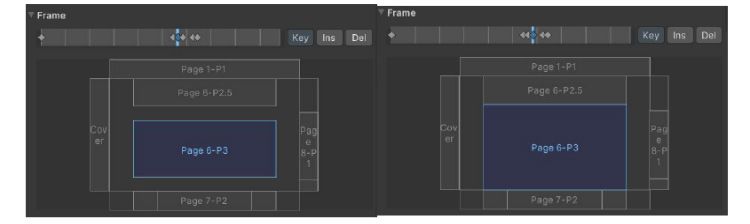
Designing Motion Comic About Information of Indonesian’s Traditional Medicine (Case Study: Djammoe)
      Y Satrio and A Zulkarnain

      object as a complete object--that principle is called closure [8]. In comic books, this principle is also
      applied as an indicator for change of time or movement. The closure appears in the form of “the gutter”,
      the space between two or more panels. Even though the panels are separated, people still perceive them
      as a chain of continuation and see them as a whole. There are six kinds of closure that are often used
      in comic books : moment-to-moment; action-to-action; subject-to-subject; scene-to-scene; aspect-to-
      aspect, and non-sequitur [9].
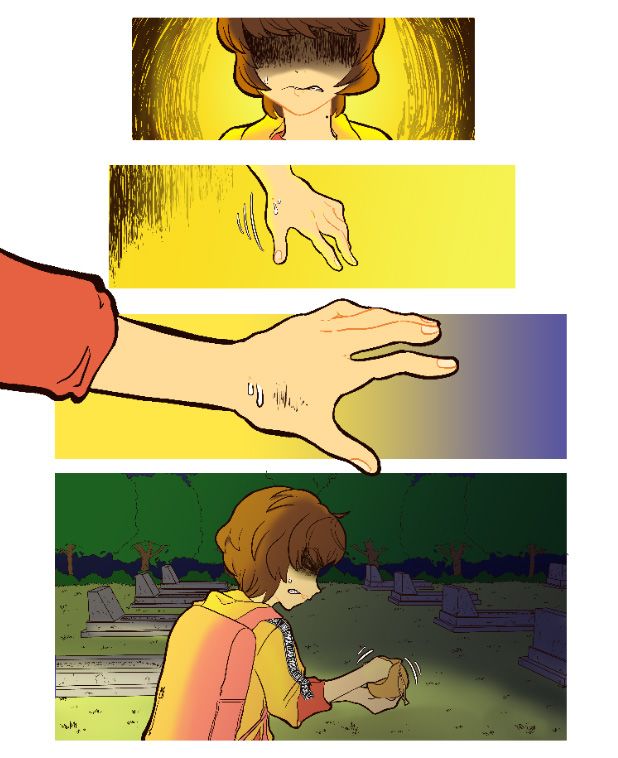
                This part is going to discuss the use of action-to-action on one page to show the transition
      of action between the panels. The page starts with a small panel slowly transitioning to a bigger panel
      to emphasize the intensity and the importance of each movement made by the character in each panel
      (Figure 4). The movement made by a single subject is called action-to-action. With this kind of panel
      composition where the size is getting bigger with each panel that comes after one another, a sense of
      hierarchy is created within the indicated page.

       Figure 4. The Application of Gestalt’s Closure Action-to-Action in Panel Transition (Author, 2021)

      4. Conclusions
      Overall, using cinematography techniques in animating transition between panels can create a cinematic
      experience in a medium that does not entirely motion picture media. Adding to that, applying gestalt’s
      principle of closure can also create a continuation between panels so that they are perceived as a whole
      story. Giving a human-like characteristic to a non-human object such as panels can be used as a means
      of conveying emotions and movements. Those characteristics can be exaggerated as well to emphasize
      the emotions being shown by the character inside the panel. With all these techniques the final product
      is expected to be coherent, appealing, engaging, fluid, and new in conveying the message and achieving
      the objective.

      5. References
      [1]      Badan Pengawas Obat dan Makanan Republik Indonesia 2019 Persyaratan Keamanan dan
               Mutu Obat Tradisional p 2
      [2]      Ika 2019 UGM Kenalkan Jamu ke Generasi Milenial p 1
      [3]      Ubaidillah 2019 Minat Baca Mahasiswa Milenial Terhadap Sumber-Sumber Online dan Cetak
      [4]      Hasanah, Umi Ma’rufah Uswatun 2012 Budaya Membaca di Kalangan Anak Muda p 9-10
      [5]      Farinella, Matteo 2018 The Potential of Comics in Science Communication p 3

137   IMOVICCON 2021 Proceeding
Designing Motion Comic About Information of Indonesian’s Traditional Medicine (Case Study: Djammoe)
Y Satrio and A Zulkarnain
[6] Alexio, Paul and Norris C 2010 The Comic Book Textbook vol.28 No.4 p 73
[7] Dani 2020 Witch Hat Atelier: Visual Storytelling through Manga Panelling
[8] Todorovic, Dejan 2008 Gestalt Principles p 16
[9] McCloud, Scott 1993 Understanding Comics the Invisible Art (New York: Harper Perennial)
p 70-72
IMOVICCON 2021 Proceeding 138You can also read


