Do Obese Children Achieve Maximal Heart Rate during Treadmill Running? - MDPI
←
→
Page content transcription
If your browser does not render page correctly, please read the page content below
sports
Article
Do Obese Children Achieve Maximal Heart Rate
during Treadmill Running?
Sveinung Berntsen 1, *, Elisabeth Edvardsen 2,3 , Shlomi Gerbi 1 , Magnhild L. Kolsgaard 4 and
Sigmund A. Anderssen 2
 1    Department of Public Health, Sport and Nutrition, Faculty of Health and Sport Sciences,
      University of Agder, P.O. Box 422, NO-4604 Kristiansand, Norway; gerbishlomi@gmail.com
 2    Department of Sports Medicine, Norwegian School of Sport Sciences, 0806 Oslo, Norway;
      elisabeth.edvardsen@nih.no (E.E.); s.a.anderssen@nih.no (S.A.A.)
 3    Department of Pulmonary Medicine, Oslo University Hospital, 0424 Oslo, Norway
 4    Department of Paediatrics, Oslo University Hospital, 0424 Oslo, Norway; UXPOMA@ous-hf.no
 *    Correspondence: sveinung.berntsen@uia.no; Tel.: +473-841-045

 Received: 30 October 2018; Accepted: 17 January 2019; Published: 19 January 2019

 Abstract: Objective: Maximal heart rate (HR) is commonly defined as the highest HR obtained
 during a progressive exercise test to exhaustion. Maximal HR is considered one of the criteria to
 assess maximum exertion in exercise tests, and is broadly used when prescribing exercise intensity.
 The aim of the present study was to compare peak HR measurements during maximal treadmill
 running and active play in obese children and adolescents. Design: Comparison of peak heart rate
 during active play vs. maximal treadmill running in 39 (7–17 years old, 18 males) obese children
 and adolescents. Methods: Heart rate was recorded during intensive active play sessions, as well as
 during a progressive running test on a treadmill until exhaustion. HR, respiratory exchange ratio
 (RER), and oxygen uptake were continuously measured during the test. The criteria for having
 reached maximal effort was a subjective assessment by the technician that the participants had
 reached his or her maximal effort, and a RER above 1.00 or reporting perceived exertion (RPE) above
 17 using the Borg-RPE6–20 -Scale. Results: Thirty-four children had a RER ≥1.00, and 37 reported a
 RPE ≥ 17. Thirty-two children fulfilled both criteria. During active play, peak HR was significantly
 (p < 0.0001) increased (4%) (mean and 95% confidence intervals; 204 (201, 207) beats/min), compared
 to during maximal treadmill running (196 (194, 199) beats/min), respectively. Conclusion: The
 results of the present study indicate that peak heart rate measurements during progressive running to
 exhaustion in obese children and adolescents cannot necessarily be determined as maximal heart rate.

 Keywords: play; exercise; fitness; physical activity; exercise testing

1. Introduction
     Behavioral lifestyle interventions focusing on physical activity may have the potential to reduce
level of overweight and obesity in children and adolescents [1]. Encouraging or participating in active
play sessions has been reported to stimulate to increased energy expenditure [2] or physical activity
level among obese children [3]. In order to encourage lifestyle changes in children, physical activity or
exercise training should be enjoyable, age-specific, and adapted to the child’s fitness level [4]. To tailor
exercise intensity to the child’s cardiorespiratory fitness level or to prescribe an intensity zone based
on maximal heart rate (HRmax), e.g., above 80% of their HRmax, cardiopulmonary exercise testing
with measures of peak HR is common and recommended [5,6]. HRmax is commonly defined as the
highest HR obtained during a progressive exercise test to exhaustion [7]. Equations for predicting
HRmax have been developed [8,9] and validated in children and adolescents performing maximal

Sports 2019, 7, 26; doi:10.3390/sports7010026                                   www.mdpi.com/journal/sports
Sports 2019, 7, 26 2 of 7
treadmill running or bicycling on a cycle ergometer [10–13]. Though, unmotivated performances
during maximal testing may influence children’s test results [13–15], and peak HR attained during,
e.g., treadmill running, may not reflect true maximal HR. When underestimating HRmax, exercise
intensity during more enjoyable activities may be performed at lower exercise intensity than actually
supposed. Comparisons of peak HR during active play and more traditional exercises, like treadmill
running, have not been carried out. The aim of the present study was, therefore, to compare peak HR
measurements during maximal treadmill running and active play in obese children and adolescents.
2. Methods
Obese and overweight children and adolescents (hereafter called children) from Oslo were
referred by their physician or school nurse to the outpatient pediatric clinic for participation in a
multidisciplinary obesity management program at the Department of Pediatrics at Oslo University
Hospital in Norway [16]. The children were examined by a pediatrician and included if they were obese
according to the Norwegian percentile diagram (body mass above the 97.5th percentile for height) [17].
Children 7–17 years old, without an overt or organic disease (in which there were anatomical or path
physiological changes in some bodily tissue or organ) causing the obesity, medical conditions that
could limit the ability to be physically active, and receiving medication which could affect growth
or weight control, were included. A detailed description of the inclusion procedures, methods, and
intervention are presented elsewhere [3,16].
Of the 120 referred children, 60 subjects participated in physical activity intervention [3], and
39 children, with both treadmill test and heart rate measurements during active play sessions, attended
the present study. The children included in the present study were representative of 7–17-year-old
subjects in “The Oslo Adiposity Intervention Study” with respect to gender, age, pubertal status and
body mass above the 97.5th percentile for height.
The study was approved by the Regional Committee for Medical and Health Research Ethics,
South East, and the Data Inspectorate of Norway (S-04313). Written informed consent was obtained
from all children and their respective parents.
Body mass was measured wearing light underwear to the nearest 0.1 kg (Seca 770, Hamburg,
Germany). Height was measured by a stadiometer to the nearest 0.5 cm. Body composition was
measured by an experienced technician by dual-energy X-ray absorptiometry (DXA; GE-Lunar Prodigy,
Madison, WI, USA). Participants were scanned from head to toe in a supine position, providing fat
mass for the total body, as well as separately for arms, legs, and trunk. Test–retest analyses from
30 scans in 15 children and further details have been reported previously [3]. Physical activity was
objectively recorded by the ActiGraph 7164 accelerometer (LLC, Fort Walton Beach, FL, USA) for seven
consecutive days before start of the intervention. The output was sampled every 20 s and presented as
mean counts per minute (cpm). Sequences of ≥10 min with consecutive zero counts were automatically
deleted. As in other studies, moderate-to-vigorous intensity physical activity (MVPA) was defined as
all physical activity above 2000 cpm [18,19].
A progressive maximal treadmill test (Woodway, WI, USA) was performed after five minutes
familiarization while walking on the treadmill. The maximal test started at four kilometers per
hour (km·h−1 ) with an inclination of 0%, increasing the work load (individualized increase in speed,
0.5 km·h−1 per minute, and/or inclination, 1% per minute) until exhaustion. During the last part of
the test, the participant’s effort was largely encouraged by the technician until voluntary termination.
Chest-measured HR was recorded continuously during the test (Polar Sports Tester 3000, Polar Electro
·
KY, Kempele, Finland), with the highest recorded HR defined as peak HR. Minute ventilation (VE ),
·
respiratory exchange ratio (RER), and VO2 were continuously measured using the Sensor Medics,
Vmax Spectra (Yorba Linda, CA, USA). The rating of perceived exertion (RPE) was obtained using the
Borg-RPE-Scale6–20 [20]. The criteria for reached maximal effort was a subjective evaluation by the
technician that the child had reached his or her maximal effort, and a RER above 1.00 or RPE above 17.Sports 2019, 7, 26 3 of 7
The five-month exercise intervention consisted of 60 min guided active play, twice a week, with
different activities focusing on coordination, flexibility skills, and self-esteem in the first four weeks.
Thereafter, team play, endurance-, and strength-type activities, such as body weight calisthenics,
ball games, wrestling, or fun-related movements were included. Duration and intensity of each activity
varied. The mean attendance in the sessions was 60%. During the active play sessions, chest-measured
HR was recorded using Polar Vantage (Polar Electro KY, Kempele, Finland). The highest recorded HR
(recorded within 30 s intervals) during any of the active play sessions (60 min each) was defined as
peak HR during active play [3].
Demographic data are given as mean with standard deviation (SD), unless otherwise stated,
and results as mean with SD or 95% confidence intervals (CI). Independent t-test was used to analyze
differences between groups. Paired sample t-test was used to analyze differences between peak HR
measurements during active play sessions and maximal treadmill running. Statistical significance level
was set to 5%. Statistical analyses were performed with Statistical Package for Social Sciences Version
21.0 (SPSS, Chicago, IL, USA).
3. Results
Physical characteristics of the participants are shown in Table 1. Girls were significantly lower
(p = 0.01) and had significantly higher percentage body fat (p = 0.03). Boys participated in a significantly
higher amount of MVPA (p < 0.01).
Table 1. Baseline physical characteristics of the 39 participating children presented by gender. Data are
given as mean and standard deviation in parentheses.
Girls (n = 21) Boys (n = 18) P-value **
Age (years) 12 (2) 13 (2) 0.10
Body mass (kg) 70 (19) 75 (17) 0.15
Height (cm) 154 (10) 161 (10) 0.01
Percentage of body fat (%) 49 (5) 45 (6) 0.03
MVPA (min·day−1 ) 43 (14) 81 (22)Sports 2019, 7, 26 4 of 7
Sports 2018, 6, x FOR PEER REVIEW 4 of 7
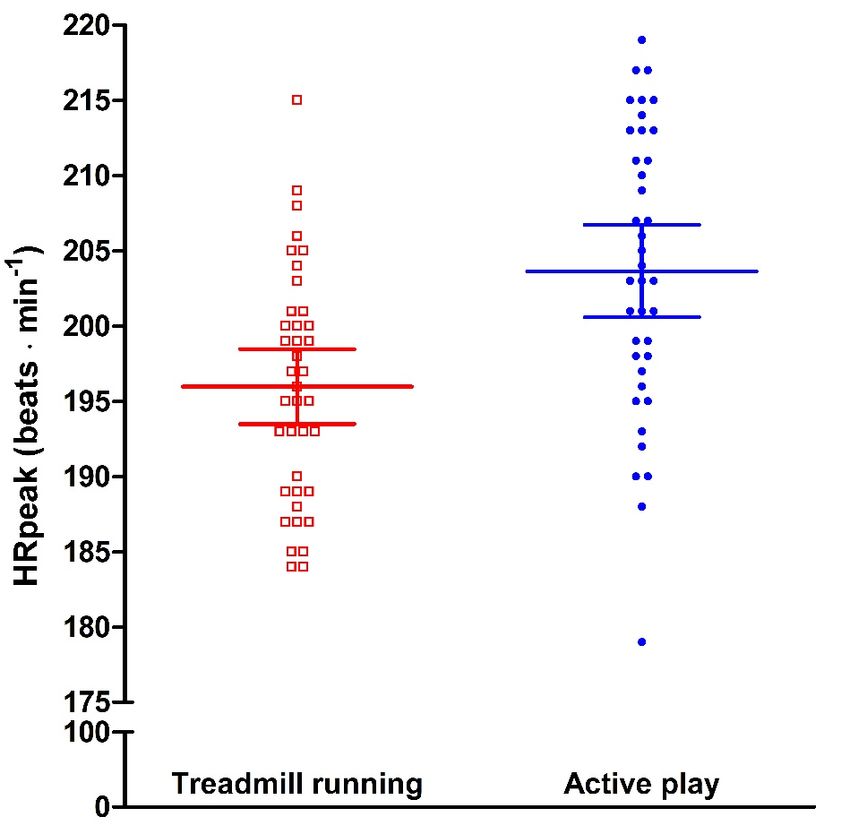
Peak HR was 4% higher and significantly (p < 0.0001) increased during active play (mean and
Peak HR was
95% confidence 4% higher
intervals; and207)
204 (201, significantly
beats per (p
min< 0.0001)
(bpm)) increased
comparedduring active
to during play (mean
maximal and
treadmill
95% confidence
running (196 (194,intervals;
199) bpm),204respectively
(201, 207) beats per 1).
(Figure min (bpm)) compared to during maximal treadmill
running (196 (194, 199) bpm), respectively (Figure. 1).
Figure 1. HR peak during both treadmill running and active play. Individual values with corresponding
Figure 1. HR peak during both treadmill running and active play. Individual values with
mean and 95% confidence intervals.
corresponding mean and 95% confidence intervals.
4. Discussion
4. Discussion
In the present study, peak HR increased during active play compared to during maximal treadmill
running In in
theobese
present study,Topeak
children. our HR increased
knowledge, during
this is the active playtocompared
first study to duringpeak
compare obtained maximal
HR
treadmill running in obese children. To our knowledge, this
during different test conditions, like laboratory-based and play-based (in the field). is the first study to compare obtained
peak HR during
Despite differenttesting
that exercise test conditions, like laboratory-based
using a treadmill or stationaryand bikeplay-based (in the field).
in the laboratory is common
Despite that exercise testing using a treadmill or stationary bike
when assessing physiological variables, there is no consensus in relation to protocols for assessmentin the laboratory is common of
when assessing physiological variables, there is no consensus in relation to protocols
maximal effort or HR in children [1]. Together with age, gender, type of exercise, state of health, fitness, for assessment
of maximal
and effort or
environmental HR in children
conditions [1].
[13], the Together
type with protocol
of exercise age, gender,could type of exercise,
affect peak HR.state The of health,
average
fitness, and environmental conditions [13], the type of exercise protocol
peak HR from active play sessions of 204 bpm and 194 bpm during treadmill testing cannot necessarily could affect peak HR. The
average peak HR from active play sessions of 204 bpm and 194
be compared with previous studies reporting peak HR of 193 bpm [21] to 202 bpm [22] during bpm during treadmill testing cannot
necessarily
treadmill be compared with previous studies reporting peak HR of 193 bpm [21] to 202 bpm [22]
running.
during treadmill
An exercise test running.
with the purpose of measuring a physiological peak level is dependent on the
An exercise test
participant to provide the with the purpose
maximum of measuring
of what a physiological
is physiologically possiblepeak level is
for them. dependent
Lack on the
of motivation
participant
could to provide
be a factor the maximum
that makes of what terminate
the participants is physiologically
the test possible for them.their
before reaching Lackphysiological
of motivation
could be a factor that makes the participants terminate the test
peak level [15]. For instance, testing in a laboratory can be more competitive and unpleasantbefore reaching their physiological
compared
peak level [15]. For instance, testing in a laboratory can be more
to other forms of testing, and fitness testing can be regarded as “demanding, embarrassing and highlycompetitive and unpleasant
compared to other
uncomfortable” andforms
couldofdevelop
testing, aand fitnessattitude
negative testing can be regarded
toward physicalasactivity
“demanding,
[2]. Thisembarrassing
is in deep
and highly uncomfortable” and could develop a negative attitude toward
contrast to free play, where the aim is to develop a positive attitude to activity and the perspective physical activity [2]. This
ofisfun,
in deep
where contrast to free play,
the motivation come where
fromthe aim the
within is toplayer
develop [23].a positive
Also, motorattitude
skillstoefficiency
activity andandthea
protocol that can match the motor skills are important determinants of peak HR [12]. A peak HR skills
perspective of fun, where the motivation come from within the player [23]. Also, motor that
efficiency
was 4% higherandduring
a protocol that
active canmay
play match the motor
indicate skills
that the are important determinants
laboratory-based protocol in theofpresent
peak HR [12].
study
A peak HR that was 4% higher during active play may indicate that the laboratory-based protocol in
the present study failed in motivating children in a similar way to the active play sessions, explaining
the higher peak HR. This corresponds to a previous study arguing that a high level of perceivedSports 2019, 7, 26 5 of 7
failed in motivating children in a similar way to the active play sessions, explaining the higher peak
HR. This corresponds to a previous study arguing that a high level of perceived competence enables
individuals to endure the discomforts of the maximum effort and to achieve higher performance [15].
Until now, in several studies [21,24–26], measures of children’s peak HR using treadmill and
cycle ergometer [13] have been carried out, but hardly any literature exists showing peak HR in
relation to children in active play or out of the laboratory. With the present study showing that obese
children can reach significantly higher peak HR during active play, compared with treadmill running,
the role of conventional laboratory testing to target exercise intensity zones in children could be
questioned. Protocols adapted to children’s motor skills and motivation should be developed as peak
HR is a commonly used variable in clinical medicine and physiology prescribing exercise intensity
in rehabilitation and disease prevention programs [9]. The implications of underestimating peak
HR could be to prescribe lower exercise intensity than initially planned. The American College of
Sports Medicine (ASCM) recommends a moderate and vigorous exercise intensity level for children [7].
For instance, if the treadmill protocol would be the foundation for establishment of exercise intensity,
a recommendation to exercise at moderate intensity (using ASCM intensity scale [27]) would be
to exercise with a HR between 125 bpm and 147 bpm for the average child in the present study.
The fact that the active play protocol in the present study showed that the same average child had a
significantly higher peak HR, illustrates that the average child with a HR of 135 bpm during exercise
may be classified as low intensity, instead of moderate intensity [28]. A consequence of exercising
at lower intensity may result in reduced improvements in fitness. The 4% difference between active
play and treadmill running may change the distribution of work in both rehabilitation and disease
prevention programs, as it is important, in an exercise program, to determine and report the correct
amounts of volume, frequency, and intensity [29].
The main strengths of the present study are the experienced test leaders, a relatively large number
of participants, and several play-based exercise sessions. Whether use of an alternative treadmill
protocol may have resulted in improved peak HR values compared to the present protocol cannot be
excluded. Warming up for at least 20 minutes followed by two to three uphill running sessions may
give higher peak HR values compared to the present treadmill protocol [30].
5. Conclusions
In conclusion, obese children tested for peak HR in two different environments had significantly
higher peak HR during free play compared to treadmill running. The results of the present study
indicate that peak HR measurements during progressive running to exhaustion in obese children
cannot necessarily be determined as maximal HR.
6. Practical Implications
1. How to report and interpret exercise intensity seems important in training programs for obese
children and adolescents.
2. The type of exercise as well as setting may influence exercise intensity.
3. Active play may result in higher exercise intensity compared to treadmill running in obese
children and adolescents.
Author Contributions: Conceptualization, S.B.; methodology, S.B., E.E., S.A.A; software, S.B.; validation, S.B.,
E.E.; formal analysis, S.B.; investigation, S.B.; resources, S.B., S.A.A.; data curation, S.B.; writing—original draft
preparation, S.B., S.G.; writing—review and editing, S.B., S.G., E.E., M.L.K., S.A.A.; visualization, S.B.; supervision,
S.A.A.; project administration, S.B., M.L.K., S.A.A.; funding acquisition, S.B., S.A.A.
Funding: The present study was supported by grants from the Eastern Norway Regional Health Authority and
the County Governor in Oslo and Akershus.
Conflicts of Interest: There is no competing or conflicts of interests.Sports 2019, 7, 26 6 of 7
References
1. Oude, L.H.; Baur, L.; Jansen, H.; Shrewsbury, V.A.; O’Malley, C.; Stolk, R.P.; Summerbell, C.D. Interventions
for treating obesity in children. Cochrane Database Syst. Rev. 2009, CD001872.
2. DiNubile, N.A. Youth fitness—Problems and solutions. Prev. Med. 1993, 22, 589–594. [CrossRef] [PubMed]
3. Berntsen, S.; Mowinckel, P.; Carlsen, K.H.; Lodrup Carlsen, K.C.; Pollestad Kolsgaard, M.L.; Joner, G.;
Anderssen, S.A. Obese children playing towards an active lifestyle. Int. J. Pediatr. Obes. 2010, 5, 64–71.
[CrossRef] [PubMed]
4. Speiser, P.W.; Rudolf, M.C.; Anhalt, H.; Camacho-Hubner, C.; Chiarelli, F.; Eliakim, A.; Freemark, M.;
Gruters, A.; Hershkovitz, E.; Iughetti, L.; et al. Childhood obesity. J. Clin. Endocrinol. Metab. 2005, 90,
1871–1887. [CrossRef] [PubMed]
5. Mann, T.; Lamberts, R.P.; Lambert, M.I. Methods of prescribing relative exercise intensity: Physiological and
practical considerations. Sports Med. 2013, 43, 613–625. [CrossRef] [PubMed]
6. Braaksma, P.; Stuive, I.; Garst, R.M.E.; Wesselink, C.F.; van der Sluis, C.K.; Dekker, R.; Schoemaker, M.M.
Characteristics of physical activity interventions and effects on cardiorespiratory fitness in children aged
6–12 years—A systematic review. J. Sci. Med. Sport 2018, 21, 296–306. [CrossRef] [PubMed]
7. American College of Sports Medicine. ACSM's Guidelines for Exercise Testing and Prescription; Lippincott
Williams & Wilkins: Baltimore, MD, USA, 2005.
8. Fox, S.M., III; Naughton, J.P.; Haskell, W.L. Physical activity and the prevention of coronary heart disease.
Ann. Clin. Res. 1971, 3, 404–432. [CrossRef]
9. Tanaka, H.; Monahan, K.D.; Seals, D.R. Age-predicted maximal heart rate revisited. J. Am. Coll. Cardiol. 2001,
37, 153–156. [CrossRef]
10. Fernhall, B.; McCubbin, J.A.; Pitetti, K.H.; Rintala, P.; Rimmer, J.H.; Millar, A.L.; De Silva, A. Prediction
of maximal heart rate in individuals with mental retardation. Med. Sci. Sports Exerc. 2001, 33, 1655–1660.
[CrossRef]
11. Machado, F.A.; Denadai, B.S. Validity of maximum heart rate prediction equations for children and
adolescents. Arq. Bras. Cardiol. 2011, 97, 136–140. [CrossRef]
12. Mahon, A.D.; Marjerrison, A.D.; Lee, J.D.; Woodruff, M.E.; Hanna, L.E. Evaluating the prediction of maximal
heart rate in children and adolescents. Res. Q. Exerc. Sport 2010, 81, 466–471. [CrossRef]
13. Washington, R.L.; Bricker, J.T.; Alpert, B.S.; Daniels, S.R.; Deckelbaum, R.J.; Fisher, E.A.; Gidding, S.S.;
Isabel-Jones, J.; Kavey, R.E.; Marx, G.R.; et al. Guidelines for exercise testing in the pediatric age group. From
the Committee on Atherosclerosis and Hypertension in Children, Council on Cardiovascular Disease in the
Young, the American Heart Association. Circulation 1994, 90, 2166–2179. [CrossRef] [PubMed]
14. Naughton, G.A.; Carlson, J.S.; Greene, D.A. A challenge to fitness testing in primary schools. J. Sci. Med. Sport
2006, 9, 40–45. [CrossRef] [PubMed]
15. Tsigilis, N. The influence of intrinsic motivation on an endurance field test. J. Sports Med. Phys. Fit. 2005, 45,
213–216.
16. Kolsgaard, M.L.; Andersen, L.F.; Tonstad, S.; Brunborg, C.; Wangensteen, T.; Joner, G. Ethnic differences in
metabolic syndrome among overweight and obese children and adolescents: The Oslo Adiposity Intervention
Study. Acta Paediatr. 2008, 97, 1557–1563. [CrossRef]
17. Knudtzon, J.; Waaler, P.E.; Skjaerven, R.; Solberg, L.K.; Steen, J. New Norwegian percentage charts for height,
weight and head circumference for age groups 0–17 years. Tidsskr. Nor. Laegeforen. 1988, 108, 2125–2135.
[PubMed]
18. Andersen, L.B.; Harro, M.; Sardinha, L.B.; Froberg, K.; Ekelund, U.; Brage, S.; Anderssen, S.A. Physical
activity and clustered cardiovascular risk in children: A cross-sectional study (The European Youth Heart
Study). Lancet 2006, 368, 299–304. [CrossRef]
19. Ekelund, U.; Sardinha, L.B.; Anderssen, S.A.; Harro, M.; Franks, P.W.; Brage, S.; Cooper, A.R.; Andersen, L.B.;
Riddoch, C.; Froberg, K. Associations between objectively assessed physical activity and indicators of body
fatness in 9- to 10-y-old European children: A population-based study from 4 distinct regions in Europe
(the European Youth Heart Study). Am. J. Clin. Nutr. 2004, 80, 584–590. [CrossRef]
20. Borg, G. Perceived exertion as an indicator of somatic stress. Scand. J. Rehabil. Med. 1970, 2, 92–98.Sports 2019, 7, 26 7 of 7
21. Shephard, R.J.; Allen, C.; Bar-Or, O.; Davies, C.T.; Degre, S.; Hedman, R.; Ishii, K.; Kaneko, M.; LaCour, J.R.;
di Prampero, P.E.; et al. The working capacity of Toronto schoolchildren. I. Can. Med. Assoc. J. 1969, 100,
560–566.
22. Lambrick, D.; Jakeman, J.; Grigg, R.; Kaufmann, S.; Faulkner, J. The efficacy of a discontinuous graded
exercise test in measuring peak oxygen uptake in children aged 8 to 10 years. Biol. Sport 2017, 34, 57–61.
[CrossRef] [PubMed]
23. Aras, S. Free play in early childhood education: A phenomenological study. Early Child. Dev. Care 2016, 186,
1173–1184. [CrossRef]
24. Wilmore, J.H.; Constable, S.H.; Stanforth, P.R.; Tasao, W.Y.; Rotkis, T.C.; Paicius, R.M.; Mattern, C.M.;
Ewy, G.A. Prevalence of coronary heart disease risk factors in 13-to 15-year-old boys. J. Cardiac. Rehabil. 1982,
2, 223–233.
25. Hermansen, L.; Oseid, S. Direct and indirect estimation of maximal oxygen uptake in pre-pubertal boys.
Acta Paediatr. Scand. Suppl. 1971, 217, 18–23. [CrossRef] [PubMed]
26. Goldberg, S.J.; Weiss, R.; Adams, F.H. A comparison of the maximal endurance of normal children and
patients with congenital cardiac disease. J. Pediatr. 1966, 69, 46–55. [CrossRef]
27. Garber, C.E.; Blissmer, B.; Deschenes, M.R.; Franklin, B.A.; Lamonte, M.J.; Lee, I.M.; Nieman, D.C.; Swain, D.P.;
American College of Sports Medicine. American College of Sports Medicine position stand. Quantity and
quality of exercise for developing and maintaining cardiorespiratory, musculoskeletal, and neuromotor
fitness in apparently healthy adults: Guidance for prescribing exercise. Med. Sci. Sports Exerc. 2011, 43,
1334–1359. [PubMed]
28. Epstein, L.H.; Paluch, R.A.; Kalakanis, L.E.; Goldfield, G.S.; Cerny, F.J.; Roemmich, J.N. How much activity
do youth get? A quantitative review of heart-rate measured activity. Pediatrics 2001, 108, E44. [CrossRef]
29. Hawley, J.A. Adaptations of skeletal muscle to prolonged, intense endurance training. Clin. Exp. Pharmacol.
Physiol. 2002, 29, 218–222. [CrossRef]
30. Ingjer, F.; Stromme, S.B. Effects of active, passive or no warm-up on the physiological response to heavy
exercise. Eur. J. Appl. Physiol. Occup. Physiol. 1979, 40, 273–282. [CrossRef]
© 2019 by the authors. Licensee MDPI, Basel, Switzerland. This article is an open access
article distributed under the terms and conditions of the Creative Commons Attribution
(CC BY) license (http://creativecommons.org/licenses/by/4.0/).You can also read


