Easton Statistical Ward Profile 2021 - May 2021 - Bristol City Council
←
→
Page content transcription
If your browser does not render page correctly, please read the page content below
Easton
                                                            Statistical Ward
                                                                       Profile
                                                                        2021
                                                                         May 2021

Insight, Performance and Intelligence Service, Bristol City Council
www.bristol.gov.uk/statistics - email: research@bristol.gov.uk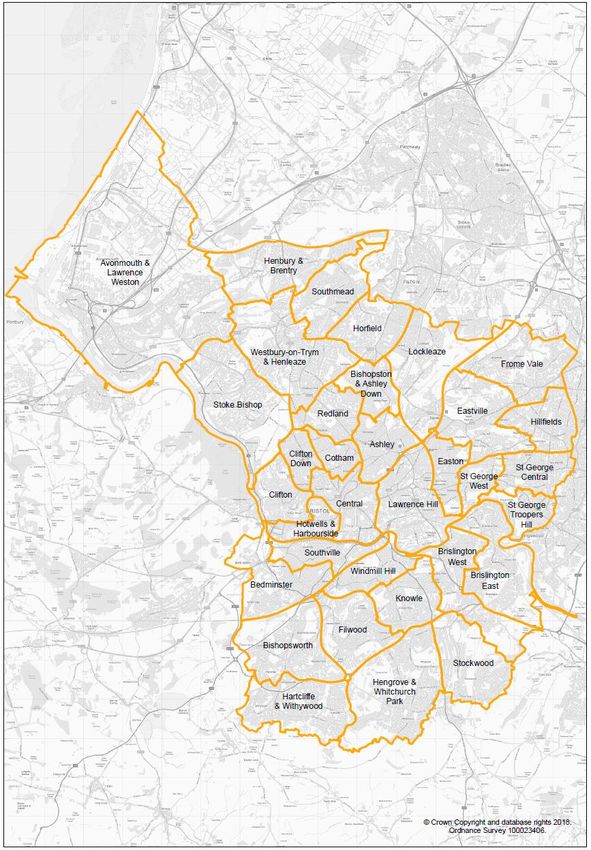
CONTENTS - HELP PAGE
 These 2021 Ward Profiles have been compiled for Bristol City Council wards using latest data as of May 2021. This update publishes
 new data on quality of life, life expectancy, premature mortality, child poverty, crime and social care. Please note due to the
 impact of the Coronavirus (Covid-19) it has not been possible to update data for the Public Health National Child Measurement
 Programme and some education data.

 This interactive tool provides data for each of the wards and for Bristol overall, highlighting any significant differences for the
 relevant ward compared to the Bristol average. The tool is designed to allow users to copy pages into other reports, to provide
 local evidence. There is also a suite of individual Ward Profile reports. See www.bristol.gov.uk/wardprofiles .

Contents
     Page 3     Population - ONS 2019                              Page 19     Mapping Tools
     Page 4     Deprivation - 2019                                 Page 20     Sources (p1)
     Page 5     Quality of Life (p1) - 2020-21                     Page 21     Sources (p2)
     Page 6     Quality of Life (p2) - 2020-21                     Page 22     Ward Names
     Page 7     Healthy Lifestyles - 2020-21                       Page 23     Ward Boundary Map
     Page 8     Life Expectancy - 2018-2020
     Page 9     Premature Mortality - 2018-2020
    Page 10     Child Poverty 2019-20
    Page 11     Crime - 2020-21
    Page 12     Education - 2019 & 2020
    Page 13     Social Care 2021
    Page 14     Housing - Census 2011
    Page 15     Household Size - Census 2011
    Page 16     Car Availability - Census 2011
    Page 17     Ethnicity - Census 2011

 Help / Notes
 1/ The 34 Bristol Wards (established in 2016) are listed in blue down the left hand margin. Click the box to change
 ward.
 2/ The Indicator pages are in orange down the right hand margin. There are 16 pages of data. Click the box                     to
 change indicator.
 3/ Full details, definitions and sources for each indicator are noted in the Sources pages.
 4/ Many pages have infographics to highlight a key indicator(s), with other indicators listed below.
 5/ Several pages includes a chart ranking all wards, with the chosen ward noted in a different colour.
 6/ The tool shows the current latest data. It does not show past trend data.
 7/ For Deprivation and Child Poverty, the data is shown by LSOA (Lower Super Output Area) not ward.
 8/ The rating uses statistical confidence intervals or t-tests to identify if the gap is statistically significant. Different
 wards and data-sets have different size confidence intervals, so trigger points for the below colour ratings will
 vary.
 9/ All indicators are colour-coded to show any significant difference between the ward and the city average. These

Significantly Better than the city average                            Significantly Higher than the city average

Not Significantly Different for the city                              Significantly Lower than the city average

Significantly Worse than the city average

 Insight, Performance and Intelligence Service, Bristol City Council                         www.bristol.gov.uk/statistics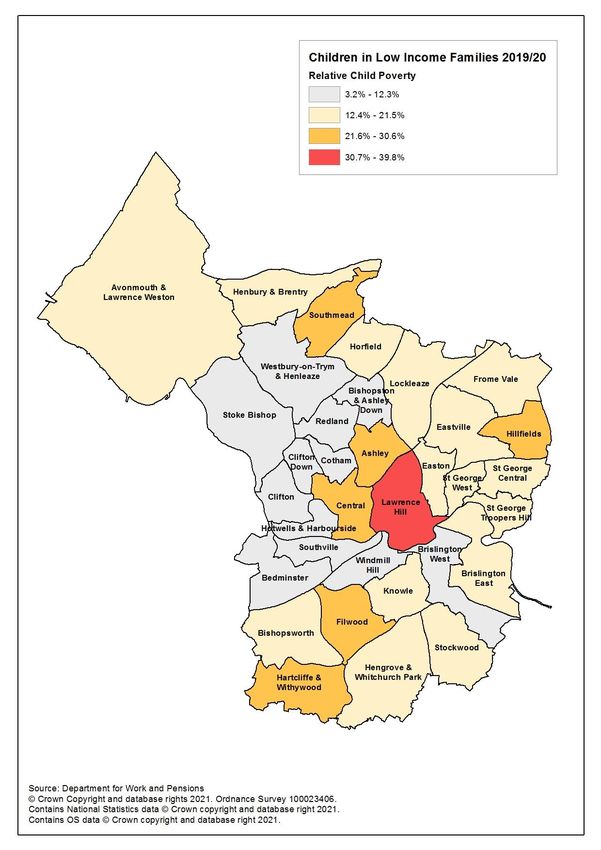
POPULATION ESTIMATE Office for National Statistics 2019
EASTON
                      Easton (population 14,200)                                                                          Significantly High
                                                                                                                  Not Significantly Different
                      Bristol
                                                                                                                            Significantly Low

AGE GROUPS
                                         20.1%                                                                      18.6%
0-15                                                                    40-54
                                     18.5%                              years                                 16.5%
years

                       9.1%                                                                     8.0%
16-24                                                                   55-64
years                            15.7%                                                            8.9%
                                                                        years

                                                                35.3%                             8.9%
25-39                                                                    65 +
years                                             27.3%                                                   13.0%
                                                                        years

POPULATION PYRAMID                                                      WARD COMPARISON
                                                                               Children             Working Age             Older People

    90+                                                                                       Ashley
   85-89                                                       Avonmouth & Lawrence Weston
                                                                                       Bedminster
   80-84                                                            Bishopston & Ashley Down
   75-79                                                                            Bishopsworth
                                                                                  Brislington East
   70-74
                                                                                 Brislington West
   65-69                                                                                    Central
   60-64                                                                                      Clifton
                                                                                    Clifton Down
   55-59                                                                                   Cotham
   50-54                                                                                     Easton
           Age

                                                                                            Eastville
   45-49                                                                                    Filwood
   40-44                                                                               Frome Vale
                                                                        Hartcliffe & Withywood
   35-39
                                                                             Henbury & Brentry
   30-34                                                          Hengrove & Whitchurch Park
                                                                                            Hillfields
   25-29
                                                                                            Horfield
   20-24                                                                Hotwells & Harbourside
   15-19                                                                                    Knowle
                                                                                    Lawrence Hill
   10-14                                                                                 Lockleaze
     5-9                                                                                   Redland
                                                                                      Southmead
     0-4                                                                                  Southville
                                                                             St George Central
           20         10             0            10           20       St George Troopers Hill
                                Percentage                                       St George West
                                                                                       Stockwood
                                                                                     Stoke Bishop
           Easton Males                                          Westbury-on-Trym & Henleaze
           Easton Females                                                              Windmill Hill

           Bristol Males                                                                                 0K             10K              20K
           Bristol Females                                                                                         Population

Population – Source: Bristol City Council using ONS 2019 Small Area Population Estimates ONS © Crown Copyright
See source pages for further details
 Insight, Performance and Intelligence Service, Bristol City Council                                www.bristol.gov.uk/statistics
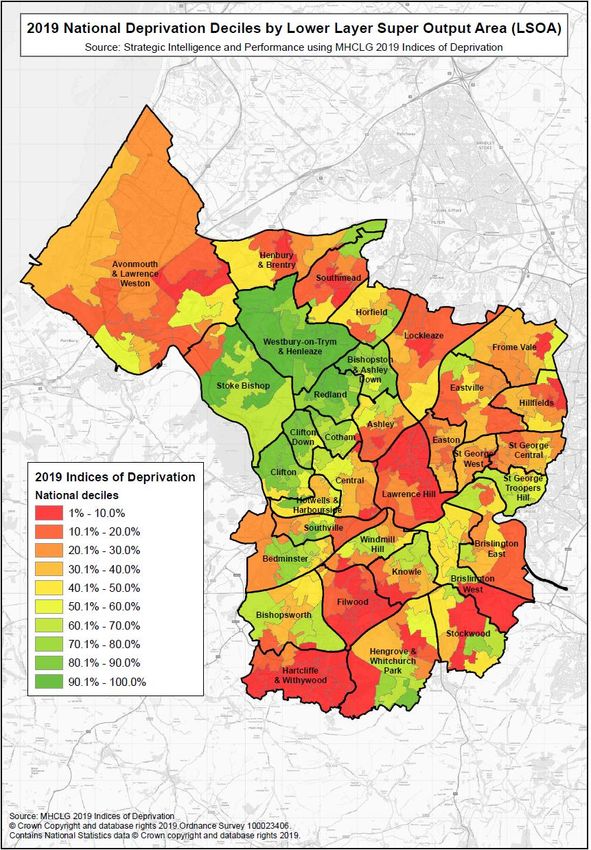
DEPRIVATION Indices of Multiple Deprivation 2019
EASTON

                                                                                       Most deprived 10% in England

       For further information about the deprivation indices, including scores, ranks and maps, please
       refer to ‘Deprivation in Bristol 2019’ report - www.bristol.gov.uk/deprivation
       LSOA maps can be found on Pinpoint http://maps.bristol.gov.uk/pinpoint/

Source: MHCLG English Indices of Deprivation 2019

 Insight, Performance and Intelligence Service, Bristol CityCouncil             www.bristol.gov.uk/statistics
QUALITY OF LIFE 1Quality of Life Survey 2020-21
EASTON
Significantly Better Significantly Worse Not Significantly Different
Significantly High Significantly Low
Easton Bristol
% satisfied with the way the Council runs things 51 47
Council & Democracy
% who feel Bristol City Council provides value for money 41 32
% who feel an elected mayor for Bristol is improving the leadership of the city 46 35
% who agree they can influence decisions that affect their local area 25 21
% satisfied BCC has supported their local community during the Coronavirus 33 40
pandemic
% satisfied with life 66 71
% in good health 89 87
% below average mental wellbeing 10 20
Health & Wellbeing
% who see friends and family as much as they want to 68 73
% who do enough regular exercise each week 66 68
% who play sport at least once a week 38 41
% households with a smoker 27 16
% at a higher risk of alcohol related health problems 22 16
% households which have experienced moderate to severe food insecurity 5 4
% households that used a 'food bank' during the last 12 months 4 2
% whose fear of crime affects their day-to-day lives 16 16
Crime & Safety
% who feel police and public services successfully tackle crime and anti -social
behaviour locally 25 30
% victim of racial discrimination or harassment in last year 12 7
% who think domestic abuse is a private matter 3 7
% satisfied with the range and quality of outdoor events 54 57
Culture & Leisure
% satisfied with activities for children/young people 38 35
% who participate in cultural activities at least once a month 30 33
% satisfied with libraries 59 54
% satisfied with leisure facilities/services 44 40
Economy
% who find it difficult to manage financially 7 7
% who shop in their local shopping street at least once a week 63 47
See source pages for further details.
Insight, Performance and Intelligence Service, Bristol City Council www.bristol.gov.uk/statisticsQUALITY OF LIFE 2 Quality of Life Survey 2020-21 Bristol Quality of Life
EASTON
Significantly Better Significantly Worse Not Significantly Different
Significantly High Significantly Low
Easton Bristol
Education
% who know where to get information, advice and guidance about employment
& Skills
67 65
% satisfied with adult learning opportunities 21 27
% who think traffic congestion is a problem locally 81 70
Transport
% who ride a bicycle at least once a week 43 28
% satisfied with the local bus service 55 57
Housing
% satisfied overall with their current accommodation 86 87
% satisfied with the cost of their rent or mortgage payments 75 60
% who think street litter is a problem locally 96 82
% satisfied with the general household waste service 86 75
Sustainability & Environment
% satisfied with the quality of parks and green spaces 81 79
% who visit Bristol's parks and green spaces at least once a week 61 60
% satisfied with the recycling service 86 74
% who think air quality and traffic pollution is a problem locally 90 71
% concerned about climate change 91 86
% who have reduced their household waste due to climate change concerns 67 66
% who have reduced energy use at home due to climate change concerns 54 51
% who feel they belong to their neighbourhood 61 63
% who agree people from different backgrounds get on well together in their
neighbourhood 83 71
47 47
Community & Living
% who volunteer or help out in their community at least 3 times a year
% who have access to the internet at home 95 96
% comfortable using digital services 78 82
% who lack the information to get involved in their community 30 31
% who’ve noticed "gentrification" taking place who think it has had a negative
impact 0 25
% satisfied with their local area 80 80
See source pages for further details.
Insight, Performance and Intelligence Service, Bristol City Council www.bristol.gov.uk/statisticsHEALTHY LIFESTYLES Quality of Life Survey 2020-21
EASTON
Significantly Better
% who say they are in good health Not Significantly Different
Significantly Worse
Easton 89 87 Bristol
90 Bristol Average 87.1
%
70
50
Henbury & Brentry
Hartcliffe & Wwood
Bris West
Bedminster
Knowle
Frome Vale
Stockwood
B'ston & AshDown
St G West
Eastville
Clifton
Lockleaze
Ashley
Clifton Down
Filwood
Cotham
Easton
Bishopsworth
Hillfields
Central
Bris East
Southmead
Stoke Bishop
St G Troopers Hill
Southville
Lawrence Hill
Redland
Horfield
St G Central
A'mouth & LW
Windmill Hill
Hotwells & H'side
WoT & Henleaze
Hengrove & WhitPk
Results from the Quality of Life survey 2020-21
Easton Bristol
% with illness or health condition which limits day-to-day activities at least a little 31 25
% above average mental wellbeing 12 8
% households where someone smokes regularly within the home 7 4
% who cook a 'ready meal' once a week at most 91 88
% who do enough regular exercise each week 66 68
% overweight or obese 43 46
Public Health National Child Measurement Programme 2016/17 - 2018/19 *
% children in reception (4/5yr olds) who have excess weight 19.2 22.7
% children in year 6 (10/11yr olds) who have excess weight 31.1 32.8
See source pages for further details. * Please note due to the impact of the Coronavirus (Covid-19) this remains the latest data available
under the Public Health National Child Measurement Programme.
Insight, Performance and Intelligence Service, Bristol City Council www.bristol.gov.uk/statistics50
55
65
70
75
85
90
55
60
75
80
95
60
80
50
65
70
85
90
*
Cotham Cotham
Males
Clifton Down Clifton Down
Females
Bris East Clifton
Clifton St G Troopers Hill
EASTON
B'ston & AshDown Ashley
Bristol males
WoT & Henleaze Horfield
Easton males
Bristol females
Easton females
Stoke Bishop B'ston & AshDown
Three Year Averages
Hotwells & H'side WoT & Henleaze
Horfield Hillfields
Bishopsworth Redland
Knowle Stoke Bishop
Bris West Bris East
Frome Vale Knowle
Hengrove & WhitPk Hotwells & H'side
Bedminster Bris West
Redland Hengrove & WhitPk
76.8
Hillfields Bishopsworth
78.5
Henbury & Brentry Frome Vale
Insight, Performance and Intelligence Service, Bristol City Council
Stockwood Henbury & Brentry
80.8
These figures are averages of a 3 year period. See source pages for further details
Windmill Hill Eastville
82.7
St G Troopers Hill Central
Ashley Stockwood
Eastville Lawrence Hill
Southmead A'mouth & LW
LIFE EXPECTANCY Public Health 2018-2020
Lockleaze Filwood
Easton Windmill Hill
A'mouth & LW Bedminster
St G Central Lockleaze
Hartcliffe & Wwood Easton
Filwood Southmead
Southville St G West
www.bristol.gov.uk/statistics
Central St G Central
St G West Hartcliffe & Wwood
Significantly Better
Significantly Worse
Not Significantly Different
Bristol Average 82.7
Bristol Average 78.5
Lawrence Hill SouthvillePREMATURE MORTALITYPublic Health 2018-2020
EASTON
Three Year Averages
All Causes
Significantly Better
Directly age standardised rates for deaths in people aged under 75
years, per 100,000 population Not Significantly Different
Significantly Worse
Easton 491.2 377.5 Bristol
600
500
Bristol Average 377.5
400
Deaths
300
200
100
0
St G Central
Hotwells & H'side
Bris West
Southville
Bris East
Lawrence Hill
Bedminster
Windmill Hill
WoT & Henleaze
Eastville
Knowle
Frome Vale
Ashley
Stockwood
Hartcliffe & Wwood
Henbury & Brentry
Hengrove & WhitPk
Easton
Lockleaze
Filwood
Redland
Clifton
Clifton Down
Central
St G West
Hillfields
B'ston & AshDown
Southmead
Cotham
Bishopsworth
Stoke Bishop
Horfield
A'mouth & LW
St G Troopers Hill
Selected Causes
Directly age standardised rates for deaths in people
aged under 75 years, per 100,000 population
Easton Bristol
Cancer 141.0 147.8
Cardiovascular Disease 127.4 73.1
Respiratory Disease 53.1 36.5
These figures are averages of a 3 year period. See source pages for further details
Insight, Performance and Intelligence Service, Bristol City Council www.bristol.gov.uk/statisticsCHILD POVERTY Children living in low income families 2019-20 This is a new measure of the percentage of children living in low income families, mapped by ward. A family must have claimed one or more of Universal Credit, Tax Credits or Housing Benefit at any point in the year to be classed as low income in these statistics. Insight, Performance and Intelligence Service, Bristol City Council www.bristol.gov.uk/statistics
CRIME Crime and Policing 2020-21 Significantly Better
Not Significantly Different
EASTON Significantly Worse
Selected Offence Rates
(per 1,000 population) 2020-21 Easton Bristol
104.3 101.0
All Crime
Violent &
Burglary Sexual 5.7 40.8 5.6 36.1
Offences
Anti Social 32.7 29.5
Behaviour
300 All Crime Offence Rate (per 1,000 population) 2020-21
250
200
150 Bristol Average 101
100
50
0
Hengrove &…
Hartcliffe &…
Henbury & Brentry
Bris West
Bedminster
WoT & Henleaze
Frome Vale
Stockwood
Ashley
Knowle
B'ston & AshDown
Eastville
Lockleaze
St G West
Filwood
Clifton Down
Clifton
Easton
Central
Bishopsworth
Hillfields
Redland
Cotham
Horfield
Southmead
Stoke Bishop
St G Troopers Hill
St G Central
A'mouth & LW
Bris East
Windmill Hill
Lawrence Hill
Southville
Hotwells & H'side
Results from youth offending team - Rate of Offenders (per 1,000 10 -17 year olds) 2020-21
Youth
Offences 6.4 3.9
Results from the Quality of Life survey 2020-21 Easton Bristol
% who feel anti-social behaviour is a problem locally 36 34
% who feel safe outdoors after dark 54 63
% who have been a victim of crime in the last 12 months 13 11
Sources: 1. Selected Offence Rates 2020-21 from www.police.uk . 2. Youth offending data from Youth Offending Team, Bristol City Council
3. Quality of Life Survey from Bristol City Council
See source pages for further details
Insight, Performance and Intelligence Service, Bristol City Council www.bristol.gov.uk/statisticsEDUCATION Bristol City Council / Dept for Education 2019 & 2020*
EASTON
Attainment 8 - average achievement score Significantly Better
(at end Key Stage 4) across 8 subjects (2019) Significantly Worse
Not Significantly Different
Significantly High
Significantly Low
Easton 40.5 44.2 Bristol
100
75
Bristol Average 44.2
Attainment 8 Score
50
25
0
Henbury & Brentry
Stockwood
Bedminster
Hartcliffe & Wwood
B'ston & AshDown
Frome Vale
Knowle
Clifton
Ashley
Bishopsworth
Lockleaze
Clifton Down
Redland
St G West
Filwood
Bris West
Hillfields
Easton
Central
Cotham
Stoke Bishop
Bris East
Horfield
Southmead
St G Troopers Hill
A'mouth & LW
Southville
St G Central
Windmill Hill
Lawrence Hill
Eastville
WoT & Henleaze
Hengrove & WhitPk
Hotwells & H'side
Education Indicators 2019 & 2020*
Easton Bristol Easton Bristol
Progress 8 - average progress
Free School Meals % (2020) 20.6 23.1 score (KS2 to KS4) across 8 0.03 -0.07
subjects (2019)
Early years pupils achieving a
Disadvantaged % (2020) 26.5 27.8 good level of development % 68.0 70.7
(2019)
KS2 reaching expected
Special Educational Needs 17.6 16.0 56.4 64.1
standard RWM combined %
% (2020)
(2019)
English as an Additional 31.7 21.1 7.9 7.2
Absence rate % (2019)
Language % (2020)
Source: Insight, Performance and Intelligence, Bristol City Council. See source pages for further details.
* Please note due to the impact of the Coronavirus (Covid-19) it has not been possible to update all the indicators due at this time.
Insight, Performance and Intelligence Service, Bristol City Council www.bristol.gov.uk/statisticsSOCIAL CARE Adult Social Care 2021
EASTON
Clients receiving a community based service aged Significantly Better
65+ (rate per 1000) Significantly Worse
Not Significantly Different
Significantly High
Significantly Low
Easton 42.7 30.8 Bristol
80
60
Clients (per 1000)
40 Bristol Average 30.8
20
0
St G West
Bishopsworth
Clifton Down
Ashley
Knowle
Lockleaze
Easton
Central
St G Central
Horfield
St G Troopers Hill
Clifton
Redland
Stoke Bishop
Lawrence Hill
Bris East
Southmead
Hillfields
Bris West
Frome Vale
A'mouth & LW
Bedminster
Stockwood
Hengrove & WhitPk
Southville
Filwood
Hotwells & H'side
Eastville
Windmill Hill
Cotham
WoT & Henleaze
Henbury & Brentry
B'ston & AshDown
Hartcliffe & Wwood
Social Care Indicators 2021
Easton Bristol
Children in social care (rate per 1000) 12.3 20.5
Clients in Care Homes 65+ (rate per 1000) 31.6 19.2
Clients receiving a domestic care service aged 65+ (rate per 1000) 30.9 18.0
Clients receiving a community based service aged 18 - 64 (rate per 1000) 7.5 6.5
Results from the Quality of Life survey 2020-21
% who feel lonely because they don't see friends and family enough 10 5
% whose physical health prevents them from leaving their home when 8 9
they want to
See source pages for further details
Insight, Performance and Intelligence Service, Bristol City Council www.bristol.gov.uk/statisticsHOUSING 2011 CENSUS
EASTON
Significantly High
Tenure Not Significantly Different
Significantly Low
Easton Bristol
51.5% 54.8% 12.7% 20.3% 35.8% 24.9%
3,017 100,093 742 37,083 2,100 45,571
Owned Social Rented Private & other rented
Accommodation Type
3% 5.9% 5.9% 26.3% 68.8% 33.4% 22.3% 34.4%
181 11,164 360 49,983 4,174 63,331 1,351 65,239
Detached Semi-Detached Terraced Flat
10K 2011 Houses 2011 Flats
8K
Household spaces
6K
4K
2K
0K
Hartcliffe & Wwood
Hengrove & WhitPk
B'ston & AshDown
St G Central
Bishopsworth
Stoke Bishop
Redland
Easton
Henbury & Brentry
Knowle
Bris East
Cotham
Stockwood
A'mouth & LW
Southmead
Lawrence Hill
Clifton
Filwood
Hillfields
WoT & Henleaze
Central
Bris West
Ashley
Bedminster
Frome Vale
Horfield
Lockleaze
St G West
Eastville
Southville
Clifton Down
St G Troopers Hill
Windmill Hill
Hotwells & H'side
Source: 2011 Census ONS Crown Copyright Reserved [from Nomis]
See source pages for further details
Insight, Performance and Intelligence Service, Bristol City Council www.bristol.gov.uk/statisticsHOUSEHOLD SIZE 2011 CENSUS
EASTON
Significantly High
Easton Bristol Not Signifcantly Different
Significantly Low
1 bedroom or less 14.9% 16.5%
2 bedrooms 42.3% 27.9%
3 or more bedrooms 42.4% 55.4%
Overcrowded Households 9.4% 5.2%
2.4
Average bedrooms per Easton
household Bristol
2.6
2.3
Average household size Easton
(persons per household) Bristol
2.3
20 %
Overcrowded households
15 %
Households
10 %
Bristol Average 5.2%
5%
0%
St G Troopers Hill
Hillfields
Hotwells & H'side
Stoke Bishop
Easton
St G Central
Bris East
Bishopsworth
Bris West
Central
Windmill Hill
Lawrence Hill
Horfield
Southmead
Southville
Knowle
Frome Vale
Hengrove & WhitPk
Ashley
Stockwood
Bedminster
Henbury & Brentry
Redland
Clifton
Eastville
Filwood
WoT & Henleaze
Clifton Down
St G West
B'ston & AshDown
Cotham
Hartcliffe & Wwood
Lockleaze
A'mouth & LW
Source: 2011 Census ONS Crown Copyright Reserved [from Nomis]
See source pages for further details
Insight, Performance and Intelligence Service, Bristol City Council www.bristol.gov.uk/statisticsCAR AVAILABILITY 2011 CENSUS
EASTON
Car Availability
Car availability refers to the number of cars or vans that are owned, or available for use, by one or more
members of a household. This includes company cars and vans that are available for private use. It does not
include motorbikes or scooters. The count of cars or vans in an area relates only to households. Cars or vans
used by residents of communal establishments are not counted. Households with 10 or more cars or vans are
counted as having only 10.
Significantly High
Total Cars in the area 4,849 190,530
Not Significantly Different
Significantly Low Ave no. cars per household 0.83 1.04
No cars or vans in 1 car or van in 2 cars or vans in 3 cars or vans in 4 + cars or vans in
household household household household household
Easton
36.8% 47.3% 13.2% 2.3% 0.4%
2157 Households 2769 Households 774 Households 133 Households 26 Households
Bristol
28.9% 45.1% 20.7% 3.9% 1.3%
52814 Households 82483 Households 37858 Households 7172 Households 2420 Households
2
Average number of cars per household
Bristol Average 1.04
1
0
St G Central
Eastville
Stoke Bishop
Bedminster
Horfield
Lockleaze
Southville
Lawrence Hill
Clifton Down
Clifton
Central
Cotham
Hartcliffe & Wwood
Stockwood
Bris East
St G West
Easton
Knowle
Frome Vale
Windmill Hill
Southmead
Filwood
Ashley
Redland
B'ston & AshDown
Bris West
Hillfields
WoT & Henleaze
Bishopsworth
Henbury & Brentry
St G Troopers Hill
A'mouth & LW
Hengrove & WhitPk
Hotwells & H'side
Source: 2011 Census ONS Crown Copyright Reserved [from Nomis]
See source pages for further details
Insight, Performance and Intelligence Service, Bristol City Council www.bristol.gov.uk/statisticsETHNICITY 2011 CENSUS
EASTON
Population by Ethnicity BME 37.9 %
0% 10% 20% 30% 40% 50% 60% 70% 80% 90% 100%
Significantly High
Not Significantly Different
Easton Bristol Easton Bristol
Significantly Low
52.5 % 77.9 % White British 0.5 % 0.9 % Chinese
0.9 % 0.9 % White Irish 1.1 % 1% Other Asian
0.4 % 0.1 % White Gypsy or Irish Traveller 5.4 % 2.8 % Black African
8.2 % 5.1 % Other White 6.2 % 1.6 % Black Caribbean
6.7 % 3.6 % Mixed 4.3 % 1.6 % Other Black
2.8 % 1.5 % Indian 0.5 % 0.3 % Arab
7% 1.6 % Pakistani 1.6 % 0.6 % Other ethnic group
1.8 % 0.5 % Bangladeshi Black and Minority Ethnic
37.9 % 16 %
Group Total
70%
60%
% population who belong to a
50% Black or Minority Ethnic group
40%
30%
20% Bristol Average 16%
10%
0%
St G Central
Eastville
Bedminster
Lockleaze
Stoke Bishop
Horfield
Cotham
Southville
Lawrence Hill
Clifton
Central
St G West
Easton
Bris East
Stockwood
Hartcliffe & Wwood
Ashley
Frome Vale
Knowle
Southmead
Windmill Hill
Clifton Down
Filwood
Redland
B'ston & AshDown
Bris West
Hillfields
WoT & Henleaze
Bishopsworth
Henbury & Brentry
St G Troopers Hill
A'mouth & LW
Hengrove & WhitPk
Hotwells & H'side
The population as a whole can be broken down into 18 different ethnic groups according to what tick box people
chose on the 2011 Census questionnaire.
The Somali population did not have a separately identified tick box on the 2011 Census questionnaire and so will be
included in both the ‘Black African’ and the ‘Other Black’ groups. The Mixed/Multiple Ethnic Groups have been
aggregated from four separately identified groups to one ‘Mixed’ group in the table above. The Black or Minority
Ethnic group (BME) population includes all ethnic groups with the exception of the White groups (i.e. White British,
White Irish, White Gypsy or Irish Traveller and Other White).
Source: 2011 Census ONS Crown Copyright Reserved [from Nomis]
See source pages for further details
Insight, Performance and Intelligence Service, Bristol City Council www.bristol.gov.uk/statisticsRELIGION, COUNTRY OF BIRTH AND LANGUAGE 2011 CENSUS
EASTON
Religion
0% 10% 20% 30% 40% 50% 60% 70% 80% 90% 100%
Significantly High
Not Significantly Different
Easton Bristol Easton Bristol
Significantly Low
36.1 % 46.8 % Christian 1.5 % 0.5 % Sikh
0.9 % 0.6 % Buddhist 1.1 % 0.7 % Other religions
0.7 % 0.6 % Hindu 34.8 % 37.4 % No religion
0.2 % 0.2 % Jewish 9.6 % 8.1 % Religion not stated
15 % 5.1 % Muslim
Main Language
Easton Bristol
Born
outside
the UK
27.2% 14.7% Not English English
Easton
Top 3 countries of birth outside of the UK Bristol
100%
17.5% 8.5%
600 90%
80%
70%
60%
people
400 435 416
50%
403 40%
30%
20%
200 10%
82.5% 91.5%
Poland Jamaica Pakistan
0%
Source: 2011 Census ONS Crown Copyright Reserved [from Nomis]
See source pages for further details
Insight, Performance and Intelligence Service, Bristol City Council www.bristol.gov.uk/statisticsMAPPING TOOLS Bristol City Council provides a number of web-based tools which are designed to provide users with access to maps and spatial information quickly and easily. The main tools are described below; Pinpoint http://maps.bristol.gov.uk/pinpoint/ Pinpoint is designed to help members of the public locate local information on the most convenient services from a specific location, such as the nearest library to your home or work address. Details such as opening times and contact numbers are also displayed when clicking on a location. Local information is organised under the following themes: community and safety, education, environment and planning, health and adult care, housing and property, leisure and culture, sport and transport and streets. In addition to local information, there is information on council assets and the historic environment. Pinpoint also includes the following area boundaries: Polling Districts, Wards, Parliamentary Constituencies, Lower Layer Super Output Areas and Census Output Areas My Neighbourhood https://www.bristol.gov.uk/my-neighbourhood-search My Neighbourhood includes links to relevant statistical data, and information about planning applications, waste collections, political representation etc in your area, all summarised in a single view. Plus a "find my nearest" search to find the closest of a range of facilities to any given address. Know Your Place https://www.bristol.gov.uk/planning-and-building-regulations/know-your-place Know Your Place provides access to a variety of historic maps that cover the administrative area of the City of Bristol. The majority of the maps have been scanned from original archives held at Bristol Record Office (BRO). Because these are scans taken from the original archives you will see damage to the maps in some places including tears and stains and even some areas where people have tried to repair the map. You will also notice variations in the colour of the maps because they have been digitally stitched together from individual sheets. We hope this adds to the historic character of the website and doesn’t detract from your enjoyment in browsing these maps. The scanned images have been overlain on Modern Ordnance Survey Mastermap digital mapping and contextual layers. Including the historical environment records, picture, postcard and photo collections, public contributions and points of interest. Bristol ArcGIS Online Maps http://bcc.maps.arcgis.com/home/index.html A collection of online maps, map apps and story maps. Open Data Bristol https://opendata.bristol.gov.uk/pages/tools/ A site for using, sharing and visualising open data in Bristol. Under the 'Tools' page you can find the ability to create maps using one or more sets of data that relate to the Bristol area. Insight, Performance and Intelligence Service, Bristol City Council www.bristol.gov.uk/statistics
BACKGROUND AND SOURCES
This Ward Profile tool is produced by the Strategic Intelligence and Performance Team, part of the Insight, Performance &
Intelligence Service in Bristol City Council. Unless noted otherwise, all data and reports below are collated, analysed and
produced by Insight, Performance & Intelligence in Bristol City Council.
See www.bristol.gov.uk/statistics. If any further queries, please email: research@bristol.gov.uk
The Ward Profile tool and reports are part of the overall Joint Strategic Needs Assessment (JSNA) process. They provide a
local ward-based focus on the data produced for the JSNA Health and Wellbeing profile, which is updated throughout
the year. The Ward Profiles can also be used in their own right. For further information on the JSNA, including the JSNA
data profile and Chapters, see www.bristol.gov.uk/jsna
Open Data Bristol A new Open Data platform for Bristol which includes hundreds of downloadable datasets and a number
of Dashboards including Quality of Life in Bristol, Air Quality and Council Elections. Most of the data has been published by
Bristol City Council, based on the services it provides, but data is also welcome from other organisations and companies in
the city. It can be found at https://opendata.bristol.gov.uk. The data can be viewed, used and re-used, subject to the
associated licence terms, with the ability to build maps and charts within the platform. You can also export the data,
2016 wards All data in these Ward Profiles is presented for the ward boundaries that came into effect in May 2016.
Calculation of ratings the ratings use a combination of; statistical tests ("t tests"), standard deviation and confidence
intervals to assess whether the differences between wards and the Bristol average is likely to be “statistically significant” .
Different wards and data-sets have different size confidence intervals, so trigger points for the colour ratings will vary.
Data release periods Where possible, the Ward Profiles will be published twice a year in order to capture the most recently
available data for each topic page. However, each dataset updates at a different time of the year. This means the data
profiles may not always align exactly to other reports, as publication dates may differ. Each page states the time period
that the data is covering for that topic.
Sources
Population estimates Small Area Population Estimates produced by the Office for National Statistics. Mid-2019 population
estimates, released in September 2020. Further details for Bristol overall is in: The Population of Bristol at
Deprivation The Indices of Multiple Deprivation 2019 combine a number of indicators, covering a range of economic,
social, environmental and housing issues, into a single deprivation score for each small area (Lower Super Output Area,
LSOA) in England. The full report: Deprivation in Bristol 2019 is at www.bristol.gov.uk/deprivation
Quality of Life The Quality of Life (QoL) survey is an annual snapshot of the quality of life in Bristol, including community
cohesion, crime, health, sustainability and satisfaction with services. It is the council's main tool for providing
neighbourhood level statistics and public perception information. The 2 pages here are the Priority Indicators from Quality
of Life 2020-21. The report and further indicators are at www.bristol.gov.uk/qol.
Crime Avon and Somerset Police provide statistics on Offences in Bristol . This is new data, covers 2020-21. Further notes:
These data are unaudited figures extracted from a live police dataset. Owing to the ongoing nature of police
investigations the information is subject to change and may differ from subsequent national crime statistics, which are
quality assured by statisticians. The data only includes incidents where exact location of the offence has been
recorded. The crime rate per 1,000 has been calculated using offence location and population estimates provided by
Bristol City Council.
Further Police performance data is available at www.police.uk.
Youth Offending data has been provided by the Youth Offending Team, Bristol City Council. This is the number of
offenders (10-17 year olds) who commited an offence during 2020-21 whilst living in that ward at the time, as a rate per
1,000 of the 10-17 years population in that ward.
Insight, Performance and Intelligence Service, Bristol City Council www.bristol.gov.uk/statisticsFURTHER SOURCES
Education
Education
The figures are based on all children in Bristol local authority maintained schools, academies and free schools (but not Independent
The figures
schools). Theare based
Bristol totalon
willall children
include in who
pupils Bristol local
live authority
outside maintained
the area, schools
but the ward figures(including
will not. Academies but not
Independent schools). The Bristol total will include pupils who live outside the area, but the ward figures will not.
Attainment 8 and Progress 8 are measures from the Department for Education(DfE)for pupils at the end of Key Stage 4 (age 16), and
are ways to measure overall GCSE performance and to encourage students to take at least 8 qualifications. Attainment 8 is a
student’s average achievement across 8 subjects, with extra weighting given to Maths and English. Although it is not compulso ry to
take eight subjects, failing to do so will reduce a pupil’s Attainment 8 score. Progress 8 is a value added measure which compares
how well a student does when compared to other pupils with the same prior attainment at the end of Key Stage 2. Note - DfE
formal explanation of Progress 8 and Attainment 8 is at:
https://assets.publishing.service.gov.uk/government/uploads/system/uploads/attachment_data/file/783865/Secondary_accountab
ility_measures_guidance.pdf
The primary indicator for pupils at end of Key Stage 2 (leaving primary school) is "% Key Stage 2 pupils achieving the expected
standard in reading, writing and maths".
Education attainment data for 2019 (for Key Stage 2 and Key Stage 4 pupils) is from the Dept for Education "Key to Success" s ecure
website, processed via Bristol City Council, and ward data is based on pupil home address. Further information by school can be
found at the Department for Education website www.compare-school-performance.service.gov.uk
Early Years pupils achieving a good level of development (Source: School statutory submissions for Assessments at end of Reception
Year, 2019).
Free School Meals is pupils “eligible for free school meals on the day of the School Census” (Source: January 2020 School Census).
Disadvantaged is pupils who have “ever been Looked After / In Care, been adopted or been eligible for free school meals at any
point in the last 6 years” (Source: Jan 2020 School Census, updated at end of the school year with Department for Education data
on looked after children (in care)).
Special Educational Needs is all levels of special educational need. That is pupils with an Education and Health Care Plan or
receiving School Support (Source: Jan 2020 School Census).
English as Additional Language (Source: January 2020 School Census).
Absence - Absence rates based on sessions missed (a session equals half a day) (Source: all three 2019 School Censuses (Jan, May &
Oct) combined, to give an average for the 2018-19 school year).
Child Poverty
This release contains annual official statistics on the number of children living in Relative low income families by local area across the
United Kingdom. These statistics replace earlier Official Statistics previously published by DWP (Children in out-of-work benefit
households) and HMRC (Personal tax credits: Children in low-income families local measure). The new statistics provide a more
coherent picture of children living in low income families by local area. Figures are calibrated to the Households Below Average
Income (HBAI) survey 3-year regional averages of children living in low income households but provide more granular local area
information not available in HBAI.
Health and wellbeing
For further information see the JSNA Health and Wellbeing profile, suite of JSNA Chapters and links to relevant national data profiles all
via the Bristol JSNA website at www.bristol.gov.uk/jsna
Healthy Lifestyles
Data from the Bristol Quality of Life Survey 2020-21 and the Public Health National Child Measurement Programme 2016/17 -
2018/2019(calculated by Public Health Knowledge Service, Bristol City Council). Please note due to the impact of the Coronavirus
(Covid-19) this remains the latest data available under the Public Health National Child Measurement Programme.
Life Expectancy & Premature Mortality
Data for 2018-20 provided by Public Health Knowledge Service, Bristol City Council. These are calculated over 3-year aggregated
periods. Data is based on the 2019 population mid-year estimate and provisional registered deaths data that may be subject to a
subsequent update.
Social Care
Children and Adult Social Care data provided by Insight, Performance and Intelligence at Bristol City Council, plus Quality of Life Survey
2020-21.
Community Based Service: refers to any service that is not a residential care or nursing home, eg Domestic (or Home) Care, Shared
Lives, Extra Care Housing, Community Support Services, "meals on wheels" etc
Clients in Care Homes: refers to clients (65 and over) in either a residential care home or a nursing care home.
Children in Social Care: refers to children allocated to a social worker for any reason, also including “Children in care” or on the
Housing, Household size, Car Availability, Method of travel, Ethnicity, and Country of birth
From the 2011 Census produced by the Office for National Statistics, extracted from NOMIS web site: www.nomisweb.co.uk . Further
details at www.bristol.gov.uk/census.
Insight, Performance and Intelligence Service, Bristol City Council www.bristol.gov.uk/statisticsWARD NAMES
Key to short versions of ward names used in charts
Ashley Ashley
A'mouth & LW Avonmouth & Lawrence Weston
Bedminster Bedminster
B'ston & AshDown Bishopston & Ashley Down
Bishopsworth Bishopsworth
Bris East Brislington East
Bris West Brislington West
Central Central
Clifton Clifton
Clifton Down Clifton Down
Cotham Cotham
Easton Easton
Eastville Eastville
Filwood Filwood
Frome Vale Frome Vale
Hartcliffe & Wwood Hartcliffe & Withywood
Henbury & Brentry Henbury & Brentry
Hengrove & WhitPk Hengrove & Whitchurch Park
Hillfields Hillfields
Horfield Horfield
Hotwells & H'side Hotwells & Harbourside
Knowle Knowle
Lawrence Hill Lawrence Hill
Lockleaze Lockleaze
Redland Redland
St G Central St George Central
St G Troopers Hill St George Troopers Hill
St G West St George West
Southmead Southmead
Southville Southville
Stockwood Stockwood
Stoke Bishop Stoke Bishop
WoT & Henleaze Westbury-on-Trym & Henleaze
Windmill Hill Windmill Hill
Insight, Performance and Intelligence Service, Bristol City Council www.bristol.gov.uk/statisticsBRISTOL WARD MAP Insight, Performance and Intelligence Service, Bristol City Council www.bristol.gov.uk/statistics
You can also read


