Effect of addition of dried potato pulp on selected quality characteristics of shortcrust pastry cookies
←
→
Page content transcription
If your browser does not render page correctly, please read the page content below
Open Life Sciences 2020; 15: 735–741
Research Article
Hanna Boruczkowska, Tomasz Boruczkowski, Danuta Figurska-Ciura, Wioletta Drożdż*
Effect of addition of dried potato pulp on
selected quality characteristics of shortcrust
pastry cookies
https://doi.org/10.1515/biol-2020-0093
received July 07, 2020; accepted August 04, 2020
1 Introduction
Abstract: Potato pulp is a nuisance waste from the Shortcrust pastry products are tasty, and hence, their
production of potato starch, containing large amounts of consumption is high. The usual proportions of the major
dietary fiber; therefore, addition of the pulp to food may ingredients are: three parts of flour, two parts of fat, and
have a positive effect on the nutritional value of food one part of sugar, but they can deviate slightly to
products. To increase the amount of dietary fiber, achieve the preferred final effect. For the production of
shortcrust pastry cookies were baked by replacing
shortcrust pastry, usually refined flour is used, although
some of the flour (20–100%) with an equivalent amount
it is devoid of many important nutrients [1]. Thanks to
of dried potato pulp. In all the tested variants, correct
the increasing consumer awareness, most of the staple
confectionery products were obtained. The color of
foods are enriched with bioactive compounds, which
finished product (measured using Konica-Minolta CM-5
stimulate human metabolism [2,3]. The health-pro-
spectrophotometer) and mechanical properties of raw
moting compounds include oligosaccharides, fatty
dough and baked cookies (subjected to a tensile test,
polyols, amino acids, peptides, proteins, polyunsatu-
using INSTRON 5544 Tensile Tester) were determined.
Furthermore, the samples were subjected to sensory rated fatty acids, vitamins, and dietary fiber [4].
consumer assessment (evaluated on a 7-point hedonic According to the definition proposed by the
scale). Colorimetric tests of the cookies showed a slight European Food Safety Authority, dietary fiber consists
shift in their color from yellow toward green but at the of carbohydrate polymers with three or more monomeric
same time lowering its saturation. Strength tests show units, which are neither digested nor absorbed in the
that only the replacement of more than 40% of flour by human small intestine [5]. In many staple foods, its
the dried pulp resulted in a significant increase in the content is low, so the diet must be supplemented with
hardness of baked products. Regarding the tests with dietary fiber. Its main sources are cereal products and
consumers, cookies containing up to 40% potato pulp vegetables [6]. High dietary fiber content is the char-
were acceptable. Such a large addition of potato pulp to acteristic of some food industry by-products, such as
shortcrust pastry cookies creates new opportunities for pressed sugar beet pulp (from sugar production) and
this waste management. dewatered potato pulp (from potato starch production).
Potato pulp and potato juice are the by-products of the
Keywords: dietary fiber, potato pulp, color, consistency starch industry. Potato juice constitutes the source of
proteins and other bioactive components that have
antioxidant properties. Nowadays, successful attempts
are engaged to apply processed potato juice into
* Corresponding author: Wioletta Drożdż, Department of Food
Storage and Technology, Wrocław University of Environmental and functional food, which is helpful in gastric ailment
Life Sciences, Wrocław, Poland, [7–9]. Due to the presence of dietary fiber in potato pulp,
e-mail: wioletta.drozdz@upwr.edu.pl the by-product is used so far as fertilizer or animal feed,
Hanna Boruczkowska: Department of Food Storage and Technology, and this increased significantly the research activity of
Wrocław University of Environmental and Life Sciences, Wrocław,
several authors to find the benefit for the environment
Poland
Tomasz Boruczkowski, Danuta Figurska-Ciura: Department of
[10]. Dietary fiber produced from the dried potato pulp
Human Nutrition, Wrocław University of Environmental and Life is used primarily in the meat industry [11–14] and also in
Sciences, Wrocław, Poland bakeries [15]. In the starch industry, by-products
Open Access. © 2020 Hanna Boruczkowska et al., published by De Gruyter. This work is licensed under the Creative Commons Attribution 4.0
International License.736 Hanna Boruczkowska et al.
Table 1: Tested recipes of shortcrust pastry cookies
Ingredient Proportion of dried potato pulp in the flour used (%)
0 20 40 50 60 100
Wheat flour type 500 (g) 250 200 150 100 50 0
Dried potato pulp (g) 0 50 100 150 200 250
Margarine (g) 125 125 125 125 125 125
Granulated white sugar (g) 50 50 50 50 50 50
Egg yolks (number) 2 2 2 2 2 2
Cream, 18% fat (g) 50 50 50 50 50 50
Baking powder (g) 5 5 5 5 5 5
Vanillin sugar (g) 5 5 5 5 5 5
Water (mL) 0 40 60 80 100 120
constitute about 80% of the mass of raw material, which starch content of 34.2% (measured with the polarimetric
places it in the third place in Poland among the food method using calcium chloride) and total dietary fiber
industries [16]. For this reason, each subsequent method content of 52.7%, soluble dietary fiber 11.3% and
of using starch waste products gives a chance for their insoluble dietary fiber 41.4% (measured with Total
effective management, while reducing the burden of dietary fibre Kit, Merck).
them on the environment [10,17]. The cookies were baked in three replicates in the
This study aimed to assess the quality of shortcrust laboratory in a combi steamer (Self Cooking Center,
pastry cookies prepared using a basic recipe in which Rational, Germany) under controlled conditions: at 210°C
several percentages of wheat flour was replaced with in dry air (relative humidity set to 0%). The cookies were
dried potato pulp [i.e., 20%, 40%, 50%, 60%, and 100% gradually cooled down to room temperature, and then,
(Table 1)]. The cookies were subjected to physical and they were placed in plastic bags to prevent drying.
organoleptic tests and compared with the control
product prepared without the dried potato pulp.
2.2 Color measurement
2 Materials and methods Color was measured using Konica-Minolta CM-5 spectro-
photometer. Results were expressed in the CIE L*a*b*
color space defined by the International Commission on
2.1 Sample preparation
Illumination in 1976. It expresses color as three values:
L* for the lightness from black to white, a* from green to
Shortcrust pastry cookies were prepared according to a red, and b* from blue to yellow. Furthermore, the hue
basic recipe (without the addition of dried potato pulp), angle (H) and chroma (C) of samples, which reflect color
and next, the recipe was modified so that a part or all of perception by the human eye, were calculated. The
the wheat flour was replaced by an equivalent amount of calculations were made using the formulas given in
dried potato pulp (Table 1). Konica-Minolta’s user manual [18]. The study was
In the experiment, commercially available products conducted in five replications.
were used: refined coarse-ground wheat flour type 500
(in Polish “Krupczatka”, manufactured by LUBELLA
Ltd., Lublin), margarine Kasia (Unilever de Argentina
S.A.), granulated white sugar (Krajowa Spółka Cukrowa 2.3 Mechanical properties
S.A.), fresh eggs (size M, Jajolux Ltd., Sokołowice), 18%
cream (Regional Dairy Cooperative, Piątnica), as well as The raw dough cut into cookies (circles 50 mm in
baking powder and vanillin sugar (Winiary S.A.). diameter and 5 mm thick) as well as the baked cookies
Dewatered potato pulp, obtained from Przedsiębiorstwo after cooling down were subjected to the tensile test
Przemysłu Ziemniaczanego S.A. in Niechlów, was dried using INSTRON 5544 Tensile Tester with software version
to 91.03% dry matter content. The dried pulp had a 5.11. The unbaked and baked cookies were cut with aEffect of dried potato pulp on shortcrust pastry cookies 737
single shear blade (head movement rate 100 mm/min). A control cookies to about 77° in the cookies with the
head with a measurement range of up to 100 N was used maximum amount of dried potato pulp (Table 2). The
for the measurements. Based on the measurements, the measured values denote small changes in color: from
maximum force Fmax (N) and energy E (mJ) needed to cut yellow toward green. It is noteworthy that already the
the cookie [19,20] were calculated. The final result of 20% addition of dried potato pulp caused a significant
tensile tests is a mean of five replications. change in cookie hue, but replacement of more than
40% of flour with dried potato pulp did not cause any
further change in this parameter.
Much greater changes were observed in values of
2.4 Organoleptic assessment color saturation (C) of the cookies depending on the
content of potato pulp. Increasing the content of dried
The baked cookies were also subjected to organoleptic potato pulp caused a significant decrease in color
consumer assessment, taking into account their shape, saturation, from 36 for control cookies to 23 in those
cohesion, and structure, as well as taste and smell of the where flour was completely replaced by the dried potato
cookies. All the attributes were evaluated on a 7-point pulp. Gómez et al. [21] also reported that cookies have
hedonic scale, from 1 (“definitely dislike”) to 7 (“defi- lower value of color saturation with the increasing level
nitely like”), by a group of 65 consumers (55 females and of chickpea flour. However, the opposite relationship
10 males, aged 22–65 years, with secondary or tertiary was found by Singh et al. [22], and there was an increase
education). The evaluations were conducted in a sensory in C and a decrease in hue angle in cookies with
laboratory. increasing amounts of sweet potato flour.
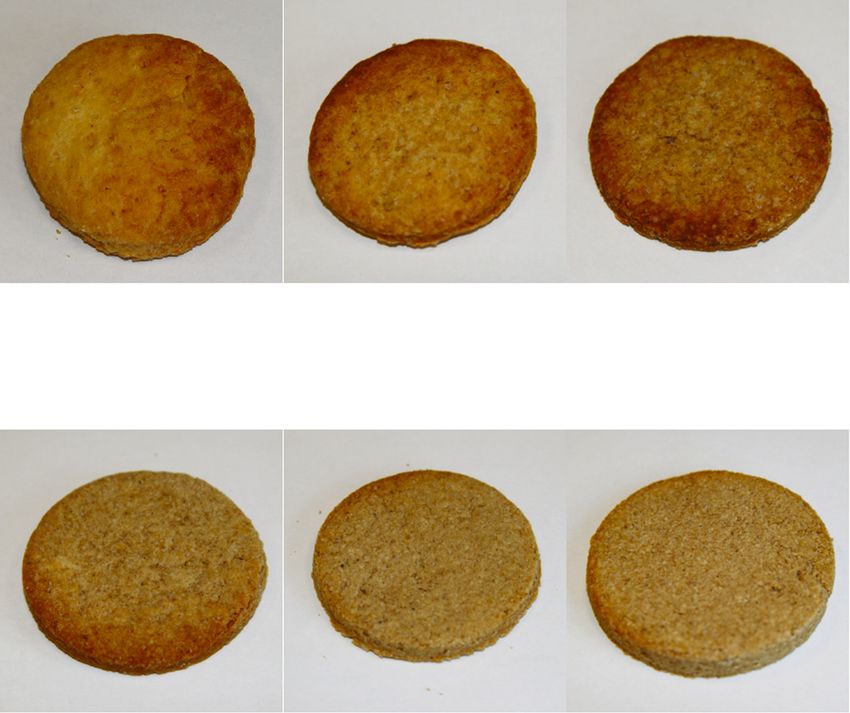
Changes in cookie color can influence the behavior
of consumers. Although the shift of color towards green
was not conspicuous, the lower color saturation of
2.5 Statistical analysis cookies with potato pulp may discourage consumers
from buying them (Figure 1).
The results of instrumental tests were subjected to the
statistical analysis using STATISTICA 13 software: one-
way analysis of variance and distinguishing of homo-
geneous groups by the Duncan test at the significance 3.2 Results of mechanical properties tests
level of α = 0.05.
The maximum force Fmax and energy E (Table 3) needed
to cut the raw dough or the baked cookie also depended
on the content of the dried potato pulp. The increasing
3 Results and discussion content of the dried potato pulp was linked with a
statistically significant rise in maximum force needed to
cut the cookies (from about 4 N for the control to about
3.1 Results of color measurements
16 N for 60% and 100% of flour replaced by potato pulp).
The changes in energy needed to cut dough were
Consumers are used to the typical appearance of somewhat different. In dough with potato pulp replacing
shortbread. Their enrichment with dietary fiber by 40% and 100% of flour, E values were only slightly
adding potato pulp to the recipe has a significant impact higher than the control value. In contrast, cutting the
on their appearance and tenderness. In the colorimetric dough with 60% of potato pulp required the greatest
analysis, the hue angle (H) ranged from about 73° in the energy (about 16 mJ). The presented results indicate that
Table 2: Dependence of cookie hue and color saturation value on potato pulp content (% of flour replaced by dried pulp). Homogeneous
groups were determined by the Duncan test and marked by small letters, LSD = 0.97
Potato pulp (%) 0% 20% 40% 50% 60% 100%
Hue (°) 73.18c 75.27b 76.1ab 74.0c 76.53a 76.71a LSD = 0.97
Color saturation 35.96a 31.57b 27.26c 28.81d 25.29e 22.92f LSD = 0.97738 Hanna Boruczkowska et al.
0% 20% 40%
50% 60% 100%
Figure 1: Photographs of baked cookies with 0% to 100% of flour replaced by dried potato pulp.
Table 3: Dependence of the maximum force needed to cut the raw dough and the cookies (Fmax) and the energy needed to cut the raw
dough and the cookies (E) on potato pulp content (% of flour replaced by dried pulp). Homogeneous groups were determined by the
Duncan test and marked by small letters
Potato pulp (%) 0% 20% 40% 50% 60% 100%
Fmax (N) of raw dough 3.44a 7.05b 8.96bc 10.73c 15.4d 14.12d LSD = 1.92
E (mJ) of raw dough 9.1a 16.56b 13.24c 19.79d 23.34e 12.02c LSD = 2.46
Fmax (N) of cookies 25.26a 31.77ab 28.78ab 53.83abc 68.18bc 90.31c LSD = 38.6
E (mJ) of cookies 11.81a 27.67abc 23.84ab 42.6bc 52.0c 125.12d LSD = 26.5
the increased proportion of potato pulp caused the cookies with 20–50% of flour replaced by potato pulp
formation of a harder surface layer on the dough, and formed a statistically homogeneous group, with energy
the cohesion of the inner part of the dough was most values varying from 24 to 41 mJ. However, complete
similar to the control in the case of dough with 40% and replacement of flour with the pulp resulted in an 8-fold
100% of flour replaced by the dried potato pulp. increase in the energy needed to cut the cookie. The
Results of strength tests of baked cookies were strength and the energy needed to break or bite cookies
slightly different (Table 3). Maximum forces needed to are some of the major parameters affecting the accep-
cut the cookies with 20–50% of flour replaced by potato tance of a food product by consumers [23].
pulp were similar and did not differ significantly from
the control value. This means that consumer assessment
of cookie brittleness after addition of up to 50% of dried 3.3 Results of organoleptic assessment
potato pulp should be similar.
A similar relationship was observed for measure- To assess how the consumers perceive the texture of the
ments of the energy needed to cut the baked cookies: it tested cookies, the products were subjected to sensory
was the lowest for control cookies (about 12 mJ), but consumer assessment on a 7-point hedonic scale (Figure 2).Effect of dried potato pulp on shortcrust pastry cookies 739
0%
7
6 Shape
5
4
100% 20% Cohesion
3
2
1 Structure
0
Taste and smell
60% 40%
50%
Figure 2: Results of consumer assessment of cookies with 0–100% of flour replaced by dried potato pulp.
In the sensory tests, control cookies were rated the Our findings are consistent with earlier studies.
highest. Increasing proportions of potato pulp resulted Baumgartner et al. [30] studied cookies with part of the
in lower scores for cookie structure, taste and smell, and flour replaced by oat bran. When 7–21% of flour was
cohesion (consistency). The structure of cookies with replaced by bran, no significant changes in cookie
potato pulp was rated lower because it was more parameters were observed although their color was
compact and not typical of shortcrust pastry according slightly darker. Curti et al. [31] investigated the influence
to consumers. This problem might be partly solved by of potato pulp on storage properties of bread and found
longer baking of the cookies with higher potato pulp an increase in product hardness during storage. Mudgil
content. The sensory properties can be affected by the et al. [32] added guar gum to cookies as a fraction of
addition of dietary fiber that is present in potato pulp. soluble fiber. Those authors reported a slightly lower
Many authors have noticed that cookies with a high fiber acceptability of the cookies with guar gum compared to
content are not well accepted [24–27]. However, there that of control cookies (7.51 vs 8.00).
are also studies in which it was found that substituting It can be concluded that the production of shortcrust
wheat flour with fiber at levels of up to 40% does not pastry cookies with up to 40% of flour replaced by dried
affect consumer acceptability [28]. The study by Jeddou potato pulp can be recommended. Mechanical properties
et al. [29] showed that substituting wheat flour in the of such cookies and their acceptance by consumers are
cake formulation with potato peel powder (up to 10%) similar to those of control cookies. The potato pulp used
maintained the sensory characteristics of the product. in this study contains 52.7% total dietary fiber. It means
Singh et al. [22] observed that incorporation of 40% that the use of the dried potato pulp can markedly
sweet potato flour yielded approximately similar results increase the dietary fiber content of such products, from
compared with wheat flour cookies. Similarly, in our about 6% when 20% of flour replaced by dried potato
study, the results of consumer assessment as well as
measurements of mechanical parameters of the cookies
indicate that the replacement of up to 40% of flour by Table 4: Correlation coefficients between instrumental measure-
the pulp enables manufacturing of products with similar ments of cookies and their consumer assessment
properties to those of the control cookies.
Coefficients of correlation of consumers rating with Maximum force needed Energy needed to
to cut a cookie (Fmax) cut a cookie (E)
instrumental measurements of cookie structure (Table 4)
were the highest (−0.95) between increasing hardness of Cohesion −0.96 −0.96
cookies (due to rising proportions of potato pulp) and Structure −0.95 −0.95
Taste and −0.96 −0.96
lowering scores of parameters like structure, cohesion,
smell
and taste and smell.740 Hanna Boruczkowska et al.
pulp, up to 30% when wheat flour is completely replaced process. J Cereal Sci. 2019;90:102852. doi: 10.1016/
by the potato pulp. Menis-Henrique et al. and Schmid j.jcs.2019.102852.
et al. stated that heat treatment does not significantly [2] Cappelli A, Oliva N, Cini E. Stone milling versus roller milling:
a systematic review of the effects on wheat flour
reduce the amount of fiber fraction [33,34], but several
quality, dough rheology, and bread characteristics. Trends
studies have revealed that the incorporation of high fiber Food Sci Technol. 2020;97:147–55. doi: 10.1016/
components increased significantly the total dietary fiber j.tifs.2020.01.008.
in the product after exposure to high temperature [3] Cappelli A, Cini E, Guerrini L, Masella P, Angeloni G, Parenti A.
[24,27,35]. Jeddou et al. reported that the incorporation Predictive models of the rheological properties and optimal
water content in doughs: an application to ancient grain flours
of the potato peel powders in cakes at 10% lead to an
with different degrees of refining. J Cereal Sci.
increase in the content of both soluble and insoluble 2018;83:229–35. doi: 10.1016/j.jcs.2018.09.006.
fiber [29]. In other studies, the increase in the dietary [4] Świderski F, Kolanowski W. Żywność wygodna i funkcjonalna.
fiber after cooking [36,37], frying, or roasting of potato Warszawa: Wydawnictwo WNT; 2003.
was observed [38]. The increase in the dietary fiber could [5] Council Directive 90/496/EEC of 24 September 1990 on
nutrition labelling for foodstuff.
generate the formation of resistant starch in products
[6] Kunachowicz H, Nadolna I, Iwanow K, Przygoda B. Wartość
after thermal processes and the formation of complexes
odżywcza wybranych produktów spożywczych i typowych
between polysaccharides and other compounds in the potraw. Warszawa: PZWL; 2012.
food (such as protein or lipid) [37,39]. [7] Kowalczewski PŁ, Olejnik A, Białas W, Rybicka I, Zielińska-
Dawidziak M, Siger A, et al. The nutritional nalue and
biological activity of concentrated protein fraction of potato
juice. Nutrients. 2019;11:1523. doi: 10.3390/nu11071523.
[8] Kowalczewski PŁ, Olejnik A, Białas W, Kubiak P, Siger A,
4 Conclusions Nowicki M, et al. Effect of thermal processing on anti-
oxidant activity and cytotoxicity of waste potato juice. Open
The results of this study proved that potato pulp may be Life Sci. 2019;14(1):150–7. doi: 10.1515/biol-2019-0017.
an excellent source of dietary fiber that can be used as a [9] Kowalczewski PŁ, Lewandowicz G, Makowska A, Knoll I,
substitute of flour in cookies. Moreover, noteworthy is Błaszczak W, Białas W, et al. Pasta fortified with potato juice:
structure, quality, and consumer acceptance. J Food Sci.
the fact that in this way, potato pulp is used as a source
2015;80:1377–82. doi: 10.1111/1750-3841.12906.
of fiber, and also this burdensome by-product of the [10] Recchia L, Cappelli A, Cini E, Garbati Pegna F, Boncinelli P.
starch industry can be utilized. The addition of potato Environmental sustainability of pasta production chains: an
pulp in an amount of up to 40% does not cause any integrated approach for comparing local and global chains.
remarkable change in their crispness and hardness, but Resources. 2019;8(1):56. doi: 10.3390/resources8010056.
[11] Kaack K, Pedersen L. Low-energy and high-fibre liver paté
shifts the color of the cookies from yellow towards green
processed using potato pulp. Eur Food Res Technol.
and causes a significant decline in their color saturation. 2005;220:278–82. doi: 10.1007/s00217-004-1055-6.
It is a success that consumers rated the cookies with the [12] Kaack K, Laerke HN, Meyer AS. Liver paté enriched with dietary
addition of pulp in an amount up to 40% as acceptable, fibre extracted from potato fibre as fat substitutes. Eur Food
which means that a large amount of this waste can be Res Technol. 2006;223:267–72. doi: 10.1007/s00217-005-
utilized in the confectionery industry. 0200-1.
[13] Kaack K, Pedersen L. Low energy chocolate cake with potato
pulp and yellow pea hulls. Eur Food Res Technol.
Conflict of interest: The authors state no conflict of 2005;221:367–75. doi: 10.1007/s00217-005-1181-9.
interest. [14] Kaack K, Pedersen L. Application of by-products from
industrial processing of potato flour and yellow peas as
Data availability statement: The datasets generated ingredients in low-fat high-fibre sausages. Eur Food Res
Technol. 2005;221:313–9. doi: 10.1007/s00217-005-1167-7.
during and/or analyzed during the current study are
[15] Kaack K, Pedersen L, Laerke HN, Meyer A. New potato fibre for
available from the corresponding author on reasonable improvement of texture and colour of wheat bread. Eur Food
request. Res Technol. 2006;224:199–207. doi: 10.1007/s00217-006-
0301-5.
[16] Juliszewski T, Kowalczyk Z, Malinowski M, Sobol Z, Wrona P.
Metoda szczegółowej klasyfikacji odpadów z sektora rolnic-
zego i rolnospożywczego. Infrastruktura i Ekologia Terenów
References Wiejskich. POLSKA AKADEMIA NAUK. Oddz w Krakowie.
2012;2:141–52.
[1] Cappelli A, Guerrini L, Cini E, Parenti A. Improving whole [17] Kot AM, Pobiega K, Piwowarek K, Kieliszek M, Błażejak S,
wheat dough tenacity and extensibility: a new kneading Gniewosz M, et al. Biotechnological methods of managementEffect of dried potato pulp on shortcrust pastry cookies 741
and utilization of potato industry waste: a review. Potato Res. and sensory properties of cakes by addition of potato peel
2020;63:431–47. doi: 10.1007/s11540-019-09449-6. powder with high level of dietary fiber and protein. Food
[18] Precise Colour Communication. Colour control from perception Chem. 2017;217:668–77. doi: 10.1016/
to instrumental. Konica Minolta Sensing; 2003. j.foodchem.2016.08.081.
[19] Żbikowska A, Rutkowska J, Marcinkiewicz A. Ocena mechan- [30] Baumgartner B, Özkaya B, Saka I, Özkaya H. Functional and
icznych właściwości ciastek kruchych metodą instrumentalną, physical properties of cookies enriched with dephytinized oat
Żywność. Nauka Technologia Jakość. 2009;2(63):103–11. bran. J Cereal Sci. 2018;80:24–30. doi: 10.3390/
[20] Guerrini L, Napoli M, Mancini M, Masella P, Cappelli A, foods9020220.
Parenti A, et al. Wheat grain composition, dough rheology and [31] Curti E, Carini E, Diantom A, Vittadini E. The use of potato fibre
bread quality as affected by nitrogen and sulfur fertilization to improve bread physico-chemical properties during storage.
and seeding density. Agronomy. 2020;10(2):233. Food Chem. 2016;195:64–70. doi: 10.1016/
doi: 10.3390/agronomy10020233. j.foodchem.2015.03.092.
[21] Gómez M, Oliete B, Rossel CM, Pando V, Fernández E. Studies [32] Mudgil D, Barak S, Khatkar BS. Cookie texture, spread ratio
on cake quality made of wheat-chickpea flour blends. LWT- and sensory acceptability of cookies as a function of soluble
Food Sci Technol. 2008;41(9):1701–9. doi: 10.1016/ dietary fiber, baking time and different water levels. LWT.
j.lwt.2007.11.024. 2017;80:537–42. doi: 10.1016/j.lwt.2017.03.009.
[22] Singh S, Riar CS, Saxena DC. Effect of incorporating [33] Menis-Henrique MEC, Scarton M, Piran MVF, Clerici MTPS.
sweetpotato flour to wheat flour on the quality characteristics Cereal fiber: extrusion modifications for food industry. Curr
of cookies. Afr J Food Sci. 2008;2:65–72. Opin Food Sci. 2020;33:141–8. doi: 10.1016/
[23] Gaines CS, Kassuba A, Finney PL, Donelson JR. Instrumental j.cofs.2020.05.001.
measurement of cookie hardness. II. Application to product [34] Schmid V, Steck J, Mayer-Miebach E, Behsnilian D, Briviba K,
quality variables. Cereal Chem. 1992;69:120–5. Bunzel M, et al. Impact of defined thermomechanical
[24] Ajila CM, Leelavathi K, Rao U. Improvement of dietary fiber treatment on the structure and content of dietary fiber and the
content and antioxidant properties in soft dough biscuits with stability and bioaccessibility of polyphenols of chokeberry
the incorporation of mango peel powder. J Cereal Sci. (Aronia melanocarpa) pomace. Food Res Int.
2008;48:319–26. doi: 10.1016/j.jcs.2007.10.001. 2020;134:109232. doi: 10.1016/j.foodres.2020.109232.
[25] Ayadi MA, Abdelmaksoud W, Ennouri M, Attia H. Cladodes [35] Sudha ML, Vetrimani R, Leelavathi K. Influence of fiber from
from Opuntia ficus indica as a source of dietary fiber: effect on different cereals on the rheological characteristics of wheat
dough characteristics and cake making. Ind Crop Products. flour dough and on biscuit quality. Food Chem.
2009;30:40–7. doi: 10.1016/j.indcrop.2009.01.003. 2007;100:1365–70. doi: 10.1016/j.foodchem.2005.12.013.
[26] Grigelmo-Miguel N, Carreas-Boladeras E, Martin-Belloso O. [36] Thian J, Chen J, Ye X, Chen S. Health bebefits of the potato
Influence of the addition of peach dietary fiber in composition, affected by domestic cooking: a review. Food Chem.
physical properties and acceptability of reduced-fat muffins. 2016;202:165–75. doi: 10.1016/j.foodchem.2016.01.120.
Food Sci Technol Int. 2001;7:425–31. doi: 10.1106/fllh-k91m- [37] Dhingra D, Michael M, Rajput H, Patil RT. Dietary fibre in
1g34-y0el. foods: a review. J Food Sci Technol. 2012;49(3):255–66.
[27] Larrea MA, Chang YK, Martinez-Bustos F. Some functional doi: 10.1007/s13197-011-0365-5.
properties of extruded orange pulp and its effect on the [38] Murniece I, Karklina D, Galoburda R, Santare D, Skrabule I,
quality of cookies. LWT Food Sci Technol. 2005;38:213–20. Costa HS. Nutritional composition of freshly harvested
doi: 10.1016/j.lwt.2004.05.014. and stored Latvian potato (Solanum tuberosum L.)
[28] Laguna L, Salvador A, Sanz T, Fiszman SM. Performance of a varietes depending on traditional cooking methods. J Food
resistant starch rich ingredient in the baking and aeting Compos Anal. 2011;24(4–5):699–710. doi: 10.1007/s13197-
quality of short-dough biscuits. LWT Food Sci Technol. 011-0365-5.
2011;44:737–46. doi: 10.1016/j.lwt.2010.05.034. [39] Yadav BS. Effect of frying, baking and storage conditions on
[29] Jeddou KB, Bouaziz F, Zouari-Ellouzi S, Chaari F, Ellouz- resistant starch content of foods. Br Food J.
Chaabouni S, EllouzGhorbel R, et al. Improvement of texture 2011;113(6):710–71. doi: 10.1108/00070701111140061.You can also read


