Effect of fuel spatial resolution on predictive wildfire models
←
→
Page content transcription
If your browser does not render page correctly, please read the page content below
CSIRO PUBLISHING

International Journal of Wildland Fire 2021, 30, 776–789
https://doi.org/10.1071/WF20192

     Effect of fuel spatial resolution on predictive
     wildfire models

     Ritu Taneja A,B,D, James Hilton               B
                                                       , Luke Wallace C, Karin Reinke A and
     Simon Jones A
     A
      Geospatial Science, RMIT University, Melbourne, Vic. 3001, Australia.
     B
      CSIRO Data61, Private Bag 10, Clayton South, Vic. 3169, Australia.
     C
      School of Geography, Planning and Spatial Sciences, University of Tasmania, Hobart,
      Tas. 7015, Australia.
     D
       Corresponding author. Email: s3704716@student.rmit.edu.au

     Abstract. Computational models of wildfires are necessary for operational prediction and risk assessment. These
     models require accurate spatial fuel data and remote sensing techniques have ability to provide high spatial resolution
     raster data for landscapes. We modelled a series of fires to understand and quantify the impact of the spatial resolution of
     fuel data on the behaviour of fire predictive model. Airborne laser scanning data was used to derive canopy height models
     and percentage cover grids at spatial resolutions ranging from 2 m to 50 m for Mallee heath fire spread model. The shape,
     unburnt area within the fire extent and extent of fire areas were compared over time. These model outputs were strongly
     affected by the spatial resolution of input data when the length scale of the fuel data is smaller than connectivity length
     scale of the fuel. At higher spatial resolutions breaks in the fuel were well resolved often resulting in a significant reduction
     in the predicted size of the fire. Our findings provide information for practitioners for wildfire modelling where local
     features may be important, such as operational predictions incorporating fire and fuel breaks, and risk modelling of peri-
     urban edges or assessment of potential fuel reduction mitigations.

     Keywords: wildfire modelling, vegetation structure, airborne laser scanning, fuel sampling, Spark, Spatial resolution.

     Received 3 January 2021, accepted 26 July 2021, published online 26 August 2021

Introduction                                                            simplistic. For example, Cassagne et al. (2011) considered only
Accurately predicting the behaviour of wildland fires is                fine fuels and Mell et al. (2007) treated live fuel combustion in
exceedingly difficult due to the complex set of coupled pro-            the same way as dead fuels only with higher moisture content.
cesses that drive fire spread. These include weather, topography,       Furthermore, apart from a few examples of the evaluation of
fuel moisture and forest fuel structure (Alexander 2013). Recent        predicted rates of fire spread and behaviour against large-scale
advances in computational models have shown the potential to            experimental fire observations published to date (e.g. Mell et al.
predict fire behaviour effectively (Gould et al. 2007; Cruz et al.      2007; Linn et al. 2012a; Dupuy et al. 2014; Pimont et al. 2014),
2013). These models are used to characterise fire behaviour             the veracity of physical model results have not been rigorously
under specific fuel and weather conditions and examine the              tested (Alexander and Cruz 2013). Due to the limitations in
potential effectiveness and ecological impacts of fuel treatment        knowledge and the dependence of the physical models on
programs and predict fire spread during a fire event. Wildfire          empiricism, use of physical model operationally is still ques-
models are typically grouped into two categories: (1) physical          tionable (Cruz et al. 2017; Jiang et al. 2021).
models; and (2) empirical models (Sullivan 2009a, 2009b).                   Empirical models are based on data from field experiments
Physical models are primarily developed with an aim of simu-            (Cheney et al. 1998; Gollner et al. 2015; Cruz et al. 2017). They
lating the physical and chemical processes controlling fire             are fast to evaluate, making them ideal for providing rapid large-
propagation and other aspects of fire behaviour (Morvan 2011;           area predictions for the path of a fire (Hilton et al. 2019). These
Sullivan 2017a, 2017b). Physical models give a better under-            models predict the behaviour of a fire using a set of associations
standing of how fuel treatments modify fire behaviour. How-             between factors driving the fire (Sullivan 2009b). These include
ever, the necessary knowledge for accurate process level                weather conditions such as wind and air temperature, as well as
modelling of combustion chemistry and outputs, heat release             fuel and landscape conditions. Fuels have particular importance
and heat transfer are still incomplete (Hanson et al. 2000; Finney      as they are the only element of the landscape that can be
et al. 2013). Despite the complexity of these models, the use of        modified to influence the behaviour of future fires (Duff et al.
spatially heterogeneous fuel distributions has been overly              2017). As such, it is important to have detailed knowledge and

Journal compilation Ó IAWF 2021 Open Access CC BY-NC-ND                                                  www.publish.csiro.au/journals/ijwf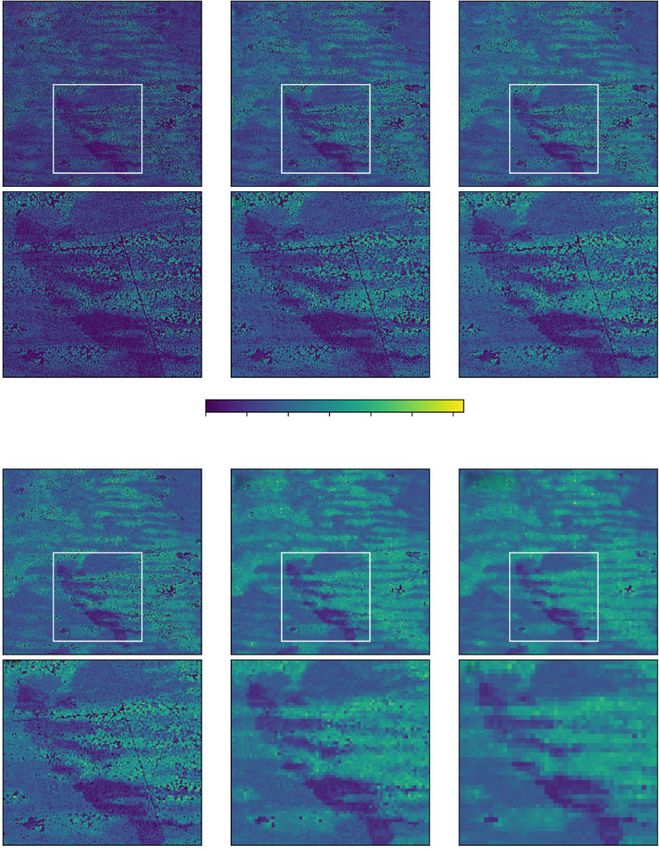
Effect of spatial resolution on wildfire models                                                                           Int. J. Wildland Fire    777

                                  Table 1. Selected studies which utilise ALS to derive wildfire fuel related metrics

Reference                            Metrics derived                                                                           Data resolution

Erdody and Moskal 2010               Canopy height, canopy base height, canopy bulk density                                    20 m
González-Olabarria et al. 2012      Forest canopy cover, shrub cover, Lorey’s height, mean shrub height, crown biomass        Landscape level (500 m2)
Kane et al. 2014                     Canopy gap, clump open and open                                                           30 m
Kramer et al. 2014                   Canopy base height, canopy fuel, basal area                                               30 m
Montealegre et al. 2014              Composite Burn Index (CBI)                                                                25 m
Gajardo et al. 2014                  Canopy surface height, canopy base height, canopy bulk density                            25 m
Huesca et al. 2019                   Fuel type, vertical vegetation profile                                                    30 m
Engelstad et al. 2019                crown fuel base height, live crown base height, canopy bulk density and stand age         10 m
Botequim et al. 2019                 Mean height, stand basal area, stand volume over bark, canopy base height                 22 m diameter plots

understanding of relevant biomass characteristics, or fuel struc-             is unable to measure detailed vertical measurements of forest
ture, as they affect fire propagation and behaviour (Bradstock                structure often required for use in fire simulation models
et al. 2012; Blanchi et al. 2014). The structure of fuel includes             (Matese et al. 2015), although future technologies (NASA’s
properties such as the horizontal and vertical distribution, the              Global Ecosystem Dynamics Investigation; GEDI) may be able
percentage of live and dead fuel and the abundance of vegetative              to progressively bridge this gap (Dubayah et al. 2017; 2020).
elements above the ground level including woody debris,                           Airborne laser scanning (ALS) is an active remote sensing
branches, barks, foliage and stems (McElhinny et al. 2005;                    technique that utilises the reflections from emitted laser pulses
Ravindranath and Ostwald 2008).                                               from a known location and orientation to determine the 3D
    Given the influence of local wind conditions and fuel                     properties of the environment (Koma et al. 2021). Studies have
heterogeneity, it is essential to explicitly account for the effects          shown that ALS can provide estimates of 3D forest canopy
of fuel structure when exploring the interaction between forest               structure (Lim et al. 2003; Korhonen et al. 2011; Hancock et al.
structure and fire behaviour (Pimont et al. 2011; Linn et al.                 2017). ALS-derived canopy height models have been used to
2013; Hoffman et al. 2015; Parsons et al. 2017; Ziegler et al.                describe canopy height distribution (Hopkinson et al. 2004,
2017; Atchley et al. 2021). Thus, it is important to explicitly               2006; Rosette et al. 2008; Nie et al. 2018) to identify individual
incorporate the effects of canopy structure to improve the                    tree heights (Brandtberg 1999; Hyyppä and Inkinen 1999; Yao
behaviour of fire (Hilton et al. 2015). However, studies that                 et al. 2013), and to estimate biomass (Cao et al. 2014) and leaf
systematically characterise the sensitivity of fire behaviour to              area index (LAI) (Luo et al. 2015). However, the reliability of
the spatial resolution of fuel inputs are absent owing to poorly              estimates can be degraded in lower forest strata particularly in
described fuel conditions and computational or experimental                   areas of high canopy cover due to occlusion (Chasmer et al.
costs. Therefore, the response of fire behaviour to fuel arrange-             2006; Vega et al. 2014; Fieber et al. 2015; Jarron et al. 2020).
ment remains poorly quantified, which limits estimates of fire                Furthermore, the resolution of the data has also been shown to
outcomes (Duff et al. 2017).                                                  play a role in the reliability of estimates from all canopy strata
    Techniques employed to estimate forest structure and bio-                 (Hayashi et al. 2014; Wilkes et al. 2015). For example, studies
mass include both direct and indirect methods of assessment.                  by Jakubowski et al. (2013) and Leitold et al. (2015) show that
Direct methods involve destructive sampling of vegetation and                 there is trade-off between LiDAR pulse density and forest
are considered to be the most accurate form of assessment                     measurement accuracy.
(Brown et al. 1989; Volkova et al. 2016). Samples are collected                   There have been many studies exploring the potential of
on site, then weighed, dried in an oven or microwaved to                      LiDAR to measure fuel properties some of which are sum-
constant dry-weight and re-weighed. These dry weights are then                marised in Table 1. In most cases, this has involved calculating
used to estimate the volume of biomass in the plot (or given                  parameters for fire behaviour models, including canopy height,
strata) (Hawley et al. 2018). Models have been developed to                   canopy base height or canopy bulk density (González-Olabarria
facilitate the extrapolation of this data over a wider area                   et al. 2012; Erdody and Moskal 2010). Due to the large amount
(Ohsowski et al. 2016). However, achieving a suitable number                  of evidence highlighting the ability of ALS to derive fuel related
of samples can be labour and cost intensive and time-consuming                metrics, their value in operational risk and modelling frame-
(Loudermilk et al. 2009; Elshikha et al. 2016).                               works are likely to be high (Price and Gordon 2016; Parsons
    In contrast to destructive sampling techniques, indirect                  et al. 2017; Gale et al. 2021). However, the spatial resolution of
assessment using remote sensing can provide synoptic, spatially               the data obtained and used in fire behaviour models from ALS
comprehensive characteristics of investigated forest stands in an             data can vary significantly (Table 1). Given the potential of ALS
efficient manner. Data captured over varying spatial, spectral                data and the ability to derive fuel maps at a range of spatial
and temporal scales has been used for the purpose of forest cover             resolutions, a greater understanding of how resolution interacts
and health assessment (Coppin and Bauer 1996; Boyd and                        with existing fuel models is required.
Danson 2005; Devaney et al. 2015; Pause et al. 2016; Lausch                       This study aimed to investigate the impact of varying spatial
et al. 2017). Satellites are suitable for covering a large area for           resolution of input fuel data on the performance of a predictive
conducting multi-temporal analysis. However, satellite imagery                wildfire model using real world fuel data. To our knowledge,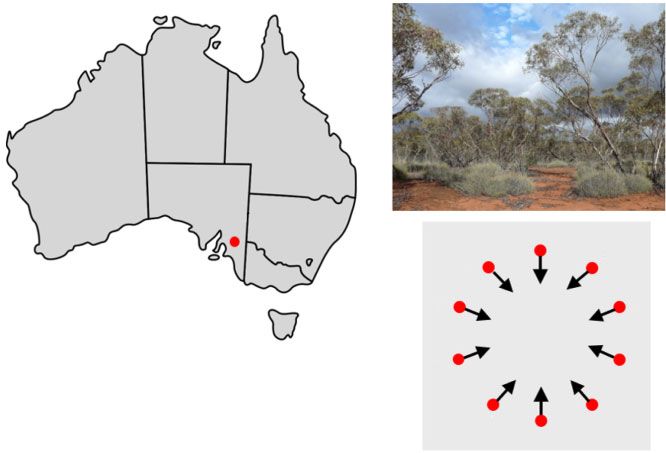
778     Int. J. Wildland Fire                                                                                                          R. Taneja et al.

                                                                                   (b)
                            (a)

                                                       Calperum Mallee
                                                                                    (c )                      1
                                                                                                   10                   2

                                                                                               9                             3

                                                                                               8                             4

                                                                                                        7               5
                                                                                                               6

                         Fig. 1. (a) Location of the study area in south-east of the state of South Australia. (b) Vegetation
                         present in the study area (source: https://supersites.tern.org.au/supersites/clpm). (c) Plot design used
                         for the study area showing the location of 10 ignition points. The wind direction at each ignition point is
                         shown as black arrows. The points were chosen to be 1.5 km from the centre of the area and at 368
                         intervals from each other.

there is limited research or guidance to select a suitable spatial               Fire propagation model
resolution of input fuel data for fire behavioural and predictive                The vegetation in the area was modelled using an empirical
models. This study therefore fills an essential knowledge gap by                 Mallee fire spread model developed by Cruz et al. (2013). This
providing information on the impact of spatial resolution input                  model gives rate of spread of both the possible surface fire, Rs
fuel data on model outputs. We model the spread of a series of                   (m min1) and crown fire, Rc (m min1) as a function of the 10-m
hypothetical fires in the Australian Mallee vegetation type using                open wind speed, U10 (km h1) and fuel parameters. The fuel
an empirical Mallee heath fire spread model (Cruz et al. 2013),                  parameters are the dead litter moisture content, MC (%), the
which gives the forward spread of the fire as a function of                      canopy cover, Covo (%) and the canopy height, H (m). The rate
canopy cover and height. ALS data is used to provide these                       of spread is given by:
inputs at a range of spatial resolutions. In this study, we employ
’Spark’, an open framework for wildfire prediction and analysis                      Rs ¼ 3:337  U10  expð0:1284  MCÞ  H 0:7073              ð1Þ
(Miller et al. 2015).
                                                                                   Rc ¼ 9:5751  U10  expð0:1795  MC Þ  ðCov0 =100Þ0:3589 ð2Þ
Method
Study area                                                                       where the moisture content used is given by Cruz et al. (2010):
The study area for this experiment was the Calperum Mallee
TERN Super Site located 25 km north of Renmark in South                            MC ¼ 4:79 þ 0:173  RH  0:1  ðT  25Þ  D  0:027  RH ð3Þ
Australia (338440 4900 S, 1408520 2200 E) (Fig. 1a). This site was
chosen due to the availability of a published empirical fire spread              where RH is the relative humidity (%), T is the air temperature
model for the fuel type at the site (see Fire propagation model)                 (8C) and D is solar radiation variable.
and high-resolution remote sensing data (see Remote sensing data                     Note Eqn 3 only holds during daytime hours (D ¼ 1 and 0
and pre-processing). The landscape is dominated by ancient sand                  otherwise). Rather than assuming the fire is a surface or crown
hills that run approximately east–west, with undulation from                     fire the model uses a probability of crowning (Pc), and combines
swale to crest being up to 8 m in elevation (Meyer et al. 2015).                 Eqn 1 and Eqn 2 into an overall rate of spread, S (m min1) using
    The vegetation in the area is dominated by multi-stem                        this probability:
Eucalypt tree species (Eucalyptus dumosa, Eucalyptus incras-
sata, Eucalyptus oleosa and Eucalyptus socialis) (Fig. 1b).                                          S ¼ ð1:0  Pc Þ  Rs þ Pc  Rc                ð4Þ
These trees are sparsely distributed (approximately 3 m apart)                   where
and grow between 3.5 and 7 m (Meyer et al. 2015). The site
contains a sparse mid-storey consists of Eremophila, Hakea,                      Pc ¼ 1:0=ð1:0 þ expðð11:138 þ 1:4054  U10  3:4217  MCÞÞÞ
Olearia, Senna and Melaleuca genera and a spaced understorey
of spiny grass.                                                                                                                                    ð5Þ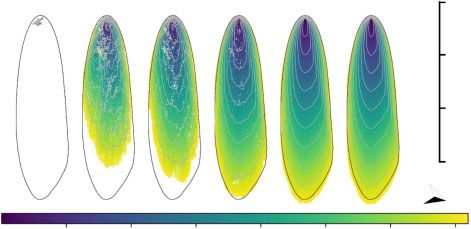
Effect of spatial resolution on wildfire models                                                                Int. J. Wildland Fire     779

   From Eqn 1, Rs –. N as H –. 0. To circumvent this, we               grids using different spatial resolutions. The cell resolution of
imposed the condition Rs 5 0 at H ¼ 0.                                 grids was set to 2 m, 5 m, 7 m, 10 m, 30 m and 50 m. These
   The Mallee heath model provides a 1D frontal rate of spread         resolutions were chosen based on the point density of the ALS
but must be modified for a 2D fire simulation. This is carried out     data and the current data resolutions used in operational settings
by assuming the 2D shape is locally elliptical with a given            (Table 1).
length-to-breadth ratio (Alexander 1985). In lieu of measured             At each resolution, canopy height was computed for each
data for this fuel type (Mallee), we have used fitted elliptical       grid cell as the 95th percentile of the AGH for each point that fell
parameters for eucalypt forest (Cruz et al. 2013):                     within that cell. To calculate canopy cover, a grid-based tech-
                                                                       nique following Korhonen et al. (2011) was used. First a binary
                  LBR ¼ 0:1143  U10 þ 0:4143                   ð6Þ    1 m resolution grid was created signifying the presence (1) or
                                                                       absence (0) of any return classified as being from the canopy.
   The fire spread model also requires the starting conditions of      Binary opening and closing are then applied to remove any small
the fire (e.g. ignition points, lines or areas of existing fire).      gaps in the data. The canopy cover at each resolution was then
Typically, topography information is also required as the speed        calculated as the proportion of 1 m grid cells containing canopy
of a fire is dependent on the slope of the terrain. This effect was    vegetation (or 1 in the binary grid) against the total number of
ignored for the simulations in this study as the focus was on the      1 m grid cells in each cell (i.e. there are 25 (1 m) cells within each
effect of spatial resolution on fuel data. The parameters in these     5 m grid cell for example). As each cell of the 2 m resolution grid
models are based on regressions from the experimental data and         only contains four (1 m) grids cells, a 0.5 m resolution binary
as such represent an average rate of spread.                           grid was used in place of the 1 m resolution grid to allow for a
                                                                       more continuous canopy cover estimate.
Remote sensing data and pre-processing
                                                                       Fire spread modelling environment and parameterisation
The ALS data used in this study was obtained from TERN
AusCover (http://www.auscover.org.au/). Small footprint ALS            The area where the fire could be modelled was limited by the
data was acquired at a flying height of 600 m above ground level       extent of the airborne ALS capture (5  5 km). To remove any
over 5  5 km study site in February 2012 with the aim of              bias in the fuel distribution pattern (e.g., horizontal striations),
characterising the vegetation and landscape of the site. A Riegl       10 ignition points were distributed evenly (at 36-degree
LMS-Q560 laser scanner was used to capture data with a                 intervals) around the edges of a 1.5 km radius circle centred
nominal pulse density of 10 pulses per m2 and with a maximum           within the data capture (Fig. 1c). At each ignition point, the wind
of seven returns per pulse.                                            direction was set such that the fire would pass through the centre
   Data was collected from a fixed wing aircraft using north-          of the study area. This allowed for a model duration of 1 h to
south orientated flight lines with a spacing of 125 m and a            sufficiently represent a medium-sized fire and to ensure each
maximum scan angle of 458 field of view. The swath overlap             simulated fire extent (at each ignition point and data resolution)
between flight lines was 50%. The scanner has a beam divergence        remained within the footprint of the ALS data. Furthermore, this
of 0.5 mrad resulting in a laser footprint of 30 cm on the ground.     also served to remove any directional bias in the results as the
   Discrete returns were classified into either ground or non-         fires moved in different directions for each of the 10 simulations.
ground using the python implementation of the Cloth Simula-                To determine the effect of varying the resolution of fuel
tion Filter (CSF) (https://github.com/jianboqi/CSF). A complete        properties, the weather conditions and topography information
description of the CSF algorithm and the various parameters can        were held constant in each simulation. The Mallee model was
be found in Zhang et al. (2016). In brief, this filter identifies      developed to suit a range of weather conditions (wind speed, 3.6–
points that are most likely belonging to the ground through the        31.5 km h1; temperature, 15–398 C’; relative humidity, 7–80%)
simulation of a rigid cloth draped over the point set. The filter is   (Cruz et al. 2010). In this study, we chose to simulate moderate
parameterised using height differences, grid resolution, time          conditions within these ranges, wind speed was set to 30 km h1,
step and rigidness parameters. In this case, values of 0.02, 0.5, 2    temperature to 258C and relative humidity was set to 20%.
and 3 were applied for height difference, grid resolution, time            A separate Spark simulation was completed for each fuel
step and rigidness, respectively.                                      resolution at each ignition point. The raster resolution of the
   Once the ground points were identified, linear interpolation        model simulations was set to 1 m  1 m. All input raster layers
was used to generate a 1 m resolution Digital Elevation Model          were re-sampled to this resolution and all output layers written at
(DEM). Subsequently, the above ground height (AGH) of all              this resolution. Once the simulated fire reaches the cell’s
non-ground points was calculated by subtracting the value of the       centroid the cell is considered ignited (and burnt by the end of
DEM elevation at each horizontal location. Points with an AGH          the simulation) and the current time is recorded as the arrival
of greater than 1.35 m were then classified as originating from        time of fire. After the simulation has been completed, an arrival
the canopy. This height has been shown to efficiently separate         time raster and a shapefile of arrival time isochrones is generated
the tree crowns from the under-storey and ground vegetation            as output.
(McLane et al. 2009).
                                                                       Model output and statistics used
Fuel metric extraction                                                 For this study, all simulations were summarised by the total area
In order to quantify the impact of spatial resolution on the fire      burnt by fire and the ratio between the unburnt area within the
spread predictions, canopy height and cover were calculated for        fire perimeter and the total area of the fire perimeter. Area burnt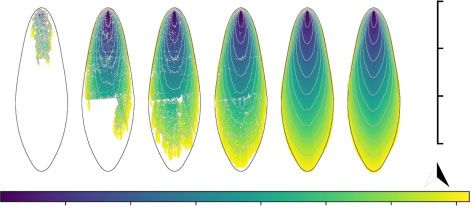
780     Int. J. Wildland Fire                                                                                                R. Taneja et al.

is a commonly used metric when fire behaviour and effects are          a lower number of cells recording no vegetation and thus a
being examined. It has been used in addressing many ecological         canopy height of 0 m (seen as a peak at 0 m in the violin plots at
and Earth science challenges, including characterising wildfires       2 m, 5 m, 7 m and to a lesser extent 10 m in Fig. 4). The standard
and evaluating their impacts (Golding and Betts 2008; Luo and          deviation of heights ranges from 2.24 m for the 2 m spatial
Weng 2011; Johnston et al. 2012; Kloster et al. 2012). However,        resolution grid to 1.68 m for the 50 m spatial resolution grid.
area alone often ignores the existence of unburnt area within a           A similar trend to that observed from canopy height is seen
fire perimeter (depending on the level of detail in the observa-       for canopy cover where there are several cells containing no
tional data); discriminating between burnt/unburnt area is an          canopy points at high resolutions resulting in a cover of 0%, or
important component of the burn mosaic (Kolden et al. 2012,            cells completely covered resulting in 100% cover (Fig. 5). These
2015; Krawchuk et al. 2016). The fire perimeter was defined by         features are not present at lower spatial resolutions. As spatial
an alpha shape (alpha ¼ 1.5) created around the centre point of        resolution decreases from 7 m, a narrowing of the distribution
all burnt cells. The area burnt was estimated as the summed area       can be observed most notable at 30 m and 50 m. Variations in the
of the grid cells burnt at the end of the simulation.                  mean cover between resolutions can also be observed in Fig. 5.
    To compare simulations obtained from the different spatial         While the mean cover is lowest at 2 m resolution (44%), a trend
resolution input fuel data, a reference fire was also simulated on     showing a reduction in cover with decreasing resolution is
a constant landscape with fixed canopy cover and height input          observed between the other resolutions from 62% (5 m) to
variables. The reference fire is an artificial benchmark in            55% (50 m).
homogeneous fuel conditions to allow comparison between                   Fig. 6 shows semi-variogram for both canopy height and
the fires. The constant cover and height for the uniform/              cover using 2 m spatial resolution input data. Both canopy height
continuous landscape were taken as the mean cover and height           (Fig. 6a) and cover (Fig. 6b) are spatially correlated up to 10 m.
of the of 5 m resolution grids. The final shape of each simulation     The magnitude of spatial correlation decreases with separation
was compared to the burnt area of this reference fire using the        distance and no spatial correlation exists after 10 m, the range of
Jaccard Similarity Index (J) (Glen 2016). Several studies have         correlation. The nugget for both canopy cover and height at 2 m
used J to compare actual fire events with simulated fires              spatial resolution is zero, which shows that there is no spatial
(Kalabokidis et al. 2013; Filippi et al. 2014) and describe            variation at distances smaller than the sampling interval.
burnt/unburnt area (Gandiwa 2011). This J index simply
expresses the proportion of burnt cells common between two             Modelled fire patterns and unburnt area
fire simulations and is given by:                                      The model output is affected by the spatial resolution of input
                                                                       data. In general, simulations running on a single resolution for
                      J ¼ ðA \ BÞ=ðA [ BÞ                       ð7Þ    all ignition points reported similar fire patterns. This was
                                                                       observed for each of the resolution, and ignition point and wind
where A is the number of grid cells burnt in landscapes using          direction combinations.
different input data resolutions and B is the number of grid cells         Fire spread from the model appears to be affected by how
burnt in the reference simulation.                                     the breaks in canopy are represented at different resolutions
                                                                       (Figs 7, 8). In the 2 to 10 m resolution grids, connectivity is
Results                                                                low, slowing down or extinguishing the fire spread. However, at
                                                                       low spatial resolution (30–50 m grids), fewer breaks and lower
Canopy height and canopy cover representation                          canopy heights are present, which helps the fire to propagate
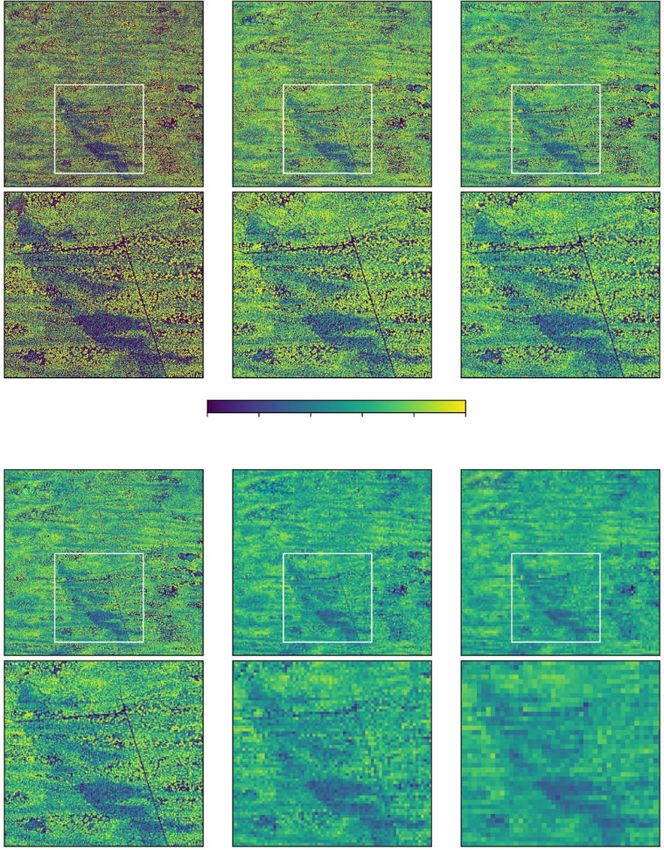
Figs 2 and 3 show the spatial distribution of canopy height and        smoothly without interruption (Figs 7, 8). This is particularly
canopy cover for the study area at the different spatial resolu-       evident with the presence of the east–west road in the study area
tions. Several differences can be seen in how these fuel prop-         (Fig. 7). For the 5 m resolution simulation, this road for most of its
erties are represented at the six different resolutions. At higher     intercepted length prevents fire spread. This effect is greatest
spatial resolutions (2 m and 5 m), features such as roads and          when wind is perpendicular to the linear feature (for an example,
evidence of past fires are very apparent in both the height and        see Supplementary Fig. S1 available at the journal website).
cover grids (Figs 2d, e, 3d, e). Such features become less                 From Table 2, it can be seen that J increases with decrease in
prominent at the 7 and 10 m spatial resolutions (Figs 2f, k, 3f, k);   spatial resolution, indicating that simulated fires become
nevertheless, at these resolutions key landscape features rele-        increasingly similar to the reference fire at low spatial resolu-
vant to fire behaviour (such as roads and evidence of past fires)      tion. The same value of J for simulation running with low spatial
remain distinguishable. At both 30 and 50 m resolutions, some          resolution input data (30 m and 50 m) indicates that modelled
of these features can still be made out but no longer have well        fire spread is independent of resolution once the cell size is 30 m
defined edges resulting in smooth transitions between areas of         or above. The area covered at these resolutions is slightly greater
low and high canopy height and cover (Figs 2l, m, 3l, m).              than the constant landscape. This is likely due to the representa-
    The violin plots (Figs 4, 5) show the distribution of the          tion of the fuel landscape having a slightly higher canopy height
canopy height and cover on a vertical axis allowing for easy           than the constant landscape at these resolutions.
comparison between the canopy height and cover distribution                Fig. 9 illustrates the ratio of unburnt area to total area in fire
for different resolutions. The distribution of canopy heights          perimeter for each spatial resolution (also reported in Table 2),
(Fig. 4) indicates that canopy height increases from a mean of         aggregated for all of the ignition points. This ratio shows greater
2.37 m for the 2 m spatial resolution grid to 4.45 m for the 50 m      variation at 2 m and this variation decreases with decreased
spatial resolution grid. This increase in mean height is driven by     spatial resolution. The mean ratio value also decreases when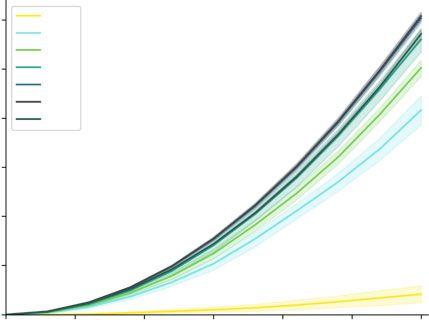
Effect of spatial resolution on wildfire models                                                                                     Int. J. Wildland Fire   781

                    (a) 2 m                                     (b ) 5 m                                    (c ) 7 m

                    (d )                                        (e )                                        (f )

                                                         0       2      4       6        8     10      12
                                                                            Height (m)

                    (h ) 10 m                                   (i ) 30 m                                   ( j ) 50 m

                    (k)                                         (l)                                         (m)

                   Fig. 2. Canopy height maps produced from ALS data for different spatial resolution over the 5  5 km study area.
                   Parts (d, e, f, k, l and m) show the zoomed-in portion (white rectangle) of (a) 2 m, (b) 5 m, (c) 7 m, (h) 10 m, (i) 30 m and
                   (j) 50 m spatial resolution canopy heights, respectively.

fuel inputs with decreased spatial resolution are used. Input                       points and the shading shows the 95% confidence interval. It
data with spatial resolutions of 30 m and 50 m show a complete                      shows that the total area burnt by fire increases with decrease in
burn area with no unburnt area within the fire perimeter and a                      spatial resolution (ranging from 20.75 ha at 2 m resolution grid
ratio value of zero. In general, a decrease in spatial resolution of                to 304.9 ha at 50 m resolution grid) (Table 2). This trend was
input data results in simplification of internal fragmentation of                   observed for all but two ignition points (#2 and #6; Supple-
burnt area.                                                                         mentary Figs S1, S5) where the 7 m burnt area prediction at
                                                                                    60 min was slightly greater (3 ha to 4 ha) than the 10 m spatial
Modelled burnt area                                                                 resolution dataset. Fig. 10 also shows that the variation in burnt
Fig. 10 shows the total area burnt by fire over a period of 60 min                  area increases with time and decreases with decreases in spatial
for each spatial resolution aggregated for all of the ignition                      resolution.
782 Int. J. Wildland Fire R. Taneja et al.
(a) 2 m (b ) 5 m (c ) 7 m
(d ) (e ) (f )
0 20 40 60 80 100
Cover (%)
(h ) 10 m (i ) 30 m ( j ) 50 m
(k) (l) (m)
Fig. 3. Canopy cover maps produced from ALS data for different spatial resolution over 5 5 km study area. Parts
(d, e, f, k, l and m) show the zoomed-in portion (white rectangle) of (a) 2 m, (b) 5 m, (c) 7 m, (h) 10 m, (i) 30 m and
(j) 50 m spatial resolution canopy covers, respectively.
Discussion homogeneous landscape with fixed fuel data, high resolution
In this study, we used an empirical fire spread model to investi- input fuel data can be used to actively inform, and possibly,
gate the effect of spatial resolution of fuel data on the behaviour of refine, fire behaviour models. Several studies have demonstrated
fire. Earlier, fuels were characterised as homogeneous or using the importance of incorporating high-resolution fuel fidelity and
spatially averaged descriptors (i.e. canopy bulk density, canopy heterogeneity information within wildland fuel structure (Pimont
base height), often without considering the spatial variability et al. 2009; Atchley et al. 2021) to improve fire behaviour fore-
(Hoffman et al. 2016). However, rapidly evolving remote sensing casts. Detailed high-resolution fuel maps used with a fire
can now characterise 3D fuel structure at high resolution, behaviour model have potential to inform fuel management
including tree-scale spatial heterogeneity (Liao et al. 2018; planning and risk assessment frameworks for operational use.
Massetti et al. 2019; Narine et al. 2019) and 3D below-canopy Our results show an interaction between the spatial resolution
fuel density (Hudak et al. 2020). Rather than simply assuming of the data and the characteristics of important features withinEffect of spatial resolution on wildfire models Int. J. Wildland Fire 783
20 where the fire is stopped by roads, than at 7 and 10 m where the
fire propagates over the roads, particularly where they are
narrower. Conversely, as the spatial resolution for input fuel
15 data decreases, the fuel properties are aggregated (Fig. 3i, j) due
to canopy features surrounding the road, resulting in a cover
Height (m)
estimate that allows the simulator to propagate the fire over the
10 feature (Figs S1–S8). Whilst these features changed the overall
burn pattern, only a minor difference in burnt area was seen
when comparing to other lower resolutions data (7–50 m)
5 (Fig. 10). As such, at high spatial resolutions, the extent of fire
spread can be modelled, while also indicating areas of slower
fire progression due to breaks.
0 Computational time is important in an operational or risk
modelling context where many simulations may have to be
2 5 7 10 30 50 performed over sets of possible states. Although many of the fire
Resolution (m) behaviour models allow a fully 3D description of the forest, they
are too computationally expensive for operational use (Atchley
Fig. 4. Distribution of height values from the canopy height models et al. 2021). And because of computational cost, the domain of
produced at six different spatial resolutions. The white dot and dark grey application of fire models is typically limited to a particular
box inside each plot represent the mean canopy height and the inter-quartile range of scales (Gollner et al. 2015). Simulations performed
range (25th–75th percentile), respectively. using 30 m and 50 m spatial resolution input data produced
similar burnt areas and no unburnt area within the total burnt
area (Figs 7, 8). This suggests computational cost in running the
100 Mallee heath model could effectively be reduced by using 50 m
spatial resolution, with a lower overall number of computational
grid cells for the model to calculate, for fuel related input data
80
instead of 30 m. This gives practitioners in these areas an idea of
the trade-off between speed and accuracy. Simulations at 30 m
Cover (%)
60 and 50 m may require an additional model to compensate for
fuel breaks but they should produce comparable results, with
40 coarser simulations taking a shorter time to compute. Similar
results may be achieved for models that use canopy height and
cover as inputs for predicting fire behaviour and make them
20
more suitable for operationally use.
The area burnt with reference fire (where canopy height and
0 cover was assumed to be constant) was found to be similar in
simulations running with different spatial resolution for all
2 5 7 10 30 50 ignition points. Additionally, the reference fire used in this
Resolution (m) study produced a similar fire boundary to the 30 m and 50 m
resolution inputs. Whilst remote sensing data is often used to
Fig. 5. Distribution of canopy cover for six different spatial resolution produce fuel maps at these resolutions (Table 1), minimal gain is
data. The white dot and dark grey box inside each plot represent the mean found in using spatially varying data over this landscape and
canopy cover and the inter-quartile range (25th–75th percentile), when simulating fire using this model.
respectively. The low spatial resolution input data missed fine breaks in the
landscape and as mentioned earlier, allows the fire to propagate.
the landscape itself, which is consistent with the studies pub- However, as soon as there is no connectivity between the fuel the
lished earlier (Parsons et al. 2011; Atchley et al. 2021). Within spread of the fire cannot be sustained and slows down or stops,
the Mallee study area, gaps that were present in the canopy creating unburnt area. This characteristic is evident in simu-
mainly consisted of linear features such as roads and fire breaks lations using high spatial resolution input data (Figs 7, 8).
as well as lower canopy density in areas recently burnt. At higher Although we are primarily concerned with physical fuel breaks
resolutions these features were resolved in the data and affected as a mechanism to stop fire spread, intense fires in this fuel type
the fire area. For example, the calculated cover at very high may generate firebrands with the resulting potential for the fire
spatial resolutions (2 m and 5 m) was 0% over the roads (Fig. 3d, e), to jump these breaks. However, there is scarce information in the
effectively stopping the fire. This effect can be clearly seen in literature on spot fire creation in this fuel type and the rate-of-
Fig. 7, a road perpendicular to the head fire direction slowed the spread models do not explicitly take this into account. If a
spread of the fire, eventually stopping the spread entirely at high spotting model was included in the simulation, the areas burnt at
resolutions. As the angle between the road and the wind higher resolution may be larger as firebrands could jump gaps,
direction becomes similar, the features effect on the fire spread although it is impossible to apply this in the current study as no
reduces (Figs S1–S8). This effect is more pronounced at 5 m, spot fire models exists for this fuel type.784 Int. J. Wildland Fire R. Taneja et al.
(a)
4
3
Semivariance
2
1
0
(b )
0.14
0.12
0.10
Semivariance
0.08
0.06
0.04
0.02
0.00
0 4 8 12 16 20 24 28 32 36 40 44 48 52 56 60 64 68 72 76 80 84 88 92 96
Distance (m)
Fig. 6. Semi-variogram of (a) canopy height and (b) cover using 2 m spatial resolutions data.
2m 5m 7m 10 m 30 m 50 m 0 2m 5m 7m 10 m 30 m 50 m 0
1
1
2
2
3 km
3 km
N
N
500 1000 1500 2000 2500 3000 3500
Time (s) 500 1000 1500 2000 2500 3000 3500
Time (s)
Fig. 7. Fire simulated for first ignition point using different spatial
resolution canopy cover and height (from 2 m (first plot) to 50 m (last Fig. 8. Fire simulated for ignition point 8 using different spatial input
plot)) for 1 h. Black curve in each plot shows the fire simulated for a constant resolution data (from 2 m (first plot) to 50 m (last plot)) for 1 h. Black curve
landscape. White area within black ellipse is completely burnt. Light grey in each plot shows the fire simulated for a constant landscape. Whole area
curve in each plot shows isochrones at 6 min intervals (10 in total for each was with in black ellipse was burnt. Light grey curve in each plot shows
plot). North arrow shows the actual north direction. isochrones at 6 min intervals (10 in total for each plot). North arrow shows
the actual north direction.
It is also important to consider the highest resolution achiev- degraded at 2 m resolution due to the inconsistent sampling of
able from the data source being considered. In this study, the the ALS data across the study area. This is also likely to play a
accuracy of the estimated cover and height is potentially role in the resulting very small areas of the predicted fires, asEffect of spatial resolution on wildfire models Int. J. Wildland Fire 785
Table 2. Summary results for all ignition points showing mean (l) and standard deviation (r) of burnt area,
Jaccard Similarity Index (J) and unburnt area ratio
Resolution (m) Burnt area (ha) Jaccard Similarity Index (J) Unburnt area ratio
m s m s m s
2 20.75 13.70 0.07 0.053 0.31 0.07
5 208.19 24.47 0.72 0.088 0.11 0.01
7 251.17 12.99 0.85 0.030 0.06 0.01
10 280.23 20.23 0.92 0.038 0.02 0.01
30 301.90 7.64 0.94 0.015 0 0
50 304.90 7.43 0.94 0.013 0 0
Unburnt area in fire perimeter/total area in fire perimeter
0.35
0.3
0.25
0.2
0.15
0.1
0.05
0
2 5 7 10 30 50
Resolution (m)
Fig. 9. Boxplot showing the ratio between the unburnt area within the fire perimeter and the total area
within the fire perimeter for all spatial resolution data.
cells with no returns were considered to have 0% canopy cover area shows similar results to the homogeneous landscape. The
and a canopy height of 0 m. Local features and data artefacts at sensitivity of fire behaviour models to fuel spatial resolutions
this resolution act as fire breaks effectively stopping the fire. We highlighted in this study suggests the need to choose an
hypothesise that the ALS data being used at the edge of its appropriate resolution of input fuel data for increased fuel
limitations at this resolution, that canopy cover as used in the description detail. Substantial gains in understanding fire behav-
development of the model is not the same as the vertically iour could be made through a stronger incorporation of the
projected canopy cover at such a fine scale. Further the fire heterogeneity within wildland fuel structure at a higher spatial
spread model developed by Cruz et al. (2013) is based on field- resolution into fuels research, particularly with respect to the
scale experiments and does not consider fuel connectivity at underlying drivers of fire regimes in the context of vegetation
very small (metre) scales, which could also account for the response. Such developments could increase the application and
breakdown of the model at this very high spatial resolution. accuracy of data-driven wildfire models (Coen and Schroeder
These results have two implications for simulating fires in a 2013; Coen et al. 2013).
forest with heterogeneous fuels using empirical modelling: (1) Whilst spatial resolution is the focus of this paper, it is also
there can be significant differences associated with representing important to keep in mind the method used to extract the canopy
the canopy fuel as a homogeneous layer for ecosystems that height and cover metrics from ALS data. In this study, the 95th
naturally include gaps; and (2) The spatial resolution at which percentile height of the canopy points within each grid cell was
fuel metrics for models are developed also influenced modelled used as the representation of canopy height. This approach
fire behaviour. In this context there are indicative bounds meant the mean canopy height within the study area increased
showing that spatial resolutions below 5 m cause the fire with decreasing resolution (Fig. 4). Alternative height (i.e.
behaviour model to breakdown, and where spatial resolutions maximum height or 50th percentile height) and cover metrics
greater than 30 m model outputs such as fire extent and burnt (such as those based on LiDAR return distribution (Korhonen786 Int. J. Wildland Fire R. Taneja et al.
300 2m causing it to produce poor results when applied to fuel data with
5m
7m a spatial resolution well below the experimental plot size. This
250 10 m insight has significant potential to inform the operational use of
30 m these models as increasingly high spatial resolution datasets are
50 m
Burnt area (ha)
200 hom becoming available at landscape scale.
150 Data availability statement
The ALS data, (Airborne LiDAR Survey, TERN AusCover –
100 Calperum Mallee SuperSite, ‘Chowilla’, 20120131-20120201,
ver. 1.0.0) that support the findings of this study was obtained
50 by the AusCover facility (http://www.auscover.org.au) of the
Terrestrial Ecosystem Research Network (TERN, http://www.
0 tern.org.au). Available at ftp://qld.auscover.org.au/airborne_
0 10 20 30 40 50 60 validation/lidar/chowilla/
Time (min)
Conflicts of interest
Fig. 10. Area (aggregated for 10 ignition points) burnt by fire simulated at The authors declare no conflicts of interest.
six different resolution data over 1 h. ‘hom’ represent area burnt by fire
simulated for homogeneous/constant landscape. Shaded area shows 95%
confidence interval for total burnt area. Declaration of funding
This research did not receive any specific funding for this
publication.
et al. 2011) derived from ALS data may interact differently with
varying spatial resolution. For example, the grid-based method
Acknowledgements
for the calculation of cover used in this study, requires each cell
within the high-resolution grid to be observed by multiple RT gratefully acknowledges the funding received towards her PhD from the
RMIT University and CSIRO. Thanks also to Samuel Hillman for advice.
LiDAR pulses to ensure any canopy present is sampled.
Approaches such as the first cover index presented in Korhonen
et al. (2011) do not require the calculation of this high-density References
grid and therefore may result in different model outputs at high Alexander ME (1985) Estimating the length-to-breadth ratio of elliptical
resolutions. Results are presented in the context of this case forest fire patterns. Pages 287-304 in Proceedings of the 8th Conference
study. We suggest future studies could test the relationship on Fire and Forest Meteorology, April 29-May 2, 1985, Detroit, MI.
between spatial resolution of fuel metrics and fire behaviour Alexander ME (2013) Fire management applications of wildland fire
in different environment. behaviour knowledge. In ‘Fire on Earth: An Introduction’. (Eds AC
Scott, DMJS Bowman, WJ Bond, SJ Pyne, ME Alexander) pp. 373–391.
Conclusion (Wiley-Blackwell)
Alexander ME, Cruz MG (2013) Are the applications of wildland
Empirical fire models are routinely used in fire management fire behavior models getting ahead of their evaluation again? Environ-
operations to predict fire spread and risk. The operational use of mental Modelling & Software 41, 65–71. doi:10.1016/J.ENVSOFT.
these models often chooses the spatial resolution of the under- 2012.11.001
lying data based on availability. This study assessed the impact Atchley AL, Linn AR, Hoffman J, Hyman JD, Pimont F, Sieg C,
of varying spatial resolution of input fuel data on the perfor- Middleton RS (2021) Effects of fuel spatial distribution on wildland
fire behaviour. International Journal of Wildland Fire 30, 179–189.
mance of an empirical fire behaviour model. By linking detailed,
doi:10.1071/WF20096
spatially explicit fuel maps with an empirical fire behaviour
Blanchi R, Leonard J, Haynes K, Opie K, James M, de Oliveira FD (2014)
model, we provide an insight to inform scientists and managers Environmental circumstances surrounding bushfire fatalities in
about the impact of fuel data spatial resolution on area burnt and Australia 1901–2011. Environmental Science & Policy 37, 192–203.
the dynamics of fire, time of arrival of fire at any particular doi:10.1016/J.ENVSCI.2013.09.013
location, and the extent of the unburnt area within the fire Botequim B, Fernandes PM, Borges JG, González-Ferreiro E, Guerra-
perimeter. Coarse resolution provides connectivity between fuel Hernández J (2019) Improving silvicultural practices for Mediterranean
elements used in the model allowing the fire to propagate. The forests through fire behaviour modelling using LiDAR-derived canopy
behaviour of the model in terms of burnt area and speed was fuel characteristics. International Journal of Wildland Fire 28(11),
similar over a threshold scale of 30 m. Below this threshold, 823–839. doi:10.1071/WF19001
Boyd DS, Danson FM (2005) Satellite remote sensing of forest resources:
however, the model was strongly affected by features such as
three decades of research development. Progress in Physical Geography
gaps and patchy data in the fuel, leading to the predicted
29, 1–26. doi:10.1191/0309133305PP432RA
perimeter being slowed or stopped. At very high resolutions the Bradstock RA, Cary GJ, Davies I, Lindenmayer DB, Price OF, Williams
connectivity of individual fuel elements was resolved in the RJ (2012) Wildfires, fuel treatment and risk mitigation in Australian
data, causing the model to break down. This was most likely eucalypt forests: Insights from landscape-scale simulation. Journal of
caused by the development of the empirical model being based Environmental Management 105, 66–75. doi:10.1016/J.JENVMAN.
on experimental data averaged over a plot of a given size, 2012.03.050Effect of spatial resolution on wildfire models Int. J. Wildland Fire 787 Brandtberg T (1999) Automatic individual tree-based analysis of high Paper Number: 162380922. (American Society of Agricultural and spatial resolution aerial images on naturally regenerated boreal forests. Biological Engineers). doi:10.13031/AIM.20162380922 Canadian Journal of Remote Sensing 29, 1464–1478. Engelstad PS, Falkowski M, Wolter P, Poznanovic A, Johnson P (2019) Brown S, Gillespie AJR, Lugo AE (1989) Biomass estimation methods for Estimating canopy fuel attributes from low-density LiDAR. Fire (Basel, tropical forests with applications to forest inventory data. Forest Science Switzerland) 2(3), 38. doi:10.3390/FIRE2030038 35, 881–902. Erdody TL, Moskal LM (2010) Fusion of LiDAR and imagery for estimat- Cao L, Coops NC, Hermosilla T, Innes J, Dai J, She G (2014) Using small- ing forest canopy fuels. Remote Sensing of Environment 114, 725–737. footprint discrete and full-waveform airborne LiDAR metrics to esti- doi:10.1016/J.RSE.2009.11.002 mate total biomass and biomass components in subtropical forests. Fieber KD, Davenport IJ, Tanase MA, Ferryman JM, Gurney RJ, Becerra Remote Sensing 6, 7110–7135. doi:10.3390/RS6087110 VM, Walker JP, Hacker JM (2015) Validation of Canopy Height Profile Cassagne N, Pimont F, Dupuy JL, Linn RR, Marell A, Oliveri C, Rigolot E methodology for small-footprint full-waveform airborne LiDAR data in a (2011) Using a fire propagation model to assess the efficiency of discontinuous canopy environment. ISPRS Journal of Photogrammetry and prescribed burning in reducing the fire hazard. Ecological Modelling Remote Sensing 104, 144–157. doi:10.1016/J.ISPRSJPRS.2015.03.001 222, 1502–1514. doi:10.1016/J.ECOLMODEL.2011.02.004 Filippi JB, Mallet V, Nader B (2014) Representation and evaluation of Chasmer L, Hopkinson C, Treitz P (2006) Investigating laser pulse wildfire propagation simulations. International Journal of Wildland Fire penetration through a conifer canopy by integrating airborne and 23, 46–57. doi:10.1071/WF12202 terrestrial lidar Can. Yaogan Xuebao 32(2), 116–125. Finney MA, Cohen JD, McAllister SS, Jolly WM (2013) On the need for a Cheney NP, Gould JS, Catchpole WR (1998) Prediction of Fire Spread theory of wildland fire spread. International Journal of Wildland Fire in Grasslands. International Journal of Wildland Fire 8(1), 1–13. 22, 25–36. doi:10.1071/WF11117 doi:10.1071/WF9980001 Gajardo J, Garcı́a M, Riaño D (2014). Applications of airborne laser Coen JL, Schroeder W (2013) Use of spatially refined satellite remote scanning in forest fuel assessment and fire prevention. In ‘Forestry sensing fire detection data to initialize and evaluate coupled weather– Applications of Airborne Laser Scanning’ (Eds M Maltamo, E Næsset, wildfire growth model simulations. Geophysical Research Letters J Vauhkonen) pp. 439–462. (Springer, Dordrecht). doi:10.1007/978-94- 40, 5536–5541. doi:10.1002/2013GL057868 017-8663-8_22 Coen JL, Cameron M, Michalakes J, Patton EG, Riggan PJ, Yedinak KM Gale MG, Cary GJ, Van Dijk AI, Yebra M (2021) Forest fire fuel through (2013) WRF-Fire: coupled weather–wildland fire modeling with the the lens of remote sensing: Review of approaches, challenges and future weather research and forecasting model. Journal of Applied Meteorol- directions in the remote sensing of biotic determinants of fire behavior. ogy and Climatology 52, 16–38. doi:10.1175/JAMC-D-12-023.1 Remote Sensing of Environment 255, 112282. doi:10.1016/J.RSE.2020. Coppin PR, Bauer ME (1996) Digital change detection in forest ecosystems 112282 with remote sensing imagery. Remote Sensing Reviews 13(3–4), 207–234. Gandiwa E (2011) Effects of repeated burning on woody vegetation doi:10.1080/02757259609532305 structure and composition in a semi-arid southern African savanna. Cruz MG, Matthews S, Gould J, Ellis P, Henderson M, Knight I, Watters J International Journal of Environmental Sciences 2(2), 458–471. (2010) Fire Dynamics in Mallee-heath: Fuel, Weather and Fire Behav- Glen S (2016) Jaccard Index/Similarity Coefficient. Available at https:// iour Prediction in South Australian Semiarid Shrublands. Report www.statisticshowto.com/jaccard-index/ A.10.01. Bush fire Cooperative Research Centre, Melbourne, Victoria. Golding N, Betts R (2008) Fire risk in Amazonia due to climate change in Cruz MG, McCaw WL, Anderson WR, Gould JS (2013) Fire behavior the HadCM3 climate model: Potential interactions with deforestation. modelling in semi-arid Mallee-heath shrublands of southern Australia. Global Biogeochemical Cycles 22(4), GB4007. doi:10.1029/ Environmental Modelling & Software 40, 21–34. doi:10.1016/J. 2007GB003166 ENVSOFT.2012.07.003 Gollner M, Trouve A, Altintas I, Block J, De Callafon R, Clements C, Cortes Cruz MG, Alexander ME, Sullivan AL (2017) Mantras of wildland fire A, Ellicott E, Filippi JB, Finney M, Ide K, Jenkins MA, Jimenez D, behaviour modelling: facts or fallacies? International Journal of Wild- Lautenberger C, Mandel J, Rochoux M, Simeoni A (2015) WIFIRE land Fire 26(11), 973–981. doi:10.1071/WF17097 Workshop ‘‘Towards Data-Driven Operational Wildfire Spread Model- Devaney J, Barrett B, Barrett F, Redmond J, O’Halloran J (2015) Forest ing’’ 12–13 January 2015, UCSD. cover estimation in Ireland using radar remote sensing: a comparative González-Olabarria JR, Rodrı́guez F, Fernández-Landa A, Mola-Yudego analysis of forest cover assessment methodologies. PLoS One B (2012) Mapping fire risk in the Model Forest of Urbión (Spain) based 10, e0133583. doi:10.1371/JOURNAL.PONE.0133583 on airborne LiDAR measurements. Forest Ecology and Management Dubayah R, The GEDI Science Team (2017) The GEDI Strategy for 282, 149–156. doi:10.1016/J.FORECO.2012.06.056 Improved Mapping of Forest Biomass and Structure. AGU Fall Meeting. Gould JS, McCaw WL, Cheney NP, Ellis PF, Knight IK, Sullivan AL (2007) New Orleans, LA, USA. B11H-06 ‘Project Vesta – Fire in Dry Eucalypt Forest: Fuel structure, fuel Dubayah R, Blair JB, Goetz S, Fatoyinbo L, Hansen M, Healey S, Hofton dynamics and fire behaviour’. (Ensis-CSIRO, Canberra ACT, and M, Hurtt G, Kellner J, Luthcke S, Armston J (2020) The Global Department of Environment and Conservation, Perth WA) Ecosystem Dynamics Investigation: High-resolution laser ranging of Hancock S, Anderson K, Disney M, Gaston KJ (2017) Measurement of the Earth’s forests and topography. Science of Remote Sensing fine-spatial-resolution 3D vegetation structure with airborne waveform 1, 100002. doi:10.1016/J.SRS.2020.100002 lidar: Calibration and validation with voxelised terrestrial lidar. Remote Duff TJ, Keane RE, Penman TD, Tolhurst KG (2017) Revisiting Wildland Sensing of Environment 188, 37–50. doi:10.1016/J.RSE.2016.10.041 Fire Fuel Quantification Methods: The Challenge of Understanding a Hanson HP, Bradley MM, Bossert JE, Linn RR, Younker LW (2000) Dynamic, Biotic Entity. Forests 8(9), 351. doi:10.3390/F8090351 The potential and promise of physics-based wildfire simulation. Dupuy JL, Pimont F, Linn RR, Clements CB (2014) FIRETEC evaluation Environmental Science & Policy 3, 161–172. doi:10.1016/S1462- against the FireFlux experiment: preliminary results. In ‘Advances in 9011(00)00083-6 Forest Fire Research’. (Ed. DX Viegas) pp. 261–274. (Coimbra Univer- Hawley CM, Loudermilk EL, Rowell EM, Pokswinski S (2018) A novel sity Press: Coimbra, Portugal) approach to fuel biomass sampling for 3D fuel characterization. MethodsX Elshikha DM, Hunsaker DJ, Bronson KF, Sanchez PL (2016) Using RGB- 5, 1597–1604. doi:10.1016/J.MEX.2018.11.006 based vegetation indices for monitoring guayule biomass, moisture Hayashi R, Weiskittel A, Sader S (2014) Assessing the Feasibility of Low- content and rubber. In ‘2016 ASABE Annual International Meeting’. Density LiDAR for Stand Inventory Attribute Predictions in Complex
788      Int. J. Wildland Fire                                                                                                               R. Taneja et al.

    and Managed Forests of Northern Maine, USA. Forests 5, 363–383.                  simulated by CLM-CN. Biogeosciences 9(1), 509–525. doi:10.5194/
    doi:10.3390/F5020363                                                             BG-9-509-2012
Hilton JE, Miller C, Sullivan AL, Rucinski (2015) Effects of spatial and         Kolden CA, Lutz JA, Key CH, Kane JT, Wagtendonk JWV (2012) Mapped
    temporal variation in environmental conditions on simulation of wildfire         versus actual burnt area within wildfire perimeters: Characterizing the
    spread. Environmental Modelling & Software 67, 118–127. doi:10.1016/             unburnt. Forest Ecology and Management 286, 38–47. doi:10.1016/J.
    J.ENVSOFT.2015.01.015                                                            FORECO.2012.08.020
Hilton JE, Swedosh W, Hetherton L, Sullivan AL, Prakash M (2019) Spark           Kolden CA, Abatzoglou JT, Lutz JA, Cansler CA, Kane JT, Wagtendonk
    user guide 1.1.2. CSIRO, Australia.                                              JWV, Key CH (2015) Climate contributors to forest mosaics: ecological
Hoffman CM, Linn R, Parsons R, Sieg C, Winterkamp J (2015) Modeling                  persistence following wildfire. Northwest Science 89, 219–238.
    spatial and temporal dynamics of wind flow and potential fire behavior           doi:10.3955/046.089.0305
    following a mountain pine beetle outbreak in a lodgepole pine forest.        Koma Z, Zlinszky A, Bek+o L, Bura Pi, Seijmonsbergen AC, Kissling WD
    Agricultural and Forest Meteorology 204, 79–93. doi:10.1016/J.AGR                (2021) Quantifying 3D vegetation structure in wetlands using differently
    FORMET.2015.01.018                                                               measured airborne laser scanning data. Ecological Indicators
Hoffman C, Canfield J, Linn R, Mell W, Sieg C, Pimont F, Ziegler J (2016)            127, 107752. doi:10.1016/J.ECOLIND.2021.107752
    Evaluating crown fire rate of spread predictions from physics-based          Korhonen L, Korpela I, Heiskanen J, Maltamo M (2011) Airborne discrete-
    models. Fire Technology 52, 221–237. doi:10.1007/S10694-015-0500-3               return LIDAR data in the estimation of vertical canopy cover, angular
Hopkinson C, Lim K, Chasmer LE, Treitz P, Creed IF, Gynan C (2004)                   canopy closure and leaf area index. Remote Sensing of Environment
    Wetland grass to plantation forest – Estimating vegetation height from           115(4), 1065–1080. doi:10.1016/J.RSE.2010.12.011
    the standard deviation of lidar frequency distributions. The International   Kramer HA, Collins BM, Kelly M, Stephens SL (2014) Quantifying ladder
    Archives of the Photogrammetry, Remote Sensing and Spatial Informa-              fuels: A new approach using LiDAR. Forests 5(6), 1432–1453.
    tion Sciences 36(8), 288–294.                                                    doi:10.3390/F5061432
Hopkinson C, Chasmer L, Lim K, Treitz P, Creed I (2006) Towards a                Krawchuk MA, Haire SL, Coop J, Parisien MA, Whitman E, Chong G,
    universal lidar canopy height indicator. Canadian Journal of Remote              Miller C (2016) Topographic and fire weather controls of fire refugia in
    Sensing 32(2), 139–152. doi:10.5589/M06-006                                      forested ecosystems of northwestern North America. Ecosphere 7(12),
Hudak AT, Kato A, Bright BC, Loudermilk EL, Hawley C, Restaino JC,                   e01632. doi:10.1002/ECS2.1632
    Ottmar RD, Prata GA, Cabo C, Prichard SJ, Rowell EM (2020)                   Lausch A, Erasmi S, Douglas JK, Magdon P, Heurich M (2017) Under-
    Towards spatially explicit quantification of pre-and postfire fuels and          standing Forest Health with Remote Sensing-Part II—A Review of
    fuel consumption from traditional and point cloud measurements. Forest           Approaches and Data Models. Remote Sensing 9(2), 129. doi:10.3390/
    Science 66, 428–442. doi:10.1093/FORSCI/FXZ085                                   RS9020129
Huesca M, Riaño D, Ustin SL (2019) Spectral mapping methods applied to          Leitold V, Keller M, Morton DC, Cook BD, Shimabukuro YE (2015)
    LiDAR data: Application to fuel type mapping. International Journal              Airborne lidar-based estimates of tropical forest structure in complex
    of Applied Earth Observation and Geoinformation 74, 159–168.                     terrain: opportunities and trade-offs for REDDþ. Carbon Balance and
    doi:10.1016/J.JAG.2018.08.020                                                    Management 10(1), 3. doi:10.1186/S13021-015-0013-X
Hyyppä J, Inkinen M (1999) Detecting and estimating attributes for single       Liao W, Van Coillie F, Gao L, Li L, Zhang B, Chanussot J (2018) Deep
    tree using laser scanner. The Photogrammetric Journal of Finland                 learning for fusion of APEX hyperspectral and full-waveform LiDAR
    16, 27–42.                                                                       remote sensing data for tree species mapping. IEEE Access : Practical
Jakubowski MK, Guo Q, Kelly M (2013) Trade-offs between lidar pulse                  Innovations, Open Solutions 6, 68716–68729. doi:10.1109/ACCESS.
    density and forest measurement accuracy. Remote Sensing of Environ-              2018.2880083
    ment 130, 245–253. doi:10.1016/J.RSE.2012.11.024                             Lim K, Treitza P, Wulder M, St-Onge B, Flood M (2003) LiDAR remote
Jarron LR, Coops NC, MacKenzie WH, Tompalski P, Dykstra P (2020)                     sensing of forest structure. Progress in Physical Geography 27(1), 88–106.
    Detection of sub-canopy forest structure using airborne LiDAR.                   doi:10.1191/0309133303PP360RA
    Remote Sensing of Environment 244, 111770. doi:10.1016/J.RSE.                Linn RR, Anderson K, Winterkamp J, Brooks A, Wotton M, Dupuy J-L,
    2020.111770                                                                      Pimont F, Edminster C (2012a) Incorporating field wind data into
Jiang W, Wang F, Fang L, Zheng X, Qiao X, Li Z, Meng Q (2021)                        FIRETEC simulations of the International Crown Fire Modeling Exper-
    Modelling of wildland-urban interface fire spread with the heteroge-             iment (ICFME): preliminary lessons learned. Canadian Journal of
    neous cellular automata model. Environmental Modelling & Software                Forest Research 42, 879–898. doi:10.1139/X2012-038
    135, 104895. doi:10.1016/J.ENVSOFT.2020.104895                               Linn RR, Sieg CH, Hoffman CM, Winterkamp JL, McMillin JD (2013)
Johnston FH, Henderson SB, Chen Y, Randerson JT, Marlier M, DeFries                  Modeling wind fields and fire propagation following bark beetle out-
    RS, Kinney P, Bowman DMJS, Brauer M (2012) Estimated global                      breaks in spatially heterogeneous pinyon–juniper woodland fuel
    mortality attributable to smoke from landscape fires. Environmental              complexes. Agricultural and Forest Meteorology 173, 139–153.
    Health Perspectives 120, 695–701. doi:10.1289/EHP.1104422                        doi:10.1016/J.AGRFORMET.2012.11.007
Kalabokidis K, Palaiologou P, Finney M (2013): Fire Behavior Simulation          Loudermilk EL, Hiers JK, O’Brien JJ, Mitchell RJ, Singhania A, Fernan-
    in Mediterranean Forests Using the Minimum Travel Time Algorithm.                dez JC, Cropper WP Slatton KC (2009) Ground-based LIDAR: A novel
    In ‘Fourth Fire Behavior and Fuels Conference Proceedings – At The               approach to quantify fine-scale fuelbed characteristics. International
    Crossroads: Looking Toward the Future in a Changing Environment’,                Journal of Wildland Fire 18(6), 676–685. doi:10.1071/WF07138
    July 1–4, 2013, St. Petersburg, Russia. (International Association of        Luo YQ, Weng ES (2011) Dynamic disequilibrium of the terrestrial carbon
    Wildland Fire: Missoula, Montana, USA)                                           cycle under global change. Trends in Ecology & Evolution 26(2),
Kane VR, North MP, Lutz JA, Churchill DJ, Roberts SL, Smith DF,                      96–104. doi:10.1016/J.TREE.2010.11.003
    McGaughey RJ, Kane JT, Brooks ML (2014) Assessing fire effects on            Luo S, Wang C, Pan F, Xi X, Li G, Nie S, Xia S (2015) Estimation of
    forest spatial structure using a fusion of Landsat and airborne LiDAR            wetland vegetation height and leaf area index using airborne laser
    data in Yosemite National Park. Remote Sensing of Environment                    scanning data. Ecological Indicators 48, 550–559. doi:10.1016/J.ECO
    151, 89–101. doi:10.1016/J.RSE.2013.07.041                                       LIND.2014.09.024
Kloster S, Mahowald NM, Randerson JT, Lawrence PJ (2012) The impacts             Massetti A, Rudiger C, Yebra M, Hilton J (2019) The Vegetation Structure
    of climate, land use, and demography on fires during the 21st century            Perpendicular Index (VSPI): a forest condition index for wildfire
You can also read


