Efficiency and Effectiveness in Choosing and Using an EMIS - Education Management Information Systems
←
→
Page content transcription
If your browser does not render page correctly, please read the page content below
Education Management Information Systems

Efficiency and Effectiveness
in Choosing and Using
an EMIS

Guidelines for Data Management and Functionality
in Education Management Information Systems (EMIS)

Chris van Wyk and Luis Crouch
Education Management Information Systems

Efficiency and Effectiveness
in Choosing and Using an EMIS

Guidelines for Data Management and Functionality
in Education Management Information Systems (EMIS)

Chris van Wyk and Luis Crouch
UNESCO
The constitution of the United Nations Educational, Scientific and Cultural Organization (UNESCO) was adopted by 20 countries at
the London Conference in November 1945 and entered into effect on 4 November 1946. The Organization currently has 195 Member
States and 11 Associate Members.

The main objective of UNESCO is to contribute to peace and security in the world by promoting collaboration among nations through
education, science, culture and communication in order to foster universal respect for justice, the rule of law, and the human rights
and fundamental freedoms that are affirmed for the peoples of the world, without distinction of race, sex, language or religion, by the
Charter of the United Nations.

To fulfil its mandate, UNESCO performs five principal functions: 1) prospective studies on education, science, culture and
communication for tomorrow’s world; 2) the advancement, transfer and sharing of knowledge through research, training and teaching
activities; 3) standard-setting actions for the preparation and adoption of internal instruments and statutory recommendations; 4)
expertise through technical cooperation to Member States for their development policies and projects; and 5) the exchange of
specialized information.

UNESCO Institute for Statistics
The UNESCO Institute for Statistics (UIS) is the statistical office of UNESCO and is the UN depository for global statistics in the fields of
education, science, technology and innovation, culture and communication.

The UIS is the official source of internationally comparable data used to monitor progress towards the Sustainable Development Goal
on education and key targets related to science, culture, communication and gender equality.

Published in 2020 by:

UNESCO Institute for Statistics
P.O. Box 6128, Succursale Centre-Ville
Montreal, Quebec H3C 3J7 Canada

Tel: +1 514-343-6880
Email: uis.publications@unesco.org
http://www.uis.unesco.org

ISBN 978-92-9189-247-1
Ref: UIS/2020/ED/TD/2

© UNESCO-UIS 2020

This publication is available in Open Access under the Attribution-ShareAlike 3.0 IGO (CC-BY-SA 3.0 IGO) license (http://
creativecommons.org/licenses/by-sa/3.0/igo/). By using the content of this publication, the users accept to be bound by the terms of
use of the UNESCO Open Access Repository (http://www.unesco.org/open-access/terms-use-ccbysa-en).

The designations employed and the presentation of material throughout this publication do not imply the expression of any opinion
whatsoever on the part of UNESCO concerning the legal status of any country, territory, city or area or of its authorities or concerning
the delimitation of its frontiers or boundaries.

The ideas and opinions expressed in this publication are those of the authors; they are not necessarily those of UNESCO and do not
commit the Organization.
Table of contents

ACRONYMS AND ABBREVIATIONS  .  .  .  .  .  .  .  .  .  .  .  .  .  .  .  .  .  .  .  .  .  .  .  .  .  .  .  .  .  .  .  .  .  .  .  .  .  .  .  . 5

LIST OF FIGURES, BOXES AND TABLES  .  .  .  .  .  .  .  .  .  .  .  .  .  .  .  .  .  .  .  .  .  .  .  .  .  .  .  .  .  .  .  .  .  .  .  .  . 6

1. INTRODUCTION  .  .  .  .  .  .  .  .  .  .  .  .  .  .  .  .  .  .  .  .  .  .  .  .  .  .  .  .  .  .  .  .  .  .  .  .  .  .  .  .  .  .  .  .  .  .  .  .  . 7

2. ABOUT THE “BUYER’S” AND “USER’S” GUIDES  .  .  .  .  .  .  .  .  .  .  .  .  .  .  .  .  .  .  .  .  .  .  .  .  .  .  .  .  .  .  . 9

3. EMIS DEFINITION .  .  .  .  .  .  .  .  .  .  .  .  .  .  .  .  .  .  .  .  .  .  .  .  .  .  .  .  .  .  .  .  .  .  .  .  .  .  .  .  .  .  .  .  .  .  .  . 11

4. EMIS ARCHITECTURE .  .  .  .  .  .  .  .  .  .  .  .  .  .  .  .  .  .  .  .  .  .  .  .  .  .  .  .  .  .  .  .  .  .  .  .  .  .  .  .  .  .  .  .  . 13

5. BUYER’S GUIDE .  .  .  .  .  .  .  .  .  .  .  .  .  .  .  .  .  .  .  .  .  .  .  .  .  .  .  .  .  .  .  .  .  .  .  .  .  .  .  .  .  .  .  .  .  .  .  . 15
   5.1 The Scope and Context of EMIS .  .  .  .  .  .  .  .  .  .  .  .  .  .  .  .  .  .  .  .  .  .  .  .  .  .  .  .  .  .  .  .  .  .  .  .  .  .  15
         5.1.1 Key components of an EMIS .  .  .  .  .  .  .  .  .  .  .  .  .  .  .  .  .  .  .  .  .  .  .  .  .  .  .  .  .  .  .  .  .  .  .  .  .  15
         5.1.2 How the SDG 4 Indicators have changed the scope of EMIS .  .  .  .  .  .  .  .  .  .  .  .  .  .  .  .  .  .  .  .  17
         5.1.3 The Importance of a data or EMIS policy  .  .  .  .  .  .  .  .  .  .  .  .  .  .  .  .  .  .  .  .  .  .  .  .  .  .  .  .  .  .  19
   5.2 EMIS Procurement .  .  .  .  .  .  .  .  .  .  .  .  .  .  .  .  .  .  .  .  .  .  .  .  .  .  .  .  .  .  .  .  .  .  .  .  .  .  .  .  .  .  .  .  .  19
   5.3 A Total Data Quality Framework  .  .  .  .  .  .  .  .  .  .  .  .  .  .  .  .  .  .  .  .  .  .  .  .  .  .  .  .  .  .  .  .  .  .  .  .  .  .  21
   5.4 EMIS Functionality and Standards – Buyer’s Guide Aspects  .  .  .  .  .  .  .  .  .  .  .  .  .  .  .  .  .  .  .  .  .  .  .  . 23
   5.5 Additional Minimum Requirements and Standards Related to Technology  .  .  .  .  .  .  .  .  .  .  .  .  .  .  .  .  . 30
         5.5.1 Software requirements .  .  .  .  .  .  .  .  .  .  .  .  .  .  .  .  .  .  .  .  .  .  .  .  .  .  .  .  .  .  .  .  .  .  .  .  .  .  .  .  31
         5.5.2 Database requirements  .  .  .  .  .  .  .  .  .  .  .  .  .  .  .  .  .  .  .  .  .  .  .  .  .  .  .  .  .  .  .  .  .  .  .  .  .  .  .  . 32
         5.5.3 Telecommunications and data networking requirements (including networks and the internet)  .  .  33
   5.6 Future Technology Considerations .  .  .  .  .  .  .  .  .  .  .  .  .  .  .  .  .  .  .  .  .  .  .  .  .  .  .  .  .  .  .  .  .  .  .  .  .  34

6. USER’S GUIDE .  .  .  .  .  .  .  .  .  .  .  .  .  .  .  .  .  .  .  .  .  .  .  .  .  .  .  .  .  .  .  .  .  .  .  .  .  .  .  .  .  .  .  .  .  .  .  .  . 37
   6.1 Staff Requirements  .  .  .  .  .  .  .  .  .  .  .  .  .  .  .  .  .  .  .  .  .  .  .  .  .  .  .  .  .  .  .  .  .  .  .  .  .  .  .  .  .  .  .  .  .  37
   6.2 EMIS Production Life Cycle  .  .  .  .  .  .  .  .  .  .  .  .  .  .  .  .  .  .  .  .  .  .  .  .  .  .  .  .  .  .  .  .  .  .  .  .  .  .  .  .  . 37
         6.2.1 Compilation of the survey questionnaire (design and development)  .  .  .  .  .  .  .  .  .  .  .  .  .  .  .  .  . 38
         6.2.2 The Allocation of unique identifiers  .  .  .  .  .  .  .  .  .  .  .  .  .  .  .  .  .  .  .  .  .  .  .  .  .  .  .  .  .  .  .  .  .  . 41
         6.2.3 The Maintenance of the directory (register) of schools  .  .  .  .  .  .  .  .  .  .  .  .  .  .  .  .  .  .  .  .  .  .  .  . 43
         6.2.4 Data entering .  .  .  .  .  .  .  .  .  .  .  .  .  .  .  .  .  .  .  .  .  .  .  .  .  .  .  .  .  .  .  .  .  .  .  .  .  .  .  .  .  .  .  .  .  43
         6.2.5 Data storage  .  .  .  .  .  .  .  .  .  .  .  .  .  .  .  .  .  .  .  .  .  .  .  .  .  .  .  .  .  .  .  .  .  .  .  .  .  .  .  .  .  .  .  .  .  44
         6.2.6 Data interoperability .  .  .  .  .  .  .  .  .  .  .  .  .  .  .  .  .  .  .  .  .  .  .  .  .  .  .  .  .  .  .  .  .  .  .  .  .  .  .  .  .  . 45

Table of contents                                                                                                                                                        3
6.2.7 Data analysis and reporting . . . . . . . . . . . . . . . . . . . . . . . . . . . . . . . . . . . . . . 45
6.2.8 Data release, data dissemination and data usage . . . . . . . . . . . . . . . . . . . . . . . . . . 47
SUGGESTED READING . . . . . . . . . . . . . . . . . . . . . . . . . . . . . . . . . . . . . . . . . . . . . . 49
ANNEX A. LIST OF CONTRIBUTORS . . . . . . . . . . . . . . . . . . . . . . . . . . . . . . . . . . . . . . . 51
ANNEX B. LIST OF SDG 4 INDICATORS AND CONSIDERATIONS FOR EMIS . . . . . . . . . . . . . . . . . 53
ANNEX C. SAMPLE EMIS CALENDAR . . . . . . . . . . . . . . . . . . . . . . . . . . . . . . . . . . . . . . 65
4 Efficiency and Effectivenessin Choosing and Using an EMISAcronyms and abbreviations ADEA Association for the Development of Education in Africa API Application programming interface AU African Union DBMS Database management system DHIS District Health Information Software EMIS Education Management Information System(s) GPE Global Partnership for Education HISP Health Information Systems Program MoE Ministry of education OLAP Online analytical processing OTP Operational transactional processing RDBMS Relational database management system SaaS Software as a service SDG Sustainable Development Goal TPS Transaction processing system UIS UNESCO Institute for Statistics UNESCO United Nations Educational, Scientific and Cultural Organization URS User requirement specifications Acronyms and abbreviations 5
List of figures, boxes and tables

LIST OF FIGURES
Figure 1.	 Components of an Enterprise Architecture  .  .  .  .  .  .  .  .  .  .  .  .  .  .  .  .  .  .  .  .  .  .  .  .  .  .  .  .  .  . 13
Figure 2. Typical Data Architecture of an EMIS  .  .  .  .  .  .  .  .  .  .  .  .  .  .  .  .  .  .  .  .  .  .  .  .  .  .  .  .  .  .  .  .  . 14
Figure 3. EMIS Production Life Cycle . . . . . . . . . . . . . . . . . . . . . . . . . . . . . . . . . . . . . . 38

LIST OF BOXES
Box 1.        A Word on “Standards” .  .  .  .  .  .  .  .  .  .  .  .  .  .  .  .  .  .  .  .  .  .  .  .  .  .  .  .  .  .  .  .  .  .  .  .  .  .  .  . 10
Box 2.        Urgent Data Under COVID-19  .  .  .  .  .  .  .  .  .  .  .  .  .  .  .  .  .  .  .  .  .  .  .  .  .  .  .  .  .  .  .  .  .  .  .  .  . 18
Box 3.        Summary of UN Principles of SDG Indicator Reporting .  .  .  .  .  .  .  .  .  .  .  .  .  .  .  .  .  .  .  .  .  .  . 22
Box 4.        Technical Skills for EMIS Staff at National, Subnational and School Levels  .  .  .  .  .  .  .  .  .  .  .  . 37
Box 5.        School Census Approach: Manual or Web? .  .  .  .  .  .  .  .  .  .  .  .  .  .  .  .  .  .  .  .  .  .  .  .  .  .  .  .  . 39
Box 6.        Discrepancies Between Manual Data Collection and EMIS Input Screens .  .  .  .  .  .  .  .  .  .  .  .  . 39
Box 7.        Interoperability Strategy  .  .  .  .  .  .  .  .  .  .  .  .  .  .  .  .  .  .  .  .  .  .  .  .  .  .  .  .  .  .  .  .  .  .  .  .  .  .  .  . 45

LIST OF TABLES
Table 1.      Dimensions of Quality of Data  .  .  .  .  .  .  .  .  .  .  .  .  .  .  .  .  .  .  .  .  .  .  .  .  .  .  .  .  .  .  .  .  .  .  .  . 22
Table 2.      EMIS Functionality Standards, by Data Collection Layer  .  .  .  .  .  .  .  .  .  .  .  .  .  .  .  .  .  .  .  .  .  . 23
Table 3.      Technology Upgrade Paths .  .  .  .  .  .  .  .  .  .  .  .  .  .  .  .  .  .  .  .  .  .  .  .  .  .  .  .  .  .  .  .  .  .  .  .  .  . 35
Table B.1 SDG 4 Indicators – and How EMIS Could Approach Them  .  .  .  .  .  .  .  .  .  .  .  .  .  .  .  .  .  .  .  .  . 54
1. Introduction

The United Nations Education, Scientific and                            Institute for Statistics (UIS) and GPE to address
Cultural Organization (UNESCO) and the Global                           these needs expressed by countries, and is the
Partnership for Education (GPE) joined forces and                       result of numerous discussions in various forums
held the first International Conference on EMIS                         leading up to and including a meeting of the Data
at UNESCO Headquarters April 11–13, 2018. A                1
                                                                        Solutions Roundtable (DRT) in September 2019 at
sentiment frequently expressed by representatives                       the margins of the UN General Assembly.3
of national Education Management Information
System (EMIS) units was a need for guidance from                        Over the past decade, a plethora of systems for
the international community on (i) how to make                          collection, management and reporting of education
decisions about improvements to their EMIS; (ii)                        data has evolved. Consequently, deciding what
what technical basis to negotiate with vendors                          system to use is a difficult and challenging task, as
or suppliers; and (iii) how to better discuss their                     a system’s capabilities have to align with a country’s
requirements with development partners wishing                          objectives and priorities. The aim of this report is to
to contribute to the development of their data for                      assist countries to make a more informed choice
education, both lacking in comparative information                      in obtaining specific and relevant EMIS software
about what a modern EMIS ought to be able to do.                    2
                                                                        solutions. As the name implies, this report is a
Unlike in the health sector, where a default standard                   guide (or manual) – it’s objective is not to lay out
system has emerged through the District Health                          philosophies (unless absolutely necessary), report
Information Software (DHIS), in education there is a                    on research findings or engage in advocacy. This
proliferation of systems proffered by various donors                    guide is intended for a technical audience (i.e.
and suppliers. In addition, ministries of education                     data, IT, planning) in developing countries or in the
lack clarity as to how other data systems (e.g.                         international agencies and academic institutions
assessments, teacher HR) should interface with                          that work with them. Nonetheless, nontechnical
EMIS. In line with this, a need was also expressed                      policymaker audiences in a ministry may benefit
for more unified ways to diagnose EMIS as well as a                     from some of the early sections in particular.
more standardized default EMIS platform (perhaps
with a view toward education in emergencies). This                      Effective decision-making relies on quality
guide – essentially a “Buyer’s Guide” and a “User’s                     data managed in efficient information systems.
Guide” to EMIS – is an attempt by UNESCO’s                              Information is a necessary resource, produced by
                                                                        information systems, and is a key building block to
1   See https://en.unesco.org/themes/education-policy-planning/emis-
                                                                        management and decision-making in education. An
    2018.                                                               EMIS is not only a technological solution restricted
2   See https://en.unesco.org/news/unesco-gpe-launch-first-
                                                                        to operational processes. As an information system,
    international-conference-education-management-information-
    systems-0. Also noted was a need to harmonize the various
    frameworks used by international agencies (e.g. World Bank,
    UNESCO, UNICEF, ADEA) to evaluate EMIS. While this is a valid       3   https://www.globalpartnership.org/content/outcomes-education-
    and important need, this guide focuses on the systems per se.           data-solutions-roundtable – see Outcome 4.

1. Introduction                                                                                                                             7
it should facilitate strategic decision-making, policy EMIS has a responsibility to collect, process, analyze
formulation and budgeting, and, if possible and and disseminate education data and information in
relevant, routine management at at district level, order to support the monitoring and evaluation of the
in helping schools. In general, however, this report performance of the education system. Whether the
does not address school-level data recording EMIS Unit carries out the analysis stage or whether
systems for internal school management. this is done in offices such as planning, budgeting or
policy, will differ from country to country, and should
An EMIS is typically a function and unit within a ideally be based on where the right skills profile
country’s ministry of education (MoE), with the exists (refer to Section 6.1 for details on required
responsibility to acquire and maintain an integrated technical skills of EMIS staff). At the very least, the
education information system for the management EMIS unit can provide some value-add as a service
of education. A more complete definition of an to other units, even if it is only to produce relevant
EMIS is provided in Section 3. indicators for them.
8 Efficiency and Effectivenessin Choosing and Using an EMIS2. About the “Buyer’s” and “User’s”
Guides
This guide is a collective effort and has been The assumption here is that most ministries would
developed by an EMIS consultant appointed by the procure (or be provided by a development partner)
UIS. The development process was informed by
4
new additions to an existing “EMIS backbone”,5 or
a literature review and inputs from key role players that they would use off-the-shelf (mass produced)
from existing and evolving EMIS platforms. The tools to replace or add new features. Occasionally
guide comprises two main sections: a ministry might turn its EMIS over completely.
Furthermore, because at least some aspects of
1. A “Buyer’s Guide” that refers to the standards improving an existing platform (or very occasionally
of functionality a system ought to have (Sec- the development of an entirely new platform) may
tion 5). be procured by a ministry or procured and provided
by a development partner, this section includes
2. A “User’s Guide” that refers to how to make guidance on procurement. After “buying” a system,
better use of an EMIS once a country has it one procures it, and then engages in a process of
(Section 6). using it – hence the “User’s Guide” that follows.
Again, this description is used loosely, and more as
Although a MoE would never strictly “buy” an EMIS a narrative device.
– indeed, an EMIS is more akin to an ecosystem
within which one operates and links many units of As background work, this report researched
an education ministry, other ministries, academia various EMIS and related software platforms to
and civil society – many of the decisions to be compile a list of functionality standards and used
made when procuring or improving an EMIS reasoning based on typical reporting requirements,
resemble a purchasing process. The “Buyer’s including the Sustainable Development Goal (SDG)
Guide” – a description used here loosely – sets 4 indicators, as well as regional variants such
out the standards of functionality for an EMIS, as those selected to monitor the African Union’s
regardless of the actual method of acquisition or Continental Education Strategy for Africa (CESA
development. (See Box 1 for what we mean by 16-25) – but without giving primacy to the latter,
“Standards” as something that is not prescriptive.) as country needs should be paramount. The aim
was to develop a set of standards to illustrate
4 Chris van Wyk (Stellenbosch University, South Africa), chrisvanwyk@ what the EMIS must be able to do, in order to
sun.ac.za. The development of this report was contingent on
the cooperation, consultation and input of representatives supply accurate, valid information to education
of organizations of existing and evolving EMIS platforms.
sector policymakers and school managers and
Representatives of these organizations have been more than
helpful, and sincere thanks are extended to them for their international organizations to whom most countries
assistance. Collaborating on the draft was Luis Crouch (RTI
International, individually consulting to GPE). Contributors who
drafted small sections or otherwise helped are listed in Annex A. 5 For a definition and discussion, see Section 3.
2. About the “Buyer’s” and “User’s” Guides 9Box 1. A Word on “Standards”
This guide repeatedly uses the word “standards.” This is not meant as an imposition on countries’ own
needs. On the contrary, these standards are meant to be helpful to EMIS units in offering a sense of what
other units in other countries may be doing (or aspire to be doing), and what experts think may be a good
idea. There is no suggestion, however, that any system has to meet all these standards in order to be
considered a good system. There are many local adaptations that are possible and indeed necessary. Two
examples include:
Level of decentralization in each country. In a truly federal state, the role of a central level in setting
norms may be quite different from those in a unitary nation, even one that is extremely decentralized.
For instance, a federal state may have more limited powers in asking its member states or provinces
to implement a common software platform. And in any case it may not be optimal as needs may
vary. Options for federal states are discussed throughout the document as a way of illustrating these
differences and how these standards can vary. In a unitary state that is decentralized, the governance
structure for EMIS may consider a committee of provincial heads of EMIS to make joint decisions. An
approach like this may be less necessary in a centralized state.
Baseline education situation in each country. Countries may prioritize the intensity of effort for different
indicators. For example, in a country where access is still a major challenge, access indicators may need
to be more granular or refined and may need to have more links to databases that can help determine why
access may be low.
owe reporting. The description of how various contained in a separate document (not an annex)
existing platforms relate to the standards laid out titled “Education Management Information
in the User’s Guide below (Section 6) is tentatively Systems: Software Platforms.”
10 Efficiency and Effectivenessin Choosing and Using an EMIS3. EMIS Definition
This guide relies on the following definition provided the classical administrative counts (such as
by UNESCO: 6
enrollment, teachers, supplies) created via annual
(or periodic) censuses and tallies of school data,
“An EMIS can be defined as ‘a system sometimes augmented by population data or
for the collection, integration, processing, other similar data needed to create the access
maintenance and dissemination of data and and flow indicators of an education system
information to support decision-making, policy (such as gross enrollment ratios, net enrollment
analysis and formulation, planning, monitoring ratios, estimates of completion ratios for each
and management at all levels of an education level). “Data warehouse” (used interchangeably
system. It is a system of people, technology, with “data mart”) will refer to the set of data that
models, methods, processes, procedures, can be added and linked to the classical EMIS
rules and regulations that function together backbone data to produce important value-add
to provide education leaders, decisionmakers analyses, whether these are done by the EMIS
and managers at all levels with a office or by other user offices such as planning,
comprehensive, integrated set of relevant, budgeting, policy analysis, teacher training,
reliable, unambiguous and timely data and health or poverty.7 To function properly, these
information to support them in completion of databases should be linkable via school IDs,
their responsibilities’.” (UNESCO 2019) district IDs, etc. Whether for the EMIS backbone
itself or an expanded warehouse, automatic data
This definition states, or strongly implies or collection, such as from a learning management
assumes, that system or administrative data collected at
school level, should be considered, though
■ EMIS is more than just a technical solution; for the lowest-income countries this is more
■ Education has an integrated and distributed likely a future orientation (for more futuristic
nature; scenarios, see Section 5.6.). Finally, there are
■ All levels (tiers) of the education structure many important indicators that are often binary
should be considered (institutional, subnational or qualitative that do not properly belong in the
and national); and EMIS backbone or even on the data warehouse,
■ All systems and technical infrastructure should such as whether a country possesses a pro-
be in place.
7 There is no hard-and-fast distinction between what constitutes the
In what follows, “EMIS backbone” will refer to traditional EMIS backbone and a broader, related data warehouse
that is useful to the ministry. Classical, school-by-school enrollment
the set of processes and data that comprise
counts belong on the backbone. Learner performance data based
on random sample assessments or public exams typically belong
in a broader warehouse. But there are variables such as population
6 Though experts may disagree on how to define an EMIS, this in the catchment area of schools that might be used so repeatedly
definition is consistent with the aims of this guide. that they could be considered part of the backbone.
3. EMIS Definition 11poor school funding system or whether there ministry (including on SDG 4 – see Section 5.1.2),
is a curricular policy on X or Y. While many they are optimally maintained or gathered by not
stakeholders will want to know such things, and an EMIS but a planning or policy office of the
while these are often reporting obligations of the ministry.
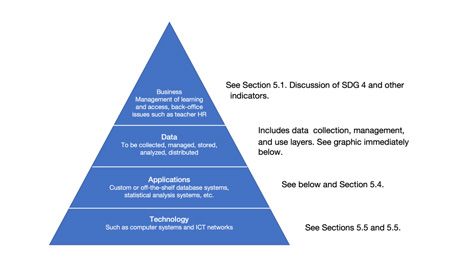
12 Efficiency and Effectivenessin Choosing and Using an EMIS4. EMIS Architecture In simple terms, the EMIS architecture underpins components of an overall enterprise architecture to the way in which data are collected, stored and be considered, namely: reported, and lies at the heart of the Buyer’s and User’s Guides. The components of any software 1. Business architecture: the domestic and solution include data collection, database international needs/requirements of the management and utilization (which includes MoE – briefly covered in Section 5.1 (see the analysis and reporting tools). The Buyer’s and discussion on SDG 4). User’s Guides draw on the EMIS architecture 2. Data architecture – covered below. discussion in this section, wich provides the 3. Application architecture – covered below but main content and structure for these sections. In also in Section 5.4. general, the EMIS architecture (or of information 4. Technology architecture: based on the choic- systems or for any organization) should respond es/needs in levels above, technologies are to the overall enterprise architecture – in this case, chosen – covered partly in Section 5.4 and that of a typical ministry. Figure 1 represents four elaborated on briefly in Section 5.5. Figure 1. Components of an Enterprise Architecture Source: Authors. 4. EMIS Architecture 13
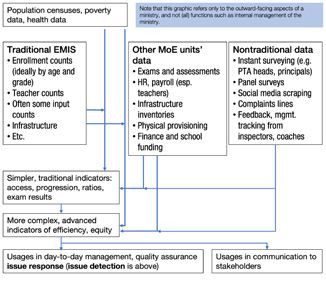
The following is a summary of the most common          Figure 2 shows how these are related in the
     components of any EMIS data architecture and           data architecture, and what the sources of data
     guides:                                                typically are.

     ■     Data collection layer: how data are gathered.    The following sections provide a more detailed
     ■     Data management and storage layer: how           overview of the most common components of
           data are managed and stored in the data mart/    any EMIS architecture and its related functions,
           data warehouse as well as transferred between    activities and processes, from data collection to
           layers in the system if there cannot be true     data processing and storage to data analysis,
           distributed entry and management.                reporting, dissemination and use.
     ■     Data utilization layer: how data are analyzed,
           reported and disseminated.

         Figure 2. Typical Data Architecture of an EMIS

         Source: Authors.

14                                                            Efficiency and Effectivenessin Choosing and Using an EMIS
5. Buyer’s Guide
5.1 The Scope and Context of EMIS should not be thought of as a technological solution
alone and restricted to the operational processes
Education systems are, by nature, extremely complex only. Therefore, EMIS should not try to encompass
and multifaceted, and the need for data as well as for all possible forms of data collection processes,
evidence-based planning, monitoring and evaluation, as this can easily become unmanageable and
decision-making, budgeting, policy formulation, risks overloading staff. EMIS simply cannot be the
resource allocation and management can be one-stop shop for all the data collection processes
similarly complex and multifaceted. Furthermore, all required in the education sector; i.e. it cannot be
education systems are different, though they share everything to everyone. A strong EMIS should,
many features (for example, it is hard to think of however, be able to link to everything.
an education system – at least for now – without
teachers, students, schools, administrators or
5.1.1 Key components of an EMIS
textbooks, or that does not need funding). Thus,
one can conceptualize of a relatively common data This section describes the context and scope
architecture, but always with the need to adapt to the of an EMIS and also describes the education
particular ministry’s aims and demands. administrative data collection processes,
procedures and challenges during the development
EMIS is not optimally designed and mandated of an integrated EMIS. Administrative data here
to produce all the datasets needed to meet the refers to data collected from schools by the national
requirements of the education sector. It ought office for recordkeeping, planning, monitoring,
to, however, provide the analyst with “hooks” evaluation and policy formulation. The basis of
with which to integrate other data (e.g. poverty, EMIS should be data for schools, learners, teachers
population), even if only ex post and in a process and physical facilities. A complete EMIS should
of value-add that is not part of the actual EMIS ideally include data on enrollments, attendance,
backbone. Data interoperability (ability of various completion rates, learning assessments, student
databases to link to each other, for example, via health, finance, teacher characteristics, and some
common school IDs) is an important principle in administrative statistics.
the production of quality data and a key element
in overall architecture of EMIS – it is really the main For the purpose of this guide and according to
source of value added by an EMIS to the higher aggregated data collection systems (i.e. datasets
levels of the ministry. Furthermore, EMIS should be typically limited to centralized databases at school
a system that can respond to the present demands level), EMIS should include among others:
but also evolve according to emerging and future
demands and technical possibilities. In some cases Basic enrollment and input counts:
this could be a service provided by the EMIS unit in ■ Enrollment (by grade, gender, poverty, age,
creating a data warehouse. Furthermore, an EMIS subject, disability, linguistic groups, etc.)
5. Buyer’s Guide 15■ Repetition (by grade, gender), dropouts, ■ Population data (e.g. national statistics office)
completion, flows in general ■ Municipalities (where they are relevant to
■ Learner demographics education)
■ Teacher (experience, qualification, gender,
placement, appointment, etc.) All of these ought to be available by level (from
■ School (physical facilities, general information, pre-primary and early childhood development/ECD
location, classrooms, etc.) on up) and by administrative jurisdiction (school,
district, province and national, as appropriate for
Other components within the education sector: the country in question).
■ School feeding program (where applicable)
■ Library and archives services Other datasets collected by other components
■ School hostels (where applicable) within the education sector and other line
■ Learner health ministries are equally important for evidence-
■ Learning materials (textbooks at a minimum, based decision-making. While it is impossible
typically) to provide a comprehensive list as this will
■ Performance data (examinations and learner depend on a country’s priorities, they typically
assessments – ideally as an intrinsic part of the might include items such as the variables related
EMIS; at a minimum the EMIS needs to be able to SDG 4 that a country EMIS may want to
to link seamlessly to assessments) produce; indeed, using SDG 4 as a case in point
■ Teacher qualification and salary (links to both can provide a useful default list. Another useful
HR and payroll) reference is a list of harmonized indicator goals
■ School funding (in many countries schools set under Africa’s continental education strategy,
receive direct funds for certain expenses) and CESA, with SDG 4 (AU and ADEA 2018). Some
budget of the interesting issues that these frameworks
raise are covered in the following section. In
Other line ministries: addition, in Annex B we list the indicators that
■ Higher education (if a different ministry rather most countries are, or should be, committed to
than a level within the MoE) providing under SDG 4, as reporting on these
■ Labor/employment (typically training programs is an international commitment acquired by
at adult or higher education levels) each country’s government; this compilation
■ Home affairs, or foreign affairs (international presents a well thought-out and logical list of
student flows, visa issues, etc.) indicators, manyof which should be suitable
■ Health (student health statistics) for many countries. It is imperative to point out
■ Social services (student family grants and that this guide should not be misinterpreted as
poverty data if relevant) a guidance tool on how to serve donors and
■ Finance or planning (poverty data for targeting, international agency requirements. See Box 3 on
for example) SDG reporting that reiterates that country needs
are paramount.
Other organizations (most likely not as part of
the EMIS itself, but enabling links if possible)
■ Non-government organizations (NGOs)
16 Efficiency and Effectivenessin Choosing and Using an EMIS5.1.2 How the SDG 4 Indicators have
changed the scope of EMIS SDG 4, as reporting on these is an international
commitment required by each country’s
The main challenge represented by the SDG 4 government, and how EMIS could approach these.
indicators is that many (in reality just about all) It is imperative to point out, however, that this guide
require the use of databases that go beyond the should not be interpreted as a tool on how to serve
EMIS backbone of data. This was true also to a donors and international agency requirements. On
large extent during the preceding period, in which the contrary: country needs are paramount.
the Millennium Development Goals (MDGs) were
a focus. However, the contrast between what Below are three examples of how SDG 4 might
is hoped for and what currently exists is rather affect data collection and reporting:
more striking today. The importance of creating
warehouses that have data collections that go Learning outcomes: the need and opportunity
beyond the traditional EMIS data backbone is to track learning outcomes (SDGs 4.1.1, 4.2.1,
becoming increasingly clear. For EMIS to respond 4.2.3, 4.4.2, etc.). EMIS units traditionally do not
to the increasing demands, it must operate as an collect data on learning. But data on learning
integrated and interconnected system with datasets could be warehoused near the EMIS in order to
coming from diverse sources. A responsive EMIS see, for instance, how strong a correlation there
would work on data inputs, processes and outputs is between learning data and measures that
at the different levels and modalities of educational EMIS usually can produce, such as profiles of
provision with a high degree of granularity; i.e. from grade progression in schools, in order to have
aggregated data at national level to the detail of early warning of problems in learning outcomes.
a particular school, classroom or even individual This would require making better and more
student (while recognizing privacy concerns in line automatic linkages across datasets.
with national and international cross-sectoral and
education standards8). In addition, the SDGs require Population (almost all of the access SDG
disaggregation according to factors that may not sub-indicators, such as 4.1.3, 4.1.5, 4.2.2,
always be present in an EMIS backbone, such as 4.2.4). There is a need to better understand
wealth. In some cases, it may be necessary to link population data and how they interact with
the EMIS backbone data to, say, a detailed poverty enrollment data. For example, comparisons
map of the country. It is also fairly clear that while could draw attention to flow inefficiencies and
even simple reporting presents certain challenges, completion rates stuck at very low levels (e.g.
the real challenges in data are in using data to drive 65%), which in turn could be a proxy for low
improvements on the SDGs. learning, and could highlight the fact that there
may be much more repetition than dropout
Annex B lists the indicators that most countries in the foundational grades or might be helpful
are, or should be, committed to providing under in triangulating weaknesses in the repetition
data. This requires that EMIS staff be able to
access population data that are as detailed as
8 Privacy and security standards are a minimum for countries’ ICT
ministries (or equivalent). An MoE may want to go further and possible, though noting that population data
consider how these standards apply to data that typically only the
become less and less reliable, when being
education sector would have, such as individual children’s cognitive
development. compared with enrollment data, the smaller the
5. Buyer’s Guide 17unit of analysis. Here, the ability to link to other of instruction at home. Yet EMIS traditionally do
datasets such as a detailed poverty map is key, not collect these sorts of data. In this case, the
because in most countries it will not be pos- issue is not so much being able to link such data
sible to estimate access by poverty level, for to other variables (such as learning outcomes),
example, without linking to such a dataset. interesting as it may be, but simply to produce
the data. Options include piloting a small change
Language and language diversity issues (SDG to the instrument that could collect those data,
4.5.2). Schools where there is a lot of linguistic as a contribution to the improvement of EMIS,
diversity may require special attention, espe- or, in an approximation that is less accurate but
cially in the foundation years and in situations also much less costly, linking to datasets from a
where none of the children speak the language census that contains linguistic information.
Box 2. Urgent Data Under COVID-19
In June 2020, schools were emerging from nationwide closures due to the pandemic created by the novel
coronavirus SARS-CoV-2, with some remaining closed. In light of this, the UIS published guidance on
essential data in these circumstances,9 which emphasized the need to maintain essential or minimal data on
• Student participation in all e-platforms (or distance learning more generally) of education delivery
disaggregated by individual student characteristics such as gender and poverty;
• Teacher participation in all e-platforms (or distance learning more generally) of education delivery
disaggregated by individual teacher characteristics such as gender and contract status; and
• Use of short and quick tests for the frequent measurement of student learning.
Learnings from this situation could apply to broader issues around other emergencies, refugees and
internally displaced persons.
9 See, for example, the fact sheet “The Need to Collect Essential Education Data During the COVID-19 Crisis” at http://uis.unesco.org/en/news/fact-
sheet-essential-education-data-collection-during-covid-19-crisis.
Datasets such as those listed above will remain increase the demand and support for the EMIS unit
fragmented islands of data and will exist in isolation from planning, school funding and other user units
if they are not linked. As mentioned earlier, data that feed directly into the ministry’s top levels. An
interoperability is an important principle in the EMIS needs to offer more than just “management”
production of quality data and a key element of data as its primary function. Nationally centralized
in the overall architecture of EMIS. In fact, data data are often hard to use for true day-to-day
interoperability is the only way to allow end users management, and an EMIS that offers the capacity
including policymakers to understand the significant for data interoperability and provides “hooks” to
value-add EMIS data offer in tackling key challenges. the units that can create value-add is more likely to
An awareness of this potential value-add can in turn
18 Efficiency and Effectivenessin Choosing and Using an EMISgenerate greater demand for its services and hence the national level and EMIS leaders from relevant
the budgetary support of the ministry. subnational levels to develop protocols and
agreements for the linking of and maintenance of
common unique identifiers for education-related
5.1.3 The Importance of a data or EMIS policy
datasets. The group should also ensure that this
A legal or policy framework should exist mandating is taking place, supervising the process, as well
EMIS as the custodian of education data. This as hold each other accountable for respective
would allow EMIS adequate data sharing and responsibilities and commitments. The actual
coordination with other data collection divisions work would typically be performed by their
within the education sector as well as other data technician subordinates.
collection processes outside of EMIS and the
education sector. Data integration of all these
datasets must be one of the most important EMIS 5.2 EMIS Procurement
development strategies. In terms of the “Buyer’s
Guide,” for instance, it should be clear that without The procurement of IT technology and services
a guiding policy framework, it is difficult to know refers to the acquisition of technology and technical
what one ought to “buy” (or build or receive in tools that align with the needs of the EMIS unit.
donation). Specific items for the policy to consider EMIS procurement is the process of acquiring
include the following two, which are by no means information system infrastructure (assets) to drive
the highest priority for the policy but are relevant for the EMIS operations. Note that, as explained in
determining user features: Section 2, in almost all cases a ministry would
not go into the market and procure a whole
■ EMIS at a national level should take the lead new system. Instead, ministries may procure
to develop and implement a data sharing and certain aspects, or be donated certain aspects
data integration policy within the country as by development partners. Even in the latter case,
well as beyond the country. This can include being clear about what the ministry wants, why
issues such as privacy and security, duties, and on what terms is crucial both for efficacy and
ethics, rights and responsibilities for data. 10
budget (as donations too have opportunity costs).
Some specification of budgetary and staff
needs can be included in such a policy. The procurement vision should line up with the
■ In order to facilitate data integration, data sharing rest of the Buyer’s Guide and the User’s Guide
and exchange of data, the national office should recommendations or standards. Below are the
establish a formal working group or task team starting points for the specifications needed, after a
to clean, link and maintain data standards. Such more general preamble.
a group could consist of thematic leaders from
Procurement of information systems has to be seen
10 For a typical set of concerns from a high-income system, see https:// with a long-term, life cycle perspective. Modern
professionallyspeaking.oct.ca/march_2008/privacy.asp. This site
systems built as progressive apps for web and
also has further references to government and security privacy
policies with regard to U.K. policy: https://www.gov.uk/government/ mobile devices can run on a range of hardware
publications/esfa-privacy-notice. For a discussion in the context of
(the computer equipment used to perform input,
an emerging economy (South Africa), see https://www.isasa.org/the-
protection-of-personal-information-act-and-south-african-schools/. processing and output activities – see more in
5. Buyer’s Guide 19Section 5.5). Apps perform better with more recent the overall process should be regarded as long
browsers and up-to-date mobile operating systems, term, while specific contracts for hardware can be
and do not necessarily require high-end hardware, handled in a similar manner as other government
as most of the heavy computation typically takes procurement, with public tenders. It may also make
place on the server. Investment in good connectivity sense for the education ministry to coordinate with
is arguably more important than the latest hardware. ministries in other sectors such as communication,
health and agriculture. Similarly, support for the
A national EMIS is a complex system, with system can often benefit from being handled by a
potentially tens or hundreds of thousands of users cross-government data center or national cloud,
in the long term, if one takes into account not just and involving the private sector, such as telecom
administrators and planners, but also teachers, and companies or other service providers and vendors,
even communities and parents who might need as properly and securely managing servers often
access to some of the information. While technology strains the capacities of line ministries.
makes rapid progress, the demands on the system
in terms of complexity are bound to increase, from Elements to consider in procurement include the
various stakeholders. It therefore becomes essential following:
to also consider the support structure within the
organization. This is to some extent technical ■ Operating in line with internal systems
(managing servers and devices), but predominantly procurement process
organizational, in the sense that information is the • Securing guidelines and sometimes ap-
backbone of the education sector. Reaching the proval of the procurement section of the
full potential of the investments made requires ministry, or the state-wide procurement if
not only the high cost of procuring thousands of needed.
devices and paying for internet connectivity, but • Defining the IT requirement (that is, the IT
also training and competence building within the should be able to handle the requirements
sector in the use of data for action. Therefore, in this guide – also note that certain IT
an important consideration for procuring any options may not be viable if one has to add
software solution is the long-term community of to a legacy system).
practice around the system; i.e. people who focus • Establishing discussions with the procure-
on improving the collection and use of education ment experts from the ministry or else-
data for a range of purposes. Procuring a national where in government, from the moment
system is not a matter of, for example, simply that IT procurement becomes an objective.
offering a contract for 2,000 laptops to ensure all This should be based on a user needs
schools have access (though such a purchase is diagnostic or specification.
likely necessary), but having a plan both for training • Managing vendors – thought should be
in core functionality and for future expansion as given to how much one can and should in-
the organization learns about what is possible and volve vendors in understanding the require-
where the greatest benefits could accrue, based on ments from early on (they may be helpful
a combination of its own experience and learning but may then acquire information others
from others in the international EMIS community. A do not have access to; follow government
procurement vision therefore needs to be holistic: procurement guidelines).
20 Efficiency and Effectivenessin Choosing and Using an EMIS• Verifying the quality of products and ser- • Time frame for performance should be
vices to be provided by asking for refer- realistic or vendors may make unrealistic
ences, past performance, both in terms promises to get the work done; consult
of process and final satisfaction of other with IT experts.
consumers. • Not anticipating life of product costs and
technical requirements on the ministry.
■ Differentiated aspects of procurement
according to what is being procured; there
may be different vendors for different aspects 5.3 A Total Data Quality Framework
• Hardware procurement: hardware includes
servers, routers, computers, printers, etc. All functionality standards have to end up supporting
• Software procurement: software includes some aspect of total data quality. To ensure data
licensed software, in-house developed quality, national EMIS needs to establish a data
software, etc. quality system, complete with a data quality
• Services: IT infrastructure is more than approach to standardize the data, provide definitions
computers and applications and includes and establish data naming conventions. This is
networking infrastructure connecting especially useful when data are transferred from
different computers, printers and servers one level to another, for example, from national
internally and to the web. to subnational to schools or from subnational to
national.
■ Ongoing support plans and costs
• “Life of product” costs and assumptions Such a system should identify quality requirements
about technical requirements that the and criteria; key EMIS processes and their
ministry should be ready to take on. This sequence and interaction; the policies; and the
should be done with reference to staffing criteria and methods for defining, detecting,
needs and plans. Training of staff could correcting and preventing nonconformity.
be part of IT procurement, both short and
long term. Note that open-source software The quality of data can be defined in terms of
may have low up-front costs but high life of completeness, relevance, accuracy, timeliness
product or other hidden costs. and accessibility. These dimensions of quality are
described in Table 1.
■ Procurement risks
• Time frames for procurement – it is import- Another useful reflection on principles that
ant to be realistic, such as not attempting determine quality (as well as other issues such as
to procure something very expensive in 10 usability, sustainability, etc.) are the UN’s “Principles
days; seek general guidelines from ministry of SDG Indicator Reporting and Dissemination
or general government procurement. Platforms and Guidelines for Their Application” (see
• Funding/budget – the budget must not be Box 3 for a summary).11
unrealistic (insufficient) or it may encour-
age vendors to lowball or make unrealistic 11 For full explanations, see https://unstats.un.org/unsd/statcom/50th-
session/documents/BG-Item3a-Principles-guidelines-SDG-
promises. Monitoring-Reporting-Platforms-E.pdf.
5. Buyer’s Guide 21Table 1. Dimensions of Quality of Data
Dimension Description
Data for all data elements for all reporting entities (e.g. schools, learners) should have been submitted. Data are
Completeness complete when data values are present for all records, occurrences or logical entities in pre-primary, primary and
secondary education, including learners with special educational needs.12
There is no point in collecting data unless it is put to some meaningful use in education decisions. Excessively long
Relevance
questionnaires should be avoided.
Accuracy should be prioritized in the data capturing methods, data validation methods and data verification
processes, possibly at the expense of time and money. Data should be within the normal range for data collected
Accuracy
for that specific data element and entity. Check for outliers – the capacity to check for automatic detection of most
outliers upon entry should be part of the user specifications.
Data should be current or up to date. Data must be on time and available when they are required, otherwise the
Timeliness credibility of the information system diminishes. Data from all the reporting institutions should be submitted at the
appointed time.
Data should be accessible to the users at all levels of the education system. The user should know what data are
available, as well as where to find and retrieve the data. Metadata and data dictionaries are important to enhance
Accessibility the accessibility of data within an organization. Data should be available when-needed, as-needed in a manner that
is as open as is consistent with broader privacy and security concerns as well as with the country’s multisectoral
data policy (see Footnote 11).
Source: van Wyk 2006, modified by authors.
12 Note that these descriptions are fairly present oriented and most appropriate for typical situations now in low-income countries. A more futuristic
orientation might have slightly different descriptors – see Section 5.6.
Box 3. Summary of UN Principles of SDG Indicator Reporting
■ Clear institutional arrangements and ■ User-centered design
management of data ■ Emphasis on data communication
■ Fitness for purpose ■ Data disaggregation
■ Dissemination platforms compliant with ■ Modularity and extensibility
fundamental principles of official statistics ■ Standardized interfaces
■ Sustainability ■ Metadata availability
■ Interoperability and statistical standards ■ Open data
■ National ownership ■ Linked data
■ Collaboration
22 Efficiency and Effectivenessin Choosing and Using an EMIS5.4 EMIS Functionality and Standards – The following are three conventions used in this
Buyer’s Guide Aspects section to highlight important information (i.e. they
are not asides):
In Table 2, some functionality standards are features
that a system must possess, based on the authors’ ■ Note: more detailed and additional information
and reviewers’ experience with EMIS and the EMIS to explain the functionality that should be
literature; others are more open-ended choices considered.
with pros and cons. The technology a system
should possess or be based on is also a crucial ■ Tip: useful advice, such as how to perform a
consideration, and is briefly elaborated in Section particular task more efficiently
5.5. The table refers to the data architecture of a
13
typical EMIS, as referenced in Section 4. ■ Caution: a warning about
a choice or decision that the “buyer” needs to
13 For a discussion of the new issues created by the SDG 4 indicators,
see Section 5.1.2.
think about
Table 2. EMIS Functionality Standards, by Data Collection Layer
DATA COLLECTION LAYER (AGGREGATED)
Feature Description Essential points to consider
Aggregated vs. individual-level data: Aggregated data refers to data collected at the school level (the school census approach).
Aggregated or summary data collection provides information on issues at institutional level, such as enrollment by grade, age or
NOTE:
gender. Unit record (individual) data refers to the data collected for each learner through a school administration and management
system and is discussed after this section.
The system has a feature to manage a directory of institutions.
Directory The system has a feature to add and delete institutions (i.e. to maintain the directory to stay up to date).
The system has the capability to import institutional information from other systems (e.g. Excel, csv).
Tip: The Master File System for institutions is a key process to provide a unique identifier to an institution
and should be supervised at the national level. This may be easier or harder depending how whether the
system is truly federal as opposed to merely decentralized.
Tip: The unique identifier could contain the geographical codes of the governance organizations above
the school so as to make it easier to link to databases (e.g. poverty) that do not go “down” to school
Allocate unique identifier level. Alternatively, the file should contain fields that denote the organizational unit the school belongs to
Unique Identifier for institutions according (e.g. district, province).
to specific algorithms.
Tip: Ideally a good system should contain the ability to generate (possibly with a manual assist) new
codes from a look-up database and a set of rules. For instance, it could assign a school an ID code
based on the district and province it is located in.
Caution: Avoid using a sequential number; rather use a specific algorithm that includes codes for
subnational levels.
5. Buyer’s Guide 23DATA COLLECTION LAYER (AGGREGATED)
Feature Description Essential points to consider
The system enables countries to design custom questionnaire forms to be used at the institution level (the school census approach).
Questionnaire
Design The system is customizable and flexible to add fields according to the use case. For instance, it should allow a new field to account
for, say, a new category of teacher that had not been considered before.
Note: The system has the capability to store data across multiple years, thus enabling the seamless
The system has the transfer of the information from one year to the next.
capability that enables Tip: This ability is key to the generation of time trends and other forms of value-add data.
Baseline Data users to transfer existing
Transfer data from previous years Tip: Where applicable, the system should have the option to preprint (or pre-populate if online) baseline
into a new database for all data on the physical questionnaire before it is disseminated to the institutions.
institutions. Caution: Preprinting (as opposed to online pre-populating where possible) vastly increases the logistical
requirements as exactly the right questionnaire has to get to exactly the right school.
The system has a
barcoding feature to
Barcoding manage the dissemination Note: This is only applicable where questionnaires are physically printed and disseminated to schools.
and collection of
questionnaires.
Caution: Centralization vs. decentralization − in practice, the decentralization of systems involves
The system has the the transfer of authority from the national office to the subnational offices. While acknowledging the
capability to set up significant advantages of decentralized information systems, it is also necessary to be aware of the risks
Data Entry data entry at any level and disadvantages. Given that the national office is further removed from the detail and often unaware of
(national, subnational and the decisions made at subnational levels, the national office should ensure that it does not decentralize
institutional). its responsibility and consequently lose control of the norming and supervision of the data collection
processes.
Data entry takes place on
a computer keyboard
Note: This functionality exists on a local computer without connectivity.
locally as a manual
process.
Data entry takes places Note: This is especially advantageous in a decentralized EMIS.
over a browser using Caution: Ensure that the bandwidth and connectivity adhere to system requirements.
Data Entry: internet protocols. Could
Technology involve manual processes Caution: Ensure that for areas of the country where bandwidth is not completely reliable and of high
in a browser or automated speed, that the system can take asynchronous data entry in any reasonable device, such as tablets.
processes with application Note: An API is software that can call data from other databases that are programd with a different
programming interface software, such as a cell phone’s contacts app being able to pull up a list of school principals from the
(API) calls. EMIS.
The system has the feature to enable organizations to develop and deliver content to mobile devices and takes advantage of mobile
devices’ native capabilities (e.g. a contacts app and that app’s ability to use either data or Wi-Fi).
Note: The system allows the user to define various validation rules to identify violations. At the point of
data entry, a check should be made to see if the data fall within acceptable range levels of minimum and
maximum values for any particular data element.
The system has built-in
Data Entry: Tip: The system should automatically calculate certain ratios (not necessarily to put into the form) and
quality assurance rules,
Quality use those as error traps, as error ranges for ratios (e.g. the pupil-teacher ratio) are easier to set up than
such as authentication and
Assurance absolute value ranges.
validations.
Caution: Be aware that the built-in validation and verification rules do not slow down the data entry
process. Furthermore, the validation rules should alert the user but must not stop the user from
continuing with the data entry process.
24 Efficiency and Effectivenessin Choosing and Using an EMISYou can also read


