Empty shell no more: China's growing footprint in Central and Eastern Europe
←
→
Page content transcription
If your browser does not render page correctly, please read the page content below
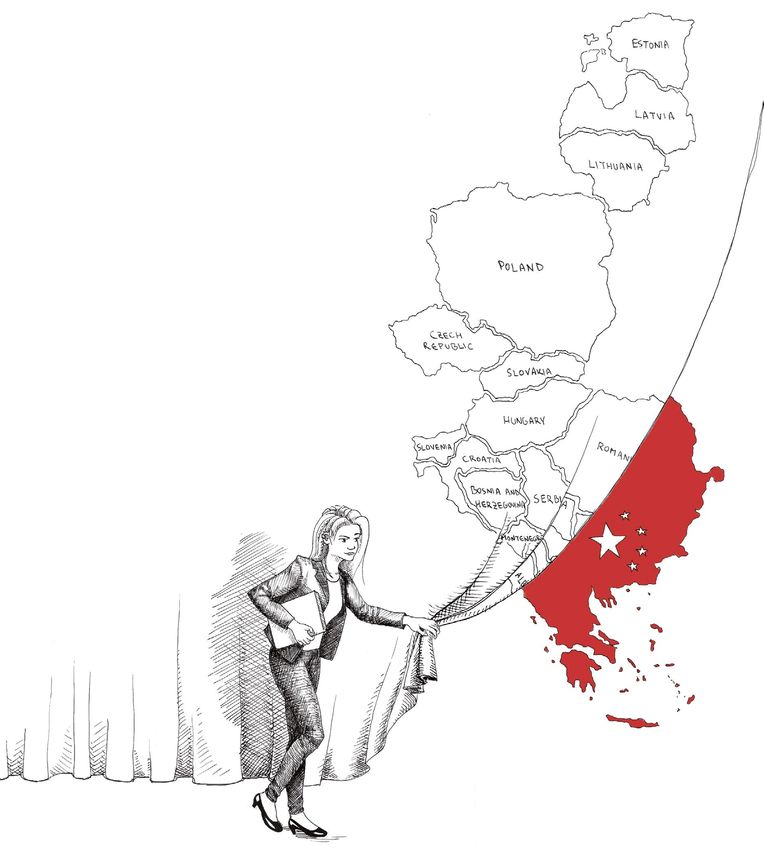
Empty shell no more:
China’s growing footprint in
Central and Eastern Europe
P O L I CY PA P E R

IVANA KARÁSKOVÁ, ALICJA BACHULSKA,
ÁGNES SZUNOMÁR, STEFAN VLADISAVLJEV,
UNA ALEKSANDRA BĒRZIŅA-ČERENKOVA,
KONSTANTINAS ANDRIJAUSKAS, LIISI KARINDI,
ANDREEA LEONTE, NINA PEJIĆ, FILIP ŠEBOK
Empty shell no more:
China’s growing footprint in
Central and Eastern Europe
P O L I CY PA P E R

IVANA KARÁSKOVÁ, ALICJA BACHULSKA, ÁGNES SZUNOMÁR, STEFAN VLADISAVLJEV,
UNA ALEKSANDRA BĒRZIŅA-ČERENKOVA, KONSTANTINAS ANDRIJAUSKAS, LIISI KARINDI,
ANDREEA LEONTE, NINA PEJIĆ, FILIP ŠEBOK
EMPTY SHELL NO MORE: CHINA’S GROWING FOOTPRINT
IN CENTRAL AND EASTERN EUROPE

Policy paper
April 2020

Editor – Ivana Karásková
Authors – Konstantinas Andrijauskas, Alicja Bachulska, Una Aleksandra Bērziņa-Čerenkova,
Ivana Karásková, Liisi Karindi, Andreea Leonte, Nina Pejić, Ágnes Szunomár, Filip Šebok,
Stefan Vladisavljev
Citation – Karásková, I., Bachulska, A., Szunomár, A., Vladisavljev, S. (eds.) (2020).
Empty shell no more: China’s growing footprint in Central and Eastern Europe.
Prague, Czech Republic, Association for International Affairs (AMO).

Handbook for stakeholders – To access the handbook for stakeholders stemming from this report,
please refer to the electronic version which can be found online at www.chinaobservers.eu.

The publication was prepared within the China Observers in Central and Eastern Europe
(CHOICE) collaborative platform. CHOICE monitors and evaluates the rising influence of the
People’s Republic of China in countries of Central and Eastern Europe which participate in
the China-proposed 17+1 initiative. CHOICE strives to build a multinational platform for open
discussion, experience-sharing and critical assessment. CHOICE is run by the Association for
International Affairs (AMO), a Prague-based foreign policy think tank and NGO. The preparation
of this paper was supported by a grant from National Endowment for Democracy (NED).

Typesetting – Zdeňka Plocrová
Print – Vydavatelství KUFR, s.r.o. – tiskárna

ASSOCIATION FOR INTERNATIONAL AFFAIRS (AMO)
Žitná 27/608
CZ 110 00 Praha 1
Tel.: +420 224 813 460
info@amo.cz
www.amo.cz

© AMO 2020
ISBN 978-80-87092-72-9 (print version)
ISBN 978-80-87092-71-2 (pdf version)
Table of Contents

Summary                                                                    7
Recommendations                                                            9
Engaging China in 17+1: Outline of ACT strategy                           11

1. Political relations: Beyond proclamations                              14

Bilateral relations: Different trajectories                               18
Let’s party, comrades: Local political parties’ relations with CCP        23
Sub-national, underestimated? A booming component of 17+1 cooperation     26
Cutting-edge, or driving a wedge: Is 17+1 dividing Europe?                30
China in CEE politics: Conclusion and recommendations                     32

2. Economic relations: A sugar cane, or a sugar-coated stick?             35

Not so special: Modest impact of 17+1 on trade relations                  35
We are the champions: V4 countries and China’s foreign direct investments 42
All roads lead to China: Cooperation in infrastructure and connectivity   47
Follow the money: Financial cooperation in V4                             51
The irresistible draw: China-CEE tourism as a success story               53
The economy of pros and cons: Conclusion and recommendations              55

3. We the people? The challenges of societal relations with China         57

Don’t trust anyone under thirty: Youth cooperation and its perils         64
Collective sports? Support for China before the 2022 Olympics             66
Natural remedy? The curious case of traditional Chinese medicine
as an export commodity                                                    68
The fourth estate and a new global power: Telling the China story         69
People-to-People’s Republic relations: Conclusion and recommendations     71
Authors                                                                   73
About CHOICE                                                              75
About AMO                                                                 77
Footnotes                                                                 79
Summary

→   The 17+1 platform has been              characterized by a hub and
    labeled as an ‘empty shell’ with        spokes logic of cooperation
    the assertion that cooperation          with China taking the lead in
    between Central and Eastern             ‘multilateral bilateralism’.
    Europe with China lacks
    substance. A large-scale audit      →   Despite its efforts, China has not
    of relations, however, points           transplanted its foreign policy
    to a more complex scenario.             concepts into the language
    Relations between China and             of cooperation with Central
    Central and Eastern Europe are          and Eastern Europe. On the
    growing, encompassing political,        contrary, the CEE countries
    economic and societal domains           have successfully shaped the
    and are loaded with action.             diplomatic language to stay
                                            in accordance with the EU
→   The fragmented nature of                framework. 17+1 cooperation
    the information complicates             has almost universally led to
    understanding of the real nature        the growth of high-level political
    of 17+1, as in individual states        contacts between the CEE

                                                                                   Empty shell no more: China’s growing footprint in Central and Eastern Europe
    China’s actions seem scarce             countries and China. However,
    and random. Also the areas              the development of bilateral
    of interaction are treated as           relationships happens on separate
    separate. It is only when the           trajectories. It is the activity and
    whole picture is analyzed that          decisions taken by the individual
    the progress and direction of the       17 CEE countries rather than the
    17+1 platform become evident.           format itself which shape the level
                                            of engagement.
→   In the past eight years, China
    has managed to build a system       →   While Hungary and Serbia have
    of interconnected relations in          supported China on political
    Central and Eastern Europe              issues, they represent an
    (CEE), where it was almost              exception rather than the rule. The
    absent before. Paradoxically,           assumptions that CEE as a whole
    China has contributed to                has become more forthcoming
    the conceptualization and               towards China on political issues
    institutionalization of CEE as          is not supported by the evidence.
    a region.
                                        →   China has used the CEE as
→   Resembling a version of                 a testing ground for more activist
    US alliances in East Asia,              party diplomacy led by the
    the 17+1 framework can be               Chinese Communist Party.

                                                                                   7
China cultivates relationships with → Chinese FDI are modest and
important political elites to assure concentrated in a few countries
a long-term pro-China inclination (Hungary, Czechia and Poland)
in the respective countries. with almost no opportunity for
other countries to receive sizable
→ China has unsuccessfully tried amounts of investment. Although
to assuage the EU’s concerns financial cooperation has gained
about using the format to divide momentum, it is limited to EU
Europe. The US-China rivalry has member states.
become a factor in CEE relations
with China, with several countries → Tourism is the real success story of
afraid of endangering their economic cooperation within the
traditional ties with Washington. framework, since CEE countries
China has tried to walk a fine line have achieved higher visibility in
in its approach towards Russia in China (while a general increase
CEE. in the amount of Chinese middle
class travelers may also play
→ Economic cooperation in 17+1 is a role).
mainly driven by China as it sets
the agenda. → Given the character of the
Chinese system and the high level
→ China’s economic impact on of penetration of Chinese society
CEE countries is still small. CEE by the state, people-to-people
countries are highly dependent contacts actually mean Chinese
Empty shell no more: China’s growing footprint in Central and Eastern Europe
on both trade and investment government-to-people in relations
relations with developed, mainly with CEE countries.
EU member states, while China
represents a minor yet increasing → The number of Confucius Institutes
share. The CEE region is also has increased in CEE countries.
far from being among the most Youth cooperation is also on the
important partners for China. rise, with increased numbers of
Chinese government scholarships
→ Despite the 17+1 format, China issued to CEE students.
still handles its economic affairs
on a bilateral basis. Relations → Politically motivated programs
with the countries of the Visegrád targeting youth and political
region and Serbia are of particular leaders, such as Bridge for the
importance, while relations with Future, China-CEE Young Political
other CEE countries lag behind. Leaders Forum and Political
Parties Dialogue, go largely
→ Trade relations remain relatively unnoticed in all 17 CEE countries.
limited and unbalanced, leading
to an increased trade deficit in all
17 CEE countries with China.
8Recommendations
→ The 17+1 format should not be to take advantage of the lower
discarded. The simplistic view of profile of local contacts to avoid
Europe being divided by China attention.
through 17+1 should be opposed as
it infantilizes the CEE states and → The increased prominence of the
denies CEE countries their agency. Chinese Communist Party (CCP)
17 CEE countries should adopt in China’s approach towards the
the ACT strategy proposed in this CEE warrants vigilance. There
paper in their dealings with China. should be greater scrutiny by the
civil society and media towards
→ The EU needs to continue nontransparent dealings between
including CEE EU members in the local parties and the CCP.
efforts to shape a common EU
policy towards China that should → In order to benefit more from
represent the interests of all economic cooperation with China,
member states. CEE countries should act together.
Regular 17+0 consultation meetings
→ The EU should open a clear path to should precede summits.
Empty shell no more: China’s growing footprint in Central and Eastern Europe
membership to the Western Balkan
countries to offset the growth of → The major challenges of trade
China’s political influence. The relations, such as trade deficit,
EU must play a more active role cannot be overcome by single
in the Western Balkan’s economic country solutions; CEE countries
development. should follow the EU’s strategic
aims in trade policy.
→ The 17 countries should improve
their communication and → Coordinated rules should be
coordination in feasible areas to established relating to investment
shift the 17+1 into a multilateral screening also in non-EU member
forum serving primarily their states.
interests.
→ Independent, fact-based media
→ More attention should be given coverage is needed in order to
to the sub-national (regional, achieve greater transparency and
provincial, etc.) dimension of understanding of mechanisms
China-CEE cooperation that has behind societal cooperation
largely developed under the radar. between China and CEE countries.
CEE states should pay attention to
the potential politicization of such → More public (on EU, state, or
cooperation and China’s efforts regional levels) as well as private
9financial support for academic
institutions researching China
is needed in order to avoid
a situation where Confucius
Institutes and other PRC-related
institutions become the most
influential actors producing and
disseminating knowledge about
Chinese politics, society and
culture.
→ China watchers should exchange
knowledge and experiences across
Europe and with other parts of the
world in order to detect potential
threats to democratic standards
governing the societal level of
cooperation with Chinese actors
outside of the PRC.
→ It remains crucial not to equate
all forms of societal cooperation
with China with potential threats.
The focus should be on achieving
Empty shell no more: China’s growing footprint in Central and Eastern Europe
transparency.
→ CEE countries should be aware of
the risks associated with a growing
skepticism towards China turning
into racist attitudes against the
Chinese diaspora, students and
tourists. In order to avoid the
rise of Sinophobia in CEE, clear
divisions should be drawn between
public criticism of government or
party-led activities and Chinese
nationals and their presence in the
region.
10Engaging China in 17+1:
Outline of ACT strategy
Ivana Karásková
The 17+1 platform1 has been labeled by some as China’s tool to divide and conquer
Europe.2 At the same time, analysts (the author included) frequently dismissed these
charges, arguing that 17+1 is an ‘empty shell’ and cooperation between Central and
Eastern Europe (CEE) and China lacks substance.3 The divide in understanding of
the platform became apparent when China announced the upgrading of the annual
17+1 summit which was expected to be held in Beijing in April 2020 from the level
of prime ministers to the level of heads of state. The first camp of analysts perceived
it as a worrisome trend, while the latter argued that it is mostly the prime ministers,
not the presidents, who call the shots in Central and Eastern European politics. Thus
the upgrade, they argued, was only symbolic. 4
The proponents of the ‘empty shell’ concept, however, seem to be wrong. A large-
scale audit of relations between China and the 17 Central and Eastern European
countries points to a more alarming scenario. Substance in relations with China is,
indeed, not lacking, and cooperation between China and Central and Eastern Europe
Empty shell no more: China’s growing footprint in Central and Eastern Europe
flourishes, encompassing political, economic and societal dimensions, and is loaded
with action.
The reason why observers missed these developments is two-fold. First, the in-
formation is fragmented. In individual Central and Eastern European states, China’s
actions look scarce and random. 17+1 is neither a multilateral forum, nor a bilateral one.
It is an exercise of ‘multilateral bilateralism’5, resembling the hub and spoke system
of relations, with China acting as a hub in the middle. The spokes, i.e. the Central and
Eastern European countries, exhibit – to their detriment – limited if any cooperation
among themselves. Second, the areas of interaction, be they political, economic or
societal, have been treated as separate. However, 17+1 is not only a political platform,
it breaches politics and enters into domains of economy, youth cooperation, academic
exchanges, sport, health or media cooperation. Only when the whole picture is ana-
lyzed, does the progress and direction of the 17+1 platform become evident.
Over the past eight years, since the inception of 17+1 in 2012, China has ma
naged to build a system of interconnected relations in CEE, a region where it had
been almost absent before. For the foreseeable future, China will continue to rise in
power and importance. Its increasing global presence, already taken for granted, will
inevitably stimulate its willingness to seek influence through different organizational
and institutional settings, including (sub)regional organizations. Given the fact that
China finds it extremely difficult to ‘infiltrate’ the long-existing ones, it will attempt
to multiply the groupings of its own founding, and will try to extract as much as
possible from those already in existence, such as 17+1.
11The fears of Chinese incursions on many levels (technological, economic, poli
tical, or even military) are, factoring in specific regional contexts, substantiated and
the dangers are real. However, a response to the threat of expanding Chinese influ-
ence in the form of shutting Beijing out is, in practical terms, impossible – not least
because it would probably provoke more extreme reactions from the PRC. Instead,
a three-pronged ACT (adapt > counter > target) strategy, modeled on the realities of
the 17+1 initiative, is suggested.
While seemingly obvious, adapting to China’s presence in the region (be it in Cen-
tral and Eastern Europe, or elsewhere) may in fact be the hardest component and the
most difficult to pull off correctly. China as an actor and an issue will continue to be
a stable and growing, if often irritating, component of various regional constellations.
Accepting this fact should not be confused with resignation and much less submission
to China’s strategic interests. Quite the contrary: national and international strategies
need to assess the existing and potential scope of China’s presence, define priorities
as well as risks stemming from this phenomenon, and implement or address them
through subsequent policies.
Groupings like 17+1 were clearly born out of China’s intention to create institu-
tional tools for amplifying its message and increasing its influence. Still, their members
can conceivably utilize them as platforms for countering, limiting or even curbing
China’s heft. The way forward consists in making full use of these organizations’ mul-
tilateral settings. While countries like Czechia, Estonia or Greece may find it difficult
to face Chinese actions alone, there is no formal impediment against them bonding
together and presenting their Chinese partners with a unified position. If China wants
to retain its presence through these institutions, it is more likely (if grudgingly) to
Empty shell no more: China’s growing footprint in Central and Eastern Europe
accept the ‘multilateral condition’ than to risk losing its influence altogether.
Once the members of regional platforms like 17+1 rediscover the multiplication
effects inherent in ‘effective multilateralism’, to borrow a phrase from the 2003
European Security Strategy, they could even turn these platforms into offensive
instruments for targeting China with their specific demands. These might include
widely controversial topics (from the Chinese perspective), such as limits imposed
on Chinese technological companies or concerns with unfair trade practices, but also
more cooperative issues like the need for properly regulating Chinese investment
and improving market access for CEE countries’ products. While the actions of EU
member states need to be in line with the agreed position on China within the EU,
the CEE EU member states can utilize the 17+1 to achieve a better standing in nego-
tiations not only vis-à-vis China, but also within the EU. The Western Balkans nat-
urally pivot towards the European Union, despite the unfortunate lack of a credible
and clear enlargement roadmap at the time of writing the publication. The EU should
then open a clear path to membership to the Western Balkan countries to offset the
growth of China’s political influence.
The current debate seems transfixed by the image of China as an omnipotent,
ever-present and inescapable threat. China is – and will remain – far from it. Even small
states, especially those safely separated from the immediate effects of China’s economic,
political and military might, can succeed in promoting their own interests to their
dealings with the PRC. The ACT strategy provides a general outline for achieving
this objective.
12The following chapters analyze relations between China and 17 Central and
Eastern European countries (CEECs) in three separate areas – political, economic
and societal, documenting China’s increasing footprint in the region. The publication
represents the first attempt to systematically audit China-CEE relations. Given the
scope of the endeavor and a lack of information in several areas or specific countries,
the publication does not claim to tackle each and every form of cooperation. Still, it
attempts to uncover and analyze patterns pertaining to the region as a whole.
Ten China experts from Czechia, Estonia, Hungary, Latvia, Lithuania, Poland,
Serbia, Slovenia, Slovakia and Romania provided their input via a novel and unique
collaborative platform, China Observers in Central and Eastern Europe (CHOICE),
in order to reach realistic and achievable suggestions for a joint action plan of CEE
countries within the outlined ACT strategy.
Empty shell no more: China’s growing footprint in Central and Eastern Europe
131. Political relations:
Beyond proclamations
Stefan Vladisavljev, Konstantinas Andrijauskas and Filip Šebok
During the past eight years, political cooperation between China and CEE through
the 17+1 platform has developed beyond mere meetings of heads of governments
(annual summits). It now encompasses cooperation between the Chinese Commu-
nist Party (CCP) and political parties from the region, as well as cooperation on the
sub-governmental or sub-national (provincial, regional, etc.) levels. Given that 12 of
the 17 European countries gathered in 17+1 are also EU members, political cooperation
with China has the potential to influence the internal decision-making and external
actions of the EU in regards to China.
Since 2012 the main framework for cooperation between China and CEECs has
been the 17+1 platform. The profiles of European countries that are included in the
platform are different – it encompasses Baltic countries, Balkan countries and Viseg-
rád Four (V4) countries. Some of them are EU members, some of them are NATO
members, some of the countries remain EU candidate countries or are in the middle
of their negotiations with the EU.
Empty shell no more: China’s growing footprint in Central and Eastern Europe
The 17+1 as a platform of cooperation slightly predates the most notable Chinese
foreign policy mega-project – the Belt and Road Initiative (BRI, previously named the
One Belt One Road initiative), which was launched by Chinese president Xi Jinping in
2013. Even though 17+1 predates the BRI, after its launch 17+1 has become an integral
part of the wider, global BRI project. The BRI is designed to increase connectivity
through improvement of infrastructure development6 that would make China one
of the most ubiquitous global powers worldwide with its numerous financial agree-
ments and construction projects all around the world, including Europe, where CEE
represents a geographical gateway to the rest of the continent. Through both the
17+1 and the BRI, China has ensured that the CEECs are willing to upgrade economic
and thus also political relations with it.
Ever since the format’s inaugural Warsaw 2012 summit, its most important mani
festation has been the China-CEECs meeting of heads of governments conducted
annually in one of the participating countries in order to review cooperation achieve-
ments and set the direction for the future, thus performing dual decision-making and
coordinating functions. As of the beginning of 2020, there have been 8 such summits
thus far (see below) that have taken place in every major CEECs sub-region (two in
the V4, four in the Balkans and one in the Baltic countries) and in China (Suzhou
2015) itself. The 2019 inclusion of Greece allows one to expect a forthcoming summit
there, although the 2020 one will be hosted by the Chinese capital, Beijing.
While the largest share of attention has been focused on the high-level summits,
the 17+1 has grown to encompass a vast number of different cooperation formats,
14MAP 1: CENTRAL AND EASTERN EUROPEAN MEMBERS OF THE 17+1 PLATFORM
Finland
Norway
Sweden
Estonia
Russia
Latvia
Denmark
Lithuania
Belarus
Netherlands Poland
Germany
Belgium
Czech
Luxembourg Republic Ukraine
Empty shell no more: China’s growing footprint in Central and Eastern Europe
Slovakia
France
Austria
Switzerland
Hungary Moldova
Slovenia
Romania
Croatia
Bosnia and Serbia
Herzegovina
Italy
Montenegro Kosovo Bulgaria
Macedonia
Albania
Greece
Turkey
Members of the 17+1 format
EU 17+1 members Non-EU 17+1 members EU member states Non-EU member states
15ranging from ministerial dialogues to seminars and even dance camps. Moreover,
as the platform has progressed through the years, China has encouraged the CEECs
to take the lead in particular cooperation areas usually commensurate with their
comparative advantages or at least ambitions by hosting the inaugural events and/or
establishing relevant institutional structures, variously defined as 17+1 associations,
secretariats, centers, etc.
The various cooperation structures differ significantly in terms of their charac-
ter and functioning. While sectoral leadership in a certain area seems to have been
utilized by some CEE countries as an opportunity to pursue their priority agendas
(usually bilateral vis-à-vis China rather than multilateral) with the useful cover, in
other cases, it appears purely symbolic. For example the China-CEECs Technology
Transfer Center in Slovakia is only a dormant website rather than a fully-fledged
institution as its name might suggest.
Not only in terms of membership but also institutionally the platform is a rather
loose grouping of states. The multilateral aspect of the format largely resembles that
of a hub and spokes model, with China in the center but no connections between
the individual CEE countries. The principal formalized administrative vehicle of the
format is the Secretariat. This institution, announced during the inaugural summit and
established the following year under China’s Ministry of Foreign Affairs (MFA), deals
with communication and coordination on matters related to cooperation, preparation
for meetings and implementation of relevant outcomes. The Secretariat consists of
24 institutions representing China’s most important ministries and agencies active
in the country’s foreign relations, while its administrative leadership comes out of
the MFA higher ranks, particularly from its Department of European Affairs. China
Empty shell no more: China’s growing footprint in Central and Eastern Europe
also appointed a special representative for China-CEE cooperation in 2015.
From the other side, every CEE country designated a counterpart department
within their institutional structure and chose national coordinators to take part in
work with the Secretariat and to promote the cooperation format in general. National
coordinators have been meeting bi-annually with the Secretariat since 2013, with
quarterly meetings with the CEECs’ embassies instituted in 2015. This points to
a gradual deepening of the involvement of CEE countries in the process of coordina-
tion and agenda-setting, although it is China that remains the one running the show.
So far, the following 17+1 summit meetings have been conducted: the inaugural
summit in Warsaw 2012 (Poland), Bucharest 2013 (Romania), Belgrade 2014 (Serbia),
Suzhou 2015 (China), Riga 2016 (Latvia), Budapest 2017 (Hungary), Sofia 2018 (Bulgaria)
and Dubrovnik 2019 (Croatia). Whereas Warsaw was still more of an ad hoc meeting, the
following summit in Bucharest manifested China’s institutionalization of the format.7
The most important outcomes produced by these events have been provided in a series
of concluding statements, namely China’s 12 Measures for Promoting Friendly Co
operation with CEECs which came out of the format’s inaugural 2012 Warsaw summit8,
and the joint guidelines which have come out at the end of all of the subsequent meetings.
While the 12 measures were proposed by China unilaterally without prior consulta-
tion with the CEE countries, the guidelines have been a result of joint consultations,
with the EU also involved in the process. Although China still plays a central role
in proposing the guidelines, they have actually been, quite surprisingly, little influ-
enced by typical Chinese diplomatic language – a brief look at the language of the
16analogous China-led format for Africa (FOCAC) points to a striking difference.9 On
the contrary, the guidelines have stressed complementarity and respect for the EU
rules and principles (as a result of the insistence of some EU member states) and also
reflected some of the misgivings of the CEE countries (such as access to the Chinese
market and the need for a “more focused, results oriented approach” of the format).
This shows greater agency on the part of CEE countries than is often assumed.
The comparatively brief 12 measures set the stage for cooperation, by outlining
China’s plans for the format’s above-described institutional mechanism and general
pledges to deepen cooperation in widely diverse economic (trade, investment, financial
services), infrastructural (transportation), technological (high-tech, green economy)
and people-to-people areas (culture, education, academic exchange).
The 2013 Bucharest guidelines, being the first such, provided the structural frame-
work on which all of the following ones would largely be based. These joint statements
first commend the strengthening of China-CEECs cooperation in general and stress
that it is in concord with the China-EU comprehensive strategic partnership and
relevant national legislation and regulations (including the EU’s where those apply),
designate a pompously defined theme of the meeting, then outline a list of the actual
guidelines for cooperation, and finally present the annex on the implementation of
the previously agreed-upon measures.
As was to be expected, the issue areas (along with the actual space dedicated to
them in the guidelines) expanded with every summit conducted, but also increasingly
propelled the agenda beyond the framework itself. Curiously, although the famed
catchphrase of “connectivity” appeared in the first 2013 Bucharest Guidelines, agreed
upon soon after the official proclamation of the BRI by China, the mega-project has
Empty shell no more: China’s growing footprint in Central and Eastern Europe
been explicitly addressed only since the 2016 Riga Guidelines that emphasized pre-
cisely infrastructure and logistics. The 2017 Budapest Guidelines briefly mentioned
the “instabilities and uncertainties of the world”, while the 2018 Sofia ones inserted
the EU-inspired vocabulary about the need to establish a “level playing field” in the
economic relationship between China and CEECs. The latest Dubrovnik 2019 summit
has produced the largest change in the cooperation framework thus far due to the
accession of Greece.
The annual summits have been most politically important for the hosting coun-
tries, as the Chinese PM’s attendance has been coupled with bilateral visits offering an
opportunity to close high-profile deals. Conversely, apart from the largely ceremonial
multilateral aspects of the summits, the other participating CEE countries have only
had a chance to have a 15 minute face-to-face meeting with the Chinese PM with little
opportunity to achieve deliverables. Therefore, the CEE countries have competed for
the hosting role, with China apparently choosing countries where the summit could
be linked with some headline-grabbing deliverables. Prague has reportedly failed to
host a meeting despite repeated offers, perhaps pointing to China’s fear of negative
attention to the summit if held in Prague.10
Annual summits started as a good opportunity for China to establish relations
with CEE and bypass relations with the EU despite the fact that the format gathers
12 EU members. Since then, the 17+1 framework has evolved and it is not anymore
a one-sided presentation of Chinese intentions for this grouping of countries. And
while summits host heads of governments and have been a good place for the an-
17nouncement of any results of cooperation, most of the work is finished between two
summits and as a part of sectoral cooperation, with the facilitation of the Secretariat
and other institutionalized mechanisms of cooperation in the 17+1 framework, show-
ing that cooperation between China and CEE is continuous, since it is in progress
throughout the whole year.
In the run-up to the 2018 Sofia summit, there were some reports that China would
downplay the format going forward, opting for biannual meetings and other chan
ges due to concerns of the EU and a lack of results of the cooperation.11 However, no
changes were made in the end and the cooperation seems to have stabilized, gaining
new impetus by the 2019 inclusion of Greece. The 2020 summit is set to bring yet
another change as it will be hosted by Chinese president Xi Jinping rather than PM
Li Keqiang. It is yet to be seen whether this is a one-off adjustment based on protocol
requirements or a permanent change to the summit meetings.
BILATERAL RELATIONS: DIFFERENT TRAJECTORIES
Participation in the 17+1 platform and close ties with China are presented as
a matter of prestige that has been manifested through an increased number of visits
of Chinese high level officials to CEECs as well as visits of CEECs’ leaders to China.
For China, the format and especially the high-level summits have a cost-saving be
nefit, as it enables Beijing to manage relations with 17 countries simultaneously. At
the same time, the 17 countries have gained an unprecedented opportunity to meet
Chinese partners regularly and explore cooperation opportunities.
Empty shell no more: China’s growing footprint in Central and Eastern Europe
While the emergence of the format has transformed the overall environment of
the CEECs’ relations with China, the development of individual bilateral relations
has varied significantly, with some countries taking the lead while others seeing
limited development. On a similar note, while all the CEE countries have gradually
signed BRI memoranda, implementation has varied from state to state, proving
“accession to BRI” to be mostly a political statement. The most significant uptick in
bilateral relations, including high-level visits and political documents can be seen in
Hungary, Czechia and Serbia. On the opposite side, countries such as Slovakia and
Slovenia have not experienced any significant change in the previous trajectory of
the relationship. The stances of individual countries have also undergone significant
evolution, mostly towards a less active posture after the expected economic benefits
from participation in the platform failed to materialize and as a reaction to EU and
US misgivings towards the cooperation. This appears to be the case especially for
Poland, Czechia and Romania. While no particularly strong domestic political debate
has grown around the individual countries’ participation in the format, opposition
politicians in Lithuania and Slovakia, for example, have expressed interest in rethink-
ing their participation.12 Similar voices have been heard in Czechia, although so far
only from non-parliamentary parties and some NGOs13.
Moreover, despite the Chinese hope to improve “political trust” with the CEE
countries through the format, political differences have (re)emerged in different
countries to frustrate the bilateral relationships. In Czechia, Taiwan, Tibet and hu-
man rights issues have returned in full swing after being somewhat sidelined by the
18previous administration between 2013-2017. Beijing reacted harshly to the Czech
government’s stance on Huawei, just as it did in neighboring Poland. In Slovakia, the
political relationship with China took a hit after the acceptance of released Uyghur
prisoners from Guantanamo and the meeting of the Slovak president with the Dalai
Lama in 2014 and 2016 respectively. A final example is the interference in counter
demonstrations against pro-Hong Kong democracy events in Lithuania in 2019.14
While these issues have mostly been bilateral, they have to some extent affected
17+1 cooperation as well. For example, due to worsened relations with Czechia, the
2019 Chinese Investment Forum under the 17+1 framework was canceled. In yet
another case, the Chinese PM Li Keqiang reportedly scrapped his bilateral meeting
with Slovak PM Robert Fico over the Dalai Lama meeting at the Riga summit.15
The record of political support for China resulting from 17+1 cooperation seems to
be mixed. There have been salient cases of support for China on political issues, such
as that of Hungary (e.g. refusal to sign a joint letter by EU ambassadors criticizing BRI
or support for China’s stance on the South China Sea16) or Serbia (see below), but these
appear to be more of a function of the peculiarities of the respective countries than
a reflection of overall trends in CEE as a result of 17+1. In the July-October 2019 “letter
wars” at the UN with groups of countries expressing condemnation versus support
for China’s policies in Xinjiang, only Serbia joined the latter group. Lithuania, Latvia,
Estonia and later Albania joined the critique while other CEE countries decided to sit
it out.17 However, the silence of the other CEE countries can be attributed to long-term
under-representation of these issues in their foreign policy, rather than an outcome
of Beijing’s explicit or implicit pressure.
The V4 countries have for a long time been seen by China as the most important
Empty shell no more: China’s growing footprint in Central and Eastern Europe
partners in the CEE grouping. To a large extent, this stems from the fact that the
four countries have taken the lion’s share of Chinese trade and investment with CEE
countries. Hungary and Poland, the latter by far the largest V4 country, have been
seen as strategically important by China. The region also assumed an important role
in the forming of the 17+1 concept. While the first fully-fledged 17+1 meeting took
place in Warsaw in 2012, it was preceded by a meeting of CEE economic ministers
during the visit of Chinese PM Wen Jiabao in Budapest. The Hungarian capital also
hosted the 17+1 summit in 2017.
Skipping summit meetings might be indicative of dissatisfaction with the co-
operation or the low level of attention paid to it. While Hungary has been present at
all the 17+1 summits at the highest level, this was not so for the other V4 countries.
Slovakia was only represented by its deputy PM in Suzhou in 2015 while Poland has
sent its deputy PM to attend the meeting twice. It has been argued that Poland’s dis-
satisfaction with China’s stance on Russian aggression in Ukraine might have led to
PM Eva Kopacz skipping the 2014 Summit in Belgrade.18 The Slovak PM Robert Fico
bemoaned the lack of practical results coming out of the cooperation with Beijing
prior to his no-show in Suzhou in 201519. Finally, lack of investments was cited when
the previously staunchly pro-China Czech president Miloš Zeman announced that
he would not attend the 2020 Beijing summit, with only the vicePM instead of PM
Andrej Babiš to represent the country there.20
In the case of Czechia, China’s outreach towards the region through the 17+1 for-
mat brought about the opportunity to reopen high-level contacts that had been frozen
19since the 2009 meeting of Czech PM Jan Fischer with the Dalai Lama. Moreover,
soon the new leadership in Prague represented by president Zeman and the govern
ments of PM Jiří Rusnok and PM Bohuslav Sobotka (since 2014) respectively, initiated
a ‘restart’ of relations with China. Cooperation under the 17+1 with China provided
for an increase in visits of Chinese officials to the Czech Republic and vice-versa.
For example, the annual high-profile China Investment Forum held in the Czech
Republic under the 17+1 format since 2013 has been attended by Chinese vicePM
Zhang Gaoli or Politburo member Liu Yunshan. In the other direction, PM Sobotka
attended the 3rd China-CEE Regional Leaders Summit and the 2nd China-CEE
Health Ministers Forum held in China in 2016. The Chinese President Xi Jinping
visited Prague in 2016, the first CEE country since becoming president, which was
duly stressed in the Chinese media. During the visit a strategic partnership between
the two countries was signed. Nevertheless, the large part of diplomatic dealings
between the two countries in recent years is attributed to president Zeman, who has
met with Xi Jinping seven times altogether, but has not been personally involved in
the 17+1 cooperation, as it has been led by the government. The new government since
2017 has paid less attention to China and coupled with political friction (described
above), Czechia has receded from its position as an active country vis-à-vis China
among the CEECs.
Slovakia has seen relatively little development of political relations with China
since the establishment of the 17+1 format. Not much seems to have changed in terms
of the quality of political ties as compared to the previous period. No bilateral visit
on the Prime Ministerial or presidential level has been undertaken since 2012 which
attests to the long-term absence of high-level contact. Political conflict over the ac-
Empty shell no more: China’s growing footprint in Central and Eastern Europe
ceptance of former Uyghur captives and meetings with the Dalai Lama put a dent
into the relationship as well. Slovakia has also not hosted any high-level meeting of
the 17+1 format so far. Therefore, most opportunity for contacts has been left to the
annual heads of government meetings and attendance of Slovak representatives at
ministerial-level meetings under the format. Slovakia’s reserved approach is reflected
also by the lack of a top-level presence at BRI summits.
The mutual interest in developing relations between Poland and China preceded
the establishment of the 16+1 format. It was as early as 2011, during the visit of the
then-president Bronisław Komorowski to Beijing, that the two sides signed a strate-
gic partnership. The document, the second of such a kind between China and a CEE
country after Serbia, was subsequently upgraded to a comprehensive strategic part-
nership in 2016 during Xi Jinping’s visit.
In 2012, Poland’s capital Warsaw was the venue of the inaugural 16+1 summit,
with Chinese PM Wen Jiabao announcing his offer to the region there. In terms of
high-level visits, Polish president Duda visited China on the occasion of the Suzhou
summit in 2015 and Chinese president Xi Jinping visited Poland in 2016. While the
BRI summit in 2017 was attended by Polish PM Beata Szydlo, Warsaw only sent a de
legation led by vice minister of finance Banaś for the 2019 summit. Coupled with the
Polish PM’s no-show at the 16+1 Sofia summit in 2018, Warsaw seems to have had an
ambivalent position towards China, with attempts to recalibrate its relationship in
light of the unmet economic expectations.21 Especially since the election of Donald
Trump as the US president and his subsequent attempts to limit China’s international
20expansion, Warsaw has started to recalibrate its position vis-à-vis Beijing towards
increased skepticism.
Hungary has been the most enthusiastic partner of China among the V4 countries.
The Orbán government foresaw the Chinese outreach towards the region in 2011,
when it announced its “Opening to the East” policy although China-friendly policies
have preceded Orbán’s government. As mentioned above, Budapest hosted the meet-
ing of economy ministers attended by Chinese PM Wen Jiabao in 2011 that led to the
establishment of 16+1 a year later. Budapest was also the venue of the 16+1 summit
in 2017, where a comprehensive strategic partnership between the two sides was
signed. The Hungarian PM has attended all the summits of the 17+1 initiative as well
as the two BRI summits. Orbán also visited China on two other separate occasions.
Hungary is distinguished by hosting the highest number of China-CEE joint insti-
tutions among all the participating countries (except for China)22. The importance of
Hungary within the format is also due to its co-hosting the project of a railway upgrade
on the Budapest-Belgrade line, which has been cited by China as an important (and
to date actually the sole) example of a cross-state infrastructure project in the CEE.
However the project has turned out to be problematic due to suspicions surrounding
the tender on the Hungarian side and has not yet been completed.23
High level visits have not been a major feature of Sino-Baltic relationships. The
Chinese president has come to the subregion only once (mid-2002), and thus it was
the establishment of the then 16+1 framework that added a semblance of consist
ency and regularity to the higher level meetings. Despite two occasions of PMs from
China and the Baltics touching each other’s soil during the respective 17+1 summit
meetings (Suzhou 2015 and Riga 2016), there were no highest-level visits outside of
Empty shell no more: China’s growing footprint in Central and Eastern Europe
this framework for the first seven years of its existence. However, all of the Baltic
presidents came to China in autumn 2018, the Estonian and Latvian ones in order
to attend the so-called Summer Davos Forum in Tianjin, while the Lithuanian one
to launch the Trade and Investment Forum in Shanghai. Notably, the Latvian and
Lithuanian visits proved to be possible at least partly due to the presidents’ decisions
not to meet the visiting Dalai Lama several months earlier. The issue was especially
remarkable in the case of Dalia Grybauskaitė, as the Lithuanian head of state had met
the Tibetan spiritual leader in a “private capacity” during his previous visit back in
201324 which had caused a years-long period of Chinese economic retaliation against
the country’s potential exporters by freezing negotiations.25
The composition of the Baltic states’ delegations sent to the 17+1 summit meet-
ings showcases the apparently lower level of priority in comparison to most other
CEECs and provides several interesting clues. Although Estonia is the only Baltic
state to always be represented by its PM in the summits thus far, it is also the one
least mentioned in the guidelines out of all the CEECs. The PM of Lithuania has only
skipped one summit meeting (Sofia 2018) sending in his stead the country’s minister
of finance. Such a seemingly unusual choice was motivated by Lithuania’s ambitions
to become a fintech gateway to Europe for China which was enshrined in the Sofia
guidelines with its pledge to establish a 17+1 Fintech Coordination Center and conduct
the format’s High-Level Fintech Forum in 2019. Curiously a 17+1 “network of fintech
coordinators” was actually established during the Forum in Vilnius,26 probably as
a result of the below-mentioned China-related controversies in the country. In any
21case, Lithuania thus managed to find an additional sphere of expertise and coopera-
tion adding to its earlier interest in focusing on agriculture as showcased by hosting
the 3rd China-CEECs Agricultural Ministers’ Meeting and the 13th China-CEECs
Agro-trade and Economic Cooperation Forum in May 2018.
Although it was Latvia that failed to send its PM to the summit twice (Bucharest
2013 and Dubrovnik 2019), both times being represented by the minister of foreign
affairs instead, the Baltic region’s centermost country has clearly stood out in terms
of the political relationships within the 17+1 format itself. Indeed, it was Riga that
hosted the framework’s only summit in the Baltics so far, in 2016, thus attracting the
only visit by the Chinese PM to the whole region to this day. During the event the
need to strengthen the Adriatic-Baltic-Black Sea Seaport Cooperation was especially
emphasized. No wonder since following the 2015 Suzhou guidelines the CEECs-
China Secretariat on Logistics Cooperation27 was established in Latvia the same year,
thus becoming the format’s first coordinating institution located in the Baltics. As
expected, the 2016 Riga Summit was preceded by the 1st China-CEECs Transport
Ministers’ Meeting and the 8th China-CEECs National Coordinators’ Meeting in
May and October of that same year respectively. On a side note, the following year
Chinese naval ships made a friendly port call in Riga soon after their below-mentioned
joint military drills with Russia. Long eager to attract direct flights from China to
the Baltics’ largest airport in Riga, Latvia hosted the 5th China-CEECs High-Level
Conference on Tourism Cooperation in October 2019.
In the Balkans, four summits have been organized so far in Romania, Serbia, Bul-
garia and Croatia. In most cases, summits were seen as a chance for the promotion of
cooperative projects or announcements of future cooperation with the host country.
Empty shell no more: China’s growing footprint in Central and Eastern Europe
For Romania, it was a chance to sign agreements valued at more than 8 billion EUR.
Almost none of those projects have been implemented in the end with a lot of them
still being negotiated.28 When Serbia hosted the summit, the Chinese PM attended
the official opening of the Mihailo Pupun bridge, the result of a Chinese preferential
loan agreement. In Bulgaria, during the summit, a new Chinese Embassy was opened
and in Croatia, the visit of high level Chinese representatives was a chance to pro-
mote the Pelješac bridge project that is being implemented by a Chinese construction
company and financed from EU funds.29 Besides hosting the 17+1 summits, Balkan
countries have also been promoting cooperation with China through bilateral visits
and meetings with other Chinese representatives on the highest level. Most notably,
Chinese leader Xi Jinping visited Serbia in 2016. His visit was interpreted in Serbia
as another signal that the country is one of the most reliable Chinese partners in the
CEE. The visit also resulted in the signing of an upgraded comprehensive strategic
partnership.30
While Serbia can be perceived as the country with the most intensive cooperation
with China of all the Balkan states, other Balkan countries are trying to bring the
level of cooperation to a higher, strategic level. This is true especially for countries
with an uncertain path towards EU membership which not only left them without EU
structural funds but also opened up space for third actors in the region (China, Russia,
Turkey, etc.). Montenegro31 and North Macedonia have notable infrastructural projects
with China. Albania, despite having had traditional relations with China during the
communist period, does not seem to know how to utilize the 17+1 platform. Slovenia
22has been on the sidelines of the platform, however, new developments, such as the
the visit of Wang Yi, Chinese minister of foreign affairs, at the end of 2019, signaled
that some development of relations between the two countries can be expected. Re-
lations between China and Bosnia and Herzegovina so far have been based mostly
on sub-national cooperation due to close relations between Republika Srpska and
Serbia, which created a context for cooperation with China and this Bosnian entity.
The announcement of Xi Jinping’s visit to Serbia in 2020 made by the Serbian side32
serves as another piece of evidence that Serbia has the most developed relations
with China in the Balkans. In the wider CEE region Serbia will be the first of the
CEECs visited by Xi Jinping twice, and also one of the few European countries that
has hosted Xi more than once. This is again seen in Serbia as an important factor in
the further development of relations between the two sides, given that China has
been promoted as one of the most important foreign actors in Serbia in recent years.
LET’S PARTY, COMRADES:
LOCAL POLITICAL PARTIES’ RELATIONS WITH CCP
Despite Beijing’s rhetoric of the 17+1 format being of “apolitical nature”33 China
has initiated a dialogue of political parties with the Chinese Communist Party
(CCP) within the 17+1 initiative as well as with individual countries. China’s stress
on inter-party contacts illustrates some key trends: first, it shows the extension of
party diplomacy, hitherto mostly limited to links with communist and leftist parties
to cover the whole political spectrum; second, it points to the growing role of the
Empty shell no more: China’s growing footprint in Central and Eastern Europe
party in China’s foreign policy at the expense of the state, especially under Xi Jinping
since 2012; finally, it shows China’s self confidence to marry foreign policy with ide-
ology and actively promote the supposed advantages of its political system abroad.
Inter-party cooperation with the CEE countries has been run by the International
Liaison Department (ILD) of the CCP. The fact that Song Tao, the current head of the
ILD, acceded to this role from his previous appointment as a vice-minister of foreign
affairs and head of the China-CEE secretariat is worthy of attention. The scope of the
ILD’s activities has gradually enlarged from ideologically fraternal parties (Vietnam,
Cuba or North Korea) to wider partnerships as China has become more diplomatically
active worldwide. The ILD’s work has been instrumental in giving legitimacy to
China’s regime and its concepts for international relations. The most successful result
of these efforts was the 2017 ILD-organized “CCP in Dialogue with World Political
Parties Forum”, dedicated to the promotion of China’s “community of shared destiny”
concept, with over 600 representatives from 300 parties.34
Two main multilateral forums of inter-party cooperation under the 17+1 format
have been held since 2012 – The China-CEE Young Political Leaders Forum and the
Political Parties Dialogue. The Young Political Leaders Forum had been included in
the 12 measures of Wen Jiabao and was held in 2013. Two more forums were held on
a biannual basis afterwards. The cooperation has been shrouded in secrecy, with no
clear list of participating parties. For example, attendees of the 2015 forum are only
said to have included 50 representatives of 31 different political parties and youth
organizations from CEE countries.35 The China-CEE Countries Political Parties
23Dialogue has been held twice, in Budapest in 2016 and in Bucharest in 2017 with
leading parties from some CEE countries (a prominent role again for Czech, Serbian
and Hungarian representatives) in attendance. The societal part of this publication
discusses the dialogue in more detail.
Interestingly, both multilateral dialogues were halted in 2018 and 2019. This
may point to Beijing’s wariness that overt political contacts under the format may
be controversial in the context of the worsening climate in the EU. However ac-
cording to reports, the 17+1 Political Parties Dialogue is to take place in 2020 again
(probably to be tied with the Beijing summit to increase its profile) and the contacts
seem to have been continuing in a different form in the meantime – for example,
in November 2019, representatives of governing parties of CEE countries attended
a roundtable with the CCP, organized by the ILD.36 Illustrating China’s view of the
utility of inter-party cooperation, the vice-minister of the ILD, Qian Hongshan, was
quoted as saying at the meeting that “the governing parties have the responsibility
to exhibit political guidance” in China-CEE relations.37
In Czechia, Beijing has cultivated ties between the CCP and the local political
parties as well as individual politicians. This has been particularly the case with the
Czech Communist Party (KSČM) and the Social Democrats (ČSSD).38 CCP has va
lued these ties greatly – as argued by the ILD vice-minister Zhou Li, the CCP’s ties
with ČSSD, with which it signed an MoU on cooperation in 2012,39 were one of the
chief pillars that helped reorient Prague’s policy towards China.40 Moreover, former
ČSSD politicians-turned lobbyists have played an outsized role in the promotion of
ties with China in the country. 41 Recently, CCP also approached ANO, the leading
party of the current government since 2017 with the hope of establishing relations.42
Empty shell no more: China’s growing footprint in Central and Eastern Europe
KSČM and ČSSD representatives attended the Political Parties Dialogue meetings
under 17+1 as well as the CCP in Dialogue with World Political Parties Forum in
Beijing in 2017. 43 In recent years, Czech politicians have maintained contacts with
the ILD, despite the warnings of the Czech Security Information Service (BIS) that
it is “a specific Chinese intelligence organization”.44
Czechia has also hosted several high profile CCP apparatchiks as opposed to
representatives of the government. Hungary is another interesting case of inter-party
dialogue. Despite the anti-communist roots of Hungary’s governing Fidesz party and
its leader Viktor Orbán, it has developed extensive links with the CCP. It comes as
no surprise that the inaugural China-CEE Countries Political Parties Dialogue was
thus held in Budapest. Orbán used the highly charged keynote speech at the event
to praise the CCP’s willingness to engage with parties in CEE despite ideological
differences, something he claimed is not common in the EU. 45 Orbán also attended
the second iteration of the forum in Bucharest in 2017. The distinguishing feature
of Orbán’s stance has been his active admiration of the Chinese political and socio-
economic system, including the CCP leadership. This stands in contrast with Czech
CCP interlocutors (except the communist party) who have largely tried to avoid
publicity on their contacts, fearing domestic backlash.
The Baltic states present China with particular challenges in terms of inter-party
political relations. Although similar to the V4 countries in the following respect, the
trio reached an even higher level of solidarity in banning both the communist party
and communist symbols, thus making inter-party cooperation with the CCP more
24You can also read


