Establishment of plant regeneration system for young leaf explants of Cassia mimosoides
←
→
Page content transcription
If your browser does not render page correctly, please read the page content below
E3S Web of Conferences 245, 03067 (2021)                                                               https://doi.org/10.1051/e3sconf/202124503067
AEECS 2021

         Establishment of plant regeneration system for young leaf
         explants of Cassia mimosoides
         Yali Yang1,2, Peiting He 1, Shengyuan Zhang1,2, Dadu Lin 1, Zhentao Liu1, Lubin Zhang1,2, Ming Zhai1*, and Ying Liu3*
         1
          School of Medicine, Jiaying University, Meizhou 514031, China
         2Guangdong Provincial Key Laboratory of Conservation and Precision Utilization of Characteristic Agricultural Resources in
         Mountainous Areas, Meizhou 514031, China
         3
          College of Coastal Agricultural Sciences, Guangdong Ocean University, Zhanjiang 524088, China

                       Abstract. In the present study, a plant regeneration system was established by using young leaf explants
                       from aseptic seedlings of Cassia mimosoides. The results showed that when the explants were inoculated on
                       the 1/2MS medium contained 2.0 mg/L 6-BA and 0.5 mg/L NAA, high rate of callus induction and good
                       growth status of adventitious bud, and the highest number of buds were obtained. Further studies
                       conclusively suggested that IBA could not promote root formation effectively, but the root regeneration
                       could be induced by NAA. However, although the rooting of regeneration buds could be induced when
                       adventitious buds were placed into 1/2MS medium supplemented with 0.5 mg/L NAA, the rate of rooting
                       was reduced, and the roots became shorter. Therefore, the best medium for adventitious bud regeneration
                       using young leaf as explants in C. mimosoides was 1/2MS medium contained 2.0 mg/L 6-BA and 0.5 mg/L
                       NAA, and the best rooting medium was 1/2MS.

       1 Introduction                                                         mimosoides are difficult to meet the increasing demand
                                                                              of the market. Therefore, this study intends to establish a
       Cassia mimosoides Linn., belongs to the genus of Cassia                tissue culture regeneration system for shortening the
       in the legume family [1]. It is mainly distributed in the              growth cycle and increasing the yield of C. mimosoides,
       provinces of Guangdong, Guangxi, Sichuan, Hunan and                    which will provide the early foundation for expanding
       Fujian in China. It has the effect of clearing away heat               the planting area of C. mimosoides. It also provides raw
       and detoxifying, invigorating spleen and dampness, and                 material for the further analysis of biochemical activities
       purging, mainly used for treating many diseases such as                and lays a foundation for applied basic research of liver
       jaundice, vomiting and diarrhea, infantile malnutrition                protection.
       and edema, habitual constipation and malignant boils
       and so on [2]. The chemical components of C.
       mimosoides include anthraquinones, flavonoids, sterols,                2 Materials and Methods
       etc. [3]. Domestic and foreign studies on the medicinal
       activity of C. mimosoides are mainly focused on its                    2.1 Plant materials
       hepatoprotective effect. Some studies suggest that the
       compounds of anthraquinone in C. mimosoides have                       In this study, the seeds of C. mimosoides were collected
       strong inhibitory effect on lipase, which can prevent and              from Yinna Mountain (at 24 degrees north and 116
       improve body obesity, liver hypertrophy and                            degrees longitude), Meizhou City, Guangdong Province
       hypertriglyceridemia caused by high fat diet [4, 5].                   in China.
       Furthermore, a series of studies have found that the
       active substances extracted from C. mimosoides can
                                                                              2.2 Experimental reagents
       protect liver tissue by lowering lipid, inhibiting liver
       fibrosis and enhancing anti-oxidation [6, 7, 8]. The                   The main reagents used in this study were 6-BA (6-
       serum containing the active components of C.                           benzylamino purine), IBA (indolebutyric acid), NAA
       mimosoides has a protective effect on liver cell injury [9].           (naphthalene acetic acid), sucrose, inositol and agar
          Because of its high medicinal value, C. mimosoides is               powder, which were purchased from Beijing Solarbio
       in great demand on the market. However, due to the low                 Science & Technology Co., Ltd.
       seed germination rate, long growth cycle, lack of high-
       quality germplasm resources and other problems in the
       cultivation process, the yield and quality of C.

         *
             Corresponding author: yyali198622@163.com

  © The Authors, published by EDP Sciences. This is an open access article distributed under the terms of the Creative Commons Attribution License 4.0
  (http://creativecommons.org/licenses/by/4.0/).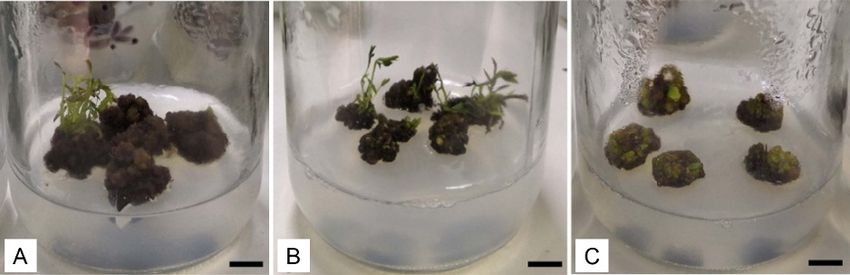
E3S Web of Conferences 245, 03067 (2021) https://doi.org/10.1051/e3sconf/202124503067
AEECS 2021
2.3 Culture conditions young leaf explants, which were inoculated on basal
medium supplemented with different concentrations of
1/2MS medium [10] supplemented with 30 g/L sucrose NAA for 80 days of culture. The results showed that the
and 8 g/L agar was served as the basic medium. The pH maximum callus induction rate (98.5%) and adventitious
value of the medium was adjusted to 5.8, and the shoot regeneration rate (60%) were gained when the
medium was placed in autoclave under conditions of concentration of NAA was at 0.5 mg/L, while the
121℃ and 0.1 MPa for sterilization for 20 min. The regeneration effect would be restrained with continuing
culture conditions of the incubator were set to adjust to increase NAA concentration. These results suggested
light at 12 h, light intensity at 2000~2500 lx, humidity at that NAA had positive effect on improving callus
80%, and temperature at 22℃. formation and adventitious bud regeneration, and the
optimal concentration of NAA was 0.5 mg/L.
2.4 Experimental methods Table 1. Results of NAA on the induction of callus and
adventitious bud
2.4.1 Germination of seeds Callus Induction rate
Concentrations of
induction rate of adventitious
The C. mimosoides seeds were soaked in water at 80℃ NAA (mg/L)
(%) bud (%)
for 5 minutes, washed firstly with 70% ethanol for 2-3
times and then with 5% NaClO for 5-10 minutes, finally 0 81.1±5.1b 33.3±6.7b
with sterile distilled water for 3 times. The sterilized
seeds were inoculated on 1/2MS medium for 8 days of 0.5 98.5±2.0a 60.0±11.5a
culture. Young leaves (size with 0.5 cm 0.5 cm
squares) were taken from the asepsis seedlings as 1 93.7±7.5ab 6.67±0.1c
explants.
Note: Different letters after the data indicated significant
differences.
2.4.2 Callus and adventitious bud induction
The young leaf explants were inoculated horizontally on
1/2MS medium contained 2.0 mg/L 6-BA and different
concentrations of NAA (0, 0.5 and 1 mg/L) for callus
and adventitious bud induction for 80 days of culture.
2.4.3 Screening of rooting medium
Figure 1. Effects of NAA on the induction of callus
The regeneration buds (longer than 1 cm) were vertically and adventitious bud in C. mimosoides
inoculated on 1/2MS medium supplemented with
Young leaf explants were inoculated on 1/2MS medium
different concentrations of IBA (0, 0.5 and 1.0 mg/L)
contained 2.0 mg/L 6-BA and A: 0 mg/L, B: 0.5 mg/L, C: 1
and NAA (0, 0.1, 0.2 and 0.5 mg/L) respectively for mg/L NAA for induction of callus and adventitious bud in C.
rooting for 20 days. mimosoides for 80 days. (Bars=1 cm)
2.4.4 Data analysis 3.2 Influences of IBA and NAA on rooting of
regeneration shoots
The induction rate of callus = (number of explants with
callus/total number of inoculated explants) 100%; The In order to investigate the effect of IBA and NAA on the
induction rate of adventitious bud = (number of explants rooting effect of the regeneration shoots, which were
with buds/total number of inoculated explants) 100%; placed into 1/2MS medium contained various
Rooting coefficient = (number of roots/number of root concentrations of IBA and NAA for 20 days of culture.
explants) 100%; Rooting rate = (number of rooting The results indicated that IBA could not effectively
shoots/number of inoculated shoots) 100%. The data promote the rooting of C. mimosoides regeneration
was analysed by the software SPSS 22.0 and conducted shoots, and with the increasing of IBA concentration, the
with Duncan multiple comparisons (P ≤ 0.05). And rooting efficiency of shoots decreased gradually (Table
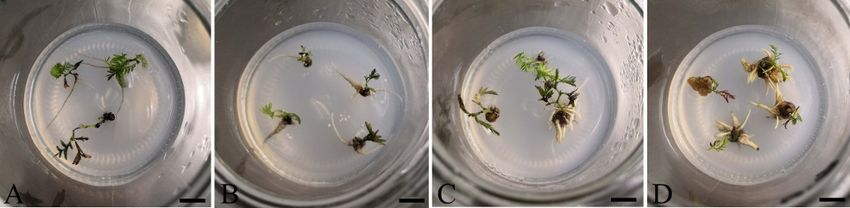
significant difference was represented by different letters. 3). The study also found that NAA had a certain effect
on the rooting of shoots. Although the number of roots
increased, the rooting rate would gradually reduce with
3 Results the increasing of NAA concentration (Table 4, Figure 2).
Therefore, 1/2MS medium without IBA or NAA was the
3.1 Effects of NAA on the induction of callus most suitable medium for rooting induction.
and adventitious bud
For the purpose of studying the effect of NAA on callus
formation and adventitious bud induction from the
2E3S Web of Conferences 245, 03067 (2021) https://doi.org/10.1051/e3sconf/202124503067
AEECS 2021
Table 2. Results of different concentration of IBA on rooting inducing callus and adventitious bud regeneration. Some
of regeneration shoots studies show that the signaling pathways between auxin
and cytokinin influence callus formation and
Concentrations of Rooting Rooting rate adventitious bud regeneration through different
IBA (mg/L) coefficient (%)
contributing factors [11].
0 5.2±0.4a 96.7±5.0a
4.2 Effects of IBA and NAA on rooting of
0.5 2.8±1.6b 80±8.7b regeneration shoots
Root is important organs for plant to absorb water and
1 0.8±1.0b 16.7±3.9c nutrients, which can provide various substances for plant
growth and development. It is very important for the
Note: Different letters after the data indicated significant establishment of plant tissue culture regeneration system
differences. to investigate whether regeneration buds can take root.
Therefore, it is very necessary to explore the suitable
Table 3. Effects of various concentration of NAA on rooting
nutrient content and hormone concentration in the
of regeneration shoots
medium for the rooting of regeneration shoots. In this
Concentrations of Rooting Rooting rate study, it was found that regeneration shoots had the best
NAA (mg/L) coefficient (%) effect of rooting in 1/2MS medium, while the growth of
root was inhibited by the addition of hormones. For
0 3.3±0.8b 93.8±2.4a example, the induction of adventitious root was
restrained after adding different concentrations of IBA in
0.1 4.0±1.6ab 86.1±8.3ab medium. Meanwhile, adding different concentrations of
NAA could promote the increasing of number of roots,
but the roots became shorter and bulkier, and some
0.2 9.0±1.0a 79.2±5.1b
callus even grown on the roots and the rooting rate
decreased. These results are very similar to some that
0.5 11.0±1.0a 65.6±6.9b have been reported [12]. Hence, 1/2MS medium was the
most suitable medium for the rooting of adventitious
Note: Different letters after the data indicated significant shoots of C. mimosoides in the present study.
differences. Application of the established plant regeneration
system from young leaf explants of C. mimosoides in
this study, the incubation time of the plant could be
reduced, and the yield of plant material might be
increased. However, there are still the following
problems in the development of C. mimosoides industry,
which are worth further discussion. Firstly, the addition
of exogenous hormones may cause changes in the ratio
and level of endogenous hormones, so as to further
Figure 2. Effects of NAA on rooting of regeneration regulate the growth of cultures. Although the effect of
shoots in C. mimosoides adding exogenous hormones in the tissue culture of C.
Regenerated shoots were inoculated on 1/2MS medium mimosoides has been clarified in this study, the
supplemented with A: 0 mg/L, B: 0.1 mg/L, C: 0.2 mg/L, D: mechanism of action between various hormones is still
0.5 mg/L NAA for rooting in C. mimosoides for 20 days. unclear. Therefore, the investigation of the physiological
(Bars=1 cm) mechanism of endogenous hormones in the tissue culture
process of C. mimosoides will provide a theoretical basis
for the use of exogenous hormone concentrations and
4 Discussion different hormone combinations in the future, and also
provide reference for the protection of medicinal plant
4.1 Effects of hormones on the induction of resources of Cassia and industrial seedling cultivation.
callus and adventitious bud Secondly, the quality of tissue culture seedlings must be
further improved to provide raw materials for the large-
Plant hormones are a series of extremely low levels of scale artificial planting of C. mimosoides. On the basis of
naturally occurring organic compounds in plants. The tissue culture combined with modern biological breeding
interactions among various plant hormone signals technology, excellent varieties with good quality and
regulate the growth and differentiation of plant cells. strong disease resistance will be cultivated, and scientific
Plant hormones play an important role in the normal and standardized planting will be carried out to achieve
development of plants. NAA is a member of auxin greater economic benefits.
family, while 6-BA is one of the cytokinin species, both
of them play an important part in induction of callus
formation and adventitious bud regeneration. Our results
revealed that both NAA and 6-BA were effective in
3E3S Web of Conferences 245, 03067 (2021) https://doi.org/10.1051/e3sconf/202124503067
AEECS 2021
5 Conclusion hyperlipidemia rats. J. Chin. Med. Mate. 38, 2169-
2171 (2015)
In this study, a method for plant regeneration of young 7. W. Zhang, J.D. Zhang, R.L. Li, et al. Experimental
leaf explants from aseptic seedlings of Cassia study of alcohol extract of Cassia mimosoides on
mimosoides was established successfully. Our inhibition of liver fibrosis induced by
preliminary results suggested that when the explants dimethylnitrosamine in rats. New Dru. Chin. Mate.
were placed onto the 1/2MS medium supplemented with Med. Clin. Pharma. 20, 308-312 (2009)
2.0 mg/L 6-BA and 0.5 mg/L NAA, high callus
induction rate and good growth status of adventitious 8. Z.W. Liu, W. Kuang, C. Zhang, et al. The anti-
bud, and the highest number of buds were gained. oxidant activities of Cassia mimosoides extracts.
Further research results revealed that IBA could not Food Sci. Technol. 39, 225-228 (2014)
promote root formation effectively, but the roots could 9. L. Huang, Y.S. Fu, C.X. Zhu, et al. Study on the
be induced by NAA. Howerer, although the rooting of protective effect of drug serum of Cassia
buds could be induced when adventitious shoots were mimosoides on hydrogen peroxide-induced
inoculated into 1/2MS medium contained 0.5 mg/L NAA, hepatocyte injury. J. Liaoning Univ. Trad. Chin.
only poor rooting effect could be obtained. In conclusion, Med. 19, 45-47 (2017)
the best medium for induction of adventitious bud 10. T. Murashige, F, Skoog. A revised medium for rapid
regeneration using young leaf as explants in C. growth and bioassays with tobacco tissue cultures.
mimosoides was 1/2MS medium supplemented with 2.0 Physiol Plant. 15, 473-479 (1962)
mg/L 6-BA and 0.5 mg/L NAA, and the optimum 11. M. Ikeuchi, K. Sugimoto, A. Iwase. Plant callus:
rooting medium was 1/2MS. mechanisms of induction and repression. Plant Cell.
25, 3159-73 (2013)
Acknowledgement 12. Z.P. Wu, Y.K. Gao, M. Fan, et al. Construction of
regeneration and transformation system of
This study was supported by Science and Technology chrysanthemum 'Jinbudiao'. Mol. Plant Breed. 18,
Program of Guangdong Province: Guangdong Provincial 150-158 (2020)
Key Laboratory of Conservation and Precision
Utilization of Characteristic Agricultural Resources in
Mountainous Areas (2020B121201013), Project of
Traditional Chinese Medicine Bureau of Guangdong
Province (20202211), the College Students Innovation
and Entrepreneurship Training Program
(S201910582106), Allowance Adjustment on Medical
Care and Insurance in 2019 (Sustainable Development of
Chinese Medicine) National Investigation on Chinese
Phytomedicine ( funding: 2019 No.39).
References
1. J.D. Zhang, S.P. Wen, Y.S. Fan. Inhibitive effects of
extract of Cassia mimosoides Linn on
dimethylnitrosamine-induced hepatic fobrosis in rats.
Lishizhen Med. Mate. Med. Res. 20, 2879-2881
(2009)
2. L.R. Song, X. Hong, X. L. Ding, et al. Dictionary of
modern Chinese medicine. Beijing: People Med.
Publish. House, 184, 192-195 (2001)
3. D.F. Han, C.L. Du, X.J. Wang. Chemical
constituents of Cassia mimosoides. Chin. J. Exp.
Trad. Med. Form. 22, 78-81 ( 2016)
4. S.S.N. Subramanian, S. Subramanian, N.S. Sankara.
Chemical examination of the leaves of Cassia
mimosoides. Ind. J. Pharm. 31, 110-111 (1969)
5. S.S.N. Subramanian. Chemical components of the
roots and seeds of Cassia mimosoides. Ind. J. Pharm.
32(3): 70-71(1970)
6. C.P. Shen, Q.H. Du, Y.Y. Zhang, et al.
Experimental study on lipid-regulating effect of
water extract of Cassia mimosoides on
4You can also read


