External Body Conditions in Cetaceans from La Gomera, Canary Islands, Spain
←
→
Page content transcription
If your browser does not render page correctly, please read the page content below
Journal of Marine Animals and Their Ecology                                                                               Vol 11, Issue 2, 2019
   Copyright © 2008 Oceanographic Environmental Research Society                                                               Printed in Canada

                                External Body Conditions in Cetaceans from
                                     La Gomera, Canary Islands, Spain
                                 Gratia Kautek1,2*, Marie-Francoise Van Bressem3, and Fabian Ritter1
                                                       1
                                                        M.E.E.R. eV., Berlin, Germany.
                                      2
                                    University of Vienna, Department of Cognitive Biology, Vienna, Austria.
                     3
                       Cetacean Conservation Medicine Group, Peruvian Centre for Cetacean Research (CEPEC), Lima, Peru.

Abstract                                                                            anthropogenic threats (14). High speed ferry traffic has
         We report on externally visible pathological and natural conditions        expanded during the last 20 years with a subsequent
in free-ranging cetaceans off La Gomera, Canary Islands, in the period 1995
-2018. Photographic records of Atlantic spotted dolphins (Stenella                  increase of ship strikes (1, 10). The whale watching
frontalis), bottlenose dolphins (Tursiops truncatus), short-finned pilot            industry has developed rapidly, and cetaceans off
whales (Globicephala macrorhynchus), rough-toothed dolphins (Steno                  Tenerife are among the most intensely watched
bredanensis), common dolphins (Delphinus delphis), Cuvier’s beaked
whales (Ziphius cavirostris), Blainsville’s beaked whales (Mesoplodon               populations in the world, causing suspected long-term
densirostris) and Bryde’s whales (Balaenoptera edeni) were screened for             negative impacts (30). Other significant anthropogenic
the presence of pathological and natural body conditions. External                  threats include fisheries interactions and marine debris
conditions were classified according to their characteristics. A total of 279
individuals were found presenting skin disorders, injuries, emaciation,             as well as chemical pollution and underwater noise (1,
deformations or parasitism. Epidermal conditions including tattoo skin              14, 17). The marine ecosystem south of La Gomera, one
disease, focal skin disease, cutaneous nodules, pale skin patches and               of the Western Canary Islands, was declared a Special
abnormal pigmentation were detected in 76 delphinids and seemed common
in T. truncatus. Cases of emaciation were observed in 25 T. truncatus and           Area of Conservation (SAC) under the EU Habitats
in one G. macrorhynchus in 2010 and 2014. The dorsal fin of 76 dolphins             Directive in January 2002. In this study, external
and whales was bent, collapsed, injured or amputated. Traumata of possible          evidence of pathological and natural conditions were
anthropogenic origin affected the dorsal fin, tailstock and head of 24
delphinids and two B. edeni. The obligate cetacean barnacle Xenobalanus             assessed in cetaceans from La Gomera using
globicipitis infested 23 individuals of five species. Scars and wounds              photographic records taken in the period from 1995
attributed to Petromyzon marinus and Isistius sp. occurred in most species,         until 2018.
including B. edeni. Lesions possibly caused by Pennella balaenoptera were
seen in two T. truncatus and one Z. cavirostris. This study provides a
preliminary insight into externally visible skin disorders, traumata, body          Methods
conditions and parasites occurring in cetaceans south of La Gomera, Canary
Islands. [JMATE 2019;11(2):4-17]
                                                                                             The survey area covered the coastal waters south
                                                                                    and southwest of La Gomera, an area characterized by
Keywords: cetaceans, skin disease, body condition, injuries, epizoa                 usually calm waters, created by the lee side of the
                                                                                    prevailing north-eastern trade winds. The study area is
Introduction                                                                        also characterized by deep waters (with depths up to
        Skin diseases, body traumata and deformations                               2,000-3,000 meters below sea level) within 10 km from
are increasingly reported in free-ranging cetaceans,                                the coast. The water temperature is around 18°C to 19°C
causing growing concern worldwide (6, 31, 52). Viruses,                             in winter and varies between 22°C to 25°C from late
bacteria, fungi and protozoans may cause a variety of                               summer to autumn.
cutaneous diseases (7). However, in many cases, the                                          Photographs were taken regularly between
etiology of these conditions is unknown (8, 39, 49).                                September 1995 and November 2015 from several
Though several skin diseases resolve over weeks or                                  whale watching boats used as platforms of opportunity
months, some are chronic and progress over time (31,                                and operating from the harbor of Vueltas in the
33, 52). Depending on their severity, traumata and                                  municipality Valle Gran Rey. Additional photographs
deformations may affect fitness, reproduction, feeding                              from three sightings made in May 2017 and April and
and welfare and, in extreme cases, can lead to premature                            November 2018 were included in the analysis. The boat
death (9, 57).                                                                      trips lasted an average of 3-4 hours with a maximum of
        Approximately 400 km east of the African                                    8 hours and reached up to 5 nautical miles (9.3 km)
continent in the Northeast Atlantic Ocean, the Western                              from the shore, depending on weather and sea state.
Canary Islands represent a major tourist destination in                             Vessels included an 11 m open wooden former fishing
Europe. The waters in the Archipelago are home to 30                                boat and a 14 m steel ketch (max. 12 passengers each),
cetacean species that are increasingly exposed to                                   as well as a 24 m motor yacht carrying up to 60

Submitted March 21, 2019; Accepted December 22, 2019
Correspondence: Gratia Kautek
Telephone: +1-907-953-2340                                                      4
                                                                                                                              JMATE
Email: gratia.kautek@chello.at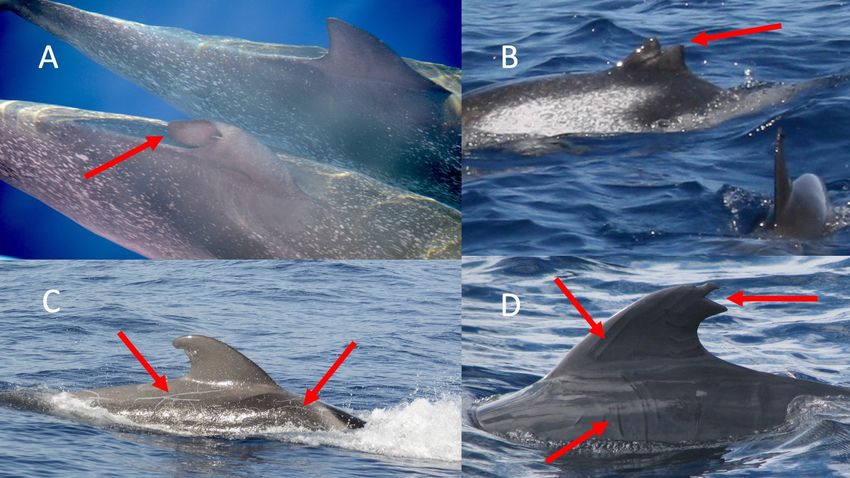
Vol 11, Issue 2, 2019                                                             Body conditions in cetaceans from La Gomera
Printed in Canada

passengers. Boat operators hold a whale watching                 classification and morphology could not be assigned to
license to conduct commercial whale watching trips               the above categories.
once or twice a day. On each survey trip, the sea was                    Skin lesions were classified as small,
visually scanned by experienced observers. Cetaceans             medium-sized or large, on the basis of their relative size
were approached according to the Canary Island whale             to the eye or blowhole diameter and to the dorsal fin as
watching regulations (22).                                       follows: i) small - lesions appearing smaller than the
      Photographs were taken with different SLR                  diameter of the eye or blowhole; ii) medium - lesions
cameras, equipped with zoom lenses ranging from                  smaller than twice the size of the eye or blowhole
80mm to 400mm. Some high-quality photographs taken               diameter, and iii) large - lesions bigger than a quarter of
by other trip participants were evaluated as well. All           the dorsal fin base length (39, 48).
photographs were screened for the presence of species-           -External injuries: This category includes scars, fresh
specific features and distinctive markings on the dorsal         wounds and amputations of miscellaneous origin. To
fin and on the body, as described in Würsig & Jefferson          determine if lesions were of anthropogenic origin,
(59). High quality images were sharp, bright, and well           criteria and case definitions for serious injury and death
exposed. Medium quality images were sharp and bright             of cetaceans from anthropogenic trauma defined by
enough to allow cetacean identification and the detection        George et al., Azevedo et al., Dwyer & Visser, and
of pathological versus natural conditions. Photographs of        Moore et al. were used (2, 13, 18, 32). Four types of
medium to high quality were selected for the analysis of         injuries were distinguished: a) Traumata: Fresh wounds
skin disorders. Low quality images that appeared blurry          and scars of non-predatory and non-parasitic origin that
or underexposed but showed the full dorsal fin for               could be observed on all body parts except the dorsal fin;
identification were only used to detect injuries.                b) Disfigurement of the dorsal fin: nicks, scars and
      Species were identified following criteria                 wounds resulting in significant damage of the fin and
described in Shirihai and Jarrett (42). Individuals were         including partial or complete amputation, bending or
classified into three age categories (calves, immatures,         total collapse (3, 54); c) Parasitic wounds: round or
adults) based on body length, coloration pattern as well         oval-shaped, crater-like lesions with a diameter of
as group dynamics, as described in Perrin & Reilly and           approximately 6 cm were attributed to cookie cutter
Wells et al. (35, 56).                                           shark (Isistius sp.) bites (13). Circular fresh and healed
                                                                 lesions, with greyish or pale coloration that may bear a
Classification of external conditions:                           dentition pattern were regarded as bites by the sea
        Photographs were examined for the presence of            lamprey Petromyzon marinus (34). Thin white scars that
externally visible pathological conditions, traumata,            may present a central pit were classified as lesions
abnormal pigmentation and parasites, as previously               induced by the large parasitic copepod Pennella
described (2, 3, 39, 45). External factors that could have       balaenopterae (6); d) Predation marks: Three to four
caused morphological abnormalities (e.g., vessel                 tooth rakes separated by spaces measuring more than
propellers, fishing gear, parasitism, etc.) were                 25mm and within the range of inter-dental
documented for each individual. Based on their                   measurements for killer whales.
macroscopic appearance and current literature, the               -Masses: Masses are abnormal tissue growths that may
external conditions were categorized as follows:                 be tumors or abscesses and can occur on any part of the
-Skin disorders: Skin conditions were classified into the        body (21).
following categories: a) Cutaneous nodules (CNO):                - Deformations: This category describes alterations in
abnormally or normally pigmented small skin elevations           the shape and/or structure of a body part, e.g. the dorsal
(6, 46); b) Pale skin patches (PSP): irregular or rounded        fin, beak or vertebral column (3, 5, 54).
light grey or whitish marks on the skin (39); c) Focal           -Thinness and emaciation: Dolphins and whales
skin disease (FSD): characterized by small, black or             showing a loss of body mass were considered thin or
white dot lesions that may be spread over the whole              emaciated (25, 36). Specific anatomical indicators to
body and may present a small hole in their center (6, 8,         identify the body condition were restricted to the epaxial
39, 49); d) Tattoo skin disease (TSD): irregular, grey or        body section. Thin individuals showed mild to moderate
black stippling of the skin (20, 51); e) Anomalous               concavity ventrolateral to the dorsal fin and a moderate
pigmentation (ANP): modification of the                          depression posterior to blowhole, and visibility of ribs.
species-specific pigmentation pattern described for the          Emaciated individuals showed a severe concavity and
species (45); f) Other skin disorders (OSD): all other           deeper depression posterior to the blowhole, as well as
unusual cutaneous pathological findings where                    visible ribs (25).
                                                             5
                                                                                                            JMATE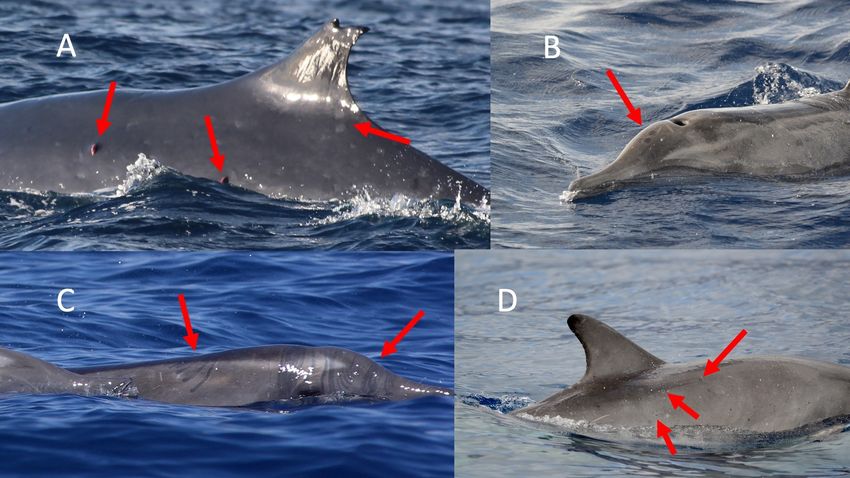
Printed in Canada
                                                                                                                                                                 Vol 11, Issue 2, 2019

                    Table 1: Numbers of individuals analyzed for the presence of abnormal skin and body conditions per year (1995-2018), off La
                    Gomera, Canary Islands

        Year Data        # Individuals         S.            T.              G.                  S.             D.         B.          Z.             M.
        Collected          analyzed         frontalis    truncatus      macrorhynchus        bredanensis      delphis     edeni    cavirostris    densirostris

         1995                 1                 0           1                  0                 0              0          0            0              0
         1998                 3                 1           1                  1                 0              0          0            0              0
         2000                 7                 0           1                  3                 3              0          0            0              0
         2001                13                 2           2                  9                 0              0          0            0              0
         2002                 5                 0           4                  1                 0              0          0            0              0
         2003                10                 1           5                  4                 0              0          0            0              0
         2004                 3                 1           0                  0                 0              2          0            0              0
         2005                 5                 2           0                  1                 1              1          0            0              0

   6
         2006                 5                 1           1                  3                 0              0          0            0              0
         2007                28                 5           6                  9                 1              4          1            1              1
         2008                 2                 0           0                  2                 0              0          0            0              0
         2009                 4                 1           1                  0                 1              1          0            0              0
         2010                19                 1           6                 10                 1              0          0            1              0
         2011                22                 0          14                  6                 1              0          0            1              0
         2012                16                 2           7                  5                 2              0          0            0              0
         2013                32                10          13                  5                 4              0          0            0              0
         2014                80                11          33                 35                 0              0          1            0              0
         2015                21                 5           8                  4                 0              4          0            0              0
         2017                 1                 0           0                  0                 0              0          1            0              0
         2018                 2                 0           0                  0                 1              0          1            0              0
        TOTAL                279               43          103                98                 15             12         4            3              1

JMATE
                                                                                                                                                                        Body conditions in cetaceans from La Gomera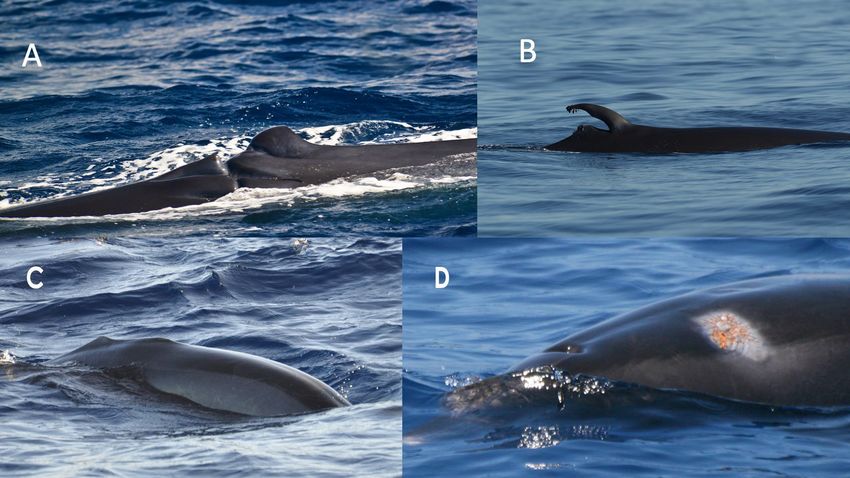
Vol 11, Issue 2, 2019 Body conditions in cetaceans from La Gomera
Printed in Canada
Results
There were 1,218 cetacean photographs of
Fishing
Anthropogenic
gear
seven species, presenting externally visible
2
1
3
1
0
0
0
0
7
pathological and natural conditions collected during 54
injuries
whale watching trips from 1995 until 2018. Most whale
watching trips occurred in the spring (41%, March-
Boat pro-
May) and fall seasons (33%; September-November).
pellers
Table 2: Natural and pathological conditions observed in seven species of cetaceans off La Gomera, Canary Islands in
19
7
5
3
2
0
2
0
0
The highest number of images was taken in 2014
(N=748), followed by 2011, 2013 (N=76) and 2015
(N= 70). A total of 279 cetaceans exhibited conditions
that were evaluated in the present study. Of these, 271
Emaciation
Pathological conditions
individuals belonged to the five species most
25
26
commonly observed in these waters: the Atlantic
1
0
0
0
0
0
0
spotted dolphin (Stenella frontalis, N=43), bottlenose
dolphin (Tursiops truncatus, N=103), short-finned pilot
whale (Globicephala macrorhynchus, N=98),
Masses
rough-toothed dolphin (Steno bredanensis, N=15) and
0
2
1
1
0
0
0
0
4
common dolphin (Delphinus delphis, N=12).
Additionally, three Cuvier’s beaked whales (Ziphius
cavirostris), one Blainville’s beaked whale
Skin le-
(Mesoplodon densirostris) and four Bryde’s whales
sions
29
48
5
9
2
3
0
0
0
(Balaenoptera edeni) also presented skin anomalies,
traumata or deformities (Table 1). Forty-four cetaceans
had more than one condition (S. frontalis, N=2;
ANP
15
the period 1995 till 2018. ANP = Anomalous skin pigmentation.
T. truncatus, N=27; G. macrorhynchus, N=7;
4
2
6
2
1
0
0
0
S. bredanensis, N=5; D. delphis, N=2 and B. edeni,
N=1). Progression of the traumata could be monitored Parasites
in four T. truncatus, one of which was re-sighted seven
18
Natural conditions
4
3
5
1
1
2
2
0
times over a 13-year period.
External injuries and disfigurement:
Vessel propellers (N= 19) and fishing gears
Conspecifics
(N=7) likely caused wounds and scars in 25 individuals
15
44
64
3
2
0
0
0
0
from five species (Table 2, Figures 1A, 1B, 1C, 2B,
2D). Linear, parallel deep cuts suspected to have been
caused by propellers (9, 19, 53) occurred on the body
or fins of seven G. macrorhynchus, five S. frontalis,
Predation
three T. truncatus and two S. bredanensis (Table 2).
One B. edeni sighted in 2018 presented a minimum of
4
2
0
0
0
0
0
0
three parallel straight, deep healed slashes on the back 6
and DF that were also likely the result of a propeller
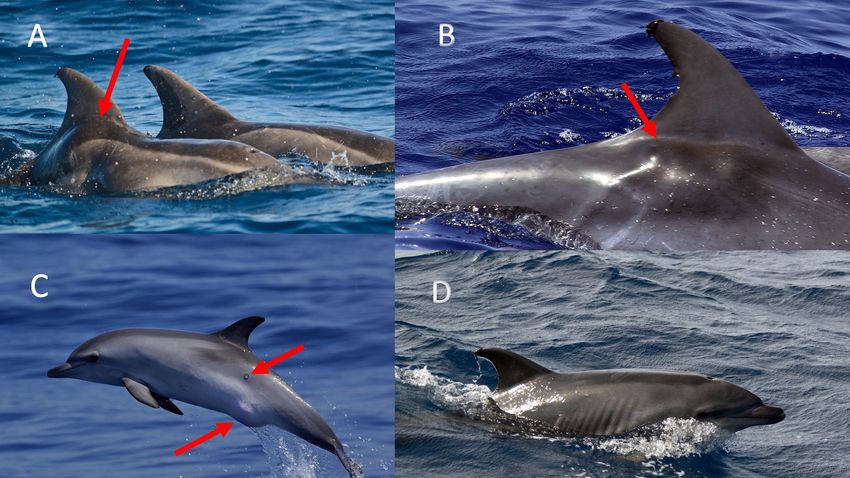
strike (Figure 1A). One B. edeni photographed in May
TOTAL
2017 presented a deep V-shaped cut on the trailing
M. densirostris
G. macrorhyn-
S. bredanensis
Z. cavirostris
T. truncatus
S. frontalis
edge of the dorsal fin (Figure 1B).
D. delphis
B. edeni
The dorsal fin of 76 individuals was injured,
chus
bent or collapsed. In eight T. truncatus, seven G.
macrorhynchus, three S. bredanensis, one D. delphis,
five S. frontalis and one Z. cavirostris the tip of the
dorsal fin was missing or severely injured. In four S.
frontalis, two T. truncatus, two G. macrorhynchus and
7
JMATE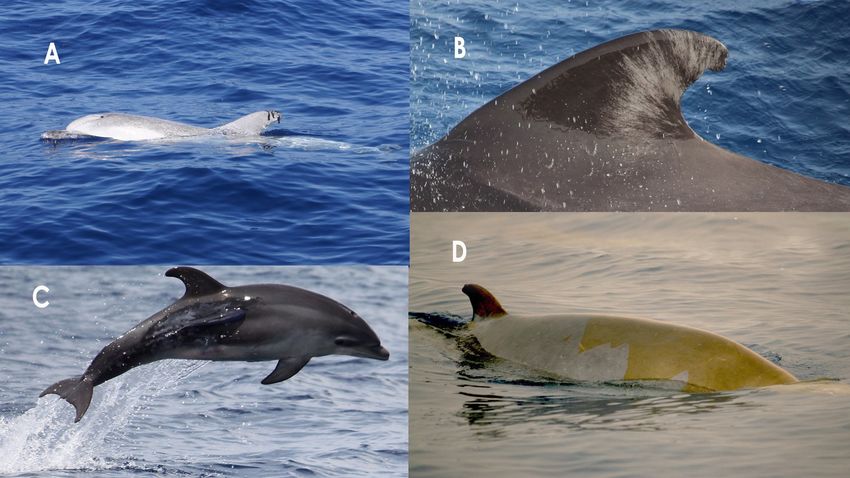
Vol 11, Issue 2, 2019                                                                     Body conditions in cetaceans from La Gomera
Printed in Canada

     Figure 1: External injuries in cetaceans photographed between 2010 and 2018 off La Gomera, Canary Islands: A, B) Traumata on the
     back and dorsal fin of a Bryde’s whale (Balaenoptera edeni). C) Complete amputation of the dorsal fin in a bottlenose dolphin.
     D) Open wound on the back of a bottlenose dolphin (Tursiops truncatus).

one B. edeni the dorsal fin had been partially amputated.               and one adult G. macrorhynchus and two immature S.
In a T. truncatus photographed several times between                    frontalis. The spaces between the tooth rakes marks
1998 and 2014 it had been completely severed (Figure                    were estimated to be over 20mm, and were within the
1C).                                                                    range of inter-dental measurements for O. orca
      The dorsal fin of one S. frontalis had collapsed                  (Figure 2C, 2D, Table 2).
(Figure 2A), while in one T. truncatus and in one                              Wounds possibly caused by parasitic fishes
S. bredanensis it was partially bent to one side. All                   (Isistius sp. and Petromyzon marinus) and the large
affected dolphins were adults. Collapse of the dorsal fin               copepod P. balaenopterae were seen in 18 individuals
was associated with a cut in the trailing edge of the                   (Table 2). Fresh wounds were observed in 13
S. frontalis. Cuts and large scars were also seen on the                individuals of six species. In two S. frontalis they
side of the bent dorsal fin of the T. truncatus. The                    resembled the marks inflicted by P. marinus. In one
trauma that caused these injuries may have been at the                  S. frontalis, three T. truncatus (Figure 1D), four
origin of the bent dorsal fin.                                          G. macrorhynchus, one S. bredanensis, one D. delphis
      Long, linear, white scars on the anterior body, tail              and one B. edeni they were likely caused by Isistius
and tailstock, likely caused by entanglement in fishing                 sp., as described in other species (13, 32). Numerous,
gears, were seen in three T. truncatus, two G.                          short linear scars surrounded by a pale halo, possibly
macrorhynchus, one S. bredanensis and one S. frontalis.                 caused by P. balaenoptera, occurred on the flank and
      Scars and wounds affecting other body parts than                  back of two adult T. truncatus. Several light gray
the dorsal fin were seen in five species. Scars were more               marks, some with a central pit, were present on the
frequent than open wounds. Their size varied from                       back of an adult Z. cavirostris. Two of them were seen
about 2 cm to about 125 cm and were observed on the                     close to the attachment site of a cluster of possible but
dorsal part of the back (69%) and on the tailstock                      unconfirmed P. balaenoptera. Four G. macrorhynchus
(37%). Predation by killer whales (O. orca) was                         had linear wounds of unknown origin on their back and
suspected in six cases (Table 2). Three to four parallel                dorsal fin, varying between approximately 10 to 30 cm
tooth rakes occurred on the back of three immature and                  in length.
                                                                    8
                                                                                                                      JMATE
Vol 11, Issue 2, 2019 Body conditions in cetaceans from La Gomera
Printed in Canada
Figure 2: External injuries in cetaceans photographed between 2010 and 2018 off La Gomera, Canary Islands: A, B) Bent and cut
dorsal fin in Atlantic spotted dolphins (Stenella frontalis). C, D) Scars on the body of short-finned pilot whales (Globicephala
macrorhynchus).
Figure 3: Skin disorders in cetaceans photographed between 1995 and 2018 off La Gomera, Canary Islands: A, B) Abnormal
pigmentation in an Atlantic spotted dolphin (S. frontalis) and a short-finned pilot whale (G. macrorhynchus). C) Hypopigmentation
associated with the presence of a remora in a bottlenose dolphin (T. truncatus). D) Yellow film on the back of a Blainsville’s beaked
whale (Mesoplodon densirostris).
9
JMATEVol 11, Issue 2, 2019 Body conditions in cetaceans from La Gomera
Printed in Canada
Skin disorders:
Five types of skin disorders were observed in 76
Mult.
individuals belonging to the seven species (Table 3).
SDs
0
1
4
0
0
0
0
5
One S. frontalis and four T. truncatus individuals had at
least two types of skin conditions. Cutaneous nodules
and anomalous pigmentation were the conditions most
frequently detected, followed by focal skin disease and
Table 3: Number of individuals with skin disorders in seven species of odontocetes observed off La Gomera, Canary Islands
in 1995-2018 (N= total number; CNO= cutanous nodules; TSD= tattoo skin disease; FSD= focal skin disease; PSP= pale
tattoo skin disease. The majority of the 16 animals
OSD
skin patches; ANP= anomalous pigmentation; OSD= other skin disorders; Mult. SDs=Multiple skin disorders (i.e. any
14
11
presenting cutaneous nodules were T. truncatus (N=11),
1
0
1
0
1
1
of which 77% were adults and 23% immatures.
Cutaneous nodules were additionally seen in two
immature S. frontalis, two adult G. macrorhynchus and
in one adult D. delphis. Abnormal pigmentation
ANP
affected the dorsal fin, back, flank or beak of two
15
4
2
6
2
1
0
0
S. frontalis, six T. truncatus, four G. macrorhynchus,
two S. bredanensis and one D. delphis. One S. frontalis
was mostly white, but as its eyes were not visible, it
was not possible to determine if it was affected by
PSP
leucism or albinism (Figure 3A). Pigmentation on the
2
2
2
0
0
0
0
6
dorsal fin and side of another S. frontalis and of a
D. delphis was lighter than in the other individuals of
these species. Three T. truncatus and two
G. macrorhynchus (Figure 3B) presented piebaldism, a
condition characterized by the absence of pigmentation
FSD
10
12
on the beak or the dorsal fin (Table 3).
1
1
0
1
0
0
Focal skin disease (FSD) characterized by black
or white dots occurring on the back and flanks, evenly
distributed or grouped in small clusters, was detected in
nine T. truncatus (Figure 4D), one S. frontalis, one
TSD
G. macrorhynchus and one D. delphis (Table 3). One
0
3
2
2
1
0
0
8
T. truncatus also exhibited a white mark of unknown
etiology on its neck. Most affected T. truncatus were
combinations of the previous skin disorders).
adults.
Small to medium-sized tattoo skin lesions were
CNO
seen on the back, head and flippers of three S. frontalis,
16
11
2
2
0
1
0
0
two T. truncatus, two S. bredanensis (Figure 4B) and
one D. delphis. Among these individuals a S. frontalis
and a T. truncatus also presented pale skin patches
(PSP). Tattoo number was generally low (Vol 11, Issue 2, 2019 Body conditions in cetaceans from La Gomera
Printed in Canada
Figure 4: Skin conditions in cetaceans photographed between 1995 and 2018 off La Gomera, Canary Islands: A) Grey oval patches
and unidentified parasite on the flank and back of a Bryde’s whale (B. edeni). B) Tattoo skin disease in a rough-toothed dolphin
(Steno bredanensis). C) Possible Physalia physalis marks in a rough-toothed dolphin. D) Focal skin disease in a bottlenose dolphin
(T. truncatus).
Figure 5: Pathological conditions in small cetaceans photographed off La Gomera, Canary Islands, between 1995 and 2018.
A, B) Masses on the back of a rough-toothed dolphin (S. bredanensis) and a bottlenose dolphin (T. truncatus). C) Mass in the genital
area of an Atlantic spotted dolphin (S. frontalis). D) Emaciated T. truncatus with ribs visible.
11
JMATEVol 11, Issue 2, 2019 Body conditions in cetaceans from La Gomera
Printed in Canada
Some small to medium, light gray oval marks with a to have caused these injuries in six T. truncatus, nine
black outline occurred on the back and flank of three G. macrorhynchus, three S. bredanensis, six
adults and one immature T. truncatus. Light gray S. frontalis and two B. edeni. Fishing activities occur
blotches of varying size occurred on the back and dorsal year-round off the Canary Islands, regularly
fin of two adult G. macrorhynchus. Several linear, dark contributing to cetacean mortality (1, 12, 43). Vessel
grey marks, possibly caused by the tentacles of a strikes are another significant cause of injuries and
Portuguese Man-O-War (Physalia physalis), were mortality in dolphins and whales from these waters (1,
present on the back and head of an adult S. bredanensis 10, 12). During the study period, several cetacean
(Figure 4C). strandings were reported in the Canary Islands, of
which a large proportion was caused by ship collisions
Masses and deformations: and fishing activities (1, 12). Because of their regular,
Masses were detected in two immature prolonged resting periods close to the surface,
S. frontalis, one T. truncatus of unknown maturity and G. macrorhynchus may be prone to vessel strikes,
in one immature S. bredanensis (Table 2, Figure 5A, 5B, which may explain the presence of these lesions in five
5C). The S. bredanensis had a large mass extending on individuals. In smaller dolphins, propeller strikes may
both sides of the dorsal fin base (Figure 5A). Fist-size occur when animals approached boats to bow-ride.
lumps were seen on the right side of the back, below the Though dolphins and whales may survive
dorsal fin in a T. truncatus photographed on 12 May entanglement in fishing gear and vessel strikes, the
2011 (Figure 5B). When re-sighted on 15 October 2011, inflicted lesions and traumata likely increase stress and
the lumps were no longer visible. One S. frontalis had a affect fitness, longevity and reproduction (57).
melon-sized lump around the genital region while the Non-lethal injuries of anthropogenic origin are
other presented a fist-sized lump on the lateral side of increasingly reported in cetaceans worldwide and are
the flank (Figure 5C). The beak of an adult T. truncatus considered a threat to the survival and welfare of
was abnormally curved upwards. several species and populations (10, 18, 53).
The dorsal fin of one S. frontalis had
Body condition and Xenobalanus sp.: completely collapsed and, in one T. truncatus and one
Thinness and emaciation were seen in 25 S. bredanensis, it was partially bent to one side.
T. truncatus of all age classes (2 calves, 4 immatures, Traumata may be at the origin of this condition.
19 adults) and in one adult G. macrorhynchus (Table 2, Collapsed and bent dorsal fins have been observed in a
Figure 5D). The ribs were visible in all individuals. One white-beaked dolphin (Lagenorhynchus albirostris)
of them also presented an additional concavity of the photographed off northern Newfoundland, Canada, in
epaxial musculature. Five T. truncatus and the false killer whales (Pseudorca crassidens) from
G. macrorhynchus were sighted in April 2010. The other Hawaii and Aruba, and in killer whales from
ten emaciated bottlenose dolphins were photographed New Zealand, Norway and British Columbia, Canada
from October to December 2014. (3, 24, 54). In a false killer whale (Pseudorca
The coronulid barnacle Xenobalanus sp. was seen crassidens) from Hawaii, the dorsal fin collapse was
on the fins of eight T. truncatus, nine associated with interactions with the tuna and
G. macrorhynchus, one S. bredanensis, four S. frontalis, swordfish long-line fishery (3). In one L. albirostris
one Z. cavirostris and one B. edeni, predominantly on dorsal fin collapse was likely related to a gunshot
the trailing edge of the dorsal fin. wound on the anterior flank of the body. Other
reported causes for these conditions in free-ranging
Discussion odontocetes include intra- and inter-specific
This study is based on photographs taken during interactions, boat strikes and scarring from tags (3).
whale watching trips from 1995-2018. It reports on the Skin diseases were observed in seven species of
presence of skin diseases, injuries, anomalous odontocetes and seemed common in T. truncatus, with
pigmentation, masses and deformations in 8 cetacean a minimum of 29 individuals affected. Caused by
species from the waters of La Gomera. Traumata cetacean poxviruses, TSD is endemic in several species
characterized by partial or complete amputation of the worldwide with prevalence levels varying broadly
dorsal fin, deep wounds and incisive cuts affected between species and populations (16, 20, 51). Its
several individuals of each species. Entanglement in epidemiological pattern is a potential general health
fishing gear and boat propeller strikes were suspected indicator for cetaceans (47). Very large tattoos
12
JMATEVol 11, Issue 1, 2019 Body conditions in cetaceans from La Gomera
Printed in Canada
suggestive of immune suppression were not seen during the same prey as dolphins with which tunas form large
this study, and relatively few cases (one to five) were aggregations (40). Emaciation was indeed observed
documented for each delphinid species. FSD was during years of poor tuna catch (2011 and 2014)
regularly seen in T. truncatus but rarely in the other indicating that the strong inter-annual variability in
species. Though herpesvirus-like particles were primary and secondary productivity is affecting
detected in FSD skin lesions sampled in dusky dolphins bottlenose dolphins. Prey limitation is one of the main
(Lagenorhynchus obscurus) from Peru, its origin is anthropogenic threats affecting O. orca off the coast of
generally unknown (8, 39, 49). FSD has regularly been Vancouver, limiting their reproduction and recovery
reported in several species of small cetaceans from the (55).
Americas, Europe and Australasia (8, 39, 58). Of Masses of unknown aetiology were detected in
unknown aetiology, pale skin patches affected a low two immature S. frontalis, one adult T. truncatus and
number of T. truncatus, S. frontalis and one immature S. bredanensis. In other cetaceans,
G. macrorhynchus. swelling and masses were found to be abscesses,
Epibiont diatoms are suspected as the tumors and scarification tissue (23, 41). Obstruction of
aetiological agent of the extensive yellow film that the urethra may have caused the mass in the genital
covered the dorsal fin and back of a mature female region of a S. frontalis.
M. densirostris (37). Anomalous pigmentation was Fresh and healed bite marks, likely due to cookie
detected in all five delphinid species. An immature -cutter sharks, occurred in S. frontalis, T. truncatus
S. frontalis was white on most of the visible body with a and D. delphis. The cookie-cutter shark Isistius sp.
noticeably light grey cape. As its eyes were not visible, inhabits oceanic subtropical and tropical waters of the
we could not determine if it represented a case of Atlantic, including the central eastern tropical Atlantic
leucism (pigmented eyes) or albinism (unpigmented off North-West Africa (28, 44). Isistius sp. bites have
eyes). It could also have been a case of pseudo- been reported in fin (Balaenoptera physalus),
albinism, as seen in Chediak-Higashi Syndrome, an humpback (Megaptera novaeangliae) and
inherited disorder characterized by diluted pigmentation melon-headed whales (Peponocephala electra) from
patterns, white blood cell abnormalities, and a shortened the waters of Cape Verde Islands (53) as well as in
life span that has been observed in a captive killer whale cetaceans from the Gulf of Guinea (11). A remora
(15). Cost of abnormal colouration may include reduced possibly caused a large cutaneous reaction around its
heat absorption in colder waters, skin damage and attachment site in an immature T. truncatus. Small
increased conspicuousness to predators (15). In the tooth-like projections of mineralized tissue known as
eastern Atlantic, a white pigmented S. bredanensis calf spinules protrude from the suction disc of remoras,
was reported off the coast of Gabon, West Africa in increasing their resistance to slippage and, possibly
2009 (11). During the present study, one T. truncatus also causing abrasion and irritation of the host skin (4).
and two G. macrorhynchus displayed piebaldism, a Numerous, short linear scars surrounded by a pale halo
condition characterized by the lack of pigmentation in occurred on the flank and back of two adult
some body areas (45). Caused by mutations in genes T. truncatus and a Z. caivirostris. Their origin remains
responsible for the production of melanin, albinism, unknown but similar scars have been observed in
leucism and piebaldism have been documented in minke whales (Balaenoptera acutorostrata) following
several cetacean species (15, 27, 29, 45). Their P. balaenoptera infestation (6, 37). The linear, dark
frequency seems to increase with genetic isolation (27). grey marks observed on the back and head of an adult
Emaciation and thinness were detected in 25 S. bredanensis may have been marks caused by the
T. truncatus and one G. macrorhynchus and seemed to tentacles of Portuguese Man-O-War
affect T. truncatus more severely during some years (Physalia physalis), a poisonous hydrozoan abundant
than during others, possibly because of lower prey off La Gomera in springtime and capable of inflicting
availability, as a result of reduced productivity or painful stings. Though cetaceans were repeatedly
overfishing. The fact that this condition almost sighted approaching Portuguese Man-O-Wars during
exclusively affected T. truncatus and was observed in this study, they were never seen in to be in direct
all age classes suggests that this population does not physical contact with them. Nonetheless, it is possible
always catch enough food. The tuna fishery off La that a dolphin can be accidentally hit by the tentacles
Gomera fluctuates according to the occurrence and when surfacing.
abundance of its target species, which supposedly has The coronulid barnacle Xenobalanus sp.
13
JMATEVol 11, Issue 2, 2019 Body conditions in cetaceans from La Gomera
Printed in Canada
attached to the fins of T. truncatus, G. macrorhynchus, References
S. bredanensis, S. frontalis, D. delphis and B. edeni, 1. Arbelo M, Los Monteros AE, Herráez P,
predominantly on the dorsal fin trailing edge. This Andrada M, Sierra E, Rodríguez F, et al.
epibiont infests at least 34 cetacean species in both Pathology and causes of death of stranded
coastal and offshore waters from the Arctic to Antarctic cetaceans in the Canary Islands (1999-2005).
(26) and is regularly seen in cetaceans off La Gomera. Diseases of Aquatic Organisms 103:7-99.
Two unidentified, short, pink, suspected parasites were doi: 10.3354/dao02558. 2013.
attached to the left flank of an adult B. edeni (Figure 2. Azevedo AF, Lailson-Brito J, Dorneles PR,
4A) together with several oval light grey scars, van Sluys M, Cunha HA, Fragoso AB. Human-
corresponding to the diameter of the organism’s anterior induced injuries to marine tucuxis (Sotalia
body. Though the literature on external parasites and guianensis) (Cetacea: Delphinidae) in Brazil.
parasitic fishes in cetaceans was extensively reviewed, Marine Biodiversity Records, 2. E22.
no similar observation could be found. In summary, doi:10.1017/S1755267208000262. 2009.
these results indicate that a broad variety of parasites 3. Baird RW, Gorgone AM. False killer whale DF
and commensals infest cetaceans in the waters around disfigurement as a possible indicator of longline
La Gomera. fishery interactions in Hawaiian waters. Pacific
Science 59: 593-601. 2005.
Conclusion 4. Beckert M, Flammang BE, Nadler JH. Remora
During this study, several natural and fish suction pad attachment is enhanced by
pathological conditions were externally detected in spinule friction. Journal of Experimental
cetaceans from La Gomera, with traumata, emaciation Biology 218:551–558. 2015.
and skin diseases causing particular concern, especially 5. Berghan J, Visser IN. Vertebral column
in T. truncatus where they seem common. This study malformations in New Zealand delphinids with a
further confirms that visual health assessments are review of cases worldwide. Aquatic Mammals
valuable, non-invasive tools to monitor pathological and 26(1):17-25. 2000 .
natural conditions in cetaceans (6, 33, 58). Combined 6. Bertulli CG, Cecchetti A, Van Bressem MF,
with studies on the pathology and toxicology of Van Waerebeek K. Skin disorders in common
stranded whales and dolphins (1, 12, 17, 38, 43), visual minke whales and white-beaked dolphins off
health assessments provide a more complete picture of Iceland, a photographic assessment. Journal of
the threats affecting these marine mammals. Marine Animals and Their Ecology 5(2):29-40.
2012.
Acknowledgements 7. Bossart GD, Schaefer AM, McCulloch S,
M.E.E.R. was funded by Gesellschaft zur Rettung der Goldstein J, Fair PA, Reif JS. Mucocutaneous
Delfine (GRD), International Fund for Animal Welfare lesions in free-ranging Atlantic bottlenose dol-
(IFAW), OceanCare, Deutsche Umwelthilfe, Heinz-Sielmann phins Tursiops truncatus from the southeastern
-Stiftung, Beatrice-Nolte-Stiftung (Hamburg), and Deutsche USA. Diseases of Aquatic Organisms
Stiftung Meeresschutz. We thank the local whale watching
115:175-84. doi: 10.3354/dao02895. 2015.
operators Club de Mar (1995-2007) and OCEANO Gomera
(2008-2018) for being the long-standing partner of M.E.E.R. 8. Burdett-Hart L, Rotstein DS, Wells RS, Allen J,
as well as Tina Excursions, for providing spaces on their Barleycorn A, Balmer BC, et al. Skin lesions on
whale watching vessels. Many thanks to the skippers and the common bottlenose dolphins (Tursiops
guides of those vessels, as well as to their passengers who truncatus) from three sites in the Northwest
supported our study. Bettina and Axel Kelm were involved in Atlantic, USA. PLoS ONE 7(3), e33081. https://
an initial assessment of the photographic data. We kindly doi.org/10.1371/journal.pone.0033081. 2012.
acknowledge Drs JA Raga, F Aznar and K Van Waerebeek 9. Byard RW, Winskog C, Machado A, Boardman
for their help with identifying external parasites. We thank W. The assessment of lethal propeller strike
Christina Sommer for carefully reading the original
manuscript, as well as Sarah Cleaver and Hallie Peterson for
injuries in sea mammals. Journal of Forensic
their final editorial assistance. We kindly acknowledge the and Legal Medicine 19(3):158-161. 2012.
reviewers and the Editor for their comments that greatly 10. Carrillo M, Ritter F. Increasing numbers of ship
improved the manuscript strikes in the Canary Islands: proposals for
immediate action to reduce risk of vessel-whale
collisions. Journal of Cetacean Research and
14
JMATEVol 11, Issue 2, 2019 Body conditions in cetaceans from La Gomera
Printed in Canada
Management 11(2):131-138. 2010. pox: a skin disease of cetaceans. Canadian
11. De Boer MN. First record of a white rough- Journal of Comparative Medicine 43(4):
toothed dolphin (Steno bredanensis) off West 399-404. 1979.
Africa including notes on rough-toothed dolphin 21. Geraci JR, Palmer NC, St. Aubin DJ. Tumors in
surface behaviour. Marine Biodiversity Records cetaceans: analysis and new findings. Canadian
3: e66.doi:10.1017/S1755267210000539. 2010. Journal of Fisheries and Aquatic Sciences 44(7):
12. Díaz-Delgado J, Fernández A, Sierra E, 1289-1300. 1987.
Sacchini S, Andrada M, et al. Pathologic 22. Gobierno de Canarias. Boletín Oficial de
findings and causes of death of stranded Canarias Número 97. Miercoles, 1 de Agosto de
cetaceans in the Canary Islands (2006-2012). 2001. Decreto 151/2001. 11106-11111. 2001.
PLoS ONE 13(10): e0204444. https:// 23. Goertz CE, Frasca S Jr, Bohach GA, Cowan DF,
doi.org/10.1371/journal.pone.0204444. 2018. Buck JD, French RA et al. Brucella sp. vertebral
13. Dwyer SL, Visser IN. Cookie Cutter Shark osteomyelitis with intercurrent fatal
(Isistius sp.) bites on cetaceans, with particular Staphylococcus aureus toxigenic enteritis in a
reference to killer whales (Orca, Orcinus orca). bottlenose dolphin (Tursiops truncatus). Journal
Aquatic Mammals 37(2):111–138. 2011. Of Veterinary Diagnostic Investigation 23(4):
14. Fernandez R, Santos MB, Carrillo M, Tejedor 845-51. Doi: 10.1177/1040638711407683. 2011.
M, Pierce GJ. Stomach contents of cetaceans 24. Higdon Jeff W, Snow D. First record of a
stranded in the Canary Islands 1996–2006. collapsed dorsal fin in a White-beaked Dolphin,
Journal of the Marine Biological Association of Lagenorhynchus albirostris, with a gunshot
the United Kingdom 89(5):873-883. 2009. wound as a possible cause. Canadian Field-
15. Fertl D, Rosel P. Albinism In: Encyclopedia of Naturalist 122(3): 262–264. 2008.
Marine Mammals, Third Edition, Eds: Würsig 25. Joblon MJ, Pokras MA, Morse B, Harry CT,
B, Thewissen JGM and Kovacs KM, Academic Rose KS, Sharp SM et al. Body condition
Press, Elsevier, London, UK. 2018. scoring system for delphinids based on short-
16. Fiorito C, Palacios C, Golemba M, Bratanich A, beaked common dolphins (Delphinus delphis).
Argüelles MB, Fazio A, et al. Identification, Journal of Marine Animals and Their Ecology
molecular and phylogenetic analysis of poxvirus 7(2):5-13. 2014.
in skin lesions of southern right whale. Diseases 26. Kane EA, Olson PA, Gerrodette T, Fiedler PC.
of Aquatic Organisms 116(2):157-163. 2015. Prevalence of the commensal barnacle
17. García-Alvarez N, Fernández A, Boada LD, Xenobalanus globicipitis on cetacean species in
Zumbado M, Zaccaroni A, Arbelo M, et al. the eastern tropical Pacific Ocean, and a review
Mercury and selenium status of bottlenose dol- of global occurrence. Fishery Bulletin 106(4):
phins (Tursiops truncatus): a study in stranded 395-404. 2008.
animals on the Canary Islands. Science of the 27. Kopaliani N, Gurielidze Z, Ninua L. Records of
Total Environment 536(1):489-498. 2015. anomalously white harbor porpoises and atypical
18. George JC, Philo LM, Hazard K, Withrow D, pigmented short-beaked common dolphin in the
Carroll GM, Suydam R. Frequency of Killer Georgian Black Sea waters. Journal of the Black
Whale (Orcinus orca) Attacks and Ship Sea/Mediterranean Environment 23(1): 66-74.
Collisions Based on Scarring on Bowhead 2017.
Whales (Balaena mysticetus) of the Bering- 28. Kyne PM, Gerber L, Sherrill-Mix SA. Isistius
Chukchi-Beaufort Seas Stock. plutodus. The IUCN Red List of Threatened
Arctic 47(3):247-255. 1994. Species e.T60212A3093223. http://
19. George JC, Sheffield G, Reed DJ, Tudor B, dx.doi.org/10.2305/IUCN.UK.2015-
Stimmelmayr R, Person BT, et. al. Frequency of 4.RLTS.T60212A3093223.en. 2015.
injuries from line entanglements, killer whales, 29. Lodi L, Borobia M. Anomalous coloration in an
and ship strikes on Bering-Chukchi-Beaufort Atlantic Spotted Dolphin (Stenella frontalis)
Seas bowhead whales. Arctic 70(1):37-46. 2017. from southeastern Brazil. Brazilian Journal of
20. Geraci JR, Hicks BD, St Aubin DJ. Dolphin Aquatic Science and Technology 17(2):NB1-3.
2013.
15
JMATEVol 11, Issue 2, 2019 Body conditions in cetaceans from La Gomera
Printed in Canada
30. Lusseau D, Bejder L. The long-term 41. Seol B, Gomercić MD, Naglić T, Gomercić T,
consequences of short-term responses to Galov A, Gomercić H. Isolation of Clostridium
disturbance experiences from whalewatching tertium from a Striped Dolphin (Stenella
impact assessment. International Journal of coeruleoalba) in the Adriatic Sea. Journal of
Comparative Psychology 20:228-236. 2007. Wildlife Diseases 42(3):709–711. 2006.
31. Maldini D, Riggin J, Cecchetti A, Cotter M. P. 42. Shirihai H, Jarrett B, Kirwan GM. Whales,
Prevalence of epidermal conditions in California dolphins, and other marine mammals of the
coastal bottlenose dolphins (Tursiops truncatus) world. Princeton University Press. 2006.
in Monterey Bay. AMBIO: A Journal of the 43. Sierra E, Fernández A, Espinosa de los
Human Environment 39(7):455-462. 2010. Monteros A, Arbelo M, Díaz-Delgado J,
32. Moore M, Steiner L, Jann B. Cetacean surveys in Andrada M et al. Histopathological muscle
the Cape Verde Islands and the use of findings may be essential for a definitive
cookiecutter shark bite lesions as a population diagnosis of suspected sharp trauma associated
marker for fin whales. with ship strikes in stranded cetaceans. PLoS
Aquatic Mammals 29(3):383-389. 2003. ONE 9(2):e88780. doi: 10.1371/journal.pone.
33. Murdoch ME, Reif JS, Mazzoil M, McCulloch 0088780. 2014 .
SD, Fair PA, Bossart GD. Lobomycosis in 44. Stevens J. Isistius brasiliensis. The IUCN Red
bottlenose dolphins (Tursiops truncatus) from List of Threatened Species 2003:
the Indian River Lagoon, Florida: estimation of e.T41830A10575586. http:/dx.doi.org/10.2305/
prevalence, temporal trends, and spatial IUCN.UK.2003.RLTS.T41830A10575586.en.
distribution. EcoHealth 5(3):289-297. 2008. 2003.
34. Nichols OC, Tscherter UT. Feeding of sea 45. Stockin KA, Visser IN. Anomalously Pigmented
lampreys Petromyzon marinus on minke whales Common Dolphins (Delphinus delphis sp.) off
Balaenoptera acutorostrata in the St Lawrence Northern New Zealand. Aquatic Mammals 31
Estuary, Canada. Journal of Fish Biology 78 (1):43-51. 2005 .
(1):338-343. 2011. 46. Van Bressem MF, Kastelein RA, Flamant P,
35. Perrin WF, Reilly SB. Reproductive parameters Orth G. Cutaneous papillomavirus infection in a
of dolphins and small whales of the family harbour porpoise (Phocoena phocoena) from
Delphinidae. Report of the International Whaling the North Sea. Veterinary Record 144:592-593,
Commission (Special Issue 6):97-133. 1984. 1999 .
36. Politi E, Bearzi G, Airoldi S. Evidence for mal- 47. Van Bressem MF, Raga JA, Di Guardo G,
nutrition in bottlenose dolphins photoidentified Jepson PD, Duignan PJ, Siebert U, et al.
in the eastern Ionian Sea. European Research on Emerging infectious diseases in cetaceans
Cetaceans 14:234-236. 2000. worldwide and the possible role of
37. Project Minke. Minke Biology, Parasites. environmental stressors. Diseases of Aquatic
Available from http://www.projectminke.com/ Organisms 86(2):143-157. 2009.
biology3.htm. 2019. Accessed 15 June 2019. 48. Van Bressem MF, Van Waerebeek K, Duignan
38. Puig-Lozano R, Fernández A, Saavedra P, PJ. Epidemiology of tattoo skin disease in
Tejedor M, Sierra E, De la Fuente J, et al. captive common bottlenose dolphins (Tursiops
Retrospective Study of Traumatic Intra- truncatus): Are males more vulnerable than
Interspecific Interactions in Stranded Cetaceans, females? Journal of Applied Animal Welfare
Canary Islands. Frontiers in Veterinary Science Science 21(4):305-315. 2018.
7:107. 2020. 49. Van Bressem MF, Van Waerebeek K, Garcia‐
39. Sanino GP, Van Bressem MF, Van Waerebeek Godos A, Dekegel D. Herpes-like-virus in
K, Pozo N. Skin disorders of coastal dolphins at dusky dolphins, Lagenorhynchus obscurus,
Añihue Reserve, Chilean Patagonia: a matter of from coastal Peru. Marine Mammal Science 10
concern. Boletín del Museo Nacional de Historia (3):354-359. 1994.
Natural, Chile 63:127-157. 2014. 50. Van Bressem MF, Van Waerebeek K, Reyes
40. Scott MD, Cattanach KL. Diet patterns in JC, Dekegel D, Pastoret PP. Evidence of
aggregations of pelagic dolphins and tunas in the poxvirus in dusky dolphin (Lagenorhynchus
eastern Pacific. Marine Mammal Science 14:401- obscurus) and Burmeister's porpoise (Phocoena
428. 1998.
16
JMATEVol 11, Issue 2, 2019 Body conditions in cetaceans from La Gomera
Printed in Canada
spinipinnis) from coastal Peru. Journal of Wild 56. Wells RS, Irvine AB, Scott MD. The social
life Diseases 29(1):109-113. 1993 . ecology of inshore odontocetes. In:
51. Van Bressem MF, Van Waerebeek K. Herman LM (ed) Cetacean behavior:
Epidemiology of poxvirus in small cetaceans mechanisms and functions. John Wiley & Sons,
from the Eastern South Pacific. Marine New York. 1980.
Mammal Science 12(3):371-382. 1996 . 57. Wells RS, Allen JB, Hofman S, Bassos-Hull K,
52. Van Bressem MF, Simões-Lopes PC, Félix F, Fauquier DA, Barros NB et al. Consequences of
Kiszka JJ, Daura-Jorge FG, Avila IC, et al. injuries on survival and reproduction of com-
Epidemiology of lobomycosis-like disease in mon bottlenose dolphins (Tursiops truncatus)
bottlenose dolphins Tursiops spp. from South along the west coast of Florida. Marine
America and southern Africa. Diseases of Mammal Science 24(4):774–794. 2008.
Aquatic Organisms 117(1):59-75. 2015. 58. Wilson B, Thompson PM, Hammond PS. Skin
53. Van Waerebeek K, Baker AN, Félix F, lesions and physical deformities in bottlenose
Gedamke J, Iñiguez M, Sanino GP, et al. Vessel dolphins in the Moray Firth: population
collisions with small cetaceans worldwide and prevalence and age-sex differences.
with large whales in the Southern Hemisphere, Ambio 26(4):243-247. 1997.
an initial assessment. Latin American Journal of 59. Würsig B, Jefferson TA. Methods of
Aquatic Mammals 6(1):43-69. 2007. photo-identification for small cetaceans.
54. Visser IN. Prolific body scars and collapsing Reports of the International Whaling
dorsal fins on killer whales (Orcinus orca) in Commission (Special Issue 12), 43-52. 1990.
New Zealand waters.
Aquatic Mammals 24:71-82. 1998.
55. Wasser SK, Lundin JI, Ayres K, Seely E, Giles
D, Balcomb K, et al. Population growth is
limited by nutritional impacts on pregnancy
success in endangered Southern Resident killer
whales (Orcinus orca). PLoS ONE 12(6):
e0179824. doi: 10.1371/journal.pone.0179824.
2017.
17
JMATEYou can also read


