FALL 2021AUCC COVID-19 RETURN TO CAMPUS PROTOCOLS "THE PLAYBOOK"
←
→
Page content transcription
If your browser does not render page correctly, please read the page content below

FALL 2021AUCC
                COVID-19 RETURN TO
                CAMPUS PROTOCOLS
                   “THE PLAYBOOK”
Expectations, Testing and Monitoring, Isolation & Quarantine, Contact Tracing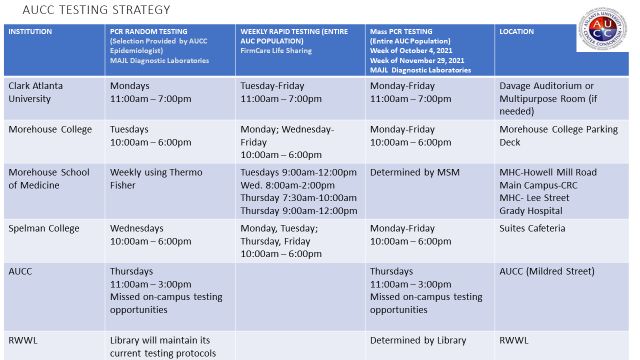
Greetings Colleagues of the Atlanta University Center Consortium:

        I want to thank everyone for following so diligently the protocols to maintain the health
and wellness of our campus communities during this period of the COVID-19 pandemic. The
news from Clark Atlanta University, Morehouse College, Morehouse School of Medicine,
Spelman College, and the Robert W. Woodruff Library of the Atlanta University Center
Consortium (AUCC) is good. Your steadfast adherence to our protocols has resulted in an
outstanding vaccination rate of nearly 90-percent across the AUCC. Additionally, COVID-19
infection rates have remained below one percent for this semester.
        However, as you are aware, conditions within the larger environment of Fulton County
and the State of Georgia necessitate continual attention and updates to our protocols. For
instance, the Delta variant of SARS-CoV-2 has emerged as the dominant factor in rising rates of
hospitalization and severe illness. As a result of these conditions we may need to update the
protocols quickly in response. This document may lag behind the actual changes. Please be
patient with document updates. Your continuing compliance with our protocols to help maintain
the incredible outcomes is greatly appreciated.
        We ensure that protocols are up to date and based on firmly established scientific
guidance by continually reviewing data from the Fulton County Department of Health, the CDC,
and the information collected with support from our colleagues at the Morehouse School of
Medicine. And, if there is a case of virus among an employee or student, we have trained public
health professionals, contact tracers, and assistance from the Morehouse School of Medicine to
engage appropriate processes to maintain a safe environment. These professionals are fully
aware of all the HIPPA and FERPA regulations related to privacy of both personal health
information and student records.
        Again, our campus community is doing great! Please continue your diligence by properly
wearing your mask where required (gently remind others), remember the simple hygiene
practices, and follow our testing protocols. If you are one of the few who is not vaccinated, GET
VACCINATED. You are carrying out your responsibilities not only to the campus, but also to
your families as well as the larger community to combat the spread of this very dangerous virus.

Best regards,

Michael E. Hodge, Ph.D.
Executive Director
INTRODUCTION:
The Atlanta University Center Consortium (AUCC) member institutions – Clark Atlanta
University, Morehouse College, Morehouse School of Medicine, Spelman College, and
the AUC Robert W. Woodruff Library – has required all students to be fully vaccinated
and members of their faculties and staffs to be fully vaccinated by the beginning of the
2021 fall semester. Each institution will review requests for medical and
religious/strongly held convictions exemptions on a case-by-case basis. Each campus
has developed processes for documenting vaccination status. We continue to operate
with the safety and well-being of the AUCC community at the forefront of our decision
making. The Centers for Disease Control and Prevention (CDC) outlines guidance
encouraging citizens to understand the importance of getting vaccinated to protect
oneself and others as we combat the threat of COVID-19 spreading and producing new
variants. At the time of this printing, the COVID-19 virus is resurging with the delta
variant predominate. Additionally, the vast majority of the serious illnesses and deaths
from COVID-19 are among the unvaccinated. The AUCC member institutions align with
this science-based guidance in putting forth this notice.
As Atlanta University Center Consortium (AUCC) member institutions welcome groups
of students and employees back to our campuses for the 2021-22 academic year, it is
important to understand health and safety protocols designed to help mitigate the
spread of the COVID-19 virus. These protocols are informed by guidance from the
Georgia Department of Public Health, Fulton County Board of Health, and the Centers
for Disease Control and Prevention. While these protocols are detailed, the effectiveness
of these plans are dependent upon adherence by all members of the AUCC
community who accept responsibility for their own safety as well as the safety of
others. Because the public health environment may change, these guidelines may be
amended should conditions and public health responses dictate.
AUCC health and safety protocols include:
faculty, staff, and student expectations
vaccination requirements and exemptions
COVID-19 testing (pre-arrival testing, arrival testing, and frequent surveillance
testing)
contact tracing
isolation and quarantine processes
daily self-monitoring
Please review the information that follows
carefully and completely.Student and Employee Expectations:
Students and employees, regardless of vaccination status, must
properly wear face masks in all indoor (apart from their personal residential
dorm room, single occupancy offices) and all outdoor spaces where groups may
congregate until further guidance from our science team (expected by October 11,
2021—when students return from fall break and complete the campus-wide PCR
testing protocols). Masking is also required for the entire semester when
attending large or crowded gatherings (e.g.: stadium/arena events). The mask
must cover the mouth and nose. Face shields do NOT replace mask wearing.
Students and employees who choose to wear a face shield, must also wear a mask
that covers the mouth and nose.
Physical Distancing: Crowded settings still present a greater risk of
transmission. Students and employees, regardless of vaccination status, are
expected to observe physical distancing of at least 6 feet. In classroom settings
where physical distancing cannot be maintained, masking is required
for all students and employees, regardless of vaccination status. This
means that no food or drinks are allowed in the classrooms and
research or teaching labs—as masks must not be removed.
Testing: AUCC member institutions require all unvaccinated persons and
those not fully vaccinated to submit a negative Covid-19 PCR test result 5 days
before their arrival for move in (residential students), the first day of classes
(commuter students), or first day of work (employees). The AUCC epidemiologist
will closely monitor the incidences of COVID-19 on each campus, which includes
ongoing regular antigen (rapid) and/or PCR COVID-19 testing for all campus
stakeholders, with varying frequency for vaccinated and unvaccinated employees,
students who live on campus, commuter students, student athletes, and others
who work on campus or otherwise have a regular presence on campus. Due to the
increasing hospitalization rates and increasing incidence of the Delta variant in the
region and our county, we will increase surveillance testing. All faculty, staff,
and students, regardless of vaccination status must submit to weekly
antigen rapid testing. Additionally, the epidemiologist has created a
procedure to gather randomized samplings of the campuses for weekly
PCR testing.
Isolation and Quarantine: Students and employees are required to comply
with institutional policies when quarantine, isolation, and/or preventative health-
related measures become necessary.
Contact Tracing: Students and employees are expected to comply with all
contact tracing efforts undertaken by their institution in collaboration with the
Georgia Department of Public Health.
Symptom Monitoring: Students and employees are required to conduct daily
personal health screening, including temperature checks.Student Pre-Arrival Checklist
The Pre-Arrival Checklist pertains to all unvaccinated students (those individuals
receiving an approved medical/religious/strongly held belief exemption) attending in-
person classes, including both those living on campus and those living off campus. The
checklist includes the following tasks:
Students are considered fully vaccinated:
2 weeks after their second dose in a 2-dose series, such as the Pfizer or
Moderna vaccines, or
2 weeks after a single-dose vaccine, such as Johnson & Johnson’s Janssen
vaccine.
If you do not meet these requirements, regardless of your age, you are
NOT fully vaccinated.
Previous infection with COVID-19 DOES NOT indicate a vaccinated
status. Individuals are required to be fully vaccinated to access the
campus.
Pre-arrival COVID testing
1. In order to reduce the possibility of a student arriving on campus for the semester
while they are COVID-19 positive, AUCC member institutions require that
students test negative very close to their arrival for move in (residential students),
or the first day of classes (commuter students).
Prior to arrival on campus for move-in, students living on campus are required to
take a COVID-19 PCR test AND receive a negative result within a time period
beginning no earlier than 5 days before their move-in date. To meet the
requirement, the student cannot take the test prior to 5 days before they move in,
and must receive and submit the result of their test before arriving on campus to
move in. For example, a student moving in on Friday cannot take their PCR test
before Monday of that same week and must receive and submit a negative test
result prior to arriving on Friday. In the same manner, commuter students must
take a COVID-19 PCR test and receive a negative result within a time period
beginning no earlier than 5 days before the first day of classes.
o What is a PCR test?
A polymerase chain reaction (PCR) test detects the COVID-19 virus by
searching for the presence of ribonucleic acid (RNA), the virus’s basic
genetic material, inside a person. The virus’s RNA will be present only if a
person is currently infected. The PCR test differs from an antibody test.
An antibody test can be used to determine if a person has had the virus in
the past by examining a person’s bloodstream for the presence of a
specific antibody produced by the body’s immune system to defend
against the virus.o Where can students get a PCR test?
PCR-based testing is generally available through many sources, including
private physician offices (where there may be a charge), and county or
parish departments of public health (where they are generally free). To
receive testing within the required testing window, students are strongly
encouraged to schedule tests well in advance, as appointment times may
not be available for several days due to high demand.
Georgia residents may use this link to schedule a test
through county health departments.
Non-Georgia residents may use this link to find the nearest
COVID-19 testing locations.
If there are no testing sites available, students should
contact their Office of Student Affairs to receive alternative
options (i.e. instructions on mail kit to home).
2. Students should submit pre-arrival COVID-19 PCR test results to the designated
contact in the Office of Student Affairs. All results are covered under the HIPAA
Privacy Rule requiring protection and confidentiality of any personal health
information.
o All AUCC institutions have committed to a zero-tolerance approach
to noncompliance related to COVID-related policies.
o Failure to submit PCR testing prior to arrival will result in a delay of the
student move-in date, inability to access campus buildings and facilities
until the test is complete and test results received. In this instance, the
student will be responsible for identifying and paying for their own lodging,
meal, and other expenses.
o Students who have not submitted a PCR test prior to arrival will need to
schedule an appointment with the Georgia Department of Health for a
COVID-19 test to complete onboarding. This will delay move-in and access
to campus for classes.
3. Within the two weeks prior to campus arrival, if a student tests positive for COVID-
19, has symptoms consistent with COVID-19, or has been in close contact with
someone who tested positive for COVID-19, the student must: 1.) stay home and
delay arrival until the recommended isolation/quarantine period is complete; 2.)
receive a negative Covid-19 PCR test result; 3.) receive clearance from his/her
institution’s Student Affairs Office before returning to campus.
4. Prior to retuning to campus, all students are required to complete an online
training called “Safe Start Guide” and take an AUC Safety Pledge. This training will
provide information on AUCC COVID-19 guidelines and shared responsibilities, as
well as strategies for limiting the spread of COVID-19. All students are required to
complete the training.Employee Pre-Arrival Checklist
Pre-arrival COVID testing
1. In order to reduce the possibility of a faculty or staff member reporting for work
during the fall semester while they are COVID-19 positive, AUCC member
institutions require that unvaccinated (those individuals receiving an approved
medical/religious/strongly held belief exemption) employees test negative before
reporting to work for the first time during the semester.
Employees are considered fully vaccinated:
2 weeks after their second dose in a 2-dose series, such as the Pfizer or
Moderna vaccines, or
2 weeks after a single-dose vaccine, such as Johnson & Johnson’s Janssen
vaccine.
If you do not meet these requirements, regardless of your age, you are
NOT fully vaccinated.
Previous infection with COVID-19 DOES NOT indicate a vaccinated
status. Individuals are required to be fully vaccinated to access the
campus.
Prior to reporting to work, employees are required to take a COVID-19 PCR test AND
receive a negative result within a time period beginning no earlier than five days before
they report to work. To meet the requirement, the employee cannot take the test prior to
five days before they report to work and must receive and submit the result of their test
before arriving on campus for work. For example, an employee reporting to work on Friday
cannot take their PCR test any earlier than Monday of that same week and must receive
and submit a negative test result prior to arriving on Friday.
Georgia residents may use this link to schedule a test through county health
departments.
Non-Georgia residents may use this link to find the nearest COVID-19
testing locations.
Employees may consult their private physician to obtain testing where
insurance may or may not apply.
2. Employees should submit pre-arrival COVID-19 PCR test results to the designated
contact in the Office of Human Resources. All results are covered under the HIPAA
Privacy Rule requiring protection and confidentiality of any personal health
information.
3. Within the two weeks before returning to campus, employees who test positive for
COVID-19, have symptoms consistent with COVID-19, or have been in close contact
with someone who tested positive for COVID-19 must stay home and contact the
designated human resources staff member for further direction.
4. Prior to returning to campus, all employees are required to review the AUCC COVID-
19 guidelines and shared responsibilities, as well as strategies for limiting the spread
of COVID-19.Student and Employee Testing Process and Frequency
Mitigating the spread of COVID-19 means closely monitoring the incidences of COVID-
19 on each campus. This includes ongoing regular testing for all campus stakeholders,
with varying frequency for employees, students who live on campus, commuter students,
student athletes, and others who work on campus or otherwise have a regular
presence on campus. Some of this testing may occur through self-administered tests, in
which a student or employee collects specimen samples from their own bodies (usually
through a nasal swab https://www.color.com/self-swab-instructions) that can be used to
indicate the possible presence of COVID-19. The process for collecting and submitting
specimen samples through self-administered tests is simple, not painful, and
streamlined to take approximately one to two minutes (self-swab instructions will be
provided in “Safe Start Guide training and AUCC COVID-19 guidelines). In general, the
self-administered testing process is as follows:
Fully vaccinated students and employees: PCR test every 6 weeks; institutions will
facilitate testing.
Unvaccinated students and employees: PCR test every 7 days or rapid test twice a
week; institutions will facilitate testing.
Vaccinated and unvaccinated student-athletes should follow testing frequency
established by the NCAA (or whichever are stricter).
Residential and nonresidential students, faculty and staff will be assigned days on
which they must undertake specimen collection.
Test kits will be made available and instructions on how to self-administer a
specimen collection will be provided.
Specimen collection submission locations will be available at each AUCC campus.
Test results are returned via email or text within 36-48 hours after a specimen has
been picked up at a submission location.
Students and employees with inconclusive results should retest themselves within
48 hours of notification. Residential students should retest at their designated
campus location and employees should contact their respective Office of Human
Resources for further guidance.
Test results are not shared publicly and are used as data to understand overall
positivity rates.
Testing not obtained through the AUCC must be PCR tests taken in compliance
with the AUCC testing frequency protocol.HEIGHTENED TESTING PROTOCOLS (adopted 8/25/21—COP)
Fulton County is experiencing spikes in COVID-19 cases resulting in increased
hospitalizations (mostly among unvaccinated individuals) and reductions in
available bed spaces for sick individuals. This raises concerns for our community
in the event any of our employees or students would need hospitalization
(including any circumstances unrelated to COVID-19). In order to more closely
monitor and mitigate any potential spread into the AUCC campus community, we
will be implementing the following testing regimen (the COVID-19 task for will
continually monitor the data from these test results and make appropriate
adjustments):Student and Employee Contact Tracing
Contact tracing will be coordinated by the AUCC epidemiologist in order to share
resources and related expenses which are billed to the institutions. Reporting to the AUCC
epidemiologist, certified contact tracers will work as needed to perform tracing
responsibilities. Additional contact tracing support will be provided if needed.
Contact Tracers: AUCC contact tracers will conduct contact tracing for students.
Additionally, each campus should designate one or more staff members in its
Office of Human Resources to coordinate contact tracing services among faculty
and staff with the assistance of the AUCC epidemiologist.
Referral to Isolation and Quarantine: Each campus has dedicated isolation spaces
for residential students should the need arise. Upon identification of an infected
student, the AUCC epidemiologists’ team will notify the student’s close contacts
with quarantine guidance. Upon identification of an infected employee, the human
resources designee will notify the employee’s close contacts with quarantine
guidance.
Student and Employees Self-Quarantine
During the semester, unvaccinated (approved religious/medical exemptions) students
and employees may be required to self-quarantine. The AUCC identifies two types of self-
quarantine:
1. exposure quarantine; and
2. the pause and prepare period
Students and employees are required to comply with institutional policies when
quarantine, isolation, and/or preventative health-related measures become necessary.
Students and Employees must strictly adhere to these requirements:
Exposure self-quarantine applies to unvaccinated students and employees
who have come into close physical contact with someone who tests positive for
COVID-19 and have not submitted proof of COVID-19 vaccination (please see
CDCs fully-vaccinated definition). The length of quarantine will be determined by
the last date of exposure.
The pause and prepare period applies to students only. In the event of an
increase in COVID-19 cases among residential students, institution(s) may pause
all non-essential activities to control the spread of COVID-19.
1. Exposure Self-Quarantine
The AUCC epidemiologist will develop an algorithm to notify campuses of
students needing to quarantine due to exposure.
Through contact tracing efforts coordinated by the AUCC, unvaccinated
students who have come into close contact with someone known to have tested
positive for COVID-19 will be required to quarantine in their room or move to
a temporary housing assignment for minimum of 7 days. Student healthservices representatives and staff from the Office of Student Affairs will provide
support to these students during this quarantine period.
If students must leave their room during exposure self-quarantine: they must
always wear a mask and strictly follow protocols for physical distancing.
Each campus will provide support services such as dining, educational
continuity, and counseling for students in quarantine.
When in quarantine, students should not return to classes, attend athletic
events or gatherings of any size until they receive clearance from the designated
campus staff member.
Students in quarantine will have daily wellness check-ins by phone, through
email, or in person with institutional student health service professionals who
will report any concerns to the AUCC Health and Wellness Primary Care team.
While in quarantine, students should monitor for symptoms consistent with
COVID-19. If symptoms develop, students should contact their institutional
student health service professional to relocate to isolation housing.
Students should test twice per week while in quarantine; and, upon returning
to campus they must provide a negative Covid-19 PCR test result. When a
negative test result is confirmed, students will have completed exposure
quarantine and will receive written clearance from campus personnel
indicating that they can return to in-person classes and campus interaction.
Students may quarantine off campus; however, they must submit a negative
covid-19 PCR test result upon returning to campus.
Vaccinated students and employees who have come into close physical
contact with someone who tests positive for COVID-19 must take a PCR test
3-5 days after exposure and wear a mask until they have received a negative
result.
Through contact tracing efforts coordinated by their institutions’ HR
departments, unvaccinated employees who have come into close contact
with someone known to have tested positive for COVID-19 will be required to
quarantine off campus for minimum of 7 days.
Upon returning to campus unvaccinated employees must provide a negative
COVID-19 PCR test result. When a negative test result is confirmed, employees
will have completed exposure quarantine and will receive notification from
campus personnel indicating that they can return to campus.2. Pause and Prepare Period
During this time, all non-essential campuses activities will be suspended. All
residential students will shelter in place in their rooms, only leaving for
essential activities, (meals or to use bathroom facilities, etc.). If students must
leave their rooms, they must always wear a mask and follow protocols for
physical distancing.
Campuses will develop clear schedules for meals and food service during the
pause and prepare period to mitigate COVID-19 spread and to assist with
contact tracing.
Students will monitor symptoms daily using a digital symptom tracker. If
symptoms develop consistent with COVID-19, the student must notify medical
personnel.
Students will test periodically during pause and prepare using the Abbott
Rapid Ag test. Results from this test will be used to establish the initial
positivity rate baseline for the campus community.
Students may quarantine off campus, however, they must submit a negative
Covid-19 PCR test result upon returning to campus.
Student Self-Isolation
Isolation differs from quarantine in that it pertains to individuals who have tested positive
for COVID-19 or have experienced symptoms consistent with COVID-19 regardless of
vaccination status. With respect to the student processes at the AUCC:
The AUCC epidemiologist will develop an algorithm to notify campuses of students
needing isolation due to positive COVID-19 test results.
The AUCC Student Health and Wellness Center, in consultation with the respective
institutional Health Care service professionals, will provide medical care for
isolated students, including counseling and emotional support.
During isolation, students will relocate to a temporary housing assignment for a
minimum of 10 days, leaving only for an urgent medical need or a life-threatening
emergency.
Each campus will provide support services (dining, educational continuity) for
isolated students.
Students in isolation will have daily wellness check-ins by phone, through email,
or in person with institutional student health service professionals who will report
any concerns to the AUCC Health and Wellness Primary Care team.
When in isolation, students should not return to campus, classes, or participate in
or attend any athletic events or other social or civic gatherings until they receive
written clearance from a designated campus official. While in isolation, students should continue to self-monitor for symptoms
consistent with COVID-19 including taking temperatures at least twice daily. (It
will be important to note whether symptoms are improving or degrading.)
No earlier than 10 days after symptom onset, a student can discontinue isolation if
the following conditions are met:
o resolution of fever for at least 24 hours without the use of fever-reducing
medications;
o improvement of symptoms; and
o obtain negative result from a rapid Ag test
Student and Employee Medical Care
AUCC Student Health and Wellness physicians, in consultation with institutional
student health service professionals, will assess and manage student medical
treatment. AUCC campus nurses will provide ongoing care to help with diagnosis,
treatment, and recovery.
The AUCC Student Health and Wellness Center’s (SHWC) Primary Care Team will
have regular student health updates with the nursing staff on each campus.
Services will include the following: 1) telehealth visits coordinated between the
SHWC Primary Care Team and nursing staff on each AUC campus; 2) after-hours
on-call answering service available to AUCC students in isolation or quarantined
students; and 3) isolated and quarantine students may receive in-person follow-up
visits deemed medically necessary by the SHWC Primary Care Team.
AUCC campus nurses will provide the initial assessment of all students diagnosed
or exhibiting symptoms consistent with COVID-19 infection. AUCC campus nurses
will notify the AUCC Student Health and Wellness Center Primary Care Team of
any students needing a tele-health visit.
Symptomatic residential students should immediately return to their room and
contact their institutional student health service professional. The medical team
will determine if the student requires an in-person examination and, if necessary,
will schedule a face-to-face visit with The AUCC Student Health and Wellness
Center’s (SHWC) Primary Care Team.
If immediate medical attention is required for isolated students who have tested
positive for COVID-19 and are experiencing deteriorating medical conditions,
campuses will utilize their established emergency management protocols (911-
EMS). This determination will be made by campus health personnel in
consultation with the AUCC Student Health and Wellness Center Primary Care
Team.
The AUCC Student Health and Wellness Center Primary Care Team will provide
medical evaluation for all students who continue to test positive after completing
at least 10 days of isolation. Employees who test positive for COVID-19, who are experiencing symptoms
consistent with COVID-19 infection or who are named as a “close contact” should:
1) stay home and isolate/quarantine themselves from others; 2) notify their human
resources department; and 3) consult their private physician for instructions.
Employees who continue to test positive after completing at least 10 days of
isolation must be evaluated by a medical professional. Upon returning to campus,
employees must: 1) provide a note from a medical professional stating the
employees can return to campus; and 2) receive approval from the institutions
before returning to campus.
Employees and students who need to schedule a COVID-19 vaccine appointment
please call 404-752-1000 (employees), or 404-756-1241 (students). Vaccinations
are available at Morehouse Healthcare - 455 Lee Street SW, 2nd Floor Atlanta,
GA 30310 for employees, and AUCC Student Health and Wellness Center- 455
Lee Street SW, 3rd Floor Atlanta, GA 30310.
Campus Screening Tool
Anyone accessing an AUCC campus (including the Woodruff Library) is expected to
complete a web-based questionnaire relating to symptoms and possible exposure to
COVID-19. This includes students, faculty, and staff. This is for educational
purposes only; the objective is to ensure campus communities are aware of COVID-19
symptoms.
Students and employees are expected to complete a daily symptom checker prior
to attending on-campus work, programming, or activities, including classes.
Students and employees in the AUCC community using a daily symptom checker
are expected to provide truthful answers to the questionnaire.
Students and employees in the AUCC community who have symptoms consistent
with COVID-19 should stay home or in their residence room and consult with their
medical provider, the institutional student health service professionals, and/or the
AUCC Student Health and Wellness Center.
Students and employees who do not have symptoms are cleared to come to
campus.Monitoring
It is imperative that we aggressively monitor our campuses to limit the potential for
COVID-19 spread. Key elements of the monitoring process are frequent testing within the
AUCC community and the timely reporting of results.
Each AUCC institution will ensure all Rapid Ag COVID-19 test results are
expeditiously reported to the AUCC data analyst every Friday by 12 pm. The analyst
will help to monitor COVID positivity rates among AUCC schools and assist the
AUCC epidemiologist with establishing and revising the testing cadence.
The AUCC data analyst will manage confidential data stored in a variety of file
formats, prepare descriptive analyses and reports, calculate frequencies and rates,
and manage AUCC dashboards and dashboards for each campus.
The AUCC epidemiologist will monitor, and track COVID-19 test results through a
shared spreadsheet updated daily with data supplied by the institutions. The AUCC
data analyst will update the dashboard weekly.
The AUCC epidemiologist will use relevant data to guide AUCC testing strategies,
safety protocol modifications, and relevant interventions to mitigate the COVID-
19 spread.
The AUCC will not have access to employee personal identifiable information (PII).
Data related to positivity amongst AUCC employees will be reported to the AUCC
data analyst and epidemiologist in aggregate.
Visitors and Vendors
Visitors are those who are not active members of an AUCC institution’s faculty, staff, or
student populations, as defined by the institution’s human resources department.
Vendors provide products and/or services to the institution and are not formally
considered visitors.
Visitors and vendors are required to always wear a face mask and physically
distance while on campuses.
Visitors and vendors are prohibited from being on campus if they have tested
positive for COVID-19 within the past two weeks, are exhibiting signs or
symptoms of illness of COVID-19 or were in close contact to someone confirmed
to have COVID-19.
Depending on their relationship to the institution, including the extent of time
they spend on campus and the type and duration of engagement with institution
employees and students, some vendors (unvaccinated) may be required to
participate in the testing protocols herein described (and if no mandated regular
testing regime is mandated by their employer).International Students Vaccines
CDC guidance for those fully vaccinated applies to COVID-19 vaccines currently
authorized for emergency use by the U.S. Food and Drug Administration: Pfizer-
BioNTech, Moderna, and Johnson & Johnson (J&J)/Janssen COVID-19 vaccines. This
guidance can also be applied to COVID-19 vaccines that have been authorized for
emergency use by the World Health Organization.
Vaccines approved by WHO are: AstraZeneca, Covishield (Serum Institute of
India) Sinopharm (Beijing Bio-Institute of Biological Products)
Comirnaty/BNT162b2 (Fosun Pharmaceuticals, Hong Kong) and Sinovac-
CoronaVac.
Students who have not received an FDA- or WHO-approved COVID-19 vaccine
by the time fall classes begin will need to be revaccinated with one of the
vaccines approved for use in the U.S. once they arrive on campus.
Students traveling internationally into the U.S will be required to provide a
negative PCR test within 5 days before their arrival for move in (residential
students), and the first day of classes (commuter students).Initial Testing and Frequency Model (2021-2022)
COVID-19 Student Testing Frequency
Where will How will How often How often How Type of
you live in you will you be will you be often do Test
the Spring attend tested: tested: you check
classes Unvaccinated Vaccinated your
symptoms
In person
University
and/or Weekly Every 6 weeks Daily PCR*
housing
remotely
University In person
Weekly (or per Every 6 weeks
housing and/or Daily PCR*
NCAA) (or per NCAA)
Athletics remotely
In person
Off campus at least Weekly Every 6 weeks Daily PCR*
once a week
Off campus No test No test Not Not
Remotely
required required required required
*If unvaccinated and testing with rapid ag, testing frequency increases to 2x per week
COVID-19 Faculty, Staff, and Vendors Testing Frequency
How often will How often How often will How often do Type of
you be on will you be you be tested: you check Test
campus tested: Vaccinated your
Unvaccinated symptoms
In person on
campus at least Weekly Every 6 weeks Daily PCR*
once a week
No test required Not
Remotely No test required Not required
required
*If unvaccinated and testing with rapid ag, testing frequency increases to 2x per week
*Note: Any student or employee
who seeks to be on campus for any
reason would need to be compliant
with testing and symptom tracking.Student Medical Care Model (2021-2022)
AUCC Student Health and Wellness Medical Care
Category MSM AUCC
Staff/Responsibilities Staff/Responsibilities
Medical o SHWC MD, NP, Nurse o Campus Health Services
Team: Onsite NP and/or Nurse and/or
MA as available
Medical o Consults (8am-5pm M- o Daily, in-person health
Services* F); telehealth visits checks of each student in
(MD/NP); symptomatic isolation (may decrease
exam/testing at SHWC frequency after first 5-7
o Select days Extended days, if medically
hours clinic until 8 pm appropriate);
(TBA) and Saturday o Q2-3 days in-person
8am-1pm health checks of each
student in quarantine
Medical o Determines whether o Provide SHWC medical
Clearance student may leave team with clinical
isolation/quarantine. updates on each student
o Granted based on so SHWC may determine
assessment of clinical if student is medically
status of student cleared to leave
isolation/quarantine
On-Call o After-Hours, weekends, N/A
Medical o 24/7 Answering Services
Services available to students &
AUCC Health Services
medical staff
Behavioral o LCSWs, Psychiatrist o Campus Counseling
Health Services: Psychologists
Services
Team: Onsite
*Note: Any student or employee
who seeks to be on campus for any
reason would need to be compliant
with testing and symptom tracking.Student Isolation Model (2021-2022)
AUCC Student Health and Wellness Isolation Care
o Initial telehealth visits by AUCC Health Services for students in isolation.
o (Recommend AUCC Health Services team provide students with COVID-19 care
package if needed).
o Follow-Up by AUCC Health Services team at least daily or more frequently if needed,
via in-person, phone, telehealth visits.
o SHWC available to provide Medical Services*
o In-person visits as appropriate in SHWC’s negative pressure room
(following communication between AUCC Health Services and SHWC
team);
o AUCC Health Services team performs on-site, in-person wellness checks for students
as needed
for example, if no communication from student in a few days and/or student
requires additional items in care package like antipyretics, etc.)
o At least once weekly meetings with AUCC Health Services team to update SHWC
team on each student’s status; daily updates as appropriate.
o On-Call/After-hours*: SHWC After-hours answering services available to students;
MSM Medical Provider available to AUCC Health Services team for consults.
o Medical Evaluation by SHWC
o Emergency Care: 911
*Note: Any student or employee who
seeks to be on campus for any reason
would need to be compliant with
testing and symptom tracking.Student Quarantine Model (2021-2022)
AUCC Student Health and Wellness Quarantine Care
o Initial phone/email communication by AUCC Health Services team for students in quarantine
o (Recommend AUCC Health Services team provide student with COVID-19 care package if
needed)
o Follow-Up by AUCC Health Services team at least 2-3 days in person or more frequently if
needed; Daily phone/telehealth visits in between in-person visits.
o In-person visits as appropriate in SHWC’s negative pressure room (following communication
btw/ AUCC Health Services and SHWC team);
o AUCC Health Services team performs on-site, in-person wellness checks for students as needed
o (if no communication from student in a few days and/or student requires additional items in
care package like antipyretics, etc.)
o At least once weekly meetings with AUCC Health Services team to update SHWC team on each
student’s clinical status; more frequently as appropriate.
o On-Call/After-Hours*: SHWC After-hours answering services available to students; MSM
SHWC provider available to AUCC Health Services team.
o Emergency Care: 911
*Note: Any student or
employee who seeks to be on
campus for any reason would
need to be compliant with
testing and symptom tracking.Student Behavior Health Model (2021-2022)
AUCC Student Health and Wellness Behavior Health
Isolation/Quarantine Care
Recommend assessment for anxiety/depression by AUCC Health Services team during
follow-up health checks as appropriate.
Referral to campus Counseling Services for tele-behavioral health visits.
o Campus Counseling Services team may refer student to SHWC’s Behavioral
Health Services for tele-behavioral health visits if long wait times or referring to
psychiatry.*
Recommend AUCC Health Services perform in-person wellness checks if no communication
by student in a few days or other concerns raised about mental health.
At least once weekly communication between SHWC Behavioral Health Services team and
AUC Counseling Services team to share updates on referred students’ mental health and
medical status; more frequently as appropriate.
After-hours: AUCC Campus Counseling Services Protocol
o On-Call: SHWC Behavioral Health Services team available to AUC Counseling
Services team for consults if established relationship exists between student and
SHWC Behavioral Health Services.
o Emergency Care: 911Surveillance
Testing
Medical & Beginning Sept. 13,
Vaccines 2021: All Students
and employees
Isolation & weekly RAPID
AUC Student Health testing; Random
Quarantine and Wellness Weekly PCR testing;
(SHWC) physicians,
Fully vaccinated:
in concert with
PCR test every six-
Campus Access Isolation: institutional student
weeks; AUCC will
regardless of health service
facilitate testing
Pre-Arrival Anyone accessing
vaccination status professionals, will
through external
students will assess and manage
vendor*
Testing an AUCC campus relocate to a student medical
(including the treatment. AUC Unvaccinated: PCR
temporary housing
Physical Woodruff Library) is assignment for a SHWC will continue test every 7 days or
All unvaccinated expected to to provided rapid test twice a
Distancing persons must complete a web-
minimum of 10 days
vaccines/boosters week; institutions
Mask submit a negative a based questionnaire
and employees are
as needed will facilitate testing
PCR test five (5) required to stay
Wearing Students and days before their
relating to away from campus Student-athletics
employees symptoms and for a minimum of 10 should follow NCAA
arrival for move in possible exposure
regardless of (residential days testing frequency
Students and vaccination status to COVID-19. This
students) the first includes students, Quarantine is for *Onsite mass
employees, are expected to day of classes faculty, and staff. the unvaccinated. testing program
regardless of observe physical (commuter This is for Students will
vaccination status, distancing of at students) or first educational relocate and
must wear face least six feet. In day of work purposes only; the employees will stay
masks in all indoor library and (employees) objective is to away from campus.
spaces (apart from classroom settings
their personal where physical ensure the campus Vaccinated
residential dorm distancing cannot communities are exposures PCR test
room, singular be maintained, aware of COVID-19 3-5 days
office) and when masking is required symptoms
attending large or for all students and
crowded gatherings employees,
e.g.: stadium regardless of
events. vaccination status.You can also read


