Features of the adaptation of the indigenous people of the Аrctic - SHS Web of Conferences
←
→
Page content transcription
If your browser does not render page correctly, please read the page content below
SHS Web of Conferences 112, 00036 (2021)                                                            https://doi.org/10.1051/shsconf/202111200036
Northern Sustainable Development Forum 2020

             Features of the adaptation of the indigenous people of the
             Аrctic
             Evgeniya. Nikolaeva1,*, Olga Kolosova2, and Elena Belchusova2
             1M.K. Ammosov North-Eastern Federal University, 27, Oyunsky street, Yakutsk, 677013 Russia.
             2 TheYakut Scientific Centre of the SBRAS, Institution of the Russian Academy of Sciences, 41, Lenin avenue, Yakutsk,
             677007, Russia

                           Abstract. To determine age-specific differences in adaptation of indigenous residents, nonspecific
                           adaptive body reactions (NARs) have been studied among the Evenki men aged 13 to 86,
                           permanently living in the Arctic. The results indicated the presence of age-specific differences in
                           NARs. The decline of nonspecific body resistance in every fourth teenager is correlated with
                           adaptive reactions developing in parallel with underlying low-level body reactivity. Adaptive
                           reactions in men aged 75-90 were characterized by a medium to a high reactivity level, which
                           enabled preservation of body reserves even under extreme climate conditions. Two age groups (22-
                           35 and 61-74) included the highest percentages of people with adverse NARs. Therefore, men in
                           these age groups should be considered as a major risk group for developing both psychosomatic and
                           somatic diseases.

      1 Introduction                                                         (1968). The body, reacting to stimuli of varying strength
                                                                             and quality, causing fluctuations in the parameters of
      Development of some specific patterns of the                           homeostasis, tries to keep them within optimal
      physiological function in individuals arriving to live in              boundaries, using a common periodic system of
      the Arctic is defined by the region’s extreme climate,                 nonspecific, anti-stressor reactions of the body. With
      geography, and heliogeophysical conditions. At the                     long-term exposure to a complex of extreme factors in
      bottom-line of an adaptive response to changing                        the body, in the process of evolution, the most optimal
      environment conditions (including extreme climate                      adaptive reactions are fixed, which allow a person not
      factors), there are nonspecific adaptive body reactions                only to survive in these conditions, but to fully live,
      (NARs). The study of strategies for adapting to the                    work, develop, etc. Under the influence of factors of
      specific ecological and climatic factors of the body of                varying strength and intensity, regardless of their nature,
      the indigenous people of the Arctic, who in the process                physiological and biochemical changes take place in the
      of evolution developed specific mechanisms for                         body, leading to nonspecific adaptive reactions of the
      biochemical and physiological adaptation, is extremely                 organism. Following this recent theory, the system of
      important and necessary. Previous studies have led to the              human adaptive reactions includes, alongside with the
      conclusion that there are adaptive types in the population             stress reaction (SR) and over-activation (OA) reaction,
      of people that are adapted to well-defined climatic and                the following types of reaction: training reaction (TR)
      geographical conditions of existence. Adaptive types of                developing under weak stimuli; activation reaction (AR)
      human organisms determine survival and can also be                     subdivided into quiet activation reaction (QAR) and
      constraints in possible adaptive processes in new                      advanced activation reaction (AAR) developing under
      environmental conditions [1]. The effectiveness of                     moderate stimuli. Each type of adaptive reaction
      adaptation to extreme conditions depends not only on                   corresponds to a specific set of indicators describing
      genetic factors, but also on the morpho-physiological                  neuro-endocrine and immune body subsystems,
      parameters of a person, which are formed in ontogenesis                processes of metabolism and energy metabolism, and
      under certain climatic and geographical conditions [2-7].              mental status. Good adaptation to changing
          In the literature, views on NARs are closely related               environmental conditions can be achieved if there is a
      to the study of adaption mechanisms. According to the                  sufficient adaptation potential of a body. This capability
      theory of Hans Selye about a ‘general adaptation                       is conditioned not just by the presence of a functional
      syndrome’, a state of stress (strain) can be induced by                body reserve, but also by body reaction adequacy and
      any strong stimulus (stressor). Because stimuli affecting              economy, as well as efficiency of control over functional
      the body may be of various intensity, theory of NARs                   reserve expenditure and recovery [7-10]. In addition,
      was further developed by L.KH. Garkavi and colleagues                  adaptive reactions can be correlated with different body

             *
                 Corresponding author: en.nikolaeva@mail.ru
© The Authors, published by EDP Sciences. This is an open access article distributed under the terms of the Creative Commons Attribution License 4.0
(http://creativecommons.org/licenses/by/4.0/).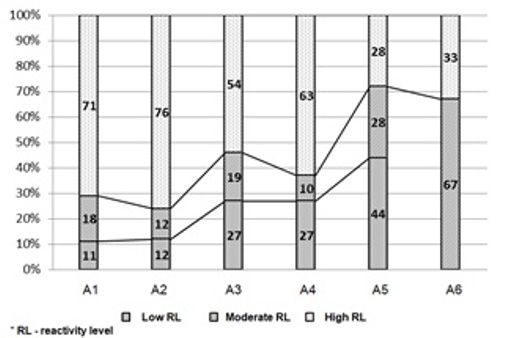
SHS Web of Conferences 112, 00036 (2021)                                                    https://doi.org/10.1051/shsconf/202111200036
Northern Sustainable Development Forum 2020

     reactivity levels (RL), depending on the magnitude of              based on processing data on the distribution of cardio
     the stimulus. The hallmark of the high reactivity level is         intervals, a stress index of regulatory systems (Stress
     low sensitivity threshold in response to factors of minor          Index - SI) was determined, which reflects the degree of
     magnitude, while a lower reactivity level is associated            centralization of heart rhythm control. The method of
     with growing sensitivity threshold developing under                identifying the hidden periodicity of the dynamic range
     factors of large magnitude. Apparently, the tendency is            of cardiointervals determined the power spectrum in the
     such that a higher body reactivity level correlates with           ranges:
     more effective synchronization of body’s protective                    1. High frequencies (High Frequency - HF) - 0.15–
     systems due to multiplicity of minor interactions. A               0.40 Hz.
     decline in the reactivity level is associated with the onset           2. Low frequencies (Low Frequency - LF) - 0.04–
     and escalation of the signs of tension, which signalize            0.15 Hz.
     desynchronized functioning of body systems. Thus,                      3. Very low frequencies (Very Low Frequency -
     reactions of training, quiet activation, and advanced              VLF) - 0.003–0.04 Hz.
     activation alongside with underlying a high reactivity                 The study is based on a simple random sample.
     level are considered beneficial body reactions.                    Storage of research results and primary processing of the
     Unfavourable NARs, which pave the way for pre-                     material was carried out in the original database
     disease, include an over-activation (OA) reaction, stress          Microsoft Excel 2007. Statistical processing was made
     reaction, and reactions of training, quiet, and advanced           using conventional methods with the package "SPSS
     activation developing in parallel with the low body                10". Mean (M), mean square deviation (SD) and mean
     reactivity level.                                                  (m) error were determined. The nature of the distribution
          In the course of evolution, under certain climatic and        was assessed using the Kolmogorov-Smirnov criterion.
     geographic factors, native northern minorities, living in          In the normal distribution of variables, the student's
     the harsh Arctic environment from generation to                    unpaired t-test was used to determine the differences
     generation, phenotypically developed specific adaptation           between the two independent groups, and in the
     mechanisms, which formed the basis for optimal                     nonparametric one, the Wilcoxon – Mann–Whitney test
     functioning and regulation of body systems [2,6,8].                was used. Correlation analysis methods for parametric
     Since genetically fixed adaptive mechanisms in the                 and nonparametric types of distribution – Pearson and
     process of ontogenesis are manifested depending on the             Spearman criteria, respectively - were used to identify
     living conditions, it is very important to understand their        the relationship between the studied parameters.
     phenotypic manifestation in different age groups of the            Differences and correlations were considered significant
     same ethnic group living for a long time in the Arctic             at p < 0.05. The study is complied with ethical guidelines
     region.                                                            of World Medical Association Declaration of Helsinki
         In light of the above said, it was deemed relevant to          and ‘The fundamentals of the legislation of the Russian
     study the age-related features of the ecological and               Federation on the protection of citizens’ health’ (issued
     physiological adaptation mechanisms developing in                  in 1993).
     residents of the Arctic in response to extreme
     environmental factors.
         The aim of this study was to detect patterns in the            3 Results and discussion
     development of nonspecific adaptive reactions in                   The results of studying the state of adaptation processes
     indigenous males (Evenki) residing permanently in the              of the organism of indigenous small ethnic groups of the
     Arctic.                                                            Arctic region, regardless of age, indicate that more than
                                                                        half of men (54%) show a high level of reactivity in the
     2 Material and methods                                             body, ensuring the possibility of rapid mobilization of
                                                                        functions and an adequate response of the body to
     259 men, permanently residing in Olenek Evenki                     external influences (Fig. 1).
     National Region, were observed. They volunteered to be                 Here is the structure of the types of nonspecific
     included to the study. All patients were Evenki by                 adaptive reactions (A) and (B) reactivity level (UR) of
     ethnicity, aged 13 to 86. All were divided to 6 age                the body of Evenk men (p=259;%):
     groups: 13-16 (A1); 17-20 (A2); 21-34 (A3); 36-60                      Against this background, a rather high percentage of
     (A4); 61-74 (A5); 75 or more (A6).                                 people (30%) is found in a state of low reactivity
         Types of NARs and reactivity levels (RL) were                  characterized by a predominance of inhibitory processes
     determined based on L.KH. Garkavi et al. Fasting                   in the body, both at the level of the central nervous
     peripheral blood samples were obtained in the morning;             system and at the periphery, whose body is unable to
     blood smears were prepared according to the standard               develop an adequate, rapid response of the adaptive
     technique.                                                         reaction. The adverse types of NARs (RS and OA) of the
         To assess the vegetative regulation, the method of             body of Evenki men are 14%. Despite the high
     heart rate variability analysis (HRV) according to R.M.            percentage of men with favourable NARs (TR, QAP and
     Baevsky was used. The study was conducted on the                   AAR) (86%), taking into account the fact that 30% of
     hardware-software complex "VNS-Micro" company                      them occur at low RL, it can be said that 35% of other
     Neurosoft (Ivanovo) for 5 minutes in the prone position            people in the body have a mismatch functioning of the
     in the morning. Using a heart rate variability analysis

                                                                    2
SHS Web of Conferences 112, 00036 (2021) https://doi.org/10.1051/shsconf/202111200036
Northern Sustainable Development Forum 2020
subsystems of the body, which is the cause of the expenditure, indicating that adaptive responses are
intensity of adaptive systems developing in a favourable way. TR was observed in
20% of adolescents, associated with the presence of
protective inhibition in central nervous system (CNS),
decreased catabolism, accumulation and preservation of
plasticity and energy reserves of the body. TR in adult
age would be labelled as an anti-stressor recovery
reaction, but in adolescent age, with its intensive
physical growth and mental development, extensive
changes affecting hormonal and nervous control
processes, this signals a worsened health level.
Moreover, 5% of adolescents were assessed to be in a
stressed state.
The study of body reactivity levels showed that in
29% of Evenki adolescents, adaptive reactions were
associated with the low or moderate reactivity level,
suggesting a decline in sensitivity of CNS,
desyncronization in regulatory systems, and
consequently, tensed adaptive reactions (Fig. 3).
.
Fig. 1. Structure of types of non-specific adaptive reactions (A)
and the level of reactivity (B) of the body of Evenki men
(n=159, %): RS - stress reaction, RT-training reaction, RSA-
quiet activation reaction, RPA-increased activation reaction,
OA - over-activation reaction.
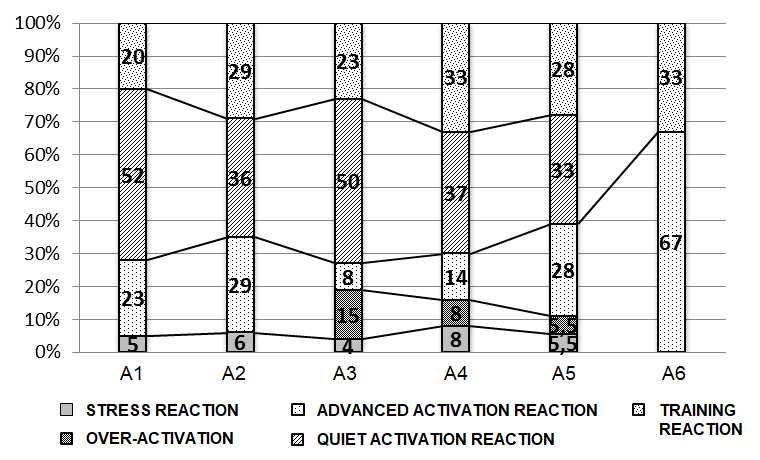
A more detailed study of the structure of adaptive Fig. 3. Prevalence of reactivity levels of nonspecific adaptive
reactions of the organism was carried out in 6 age groups body reaction indicators in males in relation to age (%) (A1 –
(Fig. 2). Statistically meaningful differences (pSHS Web of Conferences 112, 00036 (2021) https://doi.org/10.1051/shsconf/202111200036
Northern Sustainable Development Forum 2020
energy expenditures, and reduced functional body with the A2 group increases significantly (pSHS Web of Conferences 112, 00036 (2021) https://doi.org/10.1051/shsconf/202111200036
Northern Sustainable Development Forum 2020
systems of the organism, the predominance of
catabolism processes on the background of
transcendental arousal (leading to transcendent
inhibition) of the central nervous system. The
physiological mechanisms of NAR formation in these
groups differ in different levels of regulatory systems
and, therefore, in the magnitude of the body's
functioning tension. In group A5, the formation of NAR
is carried out by intrasystemic rearrangements, by
increasing the tone of the sympathetic division of the
autonomic nervous system. In the age group A3, the
mechanism of the formation of adaptation reactions is
based on energetically extremely costly processes of
intersystem rearrangements, due to the increased
duplication of adaptation processes by the central
regulation.
Acknowledgement
The study was carried out within the framework of the
projects: "Study of chronophysiological, molecular
mechanisms of adaptation and psychoemotional stress of
a person under the conditions of the combined action of
extreme climatic, technogenic factors in the Arctic and
Subarctic and a pandemic, post-pandemic, development
of ways to increase the adaptive potential"
121021600269-0), Federal Research Center YSC SB
RAS and "Physiological and biochemical mechanisms of
adaptation of plants, animals, humans to the conditions
of the Arctic / Subarctic and the development of
biological products based on natural northern raw
materials that increase the efficiency of the adaptation
process and the level of human health in extreme
environmental conditions" (No. 0297 - 2021-0025
registration number AAAA-A21-121012190035-9) of
the Institute for Biological Problems of Permafrost,
Federal Research Center of YSC SB RAS.
References
1. J. Launay, G. Savourey, Ind Health 47 (2009)
2. T.M. Mäkinen, Am J Hum Biol 19 (2007)
3. T.M. Mäkinen, Front Biosci - Scholar 2 (2010)
4. J. Bittel, Int J Sports Med 13 (1992)
5. A.T. Steegmann, Jr. Human, Am J Hum Biol 19
(2007)
6. A.J. Young, M.J, Fregly, C.M. Blatteis.
Handbook of physiology. Section 4:
Environmental physiology. Oxford University
Press (Oxford, UK, 1996)
7. N.I. Douglas, E.N. Nikolaeva, N.S. Baisheva,
O.N. Kolosova, E.A. Belchusova, L.E. Vasilieva,
Int J of Biomed 9 (2019)
8. T. Adams, B.G. Covino. J Appl Physiol 12
(1958)
9. W.D. van Marken Lichtenbelt, H.A. Daanen,
Curr Opin Clin Nutr Metab Care. 6 (2003)
10. J.W. Castellani, A.J. Young, Auton Neurosci. 196
(2016)
5You can also read


