Finding the Right Balance: A Social Norms Intervention to Reduce Heavy Drinking in University Students
←
→
Page content transcription
If your browser does not render page correctly, please read the page content below
ORIGINAL RESEARCH
                                                                                                                                                 published: 10 June 2021
                                                                                                                                        doi: 10.3389/fpubh.2021.653435

                                              Finding the Right Balance: A Social
                                              Norms Intervention to Reduce Heavy
                                              Drinking in University Students
                                              Christine Wolter 1 , Tino Lesener 1*, Tobias Alexander Thomas 2,3 , Alicia-Carolin Hentschel 1
                                              and Burkhard Gusy 1
                                              1
                                               Division of Public Health: Prevention and Psychosocial Health Research, Department of Education and Psychology, Freie
                                              Universität Berlin, Berlin, Germany, 2 Institute for Experimental Psychology, Faculty of Mathematics and Natural Sciences,
                                              Heinrich-Heine-Universität, Düsseldorf, Germany, 3 Department of Psychosomatic Medicine and Psychotherapy, Hannover
                                              Medical School, Hanover, Germany

                                              Introduction: Heavy alcohol consumption constitutes a major health risk among
                                              University students. Social relationships with peers strongly affect University students’
                                              perception of the drinking behavior of others, which in turn plays a crucial role in
                                              determining their own alcohol intake. University students tend to overestimate their peers’
                        Edited by:            alcohol consumption – a belief that is associated with an increase in an individual’s own
                        Pavel Dietz,
       Johannes Gutenberg University
                                              consumption. Therefore, we implemented a social norms intervention with personalized
                    Mainz, Germany            normative feedback at a major University in Germany to reduce and prevent excessive
                        Reviewed by:          drinking among University students.
                        Matteo Sattler,
            University of Graz, Austria       Methods: Our intervention was part of a regular health monitoring survey. We invited
                     Sebastian Heller,        all enrolled University students to take part in this survey on two occasions. A total of
       Johannes Gutenberg University
                      Mainz, Germany
                                              862 University students completed the questionnaire, 563 (65.3%) of which received
                    *Correspondence:
                                              e-mail-based feedback upon request concerning their peers’ and their own alcohol
                          Tino Lesener        consumption. For the intervention group (n = 190) as well as the control group (no
                 t.lesener@fu-berlin.de
                                              feedback requested; n = 101), we included only University students in the evaluation
                                              who overestimated their peers’ alcohol use and indicated above average consumption
                    Specialty section:
          This article was submitted to       of the peers. We applied analyses of variance to assess intervention effects with
          Public Health Education and         regard to the correction of overestimated group norms as well as University students’
                             Promotion,
                a section of the journal      drinking behavior.
              Frontiers in Public Health
                                              Results: Within the intervention group, we observed a significantly larger reduction of the
          Received: 14 January 2021
                                              previously overestimated behavioral norms compared to the control group (p < 0.001;
            Accepted: 18 May 2021
           Published: 10 June 2021            η2p = 0.06). With regard to behavioral outcomes the intervention group showed a
                             Citation:        significantly larger reduction in the AUDIT-C score (p = 0.020; η2p = 0.03).
    Wolter C, Lesener T, Thomas TA,
   Hentschel A-C and Gusy B (2021)
                                              Discussion:      Our study confirms previous research whereupon personalized,
  Finding the Right Balance: A Social         gender-specific and selective normative feedback is effective for alcohol prevention
 Norms Intervention to Reduce Heavy           among University students. However, University students still overestimated their peers’
      Drinking in University Students.
       Front. Public Health 9:653435.         alcohol intake after the intervention. Furthermore, we did not reach high-risk groups
    doi: 10.3389/fpubh.2021.653435            (University students with the highest alcohol intake) since no feedback was requested.

Frontiers in Public Health | www.frontiersin.org                                     1                                              June 2021 | Volume 9 | Article 653435
Wolter et al. Finding the Right Balance
Future studies should address factors influencing the impact of the intervention and
reachability of selective groups.
Keywords: social norms intervention, prevention of alcohol misuse, University students, alcohol intervention,
heavy drinking
INTRODUCTION Why Do University Students Overestimate
Their Peers’ Alcohol Consumption?
Harmful use of alcohol causes about 3 million deaths each year The perception of behavior is biased and therefore often differs
and more than 130 million disability-adjusted life years (1). The from the behavior actually shown (14). This discrepancy is
mortality caused by alcohol is higher than that caused by diseases particularly noticeable in alcohol consumption (15, 16). The
such as tuberculosis, HIV/AIDS, or diabetes (1). Constant alcohol core of such misperceptions usually lies in an overestimation
use causes social impairments and increases the risk for various of others’ risk behaviors and an underestimation of health-
serious diseases, like alcoholic cirrhosis, tumors and cancer, as promoting behaviors (13). Several studies at US (17–19) as well
well as premature mortality (2, 3). Especially younger adults are as European universities (20–22) showed that University students
disproportionally affected by alcohol: More than 13% of all deaths systematically overestimate their peers’ alcohol consumption.
between 20 and 39 are attributed to harmful use of alcohol (1). Thus, the fact—and behavioral norm—that the majority of
The highest prevalence rates of alcohol use disorders are in high- University students use alcohol responsibly is disguised by
income countries, especially in Europe and in the US. Heavy individual misperceptions (19). Within literature on the causes
alcohol consumption is also highly prevalent among young adults for this overestimation, there are several explanations: First,
in Germany: 42% of men and 33% of women between 18 and it is argued that overestimation is due to the size of the
29 display heavy consumption patterns (4). Research suggests peer group. As there is little/no information about unknown
that—within this age group—University students tend to drink persons within the peer group there is a lack of information
even more (5, 6) and also more frequently (5) than their non- on their alcohol use and thus overestimation occurs (23, 24).
University peers. Alcohol consumption is widespread among Second, it was postulated that among the peer group only close
German University students: On average, two thirds of the peers (e.g., significant others) are used for estimating alcohol
University students drink alcohol at least twice a month. Nearly use. Thus, overestimation is a product of “underinclusion” as
one third of the University students report binge drinking at least significant others are only a part of the peer group. However,
once a month, and more than 40% show problematic drinking this approach was disproved when being tested empirically
behavior, i.e., an AUDIT-C sum of at least 3 in women and at (25). Third, it is proposed that this overestimation is due to a
least 4 in men (7). cognitive bias resulting in better memory and attention for more
Consequently, and due to these high prevalence rates of extreme behavioral patterns. Furthermore, this more extreme
heavy alcohol consumption and negative outcomes concerning behavior is regarded as transsituationally consistent (26). Finally,
health, social life and society in general there is a particularly overestimation of peers’ alcohol use is found to be moderated by
high urgency to address the alcohol consumption of University time (e.g., “seasonal effects”) as well by own alcohol intake as well
students with proper interventions in order to prevent early- as by a loss of self-control (25). This may eventually result in risky
onsets of heavy drinking behavior. These interventions need to drinking behavior since misperceived behavioral norms may
simultaneously reduce the harmful use of alcohol and strengthen encourage individuals to adapt their alcohol intake to what they
responsible and low-risk handling of alcohol. (mis-)perceive in their peers (13). The social norms intervention
and personalized normative feedback approaches promisingly
How Do Peers Affect University Students’ attempt to break this cycle [i.e., “you (unintentionally) drink
Alcohol Consumption? more because you expect higher intake levels of your own based
Heavy drinking behavior is affected by intrapersonal and on peers’ evaluation”; (13)].
interpersonal social and normative factors (8). Among University
students, social relationships with peers play a crucial role for
their drinking behavior (9). Accordingly, University students How Could We Change the
report drinking motives such as social enhancement, enjoyment, Overestimation?
and socialization (10, 11). As a pioneer of social conformity The social norms intervention (SNI) is a health-promoting
theory, Asch (12) showed the impact of social pressure on intervention that aims to correct misperceptions by providing
individual behavior more than six decades ago. The perception information about the behavioral norm in a population in order
of others’ behavior—especially peers—affects University students’ to support more health-conscious decision-making processes
alcohol consumption through social norms as social influences (27). This intervention approach assumes that correcting the
(13). Moreover, University students adopt the drinking patterns misperceived behavioral norm by replacing it with the actual
they perceive in their peers. To prevent heavy alcohol norm reduces the individual’s pressure with regard to the
consumption, interventions could therefore address social mistakenly overestimated peer consumption (27). The SNI is
influences through social norms. based on two basic assumptions: (1) accurate information about
Frontiers in Public Health | www.frontiersin.org 2 June 2021 | Volume 9 | Article 653435Wolter et al. Finding the Right Balance
the beliefs and behaviors of relevant others is not always known students” as the normative peer group (43, 51). However, recent
and salient, (2) providing the behavioral norm may change the research highlights the importance of personal significance of the
understanding of group norms and one’s own position within reference group to the individual. Close reference persons such
the group (28). The SNI differs from traditional behavioral as friends or peers, as well as factors like specificity (e.g., gender
change approaches. It focuses on indirect methods of persuasion specificity) seem to have a greater impact on individual alcohol
by presenting information about (health-conscious) behavioral consumption than less close or specific reference groups such
norms that already exist within a group (29). SNIs do not aim as “typical University students” (35, 52–54). Furthermore, Haug
to change the behavioral norms but to correct misperceptions of et al. (55) argue for selective SNI for persons who consume more
that behavioral norm (13). The given information is a positive alcohol than the average, as the intervention was more effective
statement showing that responsible and moderate behavior is the in studies that pre-selected persons with problematic alcohol use
behavioral norm, and that the group majority acts and thinks [see also (48)].
health-consciously (30). In summary, research shows that email-based PNF for
With personalized normative feedback (PNF), each person alcohol prevention and reduction of alcohol consumption is
receives individual, personal feedback, e.g., on their own as well effective among University students. Interventions seem to be
as their peers’ alcohol consumption (28). For this purpose, a most effective when they are personalized, gender-specific, and
mode of communication is chosen that allows for this kind targeted at University students who drink more alcohol than the
of feedback, like face-to-face conversations in counseling (31), average of their peers.
e-mails (32) or web-based messages via a personal link to
a website (33). What Should We Do?
While interventions based on social norms are popular and
What Is the Current Evidence? widely applied at US universities, interventions that address
Intervention studies (34–38) and systematic reviews (27, 39, 40) University students in Europe and especially Germany are rare
demonstrate small to medium effects of SNIs on various alcohol- (41). SNIs have established themselves in the US as a meaningful
related outcomes such as drinking quantity, frequency and risky way to reduce alcohol consumption. In order to popularize this
drinking. However, these results often do not persist in the type of intervention in Germany, the effects of an SNI were tested
long term. Neighbors et al. (37) showed significant short-term in this study.
effects of their intervention (PNF, specifically) but no long-term Based on the existing evidence, we expect the effects of our
effects on the individual estimation of the behavioral norms, PNF to be two-fold: First, we expect a correction of University
alcohol frequency and quantity. Foxcroft et al. (41) reported students’ misperceived behavioral norms with regard to their
inconsistent results in their meta-analytical review: While some peers’ alcohol consumption. Second, we expect a reduction of
studies found significant short- and long-term effects of SNIs and alcohol intake on the behavioral level.
PNFs on alcohol quantity and binge drinking, other studies did The intervention aims to specifically address students who
not [see also (42)]. Additionally, the overall effect size was very overestimate their peers’ alcohol consumption and consume
small. However, Dotson et al. (43) declared even small effects more than the average of their peers. Consequently, our
as clinically relevant from a public health perspective. Referring hypotheses are:
to the “prevention paradox” even small improvements at the
individual level might achieve large health gains at the population Hypothesis 1: The intervention (personalized normative feedback)
level. In their review, PNF was proven an effective stand-alone corrects misperceived behavioral norms in University students
approach for reducing college student drinking (43). Moreover, who overestimate the alcohol intake of their peers and consume
more alcohol than the average of their peers at 12 weeks after
some recent studies were able to obtain medium- and long-term
the intervention.
effects of PNFs on drinking frequency after 3 months (44) and
drinking prevalence after 6 months (45).
Hypothesis 2: The intervention (personalized normative feedback)
PNF has proven to be effective in correcting misperceived reduces levels of alcohol intake on the behavioral level in University
drinking behavioral norms (37, 46, 47). This modification of students who overestimate the alcohol intake of their peers and
misperceived behavioral norms has been found to mediate the consume more alcohol than the average of their peers at 12 weeks
relationship between PNF and behavioral outcomes with regard after the intervention.
to reduced drinking levels (38, 47–49).
MATERIALS AND METHODS
How Can SNIs Be Improved?
Several aspects might improve the efficacy of SNIs, such as Study Procedure and Sample
the frequency, the reference group, or the selection of the Our intervention was part of a general health monitoring survey
intervention group. Samson and Tanner-Smith (50) meta- at a major University in Germany. The survey covered University
analytically showed that even one single session of PNF might students’ perception of study characteristics, health outcomes as
have the same positive impact on alcohol consumption in well as their health behavior. All University students enrolled
the short- and medium-term as motivational enhancement at the University were invited to take part in the survey. The
therapy, motivational interviewing, or even more elaborated survey was conducted twice (January/February and June/July
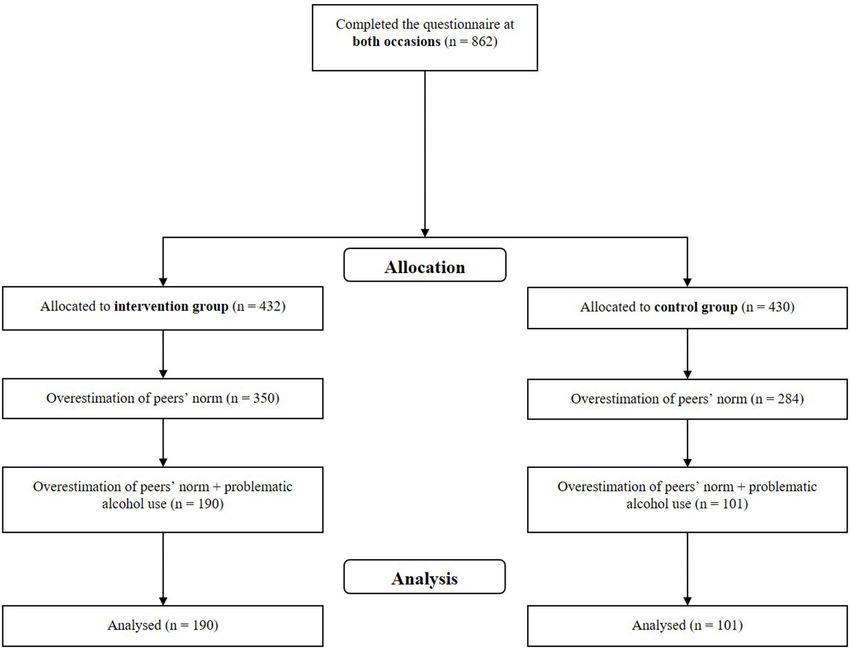
techniques. Most PNF interventions refer to “typical University 2019), with a total of 862 University students (mean age: 24 years;
Frontiers in Public Health | www.frontiersin.org 3 June 2021 | Volume 9 | Article 653435Wolter et al. Finding the Right Balance
see Figure 1) participating. Two months (6–10 weeks) after the value > 0 (meaning the individually estimated group norm
first survey, 563 (65.3%) University students received feedback is larger than the behavioral norm). We utilized frequency-
upon request concerning their own and their peers’ alcohol quantity-indices, combined values containing information about
consumption. In the second survey, 432 (76.7%) University both frequency and quantity of alcohol use, within our analyses.
students of those who had received feedback indicated that they These indices were also applied to assess the department- and
had actually read the feedback. University Students who had not gender-specific individually estimated group norm. We first
taken part in the intervention (no feedback requested or not read asked University students to evaluate their peers’ alcohol intake
the feedback) were assigned to the control group. The gender with regard to frequency (“How often does the majority of
ratio (♀:♂) was 3:1 in each group. All subjects answered the all female students in your department drink an alcoholic
questions on alcohol consumption on both occasions. beverage e.g., one glass of wine, beer, cocktail, schnapps or
Within our a-priori defined subgroup analysis, we included liqueur?”) and quantity [“How many alcoholic beverages does
only University students who overestimated their peers’ alcohol the majority of all female students in your department usually
consumption and who had indicated above average own drink per drinking occasion? One alcoholic beverage (standard
consumption compared to the median of the peers’ consumption. drink) is a small bottle of beer (0,33l), a small glass of wine
We refer to above average alcohol consumption as “heavy or sparkling wine (0,125l) or a double schnapps (4cl)”]. The
drinking.” No randomized assignment to the groups was items were adopted from AUDIT-C for estimation of peers’
possible. Consequently, 190 students fulfilling these criteria and alcohol frequency and quantity. We then multiplied frequency
were assigned to the intervention group and 101 students that and quantity and thus obtained the frequency-quantity index for
also met these criteria to the control group. Those who did not the individually estimated group norm.
fulfill inclusion criteria but wanted feedback were also given
feedback. Thus, every University student requesting feedback Personalized Normative Feedback
received one. In 2016, we started the project ISPI (“Internet, Studierende,
Peers & Intervention”) in cooperation with the Leibniz-Institut
Measures für Präventionsforschung und Epidemiologie in Bremen and
To assess University students’ individual alcohol intake, we used implemented a first intervention. This 2016 intervention resulted
the Alcohol Use Disorders Identification Test Consumption in a change of difference to norms but not a change of behavior
[AUDIT-C; (56)]. The AUDIT-C consists of three items of the regarding the alcohol consumption of University students (57).
original 10-item AUDIT. Each question (e.g., “How often do you With the current intervention, we tried to strengthen and
drink an alcoholic beverage e.g., one glass of wine, beer, cocktail, expand the effects of 2016. We further personalized the reference
schnapps or liqueur?”) is scored from 0 (e.g., “never”) to 4 (e.g., group for the University students by not only specifying it to
“6 or more times a week”) points, resulting in a score from 0 their gender but also to their study department. With an even
to 12. An AUDIT-C score of 0 means that participants never smaller comparison group we wanted to reach a higher degree
drink alcohol. of identification and a stronger effect of the intervention on both
We utilized frequency-quantity-indices, combined values group norms and behavior. Additionally, we revised and clarified
containing information about both frequency and quantity of the normative feedback. We used PNF in the form of e-mails
alcohol use, within our analyses. These indices were also applied to reach as many University students as possible. One crucial
to assess the department- and gender-specific individually advantage of e-mail-based interventions is that participants can
estimated group norm. We first asked University students to access the information at any time or place whilst also protecting
evaluate their peers’ alcohol intake with regard to frequency their anonymity (58). SNI with PNF represents a stand-alone,
(“How often does the majority of all female students in your e-mail-based, personalized, normative feedback intervention.
department drink an alcoholic beverage e.g., one glass of wine, The University students received feedback concerning their
beer, cocktail, schnapps or liqueur?”) and quantity [“How many own as well as their peers’ alcohol intake with regard to frequency
alcoholic beverages does the majority of all female students and quantity as well as binge drinking behavior (defined as six
in your department usually drink per drinking occasion? One or more alcoholic drinks per drinking occasion). The feedback
alcoholic beverage (standard drink) is a small bottle of beer consisted of three parts. In the first part, the University students
(0,33l), a small glass of wine or sparkling wine (0,125l) or a received feedback of what they had indicated with regard to their
double schnapps (4cl)”]. The items were adopted from AUDIT- own alcohol consumption (e.g., “You stated that you consume
C for estimation of peers’ alcohol frequency and quantity. alcohol 3 to 4 times per week, usually 1 alcoholic drink per
We then multiplied frequency and quantity and thus obtained drinking occasion.” / “You stated that you drink more than
the frequency-quantity index for the individually estimated 6 alcoholic drinks per drinking occasion once a month.”). In
group norm. the second part, the University students received feedback with
We computed another frequency-quantity index indicating regard to their estimated alcohol intake of their peers i.e.,
the behavioral norm (i.e., median of peers’ alcohol frequency the (mis-)perceived group norm (e.g., “You suppose, that the
multiplied with median of peers’ alcohol quantity) and compared majority of the female students in your department consume
them by using a difference value (individually estimated group alcohol 3–4 times per week, usually 2 alcoholic drinks per
norm – behavioral norm) for the two frequency-quantity indices. drinking occasion.”). In the third part, the students received
By using the term overestimation, we refer to any difference feedback about their peers’ alcohol intake (behavioral norm e.g.,
Frontiers in Public Health | www.frontiersin.org 4 June 2021 | Volume 9 | Article 653435Wolter et al. Finding the Right Balance
FIGURE 1 | Flowchart of our study.
“In fact, the majority of the female students in your department control group. Finally, we assessed the changes in intervention
consume alcohol 1–2 times per week, usually 2 alcoholic drinks and control group drinking behavior by comparing the AUDIT-
per drinking occasion.”). Lastly, the University students received C scores prior to and after the intervention. We used a 0.05
a statement indicating whether their alcohol intake was similar or significance level.
above that of their peers.
RESULTS
Data Analysis
We applied analyses of covariance (ANCOVA) to assess We first identified the gender- and subject-specific behavioral
intervention effects with regard to the correction of norms for drinking frequency and drinking quantity that were
overestimated group norms as well as University students’ also part of the intervention (feedback). Due to the high number
drinking behavior. We considered age, sex, self-efficacy and of different behavioral norms that we computed for every
depressive symptoms as covariates. To evaluate the correction gender and subject combination we only constitute the range of
of overestimated group norms, we first calculated a frequency- behavioral norms for the several combinations: Behavioral norms
quantity-index for the estimated as well as behavioral norms. for quantity varied from 2 drinks to 4.5 drinks and behavioral
Subsequently, we calculated a difference value between the norms for frequency varied from 1 time per month to 1–2 times
individually estimated group norm (perceived alcohol intake per week.
of peers) and the behavioral norm (median, department- With regard to hypothesis 1—the correction of overestimated
and gender-specific). With these indicators, we analyzed the individually estimated drinking norms—we observed a
difference values of both occasions for the intervention and significantly larger reduction in the difference value (between the
Frontiers in Public Health | www.frontiersin.org 5 June 2021 | Volume 9 | Article 653435Wolter et al. Finding the Right Balance
individually estimated group norm and the behavioral norm) in The feedback in our study was department- and gender-
the intervention group compared to the control group [F (2) = specific. We do not know whether the overestimation of the
8.46, p < 0.001, η2p = 0.06]. This confirms hypothesis 1, namely group norms was affected by this choice of reference group.
that the intervention would correct misperceived individually Galesic et al. (23) propose that the overestimation of people’s
estimated group norms in the intervention group. behavior results from judging the behavior of a rather unfamiliar
With regard to hypothesis 2—the reduction of alcohol sample. Consequently, assessing the behavior of acquainted
intake—we observed a significant reduction in their AUDIT-C others might yield more realistic estimations. However, Giese
scores [F (2) = 3.96, p = 0.020; η2p = 0.03]. Hence, the behavioral et al. (25) have disproven this hypothesis. They showed that
outcomes were in line with our hypothesis 2. Corrected means, overestimation still occurs even when the reference group
standard deviations and test statistics of the outcome measures comprises only familiar people.
are depicted in Table 1. Not much research exists concerning the content and precise
wording of the feedback. When studying the efficacy of a
campaign to correct social group norm, Thombs et al. (62) found
DISCUSSION that only 38.5% of their sample understood the intended purpose
of the campaign and its intervention. Therefore, we decided to
We investigated whether a personalized, gender-specific social not only include the participant’s own and their peers’ alcohol
norms intervention for University students would affect their intake in the feedback but to also explicitly state whether the
perception of their peers’ alcohol intake as well as their own participant’s alcohol intake was similar or above that of their
drinking behavior. Specifically, we compared the effects in the peers. We also added whether or not their consumption would
intervention group with a control group. Since most studies on be categorized as problematic. We hoped that this information
SNI in University students were conducted in the USA, Australia, would made the feedback’s intention easier to understand.
Brazil, New Zealand, Sweden, or the United Kingdom (41), our Furthermore, it is still rather unclear why SNI are more
intervention constitutes one of the first studies evaluating SNI in effective for some University students than for others. Giese
German University students. et al. (25) have shown that University students with high
Our results are in line with our hypotheses. In contrast to the self-control make more realistic estimations of their peers’
control group, participants in the intervention group ended up alcohol consumption. There may be several other individual
with a more realistic perception of their peers’ alcohol intake. characteristics that impact the efficacy of SNI. We need much
However, their perception was still above the group norm. more knowledge on why University students overestimate
Furthermore, participants of the intervention group reported peers’ alcohol intake, and which University students are
a significantly larger reduction in the AUDIT-C score, which most vulnerable to such an overestimation, in order to
means that—compared to the control group—they drank less and target SNI most effectively. Other SNI studies suggest that
less often after the intervention. However, their drinking level was several other contextual factors may influence its efficacy,
still high yet lowered. e.g., social and environmental factors [availability of alcohol,
Our results confirm prior SNI research that found that acceptance of alcohol consumption in public; (63)]. Future
University students reported significant decreases of their alcohol research could also operationalize and control these social and
intake [e.g., (59, 60)]. There has, however, been serious criticism environmental factors.
concerning SNI use with European populations. John and Alwyn
(61) argue that there are important differences in campus life and Limitations
in the definitions of alcohol misuse or heavy drinking between Our intervention is not free of shortcomings.
the UK and the US. They consider SNIs to be an ineffective tool First, we used the AUDIT-C as an efficient, reliable and
in tackling heavy drinking behavior in European populations. valid measure to assess the alcohol intake of the participants
Contrastingly, our study was able to validate SNI’s efficacy in a as well as the alcohol intake of their peers. The AUDIT-C
European population and thus makes a valuable contribution to has been successfully applied in previous SNIs (41). However,
the knowledge about SNI. more direct behavioral measures such as the Alcohol Timeline
We decided to use PNF in the form of e-mails to reach Followback [TLFB; (64)] might be better suited to examining
as many University students as possible. Since we integrated alcohol consumption and thus the effects of the intervention.
the intervention into our regular health monitoring survey, we Second, a larger sample size might have improved and
showed that it is possible to implement both, health assessment expanded our results. Since we included the intervention in our
and intervention simultaneously. This is a very effective and cost- regular health monitoring survey, only 190 University students
efficient method. Still, there are several other feedback delivery met our inclusion criteria for the intervention that we formulated
options, in particular web/computer feedback, individual face- a-priori (University students who overestimated their peers’
to-face feedback, group face-to-face feedback and general social alcohol use and indicated above average own consumption
norms marketing campaigns. In some cases, like when the compared to peers’ median alcohol use). Most of the studies
intervention targets specific and small courses, it may be more on SNI targeted University students with increased risk (41),
appropriate to choose another delivery method, e.g., face-to-face however, it may also be important to consider the intervention
feedback. Overall though, (e-)mailed feedback has been identified as a prevention tool for those who are not (yet) at increased risk
as one of the best delivery options for SNI (41). or even at low-risk University students [e.g., (65)]. Furthermore,
Frontiers in Public Health | www.frontiersin.org 6 June 2021 | Volume 9 | Article 653435Wolter et al. Finding the Right Balance
TABLE 1 | Corrected Means and test statistics of the ANCOVA outcome measures.
IG CG IG CG
T1 T2
M (SE) M (SE) M (SE) M (SE) F ratio df p ηp 2
Difference value (individually estimated group norm – behavioral norm) 17.85 (1.32) 18.73 (1.77) 7.828 (1.00) 17.41 (1.34) 8.46*** 2Wolter et al. Finding the Right Balance
REFERENCES 17. Perkins HW, Haines MP, Rice R. Misperceiving the college drinking norm and
related problems: a nationwide study of exposure to prevention information,
1. World Health Organization. Global Status Report on Alcohol and Health 2018. perceived norms and student alcohol misuse. J Stud Alcohol. (2005) 66:470–8.
World Health Organization. (2018). Available online at: https://apps.who.int/ doi: 10.15288/jsa.2005.66.470
iris/bitstream/handle/10665/274603/9789241565639-eng.pdf (accessed May 18. Perkins HW. Misperceptions of peer drinking norms in Canada: another look
28, 2021). at the “reign of error” and its consequences among college students. Addictive
2. Orth B. Die Drogenaffinität Jugendlicher in der Bundesrepublik Deutschland Behav. (2007) 32:2645–56. doi: 10.1016/j.addbeh.2007.07.007
2015: Rauchen, Alkoholkonsum und Konsum illegaler Drogen: aktuelle 19. Perkins HW, Berkowitz AD. Perceiving the community norms of
Verbreitung und Trends (BZgA-Forschungsbericht). Köln: Bundeszentrale alcohol use among students: some research implications for campus
für gesundheitliche Aufklärung (2016). Available online at: https://www. alcohol education programming. Int J Addict. (1986) 21:961–76.
drogenbeauftragte.de/fileadmin/dateien-dba/Drogenbeauftragte/2_Themen/ doi: 10.3109/10826088609077249
1_Drogenpolitik/2_Initiativen/DAS_2015_Basis-Bericht_fin.pdf (accessed 20. Boot CR, Dahlin M, Lintonen T, Stock C, van Hal G, Rasmussen S,
November 3, 2017). et al. A survey study on the associations between misperceptions on
3. Robert Koch-Institut. Gesundheit in Deutschland – die wichtigsten substance use by peers and health and academic outcomes in University
Entwicklungen (Gesundheitsberichterstattung des Bundes. Gemeinsam getragen students in North-West Europe. Int J Disabil Hum Dev. (2012) 11:273–9.
von RKI und Destatis). Berlin. (2016). Available online at: https://www.rki. doi: 10.1515/ijdhd-2012-0027
de/DE/Content/Gesundheitsmonitoring/Gesundheitsberichterstattung/ 21. McAlaney J, Boot CR, Dahlin M, Lintonen T, Stock C, Rasmussen S, et al.
GBEDownloadsGiD/2015/kurzfassung_gesundheit_in_deutschland.pdf?__ A comparison of substance use behaviours and normative beliefs in North-
blob=publicationFile (accessed February 2, 2018). West European University and college students. Int J Disabil Hum Dev. (2012)
4. Robert Koch-Insitut. Alkoholkonsum: Faktenblatt zu GEDA 2012: 11:281–7. doi: 10.1515/ijdhd-2012-0032
Ergebnisse der Studie Gesundheit in Deutschland aktuell 2012. (2014). 22. Riou França L, Dautzenberg B, Reynaud M. Heavy episodic
Available online at: http://www.rki.de/DE/Content/Gesundheitsmonitoring/ drinking and alcohol consumption in French colleges: the role of
Gesundheitsberichterstattung/GBEDownloadsF/Geda2012/Alkoholkonsum. perceived social norms. Alcoholism Clin Exp Res. (2010) 34:164–74.
pdf?__blob=publicationFile doi: 10.1111/j.1530-0277.2009.01078.x
5. Carter AC, Obremski Brandon K, Goldman MS. The college and 23. Galesic M, Olsson H, Rieskamp J. Social sampling explains apparent
noncollege experience: a review of the factors that influence drinking biases in judgments of social environments. Psychol Sci. (2012) 23:1515–23.
behavior in young adulthood. J Stud Alcohol Drugs. (2010) 71:742–50. doi: 10.1177/0956797612445313
doi: 10.15288/jsad.2010.71.742 24. Pape H. Young people’s overestimation of peer substance use:
6. Kypri K, Cronin M, Wright CS. Do University students drink more an exaggerated phenomenon? Addiction. (2012) 107:878–84.
hazardously than their non-student peers? Addiction. (2005) 100:713–4. doi: 10.1111/j.1360-0443.2011.03680.x
doi: 10.1111/j.1360-0443.2005.01116.x 25. Giese H, Stok FM, Renner B. Perceiving college peers’ alcohol consumption:
7. Grützmacher J, Gusy B, Lesener T, Sudheimer S, Willige J. Gesundheit temporal patterns and individual differences in overestimation. Psychol
Studierender in Deutschland 2017 [Health of Students in Germany 2017]: Health. (2019) 34:147–61. doi: 10.1080/08870446.2018.1514118
Ein Kooperationsprojekt zwischen dem Deutschen Zentrum für Hochschul- 26. Perkins HW. College student misperceptions of alcohol and other drug norms
und Wissenschaftsforschung, der Freien Universität Berlin und der Techniker among peers: exploring causes, consequences, and implications for prevention
Krankenkasse. (2018). Available online at: https://www.ewi-psy.fu-berlin. programs. In: Designing Alcohol and Other Drug Prevention Programs in
de/einrichtungen/arbeitsbereiche/ppg/forschung/BwB/bwb-2017/index.html Higher Education: Bringing Theory Into Practice. (1997). p. 177–206. Available
(accessed May 28, 2021). online at: http://alcohol.hws.edu/perkinstheorychapter.pdf (accessed May 28,
8. Lorant V, Nicaise P, Soto VE, d’Hoore W. Alcohol drinking among college 2021).
students: college responsibility for personal troubles. BMC Public Health. 27. Berkowitz AD. The Social Norms Approach: Theory, Research, Annotated
(2013) 13:615. doi: 10.1186/1471-2458-13-615 Bibliography. Trumansburg, NY (2004). Available online at: http://www.
9. Helmer S. Substanzkonsum von Studierenden und Einflüsse der Peergroup. alanberkowitz.com/articles/social_norms.pdf (accessed May 28, 2021).
Über die Bedeutung von sozialen Normen für den legalen und illegalen 28. Miller DT, Prentice DA. Changing norms to change behavior. Ann Rev
Substanzkonsum von europäischen Studierenden (Dissertation). Fakultät Psychol. (2016) 67:339–61. doi: 10.1146/annurev-psych-010814-015013
für Gesundheitswissenschaften der Universität Bielefeld, Bielefeld (2015). 29. McAlaney J, Bewick B, Hughes C. The international development of the
Available online at: https://d-nb.info/1073642348/34 (accessed May 28, 2021). ‘social norms’ approach to drug education and prevention. Drugs Educ Prevent
10. Kuntsche E, Knibbe R, Gmel G, Engels R. Why do young people Policy. (2010) 18:81–9. doi: 10.3109/09687631003610977
drink? A review of drinking motives. Clin Psychol Rev. (2005) 25:841–61. 30. Perkins HW. Social norms and the prevention of alcohol misuse
doi: 10.1016/j.cpr.2005.06.002 in collegiate contexts. J Stud Alcohol Suppl. (2002) 14:164–72.
11. Park CL. Positive and negative consequences of alcohol doi: 10.15288/jsas.2002.s14.164
consumption in college students. Addictive Behav. (2004) 29:311–21. 31. Neighbors C, Lewis MA, Bergstrom RL, Larimer ME. Being controlled
doi: 10.1016/j.addbeh.2003.08.006 by normative influences: self-determination as a moderator of a
12. Asch SE. Opinions and social pressure. Sci Am. (1955) 193:31–5. normative feedback alcohol intervention. Health Psychol. (2006) 25:571–9.
doi: 10.1038/scientificamerican1155-31 doi: 10.1037/0278-6133.25.5.571
13. Berkowitz AD. An overview of the social norms approach. In: Lederman 32. Larimer ME, Lee CM, Kilmer JR, Fabiano PM, Stark CB, Geisner
LC, Stewart LP, editors. Changing the Culture of College Drinking: IM, et al. Personalized mailed feedback for college drinking prevention:
A Socially Situated Health Communication Campaign. Hampton Press a randomized clinical trial. J Consult Clin Psychol. (2007) 75:285–93.
(2005). p. 193–214. Available online at: https://pdfs.semanticscholar.org/6ef6/ doi: 10.1037/0022-006X.75.2.285
20971cfda65d43ec3cac2c2a0cd7bf7c02f0.pdf (accessed August 18, 2017). 33. Neighbors C, Lee CM, Lewis MA, Fossos N, Walter T. Internet-based
14. Cooter RD, Feldman M, Feldman Y. The misperception of norms: the personalized feedback to reduce 21st-birthday drinking: a randomized
psychology of bias and the economics of equilibrium. Rev. Law Econ. (2006) controlled trial of an event-specific prevention intervention. J Consult Clin
4:899–911. doi: 10.2202/1555-5879.1222 Psychol. (2009) 77:51–63. doi: 10.1037/a0014386
15. Haug S, Ulbricht S, Hanke M, Meyer C, John U. Overestimation of drinking 34. Bryant ZE, Henslee AM, Correia CJ. Testing the effects of e-mailed
norms and its association with alcohol consumption in apprentices. Alcohol personalized feedback on risky alcohol use among college students. Addict
Alcoholism. (2011) 46:204–9. doi: 10.1093/alcalc/agq103 Behav. (2013) 38:2563–7. doi: 10.1016/j.addbeh.2013.06.007
16. Kypri K, Langley JD. Perceived social norms and their relation 35. Collins SE, Spelman PJ. Associations of descriptive and reflective injunctive
to University student drinking. J Stud Alcohol. (2003) 64:829–34. norms with risky college drinking. Psychol Addict Behav. (2013) 27:1175–81.
doi: 10.15288/jsa.2003.64.829 doi: 10.1037/a0032828
Frontiers in Public Health | www.frontiersin.org 8 June 2021 | Volume 9 | Article 653435Wolter et al. Finding the Right Balance
36. Kessler RC, Berglund P, Demler O, Jin R, Merikangas KR, Walters E. Lifetime 53. Larimer ME, Neighbors C, Labrie JW, Atkins DC, Lewis MA, Lee CM, et al.
prevalances and age-of-onset distributions of DSM-IV disoders in the national Descriptive drinking norms: for whom does reference group matter? J Stud
comorbidity survey replication. Arch Gen Psychiatry. (2005) 62:593–602. Alcohol Drugs. (2011) 72:833–43. doi: 10.15288/jsad.2011.72.833
doi: 10.1001/archpsyc.62.6.593 54. Neighbors C, Labrie JW, Hummer JF, Lewis MA, Lee CM, Desai S, et al. Group
37. Neighbors C, Lewis MA, LaBrie J, DiBello AM, Young CM, Rinker identification as a moderator of the relationship between perceived social
DV, et al. A multisite randomized trial of normative feedback for heavy norms and alcohol consumption. Psychol Addict Behav. (2010) 24:522–8.
drinking: social comparison versus social comparison plus correction doi: 10.1037/a0019944
of normative misperceptions. J Consult Clin Psychol. (2016) 84:238–47. 55. Haug S, Sannemann J, Meyer C, John U. Reduktion des Alkoholkonsums und
doi: 10.1037/ccp0000067 Förderung der Rauchabstinenz bei Jugendlichen und jungen Erwachsenen
38. Walters ST, Vader AM, Harris TR. A controlled trial of web-based mittels Internet und Mobiltelefon: Ein Literaturüberblick [Internet and
feedback for heavy drinking college students. Prevent Sci. (2007) 8:83–8. mobile phone interventions to decrease alcohol consumption and to support
doi: 10.1007/s11121-006-0059-9 smoking cessation in adolescents: a review]. Gesundheitswesen. (2012) 74:160–
39. Carey KB, Scott-Sheldon LAJ, Elliott JC, Garey L, Carey MP. Face-to- 77. doi: 10.1055/s-0030-1268446
face versus computer-delivered alcohol interventions for college drinkers: 56. Bush KR, Kivlahan DR, McDonell MB, Fihn SD, Bradley KA. The
a meta-analytic review, 1998 to 2010. Clin Psychol Rev. (2012) 32:690–703. AUDIT alcohol consumption questions (AUDIT-C): an effective brief
doi: 10.1016/j.cpr.2012.08.001 screening test for problem drinking. Arch Intern Med. (1998) 158:1789–95.
40. Sundström C, Blankers M, Khadjesari Z. Computer-based interventions for doi: 10.1001/archinte.158.16.1789
problematic alcohol use: a review of systematic reviews. Int J Behav Med. 57. Farnir E, Gräfe C, Wolter C, Gusy B. Eine Intervention zur Reduktion
(2017) 24:646–58. doi: 10.1007/s12529-016-9601-8 des Alkoholkonsums bei Studierenden der Freien Universität Berlin.
41. Foxcroft DR, Moreira MT, Almeida Santimano NML, Smith LA. Evaluationsbericht (Schriftenreihe des AB Public Health: Prävention und
Social norms information for alcohol misuse in University and psychosoziale Gesundheitsforschung 01/P18). Berlin: Freie Universität
college students. Cochrane Database Syst Rev. (2015) 1 CD006748. Berlin (2018). Available online at: https://www.ewi-psy.fu-berlin.de/
doi: 10.1002/14651858.CD006748.pub3 einrichtungen/arbeitsbereiche/ppg/publikationen/forschung/Schriftenreihe/
42. Cronce JM, Larimer ME. Individual-focused approaches to the prevention of ISPI_Gesamtbericht_V09.pdf (accessed May 28, 2021).
college student drinking. Alcohol Res Health. (2011) 34:210–21. 58. Jo SJ, Lee HK, Kang K, Joe KH, Lee SB, Efficacy of a Web-based screening
43. Dotson KB, Dunn ME, Bowers CA. Stand-alone personalized normative and brief intervention to prevent problematic alcohol use in Korea: results of
feedback for college student drinkers: a meta-analytic review, 2004 a randomized controlled trial. Alcoholism Clin Exp Res. (2019) 43:2196–202.
to 2014. PLoS ONE. (2015) 10:e0139518. doi: 10.1371/journal.pone.01 doi: 10.1111/acer.14169
39518 59. Kypri K, Vater T, Bowe SJ, Saunders JB, Cunningham JA, Horton NJ,
44. Lewis MA, Litt DM, Tomkins M, Neighbors C. Prototype Willingness et al. (2014). Web-based alcohol screening and brief intervention
model drinking cognitions mediate personalized normative feedback efficacy. for University students: a randomized trial. JAMA. 311:1218–24.
Prevent Sci. (2017) 18:373–81. doi: 10.1007/s11121-016-0742-4 doi: 10.1001/jama.2014.2138
45. Ganz T, Braun M, Laging M, Schermelleh-Engel K, Michalak J, Heidenreich 60. Martens MP, Smith AE, Murphy JG. The efficacy of single-component brief
T. Effects of a stand-alone web-based electronic screening and brief motivational interventions among at-risk college drinkers. J Consult Clin
intervention targeting alcohol use in University students of legal Psychol. (2013) 81:691–701. doi: 10.1037/a0032235
drinking age: a randomized controlled trial. Addict Behav. (2018) 77:81–8. 61. John B, Alwyn T. Revisiting the rationale for social normative interventions
doi: 10.1016/j.addbeh.2017.09.017 in student drinking in a UK population. Addict Behav. (2014) 39:1823–6.
46. Rodriguez LM, Neighbors C, Rinker DV, Lewis MA, Lazorwitz B, Gonzales doi: 10.1016/j.addbeh.2014.07.022
RG, et al. Remote versus in-lab computer-delivered personalized normative 62. Thombs DL, Dotterer S, Olds RS, Sharp KE, Raub CG. A close look at why
feedback interventions for college student drinking. J Consult Clin Psychol. one social norms campaign did not reduce student drinking. J Am Coll Health.
(2015) 83:455–63. doi: 10.1037/a0039030 (2004) 53:61–8. doi: 10.3200/JACH.53.2.61-70
47. Young CM, Neighbors C. Incorporating writing into a personalized normative 63. Dowdall GW, Wechsler H. Studying college alcohol use: widening the
feedback intervention to reduce problem drinking among college students. lens, sharpening the focus. J Stud Alcohol Suppl. (2002) 14:14–22.
Alcoholism Clin Exp Res. (2019) 43:916–26. doi: 10.1111/acer.13995 doi: 10.15288/jsas.2002.s14.14
48. Elliott JC, Carey KB, Bolles JR. Computer-based interventions for 64. Sobell LC, Maisto SA, Sobell MB, Cooper A. Reliability of alcohol abusers’
college drinking: a qualitative review. Addict Behav. (2008) 33:994–1005. self-reports of drinking behavior. Behav Res Ther. (1979) 17:157–60.
doi: 10.1016/j.addbeh.2008.03.006 doi: 10.1016/0005-7967(79)90025-1
49. Thompson K, Burgess J, MacNevin PD. An evaluation of e- 65. Neighbors C, Jensen M, Tidwell J, Walter T, Fossos N, Lewis MA. Social-
CHECKUP TO GO in Canada: the mediating role of changes in norms interventions for light and nondrinking students. Group Processes
social norm misperceptions. Substance Use Misuse. (2018) 53:1849–58. Intergroup Relations. (2011) 14:651–69. doi: 10.1177/1368430210398014
doi: 10.1080/10826084.2018.1441306
50. Samson JE, Tanner-Smith EE. Single-session alcohol interventions for heavy Conflict of Interest: The authors declare that the research was conducted in the
drinking college students:a systematic review and meta-analysis. J Stud absence of any commercial or financial relationships that could be construed as a
Alcohol Drugs. (2015) 76:530–43. doi: 10.15288/jsad.2015.76.530 potential conflict of interest.
51. Labrie JW, Lewis MA, Atkins DC, Neighbors C, Zheng C, Kenney SR,
et al. Rct of web-based personalized normative feedback for college drinking Copyright © 2021 Wolter, Lesener, Thomas, Hentschel and Gusy. This is an open-
prevention: are typical student norms good enough? J Consult Clin Psychol. access article distributed under the terms of the Creative Commons Attribution
(2013) 81:1074–86. doi: 10.1037/a0034087 License (CC BY). The use, distribution or reproduction in other forums is permitted,
52. Larimer ME, Kaysen DL, Lee CM, Kilmer JR, Lewis MA, Dillworth T, provided the original author(s) and the copyright owner(s) are credited and that the
et al. Evaluating level of specificity of normative referents in relation to original publication in this journal is cited, in accordance with accepted academic
personal drinking behavior. J Stud Alcohol Drugs Suppl. (2009) 16:115–21. practice. No use, distribution or reproduction is permitted which does not comply
doi: 10.15288/jsads.2009.s16.115 with these terms.
Frontiers in Public Health | www.frontiersin.org 9 June 2021 | Volume 9 | Article 653435You can also read


