Fire and Invasive Species Management in Hot Deserts: Resources, Strategies, Tactics, and Response
←
→
Page content transcription
If your browser does not render page correctly, please read the page content below
Society for Range Management

Fire and Invasive Species
Management in Hot Deserts:
Resources, Strategies, Tactics,
and Response
By Alix Rogstad, Travis M. Bean, Aaryn Olsson, and
Grant M. Casady

D
             eserts cover about one-fifth of the earth’s          isolated location from other regions by Mexico’s two great
             surface and occur where rainfall is less than        mountain ranges, it has developed into one of the three
             19 inches (50 cm) per year. Most deserts have        most biologically rich deserts in the world, with up to
             specialized fauna that have evolved in tandem        1,000 species adapted to that area. The Chihuahuan Desert
with specialized vegetation, and soils often have abundant        stretches from extreme eastern Arizona to southern New
nutrients but are water-limited. Ecologists have long             Mexico through the Rio Grande drainage of west Texas/
acknowledged that once invasive species are established in        northern Mexico and spreads southward over the Mexican
these ecosystems, they have the ability to displace native        Plateau into the states of Chihuahua, Coahuila, south-
plant and animal species, disrupt nutrient and fire cycles,       western Nuevo Leon, northeastern Durango, and San Luis
and alter the character of the community by enhancing             Potosí. The desert is bounded to the east and west by the
additional invasions.1–5                                          ranges of the Sierra Madre Oriental and the Sierra Madre
   For the purposes of the Wildfire and Invasive Plants in        Occidental, respectively. The northern and southern bound-
American Deserts conference that was held in Reno, Nevada,        aries, more difficult to define, are usually based on such
in December 2008, North American deserts that occur at            diagnostic indicators as climate, vegetation, or animal com-
low latitudes were grouped as “hot deserts,” and include the      munities.6 Two features that make the Chihuahuan Desert
Chihuahuan, Mojave, and Sonoran deserts of the American           region unique are the vast temperate grasslands that skirt
Southwest. These three deserts share common species such          the mountain flanks at mid-elevation and the diversity of
as creosote bush (Larrea tridentata [DC.] Coville), ocotillo
(Fouquieria splendens Engelm.), and native bunch grasses
(Bouteloua spp., Aristida spp., Muhlenbergia spp., etc.) that
are negatively impacted by wildfires driven by invasive
species. Although similarities exist, these deserts also have
unique features and issues that can make land management
challenging, especially in light of invasive species and large-
scale wildfires moving across landscapes that are not adapted
to fire.

Chihuahuan Desert
Covering nearly 250,000 square miles (647,500 km2), the
Chihuahuan Desert is the largest of the North American
deserts, and is considered to be one of the most biologi-
cally diverse arid regions in the world.6 It receives most of
its precipitation in the summer and the northern reaches in       Black grama and yucca grassland, Chihuahuan Desert, near Las Cruces,
southern New Mexico and southeastern Arizona are consid-          New Mexico, USA. Photo courtesy of Ed L. Fredrickson, USDA–
erably colder than areas to the south. Largely because of its     Agricultural Research Service, Las Cruces, New Mexico.

6                                                                                                                      Rangelands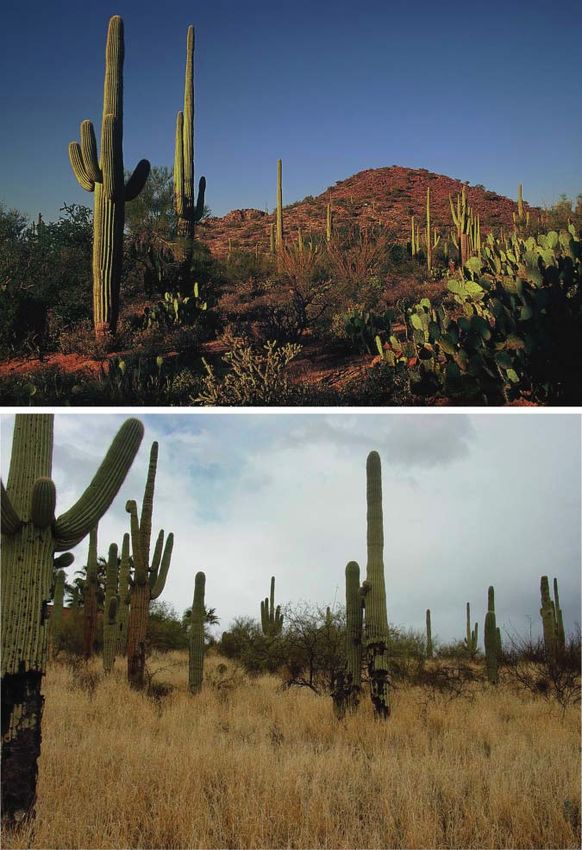
yuccas and agaves. One of the agaves, lechuguilla (Agave
lechuguilla Torr.), is considered the primary diagnostic
species of the Chihuahuan Desert.6
    The northernmost reaches of the Chihuahuan Desert
in southern New Mexico and southeastern Arizona could
be classified mostly as desert grassland, dominated by C4,
summer-flowering annual and perennial grasses that were
stable in comparison and extent across the last glacial–
interglacial cycle.7 Subtropical shrubs such as acacias (Acacia
spp.), creosote bush, and mesquite (Prosopis spp.) began
encroaching into this grassland within the past ~5,000
years,7 and this encroachment appears to have accelerated
with livestock grazing and fire suppression in the modern
era.8–12 The exact cause of this shift is debated, but probable
causes include livestock grazing, climate change, and fire
suppression.13 Grassland conversion and habitat fragmen-
tation have caused increased runoff and erosion, decreased
biological diversity through isolation, reduced carrying
capacity,14 shifts in avian species assemblages, increased
invasion by nonnative species, and decreased livestock and
wildlife forage.10,15,16
    Little is known about the extent of nonnative invasive
species in the Chihuahuan Desert. Nonnative species of
greatest concern currently include giant reed (Arundo donax
L.), Bermuda grass (Cynodon dactylon [L.] Pers.), Lehmann
lovegrass (Eragrostis lehmanniana Nees), buffelgrass (Penni-
setum ciliare [L.] Link), Johnson grass (Sorghum halepense
[L.] Pers.), and saltcedar (Tamarix spp.). At Big Bend
National Park in West Texas, bioclimatic modeling, early
detection protocols, and identifiers of vectors and pathways
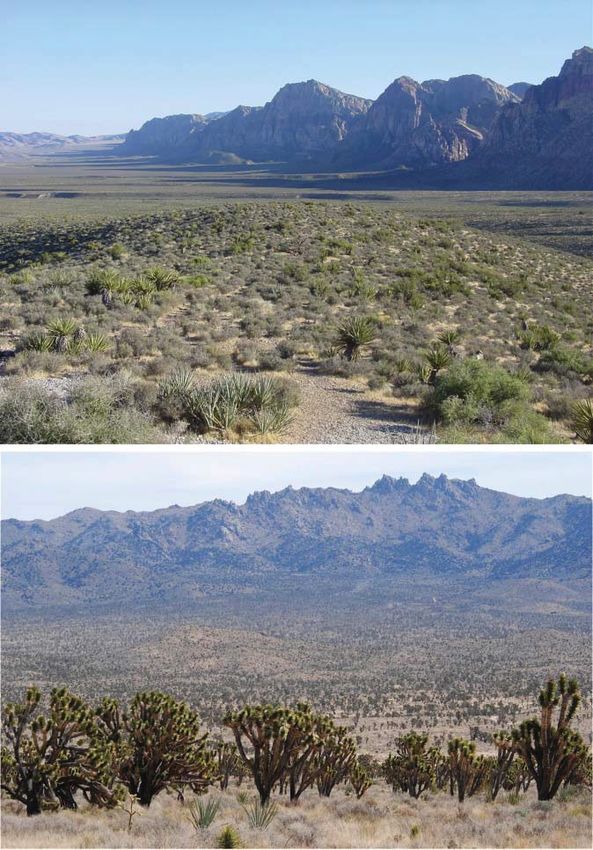
are informing management strategies for these invasive            (top) Mojave Desert near Red Rock Canyon, Nevada. Photo courtesy
                                                                  of John Mioduszewski, Rutgers University, Piscataway, New Jersey.
species.17 In New Mexico, one concern is that common
                                                                  (bottom) Mojave National Preserve, Mojave Desert, near Cima, California.
buffelgrass, or its cold resistant variety ‘Frio,’ could          Photo depicts the upper end of the Mojave Desert where grass invasions
expand northward along the Rio Grande River with regional         are taking place. Photo courtesy of Todd Esque, US Geological Survey,
warming.                                                          and John Rotenberry, University of California, Riverside, California.

Mojave Desert
The Mojave Desert occupies a significant portion of                  Ecologists have noted that since the 1970s, nonnative
southeastern California and smaller parts of southern             grasses have invaded the Mojave Desert and are now prom-
Nevada, northwestern Arizona, and extreme southwestern            inent in most native plant communities.19 Increased levels
Utah. It occupies over 25,000 square miles (64,750 km2) in        of soil nutrients typically have a positive effect on annual
a typical Basin and Range topography, and elevations range        plants, especially in low-nutrient environments such as the
from −282 feet (−86 m) to over 11,000 feet (3,353 m).             Mojave Desert. It has been suggested that nonnative annual
Situated between the Great Basin Desert to the north and          plants may utilize available resources more rapidly and effec-
the Sonoran Desert to the south (mainly between lat 34°N          tively than their native counterparts, thereby allowing them
and lat 38°N), the Mojave is defined by a combination of          an advantage over native species.20 The presence of nonna-
latitude, elevation, geology, and indicator plants. This desert   tive species has a dramatic effect on wildfire potential.
is believed to support between 1,750 and 2,000 species            Historically, wildfires rarely occurred in the Mojave Desert
of plants, and the Joshua tree (Yucca brevifolia Engelm.) is      because of limited herbaceous vegetation in the interspaces
considered an indicator species.18 Topographic boundaries         between shrubs that prevented fire spread. The invasion
include the Tehachapi together with the San Gabriel and           of species that rapidly respond to available resources and fill
San Bernardino mountain ranges, which are outlined by             in the gaps between shrubs now provides continuous fuel
the two largest faults in California: the San Andreas and the     for fires. Species of greatest concern include nonnative
Garlock. One key feature of this desert is that it receives       annual grasses (Bromus spp. and Schismus spp.), Sahara
most of its average annual rainfall of 5 inches (12.7 cm) in      mustard (Brassica tournefortii Gouan), perennial pepperweed
the winter.18                                                     (Lepidium latifolium L.), and saltcedar.

June 2009                                                                                                                               7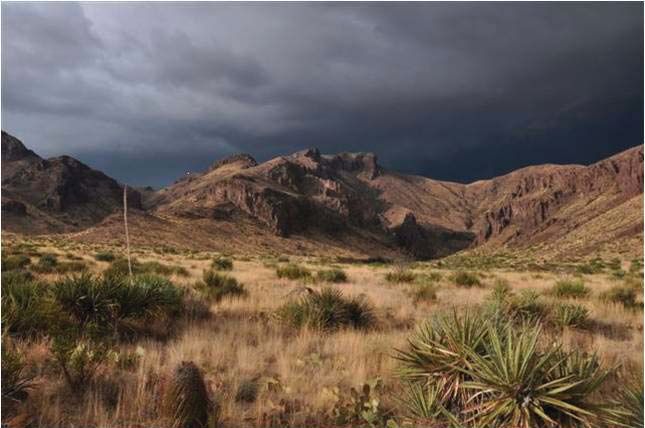
Sonoran Desert                                                              (Olneya tesota A. Gray). About half of the Sonoran Desert
The Sonoran Desert is a region covering 120,000 square                      flora are annuals, and in the Arizona Upland up to 80% are
miles (311,000 km2) in southwestern Arizona and south-                      winter annuals.24
eastern California, as well as most of Baja California del                      The biological diversity of the Sonoran Desert is threat-
Norte, the islands of the Gulf of California, and the western               ened by the introduction of invasive species, cattle ranching,
half of Sonora, Mexico. It is considered the wettest desert                 agricultural production, urbanization, groundwater deple-
in the world, receiving up to 25 inches (64 cm) per year in                 tion, mining, sand and rock extraction, catastrophic wild-
some locations. However, the Desierto de Altar, in western                  fires, and off-road recreational activities. Invasions by red
Sonora, is one of the driest areas in North America,                        brome (Bromus rubens L.), Schismus spp., and buffelgrass
with periods of drought that can last for 30 months.21                      have been particularly harmful, because they carry fire. The
The Sonoran Desert is the hottest of the North American                     perennial buffelgrass forms dense stands, crowds out both
deserts, and a distinctly bimodal rainfall pattern produces                 annual and perennial native plants, and readily carries fire in
the most biologically diverse desert in the world, with                     an ecosystem that is not fire adapted.25–28
more than 2,000 native plant species and 600+ species of
animals.22,23 The desert contains a variety of unique plants                Setting the Stage
and animals, such as the giant saguaro cactus (Carnegiea                    The Wildfire and Invasive Plants in American Deserts con-
gigantea [Engelm.] Britton & Rose) and the ironwood tree                    ference highlighted key issues related to the combined threat
                                                                            of invasives and wildfire in hot deserts through a workshop
                                                                            comprising a number of presentations. The workshop began
                                                                            with a Southern Nevada Fire Complex Case Study pre-
                                                                            sented by Karen Prentice, the Emergency Stabilization
                                                                            and Rehabilitation Coordinator for the Bureau of Land
                                                                            Management in Ely, Nevada. Due to its complex nature,
                                                                            the Southern Nevada Fire Complex provided a perfect over-
                                                                            view of the challenges faced by land managers in the hot
                                                                            deserts. The Complex burned approximately 739,000 acres
                                                                            (299,063 ha) between June and July 2005, and was primar-
                                                                            ily fueled by annual invasive Bromus species. Rehabilitation
                                                                            efforts following the Complex Fire provided a number of
                                                                            lessons learned including 1) the need for a better under-
                                                                            standing of the range of variation in vegetation response of
                                                                            desert plant communities, 2) the necessity for cross-jurisdic-
                                                                            tional communication so that technical and policy knowl-
                                                                            edge is shared, and 3) the use of a regional, landscape-level
                                                                            perspective when planning and implementing rehabilitation
                                                                            efforts.
                                                                                Sandee Dingman, a Natural Resource Specialist for the
                                                                            National Park Service at Lake Mead in Nevada, suggested
                                                                            that the most critical component of an ideal approach to
                                                                            fire and invasive species management was a comprehensive
                                                                            Fire Management Plan (FMP) that establishes goals and
                                                                            identifies fire management activities that may promote
                                                                            native plant communities or nonnative and invasive species.
                                                                            The FMP should ideally include details of operational
                                                                            guidelines, locations of existing invasive species populations,
                                                                            strategies that may reduce the spread of invasive species,
                                                                            research and monitoring findings for local vegetation
                                                                            communities, and lessons learned from previous fires in the
                                                                            area.
                                                                                An increase in invasive species that fuel wildfires is
(top) Typical Sonoran Desert vegetation, which is poorly adapted to fire.   dramatically affecting the frequency and scale of fires now
Photo taken in the Saguaro National Park West, Tucson Mountains,            occurring in the hot deserts. These fires are now burning
Arizona. Photo courtesy Manny Rubio, 2006/ASDM Sonoran Desert
                                                                            closer to urban populations and their associated infrastruc-
Digital Library. (bottom) Buffelgrass invasion in the Sonoran Desert.
Perennial buffelgrass forms dense stands, crowds out both annual and
                                                                            ture. The wildland–urban interface presents new challenges
perennial native vegetation, and readily carries fire. Photo courtesy of    to land managers responsible for vast areas, especially in the
Aaryn Olsson, University of Arizona.                                        hot deserts, which are experiencing some of the fastest

8                                                                                                                            Rangelands
population growth in the country, but have historically had
infrequent fires. Julio Betancourt, a Senior Research Scientist
with the US Geological Survey in Tucson, Arizona,
suggested that the invasion of buffelgrass in southeastern
Arizona presents challenges and opportunities. Many of
the challenges are similar to those posed by other invasions,
including increased fire risk, a greater financial burden on
fire departments and agencies to protect lives and property,
and a critical need for education and outreach. Although
these challenges are great, there are also unique opportuni-
ties in wildland–urban interface areas that should be capital-
ized upon, including 1) engagement of civic leaders, the
business community, and other stakeholders for better policy
development; 2) a larger audience base for obtaining scarce
resources for invasive species management; 3) the develop-
ment of novel approaches for managing invasive species
infestations; and 4) the availability of citizen scientist groups Figure 1. Critical issues identified by audience participation feedback
for Workshop I: Hot Desert Fire and Invasive Species Management at
to participate in research and monitoring. the Wildfires and Invasive Plants in American Deserts Conference, Reno,
Regardless of the location, existing policies can either Nevada, in December 2008.
promote or hinder quality on-the-ground invasive species
management, affecting the fire potential and risks associated
with plant communities of the hot deserts. Travis Bean, Management Essentials: Rehabilitation, Monitoring,
Principal Research Specialist at the University of Arizona, and Fuels
identified policy-related roadblocks to invasive species Management issues are widely varied, reflecting the diverse
management on large scales. Knowing the extent of the factors that must be taken into account when dealing
infestations, especially in relation to the distribution of with the often-novel situations imposed by invasive species.
Successful management for effective control requires com-
critical resources, is one of the most important pieces of
prehensive monitoring of successes and failures, good data
information a land manager can have. Definitive mapping
on occurrence and spread of the species, and strategies that
of infestations and species distributions are critical for
take into account basic life history traits of the species and
planning, control, and future management. Maps must
incorporate phenological modeling based on climate pre-
be regularly updated to provide relevant information for
dictions. However, management does not end there. In the
achieving long-term goals. Generally, with invasive species
inevitability that some wildfires cannot be contained, it con-
management immediate action is necessary to keep costs
tinues in the form of fuels management, the active control
down. The longer treatment is postponed, the larger the of fires, and the rehabilitation of infested or burned areas.
population and infestation expanse, and thus the more costly A selection of the major suggested management
the treatment. Therefore, control efforts must start big and strategies included the following:
be scaled down as control is achieved. Lastly, budget stabil- • Prioritize and target areas with high resource value for
ity is essential for making progress on controlling invasive management (not just wildland–urban interface areas).
species populations. Money used in early years for control • Clearly define duties and responsibilities for different
treatments that are not monitored or followed with second- jurisdictions—from department of transportation man-
ary treatments as necessary is essentially wasted if follow-up agement of both invasive and wildfire spread along road
treatments are not possible because of the lack of resources right-of-ways to individual landowners and homeowner’s
in subsequent years. associations.
• Adjust expectations of the end result with respect to
Recommendations climate change.
Workshop participants were invited to provide additional • Base management responses on the ecosystem’s fire
comments and feedback following the speakers’ presenta- regime and whether or not this has been changed by
tions addressing two general questions: 1) What is the most invasive species.
critical issue, challenge, or goal that must be addressed • Recognize that in a particular area, best management
in hot desert fire and invasive species management? and practices for rehabilitation may include doing nothing.
2) What is the best strategy for success? A total of 156 • Develop economic sustainability in seed markets and
participant responses, described in more detail below, were infrastructure for long-term seed storage, because seed
informative, specific, and varied in the identification of the availability is currently a limiting factor for rehabilita-
most critical issues and successful strategies (Fig. 1). tion.
June 2009 9• Identify benchmarks and desired landscapes (goals) prior support of efforts to control invasive species by connecting
to initiating monitoring, and modify as necessary given the issues associated with invasive species and wildfire to
variable climatic conditions. peoples’ everyday lives.
• Use technology to guide monitoring efforts. Suggestions for education and outreach (or public
• Regularly monitor both burned and unburned areas, engagement) included the following:
and use data to inform other aspects of invasive species • Identify and promote a champion or mascot that will
management (policy, treatment, future rehabilitation, make the invasive species–fire connection.
etc.). • Utilize existing programs (Cooperative Extension,
• Monitor fuel management treatments for efficacy and Firewise, Adopt-a-Highway and Adopt-a-Trail Pro-
share the resulting lessons learned through a centralized grams, etc.) to capitalize on and promote further public
clearinghouse. involvement.
• Conduct cross-jurisdictional education efforts at all levels
Coordination and Collaboration (K–12, general public, civic leaders, and policy makers).
Managing large landscapes necessitates the involvement • Identify and support volunteer coordinators through
of multiple stakeholders, and therefore coordination and existing youth service programs (AmeriCorps VISTA,
collaboration become key components of any successful Conservation Corps, etc.) and further promote and use
management activity. By working together, small groups can these programs to enlist workers.
overcome challenges and experience large achievements by • Develop creative ways for all sectors of the public to
leveraging scarce resources. Urbanized areas face additional participate in invasive species management.
challenges, but are also presented with a variety of new • Motivate and encourage action using a variety of
opportunities to garner support of invasive species and
methods including rewards, ordinances, and penalties.
wildfire prevention management actions.
• Develop best management practices for small-scale
A selection of strategies for better coordination and
action (i.e., a “toolkit” for homeowners’ associations,
collaboration included the following:
scout troops, and others).
• Share critical information pertaining to invasive species
• Demonstrate and publicize all successful actions through
with fire managers via fire information packets during
a clearinghouse (similar to the Wildland Fire Lessons
incidents, and promote and coordinate preventative
Learned Center).
efforts.
• Coordinate all aspects of the invasive species issue (fuel
and fire management, research, rehabilitation, funding, Research
and policy) at all levels, and share the information There are many unmet research needs that could greatly
where applicable and possible through a centralized increase the effectiveness of management and help to guide
clearinghouse. the establishment of sound policy. Unfortunately, science
• Identify and engage stakeholders early; the collaboration often focuses on defining the impacts of invasive species in
process should include multiple jurisdictions and inter- an ecosystem in order to make the case for their control.
national partners, where appropriate. With invasive species and fire in hot deserts, there is a
• Strategize regionally and coordinate data sharing using critical need for research focused on the effects and efficacy
existing tools (e.g., NASA/US Geological Survey’s of management. A general laundry list of invasive species
invasive species forecasting system). research needs includes remote sensing/mapping, economic
• Utilize cross-jurisdictional invasive species or weed analyses, Web-based decision support systems, spread and
groups (Cooperative Weed Management Areas, Natural bioclimatic models, impacts of control treatments on rare
Resource Conservation Districts, etc.) to leverage funds species and critical habitats, restoration techniques, unin-
for treatment activities. tended consequences of chemical control, phenological and
• Share and update lessons learned through a centralized propagule pressure models, seed bank and dispersal ecology,
clearinghouse of data and related information. soil nutrient dynamics, genetic studies, and biological
control, among others.
Education and Outreach Suggestions for research included the following:
Education and public outreach efforts are extremely cost- • Explore the implications and consequences of large-scale
effective tools that should be utilized to their best advan- and long-term treatments (herbicide application, manual
tage. Engaging the public in the challenges faced by land removal, etc.) on the whole ecosystem.
managers is an important component of achieving lasting • Study the postfire dynamics and ecosystem processes that
results. Stakeholders from all levels and sectors should be have implications for rehabilitation of native ecosystems,
approached and addressed via creative means, including especially under varying climate regimes.
print materials, public presentations, volunteer opportuni- • Determine the effectiveness and cost of various control
ties, and media interactions. It is crucial to enlist public techniques for species and environments.
10 Rangelands• Identify species that may be utilized for postfire • Consistently fund all aspects of invasive species man-
rehabilitation under differing climate regimes. agement (mapping, public engagement, treatment, and
monitoring).
Policy Essentials and Prioritization • Demonstrate cost-effectiveness and share lessons learned
As with many pressing environmental issues, policies influ- through a centralized clearinghouse.
encing the management of invasive species in hot deserts • Explore all alternative funding solutions including user
have been almost entirely reactive instead of proactive. fees and taxes, as well as grant and donor solicitations.
Perhaps this is because fires in these areas are a relatively • Develop a template for successful funding mechanisms
recent occurrence in the history of human management, and for small community-based groups, and make it available
thus have not necessitated active policy. Nevertheless, as via a centralized clearinghouse.
invasions and fires increase in frequency and extent, the lack • Prioritize target areas regionally for better utilization of
of a comprehensive public policy becomes a major stumbling scarce resources and funding allocations.
block in the successful management of invasive species and
fires in hot deserts. This causes countless other associated Conclusion
environmental and economic problems. Managing an ever-changing landscape to control invasive
Suggested priorities for policy included the following: species and the resulting increase in fire potential should
• Promote invasive plant control as sustained public works be a high priority. One possible solution to many of the
projects that require training, an increased work force, challenges and issues identified during this conference would
be the creation or development of a national (or at least
and greater contractor capacity.
western US) interagency invasive species team that has
• Review and modify existing policies that hinder
the responsibility of coordinating information, treatment
treatment.
options, funding opportunities, and rehabilitation prior to,
• Perform cost-benefit analyses to attract the attention of
during, and after wildfires. This proposed team could com-
policy makers and other stakeholders.
prise invasive species specialists who work closely with local
• Develop action plans with identified goals, objectives,
invasive species specialists to identify opportunities for fund-
and performance metrics for large landscapes (in
ing, early detection, and research. A centralized team can
prevention of and preparation for large-acre wildfires). also quickly respond to wildfires as they occur, and can help
• Accept that mitigation and adaptation are two necessary Burned Area Emergency Response teams as they develop
components of long-term management. It is important rehabilitation plans following incidents. The proposed team
to acknowledge that some areas cannot be “saved” and could be stationed at the National Interagency Fire Center
resources should be used where they are most effective. (NIFC) in Boise, Idaho, or another centralized location,
which may make it possible for decision makers and land
Funding managers to better capitalize on existing opportunities while
As expected, the easy answer to addressing invasive species creating new ones.
and wildfire concerns is to increase dedicated funding. Advantages of hosting such a team at NIFC are many.
However, in difficult local and national economic times First, created in 1965, NIFC is a proven national example
with scant resources available, the concept of just increasing for multijurisdictional wildland fire response coordination.
funding is generally not a feasible solution. Land managers Fire management agencies and those responsible for inva-
and other stakeholders must be especially creative in devel- sive species management are one and the same, so informa-
oping alternative solutions to these complex issues using tion regarding both invasive species infestations and fires
limited resources. Managers and funding entities must would be more readily shared and utilized if it were easily
consider the possibility that aggressive funding early in the accessible and available. Secondly, it would further promote
invasive-fire cycle may provide long-term savings by avoid- active communication between the invasive species manage-
ing ongoing expenses related to the continual treatment of ment and the fire management communities, which would
invasive plant populations that recover after insufficient or allow for increasing public awareness of the close association
unsustained control efforts. of these two issues. The development of public outreach
Suggested funding strategies included the following: and education could also be streamlined and shared across
• Incorporate nonlinear growths, costs, and comparison deserts, with the possibility of having specialists available to
associations with doing something today vs. later in all respond immediately to fires who could also address invasive
cost-benefit analyses. species concerns (trained public information officers, for
• Increase and improve fund leveraging by collaboration example). Lastly, although there would still be a need for
and cooperation across multiple jurisdictions. local knowledge, this team could serve as a clearinghouse of
• Land managers and stakeholders provide information invasive species information (funding opportunities and
and support to decision makers prior to decisions for strategies, research, rehabilitation options, and lessons
funding allocations. learned) available to the land managers who need it most.
June 2009 11Proactively addressing invasive species fuels in deserts Service, General Technical Report RMRS-GTR-79-Vol 4.
would enable fire managers to address the frequency of fires 65 p.
in these ecosystems and allow them to prioritize areas of 6. Hoyt, C. A. 2002. The Chihuahuan Desert: diversity at risk.
greatest impact overall. Even though the American deserts Endangered Species Bulletin XXVII(2):16–17.
7. Holmgren, C., J. Norris, and J. Betancourt. 2007.
offer some of the most remote country and may be consid-
Inferences about winter temperatures and summer rains from
ered lower priority areas for response when multiple fires the late Quaternary record of C4 perennial grasses and C3
occur simultaneously, these ecosystems are being dramati- desert shrubs in the northern Chihuahuan Desert. Journal of
cally impacted by wildfires and will continue to be so as long Quaternary Science 22:141–161.
as fire-promoting invasive species are present. 8. Barnes, W. C. 1936. Herds in the San Simon Valley. American
Policy makers, land managers, scientists, students, and Forests 42:456–458.
the interested public do not have all the answers, nor 9. Buffington, L. C., and C. H. Herbel. 1965. Vegetational
do they have all the questions. Completing this process of changes on a semiarid desert grassland range from 1858 to
synthesizing information from workshop presentations and 1963. Ecological Monographs 35:139–164.
audience response resulted in the identification of immedi- 10. Branson, F. A. 1985. Vegetation changes on western
ate critical issues and challenges facing the American hot rangelands. Denver, CO, USA: Society for Range Manage-
ment Range Monograph 2. 76 p.
deserts, and as with most natural resource management
11. Archer, S. 1989. Have southern Texas savannas been con-
items, specific issues needing attention will change over time verted to woodlands in recent history? The American Naturalist
as a result of new species invasions, lessons learned through 134:545–561.
active management and responses, and natural processes. 12. Báez, S., and S. L. Collins. 2008. Shrub invasion decreases
Therefore it is critical that information is shared across diversity and alters community stability in northern Chihua-
jurisdictions and at multiple levels to develop the best strat- huan Desert plant communities. PLoS ONE 3(6):e2332.
egies for managing the unique deserts of the American doi:10.1371/journal.pone.0002332.
Southwest. 13. Fredrickson, E., K. M. Havstad, R. Estell, and
P. Hyder. 1998. Perspectives on desertification: southwestern
Acknowledgments United States. Journal of Arid Environments 39:191–207.
14. Saunders, D. A., R. J. Hobbs, and C. R. Margules. 1991.
The authors would like to thank the conference planning
Biological consequences of ecosystem fragmentation: a review.
committee and conference sponsors for providing the
Conservation Biology 5:18–32.
opportunity to gather the data referenced and synthesized 15. Vickery, P. D., P. L. Tubaro, J. M. Da Silva, B. G.
herein. The authors also thank Julio Betancourt and the Peterjohn, J. G. Herkert, and R. B. Cavalcanti. 1999.
conference synthesizing committee for their valuable Conservation of grassland birds of the Western Hemisphere.
comments on earlier versions of this article. Studies in Avian Biology 19:2–26.
16. Desmond, M. J., K. E. Young, B. C. Thompson, R. Valdez,
References and A. Lafon Terrazas. 2005. Habitat associations and
conservation of grassland birds in the Chihuahuan Desert
1. Cox, G. W. 1999. Alien species in North America and Hawaii: region: two case studies in Chihuahua, Mexico. In: J. L. E.
impacts on natural ecosystems. Washington, DC, USA: Island Cartron, G. Ceballos, and R. S. Felger (eds.). Biodiversity,
Press. 387 p. ecosystems, and conservation in northern Mexico. New York,
2. Stohlgren, T. J., D. Brinkley, G. W. Chong, M. A. NY, USA: Oxford University Press. p. 439–451.
Kalkhan, L. D. Schell, K. A. Bull, Y. Otsuki, G. 17. Young, K. E., S. Schrader, G. Roemer, C. Caldwell,
Newman, M. Bashkin, and Y. Son. 1999. Exotic plant K. Boykin, H. Reiser, and A. Ernst. 2007. Early detection
species invade hot spots of native plant diversity. Ecological of invasive species in Big Bend National Park: remote sensing
Monographs 69:25–46. and GIS strategies, May. Available at: http://fws-nmcfwru.
3. DeLoach, C. J., R. I. Carruthers, J. E. Lovich, T. L. nmsu.edu/BIBE/. Accessed 23 January 2009.
Dudley, and S. D. Smith. 2000. Ecological interactions in 18. Jaeger, E. C. 1955. The California deserts. Stanford, CA,
the biological control of saltcedar (Tamarix spp.) in the United USA: Stanford University Press. 205 p.
States: toward a new understanding. In: N. R. Spencer (ed.). 19. Western Ecological Research Center. 2002. Nonnative
Proceedings of the X international symposium on biological grass invasions and fire in the Mojave Desert. US Geological
control of weeds; 4–14 July 1999; Bozeman, MT, USA. Service Factsheet, August. Available at: http://www.werc.usgs.
Bozeman, MT, USA: Montana State University. p. 819–873. gov. Accessed 15 January 2009.
4. Zavaleta, E. S., R. J. Hobbs, and H. A. Mooney. 2001. 20. DeFalco, L., D. R. Bryla, V. Smith-Longozo, and R. S.
Viewing invasive species removal in a whole-ecosystem context. Nowak. 2003. Are Mojave Desert annual species equal?
Trends in Ecology and Evolution 16:454–459. Resource acquisition and allocation for the invasive grass
5. Osborn, S., V. Wright, B. Walker, A. Cilimburg, and Bromus madritensis subsp. rubens (Poaceae) and two native
A. Perkins. 2002. Linking wilderness research and manage- species. American Journal of Botany 90:1045–1053.
ment—volume 4. Understanding and managing invasive plants 21. Ezcurra, E., and V. Rodrigues. 1986. Rainfall patterns
in wilderness and other natural areas: an annotated reading list. in the Grand Desierto, Sonora, México. Journal of Arid
Fort Collins, CO, USA: US Department of Agriculture, Forest Environments 10:13–28.
12 Rangelands22. Brown, D. E. (ed.). 1994. Biotic communities: southwestern 27. Búrquez-Montijo, A., M. E. Miller, and A. Martínez-
United States and northwestern Mexico. Salt Lake City, UT, Yrízar. 2002. Mexican grasslands, thornscrub, and the trans-
USA: University of Utah Press. 342 p. formation of the Sonoran Desert by invasive exotic buffelgrass
23. Turner, R. M., J. E. Bowers, and T. L. Burgess. 1995. (Pennisetum ciliare). In: B. Tellman (ed.). Invasive exotic
Sonoran Desert plants: an ecological atlas. Tucson, AZ, USA: species in the Sonoran region. Tucson, AZ, USA: University
University of Arizona Press. 501 p. of Arizona Press and Arizona-Sonora Desert Museum. p. 126–
24. Venable, D. L., and C. E. Pake. 1999. Population ecology 146.
of Sonoran Desert annual plants. In: R. H. Robichaux (ed.). 28. Rogstad, A. (ed.). 2008. Southern Arizona buffelgrass
The ecology of Sonoran Desert plants and plant communities. strategic plan: a regional guide for control, mitigation, and
Tucson, AZ, USA: The University of Arizona Press. p. 115– restoration. Tucson, AZ, USA: Buffelgrass Working Group.
142. 204 p.
25. Búrquez, A., and M. A. Quintana. 1994. Islands of
diversity: ironwood ecology and the richness of perennials in a
Sonoran Desert biological reserve. In: G. P. Nabhan and J. L.
Authors are Science Coordinator and Invasive Species Program
Carr (eds.). Ironwood: an ecological and cultural keystone Manager, Center for Sonoran Desert Studies, Arizona-Sonora
of the Sonoran Desert. Washington, DC, USA: Conservation Desert Museum, 2021 N Kinney Rd, Tucson, AZ 85743, USA
International. 92 p. (Rogstad); Principal Research Specialist, School of Natural
26. Van Devender, T. R., and M. A. Dimmitt. 2000. Desert Resources, University of Arizona, Tucson, AZ 85719, USA,
grasses. In: S. J. Phillips and P. W. Comus (eds.). A natural bean@email.arizona.edu (Bean); Senior Research Specialist
history of the Sonoran Desert. Tucson, AZ, USA: Arizona- (Olsson), and Assistant Research Specialist (Casady), Arizona
Sonora Desert Museum Press, and Berkley and Los Angeles, Remote Sensing Center, Office of Arid Lands Studies, University
CA, USA: University of California Press. p. 265–280. of Arizona, Tucson, AZ, USA.
June 2009 13You can also read


