Global Financial Crisis: How was India Impacted?
←
→
Page content transcription
If your browser does not render page correctly, please read the page content below
Global Financial Crisis: How was India Impacted?*

                                   Mathew Joseph
                              Senior Consultant, ICRIER
                                      New Delhi

                                       Abstract

The global crisis has hit India through a “sudden stop” of capital inflows and a collapse
of both external and domestic demand. The growth of the economy dropped to 6.7 per
cent in 2008-09 (April-March) from 9.0 per cent in the previous year and is projected to
decline further in 2009-10 to about 5.0 per cent including the bad monsoon effect. The
aggressive monetary and fiscal measures undertaken so far will not be able to secure a
sound recovery for the Indian economy with the global economy unlikely to revive its
growth soon. A strong recovery of growth to 8-9 per cent, however, is possible for India
if it unveils a “second round of reforms” similar to what it had done in the early 1990s.

*Prepared for presentation to InWEnt-DIE Conference on Global Financial Governance
– Challenges and Regional Responses, September 3-4, 2009 in Berlin, Germany.
Table of Contents
1. Background: India on the Eve of the Crisis ......................................................................................... 3
1.1 Slowing Economy Prior to the Crisis................................................................................................. 3
2. Spread of Crisis to India ........................................................................................................................ 4
3. Policy Response....................................................................................................................................... 9
3.1 Monetary Measures ........................................................................................................................... 9
3.2 Fiscal Stimulus Packages................................................................................................................. 11
4. Impact on the Economy ....................................................................................................................... 11
5. Growth Prospects, 2009-10 .................................................................................................................. 12
5.1 Signs of Recovery............................................................................................................................ 12
5.2 Some Strong Negative Signals ........................................................................................................ 13
6. Policy Suggestions for Recovery.......................................................................................................... 15
References ................................................................................................................................................... 17
21. Background: India on the Eve of the Crisis
India’s engagement with the global economy became deeper from the 1990s. Total
merchandise trade which was hardly 15 per cent of India’s GDP in 1990-91 (April-
March) rose by nearly two and half times to 36 per cent of GDP in 2007-08; invisibles
trade rose about fourfold from just 5 per cent of GDP to 19 per cent in the same period;
and capital flows increased even faster at more than fivefold from 12 per cent of GDP to
65 per cent of GDP over the same period.
Just take the case of exports. Though the ratio of export of goods and services in India’s
GDP was lower at 23 per cent in 2006 than that in China at 40 per cent (World Bank,
2008), the contribution of export demand to GDP growth in India is not that much lower
in comparison with China. This is so because the consumption-GDP ratio is much higher
for India at 58 per cent (against China’s low 33 per cent) and the import-GDP ratio lower
at 26 per cent (32 per cent for China) making the Keynesian income multiplier higher in
India1. Rough calculations indicate that a 10 per cent increase in export demand can raise
the GDP by 4 per cent in China, other things being equal, whereas in India the rise in
GDP is 3 per cent.
The deepening global integration of India has made it vulnerable to the global financial
crisis. However, three factors helped India to cope with the crisis and soften the blow.
They are: (1) the robust, well capitalized and well-regulated financial sector; (2) gradual
and cautious opening up of the capital account; and (3) the large stock of foreign
reserves.
1.1 Slowing Economy Prior to the Crisis
Indian economy began to slow down in 2007-08 (April-March) after reaching a GDP
growth of 9.8 per cent in the last quarter of 2006-07. In fact, Indian economy grew at an
annual average rate of 8.8 per cent during the five years ending 2007-08. In the first half
of the financial year 2008-09, the growth rate dropped to 7.8 per cent.
The pre-crisis slowdown of the economy can be attributed to the tightening of monetary
policy right from September 2004 in response to the fear that the Indian economy had
been overheating and inflation rising. The monetary tightening became harder in 2006-07
and later in early 2008-09 as the huge rise in world commodity prices pushed India’s
inflation also high.
1
The income multiplier is given by the formula: 1/1-c (1-t) +m where c=marginal propensity to consume,
t=direct taxes as a proportion of GDP, m=imports as a proportion of GDP. With the assumption of a
same tax ratio (say, 10 per cent), the income multiplier for India is 1.35 and China just below 1.
32. Spread of Crisis to India
The concept of “sudden stop” was first introduced by Dornbusch et al. (1995) and later
given analytical framework by Calvo (1998) to examine the impact of a sudden and
largely unexpected cut-back in foreign capital inflows to emerging economies. This is
reminiscent of the bankers’ old saying that “it’s not speed that kills, it’s the sudden stop”
(Dornbusch, 2001). Calvo (2009) noted the likelihood of India going through a “sudden
stop” episode with the onset of the global crisis. The chart below depicts the various
stages in the process of the spread of the global financial crisis to India within the
framework of the “sudden stop” analysis.
Chart 1: The Spread of Crisis to India
2. Massive slow
down in ECB, trade
credit, banking
flows
(From Apr 08 )
3. Forex market crisis -
1. FII outflows & Fall in rupee and in
Equity market reserves
crash (From May 08 )
(From Jan 08 )
A “Sudden Stop”
episode in India
6. Credit market
4. Money market squeeze
dries up (Mid-Sep 08 )
(Nov 08 )
5. Collapse of
exports, imports,
software exports
and remittances
(Sep 08 )
The first impact of the global crisis on India was felt in the stock market in January 2008.
This came through the reversal of inflows from foreign institutional investors (FIIs) into
the country. India had received about US$ 17.7 billion as net equity investment inflows
from FIIs during 2007. This turned into a net disinvestment of US$ 13.3 billion during
the period from January 2008 to February 2009. This was the direct result of the massive
de-leveraging of US banks after the financial meltdown. The FIIs withdrew funds from
all over the emerging markets for meeting the liquidity requirements of their principals in
the US. The marked reversal of capital inflows from FIIs in India since December 2007
can be seen from Chart 2.
4Chart 2: Net FII Equity Inflows into India (US$ Million)
8000
6000
4000
2000
0
Mar-06
Mar-07
Mar-08
Jan-06
May-06
Jul-06
Nov-06
Jan-07
May-07
Jul-07
Mar-09
Nov-07
Jan-08
May-08
Jul-08
Nov-08
Jan-09
May-09
Jul-09
Sep-06
Sep-07
Sep-08
-2000
-4000
Source: Securities Exchange Board of India.
The sudden withdrawal of FIIs from the Indian stock market brought about a crash in the
market in January 2008. The benchmark stock price index, the BSE Sensex, plummeted
from 20,873 on 8 January to 9093 on 28 November 2008, a 56 per cent fall over a period
of 11 months. The fall in Wall Street started two months before in November 2007, but
the intensity of the market crash taking place after a lag in Dalal Street (India’s stock
exchange) had been much larger as can be seen from Chart 3.
Chart 3: Se nse x and Dow Jone s, 2003-09
25000
20000
15000 Dow Jones
10000
5000 Sensex
0
Jan,03
Jan,04
Jan,05
Jan,06
Jan,07
Jan,08
Jan,09
May
May
May
May
May
May
May
Sep
Sep
Sep
Sep
Sep
Sep
Source: Yahoo Finance.
In stage 2, capital inflows under external commercial borrowings, short-term trade credit
and external borrowing by banks dropped sharply from April 2008. As can be seen from
Table 1, following a substantial decline in the first half of 2008-09, there was a huge
return flow of capital from India in the second half of the year with regard to short-term
5trade finance and bank borrowings to the extent of US$ 9.5 billion and US$ 11.4 billion
respectively.
Table 1: India's Balance of Payments: 2008-09
% Change
US$ Million
(Y-O-Y)
H1 2008- H2 2008- H1 H2
2007-08 2008-09
09 09 2008-09 2008-09
Exports 166163 175184 98107 77077 35.1 -17.6
Imports 257789 294587 168208 126379 45.2 -11.0
Trade balance -91626 -119403 -70101 -49302 -62.2 -1.9
% of GDP -7.8 -10.4 -6.1 -4.3
Invisible receipts 148604 162556 84635 77921 32.5 -84.1
Invisible payments 74012 72970 36065 36905 14.0 -12.9
Invisibles, net 74592 89586 48570 41016 50.6 -3.1
% of GDP 6.4 7.8 4.2 3.6
Current account -17034 -29817 -21531 -8286 -96.1 -36.8
% of GDP -1.5 -2.6 -1.9 -0.7
Capital account (net) 109198 9737 19032 -9295 -63.0 -116.1
% of GDP 9.3 0.9 1.7 -0.8
-Foreign direct investment 15401 17496 13867 3629 185.1 -65.6
-Portfolio investment 29556 -14034 -5521 -8513 -129.9 -176.6
-External commercial borrowings 22633 8158 3157 5001 -71.7 -56.4
-Short-term trade credit 17183 -5795 3689 -9484 -44.0 -189.5
-External assistance 2114 2638 869 1769 22.6 25.9
-NRI deposits 179 4290 1073 3217 1475.6 1151.8
-Other banking capital 11578 -7687 3747 -11434 -35.4 -298.0
-Other flows 10554 4671 -1849 6520 -147.1 -1.7
Change in Reserves (-increase/
+decline) -92164 20080 2499 17581 106.2 134.0
Source: Reserve Bank of India.
The crisis then moved to the foreign exchange market (Stage 3). The rupee began to
tumble from end-April 2008 to November 2008 by about 20 per cent (Chart 4). The
Reserve Bank of India intervened by selling dollars to smoothen the fall of the rupee. The
heavy selling led to a massive depletion of the stock of reserves from US$ 315 billion in
May 2008 to US$ 246 billion in November 2008. A part of the loss of reserves had been
due to valuation changes as the dollar appreciated against other reserve currencies but
still the actual depletion of official reserves has been quite large during this period.
6Chart 4: Foreign Exchange Reserves and the Exchange Rate
FER (US$ bn) Exchange Rate (Rs/$US)
52 325
50
48 300
46
275
44
42
250
40
38 225
36
34 200
W1 Aug 08
W1 Jan 08
W1 Feb 08
W1 Jun 08
W1 Jul 08
W1 Sep 08
W4 Nov 08
W4 Dec 08
W4 Jan 09
W4 Feb 09
W4 Jun 09
w4 Jul 09
W1 Mar 08
W1 Apr 08
W1Oct 09
W5 Oct 08
W4 Mar 09
W4 Apr 09
W1 May 08
W4 May 09
Source: Reserve Bank of India.
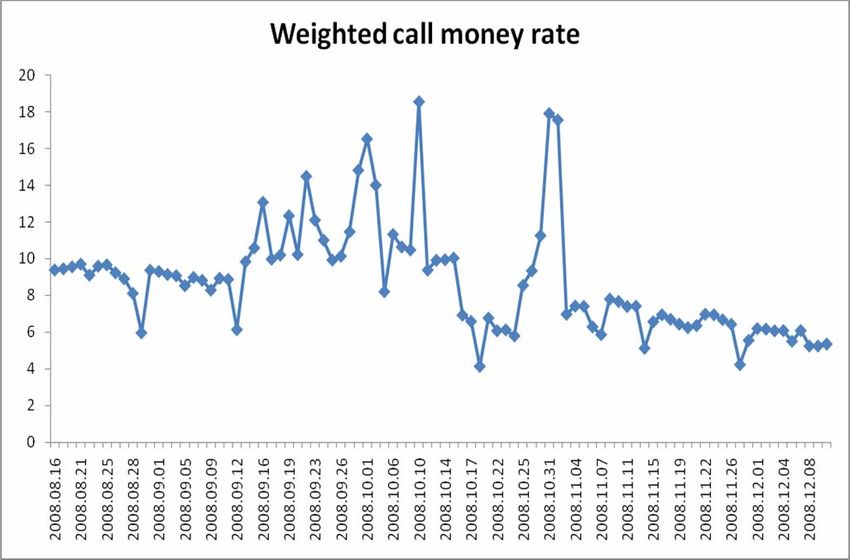
By mid-September 2008, the crisis gripped India’s money market (Stage 4). The drying
up of funds in the foreign credit markets led to a virtual cessation of external commercial
borrowing for India including the access to short-term trade finance. The collapse of
stock market ruled out the possibility of companies raising funds from the domestic stock
market. Indian banks also lost access to funds from abroad, as inter-bank borrowing
seized up in the US and Europe. And, instead, banks had to send funds to their branches
abroad in those countries. All these put heavy pressure on domestic banks leading to a
liquidity crisis from mid-September to end-October 2008 and this was reflected in the
inter-bank call money markets where the call money rates rose to 20 per cent or so (Chart
5).
Chart 5: Liquidity Crisis
Source: Reserve Bank of India.
7The current account of India’s balance of payments had shown strong growth in the first
half of 2008-09: merchandise exports grew by 35 per cent, imports by 45 per cent (Table
1 above), software exports by 38 per cent, and private transfers (remittances) by 41 per
cent (Table 2). In the second half of 2008-09, these dramatically changed: merchandise
exports declined by 18 per cent, imports by 11 per cent. The growth in software exports
dropped to less than 4 per cent and remittances declined in absolute terms by about 20 per
cent in the second half of 2008-09. Thus the impact of the global crisis manifested itself
in the real sector through the collapse of India’s trade sector (Stage 5).
Table 2: Net Invisible Earnings: 2008-09
US$ Million % Change (Y-O-Y)
1st Half 2nd Half 1st Half 2nd Half
Travel 422 1040 10.2 -39.3
Transport -1497 -214 -43.8 53.4
Insurance 183 95 -25.3 -72.9
Government not included elsewhere 6 -408 107.9 -1460.0
Miscellaneous 26561 23630 43.9 31.6
-Software 22595 21591 37.7 3.6
-Non-software 3966 2039 93.0 170.9
Transfers 24543 19736 40.3 -19.3
-Private 24548 19499 40.6 -19.6
-Official -5 237 -114.7 15.6
Income -1648 -2863 48.8 -68.5
-Invest Income -1431 -2586 50.9 -89.3
-Labour income -217 -277 28.4 16.8
Total 48570 41016 50.6 -3.1
Source: Reserve Bank of India.
Going back to the financial sector, domestic banks responded to the sudden loss of
different avenues of funds for the Indian commercial sector and increased their lending
during the period of “credit crunch”. In September and October 2008, bank finance (non-
food credit and investments in shares, bonds, debentures, commercial paper, etc.)
expanded more than the previous year partly compensating for the drying up of funds
from other sources (Chart 6).
In the next stage (Stage 6), the crisis spread to the domestic credit markets. The real
economy deteriorated from September 2008 shown first by the sharp fall in export
growth to 10 per cent in that month from about 35 per cent during April-August 2008,
and negative growth thereafter; virtually negligible or negative growth in industrial
output from October 2008; and negative growth in central tax revenue collection also
from October 2008. Business and consumer confidence began to ebb leading to a decline
in overall demand. By November 2008, the situation had fundamentally transformed.
Expansion of bank finance to the commercial sector slumped to Rs. 609 billion during the
four-month period, November 2008 to February 2009, just about a quarter in comparison
with the expansion of Rs. 2,362 billion during the same period a year ago (Chart 6). This
8is primarily due to a sharp fall in demand for funds as investment and consumption
dropped. This is also partly due to banks becoming extremely risk averse with the
perception of default rising considerably.
Chart 6: From Credit Crunch to Drop in Credit Demand
Expansion of Bank Finance to Com m ercial Sector (Rs billion)
1500
1000
500
0
Apr May Jun Jul Aug Sep Oct Nov Dec Jan Feb Mar
-500
-1000
2007-08 2008-09 2009-10
Source: Reserve Bank of India.
3. Policy Response
The major policy response to the crisis came in the form of loosening of the monetary
policy and administering fiscal stimulus packages. There were a few other measures like
relaxation of external commercial borrowing rules, raising the cap of FII investment in
debt and permission given to India Infrastructure Financing Company Limited (IIFCL) in
floating tax-free bonds for infrastructure funding, etc.
3.1 Monetary Measures
Monetary policy remained in the tightening mode till end-August 2009. In mid-
September the central bank started relaxing liquidity but no cuts were made yet in policy
rates. Inflation measured in terms of wholesale price index (WPI) peaked at 12.9 per cent
in early August 2008 and remained high for some time. From mid-September to till end-
October 2008 the economy was in the grip of a serious liquidity crisis and credit crunch
as detailed earlier. The Reserve Bank of India (RBI) acted aggressively from mid-
October to ease the situation by a series of rate cutting and liquidity injecting measures
till April 2009.
Through successive steps, the RBI brought down cash reserve ratio (CRR) from 9 to 5
per cent, statutory liquidity ratio (SLR) from 25 to 24 per cent, the repo rate from 9 to
4.75 per cent and reverse repo rate from 6 to 3.25 per cent (Chart 7).
9Chart 7: Monetary Policy Rate Changes
M a jo r P o lic y R a t e s
R e v e rs e re p o ra t e R e p o ra te C a s h R e s e r v e R a t io
11 11
10 10
9 9
8 8
7 7
6 6
5 5
4 4
3 3
Aug 4,07
Aug 30,08
Jun 25,08
Jul 19,08
Apr 14,07
Apr 26,08
May 24,08
Nov 3,08
Dec 8,08
Jan 17,09
Apr 21,09
Oct 20,08
Source: Reserve Bank of India.
The RBI opened a special window for banks to lend to mutual funds, non-banking
financial companies (NBFCs) and housing finance companies. The central bank also
opened refinance facilities for banks, the Small Industrial Development Bank of India
(SIDBI), the National Housing Bank (NHB), and the EXIM Bank. The RBI also
introduced a liquidity facility for NBFCs through a special purpose vehicle (SPV), and
increased export credit refinance. The actual/ potential release of primary liquidity by the
central bank since mid-September 2008 has been massive at about Rs. 5617 billion
amounting to about 9.5 per cent of GDP (Table 3). The RBI also made dollar swap
arrangements for branches of Indian banks in the US and Europe facing shortage of dollar
funds with the seizing up of the inter-bank markets there.
Table 3: Actual/Potential Release of Primary Liquidity since Mid-September 2008
(Rs. billion)
1 Cash Reserve Ratio (CRR) Reduction 1,600
2 Open Market Operations 801
3 MSS Unwinding /Buyback/ De-sequestering 1,555
4 Term Repo Facility (14 days) 600
7 Increase in Export Credit Refinance 266
6 Special Refinance Facility for SCBs (Non-RRBs) 385
7 Refinance Facility for SIDBI/NHB/EXIM Bank 160
8 Liquidity Facility for NBFCs through SPV 250
Total (1 to 8) 5,617
Memo: Statutory Liquidity Ratio (SLR) Reduction 400
Source: Reserve Bank of India.
103.2 Fiscal Stimulus Packages
The central government announced three successive fiscal stimulus packages one in early
December 2008, the second one in early 2009 and the last one in early March 2009.
These included: across-the-board central excise duty reduction by 4 percentage points;
additional plan spending of Rs. 200 billion; additional borrowing by state governments of
Rs. 300 billion for plan expenditure; assistance to certain export industries in the form of
interest subsidy on export finance, refund of excise duties/central sales tax, and other
export incentives; and a 2 percentage-point reduction in central excise and service tax.
The total fiscal burden for these packages amounted to 1.8 per cent of GDP.
The central budget 2008-09 announced in February 2008 showed a low fiscal deficit of
2.5 per cent of GDP. But the actual deficit turned out to be much higher due to salary
hike for the government staff, debt waiver scheme for farmers, additional expenditure on
rural employment scheme, duty reductions for petroleum products and revenue shortfalls
due to slowdown in the economy. There were off-budget items like the issue of oil bonds
and fertilizer bonds which are to be added to give a true picture of fiscal deficit. The
combined fiscal deficit of the centre and states including the off-budget bonds is now
estimated to cross 11 per cent of GDP for 2008-09, a huge rise from 2007-08 at about 5
per cent of GDP. Therefore, the total fiscal stimulus administered by India can be put at 6
per cent of GDP! Based on the budget presented in July 2009, the total fiscal deficit
would remain at 11 per cent of GDP for 2009-10 as well.
4. Impact on the Economy
The growth in GDP moved down to 5.8 per cent (year-on-year) during the second half of
2008-09 from 7.8 per cent in the first half. This can be attributed partly to the decline in
private consumption growth to just 2.5 per cent in the second half from and an already
low growth of 3.3 per cent in the first half and an average consumption growth of 8.5 per
cent in the whole of 2007-08 (Chart 8). Also, the growth in fixed investment declined to
5.7 per cent in the second half of 2008-09 from 10.9 per cent in the first half and an
average of 12.9 per cent in 2007-08. The government consumption growth, on the other
hand, rose steeply at 35.9 percent from just 0.9 per cent in the first half and 7.4 per cent
in 2007-08 (Chart 9). The sharp rise in government consumption growth cushioned the
sharp drop in aggregate demand and prevented a much sharper fall in GDP growth in the
second half of 2008-09.
11Chart 8: De mand Growth, 2004-05 to 2008-09
25.0
20.0
15.0
10.0
5.0
0.0
Q1 Q2 Q3 Q4 Q1 Q2 Q3 Q4 Q1 Q2 Q3 Q4 Q1 Q2 Q3 Q4 Q1 Q2 Q3 Q4
2004-05 2005-06 2006-07 2007-08 2008-09
Private f inal consumption expenditure Gross f ixed capital f ormation
Chart 9: Growth in Government Consumption Expenditure, 2004-05 to 2008-09
70.0
60.0
50.0
40.0
30.0
20.0
10.0
0.0
Q1 Q2 Q3 Q4 Q1 Q2 Q3 Q4 Q1 Q2 Q3 Q4 Q1 Q2 Q3 Q4 Q1 Q2 Q3 Q4
-10.0
2004-05 2005-06 2006-07 2007-08 2008-09
-20.0
Source: Central Statistical Organization.
5. Growth Prospects, 2009-10
India’s GDP growth came down to 6.7 per cent in 2008-09 from 9 per cent in the
previous year. This drop in growth is the combined effect of monetary tightening till end-
August 2008, high inflation (induced by the hike in world commodity prices) and the
global crisis. The fiscal expansion in the second half of financial year provided some
support and mitigated the contractionary impact of the other factors. The monetary
easing in the second half of the year appeared to be too early to have any impact till the
end of 2008-09.
5.1 Signs of Recovery
The current year, 2009-10 has shown some signs of recovery. Industrial output which
virtually stagnated in the second half of 2008-09 has shown positive growth of 3.7 per
cent in the first quarter of 2009-10. The group of six core industries consisting of power,
coal, steel, cement, crude oil and refinery products has improved with its composite index
growing at 4.8 per cent in the first quarter of 2009-10. The purchasing managers’ index
(PMI) has been above 50 (showing expansionary conditions) in the last few months.
There has been a strong recovery of the stock market and a substantial rise in capital
12market mobilization from March 2009 onward. The Reserve Bank of India’s “business
expectations index” for July-September 2009 has crossed the neutral 100-mark. Also,
corporate profits have recovered strongly in the last quarter of 2008-09 and the first
quarter of 2009-10 with their growth at 15 per cent and 17.5 per cent respectively in
contrast to sharp declines in the previous two quarters.
5.2 Some Strong Negative Signals
The sharp drop in exports and imports has continued at an average annual rate of 29 per
cent and 35 per cent respectively during April-July 2009. Sales of commercial vehicles
have declined at an average annual rate of 16 per cent during April-June 2009. Central
government net tax revenue receipts have fallen by about 19 per cent per annuam in the
first quarter of 2009-10 (Table 4).
Table 4: Growth in Selected Economic Indicators (% Change, Y-O-Y)
2007-08 Apr- Sep- Oct- Nov- Dec- Jan- Feb- Mar- Apr- May- Jun-
(Apr-Mar) Aug 08 08 08 08 08 09 09 09 09 09 09
Industry 8.5 4.8 6.0 0.1 2.5 -0.2 1.0 0.2 -0.8 1.2 2.2 7.8
-Core industry 5.9 3.6 4.0 2.1 1.9 1.1 1.8 1.4 3.2 5.0 2.8 6.5
-Capital goods 18.0 8.3 20.8 4.2 0.5 6.6 15.9 11.8 -8.4 -7.3 -3.4 11.8
Exports 29.1 35.1 10.4 -12.1 -9.9 -1.1 -15.9 -21.7 -33.3 -33.2 -29.2 -27.7
Imports 35.5 37.7 43.3 10.6 6.1 8.8 -18.2 -23.3 -34.0 -36.6 -39.2 -29.3
-Non-oil imports 33.7 28.2 36.2 5.5 3.4 31.9 -0.5 -10.2 -18.9 -24.6 -25.4 -16.5
Railway freight traffic 9.1 8.6 8.2 -0.1 1.3 3.0 2.9 -0.9 4.1 3.1 2.4 9.6
Major ports traffic 11.9 8.7 1.1 -5.7 -4.6 0.0 -0.4 -5.2 -3.2 -1.7 -1.6 8.1
Commercial vehicle
sales 6.2 3.9 -0.6 -34.9 -48.0 -58.2 -52.3 -34.4 -30.2 -13.0 -18.9 -15.1
Airport passenger
traffic 21.2 -0.8 -14.0 -7.7 -13.6 -12.6 -11.0 -7.3 -11.8 -10.7 -3.7
Central govt. net tax
revenue 25.2 26.2 25.6 -13.5 -15.5 -25.5 -31.1 -4.1 4.8 -31.9 -11.0 -13.1
Capital raised in
primary mkt. 45.1 -54.3 13.1 -74.6 3.0 -17.9 -48.3 -70.0 8.5 12.8 199.4 53.8
2007-08 Q3 Q4 Q1 Q2 Q3 Q4 Q1
(Apr-Mar) 07-08 07-08 08-09 08-09 08-09 08-09 09-10
Real GDP 9.0 9.3 8.6 7.8 7.7 5.8 5.8
Corporate sales 17.7 25.9 36.9 35.8 13.1 -0.4 -6.3
Corporate profit 22.1 9.4 4.1 -26.3 -29.2 14.6 17.5
(3234 companies)
Source: Economic Survey 2008-09, CSO, Ministry of Commerce, Controller General of Accounts & CMIE.
There is little evidence of a pick up in demand in the economy. While bank deposit
growth remain high and rising, bank credit growth has been falling sharply (Table 5).
13Table 5: Growth in Deposits and Credit by Bank Group
(Annual Y-O-Y Growth as of July)
Bank Group 1-Aug-08 31-Jul-09
Deposits
Public sector banks 23.1* 26.4**
Private sector banks 17.4* 6.7**
Foreign banks 20.9* 16.4**
All scheduled commercial banks 20.6 21.8
Credit
Public sector banks 26.3* 21.9**
Private sector banks 22.3* 4.2**
Foreign banks 33.3* -7.1**
All scheduled commercial banks 25.6 15.8
* As on 4 Jul 2008; ** As on 3 Jul 2009.
Source: Reserve Bank of India.
While profit growth of the corporate sector had been good in the last two quarters, that
did not reflect healthy sales growth. Companies had been able to show high profit growth
as input and interest costs have fallen and there had been a rise in treasury incomes and
asset sales. Growth in corporate sales turned negative in the last quarter of 2008-09 and
increasingly so in the first quarter of 2009-10, indicating the persistence of low demand.
Further more, new investment announcements had fallen substantially during the first
quarter of 2009-10 to less than a fourth of average in the previous four quarters (CMIE,
2009).
The central government budget for 2009-10 appeared to be expansionary. However, it
projected an expenditure growth of only 13 per cent in 2009-10 as against 33 per cent in
2008-09. Revenue growth is projected at a higher rate of 9 per cent compared to the
previous year’s revenue growth of less than 4 per cent (Table 6). Therefore, it is more
appropriate to say that there has not been much extra fiscal stimulus in 2009-10.
14Table 6: Central Government Budget 2009-10 (Rs. Billion)
2007-08 2008-09 2009-10 %Change %Change
(Actuals) (RE) (BE) 3 over 2 4 over 3
1 2 3 4 5 6
1. Revenue Receipts (3+4) 5419 5622 6145 3.7 9.3
2. Gross Tax Revenue 5931 6279 6411 5.9 2.1
Corporation tax 1929 2220 2567 15.1 15.6
Income tax 1026 1226 1128 19.4 -8.0
Customs 1041 1080 980 3.7 -9.3
Excise duties 1236 1084 1065 -12.3 -1.7
Service tax 513 650 650 26.7 0.0
3. Net Tax Revenue (Net of States' Share) 4395 4660 4742 6.0 1.8
4. Non-Tax revenue 1023 962 1403 -6.0 45.8
5. Recoveries of Loans 51 97 42 90.2 -56.4
6. Other Receipts* 33 26 11 -21.4 -56.4
7. Total Expenditure* 6772 9010 10208 33.0 13.3
8. Revenue Expenditure 5944 8034 8972 35.1 11.7
Of which: Interest payments 1710 1927 2255 12.7 17.0
9. Capital Expenditure* 827 975 1236 17.9 26.8
526 2413 2827
10. Revenue Deficit (8-1) (1.1) (4.6) (4.8) 318.2 4.3
1269 3265 4010
11. Fiscal Deficit [7- (1+5+6)] (2.7) (6.2) (6.8) 129.6 9.7
*Excludes transactions related RBI transfer of State Bank of India to central government in 2007-08 (Rs. 355 billion) which is
deficit neutral as equivalent amounts are shown on both receipts and expenditure sides.
Note: Figures in brackets are per cent to GDP.
Source: Budget Documents, Ministry of Finance.
This year the progress of monsoon from June to mid-August 2009 indicates an all-India
rain deficiency of over 25 per cent and a decline in the area sown for the summer crop at
about 22 per cent. The direct impact of the crop failure on the GDP growth in 2009-10
could be anything between 0.5 and 1.5 percentage point. Taking the mid-point for the
impact of the poor monsoon, the GDP growth for the current year could be a lot lower
than last year, at about 5 per cent.
6. Policy Suggestions for Recovery
India’s GDP growth rate had dropped from 9 per cent in 2007-08 to 6.7 per cent in 2008-
09 and the global crisis has been one of the factors behind this growth slowdown. The
growth is estimated to drop further to 5 per cent in 2009-10 due to the continued impact
of global crisis and a crop failure. Huge fiscal deficits and rising public debt are likely to
hamper recovery prospects by putting an upward pressure on interest rates. Monetary
easing measures are yet to show results. Lending rates have not fallen much for so many
reasons including the high lending risk premium. No further monetary easing is not
expected as inflation is rising rapidly in the context of the failure of the monsoon.
The global economy while showing some signs of leveling off is not expected to recover
strongly anytime soon. A vigorous recovery is predicated on the unwinding of the severe
imbalances among deficit and surplus countries and the repair of the broken financial
15system of developed countries (Blanchard, 2009). Those may take years and India may
not able to return to the 9 per cent growth path on the back of a global recovery.
Nevertheless, the Indian economy can recover fast if can get a big boost in domestic
business and consumer sentiments which are badly shaken by the global crisis. This is
very well possible by undertaking structural and procedural reforms as has happened in
the early 1990s. Indian economy recovered swiftly after it was hit by the severe external
payments crisis in 1991-92 leading to a collapse in its growth rate. Then a series of
structural reform measures were undertaken by the central government which raised
India’s potential growth rate to about 7-8 per cent. There has been a talk about the
“second-generation reforms” that are considered necessary to raise India’s potential
growth rate further to 9-10 per cent.
There are broadly five areas in which fresh reforms are needed:
1. Infrastructure
2. Education
3. Agriculture
4. Investment climate
5. Delivery of public services
The first item in the reform agenda is to organize massive investments in social and
physical infrastructure. It is well known that infrastructure is a key binding constraint for
India’s growth and the government should press hard in changing policies and procedures
to incentivise the private sector to build world class infrastructure in the power, roads,
ports, airports, urban infrastructure, water and sanitation sectors. Public-private
partnerships have been rightly identified as the way forward but the speed and efficiency
of formulation, approval and implementation of projects have to be stepped up
considerably.
Next is the reform of the education system at both school and university levels aimed at
improving both access and quality. This sector requires radical reforms to eliminate
barriers to entry and to create autonomy for curriculum modernization; it should be given
flexibility in fixing salaries and fees structure and enabled to establish multiple and
independent accreditation agencies as well as creation of conducive conditions for
foreign and domestic investment, etc.
The third is to carry out reforms in the long-neglected agricultural sector. This has to be
through a “root and branch” method at all stages, from input to output to marketing. A
sensible approach is to end the open-ended farm subsidy system and to confine fertilizer,
water and power subsidies to only marginal and small farmers owning up to 2 hectares of
land.
Fourth is further regulatory reform. While the “license-control raj” has been significantly
eroded as a result of reforms in the 1990s, there still remain significant obstacles to doing
business in India. As shown by World Bank surveys on ‘doing business’, India ranks very
low among countries on regulatory environment with regard to enforcement of contracts,
16payment of taxes, business closure, licensing, and property registration and in setting up a
business. The government should substantially relax its “permit and approval” system by
carrying out procedural reforms. The removal of regulatory constraints will substantially
improve investment climate.
Fifth is reform in the quality of delivery of public services like education, health, poverty
alleviation and employment generation. The government should empower the actual
beneficiaries with direct transfer of money through cash vouchers and smart cards which
could, on the one hand, plug leakages and, on the other, improve service delivery by not
hindering the competitive market-based production system.
References
Blanchard, Olivier (2009), “Sustaining a Global Recovery”, Finance & Development,
September, International Monetary Fund, Washington D.C.
Calvo, Guillermo (1998), “Capital Flows and Capital-market Crises: The Simple
Economics of Sudden Stops”, Journal of Applied Economics 1(1), pp 35-54.
Calvo, Guillermo (2009), “Lessons from Systemic Financial Crises”, presentation at
India Policy Forum 2009, New Delhi, July 14-15.
Dornbusch, R., Goldfajn, I., Valdes, R. (1995), “Currency Crises and Collapses”,
Brooking Papers on Economic Activity 2, pp 219-293.
Dornbusch, Rudi (2001), “A Primer on Emerging Market Crises”, NBER Working Paper
8326, June, Cambridge, MA.
CMIE (2009), “Monthly Review of the Indian Economy”, Economic Intelligence, CMIE,
July, pp 80-81.
World Bank (2008), World Development Indicators 2008.
17You can also read


