Guidelines on the implementation of 2D data Matrix Barcode for Pharmaceuticals in Lebanon - Edited by Mrs. Lina Abou Mrad Mrs. Christelle Fransawi ...
←
→
Page content transcription
If your browser does not render page correctly, please read the page content below
Guidelines on the implementation of
    2D data Matrix Barcode for
    Pharmaceuticals in Lebanon

          Edited by Mrs. Lina Abou Mrad

  Mrs. Christelle Fransawi & Mrs. Stephanie Rached

                  Edition 1 – 2020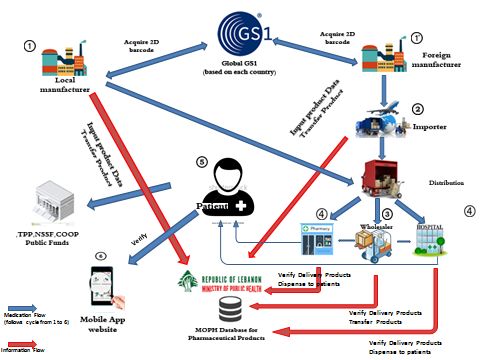
3/20

Table of Contents
Introduction ................................................................................................................................................... 4
Glossary ........................................................................................................................................................ 6
Abbreviations ................................................................................................................................................ 9
1.     Organization and personnel ................................................................................................................ 10
2.     Documentation .................................................................................................................................... 11
3.     Repackaging and relabeling ................................................................................................................ 12
4.     Complaints .......................................................................................................................................... 13
5.     Contract activities ............................................................................................................................... 14
6.     2D barcode implementation ................................................................................................................ 15
References

  Guidelines on the Implementation of the National Bar Code System for Pharmaceuticals in Lebanon – Edition 1 – 2020
4/20

                                                Introduction

With continuing and increasing pressure to reduce healthcare costs and improve patient safety,
there is a perpetual need to identify and refine how proven technologies are used to increase the
efficiency of supply chain procurement, replenishment and logistics processes and enhance the
quality of patient care.

The objective of these guidelines is to ensure safety and quality of pharmaceutical products on
the Lebanese market. It sets out appropriate steps to assist in fulfilling the responsibilities of all
stakeholders to provide a track and trace tool that will help build an integrated people centered
system that promotes and sustains the health status of the Lebanese community.

The Lebanese Ministry of Public Health issues these guidelines, according to the international
guidelines of the GS1. The ministry stresses the importance of adhering to it by all parties
involved, as relevant to the particular role that they play, believing that the bar-coding
technology adds an extra level of patient safety to the medication administration process,
reducing medication errors and making the technology increasingly more popular in hospitals
and health systems.

 Guidelines on the Implementation of the National Bar Code System for Pharmaceuticals in Lebanon – Edition 1 – 2020
5/20 Guidelines on the Implementation of the National Bar Code System for Pharmaceuticals in Lebanon – Edition 1 – 2020
6/20

                                                   Glossary

The definitions provided below apply to the words and sentences used on these guidelines:

2-dimensional symbology
Optically readable symbols that must be examined both vertically and horizontally to read the
entire message. Two-dimensional symbols may be one of two types: matrix symbols and multi-
row symbols. Two-dimensional symbols have error detection and may include error correction
features. [1]

Acceptance criteria
An allowance for a small measurement variation between commercial verifiers or operators
during barcode verification testing. [1]

Barcode
A symbol that encodes data into a machine-readable pattern of adjacent, varying width, parallel,
rectangular dark bars and pale spaces. [1]

Barcode verification
The assessment of the printed quality of a barcode based on ISO/IEC standards using ISO/IEC
compliant barcode verifiers. [1]

Batch - lot
The batch or lot number associates an item with information the manufacturer considers relevant
for traceability of the trade item. The data may refer to the trade item itself or to items contained
in it. [1]

Code
a. A character string used as an abbreviated means of recording or identifying information.
b. To represent or identify information using a specific symbolic form that can be recognized by
a computer. [1]

Counterfeit pharmaceutical product
A pharmaceutical product deliberately and fraudulently mislabeled, with respect to identity
and/or source. Counterfeiting can apply to both branded and generic products, and counterfeit
pharmaceutical products may include products with the correct ingredients, with the wrong
ingredients, without active ingredients, with an incorrect quantity of active ingredient or with
fake packaging. [2]

Data
A representation of facts, concepts or instructions in a formalised manner suitable for
communication, interpretation or processing by human beings or by automatic means. [1]

 Guidelines on the Implementation of the National Bar Code System for Pharmaceuticals in Lebanon – Edition 1 – 2020
7/20 End user An organization that employs the GS1 system as a part of its business operations. [1] Expiry date The date given on the individual container (usually on the label) of a pharmaceutical product up to and including the date on which the product is expected to remain within specifications, if stored correctly. It is established for each batch by adding the shelf-life to the date of manufacture. [2] GS1 Based in Brussels, Belgium, and Princeton, USA, it is the organization that manages the GS1 system. Its members are GS1 Member Organizations. GS1 Application Identifier The field of two or more digits at the beginning of an element string that uniquely defines its format and meaning. [1] GS1 System The specifications, standards, and guidelines administered by GS1. [1] GTIN-14 The 14-digit GS1 identification key composed of an indicator digit (1-9), GS1 Company Prefix, item reference, and check digit used to identify trade items. [1] Healthcare provider An organization or facility that delivers healthcare to a subject of care. Corresponds to “care delivery organization”, “healthcare organization”, etc. [1] MediTrack Track & Trace software developed by MOPH to store the flow of information and track the pharmaceutical products within the supply chain using 2D Matrix barcode for unique identification. Pharmaceutical product Any product intended for human use, or veterinary product intended for administration to food- producing animals, presented in its finished dosage form, which is subject to control by pharmaceutical legislation in either the exporting or the importing state and includes products for which a prescription is required, products that may be sold to patients without a prescription, biologicals and vaccines. It does not, however, include medical devices. [2] Guidelines on the Implementation of the National Bar Code System for Pharmaceuticals in Lebanon – Edition 1 – 2020
8/20

Product recall
A process for withdrawing or removing a pharmaceutical product from the pharmaceutical
distribution chain because of defects in the product, complaints of serious adverse reactions to
the product and/or concerns that the product is or may be counterfeit. The recall might be
initiated by the manufacturer, importer, wholesaler, distributor or a responsible agency. [2]

Quality system
An appropriate infrastructure encompassing the organizational structure, procedures, processes
and resources and systematic actions necessary to ensure adequate confidence that a product (or
services) will satisfy given requirements for quality. [2]

Standard operating procedure (SOP)
An authorized, written procedure giving instructions for performing operations not necessarily
specific to a given product but of a more general nature (e.g. equipment operation, maintenance
and cleaning, validation, cleaning of premises and environmental control, sampling and
inspection). [2]

Quality
The degree to which a set of inherent characteristics fulfills requirements. [3]

Continuous improvement
The recurring activity to increase the ability to fulfill requirements. [3]

Corrective actions
Action to eliminate the cause of a detected nonconformity or other undesirable situation. [3]

Preventive actions
Action to eliminate the cause of a potential nonconformity or other undesirable potential
situation. [3]

 Guidelines on the Implementation of the National Bar Code System for Pharmaceuticals in Lebanon – Edition 1 – 2020
9/20

                                               Abbreviations

2D: Two Dimensional

AI: Application Identifier

GTIN: Global Trade Item Number

MOPH: Ministry of Public Health

E: Execute

 Guidelines on the Implementation of the National Bar Code System for Pharmaceuticals in Lebanon – Edition 1 – 2020
10/20
1. Organization and personnel
1.1 There shall be an adequate organizational structure, defined with the aid of an organizational
chart that clearly identifies responsibilities, authorities and interrelationships of all personnel.
[2]
1.2 Duties and responsibilities shall be clearly defined and understood through documented job
descriptions, specifically those involved in the barcoding system. They shall be trained on
their respective duties and responsibilities and shall be aware of the relevance and
importance of their activities and how they contribute to the achievement of the warehouse
quality objectives and policy. [2] [3]
1.3 A designated competent pharmacist, who has defined authority and responsibility, shall be
appointed within the organization, for ensuring the proper implementation and maintenance
of the barcoding system. He shall be accountable on reporting to top management on the
performance of the system and any need for improvement. [1] [2] [4]
1.4 There must be a sufficient number of personnel able to fulfill all the system’s requirements.
Personnel training shall be based on written standard operating procedures in accordance
with a written training program and they shall be assessed as applicable to evaluate the
effectiveness of the actions taken. Appropriate records shall be maintained, including details
of subjects covered and participants trained. Delivered trainings shall cover the topic of bar
coding, product security, as well as aspects of product identification. [1] [2] [3]
1.5 There shall be arrangements in place to ensure that management and involved personnel are
not subject to commercial, political, financial and other pressures or conflict of interest that
may have an adverse effect on the quality of service provided or on the integrity of
pharmaceutical products. [2]
Guidelines on the Implementation of the National Bar Code System for Pharmaceuticals in Lebanon – Edition 1 – 202011/20
2. Documentation
2.1 The organization shall establish appropriate documented procedures and instructions related
to all barcoding system. [3]
2.2 The title, nature and purpose of each document shall be clearly stated. The contents of
documents shall be clear and unambiguous. Documents shall be laid out in an orderly fashion
and be easy to check. [3]
2.3 All documents shall be completed, approved, signed (as required) and dated by an
appropriate authorized person(s) and shall not be changed without the necessary
authorization. [3]
2.4 Procedures shall be established and maintained for the editing, review, approval, use of and
control of changes to all documents relating to the distribution and storage activities.
Procedures must be in place for both internally generated documents and those from external
sources. [3]
2.5 The organization shall keep records of all barcoding related information and shall ensure
appropriate backup systems. The server room shall also be appropriated maintained to
prevent any data loss [3]
Guidelines on the Implementation of the National Bar Code System for Pharmaceuticals in Lebanon – Edition 1 – 202012/20
3. Repackaging and relabeling
3.1 Repackaging and relabeling of pharmaceutical products shall not be allowed, as these
practices may represent a risk to the safety and security of the supply chain.
Guidelines on the Implementation of the National Bar Code System for Pharmaceuticals in Lebanon – Edition 1 – 202013/20
4. Complaints
4.1 There shall be a written procedure in place for the handling of complaints specifically those
related to the barcoding of the product. [3]
4.2 Appropriate follow-up action shall be taken after investigation and evaluation of the
complaint. There shall be a system in place to ensure that the complaint, the response
received from the original product manufacturer, or the results of the investigation of the
complaint, are shared with all the relevant parties. [1] [3]
Guidelines on the Implementation of the National Bar Code System for Pharmaceuticals in Lebanon – Edition 1 – 202014/20
5. Contract activities
5.1 Any activity relating to the barcoding of pharmaceutical products, which is delegated to
another entity, shall be performed by parties appropriately authorized for that function and in
accordance with the terms of a written contract. [3]
5.2 The contract shall define the responsibilities of each party. It shall also include
responsibilities of the contractor to provide adequate training for involved personnel to avoid
the entry of counterfeit pharmaceutical products into the distribution chain. [3]
5.3 All contract accepters shall comply with the requirements of these guidelines and shall be
audited periodically. Proof of audits shall be maintained. [3]
Guidelines on the Implementation of the National Bar Code System for Pharmaceuticals in Lebanon – Edition 1 – 202015/20
--
6. 2D matrix barcode implementation
6.1 The organization shall ensure that all pharmaceutical products, whether imported or locally
manufactured have a 2D barcode according to GS1 standards on their secondary packaging.
[5]
The 2D barcode is a square or rectangular shaped barcode containing many small dots and
can hold a large amount of information and remain legible even when printed in a small size.
This barcode holds a GTIN, a lot number and an expiry date. [4]
6.2 The organization shall be using the 14-digit GTIN format that is unique for each product. The
14 digits indicate the packaging level, the GS1 company prefix and the item reference.
The GS1 AI for GTIN is 01.
The format of the expiration date will be as follows: YYMMDD. The GS1 application
identifier for expiration date is 17.
The lot number is up to 20 alphanumeric characters. The application identifier for lot number
is 10. [4]
Application Identifier GTIN
01 0 9501101 53000 3
Application Identifier Expiry Date
17 14 07 04
Application Identifier Batch/Lot Number
10 AB-123
Application Identifier Serial Number
21 X1 X20
6.3 The 2D matrix barcode implementation follows the below process:
6.3.1 The organization importing or manufacturing pharmaceutical products submits by
email to drugsbarcode@moph.gov.lb all pharmaceutical products related GTIN as per the
below format [6]:
MoH Registration Brand
GTIN Strength Presentation Form Agent Manufacturer Country
Code # Name
Pharmaceutical products exempted from the 2D barcode are uniquely the free medical
samples and the IV fluids.
Guidelines on the Implementation of the National Bar Code System for Pharmaceuticals in Lebanon – Edition 1 – 202016/20
--
6.3.2 MOPH E-health department transfers received data to MediTrack Database, the
platform for national barcode system for pharmaceuticals.
6.3.3MOPH E-health department generates a username and a password, which are
automatically submitted to concerned organization importing or manufacturing
pharmaceutical products.
6.3.4 The organization importing or manufacturing pharmaceutical products has the
possibility to:
A. Access MOPH MediTrack system and perform required work online
B. Upload required drugs data to MediTrack system using an excel file
C. Perform integration with MediTrack system using specific API
A- Access MOPH MediTrack system and perform required work online
i. The organization importing or manufacturing pharmaceutical products in
addition to all recipients of pharmaceutical products shall equip its facility
with a continuously backed up computer, 2D barcode reader and an internet
connection. The barcode reader shall be subject to needed configuration in
order to properly function. [3] [4] [7]
ii. The assigned responsible at the organization importing or manufacturing
pharmaceutical products shall access MOPH database and shall work in real
time over MediTrack platform on http://meditrack.moph.gov.lb/moph
iii. The assigned responsible shall scan the products barcode on MediTrack.
iv. The assigned responsible shall complete manually the quantity section noting
that upon scanning all other sections will be filled automatically.
v. Upon distribution, the assigned responsible shall access the platform under
Market Movement Section, select destination, insert related information and
scan the barcode of the pharmaceutical product, specifying the quantity out.
vi. The assigned responsible shall save the entries performed and close the page.
vii. In case of any discrepancy, the assigned responsible shall use the section
adjustment movements to adjust any data entry error.
B- Upload required drugs data to MediTrack system using an excel file
Guidelines on the Implementation of the National Bar Code System for Pharmaceuticals in Lebanon – Edition 1 – 202017/20
--
i. The assigned responsible at the organization importing or manufacturing
pharmaceutical products shall upload an excel file based on the template as
specified in the help Menu in the Movements Upload file specific to each
organization type.
ii. In case of any discrepancy, the assigned responsible is notified automatically
to adjust any data entry error.
C- Perform integration with MediTrack system using specific API.
i. The organization importing or manufacturing pharmaceutical products shall
perform systems integration between its own system and MediTrack system
following the API compliance guideline specified in the help Menu and
specific to each organization type.
6.4 All the recipients of pharmaceutical products shall access the platform, scan the received
products and update the database accordingly.
6.5 The organization importing or manufacturing pharmaceutical products shall ensure clear
print out of expiry date on the outer package of the pharmaceutical product in a clear way
showing MM(Mon)YYYY or MM(Mon).YYYY or MM(Mon)/YYYY or MM(Mon)-
YYYY. [8]
6.6 The printed GTIN must be preceded by one of the following: (01), GTIN, PC, or CIP, printed
expiry preceded by (17) or Expiry date, and Lot/batch preceded by (10) or lot or batch
6.7 The organization shall ensure that the printed information (GTIN, Expiry date, Lot/Batch
number) is human readable.
Guidelines on the Implementation of the National Bar Code System for Pharmaceuticals in Lebanon – Edition 1 – 202018/20
--
Figure 1 Implementation Workflow
Guidelines on the Implementation of the National Bar Code System for Pharmaceuticals in Lebanon – Edition 1 – 202019/20
--
Associated Documents
Responsibilities
/ Resources
Flowchart details of IMP & MOPH
The 2D matrix barcode implementation IMP & MANU E-
MANU RESP health
START
By email
E drugsbarcode@moph.gov.lb
1.Submit by email to drugsbarcode@moph.gov.lb all pharmaceutical products
related GTIN as per the format
MediTrack
2.Transfer received data on MediTrack E
3.Generate a user and a password, which are automatically submitted to
concerned organization importing or manufacturing pharmaceutical products. E
4.1.Access MOPH database and 4.2.Access MOPH database and
perform required work online upload related excel sheet
4.3.Perform systems integration
E E
4.1.1.Equip its facility with a 4.2.1.Access MOPH database and 4.3.1.Perform needed systems
continuously backed up computer, upload an excel file with the integration in accordance with the
2D barcode reader and an internet structure as specified in the help compliance guideline issued by the E MediTrack
connection. section on the section Movements e-health department.
Upload.
4.1.2.Access MOPH database and
work live over MediTrack platform.
4.2.2.Adjust any data entry error.
E MediTrack
4.1.3.Scan the products barcode on
MediTrack. E MediTrack
4.1.4.Complete manually the
quantity section noting that upon E MediTrack
scanning all other sections will be
filled automatically.
4.1.5.Access the platform under
Market Movement Section, Select
destination, insert related
information and scan the barcode of
E MediTrack
the pharmaceutical product,
specifying the quantity out.
4.1.6.Save the entries performed
and close the page. E MediTrack
4.1.7.Use the section adjustment
movements to adjust any data entry
error
MediTrack
END
E
E: Execute
Guidelines on the Implementation of the National Bar Code System for Pharmaceuticals in Lebanon – Edition 1 – 202020/20 -- References 1. GSI glossary (GSI official website) 2. WHO good distribution practices for pharmaceutical products (WHO technical report series, No. 957, 2010) 3. ISO 9001:2015, quality management systems requirements 4. Global trade item number (GTIN): doi:http://www.gs1.org/docs/idkeys/GS1_GTIN_Executive_Summary.pdf 5. Ministerial resolution 2405/1, adoption of 2D matrix barcode on pharmaceutical products 6. Ministerial resolution 2429/1, reporting of GTIN numbers for pharmaceutical products 7. Ministerial resolution 2428/1, timeline related to 2D matrix barcode implementation 8. Ministerial resolution 2291/1, print out of expiry Date on pharmaceutical products outer package 9. www.moph.gov.lb (Programs & Projects / National E-Health Program) 10. https://www.moph.gov.lb/en/Pages/6/15089/pharmaceuticals-barcode-project Guidelines on the Implementation of the National Bar Code System for Pharmaceuticals in Lebanon – Edition 1 – 2020
You can also read


