HABEN TEILEN - Re-inforcing motion competences and self-effectivness, supporting digital participation: implementation of a digital tool for ...
←
→
Page content transcription
If your browser does not render page correctly, please read the page content below

„HABEN TEILEN - Re-inforcing motion competences and
self-effectivness, supporting digital participation:
implementation of a digital tool for people with disabilities”
from Ute Kahle

EURECO 2021 SIEGEN

Workshop 03-B: Lernen – Mitarbeiterqualifizierung und Schulungsbedarfe von
Mitarbeiter:innen in Sozialen Diensten

Siegen, 3rd November 2021

Agenda
01   Introduction: Digital participation for people in need of care
     and their supporters
         — Aims and Objectives
         — Research desideratum

02   The Kinaesthetic concept
         — Background
         — Causes and effects
         — Implementation of Kinaesthetics

03   Research strategy and design
        — Methods
        — Sample / Participants

04   Summary and Perspectives

05   Literature
        Dresden School of Management - Prof. Dr. Ute Kahle            2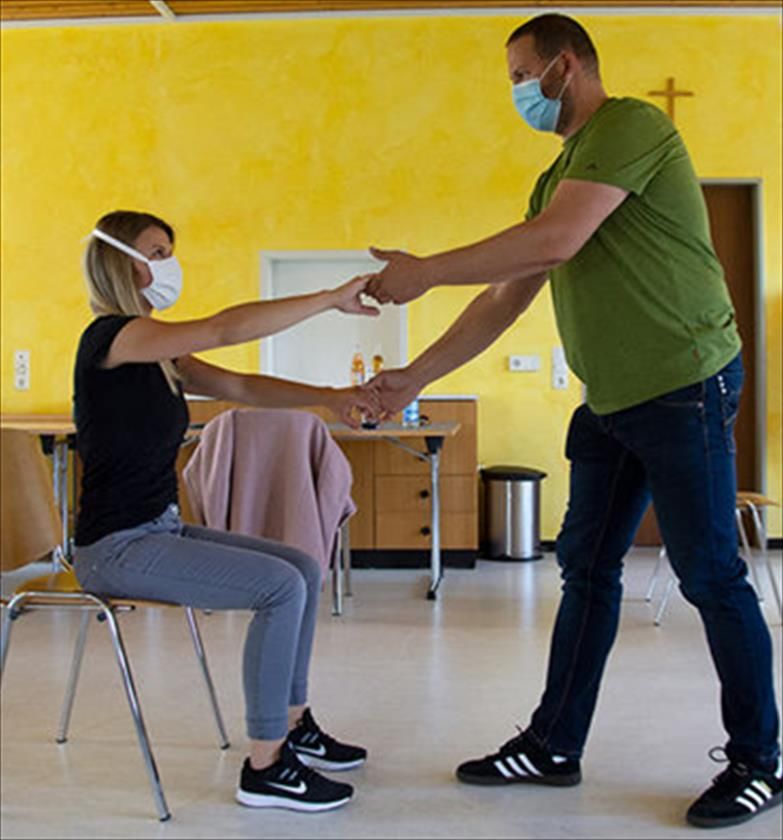
Introduction: Digital participation for
people in need of care and their
supporters

01 Dresden School of Management - Prof. Dr. Ute Kahle
                                                        https://www.google.com/search?q=digital+participation&client=firefox-b-
                                                        d&tbm=isch&source=iu&ictx=1&fir=A57AEu4mpMGIaM%252ChTtzj7GCB0xBeM%252C_&vet=1&usg=AI4_-

                                                        17&dpr=1.25#imgrc=A57AEu4mpMGIaM
                                                                                                                                              3
                                                        kS51mPu0jnRwXX1tYla7pSuEm30Bg&sa=X&ved=2ahUKEwj14ty6qdfvAhXj_7sIHcPVDlwQ9QF6BAgIEAE&biw=1293&b
Aims and Objectives
  • Temporarily scientific research studies show
    that the implementation of the kinaesthetic
    concept effects

        • less pain,

        • reduces the length of the patient`s stay,

        • improves functional skills and

        • increases the independence of people with
          high movement restrictions [Huth / Schnepp
          / Bienstein 2013, 585 ff.]

Dresden School of Management - Prof. Dr. Ute Kahle                                                                           4
                                                       https://www.diakoneo.de/magazin/magazin-menschen-mit-behinderung/kinaesthetik-in-der-
                                                       heilerziehungspflege-uebungsbeispiele/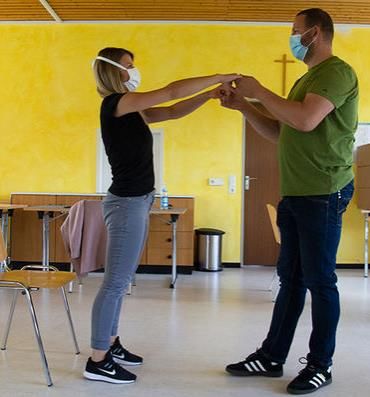
Aims and Objectives
  • As active mobilization has been shown to
    help maintain functional abilities, more
    approaches to active mobilization are
    needed.

  • The effects are that participants will be
    enabled to co-create their motion instead
    being moved passively [Huth / Schnepp /
    Bienstein 2013, 586 ff.]

  • To move from passive to active mobilization,
    the concept of Kinaesthetic may help
    [Jensen, Rasmussen et. Al 2019, 13]

Dresden School of Management - Prof. Dr. Ute Kahle                                                                          5
                                                     https://www.diakoneo.de/magazin/magazin-menschen-mit-behinderung/kinaesthetik-in-der-
                                                     heilerziehungspflege-uebungsbeispiele/
Aims and Objectives
  • Although there are evidence-based
    studies referring the positive effects of
    kinaesthetics people in need of long-term
    care where not supported in increasing
    their movement competences like they
    could [Büscher 2014].

Dresden School of Management - Prof. Dr. Ute Kahle                                                                          6
                                                     https://www.diakoneo.de/magazin/magazin-menschen-mit-behinderung/kinaesthetik-in-der-
                                                     heilerziehungspflege-uebungsbeispiele/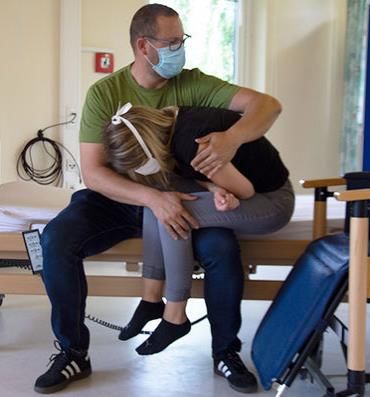
Research desideratum
  • People in need of care, people with
    disabilities and their supporters are able
    to promote sustainably their mobility
    through a digital kinaesthetic application.
  • The improvement is caused by direct
    contact and move as interacting forms.
  • Referring to the article 19 UN-CRPD
    “Living independently and being included
    in the community” the positive
    development improves the participation
    of people in need of care as well as their
    supporters [Lange-Riechmann 2015,
    125].

Dresden School of Management - Prof. Dr. Ute Kahle                                                                         7
                                                     https://www.diakoneo.de/magazin/magazin-menschen-mit-behinderung/kinaesthetik-in-der-
                                                     heilerziehungspflege-uebungsbeispiele/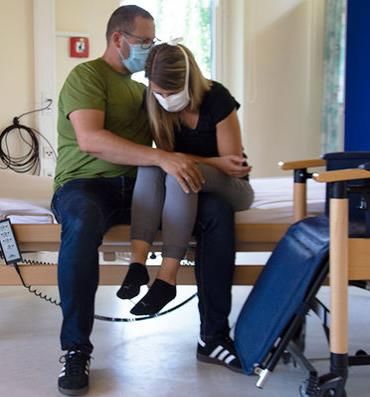
The Kinaesthetic concept

02 Dresden School of Management - Prof. Dr. Ute Kahle
                                                        https://www.google.de/search?q=kinaestethic+concept&tbm=isch&ved=2ahUKEwi7yfjNqNfvAhU44bsIHYdGCncQ2-
                                                        cCegQIABAA&oq=kinaestethic+concept&gs_lcp=CgNpbWcQAzoFCAAQsQM6AggAOgQIABBDOgQIABAeOgYIABAKEBhQic0IWJiDCWDOhQloAH
                                                        ACAAdsCiAHdEpIBCDEwLjkuMC4xmAEAoAEBqgELZ3dzLXdpei1pbWfAAQE&sclient=img&ei=g7tiYPv7KbjC7_UPh42puAc&bih=717&biw=1293

                                                                                                                                                                 8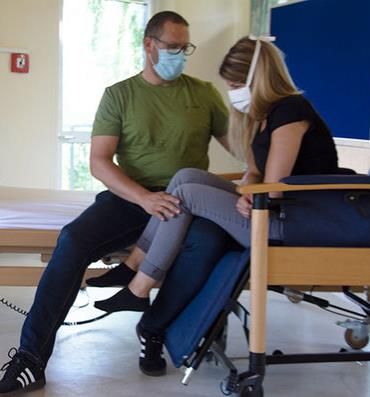
Background
•   Developed in Germany at the beginning of 1980s by American
    researchers.

•   They offered movement courses for dancers, parents and childen.

•   The courses were also offered to healthcare professionals.

•   Since 2006 Kinaesthetics has been organized in a European Network
    with national organisations (European Network Association). The
    concept was founded in

    •   Germany, Switzerland, Austria, Italy and Romania and

    •   is currently implemented in Japan, Russia and Denmark.

          Dresden School of Management - Prof. Dr. Ute Kahle            9
Background
• The word Kinaesthetic derives from the Greek words „Kino“, which
means to move, and „Aesthetics“, which means feeling and sense.
• Kinaesthetics is the study of the human movement execution for
each activity.
• The „kinaesthic sense“ is the perception of the body`s movement
through sensory perception from muscels, ligaments and joints.
Gravity and the position of the body provide orientation of balance
[Asmussen 2010].
• More than 1,000 Kinaesthetic instructors teach and develop
Kinaesthetic for different organisations and the healthcare sector.
• The concept offers a structure for a differentiated registration of
movement activity [Jensen / Rasmussen / Breier et al. 2019, 12 ff.].
Dresden School of Management - Prof. Dr. Ute Kahle 10Causes and effects
(1) Kinaesthetics is an educational and supportive
method of stimulating and training patients`
movement and their own contribution to
mobilization:
• It improves the functional skills and increase
their self-efficacy and independence.
• It strengthens the patients` movement
competences and
• provides them with the opportunity to play a
more active role in their own healing process or
prevent and retards degeneration.
• This can give them the feeling to be a person
and not just a patient and in addition the feeling
of being able to do something for themselves
[Jensen / Rasmussen / Breier et al. 2019, 13].
Dresden School of Management - Prof. Dr. Ute Kahle 11
https://www.diakoneo.de/magazin/magazin-menschen-mit-behinderung/kinaesthetik-in-der-
heilerziehungspflege-uebungsbeispiele/Causes and effects
• (2) Kinaesthetics has in addition the effect
that
• supporters of people in need of care
and disabled people perseive
themselves more mindfull.
• This effect referrs to the aim to
maintain their health.
Dresden School of Management - Prof. Dr. Ute Kahle 12
https://www.diakoneo.de/magazin/magazin-menschen-mit-behinderung/kinaesthetik-in-der-
heilerziehungspflege-uebungsbeispiele/Implementation of Kinaesthetic
• Research studies however show that the
implementation of kinaesthetics leads to enormous
improvements [Büscher et al. 2014]
• Lange-Riechmann [2015, 134 ff.] e. g. could
determine effects in the field of health insurance,
rehabilitation and participation and care insurance:
• On one hand the results of the research hightlight
improvements referring activities, existential
experiences of life, self-control, less passive
mobilization and wellbeing for the participants.
• On the other hand, cost-benefit-analyses show very
clearly a high amount of savings for the insurances.
• It can be held that these effects are really win-win-
situations.
Dresden School of Management - Prof. Dr. Ute Kahle 13
https://www.diakoneo.de/magazin/magazin-menschen-mit-behinderung/kinaesthetik-in-der-
heilerziehungspflege-uebungsbeispiele/Implementation of Kinaesthetic
• Factors which influence the implementation of
kinaesthetics were examined from Maurer, Mayer
and Gattinger [2019, 56 ff.]
• Although evidence could be determined people in
long-term care were not supported like they could.
• The research analysed
• that knowledge and action competences are missing,
• that nursing staff has a self-concept in which active
mobilization doesn`t occur, e. g. mobilization has not
the same importance as care [Reuther 2014].
• In addition, nursing staff has no concrete action plan.
Kinaesthetic is based on contact and activity during
the interaction with people in need of care and a
creative process [Hatch / Maietta 2003].
Dresden School of Management - Prof. Dr. Ute Kahle 14Implementation of Kinaesthetic
• The Consolidated Framework for Implementation
Research (CFIR) [Hoben 2016] is a model which
focusses on influencing factors and is in addition a
structure given frame for another actual research
study.
• The study shows, that following influencing factors are
essential for the implementation of kinaesthetics:
• experience of nursing stuff
• care understanding and philosophy
• understanding of mobilization
• relationship and healthy level between care and
mobilization
• integration of mobilization into activities of daily life
• attitude referring kinaesthetics and concerning movement
from A to B or moving as a health-related aspect
• Benefit for people in need of care and nursing stuff
• willingness to learn [Maurer / Mayer / Gattinger 2019,
60].
Dresden School of Management - Prof. Dr. Ute Kahle 15Research Strategy and Design
03 Dresden School of Management - Prof. Dr. Ute Kahle
https://www.google.de/search?q=research+strategy+and+design&source=lnms&tbm=isch&sa=X&ved=2ahUK
EwjyoeXMqNfvAhWVgP0HHUmBBlkQ_AUoAXoECAIQAw&biw=1293&bih=717#imgrc=l_FMCIVO_S2imM
16Research Strategy and Design
• It is obvious that implementing strategies for kinaesthetics should focus on various
criteria and influencing elements [Maurer et al. 2019, 62 ff.].
• Due to the digitalisation and to some few explorative experiences in the field of health
care and people with intelectual disabilities [e. g. Burtscher 2021, 30 ff.] catalyst by
COVID-19 pandemic our research focusses on digital practices for mobility.
• Participation for people with disabilities means also that people with strong movement
restrictions should be enabled to re-inforce their motion-competences and self-
effectivness.
• In addition it is neccessary to provide the supporting staff with contemporary digital
methods and instruments.
• Care staff has e. g. the role of a consultant in order to assist with other persons like
voluntaries, assistants and relatives.
Dresden School of Management - Prof. Dr. Ute Kahle 17Research Strategy and Design
• This research project is guided from the questions which effects
• the provision
• the implementation and
• the application of a digital platform for supporting the mobilization
for disabled people with restrictions in
• personal
• social
• pedagogic and
• economic regard will have.
Dresden School of Management - Prof. Dr. Ute Kahle 18Research Strategy and Design
Qualitative explorative longitudinal study
Methods
• Qualitative interviews
• Participating observations
• Two survey times:
• one at the beginning
• one after 1½ year after implementation of the application
Participants
• People with disabilities and limited movement competences
• Supporting staff like nursing assistance, social care workers, voluntary workers and others
Dresden School of Management - Prof. Dr. Ute Kahle 19Research Strategy and Design
Schedule
No. Milestone Time Description
1 Project presentation March 2021 • EURECO Forum 2021, Bruxelles
Project presentation December 2021 • EURECO 2021, Siegen
2 Project modelling April 2021 – Febr. 2022 • Establish research field,
• Research supporters,
• Participants,
• Contracts,
• Financing
3 Modelling the digital platform: Febr. 2022 - Dec. 2022 • IT specification book,
• Proof of scientific methods parallel • Storyboard
• Application development • Scientists,
• Provision software
4 Evaluation and adaption of April 2022 – May 2022 • Critical proof
technology
5 Application period and evaluation June 2022 – Dec. 2024 • Doing research
parallel
6 End of the Project December 2024 • Project presention, project 20
documentationSummary and Perspectives
04 Dresden School of Management - Prof. Dr. Ute Kahle
https://bertelsmann-university.com/fileadmin/Programs/Leadership_Journey_for_Leaders_of_Managers_
Germany/BU_Leadership_Journey_for_Leaders_of_Managers_-_Germany_DE_01.pdf/
21Summary and perspectives
• Re-inforcing motion competences and self-effectiveness for people with disabilities is a
contribution to article 19 UN-CRPD.
• It improves their participation and digital participation because of the use of the digital
kinasthetic application.
• In addition it prevents and retards degeneration.
• Furthermore supporting acteurs perseive themeselfes more mindfull.
• Our qualitative research strategy and the scientific design focusses on the following
issues:
• People with disabilities and strongly movement restrictions
• People who support them and
• the implementation of a digital application, evaluating their effectiveness in medical
health care, social and economic respects.
Dresden School of Management - Prof. Dr. Ute Kahle 22Literature
05 Dresden School of Management - Prof. Dr. Ute Kahle
Source: https://www.google.de/search?q=literatur+kin%C3%A4sthetik&source=lnms&tbm=isch&sa=X&ved=
2ahUKEwiJvpCektPvAhVFJhoKHYyIDQAQ_AUoA3oECAEQBQ&biw=1536&bih=722#imgrc=0VsiXHS5zZtLJM
23Literature
— Asmussen, Maren: Praxishandbuch Kinaesthetics: Erfahrungen zur individuellen Bewegungsunterstützung auf Basis der Kinästhetik,
München, Jena 2010
— Burtscher, Reinhard / Schwersensky, Nikola / Perowanowitsch, Merlin: Was geht? Der Einsatz digitaler Anwendungen durch Menschen
mit Lernschwierigkeiten in Corona-Zeiten, in: Teilhabe 1/2021, 30 - 35
— Büscher, Andreas / Blumenberg, Petra / Möller, Anna et al.: Erhaltung und Förderung der Mobilität in der Pflege: Expertenstandard nach
§ 113a SGB XI, Osnabrück 2014
— Gattinger, Heidrun: Stand der Forschung in Kinästhetik, Vortragsmanuskript der Kinaesthetics Fachtagung an der FHS St. Gallen,
18.05.2017
— Gattinger, Heidrun / Senn, Beate et al.: The self-reported and observed competence of nursing statt in mobility care based on
Kinesthetics in nursing homes – A cross-sectional study, in: Pflege 2018, 319 – 329
— Hatch, Frank / Maietta, Lenny: Kinästhetik: Gesundheitsentwicklung und menschliche Aktivität, München 2003
— Hoben: Einflussfaktoren in Implementierungsprozessen, in: Hoben / Bär / Wahl (Hrsg.): Implementierungswissenschaft für Pflege und
Gerontologie, 2016, 150 - 166
— Huth, Martina / Schnepp, Wilfried / Bienstein, Christel: Nutzen von Kinaesthetics Schulungen für die Bewältigung der häuslichen
Pflegesituation –die Sichtweise von Angehörigen, in: Pflegewissenschaft. Das Journal für Pflegewissenschaft und Pflegepraxis, 2013 15
(11), 586 – 599
Dresden School of Management - Prof. Dr. Ute Kahle 24Literature
— Jensen, Hanna Irene / Rasmussen, Anna Hedegaard / Breier, Anna: Use of Kinesthetic in patient mobilization: an evaluation
study, Nurs Med Care, 2019, 12 -20
— Kahle, Ute: Change Processes in Organisations which care for Disabled Peobple, in; Diaconia, vol. 9, 87 - 100, 2018/2019
Göttingen
— Kahle, Ute: Inklusion, Teilhabe und Behinderung. Herausforderungen und Perspektiven der Transformationsprozesse von
Organisationen der Behindertenhilfe aus institutioneller Sicht, Marburg 2019
— Lange-Riechmann, Lieseltraud: Wirtschaftlicher Nutzen von Kinaesthetics und die Bedeutung für Diakonie und
Gesundheitsökonomie, Stuttgart 2015
— Marty-Teuber, Stefan / Knobel, Stefan: Kybernetik und Kinästhetik, Linz 2018
— Maurer, Carola / Mayer, Hanna / Gattinger, Heidrun: Faktoren, die die Implementierung von Kinästhetik in die stationäre
Langzeitpflege beeinflussen: eine Konkretisierung des Consolidated Framework for Implementation Research durch
Expertenaussagen, in: HeilberufeScience, 2019 (3-4), 56 – 65
— Maurer, Carola / Vosseler, Birgit / Senn, Beate / Gattinger, Heidrun: Mutual guiding and following of movement – the
interaction process in mobilitsation based on the example of kenesthetics: A qualitative study, in: Pflege 2019, 31 (6), 319 -
329
— Reuther, Sven: Mobilitätsbeeinflussende Faktoren bei Bewohnern der stationären Altenhilfe in Deutschland, in: Pflege &
Gesellschaft, Zeitschrift für Pflegewissenschaften, 2014 (2), 124 - 138
Dresden School of Management - Prof. Dr. Ute Kahle 25Thank you for your Attention
„HABEN TEILEN - Re-inforcing motion competences and sel-effectivness,
supporting digital participation: implementation of a digital tool for people
with disabilities“
Contribution to the
EURECO 2021 SIEGEN
Workshop 03-B: Lernen – Mitarbeiterqualifizierung und Schulungsbedarfe von Mitarbeiter:innen in Sozialen
Diensten
Prof. Dr. Ute Kahle
Social Work / Study Programme Manager
SRH Berlin University of Applied Scienses
Contact: Ute.Kahle@srh.de
Dresden School of Management - Prof. Dr. Ute Kahle 26You can also read


