Haberdashers' Aske's Borough Academy - Admissions Policy Consultation
←
→
Page content transcription
If your browser does not render page correctly, please read the page content below
Haberdashers’ Aske’s Borough Academy –
Admissions Policy Consultation
Background
As part of the process of opening Haberdashers’ Aske’s Borough Academy for a September 2019
intake, Haberdashers’ Aske’s Federation held a public consultation regarding the proposed admissions
arrangements for the new school. The consultation ran at the same time as a consultation under
Section 10 of the Academies Act 2010 regarding Funding Agreements with the Secretary of State for
Education. The consultations ran for 6 weeks from 7th June to 19th July 2018.

Details of the consultation were posted on the Federation’s website (www.haaf.org.uk/Consultation-
June-2018) where respondents could reply electronically or download a form to do so by post or by
email. Leaflets were produced detailing the consultation and advising people to visit the web page to
view the policy and provide responses. These were distributed either by email or hard copy to local
authorities (Southwark and surrounding Boroughs); all schools within the Southwark Borough; schools
within a 30 minute travel commute to Borough Academy; interested parties locally including
councillors and MPs, and hard copies were provided to local primary schools. A full list of who was
written to regarding the consultation can be found in Appendix A.

The proposed admissions arrangements were described as follows on the website, including a link to
the full admissions policy.

    We intend to have a simple, fair, and easy to understand admissions policy that will use home to
    school distance as the main criterion for allocating places. If the school is oversubscribed, first
    priority will be given to children with an Education, Health and Care Plan or Statement of Special
    Education Needs naming the school followed by children who meet the following criteria, in priority
    order:

        1. Looked after children
        2. Children with exceptional medical or social needs
        3. Siblings of pupils attending the school at the time the application is received (this will not
           apply for the first year of admissions as there will be no older siblings in the school)
        4. Pupils who live nearest to the secondary school on the basis of a straight line home to
           Academy distance.

Responses
77 responses were received to the consultation (including the Section 10 consultation). Of these, 70
were received via the electronic form, 2 by paper and 5 by other means such as direct emails to the
Borough Academy email address.

72 of the respondents identified as ‘local parents with primary school aged children’, 6 as ‘other
resident’, 1 as local authority, 3 as ‘local community group’ and 5 as ‘local school’. It should be noted
that respondents were able to tick more than one box for this question and of those who selected
local school, all also selected local parents. It is therefore likely that parents ticked this box as their
children attend local schools rather than as a result of representing the views of local school
organisations.
Responses relating to admissions
Respondents were asked ‘Do you have any comments regarding the proposed admissions
arrangements for Haberdashers’ Aske’s Borough Academy?’ 52 responses were received and 25
respondents left the comment section blank. All responses, with individual names removed, are
included in Appendix B.
24 of the responses directly expressed support of the proposed admissions arrangements or
to distance as the main admissions criteria. 4 of these responses directly referred to the
proposed admissions arrangements as fair or clear.
8 of the responses made clear that they felt the school should be for local children or the local
community.
2 responses disagreed with the proposed admissions arrangements:
o ‘I think simple distance to the site is an unfair criteria as housing that near to central
London is expensive. Perhaps some places could be awarded on more of a lottery basis
to residents living in Southwark given that the shortage of decent secondary schools
is borough wide’
o ‘Not sure if the sibling policy is fair. We have seen it many times in the primary setting
where families get one child into school and move away from the area knowing their
other children will benefit from the policy. While I also understand having 3 children
myself that juggling multiple school calendars is a nightmare.
31 of the responses listed areas that they felt should be included in admissions arrangements.
o 22 of these expressed a desire for feeder primary schools and priority for the children
that attended them. Of these, 8 referred to the educational and social benefit to
children of progressing from primary school to secondary school as one cohort. For
example one respondent said, ‘I think priority should be given to feeder schools rather
than places awarded on proximity to the new school. Currently children in the local
primary schools ‘graduate’ to a worryingly high number of different secondary
schools. This is troubling from a friendship point of view but also there is good evidence
that when children progress to secondary school with their existing primary peer
groups this has a very positive impact on performance and results for the school (and
vice versa if they do not). It seems to me that it is beneficial to all to keep year 6 cohorts
together’.
o 3 responses opposed the idea of feeder schools.
o 10 of the responses listed other areas of focus such as lottery allocation, scholarships,
SEND or becoming a faith school.
Southwark Local Authority responded to the consultation and provided its view on the
proposed admissions arrangements. It was supportive and said that they were ‘clear, fair and
transparent and do not cause any undue prejudice to the community. The full response,
including suggestions for clarity regarding waiting lists are included in Appendix C.Conclusion
The following issues were raised in the consultation.
Distance and siblings as unfair criteria
Whilst we understand the desire to ensure that all children within the Borough have access to the
school we disagree with this point as we feel that distance is the simplest and fairest way to allocate
places. The siblings criteria will not apply for the first year of applications.
Feeder schools
Whilst the Federation has feeder school arrangements with its existing primary schools we have not
proposed any feeder arrangements with local schools for Haberdashers’ Aske’s Borough Academy.
We do not have feeder arrangements with any non-Haberdashers’ Aske’s primary schools at any of
our existing secondary schools. We feel that it would not be fair to include feeder arrangements for
any local primary schools within the admissions criteria for Haberdashers’ Aske’s Borough Academy
for the following reasons:
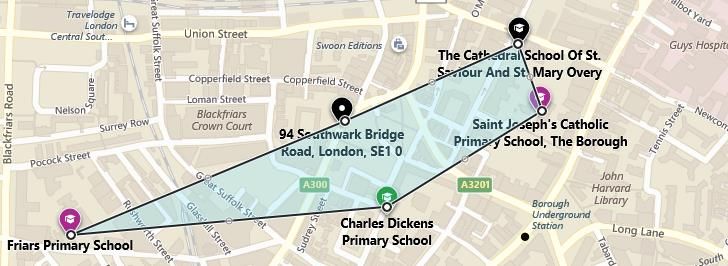
The four schools mentioned most as possible feeder schools were Charles Dickens Primary
School, The Cathedral School of St Saviour and St Mary Overie and Friars Primary Foundation
School. These schools are located within less than 1km of the Haberdashers’ Aske’s Borough
Academy site. There are 10 other schools within this distance (data gathered from the Mayor
of London’s School Atlas) and their catchment areas most likely overlap in a number of places.
If the Federation were to give feeder school preference to these closest schools it could
disadvantage children who may live closer to the site but attend a school a bit further away,
but still less than 1km away.
It is likely that the overwhelming majority of the children who currently attend the primary
schools closest to Haberdashers’ Aske’s Borough Academy live close to their schools and as
such will be within the likely catchment area for Haberdashers’ Aske’s Borough Academy as
well.
The Office of the School Adjudicator, which regulates schools admissions, has reported in its
most recent annual report, cases of adjudicators finding that the use of named but not related
feeder schools (i.e. not part of an existing Multi Academy Trust) to be unfair on the grounds
that children who did not attend them would be unfairly disadvantaged and in some cases
face significantly longer and more difficult journeys to school. A number of the responses
given within our consultation made reference to children travelling long distances to school
within the existing school provision and as such we would not wish to add to this disadvantage
by introducing feeder schools arrangements.Benefits of a cohort moving together
A number of responses referred to the benefits of cohorts of children staying together and progression
from primary to secondary together. In some cases this was used as an argument for having feeder
school arrangements. We recognise and share the view that there is a benefit in children staying
together when they move to secondary school, and we also feel that there is a benefit from a
continuous strong ethos throughout primary and secondary schools. This is why as a Federation we
support all-through schools – all of our existing Academies (Haberdashers’ Aske’s Hatcham College,
Haberdashers’ Aske’s Knights Academy and Haberdashers’ Aske’s Crayford Academy) are all-through
from 3-18 years. If Haberdashers’ Aske’s Borough Academy were to have its own primary phase then
it would have feeder priority as our other primary schools do.
Comments from Southwark Council
In Southwark Council’s response they recommended a number of changes that regarding the
proposed admissions arrangements. These are listed below as well as our response to these:
‘Admission of children outside their normal age group: For safeguarding purposes Southwark
Council’s school admissions team is co-ordinating the process for requesting admission of
children outside of their normal age group. However, the decision as to whether to agree or
refuse such requests would still remain with the Academy. You may wish to include that any
such requests from Southwark residents must be made using Southwark Council’s request form
which is available on the website at www.southwark.gov.uk/schooladmissions. Further
information can also be found within the LA’s policy on ‘Admission outside of a child’s normal
age group’ which is also available to view online at
www.southwark.gov.uk/schooladmissions.’
We accept this change and will update the admissions policy to say that any requests for
admission of children outside of their normal age group should be made using Southwark’s
request form and that the decision as to whether to accept or refuse would lie with the
Academy.
Waiting lists: Please note that families who are unsuccessful in being offered a place at the
Academy will automatically be put on your waiting list if the Academy was named as a higher
preference on their application as per Southwark’s co-ordinated admissions scheme. Currently
the Academy’s waiting list paragraph states that parents may request for their child’s name
to be added to the waiting list following an unsuccessful application – as this is incorrect please
amend this sentence.
We accept this change and will amend the policy accordingly.
Please also note that looked after children, previously looked after children and those allocated
a place at the school in accordance with a Fair Access Protocol must take precedence over
those on a waiting list. It would support clarity if this is also stated within the Academy’s
admission arrangements.
We accept this change and will amend the wording within their policy regarding looked after
children and waiting lists.
Next steps
Following review of the responses to the consultation we made recommendations to proceed (once
the above changes have been made to wording) with the admissions arrangements as set out in thepolicy the Federation consulted on and therefore recommended that the Haberdashers’ Aske’s Borough Academy Steering Group approve the policy on behalf of the Federation Trust Board. The Haberdashers’ Aske’s Borough Academy Steering Group approved our recommendations. The amended policy, with the changes from the consultation version shown as tracked changes, is included at Appendix D. The results of the consultation and the approved policy are published on the Federation’s website and have been sent to Southwark Council as finalised.
Appendix A
Full list of who consulted
Local Authorities
Southwark City of Westminster
Lambeth City of London
Tower Hamlets
Schools and nurseries
Details of the consultation were sent to all nurseries, primary schools and secondary schools within
the Borough of Southwark as well as any school located within a 30 minute public transport journey
to the Haberdashers’ Aske’s Borough Academy site (according to the Mayor of London School Atlas
https://maps.london.gov.uk/schools/).
Nurseries
Ann Bernadt Nursery School Nell Gwynn Nursery School
Dulwich Wood Primary School nursery The Grove Nursery School
Kintore Way Nursery School
Primary Schools
Albion Primary School Dulwich Village Church of England
Alfred Salter Primary School School
Angel Oak Academy Dulwich Wood Primary School
Archbishop Sumner Primary School English Martyrs Roman Catholic
Ark Globe Academy Primary School
Ashmole Primary School Friars Primary School Southwark
Bellenden Primary School Galleywall Primary School
Beormund Primary School Goodrich Community Primary School
Bessemer Grange Primary School Goose Green Primary School
Blue Gate Field Infants School Grange Primary School
Boutcher Church of England Primary Harris Primary Academy East Dulwich
School Harris Primary Academy Peckham
Brunswick Park Primary School Park
Camelot Primary School Harris Primary Free School Peckham
Canon Barnett Primary School Heber Primary School
Charles Dickens Primary School Henry Fawcett Primary School
Charlotte Sharman Primary School Hollydale Primary School
Childeric Primary School Ivydale Primary School
Cobourg Primary School John Donne Primary School
Comber Grove School John Keats Primary School
Crampton School John Ruskin Primary School
Crawford Primary School Judith Kerr Primary School
Dog Kennel Hill School Kender Primary School
Dulwich Hamlet Junior School Keyworth Primary School
Lyndhurst Primary School Michael Faraday School St John the Divine Church of England
Oasis Academy Johanna Primary
Oliver Goldsmith Primary School St John’s and St Clement’s Primary
Peter Hills with St Mary’s and St Paul’s School
Phoenix Primary School St John’s Walworth Church of England
Pilgrims Way Primary School Primary School
Prior Weston Primary School St Joseph’s Camberwell Catholic
Reay Primary School Schools Federation
Redriff Primary School St Joseph’s Primary, Bermondsey
Riverside Primary School St Jude’s Church of England Primary
Robert Browning Primary School School
Rotherhithe Primary School St Luke's Church of England Primary
Rye Oak Primary School School
Saint Joseph’s Catholic Primary School St Mark's Church of England Primary
Sir John Cass's Foundation Primary School
School St Mary Magdalene C of E Primary
Snowsfields Primary School School
Southwark Park Primary School St Matthew's Primary School
St Alban's Church of England Primary St Monica's Roman Catholic Primary
School School
St Anne's Catholic Primary St Paul’s Church of England Primary
St Anthony’s Catholic Primary School School
St Clement Danes Church of England St Peter’s Church of England Primary
Primary School School
St Francesca Cabrini Primary School Surrey Square Primary School
St Francis Roman Catholic Primary The Belham Primary School
School The Cathedral School Of St. Saviour
St George’s Cathedral Catholic And St. Mary Overy
Primary School The Mayflower Federation
St James' Church of England Primary Tower Bridge Primary School
School Townend Primary School
St James the Great Catholic Primary Vauxhall Primary School
School Victory Primary School
Walnut Tree Walk Primary School
Secondary Schools
Al Ashraaf Secondary School Harris Academy East Dulwich
Archbishop Tenison's School Harris Academy Peckham
Ark All Saints Academy Harris Girls Academy East Dulwich
Ark Globe Academy Kingsdale Foundation School
Ark Walworth Academy Lillian Baylis Technology School
Bacon’s College London Nautical School
Central Foundation Boys School Michael Faraday School
City of London Academy Notre Dame Roman Catholic
Compass School Southwark Secondary Girls School
Durand Academy Oasis Academy Southbank
Harris Academy Bermondsey Platanos College Sacred Heart Catholic Secondary St Saviour’s and St Olave’s School
School St Thomas the Apostle College
Southwark Free School The Charter School East Dulwich
Southwark Park School The Charter School, Southwark
Spa School Tuke School
St Helen's Catholic School University Academy of Engineering
St John's Walworth Church School South Bank
St Michael’s Catholic College Westminster School
Other, independent schools within 30 minutes of the site
Bosco Centre College Octavia House Schools
CATS College London Jamiatul Ummah School
Charterhouse Square London Christian School
City of London School for Girls Phoenix place
City of London School for Girls St John the Baptist
DLD College London St Pauls Cathedral School
Haymerle School Westminster Abbey Choir School
Highshore School
Local Interested Parties
Diocese of Southwark BOST (Bankside Open Spaces Trust)
Catholic Diocese of Southwark Coin Street Community Builders
Bankside Residents Forum JMB Leathermarket
Councillors and MPs
Councillor Jasmine Ali Councillor David Noakes
Councillor Adele Morris Neil Coyle MP
Those who had signed up with the Federation’s mailing list
Information on the consultation and a link to the website was sent to everyone who has previously
signed up to be kept in touch with the Federation’s progress on the Haberdashers’ Aske’s Borough
Academy project.
Schools that agreed to take hard copy consultation documents
The following local schools agreed to take copies of the leaflet for distribution to their parents:
Cathedral Primary School St Joseph’s Primary School
Charles Dickens Primary School Charlotte Sharman Primary School
Snowfields Primary School Friars Primary School
News outlets
Southwark News
London SE1 Community Website (www.london-se1.co.uk)Appendix B
Full list of responses (in order of receipt)
Responses were predominantly received from local parents with primary aged children but were
also received from other local residents, local community groups (SE1 Parents Group and Mint Street
Music Festival) and Southwark LA.
The responses are listed below, by order of receipt and without names of respondents. The
response from Southwark LA is shown in Appendix C.
Siblings and then distance
I feel it should be for local children
I would like to know the catchment areas for the Borough Academy and how this will be
weighted. Will there be 11 entrance examinations?
The school would be near Rotherhithe, an area of London conically under-provisioned for
secondary schools (the only one in Rotherhithe is currently in special measures and has a
ballot system with a wide catchment area, such that when it was going well, local children
had little chance at getting into the school on their doorstep).
No that seems in line with the other schools in the area.
I live in SE1 but due to the ridiculous boundaries I am in the borough of Lambeth not
Southwark. I think distance to school is a very fair way of allocating places as I actually live
closer than say a Southwark resident who lives in Camberwell. My child missed out on a
primary school place close to home because of living in North Lambeth despite us being
closer to the school! I would therefore oppose any preference to Southwark residents first as
people in Waterloo on the Southwark/Lambeth border always lose out in this scenario.
It should be set by distance for the north Southwark area similar to how Charter school and
others operate.
"Yes. Living in Bermondsey, it's assumed we will opt for one of the closest schools, none of
which have particularly good results. My child has some sensory processing issues and think
being in a ""pioneer"" year would benefit him greatly. The school is also much closer to his
current school in Waterloo. My concerns are that admission policies regarding distance are
balanced with any special needs."
I very much prefer your proposed admissions arrangements to other possibilities. We need a
good, secular, non-selective, co-educational secondary school which is specifically for this
local community and the simple arrangement of mainly using distance from the school will
achieve that.
Like many of the parents in this area that I have spoken to, I believe that one of the principal
virtues in having a local secondary school is in improving the academic outcomes of children
through having them move fluidly from primary to secondary school in a cohort. There is
strong evidence to show this can have a very positive effect on academic results (as it has in
other areas of Southwark where this has been the case). This can partly be achieved by
having a catchment area policy, but there are many cases in which parents move very slightly
outside the catchment area during primary school, or the catchment area shrinks as the
school gains in popularity, and children then fail to get into the nearby secondary school with
all their friends. It would make more sense to have a feeder school policy, with really local
schools such as the four most local being designated. This would also help Haberdashers
understand the teaching culture that most of their intake will have come from so as toenable a smooth transition into KS3 and encourage all these schools to work together over
time.
Feeder schools strongly preferred
I think simple distance to the site is an unfair criteria as housing that near to central London
is expensive. Perhaps some places could be awarded on more of a lottery basis to residents
living in Southwark given that the shortage of decent secondary schools is borough wide.
The policy should be distance from the school. The school should not have feeder schools as
this would limit the admissions for people who have stayed in the local area and not make it
be a truly local school.
None
"Please offer a wide catchment area or nodes to give more local people a chance of getting a
placement Links to feeder schools like Cathedral School and Charles Dickins would be
welcome"
I think it should be for local children
Admissions policy sound perfect for local children
"There are three primary schools in the near vicinity and this secondary school should have a
feeder system from those three: Cathedral School, Charles Dickens and Friars. Unfortunately
for me it is too late and I had to find secondary schools outside the borough for both of my
children, but as a parent I feel strongly that the links with the local community that was
created and nurtured by these three schools should be continued in a local co-ed secondary
school. SE1 is a very special place, although located in the heart of London, where people not
living here could not imagine doing anything but work or go out and definitely not bringing
up children. We have lived in the area since 2001, brought up my two children (11 16) in a
wonderful diverse, culturally and historically rich part of London and have seen the
transformation (the good and bad) and it would be lovely that children should have the
possibility to continue their secondary education amongst local friends, rather than being
forced to move or have a long commute like my children have now."
"Yes we would really like this school to become a feeder school for the children at The
Cathedral School se1, along side being a faith school working with Southwark Cathedral and
our community. A catchment area put in place to prevent a cross divide between childrens
post code wars. Specialized scholarship 10% of intake- Music, Maths, Sports, Arts"
Admissions showed mean from feeder schools local school.
The admissions policy looks fair. There may be some value in listing feeder primary schools as
a priority as there are a number of school in the immediate vicinity (Charles Dickens, St
Joseph's, Cathedral School, Friary etc) and this would ensure it is truly a community school.
I cannot find a document on the website that outlines what these are so I cannot comment
I would like to know what the catchment area would be. We live on Blackfriars Road and I
am concerned this will be to far away?
"In addition to the stated admission criteria, certain local schools could be defined as feeder
schools. This is to make sure that the local community and friendships can experience
continuity. The local surrounding schools should become feeder schools as part of the
admissions criteria. It is vital that all children transfer as a group as we have a very strong
local community. For some reason some parents have moved further away, often to cater for
secondaries for older siblings and would therefore not be able to get a place for younger
siblings at Borough Academy. Loads of local parents disagree with the idea of gender
separation. This is a brand new school, so please reconsider this issue. It is absolutely vital for
children to learn to function and to behave in the presence of the opposite sex. The #me toomovement should not be necessary in the future! The proposed gender separation would put
this school off the list for many local parents."
What is the catchment area likely to be?
I think closest distance to the school is key. I could not get my child into a local primary
school so they go outside the borough so I do not agree with any feeder schools as this is
unfair. I would however by delighted if my daughter could attend an excellent secondary
school within walking distance of our home. As a local resident who has lived in SE1 all of
their life, it’s what local people need for their children. I think distance to school, with or
without catchment postcodes (SE1, SE11 etc) is fairest and hope this, your usual admission
policy, is adopted for Borough.
Suggest it’s done by distance from the school.
There's value in the school being a feeder school - equally, catchment area to allow kids from
further afield to come in.
Primary schools in close proximity should be established as feeder schools for Borough
Academy with their students given priority in admissions arrangements.
I believe that the admissions process should be a combination of feeder school and proximity.
I.e., a very local child that did not attend a local primary school (eg because family recently
moved into proximity) should have higher precedence than a very remote child who attends
a “feeder” school. But on the other hand, a child who attends a local school should have
much higher precedence than a child who lives the same distance, but does not attend a local
school.
I think priority should be given to feeder schools rather than places awarded on proximity to
the new school. Currently children in the local primary schools ‘graduate’ to a worryingly
high number of different secondary schools. This is troubling from a friendship point of view
but also there is good evidence that when children progress to secondary school with their
existing primary peer groups this has a very positive impact on performance and results for
the school (and vice versa if they do not). It seems to me that it is beneficial to all to keep
year 6 cohorts together.
I think closest distance to the school is key. I could not get my child into a local primary
school so they go outside the borough so I do not agree with any feeder schools as this is
unfair. I would however by delighted if my daughter could attend an excellent secondary
school within walking distance of our home. As a local resident who has lived in SE1 all of
their life, it’s what local people need for their children. I think distance to school, with or
without catchment postcodes (SE1, SE11 etc) is fairest and hope this, your usual admission
policy, is adopted for Borough.
I hope they will not favour any particular primary school.
THANK YOU for a set of admission criteria which are not based on faith. We all pay taxes, yet
somehow schools are allowed to be selective based on criteria which exclude the majority
(since only a small minority is actively religious). We do not want to play this hypocritical
game and are grateful that, with the Haberdasher's Aske's Academy, it will be possible to
have a quality education without compromising one's integrity.
"I think the admissions criteria should also clearly give priority to children who already attend
the nearest primary schools, since they are likely to be in most need of a secondary school
place and will already make the daily commute into the immediate area. There may be some
overlap between this group of families and those in the nearest catchment areas, but
equally, there will be some families who live locally but who are excluded by the catchment
areas, especially if school places are oversubscribed (which is likely to be the case after2019). The proposed criteria makes sense but should also factor in parents who are already
at local primary schools and who will be looking to move their children up (but also stay in
the area). This will help provide a clear progression pathway as an option for those families
whose children are already attending local educational primary schools. This will be very
welcome since there are currently very limited secondary school options available to local
families and so many simply move out of the area when their children get to secondary
school age."
I think the school admissions should be location based and non religious.
not sure if the sibling policy is fair. We have seen it many times in the primary setting where
families get one child into school and move away from the area knowing their other children
will benefit from the policy. While I also understand having 3 children myself that juggling
multiple school calendars is a nightmare.
I would like it to be a community school, so for local children. Or maybe include some 'lottery
or scholarships if parents are keen.
It will be good for Charles Dickens Primary school pupils (convenient and many will get to
stay with friends which will ease the transition).
As educational studies has shown, keeping peer groups together into secondary school has
proven educational benefits. The local primaries already have criteria of catchment, can the
additional criteria of a ‘feeder’ style admission policy be added alongside your current
admissions policy, so school places are offered to children of local schools before being
offered to a child who has just moved into the area, and within the catchment. ie. local
school above catchment.
I strongly feel that feeder schools should be considered as the admission criteria for the new
school. Children in our central London location are drawn from across the borough of
Southwark - currently, at Cathedral School, there is no single expected secondary destination
for leavers. The benefits of keeping a cohort together are well documented, but from the
perspective of ensuring that Years 6 and 7 are productive and purposeful, removing this
major element of doubt from the lives of students (and their parents) must be hugely
beneficial.
The admission policy should primarily target children already going to local primary schools
in the area.
"There are not enough secondary schools in se1 and there are children that are in desperate
need for a good local school. Instead of a single zone catchment area which leaves a whole
host of children excluded from having a chance at admission because they aren’t lucky
enough to live close, the school should link with local primaries as feeder schools, in
particular Cathedral School and Charles Dickens. The school should also offer catchment
‘nodes’ placed throughout the borough to give students who live further away an
opportunity to have a chance at being admitted to the school."
I think local primary schools, such as Cathedral School of St Savour
I am fine with the admissions policy.
No
It is very straightforward and clear. You could add something just in case child 180 has a twin
or an adopted sibling, for example, as I’m sure you would not wish to split the children.
Trustees should be able to breach the admission limit in such extraordinary circumstances.
Please clarify the catchment areaAppendix C Response from Southwark Council Dear colleague Thank you for the opportunity to comment on Haberdashers’ Aske’s Borough Academy’s [the “Academy”] consultation 2018. We note that comments/responses were requested via the online form, but feel it is more appropriate for Southwark LA to comment by email – we hope this is ok. For ease of reference we have responded below in the same order as the online form: DATE OF OPENING Do you think the school should open in 2019 in temporary accommodation? In order to meet anticipated demand for Year 7 places in the borough for September 2019, Southwark LA supports the opening of the Haberdashers’ Aske’s Borough Academy. FUNDING AGREEMENT No comment. ADMISSIONS CONSULTATION Do you have any comments regarding the proposed admissions arrangements for Haberdashers’ Aske’s Borough Academy? The Academy Trust may wish to consider the following comments in relation to the Academy’s admission arrangements 2019/20: 1. General We acknowledge that the Academy’s admission arrangements 2019/20 are clear, fair and transparent and do not cause any undue prejudice to the community. 2. Application process We agree and note that Southwark LA will work with the Academy post offer, to manage the withdrawal of duplicate offers and to ensure that the process remains fair. 3. Admission of children outside their normal age group For safeguarding purposes Southwark Council’s school admissions team is co-ordinating the process for requesting admission of children outside of their normal age group. However, the decision as to whether to agree or refuse such requests would still remain with the Academy. You may wish to include that any such requests from Southwark residents must be made using Southwark Council’s request form which is available on the website at www.southwark.gov.uk/schooladmissions . Further information can also be found within the LA’s policy on ‘Admission outside of a child’s normal age group’ which is also available to view online at www.southwark.gov.uk/schooladmissions . 4. Waiting lists Please note that families who are unsuccessful in being offered a place at the Academy will automatically be put on your waiting list if the Academy was named as a higher preference on their application as per Southwark’s co-ordinated admissions scheme. Currently the Academy’s waiting list paragraph states that parents may request for their child’s name to be added to the waiting list following an unsuccessful application – as this is incorrect please amend this sentence. Please also note that looked after children, previously looked after children and those allocated a place at the school in accordance with a Fair Access Protocol must take precedence over those on a
waiting list. It would support clarity if this is also stated within the Academy’s admission
arrangements.

LINKS WITH THE LOCAL COMMUNITY
Please provide your views on how the new school can be an asset for the whole community:
Allowing community access to the facilities when the Academy fully opens may be useful in terms of
establishing positive, local links.

Should you require any further information please do not hesitate to contact me.

Best regards

Glenn Garcia
Head of Education Access 0-25
Children's and Adults' Services
Southwark Council
Appendix D – Revised admissions policy

        2019/20 admission arrangements
                     Haberdashers’ Aske’s Borough Academy

Introductory statement
Haberdashers’ Aske’s Borough Academy is a new secondary school opening on Southwark Bridge
Road in September 2019. It will be a comprehensive school with 180 places in each year group up to
age 16. The first children will be admitted to year 7 in September 2019 and the school will grow by
one year group every year thereafter until all the year groups are open. It will have a sixth form with
250 places which will open in September 2024, in order to admit the first children from the school
who have completed their GCSEs.

Admission number
The school has an admission number of 180 for entry in year 7.
The school will accordingly admit this number of pupils if there are sufficient applications. Where
fewer applicants than the published admission number for the relevant year group are received, the
Academy Trust will offer places at the school to all those who have applied.

Application process
The school, for its first year of opening only, will process applications outside the normal local
authority process for co-ordinating school offers. This means you will need to complete your LA
common application form for your other choices of school in addition to a separate application for
this school.
Applications for this school should be made using the online application form at
http://borough.academy. Alternatively a copy of the form will be available to download and can be
sent to sent to BOROUGH ACADEMY ADMISSIONS at the following address C/O HABERDASHERS’
ASKE’S FEDERATION, JERNINGHAM ROAD, SE14 5NY
The closing date for applications is 31st October 2018.
Offers will be made on 1st March 2019. If we have not entered into a funding agreement with the
Secretary of State opening the school by that date, they will be conditional offers and will be
confirmed once we have a signed funding agreement.
The application form can be obtained from www.haaf.org.uk

Oversubscription criteria
When the school is oversubscribed, after the admission of pupils with an Education, Health and Care
plan or a Statement of Special Educational Needs naming the school, priority for admission will be
given to those children who meet the criteria set out below, in priority order:
    1. Looked after children and children who were previously looked after but immediately after
       being looked after became subject to adoption, a child arrangements order, or special
       guardianship order.
2. Priority will next be given to children based on their exceptional medical or social needs.
Each application must include evidence, from a medical specialist or social worker of the
child’s need and why they must attend this school rather than any other, based on those
needs. If evidence is not submitted to the school with the application, a child’s medical or
social needs cannot be considered.
3. Priority will next be given to the siblings of pupils attending the school at the time the
application is received. This criterion is only applicable if the older sibling is in years 7-10 and
will continue to be on roll when the pupil joins the secondary school.
4. The remaining places will be offered to pupils who live nearest to the secondary school on
the basis of straight-line home to Academy distance. Home to Academy distance will be
measured to a central point in the Academy’s main site on Southwark Bridge Road in a
straight line, using digitised mapping software of the area, from the applicant’s permanent
home address. If more than one applicant lives in a multi-occupancy building, such as a block
of flats, priority will be given to the applicant whose door number is the lowest numerically
and/or alphabetically. Proof of residency will be required if a place is offered.
Tie-break
If in categories 2-3 above a tie-break is necessary to determine which child is admitted, the child
living closest to the school will be given priority for admission. Distance is measured from the child’s
home to a central point in the Academy’s main site on Southwark Bridge Road in a straight line.
Random allocation undertaken by the local authority will be used as a tie-break in category 5 above
to decide who has highest priority for admission if the distance between a child’s home and the
academy/free school is equidistant in any two or more cases.’
Random allocation will not be applied to multiple birth siblings (twins and triplets etc.) from the
same family tied for the final place. We will admit them all and exceed our PAN.
Late applications
All applications received by the school after the deadline will be considered to be late applications.
Late applications will be considered after those received on time. If, following consideration of all
applicants the school is oversubscribed, parents may request that their child is placed on the
school’s waiting list.
Admission of children outside their normal age group
Parents may request that their child is admitted outside their normal age group. This process is
coordinated by Southwark Council’s school admissions team although the final decision regarding
acceptance or refusal of requests lies with the academy trust. When such a request is made, the
academy trust will make a decision on the basis of the circumstances of the case and in the best
interests of the child concerned, taking into account the views of the head teacher and any
supporting evidence provided by the parent.
To request an admission outside of normal age group parents should complete an application using
Southwark Council’s request form which is available on their website at
www.southwark.gov.uk/schooladmissions, in addition to applying to the Academy for a place.Further information can also be found within the council’s policy on ‘Admission outside of a child’s normal age group’ which is also available to view on their website. Parents may request that their child is admitted outside their normal age group. To do so parents should include a request with their application, specifying why admission out of normal year group is being requested. When such a request is made, the academy trust will make a decision on the basis of the circumstances of the case and in the best interests of the child concerned, taking into account the views of the head teacher and any supporting evidence provided by the parent. Waiting lists The school will operate a waiting list. Where the school receives more applications for places than there are places available, a waiting list will operate until the 31st December in the year of admission. This will be maintained by the Academy Trust. As per Southwark Council’s admissions scheme, if the school was listed as a higher preference on their application, children who are unsuccessful in being offered a place at the school will automatically be put on the waiting list. Looked after children, previously looked after children and those allocated a place at the school in accordance with a Fair Access Protocol will be allocated a place as precedence to those on the waiting list. After this, children’s position on the waiting list will be determined in accordance with the oversubscription criteria. Where places become vacant they will be allocated to children on the waiting list in accordance with the oversubscription criteria. The waiting list will be reordered in accordance with the oversubscription criteria whenever anyone is added to or leaves the waiting list. The school will operate a waiting list. Where the school receives more applications for places than there are places available, a waiting list will operate until the 31st December in the year of admission. This will be maintained by the Academy Trust and it will be open to any parent to ask for his or her child’s name to be placed on the waiting list, following an unsuccessful application. Children’s position on the waiting list will be determined solely in accordance with the oversubscription criteria. Where places become vacant they will be allocated to children on the waiting list in accordance with the oversubscription criteria. The waiting list will be reordered in accordance with the oversubscription criteria whenever anyone is added to or leaves the waiting list. Appeals All applicants refused a place have a right of appeal to an independent appeal panel constituted and operated in accordance with the School Admission Appeals Code. Appellants should contact BOROUGH ACADEMY ADMISSIONS, C/O HABERDASHERS’ ASKE’S FEDERATION, JERNINGHAM ROAD, SE14 5NY by Friday 5th April 2019 at 4pmto submit their appeal. Information on the timetable for the appeals process is on our website at www.haaf.org.uk. Any unsuccessful applicants will be provided with information about how to appeal and the appeal deadline in the letter informing them that their application was unsuccessful. Notes: Home address: The home address is where a child normally lives. Where a child lives with parents with shared parental responsibility, each for part of a week, the address where the child lives is determined using a joint declaration from the parents stating the pattern of residence. If a child’s residence is split
equally between both parents, then parents will be asked to determine which residential address
should be used for the purpose of admission to school. If no joint declaration is received where the
residence is split equally by the closing date for applications, the home address will be taken as the
address where the child is registered with the doctor. If the residence is not split equally between
both parents then the address used will be the address where the child spends the majority of the
school week.
Sibling:
Sibling means a natural brother or sister, or a half brother or sister, or a legally adopted brother or
sister or half-brother or sister, or step brother or sister who will be living with them at the same
address. Pupils will be considered under this criterion if they have a sibling who meets the above
definition. Proof of the sibling relationship will be required if a place is offered.
Medical and Social Need:
‘Social need’ does not include a parent’s wish that a child attends the school because of a child’s
aptitude or ability or because their friends attend the school. ‘Medical need’ does not include mild
medical conditions.
You can also read


