Handset ODM Industry White Paper - Smartphone ODM market continues to grow, duopoly Wingtech and Huaqin accelerate diversified layout - Omdia
←
→
Page content transcription
If your browser does not render page correctly, please read the page content below
Publication date:
                                April 2020
                                Authors:
                                Robin Li
                                Lingling Peng

Handset ODM
Industry White
Paper
Smartphone ODM market
continues to grow, duopoly
Wingtech and Huaqin
accelerate diversified layout

                                Brought to you by Informa Tech
Handset ODM Industry White Paper 01
Contents
Handset ODM market review and outlook 2
Global smartphone market continued to decline in 2019 4
In the initial stage of 5G, China will continue to decline 6
Outsourcing strategies of the top 10 OEMs 9
ODM market structure and business model analysis 12
The top five mobile phone ODMs 16
Analysis of the top five ODMs 18
Appendix 29
© 2020 Omdia.
All rights reserved. Unauthorized
reproduction prohibited.Handset ODM Industry White Paper 02
Handset ODM market
review and outlook
In 2019, the global smartphone market shipped 1.38 billion units, down 2.2% year-over-
year (YoY). The mature markets such as North America, South America, Western Europe,
and China all declined. China’s market though is going through a transition period from
4G to 5G, and the shipments of mid- to high-end 4G smartphone models fell sharply in
2H19. China’s market shipped 361 million smartphones in 2019, a YoY decline of 7.6%. In
the early stage of 5G switching, the operator's network coverage was insufficient.
Consequently, 5G chipset restrictions led to excessive costs, and expectations of 5G led to
short-term consumption suppression. The proportion of 5G smartphone shipments was
relatively small while shipments of mid- to high-end 4G models declined sharply.
The overall shipment of smartphones from Chinese mobile phone manufacturers reached
733 million units, an increase of 4.2% YoY. However, demand in China’s market declined;
yet, growth came from shipments in the overseas markets with 434 million smartphones
shipped in the overseas market, an increase of 12.4% YoY. OPPO's overseas market
shipments increased by more than 60% in 2019. Its sub-brand, Realme, shipped 25
million units in 2019, mainly concentrated in the Southeast Asian market. In 2019,
Xiaomi’s smartphone shipments hit 87 million units in the overseas market, an increase
of 32% YoY, and its market share in the European market grew rapidly in 2H19.
China's mobile phone original design manufacturers (ODMs) shipped a total of 325
million mobile phones in 2019, a slight increase from 320 million mobile phones in 2018.
Additionally, the net increase in smartphones of ODM manufacturers exceeded 20 million
units, concentrated in key customers such as OPPO, Samsung, LG, and Nokia. Meanwhile,
smartphone shipments from Huawei’s and Meizu’s outsourcing projects declined. OPPO
increased the number of mid- and low-end projects and fully collaborated with ODM
Wingtech, Huaqin, and Longcheer to develop new products to fulfill all market segments,
including its emerging brand, Realme. In 2019, OPPO's outsourced projects increased by
more than 50 million units, including ODM and independent design house (IDH) models.
Samsung began to cooperate with Wingtech in the mid- and low-end models in 2019.
Likewise, in 2019, its outsourcing projects shipped more than 25 million units, and it
began to collaborate with Huaqin on new projects. More than 60 million outsourcing
projects are expected to ship in 2020.
Because of the continued concentration of smartphone shipments from the top 10
OEMs, outsourcing project orders of major customers determined shipment volume and
revenue of ODM companies. According to smartphone shipments, Xiaomi, OPPO,
Huawei, Samsung, and Lenovo were the main partners of mobile phone ODMs in 2019.
The corresponding ODM suppliers were mainly concentrated in companies such as
Wingtech, Huaqin, Longcheer, and Chino. In 2019, shipments of Xiaomi's outsourced
© 2020 Omdia.
All rights reserved. Unauthorized projects were approximately 95 million units; the collaboration between Xiaomi and
reproduction prohibited.
ODMs mainly adopted the IDH model. Longcheer participated in the production and
assembly of some projects in 2019. Meanwhile, OPPO's outsourced projects shippedHandset ODM Industry White Paper 03
roughly 59 million units while the collaborative projects of Wingtech and Huaqin adopted
the ODM model, and the IDH model was adopted in cooperation with Longcheer.
Samsung’s outsourcing project began mass production in 2H19, and it collaborated with
Wingtech. Samsung’s outsourcing projects adopted an all-outsourcing model and its
single project shipments were large, making it the largest customer by revenue in 2019.
The bottleneck of the early popularization of 5G mobile phones is that the bill of
materials (BOM) cost and selling price are too high, and cost control has always been the
advantage of ODMs. For ODMs, research and development (R&D) of 5G mobile phones,
product unit price, production, and assembly revenue have all significantly improved. The
high technical threshold avoids vicious competition, and the increase in orders from large
customers will directly promote the performance growth of ODMs. At the same time,
Wingtech and Huaqin are actively planning overseas production and manufacturing. The
product line continues to expand to ecological products such as tablets, smartwatches,
True Wireless Stereo (TWS) headsets, and Internet of Things (IoT) products. For the
leading ODMs, in-depth cooperation with multiple product lines with core customers will
play an increasingly important role in the industry chain. This will also help to enrich
customer queues and product line layouts to ensure healthier development.
© 2020 Omdia.
All rights reserved. Unauthorized
reproduction prohibited.Handset ODM Industry White Paper 04
Global smartphone market
continued to decline in
2019
In 2019, the global smartphone market shipped 1.38 billion units, down 2.2% YoY. The
mature markets such as North America, South America, Western Europe, and China all
declined. China’s market though is going through a transition period from 4G to 5G, and
the shipments of mid- to high-end 4G smartphone models fell sharply in 2H19. China’s
market shipped 361 million smartphones in 2019, a YoY decline of 7.6%. Because of a
consumption upgrade, the smartphone BOM cost increased as the key devices’ screens,
cameras, chipset, and fingerprints were also upgraded. Combined with the expectations
of the upcoming 5G smartphones, the demand from the replacements market has
decreased and the replacement cycle has been significantly extended. In the early stage
of 5G switching, the operator's network coverage was insufficient, 5G chipset restrictions
led to excessive costs, and expectations of 5G led to short-term consumption
suppression. The proportion of 5G smartphone shipments was relatively small while
shipments of mid- to high-end 4G models decreased sharply in 2019. In 2020, 5G
smartphones are expected to rapidly spread in markets such as China and South Korea,
and 5G smartphones will lead the next round of market reversal.
Global smartphone shipments in 2019
1,500 30.0%
27.0% 1,444
1,450 1,435 25.0%
1,401 1,411
1,377 1,379 20.0%
1,400 1,370
Millions of units
15.0%
1,350
1,302 10.0%
1,300 1,279 8.0%
5.2% 4.8%5.0%
1.7% 3.1%
1,250
0.0%
-2.3% -2.2%
1,200 -5.0%
-5.6%
1,150 -10.0%
2014 2015 2016 2017 2018 2019 2020E 2021E 2022E
Global shipments Global YoY
© 2020 Omdia.
All rights reserved. Unauthorized Source: Omdia © 2020 Omdia
reproduction prohibited.Handset ODM Industry White Paper 05
Smartphone shipments from Chinese mobile phone manufacturers such as Huawei,
OPPO, Xiaomi, Vivo, and Transsion continued to grow in 2019. OPPO's smartphone
shipments were 134 million units, a YoY increase of 21%; shipment growth was
concentrated in Southeast Asia and India. On the other hand, the trade conflict in 2019
affected Huawei and Realme. Its smartphone shipments in the overseas markets declined
in2H19, but its shipments and market share in China grew rapidly with an overall increase
of 16.7%. Huawei ’s shipments for the overseas market are limited, leading Samsung to
be the biggest beneficiary. Its smartphone shipments rebounded in 2019, reaching 297
million units, a YoY increase of 2.3%. Xiaomi and Vivo grew slightly; their respective
shipment growth was also concentrated in the overseas market. Meanwhile, Apple's
smartphones performed poorly in the first half of the year, especially in China, where its
smartphone shipments in 2019 declined to more than 10 million units. However, because
of cuts in the selling price, camera and chipset upgrades, and excellent workmanship, the
new iPhone 11 series has received positive feedback from the market. As a result, its
shipments of the iPhone 11 increased in 4Q19.
At the beginning of 2020, because of the spread of the new coronavirus disease (COVID-
19) in China, the government adopted a strict isolation and control policy. This caused
offline mobile phone stores to close, which caused a direct negative impact on the offline
market in the mobile phone market. Smartphone shipments in China market fell rapidly
in January and February, but it began to recover gradually in March. It is expected that
smartphone shipments in the China will decline approximately 8% throughout the year.
However, COVID-19 quickly broke out in other regions outside of China and all offline
stores of Apple, except in China, were closed. Based on the rapid spread of COVID-19 in
regions other than China, the global smartphone market is expected to decline sharply by
12.7% in 2020; shipments of all mobile phone manufacturers will be affected.
Top 10 smartphone OEMs in the global market
(millions of units)
Market Market
Rank Company Jul-18 Jul-19 YoY
share share
1 Samsung 289.9 20.6% 296.5 21.5% 2.3%
2 Huawei 206.1 14.6% 240.6 17.4% 16.7%
3 Apple 208.0 14.8% 192.8 14.0% -7.3%
4 OPPO 115.3 8.2% 133.8 10.1% 21.0%
5 Xiaomi 118.7 8.4% 124.0 9.0% 4.5%
6 vivo 103.9 7.4% 105.2 7.6% 1.2%
7 Lenovo 41.8 3.0% 38.2 2.8% -8.6%
8 Tecno 34.4 2.4% 37.7 2.7% 9.6%
9 LG 44.2 3.1% 34.4 2.5% -22.2%
10 TCL-Alcatel 17.1 1.2% 14.0 1.0% -18.1%
Others 230.2 16.3% 161.6 11.3% -32.2%
Total 1,409.7 100.0% 1,378.8 100.0%
Source: Omdia © 2020 Omdia
© 2020 Omdia.
All rights reserved. Unauthorized
reproduction prohibited.Handset ODM Industry White Paper 06
In the initial stage of 5G,
China will continue to
decline
China’s smartphone market shipped 361 million units in 2019, a decline of 7.6% YoY. In
the early stage of 5G switching, the operator's network coverage was insufficient. The
excessive cost caused by 5G chipset restrictions and the expectation of 5G led to short-
term consumption suppression. The proportion of 5G smartphone shipments is relatively
small in 2019 whereas shipments of mid- to high-end 4G models declined rapidly.
Moreover, Qualcomm and Hisilicon concentrated the supply of 5G chipsets in 2019, both
had external 5G baseband only, which were used in conjunction with their high-end 4G
chips. In 2019, Samsung, Huawei, OPPO, Xiaomi, and Vivo all launched their smartphones
using the first generation of 5G chipsets, but single-model shipments were limited. In the
second half of 2019 (2H19), Huawei ’s high-end model, the Mate30 series, used
HiSilicon’s 5G system-on-a-chip (SoC). It began shipping in November 2019, driving the
growth of 5G smartphone shipments. In December 2019, Xiaomi, OPPO, and Vivo all
released mid- and high-end 5G mobile phones based on Qualcomm, MediaTek, and
Samsung 5G SoCs, but all began shipping in January 2020.
According to the research data from Omdia, Huawei ’s smartphone shipments in the
overseas markets declined because of the restrictions in the trade ban in 2019.
Consequently, it turned to China’s market for growth. In 2019, Huawei ’s smartphone
shipments in China increased 35.4% YoY and its market share reached 39.4%. In 2H19,
Huawei's market share exceeded 40%. Except for Huawei, other OEMs’ shipments
declined and the market share continued to be centralized. The overall market share of
the top five OEMs—Huawei, Vivo, OPPO, Xiaomi, and Apple—were close to 95% in 2019.
In contrast, Samsung, Meizu, Lenovo, ZTE, and other brands all had a weaker presence in
China. Among them, Samsung mainly sold its flagship models S and Note series in China.
Additionally, its A series models were at a disadvantage and shipments were limited.
© 2020 Omdia.
All rights reserved. Unauthorized
reproduction prohibited.Handset ODM Industry White Paper 07
Top 10 smartphone OEMs in China
(millions of units)
Market Market
Rank Company 2018 2019 YoY
share share
1 Huawei 105.0 26.9% 142.1 39.4% 35.4%
2 Vivo 73.8 18.9% 66.6 18.4% -9.8%
3 OPPO 75.2 19.2% 66.2 18.3% -11.9%
4 Xiaomi 52.8 13.5% 37.0 10.2% -29.9%
5 Apple 39.5 10.1% 29.4 8.1% -25.6%
6 Meizu 9.0 2.3% 3.7 1.0% -59.3%
7 Samsung 5.5 1.4% 2.7 0.7% -51.1%
8 OnePlus 2.2 0.6% 1.4 0.4% -34.9%
9 Lenovo 1.7 0.4% 0.6 0.2% -64.2%
10 ZTE 1.3 0.3% 0.6 0.2% -55.9%
Others 24.8 6.3% 10.7 3.0% -56.7%
Total 390.8 100.0% 361.0 100.0% -7.6%
Source: Omdia © 2020 Omdia
The overall shipment of smartphones from Chinese mobile phone manufacturers reached
733 million units, an increase of 4.2% YoY. Demand in China’s market declined, but
growth came from shipments in the overseas markets with 434 million smartphones, an
increase of 12.4% YoY. OPPO's shipments in the overseas market increased by more than
60% in 2019. Meanwhile, Realme shipped 25 million units in 2019, mainly concentrated
in the Southeast Asian market. In 2019, Xiaomi shipped 87 million smartphones in the
overseas market, an increase of 32% YoY, and its market share in the European market
grew rapidly in 2H19.
Because of the impact of COVID-19, smartphone shipments in China market is expected
to decline by roughly 30% in the first quarter of 2020 (1Q20). Since March, however, the
market has gradually recovered. Although, overall shipments are expected to continue to
decline by approximately 8.2% in 2020. Unfortunately, COVID-19 began to spread rapidly
in other regions outside of China in late February, and there are many uncontrollable
factors. The overseas expansion for Chinese OEMs also encountered the biggest crisis up
to date. However, the short-term downturn in the market environment will not lead to
changes in the industry ’s megatrends. The Chinese market has been close to full
recovery since March. The post-pandemic impact of COVID-19 will simultaneously spawn
new formats and accelerate the integration of 5G-related industries. The Chinese mobile
phone market is also expected to experience a rapid rebound in the second half of the
year (2H20).
© 2020 Omdia.
All rights reserved. Unauthorized
reproduction prohibited.Handset ODM Industry White Paper 08
Comparison of smartphone shipments of key Chinese OEMs, 2019
100%
90%
80% 41% 37%
50% 100%
70%
70%
Percentage
60%
50% 98% 93%
100%
40%
30% 59% 63%
50% 78%
20%
30%
10%
0% 2% 7%
0%
Huawei Xiaomi OPPO Vivo Leonovo ZTE Meizu TCL
China Export
Source: Omdia © 2020 Omdia
© 2020 Omdia.
All rights reserved. Unauthorized
reproduction prohibited.Handset ODM Industry White Paper 09
Outsourcing strategies of
the top 10 OEMs
OPPO and Samsung started to collaborate with ODMs since 2018. Currently, the top 10
OEMs (except Apple and Vivo) have all cooperated with ODMs to develop low- and mid-
end smartphones and mobile phones in the ecological chain. In the low-end smartphone
market, ODMs Wingtech and Huaqin have obvious advantages in R&D capabilities, cost
control, and manufacturing. At present, Wingtech, Huaqin, and Longcheer have
introduced systematic management processes, integrated product development,
integrated supply chain management, and other advanced process management reforms
to improve operational efficiency and ensure quality.
Because of the continued concentration of smartphone shipments from brand
manufacturers, the outsourcing project orders of major customers directly affect the
shipment and revenue scale of ODMs. According to the shipment scale of smartphones,
Xiaomi, OPPO, Huawei, Samsung, and Lenovo were the main partners of mobile phone
ODMs in 2019. The corresponding ODM suppliers are mainly concentrated in companies
such as Wingtech, Huaqin, Longcheer, and Chino. The shipments of outsourcing projects
of Xiaomi in 2019 is roughly 95 million units. The collaboration between Xiaomi and
ODMs mainly adopts the IDH model. ODMs only participate in R&D, not material
procurement and assembly. In 2019, some Longcheer models participated in the
production and assembly, accounting for a relatively small amount. The shipments of
OPPO outsourcing ODM projects in 2019 were approximately 59 million units, of which
the collaborative project of Wingtech and Huaqin adopted the ODM model and the
cooperation with Longcheer adopted the IDH model. Longcheer ’s production and
assembly capacity were relatively limited in 2019 while Huawei ’s outsourced projects
contracted. Affected by the trade ban, shipments of its ODM projects decreased, which
affected the shipment volume of Huaqin and Chino. Meanwhile, Samsung cooperated
with Wingtech and Huaqin in 2019, and Wingtech’s collaborative project began to ship in
the second half of the year. Because of Samsung's all-outsourcing model and large single-
project shipments, it contributed most of Wingtech's 2019 revenue. Over at Lenovo, its
ODM suppliers are relatively scattered. In 2019, it collaborated with the top five ODMs;
its shipments of outsourcing projects were approximately 32 million units in 2019.
© 2020 Omdia.
All rights reserved. Unauthorized
reproduction prohibited.Handset ODM Industry White Paper 10
ODM smartphone shipments of the top 10 OEMs, 2019
120
100
80
Millions of units
60
40
20
0
2018 2019 2020E
Source: Omdia © 2020 Omdia
Xiaomi’s smartphone business is divided into the Xiaomi and Redmi series. The Xiaomi
series is positioned at the mid- to high-end while the Redmi series is positioned at a
price-performance ratio. The cooperation between Xiaomi and ODMs is mainly based on
the Redmi series, which mainly adopts the IDH model. ODMs are responsible for R&D and
design. Xiaomi directly controls the procurement of materials while third-party
electronics manufacturing services (EMS) complete production and assembly. In 2019,
Xiaomi's outsourced projects accounted for roughly 77% of shipments. Longcheer,
Huaqin, and Wingtech were Xiaomi's major ODM suppliers. Longcheer shipped more than
half, followed by Huaqin and Wingtech. Because of the increase in overseas shipments of
low-end models, Xiaomi ’s shipments of outsourced projects are expected to grow
slightly in 2020. In the Indian market, Xiaomi is expected to gradually open its production
and assembly orders to ODM suppliers.
OPPO began to cooperate with ODMs since 2018. In 2019, the net increase in
smartphone shipments exceeded 50 million units, including OPPO and Realme brands.
Shipments of the Realme brand are mainly in the overseas markets; Wingtech and
Huaqin are major ODM suppliers. Meanwhile, Longcheer participated in some IDH
projects. Thanks to the increase in shipments in the overseas markets, OPPO is expected
to continue to grow shipments of outsourced projects in 2020.
Huawei's current high-end models all use the Hisilicon Kirin chips, all of which are self-
developed. In 2019, the proportion of Hisilicon chips continued to increase. The low-end
models used MTK and Qualcomm platform projects, mainly in collaboration with ODMs—
Huaqin, Wingtech, Chino, and Longcheer were main partners. Huawei contracted the
number of outsourcing projects in 2019, affected by the trade ban. Since May 2019,
© 2020 Omdia. Qualcomm shipped very little platform projects. In 2019, smartphone shipments of
All rights reserved. Unauthorized
reproduction prohibited. outsourcing projects for the whole year were 41 million units. In 2020, Huawei ’s new
outsourcing projects will all use the MediaTek platform, focusing on 5G models. TheHandset ODM Industry White Paper 11
projects are concentrated in Huaqin and Wingtech. Because of limited shipments in the
overseas markets, the number of outsourcing projects is expected to continue to decline.
In the second half of 2019, the cooperation project between Samsung and Wingtech
began to ship; 26.5 million units were shipped throughout the year, all concentrated in
Wingtech. Huaqin began to participate in Samsung's new projects in 2019; mass
production and shipments began in 1Q20. Samsung's outsourcing projects currently use
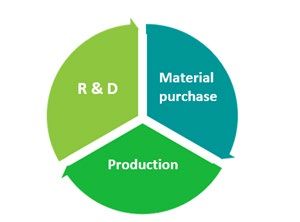
all outsourcing methods. ODM suppliers are responsible for R&D, material procurement,
and production, which contributes more to their revenue. At the same time, through
cooperation with ODMs, the cost of Samsung's low-end mobile phones has improved
greatly. In 2020, Samsung will continue to increase outsourcing ODM projects. However,
because of the need to consolidate Samsung's supply chain, some of Samsung's new
projects in 2020 will begin to adopt the model of designated suppliers or customer supply
for core materials.
In 2019, the overseas markets, which accounted for more than 95% of shipments (mainly
by the Moto brand), continued to dominate Lenovo’s smartphone shipments. The low-
end projects of the C, E, and G series of the Moto brand are outsourced to ODM suppliers
for R&D, design, production, and assembly. Currently, Huaqin, Wingtech, Longcheer,
Chino, and Tinno are all of Lenovo ’s ODM suppliers. Shipments of ODM projects in 2019
were approximately 32 million. As Lenovo projects are relatively fragmented and single-
item shipments have relatively no advantage, Wingtech, Huaqin, and Longcheer have
limited support for Lenovo. In the second half of 2019, the Lenovo Moto brand began to
collaborate with Chino and Tinno.
Key smartphone OEMs' ODM/IDH partners
Out- Out-
house house
OEMs ODM/IDH suppliers
design design
2019 2020E
Samsung 9% 22% Wingtech Huaqin
Huawei 17% 18% Huaqin Wingtech Chino Longcheer
Xiaomi 77% 74% Longcheer Huaqin Wingtech
OPPO 44% 51% Wingtech Huaqin Longcheer
Lenovo 84% 89% Huaqin Wingtech Longcheer Chino Tinno
LG 49% 56% Huaqin Wingtech Longcheer Chino
CMCC 70% 100% Huaqin Wingtech
Nokia 54% 88% Wingtech Huaqin Longcheer Chino
Meizu 0% 0% Wingtech
Source: Omdia © 2020 Omdia
© 2020 Omdia.
All rights reserved. Unauthorized
reproduction prohibited.Handset ODM Industry White Paper 12
ODM market structure and
business model analysis
In 2019, the top five mobile phone ODMs shipped 285 million smartphones, a net
increase of 20 million units YoY. Smartphone customers focused on mobile phone brands
such as OPPO, Xiaomi, Huawei, Samsung, Lenovo, and LG. The top three ODMs—
Wingtech, Huaqin, and Longcheer—accounted for more than 90% of smartphone
shipments. Samsung and OPPO increased outsourcing ODM projects in 2019, mainly
concentrated on Wingtech and Huaqin. The advantages of the duopoly of Wingtech and
Huaqin continued to magnify. In 2019, Wingtech and Huaqin’s ODM business revenue
scale all exceeded ¥30 billion and the average unit price of products exceeded ¥300.
Their advantages in strong R&D, quality control, supply chain management,
manufacturing, and product diversification are obvious. Their business is expected to
continue to grow rapidly in 2020. Longcheer’s ODM business was relatively small
compared with Wingtech and Huaqin as it mainly adopted the IDH model with major
customers Xiaomi and OPPO. Additionally, because of limited production capacity, there
is still a gap in terms of revenue and average unit price.
OPPO, Samsung, Xiaomi, Huawei, and Lenovo were the main partners of mobile phone
ODMs in 2019. The corresponding ODM suppliers were mainly concentrated on
Wingtech, Huaqin, and Longcheer. In 2019, OPPO increased outsourcing ODM projects
and all previous project collaborations were through the ODM model. ODM suppliers
participated in R&D, non-core material procurement, and production assembly, which
helped ODMs improve their revenue levels. Samsung's outsourcing projects started
shipping in the second half of 2019, mass production projects were concentrated in
Wingtech, and the early ODM suppliers were responsible for R&D, material procurement,
and production. The outsourcing projects shipped 26.5 million units in 2019, contributing
more than 40% to Wingtech’s revenue. Huawei and Lenovo continue to use core
materials such as chipsets, memory, screens, camera modules, and batteries for
customer supply. LG and Nokia both currently adopt the ODM model because their
supply chains have no cost advantage compared with ODMs.
© 2020 Omdia.
All rights reserved. Unauthorized
reproduction prohibited.Handset ODM Industry White Paper 13
Model phone ODM business model
Source: Omdia © 2020 Omdia
Supply chain & purchase
Customer Design ODM fully Non-key material Assembly Remark
purchase purchase
Samsung √ √ √ √ ODM
OPPO √ √ √ ODM+IDH
Huawei √ √ √ ODM
Mainly IDH
Xiaomi √ × × √
model
Lenovo √ √ √ ODM
LG √ √ √ √ ODM
Source: Omdia © 2020 Omdia
The global smartphone market is currently saturated. The mature markets such as China,
© 2020 Omdia.
All rights reserved. Unauthorized
Europe, and North America all declined in 2019. The replacement market has intensified
reproduction prohibited. price competition, especially in China and India. Samsung, LG, Nokia, and other
manufacturers have no advantage over Chinese manufacturers such as Huawei, Xiaomi,Handset ODM Industry White Paper 14
and OPPO in competing with low-end models in terms of cost, response speed, and
product positioning. Samsung's cooperation with ODMs in 2019 significantly helped
costs, R&D speed, and product definition of low-end models, especially in the Indian
market. In 2020, it will continue to increase collaboration with ODM projects. The ODM
industry is fiercely competitive and the overall profit is low. However, with the gradual
penetration of 5G, more mobile phone manufacturers will enter the multi-category
model and launch the external cooperation model. Challenges and opportunities co-exist
in the ODM market, and its competitive advantages will also give brand manufacturers
very effective support.
Competitive advantages of the leading ODM
companies
R&D capability Supply chain cost control
Short R&D cycle: 6–8 months for the new platform of 4G The supply chain system standards focus on low-end
smart machines and 4–6 months for the normal cycle specifications, and the standardization and shipment
scale help to lower the cost
Focus on low-end chipset platforms, compared with low-
end single-chip platform projects from OEMs, shipments Adopt mature technology, quality problems can be
are larger and cost allocation is lower effectively controlled after scale
The cost of R&D personnel is relatively low, and the
normal project investment is $30–50 million
Flexible operating model
Improve resource efficiency of OEMs
Mature platform products are quickly copied and
R&D resources can be more concentrated on high-end
applied to new customers
models and new product and technology investment
Diversified production to reduce operational risks
Reduce low-end products cost and enhance product
competitiveness Wingtech and Huaqin shipped more than 100 million
units overall; they have advantages over small and
With the help of ODMs' R&D, capital, supply chain and
medium OEMs, helping small and medium
factory resources, OEMs can reduce its own operating
manufacturers to take advantage of their
costs and risks
differentiation, such as China Mobile and Nokia
Currently, the bottleneck of the popularity of 5G mobile phones is high BOM costs and
selling prices, and cost control has always been the advantage of ODMs. For mobile
phone ODMs, 5G mobile phone R&D, product unit price, and production and assembly
parts revenue have significantly improved. Additionally, the high technical threshold
avoids vicious competition and the increased orders from key customers will directly
promote the performance growth of ODMs. At the same time, Wingtech and Huaqin are
actively deploying overseas manufacturing and the product line continues to expand to
ecological products such as tablets, smartwatches, TWS headphones, and IoT. Through
in-depth cooperation with multi-product lines of core customers, leading ODMs will play
an increasingly important role in the industrial chain to help enrich the customer queue
and product line layout to ensure a more benign and healthy development.
© 2020 Omdia.
All rights reserved. Unauthorized
reproduction prohibited.Handset ODM Industry White Paper 15
Key growth points of the mobile ODM
industry in 2020
5G
• 5G focus on mid- and high-end models in 2020
High technical threshold avoid vicious competition
Profit ~20%
BOM ASP 10–20%
Production cost 50%
Smartphone shipments growth
• Outsourcing smartphone projects shipment growth for Samsung,
OPPO, etc.
• ODM smartphone market will grow to more than 50 million units
Overseas production
• ODM overseas factory layout
• Representative: Wingtech India factory will produce Samsung
projects
• Own factory: Wingtech Equity participation to EMS companies -
Huaqin, Longcheers
Tablets, notebooks, and IoT
• Wingtech: Tablets, notebooks, 5G CPE
• Huaqin: Tablets, notebooks, smartwatches, servers
• Longcheer: Tablets, IoT
• Wingtech/Huaqin: Huawei M6 tablet
• Huaqin: Huawei Smartwatch GT2
© 2020 Omdia.
All rights reserved. Unauthorized
reproduction prohibited.Handset ODM Industry White Paper 16
The top five mobile phone
ODMs
Mobile phone ODMs shipped a total of 325 million mobile phones in 2019, a slight
increase from 320 million mobile phones in 2018. Smartphone shipments from ODMs
increased by more than 20 million units, concentrated in customers such as OPPO,
Samsung, LG, and Nokia. The shipments of outsourcing projects from Huawei and Meizu
declined relatively. OPPO increased the number of mid- and low-end outsourcing projects
in 2019 and opened cooperation with ODMs Wingtech, Huaqin, and Longcheer to
develop new products to cover different product price segments, including its Realme
brand. Shipments of its outsourcing projects exceeded 50 million units, including ODM
and IDH models. Samsung started cooperating with Wingtech in 2019 for low and mid-
range models. It shipped more than 25 million units of its outsourcing projects in 2019.
Meanwhile, it began to collaborate with Huaqin on new projects. LG ’s outsourcing ODM
projects continued to increase in 2019 while Nokia began to cooperate with ODMs. In
2019, Huawei ’s outsourced projects contracted. Affected by the trade ban, the number
of new ODM projects shrank and orders for mass production projects were revised down.
Meizu ’s mobile phone shipments continued to decline, and there were no outsourced
ODM projects in 2019. Similarly, smartphone shipments of overseas customers such as
Micromax, LAVA, Intex, and Spice suffered a rapid decline because of the impact of
Chinese mobile phone manufacturers. The growth of the ODM industry in 2019
continued to focus on large customer projects, which is mainly concentrated with the top
thee ODMs—Wingtech, Huaqin, and Longcheer.
Top 10 smartphone ODMs, 2019
(millions of units)
Rank ODMs 2017 2018 2019 YoY
1 Wingtech 83.7 90.2 110.0 22.0%
2 Huaqin 79.1 84.9 85.0 0.1%
3 Longcheer 34.2 60.0 73.4 22.3%
4 Chino/OnTim 5.9 17.8 15.2 -14.6%
5 TINNO 15.4 11.5 6.5 -43.5%
6 Wind 17.3 5.0 / /
7 Arima 2.7 1.2 / /
8 CCI 2.6 1.0 / /
9 Ragentek 8.1 0.0 / /
10 CK 4.8 0.0 / /
Notes: Smartphone shipment data based on model design.
Source: Omdia © 2020 Omdia
© 2020 Omdia.
All rights reserved. Unauthorized
reproduction prohibited. In terms of smartphone shipments, OPPO and Samsung increased the number of
outsourced projects in 2019. Wingtech was the biggest beneficiary. Its smartphoneHandset ODM Industry White Paper 17
shipments in 2019 reached 110 million units, a YoY increase of 22%. Shipments of
Samsung’s projects increased by 26.5 million units and shipments of OPPO’s projects
increased by more than 20 million units. In 2018, Wingtech:
• Adjusted for mobile phone customers
• Increased cooperation with Samsung and OPPO in new projects
• Reduced new projects with Huawei and Xiaomi
• Avoided the impact of Huawei ’s trade ban in 2019
• Gained significant revenue growth
The best-selling models in 2018 included the OPPO A5 series, the Xiaomi CC9 series, and
Samsung’s new A series. Meanwhile, Huaqin shipped 85 million smartphones in 2019,
which was flat overall. Shipments of new OPPO projects in 2019 increased by 22.5 million
units while shipments of Xiaomi and Lenovo also increased slightly. However, because of
the reduction of new projects and the restrictions of the trade ban, Huawei's overall
shipments declined, but its ODM business revenue continued to grow steadily. The best-
selling models in 2019 included the OPPO Realme 3 series, Redmi 8 series, and the
Huawei Enjoy 9 series. Over at Longcheer, its smartphone shipments were 73.4 million
units in 2019, a YoY increase of 22.3%. Shipment growth was concentrated on new
projects with Xiaomi and OPPO. The shipments of Xiaomi projects increased by 14 million
units and the shipments of OPPO projects increased by 8.9 million units, but mainly with
the IDH model. Chino, on the other hand, shipped 15.2 million smartphones in 2019, a
YoY decline of 14.6%. At the same time, Huawei's project shipments declined. LG and
Nokia's new projects began mass production in 2H19; therefore, shipments contributed
less in 2019. Tinno shipped 6.5 million smartphones in 2019; shipments of its Wiko brand
and the volume of its customer project shipments in the overseas markets both fell
sharply. As a result, it started participating in new Moto projects in 2019, which began
shipping in 2H19.
ODMs have advantages in cost control, and the top three ODMs provide very good
support to customers in R&D and the supply chain. In 2020, Samsung, OPPO, LG, Nokia,
and other customers will continue to increase their outsourcing projects. LG and Nokia
are fully seeking cooperation with mobile phone ODMs. The total increase is estimated to
be 50 million units in 2020. New projects from Samsung, Xiaomi, Huawei, and OPPO will
continue to focus on Wingtech, Huaqin, and Longcheer while LG, Nokia, and Lenovo will
collaborate with Chino and Tinno; the top three ODM suppliers will focus on shipping
smartphones. For smartphones, except for the top five ODMs, other ODMs have
withdrawn. Meizu's market has declined but ODM projects have been recovered, which
led to its ODM supplier, Wind, to stop its ODM business in 2019. Meanwhile, Arima, CCI,
and CK have abandoned the mobile ODM business. Moreover, shipments of Ragentek
smartphones is mainly focused on the Gome brand, but with very few shipment volumes.
© 2020 Omdia.
All rights reserved. Unauthorized
reproduction prohibited.Handset ODM Industry White Paper 18
Analysis of the top five
ODMs
Wingtech
In 2019, Wingtech’s smartphone shipments reached 110 million units, a YoY increase of
22%; its smartphone shipments continued to lead the market. OPPO and Samsung
increased the number of their outsourced projects in 2019; Wingtech was the biggest
beneficiary as a result. In 2018, Wingtech adjusted for its mobile phone customers,
increased cooperation with Samsung and OPPO on new projects, and reduced new
projects with Huawei and Xiaomi. Thus, it earned value gains from new customers and
the overall revenue of its ODM business achieved substantial growth. The best-selling
models included the OPPO A5 series, the Xiaomi CC9 series, and new models of the
Samsung A series. In addition to the mobile phone ODM business, Wingtech participated
in more than 8 million shipments of Huawei's tablet M6 series in 2019; IoT products have
also begun to ship.
According to the current project from major customers, shipments of Wingtech
smartphones are expected to reach 130 million units in 2020. The growth of smartphone
shipments will be concentrated on new projects with Samsung, OPPO, and Huawei, which
will be mainly based on the ODM cooperation model. At the same time, Wingtech has a
first-mover advantage in the development progress of 5G smartphones. Wingtech 5G
mobile phones are expected to mass-produce in 2Q20 and will cover multiple customers
and position on the mid and high-end models. In addition to the mobile phone ODM
business, Wingtech currently participates in Huawei and Xiaomi tablets, notebooks, smart
wearables, and IoT products. Shipments of its non-mobile phone ODM products will grow
simultaneously in 2020.
Wingtech currently has five R&D centers in Shanghai, Shenzhen, Xi'an, and Wuxi in
mainland China and Taipei, Taiwan. It also has production factories in Jiaxing and Wuxi in
China as well as in India, and Indonesia. The R&D and manufacturing centers in Wuxi
started operating in 2019; it is mainly used for R&D and producing smart hardware and
notebook products. At the same time, Wingtech invested in the Kunming Intelligent
Manufacturing Industrial Park located in the Yunnan Province, China in 2019; it is
expected to be operational in the first half of 2021 (1H21). At present, Wingtech's major
global factories have an annual production capacity of more than 80 million units,
realized global order deliveries, and can operate both global material and production
scheduling, which can be directly exported to the European and American markets. In the
future, Wingtech plans to form a production capacity of 100 million units in China and
100 million units in the overseas market as well as industrial chain integration capacity.
© 2020 Omdia. In 2019, Wingtech completed the acquisition of Nexperia, opened the upstream and
All rights reserved. Unauthorized
reproduction prohibited.
midstream of the industry chain, and formed an industrial platform that integrates chip
design, wafer manufacturing, semiconductor packaging and testing, terminal productHandset ODM Industry White Paper 19
R&D, design, and manufacturing. Nexperia is the global leader in semiconductor standard
devices. Its predecessor was the NXP Standard Products Division with more than 60 years
of integrated device manufacturing (IDM) experience. The company began to operate
independently in 2017 and has a global sales network with customers covering many
industries such as automotive, industrial and power, mobile and wearable devices,
consumer, and computers. Major customers include Bosch, Cisco, Huawei, Apple,
Samsung, and other leading global manufacturers. Nexperia products are mainly power
semiconductor discrete devices—there are six categories of metal-oxide-silicon (MOS)
tubes, transistors, diodes, electrostatic discharge (ESD) protection devices, and gallium
nitride (GaN) field-effect tubes. At present, the market share of discrete devices, logic
devices, and metal–oxide–semiconductor field-effect transistor (MOSFET) devices ranks
in the top three in China. The company's performance has been stable. In 2018, the
company's operating income was $1.534 billion, and the average annual compound
growth rate of revenue in 2010–18 reached 6.25%. Wingtech’s acquisition of Nexperia
will help Nexperia open the semiconductor market in China, expand its production
capacity, and improve its profitability under the trend of substitution in China.
© 2020 Omdia.
All rights reserved. Unauthorized
reproduction prohibited.Handset ODM Industry White Paper 20
Wingtech: Market shares of key smartphone customers, 2019
Others
11%
OPPO
Huawei
28%
7%
Lenovo/Moto
10%
Xiaomi Samsung
20% 24%
Source: Omdia © 2020 Omdia
Wingtech: Shipments of key products, 2019
Tablet, 8.6 IoT, 1.9
Phone (IDH), 23.5
Phone (ODM),
86.5
Source: Omdia © 2020 Omdia
© 2020 Omdia.
All rights reserved. Unauthorized
reproduction prohibited.Handset ODM Industry White Paper 21
Huaqin
Huaqin’s smartphone shipment reached 85 million units in 2019, which was flat overall.
In 2019, OPPO's new project shipments increased by 22.5 million units. Xiaomi and
Lenovo's shipments also increased slightly. However, because of the reduction in new
projects and the impact of the trade ban, Huawei smartphone shipments declined. In
addition to the mobile phone ODM business, its tablet, laptop, smartwatch, IoT, and
server businesses have grown rapidly. In 2019, it participated in Huawei's tablet,
notebook, and smartwatch business. Consequently, overall shipment exceeded 30 million
units and the overall revenue of its ODM business has grown steadily. The best-selling
models included the OPPO Realme 3 series, Redmi 8 series, and Huawei Enjoy 9 series.
Xiaomi, OPPO, and Huawei are its top three customers. Shipments of smartphones
accounted for 72.4% while shipments of Lenovo and LG projects remained stable.
For the mobile phone ODM business, Huaqin started collaborating with a new customer,
Samsung, in 2019; mass production started in 1Q20. Shipments of Samsung projects are
expected to reach 30 million units in 2020. Shipments of OPPO’s, Xiaomi’s, and Huawei's
new projects will grow slightly with a shipment target of 140 million smartphones in
2020. For 5G mobile phones, Huaqin is currently involved in Huawei’s, Xiaomi’s, and
OPPO’s 5G mobile phone projects; mass productions are expected in the middle of 2020.
Samsung’s ODM projects and 5G smartphone shipments will significantly improve
Huaqin's ODM performance. In addition to the mobile phone business, Huaqin is steadily
changing and it is continuing to expand its scale advantage in tablets, laptops, and
smartwatches. Huaqin's non-mobile ODM business revenue is expected to exceed 40% in
2020, and its product line and customer structure are further optimized to ensure the
healthy development of its ODM business and reduce operational risks.
Huaqin currently has five R&D centers in Shanghai, Dongguan, Xi'an, Wuxi, and Nanchang
in China as well as production bases in Dongguan and Nanchang, also in China. The
Nanchang R&D and manufacturing center started operating in 2H19; the planned annual
production capacity of intelligent terminal products exceeds 50 million units. In 2020, the
annual production capacity of China factories in Dongguan and Nanchang will reach 120
million units. Overseas, Huaqin has two major manufacturing bases—in India and
Indonesia. India mainly achieves overseas production and manufacturing layout through
its shareholding in DBG. At present, all products shipped in India are produced through
DBG while the Indonesian plant achieves its layout through its shareholding in the
Indonesian PTSN. The overseas plants are expected to achieve an annual production
capacity of 36 million units in 2020.
© 2020 Omdia.
All rights reserved. Unauthorized
reproduction prohibited.Handset ODM Industry White Paper 22
Huaqin: Market shares of key smartphone customers, 2019
Others
7% Huawei
LG
17%
8%
OPPO
26%
Xiaomi
29%
Lenovo/Moto
Source: Omdia
13% © 2020 Omdia
Huaqin: Shipments of key products, 2019
Watch, 5.2
IoT, 4.5
Notebook , 3.5
Tablet, 21.8
Phone (ODM),
60.2
Phone (IDH), 24.8
Source: Omdia © 2020 Omdia
© 2020 Omdia.
All rights reserved. Unauthorized
reproduction prohibited.Handset ODM Industry White Paper 23
Longcheer
Longcheer shipped 73.4 million smartphones in 2019, a YoY increase of 27%, thanks to
the increase in shipments of Huawei and OPPO projects. Huawei's project shipments are
mainly the Honor Play series. Meanwhile, OPPO began cooperating with Longcheer in
2019. As a result, the Realme X2 series shipped more than 6 million units in 2H19. Xiaomi
is still Longcheer ’s largest customer though with a shipment share of more than 60%, a
stable share. Longcheer partly makes its star models, the Redmi Note 7 and Note 8 series.
More than 15 million units of the Redmi Note 7 were shipped while 10 million units of
the Redmi Note 8 were shipped. In contrast, Lenovo's overall shipments declined slightly,
mainly for Moto brand models.
Xiaomi is currently Longcheer's largest customer. As such, the collaboration between the
two companies has been stable and Xiaomi accounted for more than 50% market share
of Longcheer in the past three years. In 2020, Longcheer will continue to cooperate with
Xiaomi to develop the Redmi series projects, including the best-selling series such as the
Redmi 9A and Note 9. Additionally, Longcheer began to participate in Huawei's ODM
project since 2018; it shipped 8.9 million smartphones in 2019. Because of Huawei's
contracted outsourced ODM project, shipments are expected to decline slightly in 2020.
Meanwhile, Longcheer and OPPO's collaboration currently uses the IDH model.
Longcheer does not participate in material procurement and production; thus, OPPO will
increase cooperation projects in 2020 with IDH and ODM coexistence models.
Consequently, its smartphone shipments will increase significantly in 2020. At present,
Longcheer is also actively contacting Samsung and Vivo; they have an opportunity to
cooperate through the mature IDH model.
In addition to smartphones, Longcheer’s tablet products mainly cooperate with Huawei
and Lenovo. Shipments have remained stable with 9 million units shipped in 2019. As
online education accelerated the demand for tablets, shipments are expected to increase
by 30% in 2020 to approximately 12 million units. For IoT products, a separate business
unit was set up to operate independently in 2019 to enhance the strategic position of IoT
within the company. Together with mobile phones and tablets, the company's three
major businesses were formed. In 2019, shipments were mainly concentrated on
Xiaomi’s ecological chain products. In May 2019, Longcheer and AAC Technologies jointly
signed an investment agreement for artificial intelligence (AI) wearable acoustics and
other equipment projects. They also jointly made efforts in the field of wearable
acoustics to continue expanding new IoT customers. IoT products currently shipped
mainly include smartwatches, children's watches, smart speakers and virtual reality (VR);
more than 8 million units were shipped in 2019.
© 2020 Omdia.
All rights reserved. Unauthorized
reproduction prohibited.Handset ODM Industry White Paper 24
Longcheer: Market shares of key smartphone customers, 2019
LG
Lenovo/Moto 4% Others
6% 2%
OPPO
8%
Huawei
12%
Xiaomi
68%
Source: Omdia © 2020 Omdia
Longcheer: Shipments of key products, 2019
IoT, 8.0
Tablet, 9.0 Phone (ODM),
27.4
Phone (IDH), 46.0
Source: Omdia © 2020 Omdia
© 2020 Omdia.
All rights reserved. Unauthorized
reproduction prohibited.Handset ODM Industry White Paper 25
Chino
Chino's key customers were Huawei and Lenovo (Moto and Lenovo brand) in 2019.
However, because of the recycling of Huawei's ODM projects, Chino had no new projects
to participate in. At the same time, Lenovo's projects decreased. Shipments in 2019 were
mainly from Huawei's mass-produced projects such as the Huawei Play 8C. Its
smartphone shipments were 15 million units in 2019, down 15% YoY.
The cooperation model was mainly the ODM model. Huawei and Lenovo supplied the key
components for Huawei’s and Lenovo’s projects while Chino purchased the other
materials. Chino was also responsible for the procurement of materials for other
customers' projects such as the Lenovo brand, LG, and Nokia. Chino was fully involved in
R&D and production assembly. However, the overall shipment volume was limited, and
the share of self-purchase was low. Because Chino had no advantage in the quantity and
amount of procurement, it had a weak bargaining power in the supply chain.
The low- and mid-end models of the Lenovo Moto brand are expected to become the
main force of Chino shipments in 2020 while LG and Nokia shipments will also increase
slightly. At the same time, Chino will participate in Lenovo’s mid- to low-end 5G models in
2020; shipments are expected to start in the second half of 2020 (2H20). At the same
time, Chino is also actively expanding its IoT business in search of new growth points.
© 2020 Omdia.
All rights reserved. Unauthorized
reproduction prohibited.Handset ODM Industry White Paper 26
Chino: Market shares of key smartphone customers, 2019
Others Lenovo/Moto
Nokia 7% 13%
3%
LG
5%
Huawei
Source: Omdia 72% © 2020 Omdia
Chino: Shipments of key products, 2019
Phone (ODM),
15.2
Source: Omdia © 2020 Omdia
© 2020 Omdia.
All rights reserved. Unauthorized
reproduction prohibited.Handset ODM Industry White Paper 27
Tinno
Tinno’s smartphone shipments are mainly concentrated in overseas customers such as its
brands, Wiko and MMX. Because of the rapid growth of Chinese OEMs—OPPO, Xiaomi,
and Vivo—in the Indian market, shipments of the leading brands in the local market have
shrunk rapidly. Its overall shipments have declined for four consecutive years.
Tinno began to participate in the Lenovo Moto brand project in 2019 with low-end
specifications; it began shipping in 4Q19. Tinno's bargaining power was relatively weak in
the supply chain for a limited shipment volume though.
Because of the shipments of Lenovo's Moto project, Tinno’s overall shipments are
expected to will increase in 2020, making Lenovo Tinno's largest customer. Currently,
Samsung, OPPO, Xiaomi, and Huawei are mainly focused on Wingtech, Huaqin, and
Longcheer; Tinno can compete for customer projects from LG and Nokia in 2020.
Tinno: Market shares of key smartphone customers, 2019
Lenovo/Moto
23%
Others
31%
Wiko
46%
Source: Omdia © 2020 Omdia
© 2020 Omdia.
All rights reserved. Unauthorized
reproduction prohibited.Handset ODM Industry White Paper 28
Tinno: Shipments of key products, 2019
Phone (ODM), 6.5
Source: Omdia © 2020 Omdia
© 2020 Omdia.
All rights reserved. Unauthorized
reproduction prohibited.Handset ODM Industry White Paper 29
Appendix
Authors
Robin Li Lingling Peng
Senior Analyst, China Research Senior Analyst, Semiconductors and
robin.li@omdia.com Components
lingling.peng@omdia.com
© 2020 Omdia.
All rights reserved. Unauthorized
reproduction prohibited.Handset ODM Industry White Paper 30
Get in touch Omdia consulting
www.omdia.com Omdia is a market-leading data, research, and consulting business
askananalyst@omdia.com focused on helping digital service providers, technology companies, and
enterprise decision-makers thrive in the connected digital economy.
Through our global base of analysts, we offer expert analysis and strategic
insight across the IT, telecoms, and media industries.
We create business advantage for our customers by providing actionable
insight to support business planning, product development, and go-to-
market initiatives.
Our unique combination of authoritative data, market analysis, and
vertical industry expertise is designed to empower decision-making,
helping our clients profit from new technologies and capitalize on
evolving business models.
Omdia is part of Informa Tech, a B2B information services business
serving the technology, media, and telecoms sector. The Informa group is
listed on the London Stock Exchange.
We hope that this analysis will help you make informed and imaginative
business decisions. If you have further requirements, Omdia’s consulting
team may be able to help your company identify future trends
and opportunities.
Copyright notice and disclaimer
The Omdia research, data and information referenced herein (the “Omdia
Materials") are the copyrighted property of Informa Tech and its
subsidiaries or affiliates (together “Informa Tech”) and represent data,
research, opinions or viewpoints published by Informa Tech, and are not
representations of fact.
The Omdia Materials reflect information and opinions from the original
publication date and not from the date of this document. The information
and opinions expressed in the Omdia Materials are subject to change
without notice and Informa Tech does not have any duty or responsibility
to update the Omdia Materials or this publication as a result.
Omdia Materials are delivered on an “as-is” and “as-available” basis. No
representation or warranty, express or implied, is made as to the fairness,
accuracy, completeness or correctness of the information, opinions and
conclusions contained in Omdia Materials.
To the maximum extent permitted by law, Informa Tech and its affiliates,
officers, directors, employees and agents, disclaim any liability (including,
without limitation, any liability arising from fault or negligence) as to the
accuracy or completeness or use of the Omdia Materials. Informa Tech
© 2020 Omdia. will not, under any circumstance whatsoever, be liable for any trading,
All rights reserved. Unauthorized
investment, commercial or other decisions based on or made in reliance
reproduction prohibited.
of the Omdia Materials.You can also read


