How climate change caused the world's first empire to collapse - Phys.org
←
→
Page content transcription
If your browser does not render page correctly, please read the page content below
How climate change caused the world's first
empire to collapse
3 January 2019, by Vasile Ersek

                                                       Akkadia was the world's first empire. It was
                                                       established in Mesopotamia around 4,300 years
                                                       ago after its ruler, Sargon of Akkad, united a series
                                                       of independent city states. Akkadian influence
                                                       spanned along the Tigris and Euphrates rivers from
                                                       what is now southern Iraq, through to Syria and
                                                       Turkey. The north-south extent of the empire meant
                                                       that it covered regions with different climates,
                                                       ranging from fertile lands in the north which were
                                                       highly dependent on rainfall (one of Asia's "bread
                                                       baskets"), to the irrigation-fed alluvial plains to the
                                                       south.

                                                       It appears that the empire became increasingly
                                                       dependent on the productivity of the northern lands
                                                       and used the grains sourced from this region to
                                                       feed the army and redistribute the food supplies to
                                                       key supporters. Then, about a century after its
                                                       formation, the Akkadian Empire suddenly
                                                       collapsed, followed by mass migration and
                                                       conflicts. The anguish of the era is perfectly
                                                       captured in the ancient Curse of Akkad text, which
                                                       describes a period of turmoil with water and food
                                                       shortages: "… the large arable tracts yielded no
                                                       grain, the inundated fields yielded no fish, the
                                                       irrigated orchards yielded no syrup or wine, the
                                                       thick clouds did not rain."

                                                       Drought and dust

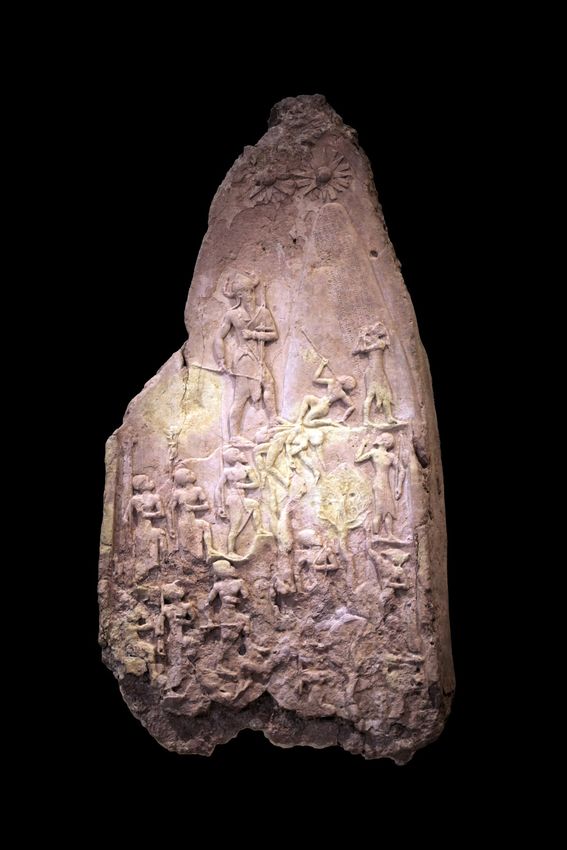
King Naram-Sin of Akkad, grandson of Sargon, leading   The reason for this collapse is still debated by
his army to victory. Credit: Rama / Louvre, CC BY-SA   historians, archaeologists and scientists. One of the
                                                       most prominent views, championed by Yale
                                                       archaeologist Harvey Weiss (who built on earlier
                                                       ideas by Ellsworth Huntington), is that it was
Gol-e-Zard Cave lies in the shadow of Mount            caused by an abrupt onset of drought conditions
Damavand, which at more than 5,000 metres              which severely affected the productive northern
dominates the landscape of northern Iran. In this      regions of the empire.
cave, stalagmites and stalactites are growing
slowly over millennia and preserve in them clues       Weiss and his colleagues discovered evidence in
about past climate events. Changes in stalagmite       northern Syria that this once prosperous region was
chemistry from this cave have now linked the           suddenly abandoned around 4,200 years ago, as
collapse of the Akkadian Empire to climate             indicated by a lack of pottery and other
changes more than 4,000 years ago.                     archaeological remains. Instead, the rich soils of

                                                                                                      1/3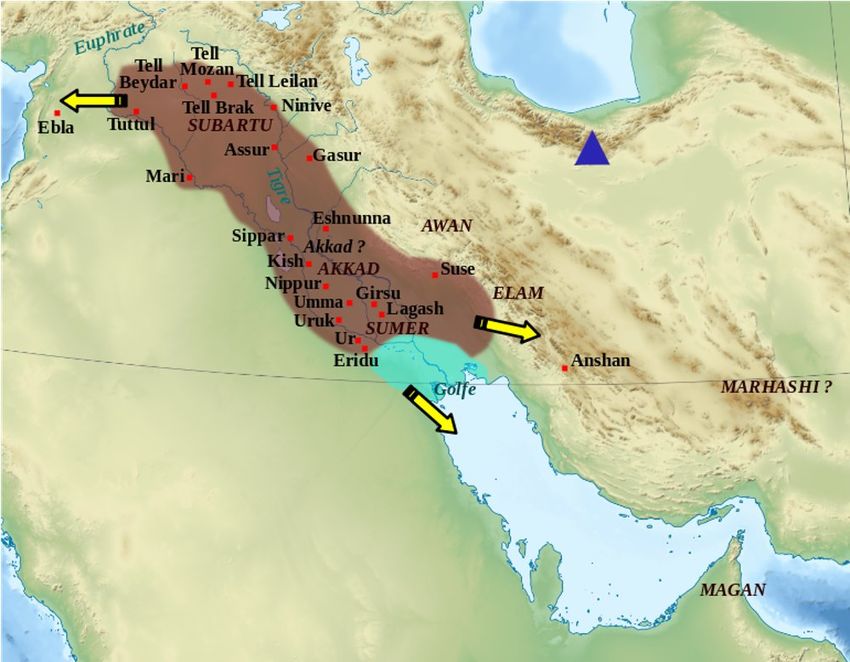
earlier periods were replaced by large amounts of the east of the former Akkadian Empire, but it is
wind-blown dust and sand, suggesting the onset of directly downwind. As a result, around 90% of the
drought conditions. Subsequently, marine cores     region's dust originates in the deserts of Syria and
from the Gulf of Oman and the Red Sea which        Iraq.
linked the input of dust into the sea to distant
sources in Mesopotamia, provided further evidence That desert dust has a higher concentration of
of a regional drought at the time.                 magnesium than the local limestone which forms
                                                   most of Gol-e-Zard's stalagmites (the ones which
                                                   grow upwards from the cave floor). Therefore, the
                                                   amount of magnesium in the Gol-e-Zard
                                                   stalagmites can be used as an indicator of
                                                   dustiness at the surface, with higher magnesium
                                                   concentrations indicating dustier periods, and by
                                                   extension drier conditions.

                                                       The stalagmites have the additional advantage that
                                                       they can be dated very precisely using uranium-
                                                       thorium chronology. Combining these methods, our
                                                       new study provides a detailed history of dustiness
                                                       in the area, and identifies two major drought
                                                       periods which started 4,510 and 4,260 years ago,
                                                       and lasted 110 and 290 years respectively. The
                                                       latter event occurs precisely at the time of the
                                                       Akkadian Empire's collapse and provides a strong
                                                       argument that climate change was at least in part
The Akkad empire during the reign of Narâm-Sîn         responsible.
(2254-2218 BC). Mount Damavand is labelled in blue.
Credit: Zunkir / Semhir / wiki, CC BY-SA               The collapse was followed by mass migration from
                                                       north to south which was met with resistance by the
                                                       local populations. A 180km wall – the "Repeller of
                                                       the Amorites" – was even built between the Tigris
Many other researchers viewed Weiss's                  and Euphrates in an effort to control immigration,
interpretation with scepticism, however. Some          not unlike some strategies proposed today. The
argued, for example, that the archaeological and       stories of abrupt climate change in the Middle East
marine evidence was not accurate enough to             therefore echo over millennia to the present day.
demonstrate a robust correlation between drought
and societal change in Mesopotamia.                    This article is republished from The Conversation
                                                       under a Creative Commons license. Read the
A new detailed climate record

Now, stalagmite data from Iran sheds new light on
the controversy. In a study published in the journal
PNAS, led by Oxford palaeoclimatologist Stacy
Carolin, colleagues and I provide a very well dated
and high resolution record of dust activity between
5,200 and 3,700 years ago. And cave dust from
Iran can tell us a surprising amount about climate
history elsewhere.

Gol-e-Zard Cave might be several hundred miles to

                                                       original article.
                                                                                                   2/3
Provided by The Conversation
                                   APA citation: How climate change caused the world's first empire to collapse (2019, January 3) retrieved
                                   8 May 2019 from https://phys.org/news/2019-01-climate-world-empire-collapse.html

                                   This document is subject to copyright. Apart from any fair dealing for the purpose of private study or research, no
                                   part may be reproduced without the written permission. The content is provided for information purposes only.

                                                                                                                                                3/3

Powered by TCPDF (www.tcpdf.org)
You can also read


