Computational Science and Its Applications-ICCSA 2019 - Siti di Unica
←
→
Page content transcription
If your browser does not render page correctly, please read the page content below
Sanjay Misra · Osvaldo Gervasi ·
             Beniamino Murgante · Elena Stankova ·
             Vladimir Korkhov · Carmelo Torre ·
             Ana Maria A. C. Rocha · David Taniar ·
             Bernady O. Apduhan · Eufemia Tarantino (Eds.)

             Computational Science
LNCS 11624

             and Its Applications –
             ICCSA 2019
             19th International Conference
             Saint Petersburg, Russia, July 1–4, 2019
             Proceedings, Part VI
Lecture Notes in Computer Science                          11624
Commenced Publication in 1973
Founding and Former Series Editors:
Gerhard Goos, Juris Hartmanis, and Jan van Leeuwen

Editorial Board Members
David Hutchison
   Lancaster University, Lancaster, UK
Takeo Kanade
   Carnegie Mellon University, Pittsburgh, PA, USA
Josef Kittler
   University of Surrey, Guildford, UK
Jon M. Kleinberg
   Cornell University, Ithaca, NY, USA
Friedemann Mattern
   ETH Zurich, Zurich, Switzerland
John C. Mitchell
   Stanford University, Stanford, CA, USA
Moni Naor
   Weizmann Institute of Science, Rehovot, Israel
C. Pandu Rangan
   Indian Institute of Technology Madras, Chennai, India
Bernhard Steffen
   TU Dortmund University, Dortmund, Germany
Demetri Terzopoulos
   University of California, Los Angeles, CA, USA
Doug Tygar
   University of California, Berkeley, CA, USA

More information about this series at http://www.springer.com/series/7407

Sanjay Misra Osvaldo Gervasi
            •               •

Beniamino Murgante Elena Stankova
                    •                   •

Vladimir Korkhov Carmelo Torre
                •               •

Ana Maria A. C. Rocha   •

David Taniar Bernady O. Apduhan
            •                       •

Eufemia Tarantino (Eds.)

Computational Science
and Its Applications –
ICCSA 2019
19th International Conference
Saint Petersburg, Russia, July 1–4, 2019
Proceedings, Part VI

123
Editors
Sanjay Misra                                            Osvaldo Gervasi
Covenant University                                     University of Perugia
Ota, Nigeria                                            Perugia, Italy
Beniamino Murgante                                      Elena Stankova
University of Basilicata                                Saint Petersburg State University
Potenza, Italy                                          Saint Petersburg, Russia
Vladimir Korkhov                                        Carmelo Torre
Saint Petersburg State University                       Polytechnic University of Bari
Saint Petersburg, Russia                                Bari, Italy
Ana Maria A. C. Rocha                                   David Taniar
University of Minho                                     Monash University
Braga, Portugal                                         Clayton, VIC, Australia
Bernady O. Apduhan                                      Eufemia Tarantino
Kyushu Sangyo University                                Polytechnic University of Bari
Fukuoka, Japan                                          Bari, Italy

ISSN 0302-9743                      ISSN 1611-3349 (electronic)
Lecture Notes in Computer Science
ISBN 978-3-030-24310-4              ISBN 978-3-030-24311-1 (eBook)
https://doi.org/10.1007/978-3-030-24311-1
LNCS Sublibrary: SL1 – Theoretical Computer Science and General Issues

© Springer Nature Switzerland AG 2019
This work is subject to copyright. All rights are reserved by the Publisher, whether the whole or part of the
material is concerned, specifically the rights of translation, reprinting, reuse of illustrations, recitation,
broadcasting, reproduction on microfilms or in any other physical way, and transmission or information
storage and retrieval, electronic adaptation, computer software, or by similar or dissimilar methodology now
known or hereafter developed.
The use of general descriptive names, registered names, trademarks, service marks, etc. in this publication
does not imply, even in the absence of a specific statement, that such names are exempt from the relevant
protective laws and regulations and therefore free for general use.
The publisher, the authors and the editors are safe to assume that the advice and information in this book are
believed to be true and accurate at the date of publication. Neither the publisher nor the authors or the editors
give a warranty, expressed or implied, with respect to the material contained herein or for any errors or
omissions that may have been made. The publisher remains neutral with regard to jurisdictional claims in
published maps and institutional affiliations.

This Springer imprint is published by the registered company Springer Nature Switzerland AG
The registered company address is: Gewerbestrasse 11, 6330 Cham, Switzerland
Preface

These six volumes (LNCS volumes 11619–11624) consist of the peer-reviewed papers
from the 2019 International Conference on Computational Science and Its Applications
(ICCSA 2019) held in St. Petersburg, Russia during July 1–4, 2019, in collaboration
with the St. Petersburg University, St. Petersburg, Russia.
    ICCSA 2019 was a successful event in the International Conferences on Compu-
tational Science and Its Applications (ICCSA) series, previously held in Melbourne,
Australia (2018), Trieste, Italy (2017), Beijing, China (2016), Banff, Canada (2015),
Guimaraes, Portugal (2014), Ho Chi Minh City, Vietnam (2013), Salvador, Brazil
(2012), Santander, Spain (2011), Fukuoka, Japan (2010), Suwon, South Korea (2009),
Perugia, Italy (2008), Kuala Lumpur, Malaysia (2007), Glasgow, UK (2006), Singa-
pore (2005), Assisi, Italy (2004), Montreal, Canada (2003), and (as ICCS) Amsterdam,
The Netherlands (2002) and San Francisco, USA (2001).
    Computational science is a main pillar of most of the current research, industrial and
commercial activities, and plays a unique role in exploiting ICT innovative technolo-
gies. The ICCSA conference series have been providing a venue to researchers and
industry practitioners to discuss new ideas, to share complex problems and their
solutions, and to shape new trends in computational science.
    Apart from the general track, ICCSA 2019 also included 33 workshops, in various
areas of computational sciences, ranging from computational science technologies, to
specific areas of computational sciences, such as software engineering, security,
artificial intelligence, and blockchain technologies. We accepted 64 papers distributed
in the five general tracks, 259 in workshops and ten short papers. We would like to
show our appreciations to the workshop chairs and co-chairs.
    The success of the ICCSA conference series, in general, and ICCSA 2019, in
particular, is due to the support of many people: authors, presenters, participants,
keynote speakers, workshop chairs, Organizing Committee members, student volun-
teers, Program Committee members, Advisory Committee members, international
liaison chairs, reviewers and people in other various roles. We would like to thank them
all.
    We also thank our publisher, Springer, for accepting to publish the proceedings, for
sponsoring part of the best papers awards and for their kind assistance and cooperation
during the editing process.
    We cordially invite you to visit the ICCSA website http://www.iccsa.org where you
can find all relevant information about this interesting and exciting event.

July 2019                                                              Osvaldo Gervasi
                                                                   Beniamino Murgante
                                                                          Sanjay Misra
Welcome to St. Petersburg Welcome to St. Petersburg, the Venice of the North, the city of three revolutions, creation of czar Peter the Great, the most European city in Russia. ICCSA 2019 was hosted by St. Petersburg State University, during July 1–4, 2019. St. Petersburg is the second largest city in Russia after Moscow. It is the former capital of Russia and has a lot of attractions related to this role in the past: imperial palaces and parks both in the city center and suburbs, respectable buildings of nobles and state institutions, multitude of rivers and canals with more than 300 bridges of various forms and sizes. Extraordinary history and rich cultural traditions of both imperial Russia and the Soviet Union attracted and inspired many examples of world’s greatest architecture, literature, music, and visual art, some of which can be found in the famous Hermitage and State Russian Museum located in the heart of the city. Late June and early July is the season of white nights where the sun sets only for a few hours, and the nighttime is covered with mysterious twilight. What to do in the city: • Enjoy the white nights, see the open bridges during the night and cargo ships passing by from Ladoga Lake to the Gulf of Finland and back. Dvortsovy bridge is open at about 1am. Be sure to stay on the correct side of the river when the bridges open! • Visit Hermitage (Winter palace) and State Russian Museum to see great examples of international and Russian art, and the Kunstkammer, the oldest museum of St. Petersburg founded by Peter the Great. • Travel to St. Petersburg suburbs Peterhof and Tsarskoe Selo to see imperial palaces and splendid parks, famous Peterhof fountains. • Eat Russian food: borsch (beetroot soup), pelmeni and vareniki (meat and sweet dumplings), bliny (pancakes), vinegret (beetroot salad), drink kvas and maybe some vodka. • Walk around and inside the Peter and Paul Fortress, the place where the city began in 1703. • Visit the Mariinsky Theater for famous Russian ballet and opera. • Have a boat tour along the Neva River and canals to look at the city from the water. • Walk along Nevsky Prospect, the main street of the city. • Climb St. Isaac’s Cathedral colonnade to enjoy great city views. • Go down to the Metro, the city’s underground train network with some Soviet-style museum-like stations. • Pay a visit to the recently renovated Summer Garden, the oldest park of St. Petersburg. • Visit a new modern open space on the New Holland Island to see modern art exhibitions, performances and just to relax and enjoy sitting on the grass with an ice cream or lemonade during a hot summer day.
viii      Welcome to St. Petersburg

   St. Petersburg State University is the oldest university in Russia, an actively
developing, world-class center of research and education. The university dates back to
1724, when Peter the Great founded the Academy of Sciences and Arts as well as the
first Academic University and the university preparatory school in Russia. At present
there are over 5,000 academic staff members and more than 30,000 students, receiving
education in more than 400 educational programs at 25 faculties and institutes.
   The venue of ICCSA is the Faculty of Economics located on Tavricheskaya Street,
other faculties and university buildings are distributed all over the city with the main
campus located on Vasilievsky Island and the natural science faculties (Mathematics
and Mechanics, Applied Mathematics and Control Processes, Physics, Chemistry)
located on the campus about 40 kilometers away from the city center in Peterhof.

                                                                       Elena Stankova
                                                                    Vladimir Korkhov
                                                                 Nataliia Kulabukhova
Organization ICCSA 2019 was organized by St. Petersburg University (Russia), University of Perugia (Italy), University of Basilicata (Italy), Monash University (Australia), Kyushu Sangyo University (Japan), University of Minho, (Portugal). Honorary General Chairs Antonio Laganà University of Perugia, Italy Norio Shiratori Tohoku University, Japan Kenneth C. J. Tan Sardina Systems, Estonia General Chairs Osvaldo Gervasi University of Perugia, Italy Elena Stankova St. Petersburg University, Russia Bernady O. Apduhan Kyushu Sangyo University, Japan Program Committee Chairs Beniamino Murgante University of Basilicata, Italy David Taniar Monash University, Australia Vladimir Korkov St. Petersburg University, Russia Ana Maria A. C. Rocha University of Minho, Portugal International Advisory Committee Jemal Abawajy Deakin University, Australia Dharma P. Agarwal University of Cincinnati, USA Rajkumar Buyya Melbourne University, Australia Claudia Bauzer Medeiros University of Campinas, Brazil Manfred M. Fisher Vienna University of Economics and Business, Austria Marina L. Gavrilova University of Calgary, Canada Yee Leung Chinese University of Hong Kong, SAR China International Liaison Chairs Ana Carla P. Bitencourt Universidade Federal do Reconcavo da Bahia, Brazil Giuseppe Borruso University of Trieste, Italy Alfredo Cuzzocrea ICAR-CNR and University of Calabria, Italy Maria Irene Falcão University of Minho, Portugal Robert C. H. Hsu Chung Hua University, Taiwan Tai-Hoon Kim Hannam University, South Korea Sanjay Misra Covenant University, Nigeria
x      Organization

Takashi Naka                Kyushu Sangyo University, Japan
Rafael D. C. Santos         National Institute for Space Research, Brazil
Maribel Yasmina Santos      University of Minho, Portugal

Workshop and Session Organizing Chairs
Beniamino Murgante          University of Basilicata, Italy
Sanjay Misra                Covenant University, Nigeria
Jorge Gustavo Rocha         University of Minho, Portugal

Award Chair
Wenny Rahayu                La Trobe University, Australia

Publicity Committee Chairs
Elmer Dadios                De La Salle University, Philippines
Hong Quang Nguyen           International University (VNU-HCM), Vietnam
Daisuke Takahashi           Tsukuba University, Japan
Shangwang Wang              Beijing University of Posts and Telecommunications,
                               China

Workshop Organizers
Advanced Transport Tools and Methods (A2TM 2019)
Massimiliano Petri          University of Pisa, Italy
Antonio Pratelli            University of Pisa, Italy

Advanced Computational Approaches in Fractals, Wavelet, Entropy and Data
Mining Applications (AAFTWTETDT 2019)
Yeliz Karaca                University of Massachusetts Medical School, USA
Yu-Dong Zhang               University of Leicester, UK
Majaz Moonis                University of Massachusettes Medical School, USA

Advances in Artificial Intelligence Learning Technologies: Blended Learning,
STEM, Computational Thinking and Coding (AAILT 2019)
Alfredo Milani              University of Perugia, Italy
Sergio Tasso                University of Perugia, Italy
Valentina Poggioni          University of Perugia, Italy

Affective Computing and Emotion Recognition (ACER-EMORE 2019)
Alfredo Milani              University of Perugia, Italy
Valentina Franzoni          University of Perugia, Italy
Giulio Biondi               University of Florence, Itay
Organization xi
Advances in Information Systems and Technologies for Emergency Management,
Risk Assessment and Mitigation Based on the Resilience Concepts (ASTER 2019)
Maurizio Pollino ENEA, Italy
Marco Vona University of Basilicata, Italy
Beniamino Murgante University of Basilicata, Italy
Blockchain and Distributed Ledgers: Technologies and Application
(BDLTA 2019)
Vladimir Korkhov St. Petersburg State University, Russia
Elena Stankova St. Petersburg State University, Russia
Bio and Neuro-inspired Computing and Applications (BIONCA 2019)
Nadia Nedjah State University of Rio de Janeiro, Brazil
Luiza de Macedo Mourell State University of Rio de Janeiro, Brazil
Computer Aided Modeling, Simulation, and Analysis (CAMSA 2018)
Jie Shen University of Michigan, USA
Hao Chen Shanghai University of Engineering Science, China
Youguo He Jiangsu University, China
Computational and Applied Statistics (CAS 2019)
Ana Cristina Braga University of Minho, Portugal
Computational Mathematics, Statistics, and Information Management
(CMSIM 2019)
M. Filomena Teodoro Portuguese Naval Academy and Lisbon University,
Portugal
Computational Optimization and Applications (COA 2019)
Ana Maria Rocha University of Minho, Portugal
Humberto Rocha University of Coimbra, Portugal
Computational Astrochemistry (CompAstro 2019)
Marzio Rosi University of Perugia, Italy
Dimitrios Skouteris Master-up, Perugia, Italy
Fanny Vazart Université Grenoble Alpes, France
Albert Rimola Universitat Autònoma de Barcelona, Spain
Cities, Technologies, and Planning (CTP 2019)
Beniamino Murgante University of Basilicata, Italy
Giuseppe Borruso University of Trieste, Italyxii Organization
Econometrics and Multidimensional Evaluation in the Urban Environment
(EMEUE 2019)
Carmelo M. Torre Polytechnic of Bari, Italy
Pierluigi Morano Polytechnic of Bari, Italy
Maria Cerreta University of Naples Federico II, Italy
Paola Perchinunno University of Bari, Italy
Francesco Tajani University of Rome La Sapienza, Italy
Future Computing System Technologies and Applications (FISTA 2019)
Bernady O. Apduhan Kyushu Sangyo University, Japan
Rafael Santos National Institute for Space Research, Brazil
Geographical Analysis, Urban Modeling, Spatial Statistics
(GEO-AND-MOD 2019)
Beniamino Murgante University of Basilicata, Italy
Giuseppe Borruso University of Trieste, Italy
Hartmut Asche University of Potsdam, Germany
Geomatics for Resource Monitoring and Control (GRMC 2019)
Eufemia Tarantino Polytechnic of Bari, Italy
Rosa Lasaponara Italian Research Council, IMAA-CNR, Italy
Benedetto Figorito ARPA Puglia, Italy
Umberto Fratino Polytechnic of Bari, Italy
International Symposium on Software Quality (ISSQ 2019)
Sanjay Misra Covenant University, Nigeria
Land Use Monitoring for Sustainability (LUMS 2019)
Carmelo M. Torre Polytechnic of Bari, Italy
Alessandro Bonifazi Polytechnic of Bari, Italy
Pasquale Balena Polytechnic of Bari, Italy
Beniamino Murgante University of Basilicata, Italy
Eric Gielen Polytechnic University of Valencia, Spain
Machine Learning for Space and Earth Observation Data (ML-SEOD 2019)
Rafael Santos Brazilian National Institute for Space Research, Brazil
Karine Reis Ferreira National Institute for Space Research, Brazil
Mobile-Computing, Sensing, and Actuation in Cyber Physical Systems
(MSA4CPS 2019)
Saad Qaisar National University of Sciences and Technology,
Pakistan
Moonseong Kim Seoul Theological University, South KoreaOrganization xiii Quantum Chemical Modeling of Solids with Computers: From Plane Waves to Local Structures (QuaCheSol 2019) Andrei Tchougréeff Russia Academy of Sciences, Russia Richard Dronskowski RWTH Aachen University, Germany Taku Onishi Mie University and Tromsoe University, Japan Scientific Computing Infrastructure (SCI 2019) Vladimir Korkhov St. Petersburg State University, Russia Elena Stankova St. Petersburg State University, Russia Nataliia Kulabukhova St. Petersburg State University, Russia Computational Studies for Energy and Comfort in Building (SECoB 2019) Senhorinha Teixeira University of Minho, Portugal Angela Silva Viana do Castelo Polytechnic Institute, Portugal Ana Maria Rocha University of Minho, Portugal Software Engineering Processes and Applications (SEPA 2019) Sanjay Misra Covenant University, Nigeria Smart Factory Convergence (SFC 2019) Jongpil Jeong Sungkyunkwan University, South Korea Smart City and Water. Resource and Risk (Smart_Water 2019) Giuseppe Borruso University of Trieste, Italy Ginevra Balletto University of Cagliari, Italy Gianfranco Becciu Polytechnic University of Milan, Italy Chiara Garau University of Cagliari, Italy Beniamino Murgante University of Basilicata, Italy Francesco Viola University of Cagliari, Italy Sustainability Performance Assessment: Models, Approaches, and Applications Toward Interdisciplinary and Integrated Solutions (SPA 2019) Francesco Scorza University of Basilicata, Italy Valentin Grecu Lucia Blaga University on Sibiu, Romania Jolanta Dvarioniene Kaunas University, Lithuania Sabrina Lai University of Cagliari, Italy Theoretical and Computational Chemistry and Its Applications (TCCMA 2019) Noelia Faginas Lago University of Perugia, Italy Andrea Lombardi University of Perugia, Italy Tools and Techniques in Software Development Processes (TTSDP 2019) Sanjay Misra Covenant University, Nigeria
xiv      Organization

Virtual Reality and Applications (VRA 2019)
Osvaldo Gervasi            University of Perugia, Italy
Sergio Tasso               University of Perugia, Italy

Collective, Massive and Evolutionary Systems (WCES 2019)
Alfredo Milani             University of Perugia, Italy
Valentina Franzoni         University of Rome La Sapienza, Italy
Rajdeep Niyogi             Indian Institute of Technology at Roorkee, India
Stefano Marcugini          University of Perugia, Italy

Parallel and Distributed Data Mining (WPDM 2019)
Massimo Cafaro             University   of   Salento,   Italy
Italo Epicoco              University   of   Salento,   Italy
Marco Pulimeno             University   of   Salento,   Italy
Giovanni Aloisio           University   of   Salento,   Italy

Program Committee
Kenneth Adamson            University of Ulster, UK
Vera Afreixo               University of Aveiro, Portugal
Filipe Alvelos             University of Minho, Portugal
Remadevi Arjun             National Institute of Technology Karnataka, India
Hartmut Asche              University of Potsdam, Germany
Ginevra Balletto           University of Cagliari, Italy
Michela Bertolotto         University College Dublin, Ireland
Sandro Bimonte             CEMAGREF, TSCF, France
Rod Blais                  University of Calgary, Canada
Ivan Blec̆ić               University of Sassari, Italy
Giuseppe Borruso           University of Trieste, Italy
Ana Cristina Braga         University of Minho, Portugal
Massimo Cafaro             University of Salento, Italy
Yves Caniou                Lyon University, France
José A. Cardoso e Cunha    Universidade Nova de Lisboa, Portugal
Leocadio G. Casado         University of Almeria, Spain
Carlo Cattani              University of Salerno, Italy
Mete Celik                 Erciyes University, Turkey
Hyunseung Choo             Sungkyunkwan University, South Korea
Min Young Chung            Sungkyunkwan University, South Korea
Florbela Maria da Cruz     Polytechnic Institute of Viana do Castelo, Portugal
   Domingues Correia
Gilberto Corso Pereira     Federal University of Bahia, Brazil
Alessandro Costantini      INFN, Italy
Carla Dal Sasso Freitas    Universidade Federal do Rio Grande do Sul, Brazil
Pradesh Debba              The Council for Scientific and Industrial Research
                              (CSIR), South Africa
Hendrik Decker             Instituto Tecnológico de Informática, Spain
Organization xv
Frank Devai London South Bank University, UK
Rodolphe Devillers Memorial University of Newfoundland, Canada
Joana Matos Dias University of Coimbra, Portugal
Paolino Di Felice University of L’Aquila, Italy
Prabu Dorairaj NetApp, India/USA
M. Irene Falcao University of Minho, Portugal
Cherry Liu Fang U.S. DOE Ames Laboratory, USA
Florbela P. Fernandes Polytechnic Institute of Bragança, Portugal
Jose-Jesus Fernandez National Centre for Biotechnology, CSIS, Spain
Paula Odete Fernandes Polytechnic Institute of Bragança, Portugal
Adelaide de Fátima Baptista University of Aveiro, Portugal
Valente Freitas
Manuel Carlos Figueiredo University of Minho, Portugal
Valentina Franzoni University of Rome La Sapienza, Italy
Maria Celia Furtado Rocha PRODEB–PósCultura/UFBA, Brazil
Chiara Garau University of Cagliari, Italy
Paulino Jose Garcia Nieto University of Oviedo, Spain
Jerome Gensel LSR-IMAG, France
Maria Giaoutzi National Technical University, Athens, Greece
Arminda Manuela Andrade University of Minho, Portugal
Pereira Gonçalves
Andrzej M. Goscinski Deakin University, Australia
Sevin Gümgüm Izmir University of Economics, Turkey
Alex Hagen-Zanker University of Cambridge, UK
Shanmugasundaram B.S. Abdur Rahman University, India
Hariharan
Eligius M. T. Hendrix University of Malaga/Wageningen University,
Spain/The Netherlands
Hisamoto Hiyoshi Gunma University, Japan
Mustafa Inceoglu EGE University, Turkey
Jongpil Jeong Sungkyunkwan University, South Korea
Peter Jimack University of Leeds, UK
Qun Jin Waseda University, Japan
A. S. M. Kayes La Trobe University, Australia
Farid Karimipour Vienna University of Technology, Austria
Baris Kazar Oracle Corp., USA
Maulana Adhinugraha Kiki Telkom University, Indonesia
DongSeong Kim University of Canterbury, New Zealand
Taihoon Kim Hannam University, South Korea
Ivana Kolingerova University of West Bohemia, Czech Republic
Nataliia Kulabukhova St. Petersburg University, Russia
Vladimir Korkhov St. Petersburg University, Russia
Rosa Lasaponara National Research Council, Italy
Maurizio Lazzari National Research Council, Italy
Cheng Siong Lee Monash University, Australia
Sangyoun Lee Yonsei University, South Koreaxvi Organization
Jongchan Lee Kunsan National University, South Korea
Chendong Li University of Connecticut, USA
Gang Li Deakin University, Australia
Fang Liu AMES Laboratories, USA
Xin Liu University of Calgary, Canada
Andrea Lombardi University of Perugia, Italy
Savino Longo University of Bari, Italy
Tinghuai Ma NanJing University of Information Science
and Technology, China
Ernesto Marcheggiani Katholieke Universiteit Leuven, Belgium
Antonino Marvuglia Research Centre Henri Tudor, Luxembourg
Nicola Masini National Research Council, Italy
Eric Medvet University of Trieste, Italy
Nirvana Meratnia University of Twente, The Netherlands
Noelia Faginas Lago University of Perugia, Italy
Giuseppe Modica University of Reggio Calabria, Italy
Josè Luis Montaña University of Cantabria, Spain
Maria Filipa Mourão IP from Viana do Castelo, Portugal
Louiza de Macedo Mourelle State University of Rio de Janeiro, Brazil
Nadia Nedjah State University of Rio de Janeiro, Brazil
Laszlo Neumann University of Girona, Spain
Kok-Leong Ong Deakin University, Australia
Belen Palop Universidad de Valladolid, Spain
Marcin Paprzycki Polish Academy of Sciences, Poland
Eric Pardede La Trobe University, Australia
Kwangjin Park Wonkwang University, South Korea
Ana Isabel Pereira Polytechnic Institute of Bragança, Portugal
Massimiliano Petri University of Pisa, Italy
Maurizio Pollino Italian National Agency for New Technologies,
Energy and Sustainable Economic Development,
Italy
Alenka Poplin University of Hamburg, Germany
Vidyasagar Potdar Curtin University of Technology, Australia
David C. Prosperi Florida Atlantic University, USA
Wenny Rahayu La Trobe University, Australia
Jerzy Respondek Silesian University of Technology Poland
Humberto Rocha INESC-Coimbra, Portugal
Jon Rokne University of Calgary, Canada
Octavio Roncero CSIC, Spain
Maytham Safar Kuwait University, Kuwait
Chiara Saracino A.O. Ospedale Niguarda Ca’ Granda - Milano, Italy
Haiduke Sarafian The Pennsylvania State University, USA
Francesco Scorza University of Basilicata, Italy
Marco Paulo Seabra University of Coimbra, Portugal
dos Reis
Jie Shen University of Michigan, USAOrganization xvii
Qi Shi Liverpool John Moores University, UK
Dale Shires U.S. Army Research Laboratory, USA
Inês Soares University of Coimbra, Portugal
Elena Stankova St. Petersburg University, Russia
Takuo Suganuma Tohoku University, Japan
Eufemia Tarantino Polytechnic of Bari, Italy
Sergio Tasso University of Perugia, Italy
Ana Paula Teixeira University of Trás-os-Montes and Alto Douro, Portugal
Senhorinha Teixeira University of Minho, Portugal
M. Filomena Teodoro Portuguese Naval Academy and University of Lisbon,
Portugal
Parimala Thulasiraman University of Manitoba, Canada
Carmelo Torre Polytechnic of Bari, Italy
Javier Martinez Torres Centro Universitario de la Defensa Zaragoza, Spain
Giuseppe A. Trunfio University of Sassari, Italy
Pablo Vanegas University of Cuenca, Equador
Marco Vizzari University of Perugia, Italy
Varun Vohra Merck Inc., USA
Koichi Wada University of Tsukuba, Japan
Krzysztof Walkowiak Wroclaw University of Technology, Poland
Zequn Wang Intelligent Automation Inc., USA
Robert Weibel University of Zurich, Switzerland
Frank Westad Norwegian University of Science and Technology,
Norway
Roland Wismüller Universität Siegen, Germany
Mudasser Wyne SOET National University, USA
Chung-Huang Yang National Kaohsiung Normal University, Taiwan
Xin-She Yang National Physical Laboratory, UK
Salim Zabir France Telecom Japan Co., Japan
Haifeng Zhao University of California, Davis, USA
Fabiana Zollo University of Venice Cà Foscari, Italy
Albert Y. Zomaya University of Sydney, Australia
Additional Reviewers
Adewumi Oluwasegun Covenant University, Nigeria
Afreixo Vera University of Aveiro, Portugal
Agrawal Akshat International Institute of Information Technology
Bangalore, India
Aguilar Antonio University of Barcelona, Spain
Ahmad Rashid Microwave and Antenna Lab, School of Engineering,
South Korea
Ahmed Waseem Federal University of Technology, Nigeria
Alamri Sultan Taibah University, Medina, Saudi Arabia
Alfa Abraham Kogi State College of Education, Nigeria
Alvelos Filipe University of Minho, Portugalxviii Organization
Amato Federico University of Basilicata, Italy
Amin Benatia Mohamed Groupe Cesi, Francia
Andrianov Serge Institute for Informatics of Tatarstan
Academy of Sciences, Russia
Apduhan Bernady Kyushu Sangyo University, Japan
Aquilanti Vincenzo University of Perugia, Italy
Arjun Remadevi National Institute of Technology Karnataka, India
Arogundade Oluwasefunmi Federal University of Agriculture, Nigeria
Ascenzi Daniela University of Trento, Italy
Ayeni Foluso Southern University and A&M College, USA
Azubuike Ezenwoke Covenant University, Nigeria
Balacco Gabriella Polytechnic of Bari, Italy
Balena Pasquale Polytechnic of Bari, Italy
Balletto Ginevra University of Cagliari, Italy
Barrile Vincenzo Mediterranean University of Reggio Calabria, Italy
Bartolomei Massimiliano Spanish National Research Council, Spain
Behera Ranjan Kumar Indian Institute of Technology Patna, India
Biondi Giulio University of Florence, Italy
Bist Ankur Singh KIET Ghaziabad, India
Blecic Ivan University of Cagliari, Italy
Bogdanov Alexander St. Petersburg State University, Russia
Borgogno Mondino University of Turin, Italy
Enrico Corrado
Borruso Giuseppe University of Trieste, Italy
Bostenaru Maria Ion Mincu University of Architecture and Urbanism,
Romania
Braga Ana Cristina University of Minho, Portugal
Cafaro Massimo University of Salento, Italy
Capolupo Alessandra University of Naples Federico II, Italy
Carvalho-Silva Valter Universidade Estadual de Goiás, Brazil
Cerreta Maria University Federico II of Naples, Italy
Chan Sheung Wai Hong Kong Baptist Hospital, SAR China
Cho Chulhee Seoul Guarantee Insurance Company Ltd., South Korea
Choi Jae-Young Sungkyunkwan University, South Korea
Correia Anacleto Base Naval de Lisboa, Portugal
Correia Elisete University of Trás-Os-Montes e Alto Douro, Portugal
Correia Florbela Maria da Instituto Politécnico de Viana do Castelo, Portugal
Cruz Domingues
Costa e Silva Eliana Polytechnic of Porto, Portugal
Costa Lino Universidade do Minho, Portugal
Costantini Alessandro Istituto Nazionale di Fisica Nucleare, Italy
Crawford Broderick Pontificia Universidad Católica de Valparaíso, Chile
Cutini Valerio University of Pisa, Italy
D’Acierno Luca University of Naples Federico II, Italy
Danese Maria Italian National Research Council, Italy
Dantas Coutinho Nayara University of Perugia, Italy
Degtyarev Alexander St. Petersburg State University, RussiaOrganization xix
Dereli Dursun Ahu UNSW Sydney, Australia
Devai Frank London South Bank University, UK
Di Bari Gabriele University of Florence, Italy
Dias Joana University of Coimbra, Portugal
Diaz Diana National University of Colombia, Colombia
Elfadaly Abdelaziz University of Basilicata, Italy
Enriquez Palma Pedro Universidad de la Rioja, Spain
Alberto
Epicoco Italo University of Salento, Italy
Esposito Giuseppina Sapienza University of Rome, Italy
Faginas-Lago M. Noelia University of Perugia, Italy
Fajardo Jorge Universidad Politécnica Salesiana (UPS), Ecuador
Falcinelli Stefano University of Perugia, Italy
Farina Alessandro University of Pisa, Italy
Fattoruso Grazia ENEA, Italy
Fernandes Florbela Escola Superior de Tecnologia e Gestão de Bragancca,
Portugal
Fernandes Paula Escola Superior de Tecnologia e Gestão, Portugal
Fernández Ledesma Universidad Pontificia Bolivariana, Bolivia
Javier Darío
Ferreira Ana C. University of Lisbon, Portugal
Ferrão Maria Universidade da Beira Interior, Portugal
Figueiredo Manuel Carlos Universidade do Minho, Portugal
Florez Hector Universidad Distrital Francisco Jose de Caldas,
Colombia
Franzoni Valentina University of Perugia, Italy
Freitau Adelaide de Fátima University of Aveiro, Portugal
Baptista Valente
Friday Agbo University of Eastern Finland, Finland
Frunzete Madalin Polytechnic University of Bucharest, Romania
Fusco Giovanni Laboratoire ESPACE, CNRS, France
Gabrani Goldie Bml Munjal University, India
Gankevich Ivan St. Petersburg State University, Russia
Garau Chiara University of Cagliari, Italy
Garcia Ernesto University of the Basque Country, Spain
Gavrilova Marina University of Calgary, Canada
Gervasi Osvaldo University of Perugia, Italy
Gilner Ewa Silesian University of Technology, Poland
Gioia Andrea University of Bari, Italy
Giorgi Giacomo University of Perugia, Italy
Gonçalves Arminda University of Minho, Portugal
Manuela
Gorbachev Yuriy Geolink Technologies, Russia
Gotoh Yusuke Kyoto University, Japan
Goyal Rinkaj Guru Gobind Singh Indraprastha University, India
Gümgüm Sevin Izmir Economy University, Turkeyxx Organization
Gülen Kemal Güven Istanbul Ticaret University, Turkey
Hegedus Peter University of Szeged, Hungary
Hendrix Eligius M. T. University of Malaga, Spain
Iacobellis Vito Polytechnic of Bari, Italy
Iakushkin Oleg St. Petersburg State University, Russia
Kadry Seifedine Beirut Arab University, Lebanon
Kim JeongAh George Fox University, USA
Kim Moonseong Korean Intellectual Property Office, South Korea
Kolingerova Ivana University of West Bohemia, Czech Republic
Koo Jahwan Sungkyunkwan University, South Korea
Korkhov Vladimir St. Petersburg State University, Russia
Kulabukhova Nataliia St. Peterburg State University, Russia
Ladu Mara University of Cagliari, Italy
Laganà Antonio Master-up srl, Italy
Leon Marcelo Universidad Estatal Peninsula de Santa Elena – UPSE,
Ecuador
Lima Rui University of Minho, Portugal
Lombardi Andrea University of Perugia, Italy
Longo Savino University of Bari, Italy
Maciel de Castro Jessica Universidade Federal da Paraíba, Brazil
Magni Riccardo Pragma Engineering S.r.L., Italy
Mandanici Emanuele University of Bologna, Italy
Mangiameli Michele University of Catania, Italy
Marcellini Moreno Ecole normale supérieure de Lyon, France
Marghany Maged Universiti Teknologi Malaysia, Malaysia
Marques Jorge Universidade de Coimbra, Portugal
Martellozzo Federico University of Florence, Italy
Mengoni Paolo University of Florence, Italy
Migliore Marco University of Cassino e del Lazio Meridionale, Italy
Milani Alfredo University of Perugia, Italy
Milesi Alessandra Istituto Auxologico Italiano, Italy
Mishra Biswajeeban University of Szeged, Hungary
Molaei Qelichi Mohamad University of Tehran, Iran
Monteiro Vitor University of Minho, Portugal
Moraes João Luís Cardoso University of Porto, Portugal
Moura Ricardo Universidade Nova de Lisboa, Portugal
Mourao Maria Universidade do Minho, Portugal
Murgante Beniamino University of Basilicata, Italy
Natário Isabel Cristina Universidade Nova de Lisboa, Portugal
Maciel
Nedjah Nadia Rio de Janeiro State University, Brazil
Nocera Silvio University of Naples Federico II, Italy
Odun-Ayo Isaac Covenant University, Nigeria
Okewu Emmanuel University of Lagos, Nigeria
Oliveira Irene University of Trás-Os-Montes e Alto Douro, Portugal
Oluranti Jonathan Covenant University, NigeriaOrganization xxi
Osho Oluwafemi Federal University of Technology Minna, Nigeria
Ozturk Savas The Scientific and Technological Research Council
of Turkey, Turkey
Panetta J. B. University of Georgia, USA
Pardede Eric La Trobe University, Australia
Perchinunno Paola University of Bari, Italy
Pereira Ana Instituto Politécnico de Bragança, Portugal
Peschechera Giuseppe University of Bari, Italy
Petri Massimiliano University of Pisa, Italy
Petrovic Marjana University of Zagreb, Croatia
Pham Quoc Trung Ho Chi Minh City University of Technology, Vietnam
Pinto Telmo University of Minho, Portugal
Plekhanov Evgeny Russian Academy of Economics, Russia
Poggioni Valentina University of Perugia, Italy
Polidoro Maria João University of Lisbon, Portugal
Pollino Maurizio ENEA, Italy
Popoola Segun Covenant University, Nigeria
Pratelli Antonio University of Pisa, Italy
Pulimeno Marco University of Salento, Italy
Rasool Hamid National University of Sciences and Technology,
Pakistan
Reis Marco Universidade de Coimbra, Portugal
Respondek Jerzy Silesian University of Technology, Poland
Riaz Nida National University of Sciences and Technology,
Pakistan
Rimola Albert Autonomous University of Barcelona, Spain
Rocha Ana Maria University of Minho, Portugal
Rocha Humberto University of Coimbra, Portugal
Rosi Marzio University of Perugia, Italy
Santos Rafael National Institute for Space Research, Brazil
Santucci Valentino University Stranieri of Perugia, Italy
Saponaro Mirko Polytechnic of Bari, Italy
Sarafian Haiduke Pennsylvania State University, USA
Scorza Francesco University of Basilicata, Italy
Sedova Olya St. Petersburg State University, Russia
Semanjski Ivana Ghent University, Belgium
Sharma Jeetu Mody University of Science and Technology, India
Sharma Purnima University of Lucknow, India
Shchegoleva Nadezhda Petersburg State Electrotechnical University, Russia
Shen Jie University of Michigan, USA
Shoaib Muhammad Sungkyunkwan University, South Korea
Shou Huahao Zhejiang University of Technology, China
Silva-Fortes Carina ESTeSL-IPL, Portugal
Silva Ângela Maria Escola Superior de Ciências Empresariais, Portugal
Singh Upasana The University of Manchester, UK
Singh V. B. University of Delhi, Indiaxxii Organization Skouteris Dimitrios Master-up, Perugia, Italy Soares Inês INESCC and IPATIMUP, Portugal Soares Michel Universidade Federal de Sergipe, Brazil Sosnin Petr Ulyanovsk State Technical University, Russia Sousa Ines University of Minho, Portugal Stankova Elena St. Petersburg State University, Russia Stritih Uros University of Ljubljana, Slovenia Tanaka Kazuaki Kyushu Institute of Technology, Japan Tarantino Eufemia Polytechnic of Bari, Italy Tasso Sergio University of Perugia, Italy Teixeira Senhorinha University of Minho, Portugal Tengku Adil La Trobe University, Australia Teodoro M. Filomena Lisbon University, Portugal Torre Carmelo Maria Polytechnic of Bari, Italy Totaro Vincenzo Polytechnic of Bari, Italy Tripathi Aprna GLA University, India Vancsics Béla University of Szeged, Hungary Vasyunin Dmitry University of Amsterdam, The Netherlands Vig Rekha The Northcap University, India Walkowiak Krzysztof Wroclaw University of Technology, Poland Wanderley Fernando New University of Lisbon, Portugal Wang Chao University of Science and Technology of China, China Westad Frank CAMO Software AS, USA Yamazaki Takeshi University of Tokyo, Japan Zahra Noore University of Guilan, India Zollo Fabiana University of Venice Ca’ Foscari, Italy Zullo Francesco University of L’Aquila, Italy Žemlička Michal Charles University in Prague, Czech Republic Živković Ljiljana Republic Agency for Spatial Planning, Serbia
Organization      xxiii

Sponsoring Organizations

ICCSA 2019 would not have been possible without tremendous support of many
organizations and institutions, for which all organizers and participants of ICCSA 2019
express their sincere gratitude:

                                    Springer Nature Switzerland AG, Germany
                                    (http://www.springer.com)

                                    St. Petersburg University, Russia
                                    (http://english.spbu.ru/)

                                    University of Perugia, Italy
                                    (http://www.unipg.it)

                                    University of Basilicata, Italy
                                    (http://www.unibas.it)

                                    Monash University, Australia
                                    (http://monash.edu)

                                    Kyushu Sangyo University, Japan
                                    (www.kyusan-u.ac.jp)

                                    Universidade do Minho, Portugal
                                    (http://www.uminho.pt)
Contents – Part VI Computational Studies for Energy and Comfort in Building (SeCoDB 2019) Engineering Modelling of Building Energy Consumption in Cities: Identifying Key Variables and Their Interactions with the Built Environment . . . . . . . . . . . . . . . . . . . . . . . . . . . . . . . . . . . 3 Javier Urquizo, Carlos Calderón, and Philip James Multi-objective Optimization of Solar Thermal Systems Applied to Residential Building in Portugal . . . . . . . . . . . . . . . . . . . . . . . . . . . . . . 26 Ana Cristina Ferreira, Ângela Silva, and Senhorinha Teixeira Assessment of Indoor Thermal Conditions in a Cinema Room Using CFD Simulation: A Case Study . . . . . . . . . . . . . . . . . . . . . . . . . . . . . . . . 40 Nelson Rodrigues, João Silva, José Teixeira, and Senhorinha Teixeira Simulation of PMV and PPD Thermal Comfort Using EnergyPlus . . . . . . . . 52 Diogo Esteves, João Silva, Nelson Rodrigues, Luís Martins, José Teixeira, and Senhorinha Teixeira Smart Factory Convergence (SFC 2019) Under Sampling Adaboosting Shapelet Transformation for Time Series Feature Extraction . . . . . . . . . . . . . . . . . . . . . . . . . . . . . . . . . . . . . . . . . . 69 Yohan Joo and Jongpil Jeong Knowledge-Based Multi-agent System for Smart Factory of Small-Sized Manufacturing Enterprises in Korea. . . . . . . . . . . . . . . . . . . . . . . . . . . . . . 81 Byungjun Park and Jongpil Jeong Design and Performance Analysis of Docker-Based Smart Manufacturing Platform Based on Deep Learning Model . . . . . . . . . . . . . . . . . . . . . . . . . . 94 Soonsung Hwang, Jaehyoung Lee, Dongyeon Kim, and Jongpil Jeong Open Source Based Industrial IoT Platforms for Smart Factory: Concept, Comparison and Challenges . . . . . . . . . . . . . . . . . . . . . . . . . . . . 105 Myungsoo Kim, Jaehyeong Lee, and Jongpil Jeong Container-Based Multi-purpose IoT Architecture for User-Friendly Applications with Cloud Chatbot Agent . . . . . . . . . . . . . . . . . . . . . . . . . . . 121 Jaehyeong Lee, Changyong Um, Soonsung Hwang, and Jongpil Jeong
xxvi          Contents – Part VI

Is a Smart City Really Smart? (Smart Cities 2019)

Smart Islands: A Systematic Review on Urban Policies
and Smart Governance. . . . . . . . . . . . . . . . . . . . . . . . . . . . . . . . . . . . . . .          137
  Giulia Desogus, Pasquale Mistretta, and Chiara Garau

Smart City Governance and Children’s Rights: Perspectives and Findings
from Literature on Natural Elements Influencing Children’s Activities
Within Public Spaces. . . . . . . . . . . . . . . . . . . . . . . . . . . . . . . . . . . . . . . .        152
   Chiara Garau, Alfonso Annunziata, and David Vale

The Concept of the Deviant Behavior Detection System
via Surveillance Cameras . . . . . . . . . . . . . . . . . . . . . . . . . . . . . . . . . . . . .         169
   Nikolay Teslya, Igor Ryabchikov, and Evgeniy Lipkin

Slow Tourism and Smart Community. The Case of Sulcis - Iglesiente
(Sardinia -Italy). . . . . . . . . . . . . . . . . . . . . . . . . . . . . . . . . . . . . . . . . . . .   184
   Ginevra Balletto, Alessandra Milesi, Silvia Battino, Giuseppe Borruso,
   and Luigi Mundula

Sport and Smart Communities. Assessing the Sporting Attractiveness
and Community Perceptions of Cagliari (Sardinia, Italy) . . . . . . . . . . . . . . .                      200
  Mara Ladu, Ginevra Balletto, and Giuseppe Borruso

Smart City and Water. Resource and Risk (Smart Water 2019)

Water Resources for a Sustainable, Smart and Resilient Urban
Development: The Case of Italy . . . . . . . . . . . . . . . . . . . . . . . . . . . . . . . .             219
  Luigi Mundula and Ginevra Balletto

A Pilot Plant for Energy Harvesting from Falling Water in Drainpipes.
Technical and Economic Analysis . . . . . . . . . . . . . . . . . . . . . . . . . . . . . . .              233
  Giacomo Viccione, Antonio Nesticò, Federica Vernieri,
  and Maurizio Cimmino

An Ontology Based Approach for Data Model Construction Supporting
the Management and Planning of the Integrated Water Service . . . . . . . . . . .                          243
   Michele Grimaldi, Monica Sebillo, Giuliana Vitiello,
   and Vincenzo Pellecchia

The ‘Dark Side’ of the Smartness . . . . . . . . . . . . . . . . . . . . . . . . . . . . . . .             253
  Luigi Mundula, Ginevra Balletto, and Giuseppe Borruso

Integrated Assessment of the Anthropic Pressure Level on Natural Water
Bodies: The Case Study of the Noce River (Basilicata, Italy) . . . . . . . . . . . .                       269
   Stefano Savalli, Lucia Saganeiti, Michele Greco,
   and Beniamino Murgante
Contents – Part VI              xxvii

Sustainability Performance Assessment: Models, Approaches
and Applications Toward Interdisciplinary and Integrated
Solutions (SPA 2019)

Ecosystem Services Approach to Evaluate Renewable Energy
Plants Effects . . . . . . . . . . . . . . . . . . . . . . . . . . . . . . . . . . . . . . . . . . . . .   281
   Angela Pilogallo, Lucia Saganeiti, Francesco Scorza,
   and Beniamino Murgante

Cyclable City: A Territorial Assessment Procedure for Disruptive
Policy-Making on Urban Mobility. . . . . . . . . . . . . . . . . . . . . . . . . . . . . . .               291
  Giovanni Fortunato, Francesco Scorza, and Beniamino Murgante

View Sheed Assessment for Urban Renovation Strategies:
Landscape Values Perception Plays a Role for Urban Development. . . . . . . .                              308
  Arianna Mazzariello, Manuela Nardozza, and Francesco Scorza

Land Suitability Analysis for New Urban Development Strategies Oriented
to ‘Active Mobility’ and Walkability: Potenza Case. . . . . . . . . . . . . . . . . . .                    318
   Giusy Brigante, Maria Carleo, and Francesco Scorza

Integrated Public Transport Planning for Urban Sustainable Development
in Potenza Town . . . . . . . . . . . . . . . . . . . . . . . . . . . . . . . . . . . . . . . . . . .      331
   Erika Di Pierro, Serena Serravallo, and Francesco Scorza

Development Strategies of Agro-Food Sector in Basilicata Region (Italy):
Evidence from INNOVAGRO Project . . . . . . . . . . . . . . . . . . . . . . . . . . . .                    347
  Lucia Saganeiti, Angela Pilogallo, Carmen Izzo, Rosanna Piro,
  Francesco Scorza, and Beniamino Murgante

Theoretical and Computational Chemistry and Its Applications
(TCCMA 2019)

Cloud and Local Servers for a Federation of Molecular Science Learning
Object Repositories . . . . . . . . . . . . . . . . . . . . . . . . . . . . . . . . . . . . . . . . .      359
  Sergio Tasso, Simonetta Pallottelli, Osvaldo Gervasi,
  Federico Sabbatini, Valentina Franzoni, and Antonio Laganà

Molecular Simulations of CO2 /N2 /H2 O Gaseous Mixture Separation
in Graphtriyne Membrane . . . . . . . . . . . . . . . . . . . . . . . . . . . . . . . . . . . .            374
   Noelia Faginas-Lago, Yusuf Bramastya Apriliyanto,
   and Andrea Lombardi

Machine Learning of Potential-Energy Surfaces Within a Bond-Order
Sampling Scheme . . . . . . . . . . . . . . . . . . . . . . . . . . . . . . . . . . . . . . . . . .        388
  Daniele Licari, Sergio Rampino, and Vincenzo Barone
xxviii         Contents – Part VI

A Modern-Fortran Program for Chemical Kinetics on Top of Anharmonic
Vibrational Calculations . . . . . . . . . . . . . . . . . . . . . . . . . . . . . . . . . . . . . .   401
  Surajit Nandi, Danilo Calderini, Julien Bloino, Sergio Rampino,
  and Vincenzo Barone

Molecular Dynamics of Chiral Molecules in Hyperspherical Coordinates . . . .                           413
  Andrea Lombardi, Federico Palazzetti, and Vincenzo Aquilanti

The Invariance Approach to Structure and Dynamics:
Classical Hyperspherical Coordinates. . . . . . . . . . . . . . . . . . . . . . . . . . . . .          428
  Andrea Lombardi, Noelia Faginas-Lago, and Vincenzo Aquilanti

Screens Displaying Structural Properties of Aminoacids in Polypeptide
Chains: Alanine as a Case Study. . . . . . . . . . . . . . . . . . . . . . . . . . . . . . . .         439
  Concetta Caglioti, Robenilson Ferreira Dos Santos, Andrea Lombardi,
  Federico Palazzetti, and Vincenzo Aquilanti

The Increase of the Reactivity of Molecular Hydrogen with Hydroxyl
Radical from the Gas Phase versus an Aqueous Environment:
Quantum Chemistry and Transition State-Theory Calculations . . . . . . . . . . .                       450
  Valter H. Carvalho-Silva, Eduardo C. Vaz, Nayara D. Coutinho,
  Hikaru Kobayashi, Yuki Kobayashi, Toshio Kasai, Federico Palazzetti,
  Andrea Lombardi, and Vincenzo Aquilanti

Hypergeometric Polynomials, Hyperharmonic Discrete and Continuous
Expansions: Evaluations, Interconnections, Extensions . . . . . . . . . . . . . . . . .                460
  Cecilia Coletti, Federico Palazzetti, Roger W. Anderson,
  and Vincenzo Aquilanti

Virtual Reality and Applications (VRA 2019)

A Mathematica Package for Visualizing Objects Inmersed in R4 . . . . . . . . . .                       479
  Ricardo Velezmoro, Robert Ipanaqué, and Josel A. Mechato

Posture Classification Based on a Spine Shape Monitoring System . . . . . . . .                        494
  Icxa Khandelwal, Katharina Stollenwerk, Björn Krüger,
  and Andreas Weber

Collective, Massive and Evolutionary Systems (WCES 2019)

Set Semantic Similarity for Image Prosthetic Knowledge Exchange . . . . . . . .                        513
   Valentina Franzoni, Yuanxi Li, and Alfredo Milani

Neural Network Based Approach for Learning Planning Action Models. . . . .                             526
  Alfredo Milani, Rajdeep Niyogi, and Giulio Biondi
Contents – Part VI            xxix

Parallel and Distributed Data Mining (WPDM 2019)

The Distributed p-Median Problem in Computer Networks . . . . . . . . . . . . . .                      541
  Anas AlDabbagh, Giuseppe Di Fatta, and Antonio Liotta

Clustering Data in Secured, Distributed Datasets . . . . . . . . . . . . . . . . . . . . .             557
  Sayantan Dey, Lee A. Carraher, Anindya Moitra, and Philip A. Wilsey

Author Index . . . . . . . . . . . . . . . . . . . . . . . . . . . . . . . . . . . . . . . . . . . .   573
Smart City Governance and Children’s Rights:
          Perspectives and Findings from Literature
         on Natural Elements Influencing Children’s
               Activities Within Public Spaces

                  Chiara Garau1(&), Alfonso Annunziata1, and David Vale2
              1
               Department of Civil and Environmental Engineering and Architecture,
                           University of Cagliari, 09129 Cagliari, Italy
                 cgarau@unica.it, annunziata.alfonso@yahoo.it
          2
              Faculty of Architecture, University of Lisbon, 1349-055 Lisbon, Portugal
                                   dvale@fa.ulisboa.pt

        Abstract. This paper shows a comprehensive literature review based on a
        comparative method that investigates a set of 25 papers from different disci-
        plinary fields. The articles are retrieved from the Web of Science and SCOPUS
        databases and individuated through queries containing the key terms child, play,
        city, neighbourhood, outdoor space, public space, urban space, mobility. The
        timeframe considered spans from 2004 to present. The analysis focuses on three
        related aspects: (i) methodology; (ii) conceptual apparatus describing children’s
        experience of spaces; (iii) green spaces and natural elements incorporated in
        public space design considered as determinant of children’s outdoor activities.
        This paper provides detailed information on the relationship between the
        availability of natural settings and elements and children’s outdoor practices and
        activities. Retrieving from previous studies the concept of practicability the
        authors reflect on significance of natural elements in reinforcing the potential of
        the built environment to promote children’s independent playful practices. This
        study is instrumental in structuring an analytic methodology for determining a
        synthetic index of the practicability of public spaces. The relevance of a
        methodology for assessing practicability relies on its potential to enable a better
        understanding of conditions conducive to children’s independent playful prac-
        tices and to support governance by assisting the implementation of strategies of
        urban regeneration within the smart city paradigm.

        Keywords: Smart cities governance  Systematic literature review
        Children’s independent activities  Built environment

This paper is the result of the joint work of the authors. ‘Methodology’ ‘The conceptual apparatus’
and ‘Conclusions’ were written jointly by the authors. Chiara Garau wrote the ‘Literature review on
children’s activities within the public space’. Alfonso Annunziata wrote the ‘Natural settings
correlates of children’s independent activities’. David Vale wrote the ‘Introduction’.

© Springer Nature Switzerland AG 2019
S. Misra et al. (Eds.): ICCSA 2019, LNCS 11624, pp. 152–168, 2019.
https://doi.org/10.1007/978-3-030-24311-1_11
Smart City Governance and Children’s Rights 153
1 Introduction
This paper investigates the potential of natural spaces and elements integrated into the
public space to enable children’s independent functional, recreational and social
activities, through a comprehensive review of the literature concerning the built
environment correlates of children’s activities within the public space [1].
This study is part of a broader research aimed at developing a synthetic index and
an assessment tool for investigating the potential of the built environment to promote
children’s outdoor independent and playful activities. This potential is encompassed in
the concept of practicability. This study aims to address two aspects: (i) the definition
of a conceptual apparatus for describing the enabling conditions and developmental
effects of children’s independent outdoor activities (CIAs); (ii) identifying features of
blue/green infrastructures, integrated in the public space, that enable children’s outdoor
practices and activities.
This paper focuses on children’s independent activities (CIAs) as a fundamental
actualisation of what Henry Lefebvre calls “the right to the city” [1–3]. Outdoor
independent activities include independent mobility and agency and thus incorporate
the complex of practices producing the meaningful engagement with the material
environment: exploration, occupation and transformation of spaces, intra-active play,
structured group activities, imaginative and creative games.
The issue of children’s independent activities leads to investigate whether the
contemporary city incorporate in its socio-spatial and symbolic structures a “place for
children” [4].
The research on children’s outdoor activities reflects a shift in the conception of
children and the recognition of their right to “a life of their own” [5] and to health -
intended as a state of complete physical, mental and social well-being [6]. Studies
involving concepts and methodologies from different disciplines, such as urban plan-
ning, social sciences, environmental psychology, geography, medicine, consistently
relate children’s outdoor play, as well as their independent spatial mobility and physical
activity to positive effects on their physical well-being, on their emotional, cognitive
and social development, on the acquisition of spatial and environmental skills, on the
construction of their social and individual identity.
In particular, outdoor activities are related to bodily health, healthier weight and
more stable body mass index [7, 8], to better motor coordination and balance and to
reducing incidence of obesity and of cardio-vascular diseases [6, 9–12]. Involvement in
outdoor practices is also associated to positive effects in sense of ownership, emotion
regulation, intellectual and creative development, socialisation, development of lan-
guage and collaborative competences, sensitivity and sympathy towards other species,
independence, autonomy, sense of confidence and of self-esteem and in supporting the
development of tactics [13–17].154 C. Garau et al.
In general terms, positive effects of outdoor activities on children’s health can be re-
conceptualised through the capability approach, as effects on children’s fundamental
capability to develop. This, in turn, incorporates ten central capabilities: life; bodily
health; bodily integrity; affiliation; practical reason; play; senses, imagination, and
thought; emotions; connection to nature and other species; control over one’s envi-
ronment [6, 18, 19].
Therefore, the questions of childhood and of its place within the contemporary city
[4] emerge as a central issue within the global processes of growing urbanization: the
construction of a built environment that ensures children’s right to the city involves
both the conceptualization of children as political becomings [17] – whose tactics and
agency have future salience, being mobilized and informing adult practices – and the
awareness of children’s right to the city as a component of their right to well-being and
as a pre-condition of their integral development. Moreover, an accessible and usable
public space can determine better conditions of access to public spaces and urban
opportunities for all city-users. Thus, children can be regarded as city-users whose
well-being, independence and satisfactory engagement with urban spaces are an indi-
cator of the sustainability and inclusivity of the contemporary city [20].
This study is, in fact, instrumental in structuring the conceptual and theoretical
framework of the analytic methodology for assessing the practicability of the public
space, in organising the layout of the evaluation tool and in offering a preliminary
insight into the built environment aspects relevant for enabling children’s practices.
Considering these premises, the paper is organised in four sections: the first section
illustrates a summary of the most relevant perspectives informing the research on
children’s experience and perception of the public space; in the second one the
methodology adopted for this study is clarified; then the results are presented and in the
fourth one, a discussion of the results is presented. The paper concludes by considering
the limitations of the study and by illustrating its relevance for the development of an
analytic methodology for assessing the practicability of public spaces.
2 Methodology
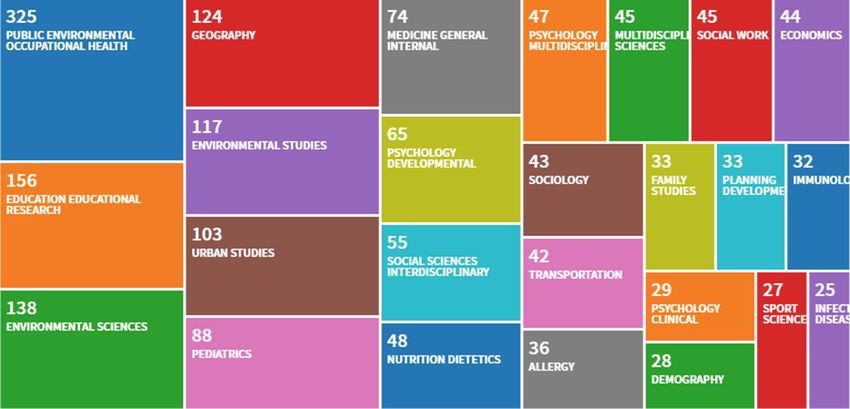
A set of 195 papers from different disciplinary fields (Education, Educational Research,
Environmental Sciences, Geography, Environmental Studies, Urban Studies, Trans-
portation, Planning Development, Civil Engineering, Environmental Engineering,
Architecture) is retrieved from the Web of Science and SCOPUS databases and indi-
viduated via queries containing the key terms child, play, city, neighbourhood, outdoor
space, public space, urban space, mobility. The time frame considered spans from 1990
to present (see Fig. 1). In a second stage, a sample of 25 journal articles is selected and
is investigated via a comparative content analysis.You can also read


