Integrated multi-vector management system for Energy isLANDs
←
→
Page content transcription
If your browser does not render page correctly, please read the page content below
Flexibility 2.1: From Demand Response to Renewable Energy Communities

Integrated multi-vector management system for Energy isLANDs
            Farhan Farrukh (Researcher at Smart Innovation Norway)
                                 Piloting Leader for E-LAND H2020

        This project has received funding from the European Union’s Horizon 2020 Research and Innovation
        programme under Grant Agreement No 824388.
        The information and views set out in this presentation are those of the author(s) and do not necessarily reflect the official opinion of
        the European Union. Neither the European Union institutions and bodies nor any person acting on their behalf may be held
        responsible for the use which may be made of the information contained therein.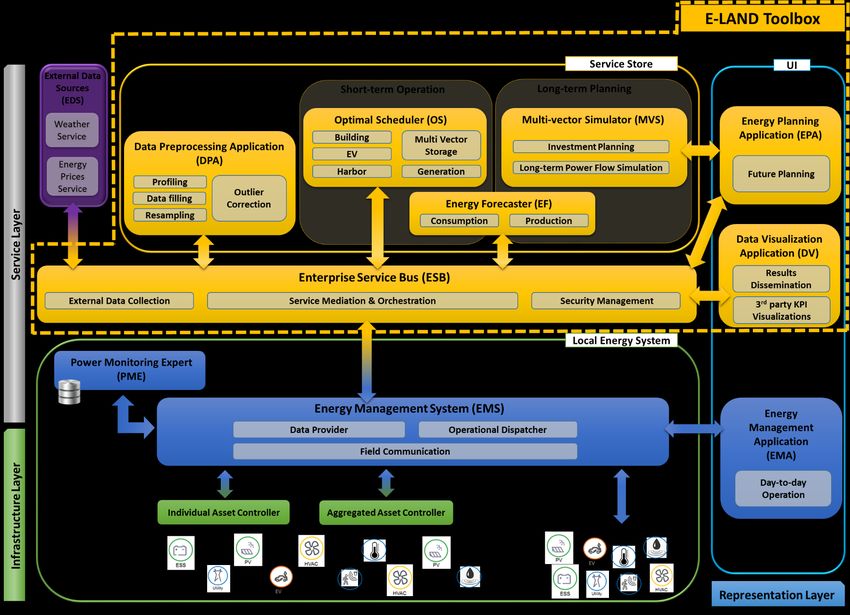
E-LAND in brief
• H2020 Innovation Action
• December 2018 - May 2022 (42
  Months)
• 6.2 M€ project with 5.4 M€ EC
  funding
• 12 European partners – 2 Indian
  partners
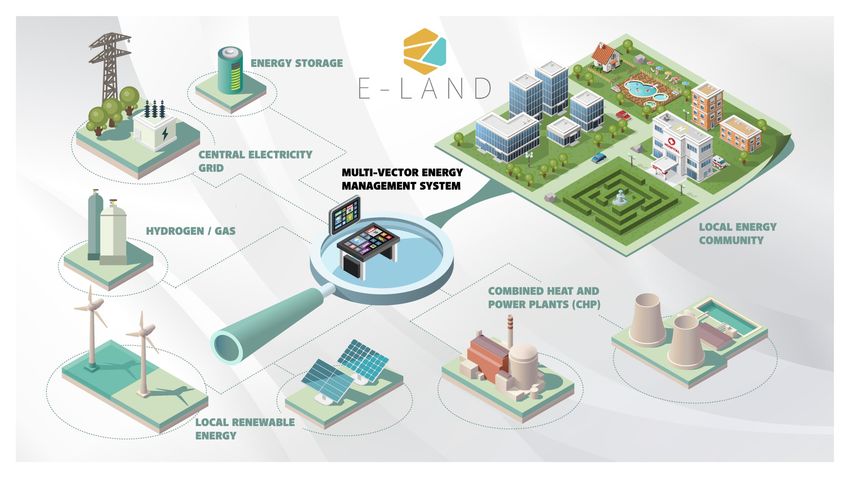
                                              E-LAND will transform the way energy is
• 3 pilots in Europe and 2 simulated       produced, stored and consumed in an Energy
  pilots in India                         Island bringing innovation across three planes:
• Open innovation through collaboration       technology, community and business.
  with stakeholders and citizens
  connected to the pilots from the              A toolbox consisting of tools to build
  beginning of the project                 decarbonised, multi-vector Energy Islands on a
                                           foundation of advanced ICT and data analytics
                                            technologies, strong community engagement
                                          tools and a solid business development models.

                                          The toolbox will be modular and customisable
                                           to specific local requirements, expandable to
                                           incorporate new tools and interoperable with
                                                 standards-based legacy systems.            2

E-LAND will solve these technology, societal and business challenges by developing the E-LAND Toolbox for
    Multi-Energy Islands. This toolbox will be offering novel methodologies and tools capable to support the
                        decarbonisation of energy islands and isolated communities.

                                                         Objective
1) Develop multi-vector energy optimisation algorithms that take into account the current and future value of energy storage
and end-user flexibility. Combining this with forecasted energy consumption and production will determine the optimal solution for
the coming timespan.
2) Develop and integrate the needed technology tools to change the role of the Energy Island or isolated community from
being a possible grid liability to an actor providing services to the grid, when needed.
3) Increase the use of, and further develop and validate the current and most advanced innovative business models for
energy communities and key energy market players.
4) Create new business opportunities for different storage technologies (apart from conventional battery storage) which
currently do not exist. These include the potential for seasonal storage and cross-vector storage optimisation.
5) Achieve an economically viable system that will be self-sustaining after project termination.
6) Understand how the dynamics of existing communities can be explored and further developed in order to secure impact
and longevity of the introduced solutions.
7) Enforce the role of citizens and communities as active players in implementing new technology.
8) Implement a modular toolbox composed of technology, business and community engagement related tools, and validate
the viability and impact of these tools in three regions in Europe and one region in India with different geography,
demography, sociography and maturity in terms of community and end-user activities, implementation of different energy vectors
including storage, amount of renewables in the local energy mix and variety of loads that call for efficient and intelligent         4
management system and process.
PART 1
Tools Introduction: Top View

                               6
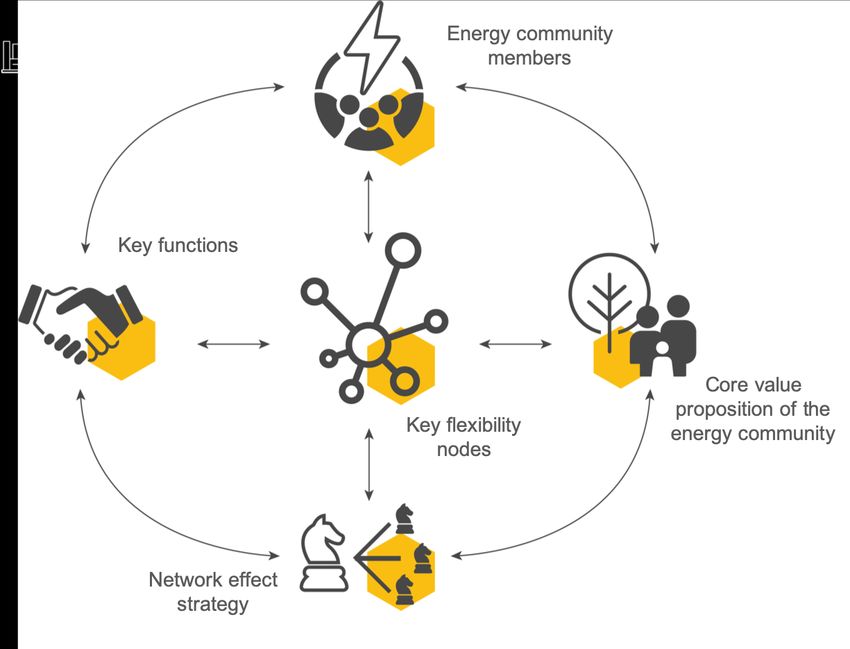
E-LAND Business Model Innovator tool: 5 core
components of energy communities
                       Business model components       Key questions

                       Core value proposition of the   What is the overall value generation of the
                       energy community                energy community?

                       Energy community members        Who is part of the energy community?
                       Energy-centered monetization    Which monetization mechanisms are access
     Energy centered
     monetization
                       mechanisms                      with the multi- vector energy community?
     mechanisms
                       Key functions                   Which key functions need to be fulfilled for the
                                                       functioning of the energy community?

                       Network effects                 Which key network effects have to be
                                                       managed successfully to use their power for
                                                       the benefit of the energy community?
ELAND’s Community Tool
The Common Impact Model

Multi-vector Local Energy System
            Production, Conversion & Storage Assets
                                            H2 Storage
                       LNG
           LNG       Storage           H2

                             Local Gas Grid                             Gas Loads
                      Battery               Wind
    PV                Storage
                                    CHP                Electrolyser

                          Local Electricity Grid                      Electrical Loads

         Gas Boiler                   HVAC
                                                   Geothermal
                                                   Conversion

                          Local Thermal Grid                          Thermal Loads

                                              HW
          Solar                              Thermal
         Thermal                             Storage
High Level Use-cases
HLUC 1: EMS integration with DER and BMS
HLUC 2: Optimization of operation of Local Energy System
HLUC 3: Optimal sizing of a Local Energy System12
he          tri Metropo it

LOCATION                                    VISION                                           IMPACT
               BYPL is licensed to
             supply and distribute          With new             The piloting will be
              electricity in central       government             conducted using
                                                                                          The local pockets
New Delhi     and north of Delhi.         initiatives on           the simulation
                                                                                               which are
              The industry actors        promoting EVs,            tools part of E-         constrained by
             are for example food       BYPL wants to be           LAND toolbox,             transformer
                   industries,         prepared in a cost-       giving a long-term
  India     incinerators, recycling
                                                                                         capacity limits will
                                        effective way to          investment plan       be enhanced, which
                  plants, care
                 providers, and             fulfill this          for pilot site and       in turn increase
               companies within             additional             also day-ahead       value for 1.6 million
              energy production,            electricity             schedules for              customer
                  storage, and               demand.                Multi Vector
                  distribution                                         sources
                   ENERGY                                              PILOTING
E er Co it
ro i e
LOCATION VISION IMPACT
The rising
temperatures in the E-LAND toolbox will
region together Auroville aims to help Auroville in
Auroville with growing be a self-sufficient simulating the
Chennai energy energy community investments and By becoming self-
consumption, are by developing a optimization sufficient for energy
India placing huge stress robust energy needed for needs, Auroville can
on its on-site system within the Auroville to be a truly net zero
energy assets and implement the emission
area that can
state-owned vision of the community in India.
operate in an
distribution islanding mode of
islanded mode.
transformers operation.
feeding Auroville.
ENERGY PILOTINGReplication plan & Replication toolkit
Replication plan Replication Toolkit:
Toolbox Documentation + Replication Guidelines.
“With the support of the consortium, Indian “To provide valuable insights for
partners shall develop a replication plan communities to build a low-carbon,
which sets a roadmap for implementing economically sustainable energy island”
outcomes generated from the project”
1- “Actionable guidelines to develop and carry out
your own project”
2- Concrete examples from real-life experience (EU
and Indian pilots)
3- Easy-to-use documentation for those who want to
utilize the E-LAND toolbox
(community, business and technology tools)THANK YOU!
Any questions or comments?
farhan.farrukh@smartinnovationnorway.com
This project has received funding from the European Union’s Horizon 2020 Research and Innovation programme under Grant Agreement No
824388.
The information and views set out in this presentation are those of the author(s) and do not necessarily reflect the official opinion of the European Union. Neither the
European Union institutions and bodies nor any person acting on their behalf may be held responsible for the use which may be made of the information contained therein.You can also read


