ISSUE GUIDE: COVID-19 CASE INVESTIGATION AND CONTACT TRACING - JULY 2020 - CONSIDERATIONS FOR USING DIGITAL TECHNOLOGIES - ASTHO
←
→
Page content transcription
If your browser does not render page correctly, please read the page content below
JULY 2020

ISSUE GUIDE:
COVID-19 CASE
INVESTIGATION AND
CONTACT TRACING
CO N S I D E R AT I O N S FO R
U S I N G D I G I TA L T EC H N O LO G I ES

                                              Association of State and Territorial Health Officials | B.Next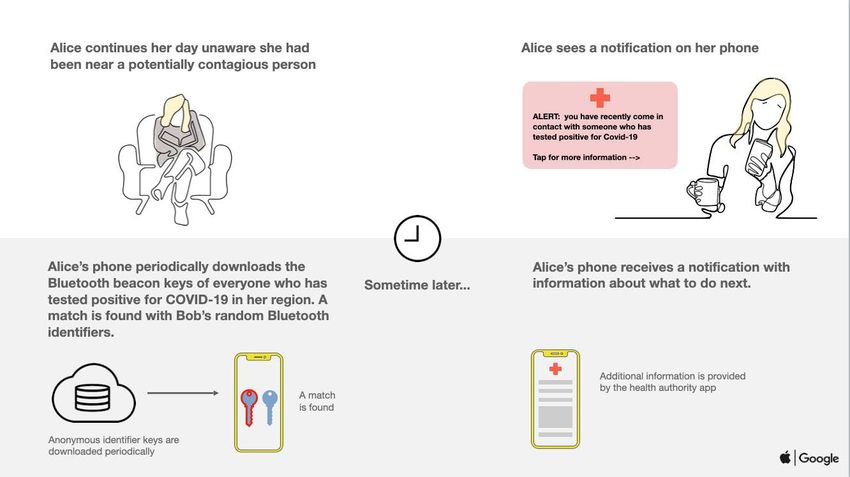
COVID–19

EXECUTIVE SUMMARY
As communities relax stay-at-home orders and ramp up testing, the public health system is seeing increases in
COVID-19 cases. Until vaccines are broadly available, the primary ways of preventing transmission of COVID-19
include interventions such as case investigation, contact tracing, social distancing, and isolation and quarantine. Case
investigation and contact tracing are well-established public health functions that have been implemented for many
diseases like Ebola, sexually transmitted infections (STIs), and tuberculosis. However, the scale and speed needed for
COVID-19 is unprecedented.

An extensive and swift expansion of the case investigation and contact tracing workforce—paired with continuous
evaluation to ensure effectiveness—is needed to adequately respond to rising caseloads and rapid investigation
cycles. To complement this time-tested, workforce-based solution, technology companies have been engaging with
various public health experts to develop new tools that could aid in COVID-19 response efforts. Public health officials
may choose to incorporate solutions that can augment and support case investigation and contact tracing while also
protecting privacy.

There are a wide range of technology options that can be used to support discrete steps involved in case investigation
and contact tracing, including those that provide capabilities for exposure notification, digital surveys, telemedicine,
symptom tracking, testing and care coordination options, and “customer” relationship management. However, no single
technology solution covers all functions required for case investigation and contact tracing. Taking full advantage of
technology options may require layering and linking multiple technologies across the case investigation and contact
tracing workflows.

Many of these technologies have not been used extensively for contact tracing and need to be tested to show that
they are fit for the purpose. Integrating these tools into the public health infrastructure will require careful thinking
about operational issues, privacy and consent, and stakeholder engagement. Given the governance structure of the
United States public health system, each state and locality may decide independently on the technology they use to
operationalize their case investigation and contact tracing programs.

This guide aims to help health officials think through critical functionalities needed for case investigations and contact
tracing, technological options, and issues of implementation in adopting these technologies. It also addresses the
latest topic of focus: the Apple|Google exposure notification application programming interface. The background and
key considerations included are intended to inform decision-making for technology-enabled enhancement of case
investigation and contact tracing capacity.

   2
                                                               Association of State and Territorial Health Officials | B.Next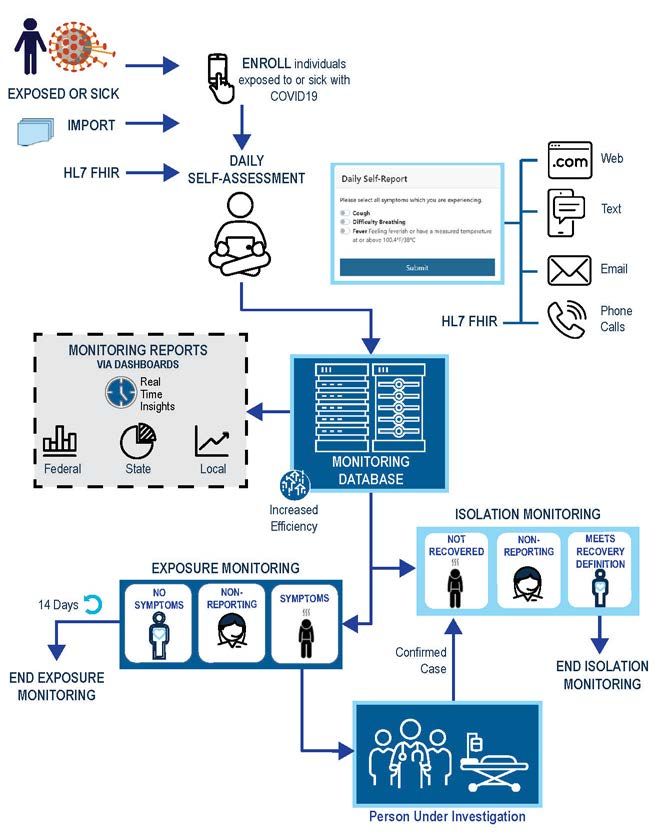
I. HEALTH AGENCY INFLUENCERS ON CASE INVESTIGATION AND CONTACT TRACING
Governmental public health in the United States consists of 59 state and territorial health departments, nearly 3,000
local health departments, tribal health departments, and the federal agencies that support them, including the U.S.
Department of Health and Human Services (HHS), Centers for Disease Control and Prevention (CDC), Assistant Secretary
for Preparedness and Response (ASPR), Health Resources and Services Administration (HRSA), U.S. Department of
Agriculture (USDA), Environmental Protection Agency (EPA), Centers for Medicare and Medicaid Services (CMS),
Office of the National Coordinator for Health Information Technology (ONC), Food and Drug Administration (FDA), and
many others. Together through a collection of complex activities, agreements, and funding sources, these local, state,
territorial, and federal agencies hold primary responsibility for planning, coordinating, and executing the public health
emergency response. State public health governance structures vary across the nation, with over half of states reporting
decentralized governance, meaning local government employees hold primary authority over local health units. Close
to 30 percent of states report a centralized structure in which state employees primarily lead local health units, with
the remainder of states reporting shared and mixed governance structures.1,2 The range of governance structures can
influence or dictate how public health decisions are made and services delivered—the impact of which is evident during
the domestic response to COVID-19.

Across the nation, jurisdictions are implementing a variety of public health containment and mitigation measures,
including population-based social distancing strategies, case investigation, and contact tracing. When determining
how to assess tools and technologies to support case investigation and contact tracing, jurisdictions involve a range
of different leaders or experts, including chief information officers, chief technology officers, chief data officers,
informatics experts, epidemiologists or others, which also influences decision-making, planning, and execution of the
response.

While there can be agreement on large-scale national policy such as social distancing, contact tracing, and other
public health approaches to respond to COVID-19, local implementation can vary significantly. These variations in
decision-making factors allow for interventions that are focused and responsive to the epidemiology and needs of the
community, yet they can also pose challenges—especially when assessing or implementing novel and evolving tools
such as exposure notification mobile applications for an infectious disease that recognizes no borders.

II. TECHNOLOGY FOR CASE INVESTIGATION AND CONTACT TRACING
Case investigation and contact tracing are core public health functions that involve working with individuals diagnosed
with an infectious disease to identify and provide support to contacts that may have been exposed to infection.
Specifics of contact tracing procedures and job tasks will vary across jurisdictions, but there are common workflows and
steps involved (Appendix 1). In addition to the core case investigation and contact tracing workflows, other functions
include both the coordination of care during isolation and quarantine, and that of teams executing this work (i.e., to
ensure efficient triage, assignment, and hand-offs between job tasks). Technology options may automate or accelerate
tasks throughout these workflows.

Figure 1 provides a condensed conceptual diagram of the workflows for case investigation and contact tracing. The
diagram highlights a subset of the case investigation and contact tracing steps described above and will serve as a
framework against which relevant technology options can be mapped.

   3
                                                             Association of State and Territorial Health Officials | B.Next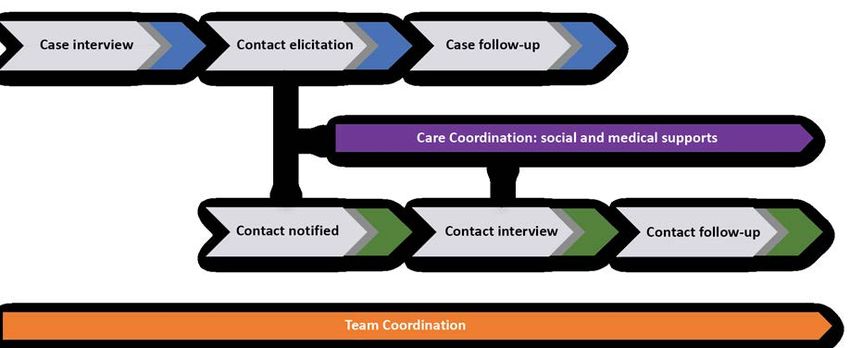
Figure 1.
Representative functions involved in case investigation (blue), contact tracing (green), care coordination (purple), and team coordination (orange).
This is a condensed conceptual diagram and as such, does not depict all the functions involved in case investigation and contact tracing.

Traditional case investigation and contact tracing can take weeks to carry out. COVID-19 modeling studies, however,
have shown that faster contact tracing is needed to curb the spread of infection. Transmission models suggest that
contact tracing must be highly effective (i.e., more than 70% of contacts traced) 3 and leverage technology to facilitate
instant contact notification in order to contain the epidemic.

The scale at which this work must be carried out is also unprecedented. ASTHO and the Johns Hopkins Bloomberg
School of Public Health have estimated that approximately 100,000 contact tracers need to be added to the
workforce to adequately conduct large-scale COVID-19 contact tracing.5 This estimate does not include the workforce
requirements for case investigation and other job functionalities. Furthermore, all workforce estimates are dynamic and
evolve with patterns of transmission, testing capacity, and other local factors. Meaningful incorporation of technology
to accelerate or automate elements of case investigation and contact tracing workflows can serve as a force multiplier
for this expanded workforce.

The Case Investigation and Contact Tracing Technology Requirements and Issues

The COVID-19 pandemic and the resulting public health response have accelerated the development of new
technologies and digital solutions, and in many cases highlighted multiple needs. In the context of case investigation and
contact tracing technologies, these needs—organized into people, process, partnerships, and technology domains—
include, but are not limited to:

    1. People: A skilled workforce trained to assess, develop, and manage technology and digital solutions; vendors
       with public health expertise.

    2. Process: Standard evaluation criteria for measuring how well solutions meet the intended outcome; guidance
       on technology procurements and contracts; trusted data-sharing frameworks within and across state lines; and
       state and federal resources to support implementation and sustainability.

    3. Partnerships: Ensuring partnerships with healthcare providers and community-based organizations are in place
       to connect cases and contacts to needed social or healthcare services.

   4
                                                                           Association of State and Territorial Health Officials | B.Next
4. Technology: Automation or acceleration of contact elicitation, contact notification, follow-up and case
management; privacy preserving, decentralized, and anonymized solutions; interoperability with other
technologies and information systems; data migration from legacy systems; predictive analytics capabilities on
data collected; real-time synchronization of data; offline data entry; and platforms support across web-based
and mobile applications.
III. TECHNOLOGIES INTENDED TO ENHANCE CASE INVESTIGATION AND CONTACT
TRACING
Data technologies, advanced analytics, and mobile devices can potentially be leveraged as force multipliers for speed
and scale in case investigation and contact tracing. As seen in South Korea, Singapore, and China, technology tools can
be deployed to facilitate contact tracing with varying outcomes. Several other countries are exploring the use of a range
of technologies with a strong focus on proximity sensing and exposure notification capabilities.i
There is a range of technology that can be used to support the steps involved in case investigation and contact tracing.
Table 1 outlines how various technology options can support specific case investigation and contact tracing steps.
Descriptions of the technology options are included below.
Notably, no single technology option spans across the full range of steps involved in case investigation, contact
tracing, care coordination, or team coordination. Rather, taking full advantage of technology options may require
layering multiple technologies across the full range of work functions.
Table 1. A range of technology is useful for specific tasks that enable the overarching case investigation (blue), contact tracing (green), care
coordination (purple), and team coordination (orange) capabilities. Checkmarks in the table indicate the technology enables at least part of the
function.
FUNCT IONALIT IES
Case Investigation Contact Tracing
Care Team
TYPES OF Case Contact Case Contact Contact Contact Coordination Coordination
TECHNOLOGY Interview Elicitation Follow-up Notified Interview Follow-up
Exposure notification
Digital surveys
Symptom tracking
Wearables
Telemedicine
Customer relationship
management
i
A group at MIT has begun tracking where exposure notification technologies are being deployed. For more information: O’Neill PH, Ryan-Mosley T, and Johnson B.
“A flood of coronavirus apps are tracking us. Now it’s time to keep track of them.” MIT Technology Review. May 7, 2020. Accessible at: https://www.technologyreview.
com/2020/05/07/1000961/launching-mittr-covid-tracing-tracker. Covid Tracing Tracker read-only database accessible at: https://docs.google.com/spreadsheets/
d/1ATalASO8KtZMx__zJREoOvFh0nmB-sAqJ1-CjVRSCOw.
5
Association of State and Territorial Health Officials | B.NextEXPOSURE NOTIFICATION
Exposure notification, sometimes referred to as digital contact tracing or proximity sensing, refers to technology
products that support the otherwise manual tasks involved in contact elicitation (traditionally collected during a case
interview) and contact notification. If users opt in, deidentified information such as broadcasted Bluetooth pings or
location details are shared between mobile devices and/or centralized systems. A contact is then logged when close
physical proximity occurs. If someone is diagnosed with COVID-19, these logged contacts can be used to communicate
with those in the log that a potential exposure has occurred.
The advantage of exposure notification technology is that it allows contacts to be notified in situations where cases may
not know their contacts (e.g., large gatherings or public spaces). This technology has garnered significant public interest
given its ability to rapidly warn contacts of their exposure. It is not known how effective this technology will be for
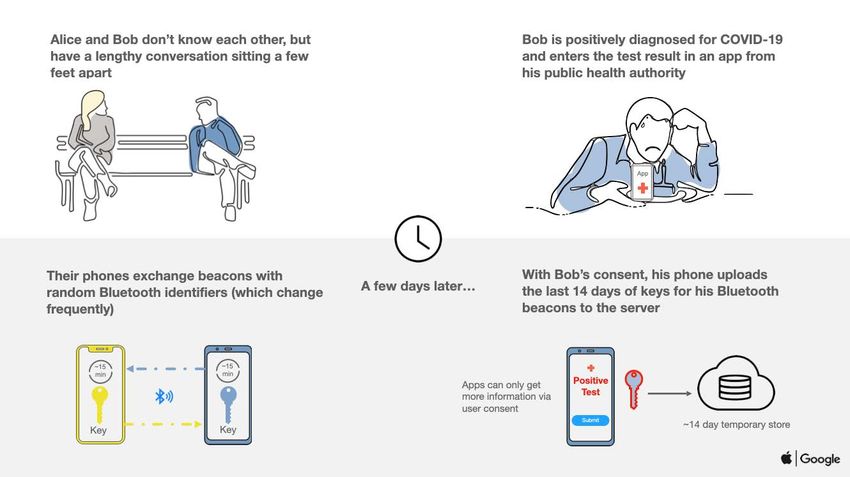
COVID-19, as it has not yet been applied for this purpose. Apple and Google jointly released a specification that would
enable public health authorities to develop and release exposure notification apps (Appendix 2).
DIGITAL SURVEYS
Case investigators use established questionnaires to conduct interviews and elicit information about close contacts
of confirmed or probable cases. The questionnaires are designed to collect information about the case and potential
contacts that would likely be at highest risk of exposure. In traditional case investigation models, these questionnaires
are used in-person, over the phone, or via videoconference.
For COVID-19, several efforts have focused on digitizing contact elicitation questionnaires so that individuals can opt-
in and volunteer information about potential exposures. The benefit of this technology is the ability to make the case
interview process faster and scalable. This approach does not require advanced location-based tracking, though it could
incorporate data from such systems as they become available. For example, a project called NextTrace is developing
digital survey technology to support COVID-19 case investigation and contact tracing.6
SYMPTOM TRACKING
Symptom tracking capabilities can be provided by a range of technologies such as apps, websites, and potentially
wearable devices.7 Integrating these data into contact tracing data systems has been worked out for some systems, such
as MITRE’s Sara Alert (Appendix 3).8
WEARABLES
Wearables are sensors that are worn by an individual to collect, analyze, or transmit data about the wearer (e.g., heart
rate, blood pressure) or their activities (e.g., steps taken, sleep quality). Fitness trackers, smart watches, smart clothes,
and real-time patient monitors are all examples of wearable technologies that could be applied to case management or
contact tracing.
TELEMEDICINE
Telemedicine allows for the remote provision of healthcare services. Telecommunication capabilities are used to enable
connection between healthcare providers and patients for consultation, monitoring, diagnoses, admissions, and clinical
interactions. Telemedicine may support diagnosis notification, in addition to medical consultations that may take place
during the follow-up and monitoring steps of the case investigation and contact tracing workflows, or as part of a care
coordination workflow.
CUSTOMER RELATIONSHIP AND CASE MANAGEMENT SOFTWARE
With respect to case investigation and contact tracing, there are at least two main types of software platforms that
enable teams to work together more efficiently and manage data on cases and contacts. These can be broadly described
as modified case management software or customer relationship management (CRM) software. Case management
tools can support the care coordination workflow by coordinating clinical and support staff to provide treatment to
6
Association of State and Territorial Health Officials | B.Nextpatients. CRM software can coordinate and track efforts by contact tracer teams and support medical service teams as
well. The main objective of these systems is to enable contact tracing teams to manage data collected from cases and
contacts and provide quality follow-up services. Within the United States, several systems (e.g., Salesforce, CommCare,
Conduent, MTX) are being adapted, piloted, and used by jurisdictions to coordinate different teams.
Comparison of Exposure Notification Technologies
Apps designed to automate exposure notification have proliferated.9 A comparison of some of the dimensions of these
approaches is shown in Table 2 below. The table displays types of proximity sensing technologies used in exposure
notification by their features and protocols to enable quick decision-making based on what each tool offers.
Emerging Uses and Practices
States are considering, developing, and piloting a variety of technology approaches and partnerships to support case
investigation and contact tracing (Appendix 4). Most states are contracting with members of the private sector to
outsource data storage, data management, and workforce functions. Examples of private sector partner technologies
include Sara Alert, Salesforce, Amazon Connect, MTX, Twilio, and Dimagi. Some states are in conversations with Apple
and Google about an affiliated API to build mobile exposure notification apps for their residents, and guidance is
emerging to support health agencies interested in using this framework.10 Other states have explored partnerships with
non-profits and universities to develop mobile contact tracing apps. While some of these apps utilize location tracking,
others use a combination of crowdsourcing and statistical modeling to act upon presumed hotspots.
Table 2. Comparison of proximity-based exposure notification apps.
TYPES OF PROXIMITY SENSING TECHNOLOGIES
USED IN EXPOSURE NOTIFICATION
Bluetooth Location Services External Sensors
Government-associated
High Medium Low
privacy
TECHNOLOGY FEATURES AND PROTOCOLS
Private sector-associated
privacy High Low High
Background capable with Requires special application programming
Yes Yes
no new OS features interface (API) and app rules
Can geolocate No Yes Yes
False positive problems Very High Medium Medium-low
Requires security services
No No Yes
coordination
Requires a network effect High
Very High No
of users (herd-immunity level)
Singapore’s TraceTogether; Google/Apple Israel’s HaMagen**
Key example(s) Exposure Notification MIT SafePaths **
Struck down by Supreme Court,
now uses GPS
API and apps
7
Association of State and Territorial Health Officials | B.NextTable 2 Definitions
Bluetooth: Phones send out pings via Bluetooth Low Energy that are received by other phones and recorded.
Location Services: Phones record location using the GPS sensor and WiFi triangulation.
External Sensors, Multi-Sensor Fusion: A combination of methods, but mostly from external sensors in use by
government security services.
Government-Associated Privacy: Government-associated privacy means keeping personally identifiable information
(PII) private from federal or local government authorities. Crowdsourced or local proximity sensing technologies such
as Ultrasonic and Bluetooth do not inherently require a central authority to collect location data. We mark Ultrasonic as
less private because of its reliance on the microphone and in the inability to guarantee that only ultrasonic waveforms
are collected.
Private Sector-Associated Privacy: Private sector-associated privacy means keeping PII private from private application
developers. Geolocation information is widely collected by private sector entities. The private sector can be compelled
to share this information with the public sector depending on local laws, therefore the privacy from the government is
not high even if there is a promise not to share.
Background Capable with no New OS Features: Can the user’s phone be on standby (screen turned off) with proximity
sensing still in effect? We believe this capability is essential for wide use of this technology.
Can Geolocate: Does the proximity sensing technology give you a longitude and latitude?
Requires Security Services Coordination: If the tracking relies on technology only available to intelligence agencies or
internal security services.
Requires a Network Effect of Users: Decentralized technologies require a wide level of population usage. For example,
if an infected person was not using the Bluetooth technology in the days before infection, there will be no way to know
who she was in contact with. Likewise, even if she used the app, any contacts not using the app will not know if they
were exposed. Location services do not have the latter weakness.
Based on our best expert opinion given descriptions of these technologies, we have assessed options for privacy
qualitatively. These assessments must be quantitatively tested to determine their accuracy as technologies are
developed and deployed.
IV. CRITICAL CONSIDERATIONS FOR PUBLIC HEALTH LEADERS
As noted above, some of the challenges posed by COVID-19 reveal the opportunities and roles digital and technology
options can play in case investigation and contact tracing. Beyond these opportunities and functionalities, the
decision of whether to adopt and use these digital and technology options includes considerations related to privacy
and consent, stakeholder and community engagement, and operational issues. While not an exhaustive list, the
considerations below aim to complement emerging guidance to assess and evaluate digital case investigation and
contact tracing tools.11,12
Privacy and Consent Considerations
The workflows for case investigation and contact tracing set out above involve the collection, storage, access, and
sometimes disclosure of personal information. Public health agencies should review and assess the impact that federal
8
Association of State and Territorial Health Officials | B.Nextprivacy laws and relevant state privacy laws may have on any of the digital and technology options used for case
investigation and contact tracing (e.g., the Health Insurance Portability and Accountability Act (HIPAA) and state laws
such as the California Online Privacy Protection Act, the California Consumer Privacy Act, the Minnesota Government
Data Practices Act, and the Kansas COVID-19 Contact Tracing Privacy Act). Public health agencies should consult with
their legal counsel if they have any questions about the applicability of federal or state law.
It is important that the design of technology options addresses privacy considerations while also deriving public
health benefits from the data. These considerations should address the points of data collection, storage, access, and
disclosure and also reduce the likelihood of a privacy breach. Breaches of privacy can result from the unauthorized
disclosure of the data and linkage attacks. An example of unauthorized disclosure is when personally identifiable
information (PII) is unwittingly sent to a cloud service during data use and analysis. Linkage attacks occur when de-
identified data is linked to additional data sources to allow re-identification.
The privacy and consent considerations outlined below are relevant across the spectrum of technology types
articulated in Table 1.
POINT OF COLLECTION
Clearly and explicitly define and communicate the purpose for collecting the data.
Limit the collected data to what is necessary and relevant for the purpose.
Depending on the case investigation or contact tracing functionality being implemented, consider whether
data computation will be done on the device collecting the data or sent and returned to the device after
computation.
Ensure that collected data are accurate and of sufficient quality for the intended use.
Encrypt the data when it is collected, transmitted and stored. When possible, use password protected files on
the device collecting the data. Avoid transmitting unencrypted data that could be copied by an email provider
and remain on a computer server.
POST-COLLECTION STORAGE AND ACCESS
Ensure that only a minimum number of necessary people or systems have access to the data through user access
controls and/or password protections and limit the sharing of passwords.
Continue data encryption if the data is transferred from the device that collected it and stored on another
computer system.
Develop and maintain policies for what is and is not an acceptable use of collected data.
If feasible, use technical solutions to block unacceptable use of data and make sure staff with data access are
trained on the acceptable use policy. Develop and use practices to prevent the data’s unauthorized disclosure
through human error and create access and usage logs for the data.
9
Association of State and Territorial Health Officials | B.NextDATA DISCLOSURE
Only the minimum amount of information collected for case investigation and contact tracing that is necessary
and consistent with acceptable use policies should be disclosed. Aggregation and differential privacy (see more
below) can provide safeguards against linkage attacks. If feasible, only allow access for research through a control
system rather than sharing a copy of the data.
To the extent possible, erect barriers to prevent unacceptable use. This might include displaying data as static
images rather than interactive web applications, disallowing download, or having researchers sign data use
agreements.
To the greatest extent possible, use activity logs on any website with an application serving sensitive data.
Logging any activity at the point of storage and processing may also capture unauthorized access by a cloud
service’s API.
OTHER CONSIDERATIONS
Unless allowed by state or federal law (e.g., situations to which the public health exception to HIPAA’s Privacy
Rule are applicable), consent for the collection and use of personal information should be voluntary, as well as
freely and expressly given. Consent should be obtained with clear, specific, and comprehensible language.
Location data is particularly prone to linkage attacks and can alone be enough to identify a person (e.g., a
nightly series of location data collected from a house can identify the person living there). When location data is
displayed in a web application, aggregating over geographical areas and adding differentially private noise may
limit the risk of linkage attacks.
Differential privacy is a mathematical definition of privacy that can limit linkage attacks. The mathematical
definition adds noise to data or data computations that reduces the likelihood of information leaking and extends
to downstream computations. While differential privacy does not guarantee that information will not leak, it
quantifies the tradeoff between privacy of individual records and precise computations so the data owner can
adjust to their level of risk tolerance.
Community and Stakeholder Considerations
Certain populations are at higher risk for severe outcomes from COVID-19 and may lack access to the technology or
technology infrastructure (e.g., internet service, a mobile device or other computer, cell phone coverage, etc.) leveraged
for contact tracing. These populations may include individuals experiencing homelessness, the elderly, low-income
individuals and families, etc. The use of additional public health measures, such as in-person contact tracing and
efforts to raise community awareness and acceptance of contact tracing, should be considered for these populations.
Additionally, with evidence showing the disparate impact of COVID-19 on minority communities, it is important to
ensure that any technology solution is culturally and linguistically competent and trusted within these communities.
Doing so can prevent creating new—or exacerbating existing—health disparities.
The use of technology options in case investigation and contact tracing may raise concerns about privacy and
discrimination. Engaging with privacy, security, accessibility, and civil rights experts, in addition to community leaders,
as technologies are being vetted and operationalized will support efforts to gain community buy-in and acceptance. In
some instances, individuals may feel that they have been wronged through their engagement with case investigation
or contact tracing technologies. Clear policies for those seeking redress should be determined prior to rolling out any
technology options.13 Community-based organizations and healthcare providers should also be consulted, as their staff
may support the care coordination activities that flow from case investigation and contact tracing.
10
Association of State and Territorial Health Officials | B.NextOperational Considerations
Operational considerations related to the use of digital and technology options for case investigation and contact
tracing include the needed expansion of the contact tracing workforce, issues around cross-jurisdictional collaboration
and sharing of data, and other legal considerations beyond data privacy and security.
CONTACT TRACING WORKFORCE
Implementation of technology options must support existing efforts to expand the contact tracing workforce.
Appropriate training and ongoing support should be provided to case investigators, contact tracers, and other job
functions involved in using technology systems. Workforce planning should account for increased needs for IT support
staff and data managers, as well as infrastructure support for local health departments and communities. These
positions are critical in supporting uptake of any new technologies, management of digital infrastructure, and new
developments or modifications to existing data systems.
CROSS-JURISDICTIONAL COLLABORATION AND DATA SHARING
While decisions around technologies implemented to support case investigation and contact tracing are made at
the state level, the implications may be felt across borders. For example, fragmented approaches to the adoption of
exposure notification technologies could reduce the likelihood of gaining the number of users required to make these
technologies effective. Adoption of differing technologies may also challenge real-time data collection, analysis, and
sharing capabilities for cases and contacts who may travel between jurisdictions.
Health officials should consider the following issues which may nurture or impede cross-jurisdictional
data sharing:
Current technological infrastructure and staff available to support data sharing.
Cultural and community concerns regarding trust and ownership of data.
Promising practices from organizations that have interjurisdictional data exchange or sharing
agreements in place.
Defining a standard minimum data set for information recorded by case investigation and contact
tracing technologies.
Ensuring transparency and privacy of case and contact data throughout the data exchange process,
with clear information about data ownership and use.
Laws, policies, or processes for effective cross-jurisdictional collaboration for case investigation and
contact tracing.
11
Association of State and Territorial Health Officials | B.NextPURCHASING MODELS
Decision-makers responsible for procuring, building, or repurposing technology to support case investigation and
contact tracing may consider an array of purchase models, including:
Paid subscription with Paid subscription License-free for a
required licenses for without required temporary period of
each user. licenses. time (post-COVID-19).
Purchased new
Current purchased Open-source or freely
product with fee for
product or contractual available tools with
service including
agreement being repur- technical support from
consultation and
posed for COVID-19 case an implementation
technical support from
investigation and partner.
the development
contact tracing.
team.
OTHER LEGAL CONSIDERATIONS
The use of digital and technology options for case investigation and contact tracing will require an awareness of
federal and state laws and regulations related to other sectors beyond public health and healthcare and in addition
to areas of privacy. The digital and technology options should be consistent with the laws and regulations governing
telecommunications, consumer protection, online privacy of children, and electronic surveillance. Employment and
labor law may also come into play if an employer is directed to require the use of the technology or an employee is
required by an employer to use it.
Contracts for digital and technology projects often require different considerations than contracts for other products
and services. For example, when negotiating these types of contracts, consider using a Statement of Objectives instead
of a Statement of Work to avoid costly and timely change orders. Also, for specialized projects it may be better to use
a variety of purchased or built systems rather than relying on commercial off-the shelf software that can cost extra
to customize and update. Needed changes are likely to occur as more information is learned about COVID-19 and
successful countermeasures to it. For custom software, governments should consider obtaining all legal rights, source
code, build and test scripts, etc., so that if necessary, any future changes can be made by the government agency
itself or by a different vendor. Otherwise, the agency could be locked into services from the initial vendor for all future
changes, risking inordinate costs. Additional resources, such as checklists and questions for state agencies to ask when
executing contracts with digital and technology vendors are available.14
12
Association of State and Territorial Health Officials | B.NextBENEFITS OF OPEN SOURCE OPTIONS
Health agencies implementing case investigation and contact tracing programs have jurisdiction-specific requirements
to support integration to internal systems, privacy adherence, launch and feature release timing, external data sharing,
and the skills of technical teams. Open source software is software where anyone can inspect, modify, and enhance its
source code (the form of software suitable for modification). Open source software has proven itself to be one of the
most effective ways to deliver individual application deployment needs without the penalty of building and supporting
bespoke solutions.
Development of open source software technologies are handled through mass collaboration. As a result, engineering
choices are transparent and open for review. Subsequently, internal and external integration paths are adaptable
and known. Privacy implementations can be verified by both community developers and security domain experts.
And finally, technical staff can use shared training resources to gain understanding of a common contact tracing
architecture. While anyone can modify such software, organizations such as public health agencies can select which
version they deploy, making open source solutions a cost-effective way of implementing software.
V. CONCLUSION
The unprecedented experience of the COVID-19 pandemic is prompting technology companies and public health
officials to explore and consider novel options to support proven, workforce-driven case investigation and contact
tracing activities. While technology options should not supplant the people-centered efforts of case investigators and
contact tracers, digital tools do hold the promise of accelerating and automating portions of these traditionally manual
workflows.
Though a wide array of technology options are being developed and piloted across jurisdictions, models of technology-
enabled contact tracing are nascent, and decision-makers must consider issues related to privacy and consent,
stakeholder and community engagement, and operational issues. Because no single technology option addresses
the full arc of functionalities required for rapid and scaled up case investigation and contact tracing, layering multiple
technologies may be required to take full advantage of digital options to support this work.
To improve effectiveness and outcomes, standards for evaluating data technologies should be established and evolved
based on lessons learned. Case investigation and contact tracing technologies should be assessed to ensure they
accomplish their intended function and protect data appropriately. The CDC has developed preliminary criteria for
evaluating digital contact tracing tools,15 and ongoing engagement from the public and private sector is required to
develop and refine evaluation standards.
Though the demands on health agencies during the COVID-19 pandemic are extraordinary, they are continuously
innovating and building or strengthening non-traditional relationships, including with partners in the technology sector.
As states explore technology options that are culturally acceptable, privacy protecting, and fit for function, planning for
sustainability is also key. Further, the technology innovations being explored—if deployed responsibly and effectively—
could help save lives during the COVID-19 pandemic and beyond.
While this guide aims to provide an overview of the factors and considerations policy leaders should take into account
for decision-making, planning and implementation purposes, the authors do wish to note that additional efforts to guide
decision-making for leaders, as well as address significant challenges such as system interoperability between existing
and new technologies, is still needed. As some jurisdictions pilot various approaches, lessons learned and emerging
practices should be closely examined and shared broadly.
13
Association of State and Territorial Health Officials | B.NextRESOURCES FOR PUBLIC HEALTH LEADERS
Think Tank, Academic, and Foundation Reports and Resources
ASTHO COVID-19 Technology and Digital Solutions Master Data Sheet
CDC Preliminary Criteria for the Evaluation of Digital Contact Tracing Tools for COVID-19
CDC Digital Contact Tracing Tools for COVID-19
Contact Tracing Mobile Apps for COVID-19: Privacy Considerations and Related Trade-offs
Harvard Business Review: How Digital Contact Tracing Slowed Covid-19 in East Asia
Health Affairs: Protecting Privacy in Digital Contact Tracing For COVID-19: Avoiding A Regulatory Patchwork
Linux Foundation Public Health Landscape
Public Health Informatics Institute (PHII) Digital Tools in Support of Contact Tracing for COVID-19
Resolve to Save Lives: COVID-19 Contact Tracing Playbook
U.S. Digital Response
14
Association of State and Territorial Health Officials | B.NextPUBLISHED BY ASTHO AND
B.NEXT, AN INITIATIVE OF IN-Q-TEL
Authors Contributors
Andy Baker-White, ASTHO J.D. Englehart, In-Q-Tel
Dylan George, B.Next Tommy Jones, In-Q-Tel
J.T. Lane, ASTHO Andy Ku, In-Q-Tel
Elizabeth Ruebush, ASTHO Todd Stavish, In-Q-Tel
Priyanka Surio, ASTHO JJ BenJoseph, B.Next
Steve Bowsher, In-Q-Tel
Tara O’Toole, B.Next
Acknowledgements: ASTHO would like to thank Linux Foundation Public Health for supporting the development of this
report, as well as the national partners that provided input and feedback, including the National Association of County
and City Health Officials (NACCHO), Association of Public Health Laboratories (APHL), and Council of State and Territorial
Epidemiologists (CSTE).
ASTHO is the national nonprofit organization representing the public health agencies of the United States, the U.S.
territories and freely associated states, and the District of Columbia, as well as the more than 100,000 public health
professionals these agencies employ. ASTHO members, the chief health officials of these jurisdictions, are dedicated to
formulating and influencing sound public health policy and to ensuring excellence in public health practice.
In-Q-Tel, Inc. (IQT) is the not-for-profit strategic investor that accelerates the development and delivery of cutting-edge
technologies to U.S. government agencies that keep our nation safe. IQT was established in 1999 with a distinct mission:
to identify and partner with startup companies developing innovative technologies that protect and preserve our
nation’s security. Visit iqt.org for more information.
15
Association of State and Territorial Health Officials | B.NextAppendix 1: Case Investigation and Contact Tracing Workflowsii
Case investigation and contact tracing involve working with individuals that have been diagnosed with an infectious
disease to identify and support contacts that may have been exposed to infection. Contact tracing procedures and job
tasks will vary across jurisdictions, but there are common workflows and steps involved, as described by CDC. Tasks
most impacted by the evolution of technology solutions during the COVID-19 pandemic are highlighted and align with
the representative functions described in Figure 1 (found on page 4).
CASE INVESTIGATION
CONTACT TRACING
COLOR KEY
Representative function as
described in Figure 1
Case investigation
Contact tracing
Care coordination
Team coordination
ii
Adapted from CDC’s Case Investigation and Contact Tracing workflows.
16
Association of State and Territorial Health Officials | B.NextIn addition to the core case investigation and contact tracing workflows, vital functions include the coordination of care
during isolation and quarantine, and the coordination of team members involved in this work.
CARE COORDINATION (HIGHLIGHTED IN PURPLE)
Information collected in the case or contact interviews may inform care coordination activities. These activities may
include linking individuals to medical care and social supports (e.g., housing, food delivery, childcare, etc.) that will
help them adhere to isolation and quarantine recommendations. The division of job tasks across case investigation,
contact tracing, and care coordination will vary across jurisdictions. Depending on local or state process variations, care
coordination may overlap with monitoring and follow-up steps included in the case investigation and contact tracing
workflows.
TEAM COORDINATION (HIGHLIGHTED IN ORANGE)
Roles and responsibilities involved in supporting COVID-19 case investigation and contact tracing are complex, and
may require discrete job functions for case investigators, contact tracers, care resource managers, high-risk medical
monitors, team leads, and surveillance and triage support—to name a few. Coordination of these teams requires
efficient triage, assignment, and hand-offs between job tasks. This work also involves the management of a high volume
of data collected throughout each of these workflows. In the diagram above, steps involving hand-offs, triage, and
referral of cases or contacts amongst team members are highlighted as team coordination steps.
17
Association of State and Territorial Health Officials | B.NextAppendix 2: Apple|Google Exposure Notification Diagramiii
Apple and Google. “Privacy Preserving Contact Tracing.” https://www.apple.com/covid19/contacttracing/
5. How will the system protect user privacy and security?
iii
18
Google and Apple put user privacy at the forefront of this exposure notification technology’s
Association of State and Territorial Health Officials | B.Next
design and have established strict guidelines to ensure that privacy is safeguarded:Appendix 3: Sara AlertTM Workflowiv
HIGHLIGHT: SARA ALERT ENGAGEMENT OF ASTHO MEMBERS
ASTHO and its respective members were approached by MITRE to inform and pilot their Sara Alert open-source
tool. The tool allows remote monitoring of persons exposed to or infected with COVID-19.
After weeks of refining their initial proof of concept and engaging in user testing, two health agencies were
prepared to pilot test and implement the tool.
Each health agency had various reasons for being an early adopter, including building up data and informatics
infrastructure, data modernization efforts, or because the current technologies being used did not adequately
manage the volume of cases for the jurisdiction, requiring more time or manual labor than was feasible.
Currently, 11 jurisdictions have adopted the Sara Alert tool for their case management efforts and MITRE is
actively engaging in discussions to build a smart Fast Healthcare Interoperability Resources API that allows other
information systems to easily connect with the tool, including Apple and Google’s exposure notification system,
REDCap, and other contact tracing applications.
iv
MITRE. “Sara Alert.” Available at: https://saraalert.org/.
19
Association of State and Territorial Health Officials | B.NextAppendix 4: Current COVID-19 Technology and Digital Solutions
ASTHO collected data on state and territorial health agency adoption of COVID-19 technology and digital solutions used
for surveillance, case investigation, symptom monitoring, case data management, and data analysis/visualization. This
evergreen resource continues to be updated bi-monthly, with the last update occurring on June 24, 2020. This data
includes details about the vendors and functionality of each option as operationalized by health agencies.
A live and more detailed version of this table is available in the data sheet here. Data was sourced in raw, unstructured
form from discussions with health agencies as they began their implementations. Blank boxes in the table represent
gaps in information, including several cases where the information is still changing and not available.ASTHO continues
to collect, refine, update, and validate this data with health agency leaders and staff working on COVID-19.
COVID-19 Technology and Digital Solutions Details
Data
Customization Characteristics Resources/Cost
Name Developer Model
(Y/N)
Data Element Definitions
Data can be customized Product features, attributes, and
to meet the needs of All stakeholders (company,
implementation considerations. health department, Cost and resource
Product name the health agency, but Information is organized by several University, federal agency, considerations for
with links to some must stay within the pre-determined functional categories,
state/territorial etc.) who created adoption and
boundaries of the which are not available
examples the product implementation
tool’s capabilities or for every tool*
the existing contract
Care19 (North Case volume support: Low
Dakota) Contact notification: Contact ProudCrowd and
Yes management limitations customized by North
Care19 (South Data tracking: Confirmed cases only Dakota Department
Dakota) Load testing: Required of Health
Availability: Rapid deployment, in
use for COVID-19
Case/PUI identification: Import data,
real-time synchronization capable
Clinical Decision Support: Yes
Contact Elicitation/Identification:
Manually record data on case
contacts
Contact Notification: Manual and
automated contact notification
Contact Follow-up: Follow-up with
known contacts for longitudinal data
Platform support: Accessible via Dimagi
CommCare Yes mobile or web browser, offline data
entry
Other: TA support from vendor,
vendor has public health experience,
supports case management
20
Association of State and Territorial Health Officials | B.NextData
Customization Characteristics Resources/Cost
Name Developer Model
(Y/N)
COVID-19 Puerto Rico License Required
Epidemiological Yes
Public Health Trust for ArcGIS
Surveillance System
Platform: App-based
Other: Standalone technology or emocha Mobile Health, Inc. Paid-subscription
emocha No
monitoring service - John’s Hopkins service
Availability: Open source
Data tracking: Confirmed cases only
Data entry: Manual
Platform: App-based
Load testing: Required in large
Epi InfoTM Yes jurisdictions CDC Open Source
Privacy concerns: Yes
Tool communication/Outreach:
Tracks locations visited not individual
contacts
Case/PUI Identification: Requires data
migration from legacy system
Platform: Accessible via mobile or
EpiTrax Yes web-browser Utah Department of Health Annual subscription
Other: Upgrades available to expand
access rights, TA support and
maintenance
Contact notification: Manual and
automated contact notification of
Custom SMS other app users
Utah Department of
Load testing: Required for use in large Open source - Utah
Healthy Together Yes Health (Developer - Twenty
jurisdictions residents only
Beta App and Holdings, Inc.).
TestUtah Platform: App-based
Other: Locate testing centers, view
test results, education
Availability: Rapid deployment, in use
for COVID-19
Case/PUI identification: Import data,
real-time synchronization capable
Contact Elicitation/Identification:
Manually record data on case
contacts, self-report contacts
Contact Notification: Manual and
automated contact notification
Contact Follow-up: Follow-up with
Maven COVID-19 Yes known contacts for longitudinal data, Conduent, Inc. License required
automated reminders to contacts,
automated predictions based on self-
reported data
Interoperability: Yes- with existing
and external systems
Platform support: Accessible via
mobile or web browser
Other: TA support from vendor,
vendor has public health experience
21
Association of State and Territorial Health Officials | B.NextData
Customization Characteristics Resources/Cost
Name Developer Model
(Y/N)
Availability: Rapid deployment, in
use for COVID-19
Case/PUI Identification: Import
data, real-time data synchronization
Contact Elicitation/Identification:
Manually record data on case
contacts, self-report contacts
Custom Microsoft Contact notification: Manual and
Solution (Microsoft automated contact notification
Dynamics) Contact Follow-up: Follow-up with Microsoft License required
Yes
known contacts for longitudinal
ContaCT data, automated reminders to
(Connecticut) contacts, automated prediction
based on self-reported data
Platform support: Accessible via
mobile or web browser, offline data
entry
Other: TA support from vendor,
vendor has public health experience
Apple, Google, and State/
Apple|Google Territorial Health Agencies
Contact Tracing own the data and the
actual application
Availability: Rapid deployment,
in use for COVID-19, insufficient
automation which does not meets
needs
Case/PUI Identification: Import
data, real-time data synchronization
Case Volume Support: Does not
keep up with the volume of cases
Contact Elicitation/Identification:
Manually record data on case
contacts, self-reported contacts Free to non-profit,
Contact Notification: Manual and academic, and
automated contact notification Vanderbilt
REDCap Yes governmental
Contact Follow-up: Follow-up with institutions
known contacts for longitudinal
data, automated reminders to
contacts, automated prediction
based on self-reported data
Level of Back-end Maintenance:
High
Platform Support: Accessible via
mobile or web browser, offline data
entry
Surveillance system integration:
Difficult
Staff capacity/requirements:
Manual burden and custom
applications are defined by the user
Other: Vendor has public health
experience
22
Association of State and Territorial Health Officials | B.NextData
Customization Characteristics Resources/Cost
Name Developer Model
(Y/N)
Availability: Rapid deployment, in
use for COVID-19, costs for non-
school entities (schools receive MTX
version for free)
Case/PUI Identification: Import
data, real-time data synchronization
Contact Elicitation/Identification:
Manually record data on case
contacts, self-reported contacts
Contact Notification: Manual and
automated contact notification
Contact Follow-up: Follow-up with
known contacts for longitudinal Salesforce System
Customer data, automated monitoring and Integrators, which include License required
Yes
Salesforce Solution reminders to contacts (SMS), Accenture, Deloitte, MTX
automated prediction based on self-
reported data, includes scripts based
on call outcomes
Platform Support: Accessible via
mobile or web browser, offline data
entry, multiple languages
Other: TA support from vendor,
vendor has public health experience,
used for symptom monitoring,
integration with tools like Amazon
Connect, cases pushed in from
surveillance system into Salesforce
Availability: Rapid deployment, in
use for COVID-19
Case/PUI Identification: Import data
Contact Elicitation/Identification:
Manually record data on
case contacts
Contact Notification: Manual and
automated contact notification
Contact Follow-up: Follow-up with
known contacts for longitudinal
data, automated reminders to MITRE
contacts, automated prediction
based on self-reported data
Sara Alert Yes Platform Support: Accessible Sara Alert sits on APHL’s Open Source
via mobile or web browser AIMS cloud platform
Staff capacity/requirements:
Requires dedicated staff time for
deployment/launch and to maintain
monitoring workflow
General: TA support from vendor,
vendor has public health experience,
messaging available in multiple
languages, supports vulnerable
populations
23
Association of State and Territorial Health Officials | B.NextData
Customization Characteristics Resources/Cost
Name Developer Model
(Y/N)
Availability: Open source,
license free
Contact Elicitation/Identification:
Manually record data on
case contacts
CDC’s National Center
Case Volume Support: Low
Text Illness for Immunization and
No Contact Notification: Manual and
Monitoring (TIM) Respiratory Diseases
automated contact notification
Contact Follow-up:
Management limitations
Other: Produces reports listing
all text responses
*
Availability, Contact notification, Data Tracking, Data Entry, Case Volume Support, Load Testing, Privacy Concerns, Case/PUI Identification
Clinical Decision Support, Contact Elicitation/Identification, Contact Follow-up, Platform Support, Tool Communication/Outreach, Interoperability, Level of Back-end
Maintenance, Surveillance System Integration, Staff capacity/requirements, General, Other (relevant information that does not fit in the above the categories)
24
Association of State and Territorial Health Officials | B.NextREFERENCES
1
ASTHO. “ASTHO Profile of State and Territorial Public Health, Volume Four.” 2017. Available at www.astho.org/profile. Accessed
6-28-2020.
2
NACCHO. “National Profile of Local Health Departments.” 2016. Available at http://nacchoprofilestudy.org/reports-publications/.
Accessed 6-28-2020.
3
Hellewell J, et al. “Feasibility of controlling COVID-19 outbreaks by isolation of cases and contacts.” The Lancet. 2020. 8:e488-96.
Available at https://doi.org/10.1016/S2214-109X(20)30074-7. Accessed 6-28-2020.
4
Ferretti L, et al. “Quantifying SARS-CoV-2 transmission suggests epidemic control with digital contact tracing.” Science. 2020. 368
(6491): eabb6936. Available at: https://science.sciencemag.org/content/368/6491/eabb6936. Accessed 6-28-2020.
5
ASTHO and Johns Hopkins Bloomberg School of Public Health. “A National Plan to Enable Comprehensive COVID-19 Case
Finding and Contact Tracing in the US. Available at: https://www.centerforhealthsecurity.org/our-work/pubs_archive/pubs-
pdfs/2020/200410-national-plan-to-contact-tracing.pdf. Accessed 6-28-2020.
6
NextTrace. “Controlling COVID-19.” Available at https://nexttrace.org/. Accessed 6-28-2020
7
Fowler GA. “Wearable tech can spot coronavirus symptoms before you even realize you’re sick. Washington Post. May 28, 2020.
Available at: https://www.washingtonpost.com/technology/2020/05/28/wearable-coronavirus-detect/. Accessed 6-29-2020.
8
MITRE. “Sara Alert.” Available at: https://saraalert.org/. Accessed 6-28-2020.
9
LF Public Health. “LF Public Health Landscape.” Available at: https://landscape.lfph.io/. Accessed 6-28-2020.
10
Public Health Informatics Institute. “Steps for Public Health to Plan for the Use of the Apple|Google Exposure Notification
Framework.” Available at https://phii.org/sites/default/files/DT4CT%20White%20Paper_6.30.20-v2.pdf. Accessed 7-13-2020.
11
CDC. “Preliminary Criteria for the Evaluation of Digital Contact Tracing Tools for COVID-19: COVID-19 Contact Tracing for Health
Departments, Version 1.2.” Available at: https://www.cdc.gov/coronavirus/2019-ncov/downloads/php/prelim-eval-criteria-digital-
contact-tracing.pdf. Accessed 6-28-2020.
12
Public Health Informatics Institute. “Digital Tools to Support Contact Tracing: Tool Assessment Report, June 2020.” Available at
https://phii.org/sites/default/files/DT4CT%20Assessment%20Report%207.9.20.pdf. Accessed 7-13-2020.
13
O’Neill Institutes for National and Global Health Law, Georgetown. “HIV Lessons for COVID-19 Contact Tracing.” Available at:
https://oneill.law.georgetown.edu/wp-content/uploads/HIV-Lessons-for-COVID19-Contact-Tracing.pdf. Accessed 6-28-2020.
14
Carnahan R, Hart R, and Jaquith W. De-risking custom Technology projects. 2019. Available at: https://github.com/18F/
technology-budgeting/blob/master/handbook.md#beware-the-customized-commercial-software-trap. Accessed 6-28-2020.
15
CDC. “Preliminary Criteria for the Evaluation of Digital Contact Tracing Tools for COVID-19: COVID-19 Contact Tracing for Health
Departments, Version 1.2.” Available at: https://www.cdc.gov/coronavirus/2019-ncov/downloads/php/prelim-eval-criteria-digital-
contact-tracing.pdf. Accessed 6-28-2020.
25
Association of State and Territorial Health Officials | B.NextYou can also read


