MOON: MapReduce On Opportunistic eNvironments
←
→
Page content transcription
If your browser does not render page correctly, please read the page content below

MOON: MapReduce On Opportunistic
                       eNvironments
               Heshan Lin∗ , Jeremy Archuleta∗ , Xiaosong Ma†‡ , Wu-chun Feng∗
                                 Zhe Zhang† and Mark Gardner∗
                               ∗ Department   of Computer Science, Virginia Tech
                                  {hlin2, jsarch, feng}@cs.vt.edu, mkg@vt.edu
                     † Department   of Computer Science, North Carolina State University
                                      ma@cs.ncsu.edu, zzhang3@ncsu.edu
              ‡ Computer    Science and Mathematics Division, Oak Ridge National Laboratory

   Abstract—MapReduce offers a flexible programming           simplifies large-scale parallel data processing [5],
model for processing and generating large data sets on        but has been relegated to dedicated computing re-
dedicated resources, where only a small fraction of such      sources found in high-performance data centers.
resources are every unavailable at any given time. In
                                                                 While the union of MapReduce services with
contrast, when MapReduce is run on volunteer comput-
ing systems, which opportunistically harness idle desktop     volunteer computing systems is conceptually ap-
computers via frameworks like Condor, it results in poor      pealing, a vital issue needs to be addressed –
performance due to the volatility of the resources, in        computing resources in desktop grid systems are
particular, the high rate of node unavailability.             significantly more volatile than in dedicated com-
   Specifically, the data and task replication scheme         puting environments. For example, while Ask.com
adopted by existing MapReduce implementations is woe-         per-server unavailability rate is an astonishingly low
fully inadequate for resources with high unavailability. To
address this, we propose MOON, short for MapReduce On
                                                              0.000455 [6], availability traces collected from an
Opportunistic eNvironments. MOON extends Hadoop, an           enterprise volunteer computing system [7] showed
open-source implementation of MapReduce, with adaptive        a more challenging picture: individual node un-
task and data scheduling algorithms in order to offer         availability rates average around 0.4 with as many
reliable MapReduce services on a hybrid resource architec-    as 90% of the resources simultaneously inacces-
ture, where volunteer computing systems are supplemented      sible (Figure 1). Unlike dedicated systems, soft-
by a small set of dedicated nodes. The adaptive task and
data scheduling algorithms in MOON distinguish between
                                                              ware/hardware failure is not the major contributor
(1) different types of MapReduce data and (2) different       to resource volatility on volunteer computing sys-
types of node outages in order to strategically place tasks   tems. volunteer computing nodes shut down at the
and data on both volatile and dedicated nodes. Our tests      owners’ will are unavailable. Also, typical volunteer
demonstrate that MOON can deliver a 3-fold performance        computing frameworks such as Condor [1] consider
improvement to Hadoop in volatile, volunteer computing        a computer unavailable for running external jobs
environments.
                                                              whenever keyboard or mouse events are detected. In
                                                              such a volatile environment it is unclear how well
                  I. I NTRODUCTION
                                                              existing MapReduce frameworks perform.
   The maturation of volunteer computing systems                 In this work, we evaluated Hadoop, a popular,
with multi-core processors offers a low-cost re-              open-source MapReduce runtime system[8], on an
source for high-performance computing [1], [2], [3],          emulated volunteer computing system and observed
[4]. However, these systems offer limited program-            that the volatility of opportunistic resources cre-
ming models and rely on ad-hoc storage solutions,             ates several severe problems. First, the Hadoop
which are insufficient for data-intensive problems.           Distributed File System (HDFS) provides reliable
MapReduce is an effective programming model that              data storage through replication, which on volatile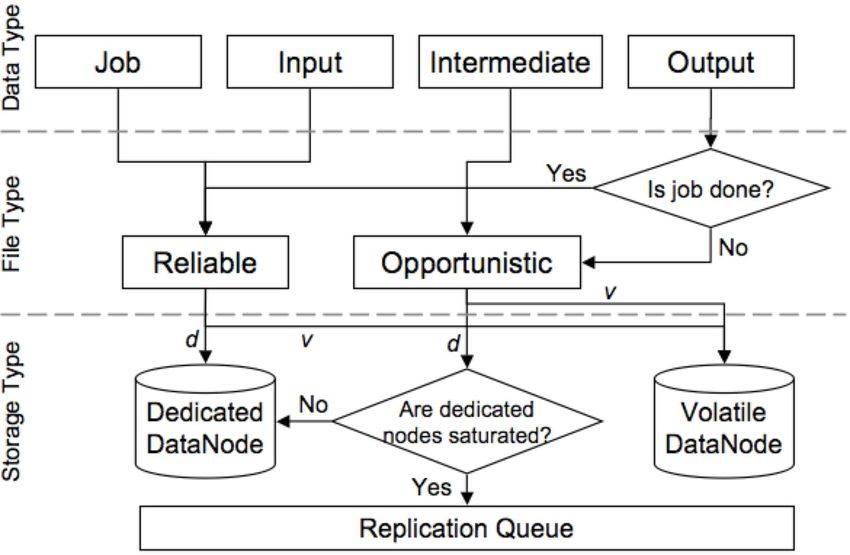
95
                                                                      other personal computers,
                                                                               DAY1
                                  85                                           DAY2
      Percentage Unavailability                                    • extending HDFS to (1) take advantage of
                                                                               DAY3
         75
                                                                      the dedicated resources for better data avail-
                                                                               DAY4
                                                                               DAY5
         65                                                           ability and (2) to provide differentiated
                                                                               DAY6
                                                                               DAY7
         55                                                           replication/data-serving services for different
         45
                                                                      types of MapReduce job data, and
                                                                   • extending the Hadoop speculative task schedul-
         35
                                                                      ing algorithm to take into account high resource
         25
                                                                      volatility and strategically place Map/Reduce
                                   00

                                                                    00

                                                                          00

                                                                                00

                                                                                       00
                                             0

                                                      0

                                                               0
                                         :0

                                                  :0

                                                           :0
                                  9:

                                                                   1:

                                                                         2:

                                                                               3:

                                                                                      4:
                                                                      tasks on volatile or dedicated nodes.
                                        10

                                                 11

                                                          12

Fig. 1. Percentage of unavailable resources measured in a 7-day
trace from a production volunteer computing system at San Diego
                                                                   We implemented these three enhancements in
Supercomputing Center [7]. The trace of each day was collected  Hadoop    and carried out extensive evaluation work
from 9:00AM to 5:00PM. The average percentage unavailability is within an opportunistic environment. Our results
measured in 10-minute intervals.
                                                                show that MOON can improve the QoS of MapRe-
                                                                duce services significantly, with as much as a 3-
                                                                fold speedup, and even finish MapReduce jobs that
systems can have a prohibitively high replication
                                                                could not be completed previously in highly volatile
cost in order to provide high data availability.
                                                                environments.
For instance, when machine unavailability rate is
0.4, eleven replicas are needed to achieve 99.99%                                 II. BACKGROUND
availability for a single data block, assuming that A. Volunteer Computing
machine unavailability is independent. Handling
large-scale correlated resource unavailability re-                 Many volunteer computing systems have been de-
quires even more replication.                                   veloped   to harness idle desktop resources for high-
                                                                performance or high-throughput computing [1], [2],
    Second, Hadoop does not replicate intermediate
                                                                [3], [4]. A common feature shared by these systems
results (the output of Map tasks). When a node
                                                                is non-intrusive deployment. While studies have
becomes inaccessible, the Reduce tasks processing
                                                                been conducted on aggressively stealing computer
intermediate results on this node will stall, resulting
                                                                cycles [9] and its corresponding impact [10], most
in Map task re-execution or even livelock.
                                                                production volunteer computing systems allow users
    Third, Hadoop task scheduling assumes that the
                                                                to donate their resources in a conservative way by
majority of the tasks will run smoothly until com-
                                                                not running external tasks when the machine is
pletion. However, tasks can be frequently suspended
                                                                actively used. For instance, Condor allows jobs to
or interrupted on volunteer computing systems. The
                                                                execute only after 15 minutes of no console activity
default Hadoop task replication strategy, designed
                                                                and a CPU load less than 0.3.
to handle failures, is insufficient to handle the high
volatility of volunteer computing platforms.                    B. MapReduce
    To mitigate these problems in order to realize                 MapReduce is a programming model designed to
the computing potential of MapReduce on volunteer simplify parallel data processing [5]. Google has
computing systems, we have a created a novel been using MapReduce to handle massive amount of
amalgamation of these two technologies to produce web search data on large-scale commodity clusters.
MOON, “MapReduce On Opportunistic eNviron- This programming model has also been found ef-
ments”. MOON addresses the challenges of pro- fective in other application areas including machine
viding MapReduce services within the opportunistic learning [11], bioinformatics [12], astrophysics and
environment of volunteer computing systems, in cyber-security [13].
three specific ways:                                               A MapReduce application is implemented
    • adopting a hybrid resource architecture by pro-           through two user-supplied primitives: Map and
       visioning a small number of dedicated comput- Reduce. Map tasks take input key-value pairs and
       ers to serve as a system anchor to supplement convert them into intermediate key-value pairs,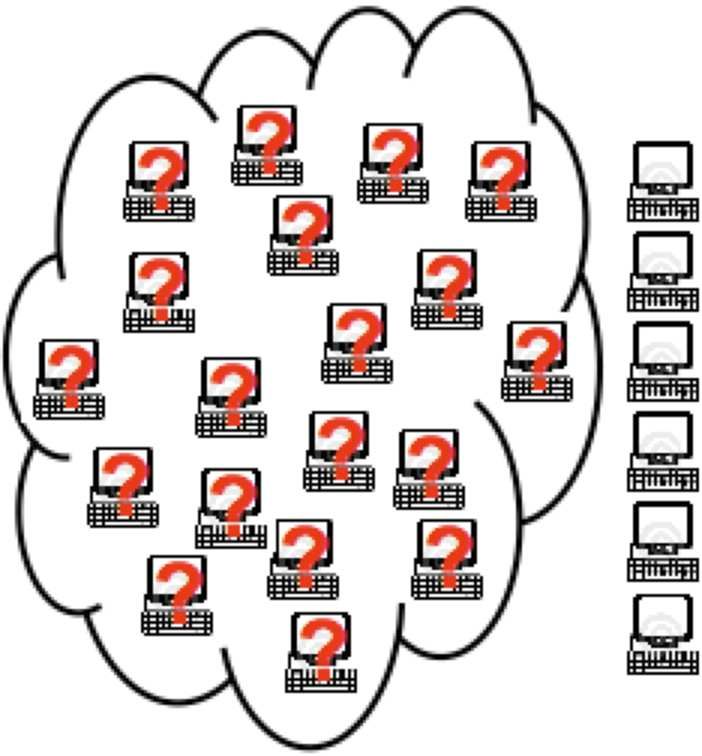
which are in turn converted to output key-value          are connected with a local area network with rel-
pairs by reduce tasks.                                   atively high bandwidth and low latency. However,
   In Google’s MapReduce implementation, the             PC availability is ephemeral in such an environment.
high-performance distributed file system, GFS [14],      Moreover, large-scale, correlated resource inacces-
is used to store the input, intermediate, and output     sibility can be normal [15]. For instance, many
data.                                                    machines in a computer lab will be occupied si-
                                                         multaneously during a lab session.
C. Hadoop                                                   Observing that opportunistic PC resources are not
   Hadoop is an open-source cluster-based MapRe- dependable enough to offer reliable compute and
duce implementation written in Java [8]. It is log- storage services, MOON supplements a volunteer
ically separated into two subsystems: the Hadoop computing system with a small number of dedicated
Distributed File System (HDFS), and a MapReduce compute resources. Figure 2 illustrates this hybrid
task execution framework.                                architecture, where a small set of dedicated nodes
   HDFS consists of a NameNode process running provide storage and computing resources at a much
on the master and multiple DataNode processes higher reliability level than the existing volatile
running on the workers. To provide scalable data nodes.
access, the NameNode only manages the system
metadata with the actual file contents stored on
the DataNodes. Each file in the system is stored
as a collection of equal-sized data blocks. For I/O
operations, an HDFS client queries the NameNode
for the data block locations, with subsequent data
transfer occurring directly between the client and
the target DataNodes. Like GFS, HDFS achieves
high data availability and reliability through data
replication, with the replication degree specified by
a replication factor.                                      (a) Volunteer computing          (b) MOON
   To control task execution, a single JobTracker          environments

process running on the master manages job status Fig. 2. Overview of MOON executing environments. The resources
and performs task scheduling. On each worker ma- on nodes with a question mark are ephemeral.
chine, a TaskTracker process tracks the available
execution slots. A worker machine can execute up            The MOON hybrid architecture has multiple ad-
to M Map tasks and R Reduce tasks simultaneously vantages. First, placing a replica on dedicated nodes
(M and R default to 2). A TaskTracker contacts can significantly enhance data availability without
the JobTracker for an assignment when it detects imposing a high replication cost on the volatile
an empty execution slot on the machine. Tasks nodes, thereby improving overall resource utiliza-
of different jobs are scheduled according to job tion and reducing job response time. For example,
priorities. Within a job, the JobTracker first tries to the well-maintained workstations in our research lab
schedule a non-running task, giving high priority to have had only 10 hours of unscheduled downtime
the recently failed tasks, but if all tasks for this job in the past year (due to an unnotified power out-
have been scheduled, the JobTracker speculatively age), which is equivalent to a 0.001 unavailability
issues backup tasks for slow running ones. These rate. Assuming the average unavailability rate of a
speculative tasks help improve job response time.        volunteer computing system is 0.4 and the failure
                                                         of each volatile node is independent, achieving
       III. MOON D ESIGN R ATIONALE AND                  99.99% availability only requires a single copy on
            A RCHITECTURE OVERVIEW                       the dedicated node and three copies on the volatile
   MOON targets institutional intranet environ- nodes. Second, long-running tasks with execution
ments, where volunteer personal computers (PCs) times much larger than the mean available interval
of volunteered machines may be difficult to finish        fail1 . Similar situations will be experienced with
on purely volatile resources because of frequent in-      temporary unavailability of intermediate or output
terruptions. Scheduling those long-running tasks on       data. However, these two types of data are more
dedicated resources can guarantee their completion.       resilient to loss, as they can be reproduced by re-
Finally, with these more predictable nodes dedicated      executing the Map and/or Reduce tasks involved.
to assist a volunteer computing system, it is easier      On the other hand, once a job has completed, lost
to perform QoS control, especially when the node          output data is irrecoverable if the input data have
unavailability rate is high.                              been removed from the system. In this case, a user
   Due to the wide range of scheduling policies used      will have to re-stage the previously removed input
in volunteer computing systems, we have designed          data and re-issue the entire job, acting as if the
for the extreme situation where MOON might be             input data was lost. In any of these scenarios the
wrapped inside a virtual machine and distributed to       time-to-completion of the MapReduce job can be
each PC, as enabled by Condor [1] and Entropia [3].       substantially elongated.
In this scenario, the volunteer computing system             As mentioned in Section I, we found that existing
controls when to pause and resume the virtual             Hadoop data management is insufficient to provide
machine according to the policy chosen by the             high QoS on volatile environments for two main
computer owners. To accommodate such a scenario,          reasons. First, the replication cost to provide the
MOON assumes that no computation or commu-                necessary level of data availability for input and out-
nication progress can be made on a PC when it             put data in HDFS on volunteer computing systems is
is actively used by the owner, and it relies on the       prohibitive when the volatility is high. Additionally,
heartbeat mechanism in Hadoop to detect when a            non-replicated intermediate data can easily become
PC is unavailable.                                        temporarily or permanently unavailable due to user
   As we will discuss in Section IV, one design           activity or software/hardware failures on the worker
assumption of the current MOON solution is that,          node where the data is stored, thereby unnecessarily
collectively, the dedicated nodes have enough aggre-      forcing the relevant Map tasks to be re-executed.
gate storage for at least one copy of all active data        To address these issues, MOON augments
in the system. We argue that this solution is made        Hadoop data management in several ways to lever-
practical by the decreasing price of commodity            age the proposed hybrid resource architecture to
servers and hard drives with large capacity. For          offer a cost-effective and robust storage service.
example, currently a decent desktop computer with
1.5 TB of disk space can be acquired for under            A. Multi-dimensional, Cost-effective Replication
$1,000. In the future, we are going to investigate        Service
scenarios where the above assumption is relaxed.             Existing MapReduce frameworks such as Hadoop
                                                          are designed for relatively stable environments run-
        IV. MOON DATA M ANAGEMENT                         ning on dedicated nodes. In Hadoop, data replication
   In this section, we present our enhancements to        is carried out in a rather static and uniform man-
Hadoop to provide a reliable MapReduce service            ner. To extend Hadoop to handle volatile volunteer
from the data management perspective. Within a            computing environments, MOON provides a multi-
MapReduce system there are three types of user            dimensional, cost-effective replication service.
data – input, intermediate, and output. Input data           First, MOON manages two types of resources –
are provided by a user and used by Map tasks              supplemental dedicated computers and volatile vol-
to produce intermediate data, which are in turn           unteer nodes. The number of dedicated computers is
consumed by Reduce tasks to create output data.           much smaller than the number of volatile nodes for
The availability of each type of data has different       cost-effectiveness purposes. To support this hybrid
implications on QoS.
                                                             1
   For input data, temporary inaccessibility will stall        In Hadoop, an incomplete Map task (e.g., caused by inaccessibil-
                                                          ity of the corresponding input data block) will be rescheduled up to
computation of corresponding Map tasks, whereas           4 times, after which the Map task will be marked as failed and in
loss of the input data will cause the entire job to       turn the corresponding job will be terminated.
scheme, MOON extends Hadoop’s data manage-                 the dedicated DataNodes as necessary. Furthermore,
ment and defines two types of workers: dedicated           only after all data blocks of the output file have
DataNodes and volatile DataNodes. Accordingly,             reached its replication factor, will the job be marked
the replication factor of a file can no longer be          as complete and the output file be made available
adequately represented by a single number. Instead,        to users.
it is defined by a pair {d, v}, where d and v                  To maximize the utilization of dedicated comput-
specify the number of data replicas on the dedicated       ers, MOON will attempt to have dedicated replicas
DataNodes and the volatile DataNodes, respectively.        for opportunistic files when possible. When dedi-
   Intuitively, since dedicated nodes have much            cated replicas cannot be maintained, the availability
higher availability than volatile nodes, placing repli-    of the opportunistic file is subject to the volatility of
cas on dedicated DataNodes can significantly im-           the volunteer PCs, possibly resulting in poor QoS
prove data availability and in turn minimize the           due to forced re-execution of the related Map or
replication cost on volatile nodes. Because of the         Reduce tasks. While this issue can be addressed by
limited aggregated network and I/O bandwidth on            using a high replication degree on volatile DataN-
dedicated computers, however, the major challenge          odes, such a solution will inevitably incur high
is how to maximize the utilization of the dedicated        network and storage overhead.
resources to improve service quality while pre-                MOON addresses this issue by adaptively chang-
venting the dedicated computers from becoming a            ing the replication requirement to provide the user-
system bottleneck. To this end, MOON’s replication         defined QoS. Specifically, consider a write re-
design differentiates between various data types at        quest of an opportunistic file with replication factor
the file level and takes into account the load and         {d, v}. If the dedicated replicas are rejected because
volatility levels of the DataNodes.                        the dedicated DataNodes are saturated, MOON will
   MOON characterizes Hadoop data files into two           dynamically adjust v to v ′ , where v ′ is chosen to
categories, reliable and opportunistic. Reliable files     guarantee that the file availability meets the user-
are defined as data that cannot be lost under any          defined availability level (e.g., 0.9) pursuant to the
                                                                                                      ′
circumstances. One or more dedicated copies are            node unavailability rate p (i.e., 1 − pv > 0.9). If
always maintained for reliable files so that they can      p changes before a dedicated replica can be stored,
tolerate potential outage of a large percentage of         v ′ will be recalculated accordingly. Also, no extra
volatile nodes. MOON always stores input data and          replication is needed if an opportunistic file already
system data required by the job as reliable files.         has a replication degree higher than v ′ . While we
   In contrast, opportunistic files contain transient      currently estimate p by simply having the NameN-
data that can tolerate a certain level of unavailability   ode monitor the fraction of unavailable DataNodes
and may or may not have dedicated replicas. Inter-         during the past interval I, MOON allows for user-
mediate data will always be stored as opportunistic        defined models to accurately predict p under a given
files. On the other hand, output data will first be        volunteer computing system.
stored as opportunistic files while the Reduce tasks           The rationale for adaptively changing the replica-
are completing, and once all are completed they are        tion requirement is that when an opportunistic file
then converted to reliable files.                          has a dedicated copy, the availability of the file is
   The separation of reliable files from opportunistic     high thereby allowing MOON to decrease the repli-
files is critical in controlling the load level of         cation degree on volatile DataNodes. Alternatively,
dedicated DataNodes. When MOON decides that                MOON can increase the volatile replication degree
all dedicated DataNodes are nearly saturated, an I/O       of a file as necessary to prevent forced task re-
request to replicate an opportunistic file on a dedi-      execution caused by unavailability of opportunistic
cated DataNode will be declined (details described         data.
in Section IV-B).                                              Similar to Hadoop, when any file in the system
   Additionally, by allowing output data to be first       falls below its replication factor this file will be
stored as opportunistic files enables MOON to dy-          put into a replication queue. The NameNode pe-
namically direct write traffic towards or away from        riodically checks this queue and issues replication
throttling algorithm running on the NameNode com-
pares the updated bandwidth with the average I/O
bandwidth during a past window. If the consumed
I/O bandwidth of a DataNode is increasing but only
by a small margin determined by a threshold Tb , the
DataNode is considered saturated. On the contrary,
if the updated I/O bandwidth is decreasing and
falls more than threshold Tb , the dedicated node is
unsaturated. Such a design is to avoid false detection
of saturation status caused by load oscillation.
Algorithm 1 I/O throttling on dedicated DataNodes
Let W be the throttling window size
Fig. 3. Decision process to determine where data should be stored.
Let Tb be the control threshold
Let bwk be the measured bandwidth at timestep k
Input: current I/O bandwidth bwi
requests giving higher priority to reliable files. Output: setting throttling state of the dedicated node
avg bw = ( i−1
P
B. Prioritizing I/O Requests j=i−W bwj )/W
if bwi > avg bw then
When a large number of volatile nodes are sup- if (state == unthrottled) and (bwi < avg bw ∗ (1 + Tb ))
plemented with a much smaller number of dedicated then
state = throttled
nodes, providing scalable data access is challenging. end if
As such, MOON prioritizes the I/O requests on the end if
different resources. if bwi < avg bw then
if (state == throttled) and (bwi < avg bw ∗(1−Tb )) then
To alleviate read traffic on dedicated nodes, state = unthrottled
MOON factors in the node type in servicing a read end if
request. Specifically, for files with replicas on both end if
volatile and dedicated DataNodes, read requests
from clients on volatile DataNodes will always try
to fetch data from volatile replicas first. By doing C. Handling Ephemeral Unavailability
so, the read request from clients on the volatile Within the original HDFS, fault tolerance is
DataNodes will only reach dedicated DataNodes achieved by periodically monitoring the health of
when none of the volatile replicas are available. each DataNode and replicating files as needed. If a
When a write request occurs, MOON prioritizes heartbeat message from a DataNode has not arrived
I/O traffic to the dedicated DataNodes according to at the NameNode within the NodeExpiryInterval
data vulnerability. A write request from a reliable the DataNode will be declared dead and its files
file will always be satisfied on dedicated DataNodes. replicated as needed.
However, a write request from an opportunistic file This fault tolerance mechanism is problematic for
will be declined if all dedicated DataNodes are close opportunistic environments where transient resource
to saturation. As such, write requests for reliable unavailability is common. If the NodeExpiryInterval
files are fulfilled prior to those of opportunistic files is shorter than the mean unavailability interval of the
when the dedicated DataNodes are fully loaded. volatile nodes, these nodes may frequently switch
This decision process is shown in Figure 3. between live and dead states, causing replication
To determine whether a dedicated DataNode is al- thrashing due to HDFS striving to keep the correct
most saturated, MOON uses a sliding window-based number of replicas. Such thrashing significantly
algorithm as show in Algorithm 1. MOON monitors wastes network and I/O resources and should be
the I/O bandwidth consumed at each dedicated avoided. On the other hand, if the NodeExpiryInter-
DataNode and sends this information to the NameN- val is set too long, the system would incorrectly con-
ode piggybacking on the heartbeat messages. The sider a “dead” DataNode as “alive”. These DataN-odes will continue to be sent I/O requests until it large percentage of tasks will likely be suspended or
is properly identified as dead, thereby degrading interrupted due to temporary or permanent outages
overall I/O performance as the clients experience of the volatile nodes. Consequently, the existing
timeouts trying to access the nodes. Hadoop solution of identifying stragglers based
To address this issue, MOON introduces a hiber- solely on tasks’ progress scores is too optimistic.
nate state. A DataNode enters the hibernate state if First, when the machine unavailability rate is
no heartbeat messages are received for more than a high, all instances of a task can possibly be sus-
NodeHibernateInterval, which is much shorter than pended simultaneously, allowing no progress to be
the NodeExpiryInterval. A hibernated DataNode made on that task. Second, identifying stragglers
will not be supplied any I/O requests so as to avoid via the comparison with average progress score
unnecessary access attempts from clients. Observing assumes that the majority of nodes run smoothly to
that a data block with dedicated replicas already completion. Third, even for an individual node, the
has the necessary availability to tolerate transient progress score is not a reliable metric for detecting
unavailability of volatile nodes, only opportunistic stalled tasks that have processed a lot of data. In a
files without dedicated replicas will be re-replicated. volunteer computing environment, where computers
This optimization can greatly save the replication are turned off or reclaimed by owner activities
traffic in the system while preventing task re- frequently independent of the MapReduce work-
executions caused by the compromised availability load, fast progressing tasks may be suddenly slowed
of opportunistic files. down. Yet, because of their relatively high progress
scores, it may take a long time for those tasks
V. MOON TASK S CHEDULING to be allowed to have speculative copies issued.
One important mechanism that Hadoop uses to Meanwhile, the natural computational heterogeneity
improve job response time is to speculatively issue among volunteer nodes plus additional productivity
backup tasks for “stragglers”, i.e. slow running variance caused by node unavailability may cause
tasks. Hadoop considers a task as a straggler if the Hadoop to issue a large number of speculative tasks
task meets two conditions: 1) it has been running (similar to an observation made in [16]). The end
for more than one minute, and 2) its progress score result is a waste of resources and an increase in job
lags behind the average progress of all tasks of the execution time.
same type by 0.2 or more. The per-task progress Therefore, MOON adopts speculative task exe-
score, valued between 0 and 1, is calculated as the cution strategies that are aggressive for individual
fraction of data that has been processed in this task. tasks to prepare for high node volatility, yet overall
In Hadoop, all stragglers are treated equally re- cautious considering the collectively unreliable en-
gardless of the relative differences between their vironment. We describe these techniques in the rest
progress scores. The JobTracker (i.e., the master) of this section.
simply selects stragglers for speculative execution
according to the order in which they were originally
A. Ensuring Sufficient Progress with High Node
scheduled, except that for Map stragglers, priority
Volatility
will be given to the ones with input data local to
the requesting TaskTracker (i.e., the worker). The In order to guarantee that sufficient progress is
maximum number of speculative copies (excluding made on all tasks, MOON characterizes stragglers
the original copy) for each task is user-configurable, into frozen tasks (tasks where all copies are simul-
but capped at 1 by default. taneously inactive) and slow tasks (tasks that are
Similar to data replication, such static task repli- not frozen, but satisfy the Hadoop criteria for spec-
cation becomes inadequate in volatile volunteer ulative execution). The MOON scheduler composes
computing environments. The assumption that tasks two separate lists, containing frozen and slow tasks
run smoothly toward completion, except for a small respectively, with tasks selected from the frozen list
fraction that may be affected by the abnormal nodes first. In both lists, tasks are sorted by the progress
is easily invalid in opportunistic environments; a made thus far, with lower progress ranked higher.It is worth nothing that Hadoop does offer a task detected by the system, and the computation needs
fault-tolerant mechanism to handle node outage. to be started all over again. To make it worse, the
The JobTracker considers a TaskTracker dead if speculative copy may also become inactive before
no heartbeat messages have been received from its completion. In the above scenario, the delay in
the TaskTracker for an TrackerExpiryInterval (10 the reactive scheduling approach can elongate the
minutes by default). All task instances on a dead job response time, especially when that scenario
TaskTracker will be killed and rescheduled. Naively, happens toward the end of the job.
using a small tracker expiry interval can help detect To remedy this, MOON separates job progress
and relaunch inactive tasks faster. However, using a into two phases, normal and homestretch, where
too small value for the TrackerExpiryInterval will the homestretch phase begins once the number of
cause many suspended tasks to be killed prema- remaining tasks for the job falls below H% of
turely, thus wasting resources. the currently available execution slots. The basic
In contrast, MOON considers a TaskTracker sus- idea of this two-phase design is to alleviate the
pended if no heartbeat messages have been re- impacts of unexpected task interruptions by proac-
ceived from the TaskTracker for a SuspensionIn- tively replicating tasks toward the job completion.
terval, which can be set to a value much smaller Specifically, during the homestretch phase, MOON
than TrackerExpiryInterval so that the anomaly can attempts to maintain at least R active copies of any
be detected early. All task instances running on a remaining task regardless the task progress score.
suspended TaskTracker are then flagged inactive, in If the unavailability rate of volunteer PCs is p, the
turn triggering frozen task handling. Inactive task probability that a task will become frozen decreases
instances are not killed right away in the hope to pR .
that they may be resumed when the TaskTracker The motivation of the two-phase scheduling stems
is returned to normal later. from two observations. First, when the number of
MOON imposes a cap on the number of spec- concurrent jobs in the system is small, computa-
ulative copies for a slow task similar to Hadoop. tional resources become more underutilized as a job
However, a speculative copy will be issued to a gets closer to completion. Second, a suspended task
frozen task regardless of the number of its copies will delay the job more toward the completion of
so that progress can always be made for the task. the job. The choosing of H and R is important to
To constrain the resources used by task replication, achieve a good trade-off between the task replica-
however, MOON enforces a limit on the total con- tion cost and the performance improvement. In our
current speculative task instances for a job, similar experiments, we found H = 20 and R = 2 can yield
to the approach used by a related Hadoop schedul- generally good results.
ing study [16]. Specifically, no more speculative
tasks will be issued if the concurrent number of C. Leveraging the Hybrid Resources
speculative tasks of a job is above a percentage
of the total currently available execution slots. We MOON attempts to further decrease the impact
found that a threshold of 20% worked well in our of volatility during both normal and homestretch
experiments. phases by replicating tasks on the dedicated nodes.
Doing this allows us to take advantage of the
B. Two-phase Task Replication CPU resources available on the dedicated computers
The speculative scheduling approach discussed (as opposed to using them as pure data servers).
above only issues a backup copy for a task after We adopt a best-effort approach in augmenting
it is detected as frozen or slow. Such a reactive the MOON scheduling policy to leverage the hy-
approach is insufficient to handle fast progressing brid architecture. The improved policy schedules
tasks that become suddenly inactive. For instance, a speculative task on dedicated computers if there
consider a task that runs normal until 99% complete are empty slots available, with tasks prioritized in
and then is suspended. A speculative copy will only a similar way as done in task replication on the
be issued for this task after the task suspension is volunteer computers.Intuitively, tasks with a dedicated speculative count, that are shipped with the Hadoop distribu-
copy are given lower priority in receiving additional tion. The configurations of the two applications are
task replicas, as the backup support from dedicated given in Table I2 . For both applications, the input
computers tends to be much more reliable. Simi- data is randomly generated using tools distributed
larly, tasks that already have a dedicated copy do with Hadoop.
not participate the homestretch phase.
TABLE I
As a side-effect of the above task scheduling A PPLICATION CONFIGURATIONS .
approach, long running tasks that have difficulty
in finishing on volunteer PCs because of frequent Application Input Size # Maps # Reduces
interruptions will eventually be scheduled and guar- sort 24 GB 384 0.9 × AvailSlots
word count 20 GB 320 20
anteed completion on the dedicate computers.
VI. P ERFORMANCE E VALUATION A. Speculative Task Scheduling Evaluation
We now present the performance evaluation of First, we evaluate the MOON scheduling algo-
the MOON system. Our experiments are executed rithm using job response time as the performance
on System X at Virginia Tech, comprised of Apple metric. On opportunistic environments both the
Xserve G5 compute nodes with dual 2.3GHz Pow- scheduling algorithm and the data management poli-
erPC 970FX processors, 4GB of RAM, 80 GByte cies can largely impact this metric. To isolate the
hard drives. System X uses a 10Gbs InfiniBand impact of speculative task scheduling, we use the
network and a 1Gbs Ethernet for interconnection. To sleep application distributed with Hadoop, which
closely resemble volunteer computing systems, we allows us to simulate our two target applications
only use the Ethernet network in our experiments. with faithful Map and Reduce task execution times,
Each node is running the GNU/Linux operating but generating only insignificant amount of inter-
system with kernel version 2.6.21.1. The MOON mediate and output data (two integers per record of
system is developed based on Hadoop 0.17.2. intermediate and zero output data).
On production volunteer computing systems, We feed the average Map and Reduce execution
machine availability patterns are commonly non- times from sort and word count benchmark-
repeatable, making it difficult to fairly compare ing runs into sleep. We also configure MOON
different strategies. Meanwhile, traces cannot easily to replicate the intermediate data as reliable files
be manipulated to create different node availability with one dedicated and one volatile copy, so that
levels. In our experiments, we emulate a volunteer intermediate data are always available to Reduce
computing system with synthetic node availability tasks. Since sleep only deals with a small amount
traces, where node availability level can be adjusted. of intermediate data, the impact of data management
We assume that node outage is mutually inde- is minimal.
pendent and generate unavailable intervals using The test environment is configured with 60
a normal distribution, with the mean node-outage volatile nodes and 6 dedicated nodes, resulting in
interval (409 seconds) extracted from the aforemen- a 10:1 of volatile-to-dedicated (V-to-D) node ratio
tioned Entropia volunteer computing node trace [7]. (results with higher V-to-D node ratio will be shown
The unavailable intervals are then inserted into 8- in Section VI-C). We compare the original Hadoop
hour traces following a Poisson distribution such task scheduling policy and two versions of the
that in each trace, the percentage of unavailable MOON two-phase scheduling algorithm described
time is equal to a given node unavailability rate. At in Section V: with and without awareness of the
runtime of each experiment, a monitoring process hybrid architecure (MOON and MOON-Hybrid re-
on each node reads in the assigned availability trace, spectively).
and suspends and resumes all the Hadoop/MOON We control how quickly the Hadoop fault-tolerant
related processes on the node accordingly. mechanism reacts to node outages by using 1, 5,
Our experiments focus on two representative
MapReduce applications, i.e., sort and word 2
Note by default, Hadoop runs 2 reduce tasks per node.and 10 (default) minutes for TrackerExpiryInterval. relatively well. However, at the 0.5 unavailability
With even larger TrackerExpiryIntervals, Hadoop rate, the MOON scheduling policy significantly
performance gets worse and hence those results outperforms Hadoop1Min, by 45% without even
are not shown here. For MOON, as discussed in being aware of the hybrid architecture. This is
Section V-B, the task suspension detection allows because the MOON two-phase scheduling algorithm
using larger TrackerExpiryIntervals to avoid killing can handle task suspension without killing tasks
tasks prematurely. We use 1 minute for Suspension- prematurely, and reduce the occurrence of tasks
Interval, and 30 minutes for TrackerExpiryInterval. failing towards the end of job execution. Finally,
when leveraging the hybrid resources, MOON can
Hadoop10Min
further improve performance, especially when the
2500 Hadoop5Min
Hadoop1Min
unavailability rate is high.
2000
MOON
MOON-Hybrid Figure 4(b) shows similar results with word
Execution Time(s)
count. While the MOON scheduler still outper-
1500
forms Hadoop1Min, the improvement is smaller.
1000 This is due to the fact the word count has
500
a smaller number of Reduce tasks, providing
less room for improvement. Nonetheless, MOON-
0
0.1 0.3 0.5
Hybrid outperforms the best alternative Hadoop
Machine Unavailable Rate policy (Hadoop1Min) by 24% and 35% at 0.3 and
(a) sort 0.5 unavailability rates, respectively. Note that the
efficacy of leveraging the hybrid nodes in word
2500
Hadoop10Min
Hadoop5Min count is slightly different than that in sort.
Hadoop1Min
MOON MOON-Hybrid does not show a performance im-
2000 MOON-Hybrid
Execution Time(s)
provement when the unavailability rates are 0.1 and
1500 0.3, mainly because the number of reduce tasks of
1000
word count is small, and the speculative tasks
issued by the two-phase algorithm on volatile nodes
500 are sufficient to handle the node outage. How-
0 ever, at the 0.5 unavailability rate, the reduce tasks
0.1 0.3 0.5
Machine Unavailable Rate
on volatile nodes are interrupted more frequently,
in which case placing reduce tasks on dedicated
(b) word count
nodes can deliver considerable performance im-
Fig. 4. Execution time with Hadoop and MOON scheduling policies. provements.
Another important metric to evaluate is the total
Figure 4 shows the execution times on various number of duplicated tasks issued, as extra tasks
average node unavailability rates. Overall, the job will consume system resources as well as energy.
execution time with the default Hadoop scheduling Figure 5 plots the number of duplicated tasks (in-
policy reduces as TrackerExpiryInterval decreases. cluding both Map and Reduce) issued with different
For the sort application (Figure 4(a)), scheduling policies. For Hadoop, with a smaller
Hadoop1Min (Hadoop with 1 minute TrackerExpiryInterval, the JobTracker is more likely
TrackerExpiryInterval) outperforms Hadoop10Min to consider a suspended TaskTracker as dead and
by 48% and Hadoop5Min by 35%, on average. in turn increase the number of duplicated tasks
When node unavailability rate is low, the by re-executing tasks. Meanwhile, a smaller Track-
performance with the MOON scheduling erExpiryInterval can decrease the execution time
policies are comparable to or slightly better than by reacting to the task suspension more quickly.
Hadoop1Min. This is because in these scenarios, Conversely, a reduction in the execution time can
a high percentage of tasks run normally, and thus decrease the probability of a task being suspended.
the default Hadoop speculative algorithm performs Because of these two complementary factors, weobserve that generally, the Hadoop scheduler creates B. Replication of Intermediate Data
larger numbers of speculative tasks as a smaller
TrackerExpiryInterval is used, with a few exceptions In a typical Hadoop job, the shuffle phase, where
for sort at 0.1 and 0.3 unavailability rates. intermediate data are copied to Reduce tasks, is
time-consuming even in dedicated environments.
The basic MOON algorithm significantly reduces
On opportunistic environments, achieving efficient
duplicated tasks. For sort, it issues 14%, 22%, and
shuffle performance is more challenging, given that
44% fewer such tasks, at the three unavailability rate
the intermediate data could be inaccessible due
levels respectively. Similar improvements can be
to frequent machine outage. In this section, we
observed for word count. With hybrid-resource-
evaluate the impact of MOON’s intermediate data
aware optimizations, MOON achieves further im-
replication policy on shuffle efficiency and conse-
provement averaging 29% gains, and peaking at
quently, job response time.
44% in these tests.
We compare a volatile-only (VO) replication ap-
proach that statically replicates intermediate data
Hadoop10Min
140
Hadoop5Min only on volatile nodes, and the hybrid-aware (HA)
Number of Duplicated Tasks
Hadoop1Min
120
MOON replication approach described in Section IV-A. For
MOON-Hybrid
100 the VO approach, we increase the number of volatile
80 copies gradually from 1 (VO-V1) to 5 (VO-V5). For
60 the HA approach, we have MOON store one copy
40 on dedicated nodes when possible, and increase the
20 minimum volatile copies from from 1 (HA-V1) to
0 3 (HA-V3). Recall that in the HA approach, if the
0.1 0.3 0.5
Machine Unavailable Rate
data block does not yet have a dedicated copy, then
the number of volatile copies of a data block is
(a) sort
dynamically adjusted such that the availability of
140 Hadoop10Min a file reaches 0.9.
Hadoop5Min
Number of Duplicated Tasks
120 Hadoop1Min
MOON
These experiments use 60 volatile nodes and 6
100
MOON-Hybrid dedicated nodes. To focus solely on intermediate
80 data, we configure the input/output data to use a
60
fixed replication factor of {1, 3} across all experi-
40
ments. Also, the task scheduling algorithm is fixed
20
at MOON-Hybrid, which was shown to be the best
0
in the previous section.
0.1 0.3
Machine Unavailable Rate
0.5
In Hadoop, a Reduce task reports a fetch failure if
the intermediate data of a Map task is inaccessible.
(b) word count
The JobTracker will reschedule a new copy of a
Fig. 5. Number of duplicated tasks issued with different scheduling Map task if more than 50% of the running Reduce
policies. tasks report fetching failures for the Map task. We
observe that with this approach, the reaction to the
Overall, we found that the default Hadoop loss of Map output is too slow, and as a result, a
scheduling policy may enhance its capability of typical job runs for hours. We remedy this by allows
handling task suspensions in opportunistic environ- the JobTracker to query the MOON file system to
ments, but often at the cost of shortening TrackerEx- see whether there are active replicas for a Map
piryInterval and issuing more speculative tasks. The output, once it observes three fetch failures from
MOON scheduling policies, however, can deliver this task, it immediately reissues a new copy of the
significant performance improvement over Hadoop Map task to regenerate the data.
native algorithms while creating fewer speculative Figure 6(a) shows the results of sort. As
tasks, especially when the resource volatility is high. expected, enhanced intermediate data availabilitythrough the VO replication clearly reduces the over- partially affected by the increasing Map execution
all execution time. When the unavailability rate is time, given that the shuffle time is measured from
low, the HA replication does not exhibit much ad- the start of a reduce task till the end of copying all
ditional performance gain. However, HA replication related Map results. For word count, the shuffle
significantly outperforms VO replication when the times with different policies are relatively close
node unavailability level is high. While increasing except with VO-V1, again because of the smaller
the number of volatile replicas can help improve intermediate data size.
data availability on a highly volatile system, this Finally, since the fetch failures of Map results
incurs a high performance cost. As a result, there is will trigger the re-execution of corresponding Map
no further execution time improvement from VO-V3 tasks, the average number of killed Map tasks is a
to VO-V4, and from VO-V4 to VO-V5, the per- good indication of the intermediate data availability.
formance actually degrades. With HA replication, While the number of killed Map tasks decreases
having at least one copy written to dedicated nodes as the VO replication degree increases, the HA
substantially improves data availability, with a lower replication approach in general results in a lower
overall replication cost. More specifically, HA-V1 number of Map task re-executions.
outperforms the best VO configuration, i.e., VO-V3
by 61% at the 0.5 unavailability rate. C. Overall Performance Impacts of MOON
With word count, the gap between the best To evaluate the impact of MOON strategies on
HA configuration and the best VO configuration is overall MapReduce performance, we establish a
small. This is not surprising, as word count gen- base line by augmenting Hadoop to replicate the
erates much smaller intermediate/final output and intermediate data and configure Hadoop to store six
has much fewer Reduce tasks, thus the cost of fetch- replicas for both input and output data, to attain a
ing intermediate results can be largely hidden by 99.5% data availability when the average machine
Map tasks. Also, increasing the number of replicas unavailability is 0.4 (selected according to the real
does not incur significant overhead. Nonetheless, node availability trace shown in Figure 1). For
at the 0.5 unavailability rate, the HA replication MOON, we assume the availability of a dedicated
approach still outperforms the best VO replication node is at least as high as that of three volatile
configuration by about 32.5%. nodes together with independent failure probability.
To further understand the cause of performance That is, the unavailability of dedicated node is less
variances of different policies, Table II shows the than 0.43 , which is not hard to achieve for well
execution profile collected from the Hadoop job maintained workstations. As such, we configure
log for tests at 0.5 unavailability rate. We do not MOON with a replication factor of {1, 3} for both
include all policies due to space limit. For sort, input and output data.
the average Map execution time increases rapidly In testing the native Hadoop system, 60 volatile
as higher replication degrees are used in the VO nodes and 6 dedicated nodes are used. These nodes,
replication approach. In contrast, the Map execution however are all treated as volatile in the Hadoop
time does not change much across different policies tests as Hadoop cannot differentiate between volatile
for word count, due to reasons discussed earlier. and dedicated. For each test, we use the VO repli-
The most noticeable factor causing performance cation configuration that can deliver the best per-
differences is the average shuffle time. For sort, formance under a given unavailability rate. It worth
the average shuffle time of VO-V1 is much higher noting that we do not show the performance of the
than other policies due to the low availability of default Hadoop system (without intermediate data
intermediate data. In fact, the average shuffle time of replication), which was unable to finish the jobs
VO-V1 is about 5 times longer than that of HA-V1. under high machine unavailability levels, due to
For VO replication, increasing the replication degree intermediate data losses and high task failure rate.
from 1 to 3 results in a 54% improvement in the The MOON tests are executed on 60 volatile
shuffle time, but no further improvement is observed nodes with 3, 4 and 6 dedicated nodes, corre-
beyond this point. This is because the shuffle time is sponding to a 20:1, 15:1 and 10:1 V-to-D ratios.4500 3000
VO-V1 VO-V1
VO-V2 VO-V2
4000 VO-V3 VO-V3
VO-V4 2500 VO-V4
3500 VO-V5 VO-V5
HA-V1 HA-V1
Execution Time(s)
Execution Time(s)
3000 HA-V2 2000 HA-V2
HA-V3 HA-V3
2500
1500
2000
1500 1000
1000
500
500
0 0
0.1 0.3 0.5 0.1 0.3 0.5
Machine Unavailable Rate Machine Unavailable Rate
(a) sort (b) word count
Fig. 6. Compare impacts of different replication policies for intermediate data on execution time.
TABLE II
E XECUTION PROFILE OF DIFFERENT REPLICATION POLICIES AT 0.5 UNAVAILABILITY RATE .
sort word count
Policy VO-V1 VO-V3 VO-V5 HA-V1 VO-V1 VO-V3 VO-V5 HA-V1
Avg Map Time (s) 21.25 42 71.5 41.5 100 110.75 113.5 112
Avg Shuffle Time (s) 1150.25 528 563 210.5 752.5 596.25 584 559
Avg Reduce Time (s) 155.25 84.75 116.25 74.5 50.25 28 28.5 31
Avg #Killed Maps 1389 55.75 31.25 18.75 292.25 32.5 30.5 23
Avg #Killed Reduces 59 47.75 55.25 34.25 18.25 18 15.5 12.5
The intermediate data is replicated with the HA
3000
approach using {1, 1} as the replication factor. As Hadoop-VO
MOON-HybridD3
shown in Figure 7, MOON clearly outperforms 2500 MOON-HybridD4
MOON-HybridD6
Hadoop-VO for 0.3 and 0.5 unavailable rates and is
Execution Time(s)
2000
competitive at a 0.1 unavailability rate, even for a
1500
20:1 V-to-D ratio. For sort, MOON outperforms
Hadoop-VO by a factor of 1.8, 2.2 and 3 with 3, 1000
4 and 6 dedicated nodes, respectively, when the 500
unavailability rate is 0.5. For word count, the 0
MOON performance is slightly better than aug- 0.1 0.3 0.5
Machine Unavailable Rate
mented Hadoop, delivering a speedup factor of 1.5
compared to Hadoop-VO. The only case where (a) sort
MOON performs worse than Hadoop-VO is for the 3000
Hadoop-VO
MOON-HybridD3
sort application at the 0.1 unavailability rate and 2500 MOON-HybridD4
MOON-HybridD6
the V-to-D node ratio is 20:1. This is due to the
Execution Time(s)
2000
fact that the aggregate I/O bandwidth on dedicated
nodes is insufficient to quickly absorb all of the 1500
intermediate and output data. 1000
500
VII. R ELATED WORK
0
Several storage systems have been designed to 0.1 0.3 0.5
Machine Unavailable Rate
aggregate idle disk spaces on desktop computers
within local area network environments [18], [19], (b) word count
[20], [21]. Farsite [18] aims at building a secure file Fig. 7. Overall performance of MOON vs. Hadoop with VO
system service equivalent to centralized file system replication
on top of untrusted PCs. It adopts replication to en-sure high data reliability, and is designed to reduce frequently suspended or interrupted, and in turn the replication cost by placing data replicas based the task progress rate is not constant on a node. on the knowledge of failure correlation between in- Currently, the MOON design focuses on environ- dividual machines. Glacier [19] is a storage system ments with homogeneous computers. In the future, that can deliver high data availability under large- we plan to explore the possibility of combining the scale correlated failures. It does not assume any MOON scheduling principles with LATE to support knowledge of the machine failure patterns and uses heterogeneous, opportunistic environments. erasure code to reduce the data replication overhead. Finally, Ko et al. discovered that the loss of Both Farsite and Glacier are designed for typical intermediate data may result in considerable per- I/O activities on desktop computers and are not formance penalty in Hadoop even under dedi- sufficient for high-performance data-intensive com- cated computing environments [24]. Their prelim- puting. Freeloader [20] provides a high-performance inary studies suggested that simple replication ap- storage system. However, it aims at providing a proaches, such as relying on HDFS’s replication read-only caching space and is not suitable for service used in our paper, could incur high repli- storing mission critical data. The BitDew frame- cation overhead and is impractical in dedicated, work [21] intends to provide data management cluster environments. In our study, we show that for computational grids, but is currently limited to in opportunistic environments, the replication over- applications with little or zero data dependencies head for intermediate data can be well paid off by between tasks. the performance gain resulted from the increased There have been studies in executing MapReduce data availability. Future studies in more efficient on grid systems, such as GridGain [22]. There intermediate data replication will of course well are two major differences between GridGain and complement the MOON design. MOON. First, GridGain only provides computing service and relies on other data grid systems for VIII. C ONCLUSION AND F UTURE WORK its storage solution, whereas MOON provides an integrated computing and data solution by extending In this paper, we presented MOON, an adaptive Hadoop. Second, unlike MOON, GridGain is not system that supports MapReduce jobs on oppor- designed to provide high QoS on opportunistic tunistic environments, where existing MapReduce environments where machines will be frequently run-time policies fail to handle frequent node out- unavailable. Sun Microsystems’ Compute Server ages. In particular, we demonstrated the benefit of technology is also capable of executing MapReduce MOON’s data and task replication design to greatly jobs on a grid by creating a master-worker task pool improve the QoS of MapReduce when running on where workers iteratively grab tasks to execute [23]. a hybrid resource architecture, where a large group However, based on information gleaned from [23], of volatile, volunteer resources is supplemented by it appears that this technology is intended for use a small set of dedicated nodes. on large dedicated resources, similarly to Hadoop. Due to testbed limitations in our experiments, we When executing Hadoop in heterogenous envi- used homogeneous configurations across the nodes ronments, Zaharia et. al. discovered several limita- used. Although node unavailability creates natural tions of the Hadoop speculative scheduling algo- heterogeneity, it did not create disparity in hardware rithm and developed the LATE (Longest Approxi- speed (such as disk and network bandwidth speeds). mate Time to End) scheduling algorithm [16]. LATE In our future work, we plan to evaluate and further aims at minimizing Hadoop’s job response time by enhance MOON in heterogeneous environments. always issuing a speculative copy for the task that Additionally, we would like to deploy MOON on is expected to finish last. LATE was designed on various production systems with different degrees heterogeneous, dedicated resources, assuming the of volatility and evaluate a variety of applications in task progress rate is constant on a node. LATE use on these systems. Lastly, this paper investigated is not directly applicable to opportunistic environ- single-job execution, and it would be interesting ments where a high percentage of tasks can be future work to study the scheduling and QoS issues
of concurrent MapReduce jobs on opportunistic                           [13] M. Grant, S. Sehrish, J. Bent, and J. Wang, “Introducing map-
environments.                                                                reduce to high end computing,” 3rd Petascale Data Storage
                                                                             Workshop, Nov 2008.
                         R EFERENCES                                    [14] S. Ghemawat, H. Gobioff, and S. Leung, “The Google file
                                                                             system,” in Proceedings of the 19th Symposium on Operating
 [1] D. Thain, T. Tannenbaum, and M. Livny, “Distributed Com-                Systems Principles, 2003.
     puting in Practice: The Condor Experience,” Concurrency and        [15] B. Javadi, D. Kondo, J.-M. Vincent, and D. P. Anderson,
     Computation: Practice and Experience, 2004.                             “Mining for Statistical Models of Availability in Large-Scale
 [2] D. Anderson, “Boinc: A system for public-resource computing             Distributed Systems: An Empirical Study of SETI@home,”
     and storage,” Grid Computing, IEEE/ACM International Work-              in 17th IEEE/ACM International Symposium on Modelling,
     shop on, vol. 0, 2004.                                                  Analysis and Simulation of Computer and Telecommunication
 [3] A. Chien, B. Calder, S. Elbert, and K. Bhatia, “Entropia: Archi-        Systems (MASCOTS), September 2009.
     tecture and performance of an enterprise desktop grid system,”     [16] M. Zaharia, A. Konwinski, A. Joseph, R. Katz, and I. Stoica,
     Journal of Parallel and Distributed Computing, vol. 63, 2003.           “Improving mapreduce performance in heterogeneous environ-
 [4] Apple Inc., “Xgrid,” http://www.apple.com/server/macosx/                ments,” in OSDI, 2008.
     technology/xgrid.html.                                             [17] Advanced        Research      Computing,       “System       x,”
 [5] J. Dean and S. Ghemawat, “Mapreduce: simplified data process-           http://www.arc.vt.edu/arc/SystemX/.
     ing on large clusters,” Commun. ACM, vol. 51, no. 1, 2008.         [18] A. Adya, W. Bolosky, M. Castro, R. Chaiken, G. Cermak,
 [6] M. Zhong, K. Shen, and J. Seiferas, “Replication degree                 J.Douceur, J. Howell, J. Lorch, M. Theimer, and R. Watten-
     customization for high availability,” SIGOPS Oper. Syst. Rev.,          hofer, “FARSITE: Federated, available, and reliable storage for
     vol. 42, no. 4, 2008.                                                   an incompletely trusted environment,” in Proceedings of the 5th
 [7] D. Kondo, M. Taufe, C. Brooks, H. Casanova, and A. Chien,               Symposium on Operating Systems Design and Implementation,
     “Characterizing and evaluating desktop grids: an empirical              2002.
     study,” in Proceedings of the 18th International Parallel and      [19] A. Haeberlen, A. Mislove, and P. Druschel, “Glacier: Highly
     Distributed Processing Symposium, 2004.                                 durable, decentralized storage despite massive correlated fail-
 [8] “Hadoop,” http://hadoop.apache.org/core/.                               ures,” in Proceedings of the 2nd Symposium on Networked
 [9] J. Strickland, V. Freeh, X. Ma, and S. Vazhkudai, “Governor:            Systems Design and Implementation (NSDI’05), May 2005.
     Autonomic throttling for aggressive idle resource scavenging,”     [20] S. Vazhkudai, X. Ma, V. Freeh, J. Strickland, N. Tammineedi,
     in Proceedings of the 2nd IEEE International Conference on              and S. Scott, “Freeloader: Scavenging desktop storage resources
     Autonomic Computing, 2005.                                              for bulk, transient data,” in Proceedings of Supercomputing,
[10] A. Gupta, B. Lin, and P. A. Dinda, “Measuring and under-                2005.
     standing user comfort with resource borrowing,” in HPDC ’04:       [21] G. Fedak, H. He, and F. Cappello, “Bitdew: a programmable
     Proceedings of the 13th IEEE International Symposium on High            environment for large-scale data management and distribution,”
     Performance Distributed Computing. Washington, DC, USA:                 in SC ’08: Proceedings of the 2008 ACM/IEEE conference on
     IEEE Computer Society, 2004, pp. 214–224.                               Supercomputing. Piscataway, NJ, USA: IEEE Press, 2008, pp.
[11] S. Chen and S. Schlosser, “Map-reduce meets wider varieties             1–12.
     of applications meets wider varieties of applications,” Intel      [22] GridGain Systems, LLC, “Gridgain,” http://www.gridgain.com/.
     Research, Tech. Rep. IRP-TR-08-05, 2008.                           [23] Sun           Microsystems,          “Compute           server,”
[12] A. Matsunaga, M. Tsugawa, and J. Fortes, “Cloudblast: Com-              https://computeserver.dev.java.net/.
     bining mapreduce and virtualization on distributed resources for   [24] S. Ko, I. Hoque, B. Cho, and I. Gupta, “On Availability of
     bioinformatics,” Microsoft eScience Workshop, 2008.                     Intermediate Data in Cloud Computations,” in 12th Workshop
                                                                             on Hot Topics in Operating Systems (HotOS XII), 2009.
You can also read


