Machine learning models for DOTA 2 outcomes prediction
←
→
Page content transcription
If your browser does not render page correctly, please read the page content below
1

                                             Machine learning models for DOTA 2 outcomes
                                                               prediction
                                                                                        Kodirjon Akhmedov and Anh Huy Phan

                                           Abstract—Prediction of the real-time multiplayer online battle            Win Probability Prediction in collaboration with OpenData-
                                        arena (MOBA) games’ match outcome is one of the most                         Science is being organized almost every year. We investi-
                                        important and exciting tasks in Esports analytical research. This            gated those contests. The most popular articles close to our
                                        research paper predominantly focuses on building predictive
                                        machine and deep learning models to identify the outcome of                  research area were Win Prediction in Multi-Player Esports:
arXiv:2106.01782v1 [cs.LG] 3 Jun 2021

                                        the Dota 2 MOBA game using the new method of multi-forward                   Live Professional Match Prediction [6], To win or not to
                                        steps predictions. Three models were investigated and compared:              win? A prediction model to determine the outcome of a Dota
                                        Linear Regression (LR), Neural Networks (NN), and a type of                  2 match [8], Performance of Machine Learning Algorithms
                                        recurrent neural network Long Short-Term Memory (LSTM). In                   in Predicting Game Outcome from Drafts in Dota 2 [10].
                                        order to achieve the goals, we developed a data collecting python
                                        server using Game State Integration (GSI) to track the real-time             Predicting the winning side of Dota 2 [11] and other articles
                                        data of the players. Once the exploratory feature analysis and               have been collected and analyzed their results, that still lack
                                        tuning hyper-parameters were done, our models’ experiments                   some specific proper and easy methodologies which we will
                                        took place on different players with dissimilar backgrounds of               discuss them in the related works section.
                                        playing experiences. The achieved accuracy scores depend on the
                                        multi-forward prediction parameters, which for the worse case
                                                                                                                        We can confidently state that scientific research in Dota 2 is
                                        in linear regression 69% but on average 82%, while in the deep               still not fully discovered in the science community; therefore,
                                        learning models hit the utmost accuracy of prediction on average             the gap in the knowledge needs more breakthroughs to bring
                                        88% for NN, and 93% for LSTM models.                                         brand new outcomes. While the market is rising at a high
                                          Index Terms—Esports analytics; Machine learning in Esports;                rate expected to 1.62 billion USD and 291.6 million people
                                        Dota 2 match outcome; Real-time data analytics; User experience              are forecasted to be occasional viewers of Esports by 2024.
                                        (UX)                                                                         Thus, the paper has strongly motivated and covered the Dota
                                                                                                                     2 game analysis. The project covers Esports’ area: develops a
                                                              I. I NTRODUCTION                                       real-time data collection process for tracking the in-game data

                                        T    HE term Esports is extended as electric sports, which
                                             is a form of competition using video games. It is often
                                        organized in teams with multiple players, and it can be played
                                                                                                                     of the gamer using game state integration (GSI), the research
                                                                                                                     focuses upon the Dota 2 Esports Steam game, investigates
                                                                                                                     the multi-forward steps prediction approach using the target
                                        by any individual online/offline. In world competitions, we                  that characterizes the success of a player throughout the game
                                        witness professional players or ”pro players” who have gained                process. Real-time prediction of the game or the post-game
                                        more experience in particular video games. Esports is not just               predictions will be possible with our real-time data collection
                                        playing on the computer, but nowadays, it is also considered                 python tool or GUI and machine and deep learning predictive
                                        one of the trending research areas in the scientific community               models to analyze the match result in advance.
                                        with its predictions and improvement in players’ performance                    The paper has the exact current and long-term goals to
                                        [5]. There has been much analysis over the several types of                  achieve for handling the problem statement. We discuss the
                                        the games such as CS:GO, and Dota 2 the top games under                      contemporary state-of-the-art works in Dota 2 match outcome
                                        the observation of many Esports researchers [9]. However,                    prediction and investigate the possibility of developing ma-
                                        there are yet many methods to investigate the games and their                chine learning models for the current plans. The following
                                        outcomes. Finding the best model for predicting the real-time                aims of the research are implemented in this paper:
                                        game results is one of the main tasks in Esport [6]. Prediction              Contributions
                                        models are at a high level in many terms. For example, for
                                                                                                                       •   Investigating how the real-time data can be collected and
                                        coaches to improve their players’ performance level or for
                                                                                                                           creating a tool for collecting data from players.
                                        business enterprises, the confident high-level models bring
                                                                                                                       •   Implementing machine learning and deep learning models
                                        much profit to their budget.
                                                                                                                           to predict the outcome of the match.
                                           There have been past competitions and investigations over
                                                                                                                       •   Data analysis, investigating features and defining most
                                        the Dota 2 game prediction. For example, Kaggle’s Dota 2:
                                                                                                                           essential variables, testing models accuracy, and finding
                                           Kodirjon Akhmedov is with the Department of Center for Computa-                 considerable features.
                                        tional and Data-Intensive Science and Engineering (CDISE), Skolkovo In-
                                        stitute of Science and Technology, Moscow, Russia, 121205 (e-mail: Kodir-
                                                                                                                       •   Experimenting with players on different occasions and
                                        jon.Akhmedov@skoltech.ru).                                                         recording results for comparison among several machine
                                           Anh Huy Phan is with the Department of Center for Computational and             learning models.
                                        Data-Intensive Science and Engineering (CDISE), Skolkovo Institute of Sci-
                                        ence and Technology, Moscow, Russia, 121205 (e-mail: a.phan@skoltech.ru)     The following section will give an overall outline of the Dota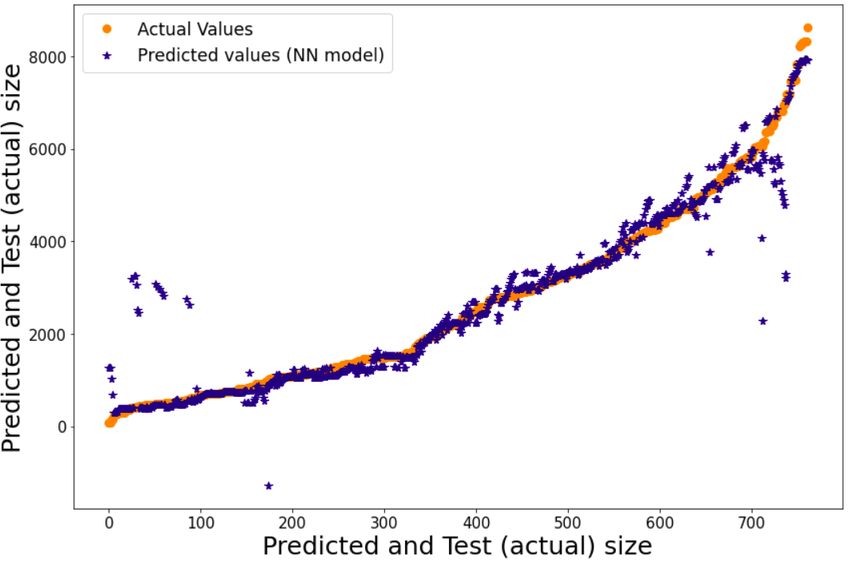
2

2 video game and Steam gaming platform. In section III, we
focus on the literature review, where we discuss and explain
the limitations of existing papers. In section IV, we propose our
new method of collecting real-time data and analyze shortcom-
ings of the data tracking. Section V will be dedicated to theory
and algorithms where all explanations of the hypothesis, sensi-
tivity analysis, feature engineering, data prepossessing will be
fully explained. Section VI will be dedicated to methodology
and experiment setups that define machine learning predictive
models and their parameters, compare models, and discuss
certain performance levels. Section VII will run through the
experimenting where real-time data collection and LR, NN,
and LSTM experiments will be presented in tables and graphs         Fig. 1. Battlefield of the Dota 2. Bottom left corner is the current map, in the
and discussed. Section VIII demonstrates how the graphical          center “Radiant” creeps and heroes fighting against “Dire” and tower throwing
user interface works and built using PyQt designer and some         fire to “Radiant.”
examples of working GUI. Finally, in the last section, we
will conclude what outcomes we got from this paper and tell
about long-term future goals and the paper’s impact on the          with each other and play online games at the same time. Steam
innovation.                                                         enables several possibilities for instance video streaming, and
                                                                    social networking, together with updating feature of the games.
 II. D OTA 2 VIDEO GAME AND S TEAM GAMING PLATFORM                  Each player in the Steam has the ability to have a Steam
A. Dota 2 video game                                                Token where we use in identifying particular player id. Our
   A Dota 2 (Short for ”Defense of the Ancients”) is a MOBA         research’s data collection process is also integrated with Steam
video game developed by Valve. The game has ten players             Token where we need to get the user’s token to our game state
in two teams called ‘Dire’ (represented in red color) and           integration (GSI) configuration.
‘Radiant’(represented in green color); there are five players
per team, and the idea is to defend your ancient tower and                                   III. R ELATED WORKS
do not let the enemy come towards your side. Each match
is played on a map split into two sides by a river. Each               We have researched over the related works, several SOTA
player chooses a hero from 115 possible heroes (the number          articles and different competitions based on Dota 2 win predic-
of heroes changes depending on Valve’s updates). Heroes             tions, data tracking, and other related fields have been selected
are the main characteristics of how the game goes. If the           and reviewed for our literature. The authors in [6], used
five players have chosen the right combination of the hero,         standard machine learning models, feature engineering, and
they have a high chance of winning or vice versa; the good          optimization. Which the method give up to 85% accurate after
gamers specifically take into account the combinations of           5 minutes of gameplay used 5.7k data from the international
their hero [8]. The heroes are defined by the strength, agility,    2017 Dota 2 tournament. [12] proposed methods in two steps,
and intelligence. There are five couriers (flying horses) which     in the first step, Heroes in Dota 2 were quantified from 17
can help five heroes to deliver some items during the game          aspects more accurately. In the second step, they proposed
from the your shops and a secret shop (which you can buy            a new method to represent a draft of heroes. A priority
many valuable items by visiting with your hero or sending           table of 113 heroes was created based on prior knowledge
your courier and asking your courier to bring where you want        to support this method. The evaluation indexes of several
but if courier seen by the enemy during the way to delivery it      machine learning methods on this task have been compared
can be killed and you need to wait to re-spawn your courier         and analyzed.
and vice versa) as heroes gain more golds during the game.             Another article [8] discussed to improve the prediction
There are not only heroes but creeps that come every half           results of the existing model, i.e., data collection, feature
minute in the game; each wave has three Melee creeps and            extraction, and feature encoding. Their idea using augmented
one Ranged creep, and every 10th wave Siege creep will also         regression was defining success probability = (heros picked
spawn. During the attack, buildings can also throw a fire for       and success heroes)/(heroes picked) and final success prob-
the closest enemy to the building; therefore, bearing in mind       ability = (regression probability + success probability)/2. If
that not coming close to the tower unless the player does not       the final success probability > 0.5, they predict a ”Radiant”
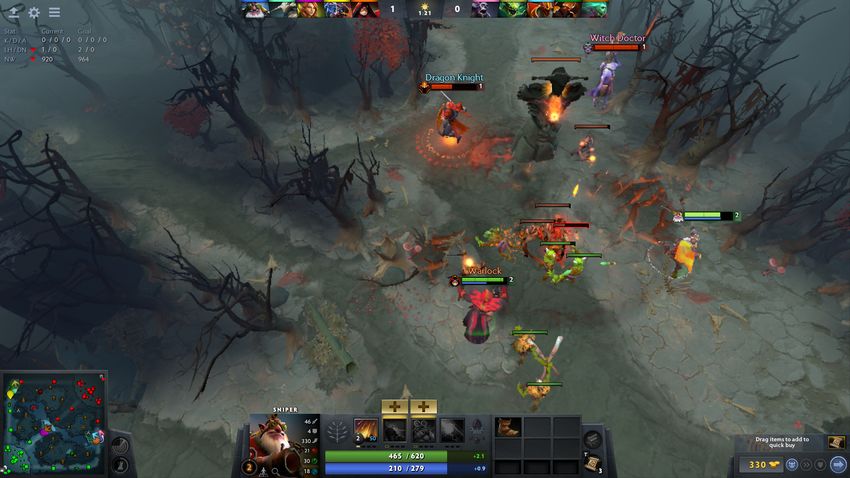
have extraordinary power. We can see the full illustration of       win; otherwise, ”Dire” win, the metrics they used include how
all heroes, creeps, buildings, maps in a screenshot taken from      an individual hero contributed and how heroes complemented
our live game in Figure 1.                                          each other in a match. The results show that the pure logistic
                                                                    regression accuracy, asymptotically approaches 69.42%, and
                                                                    they conclude that just hero selection plays a vital role in win-
B. Steam gaming platform                                            ning or losing the game. In augmented logistic regression, the
   Steam is a video game digital distribution service which is      test accuracy score approached 74.1%, and authors compared
also developed by Valve, where it enables players to connect        the both models.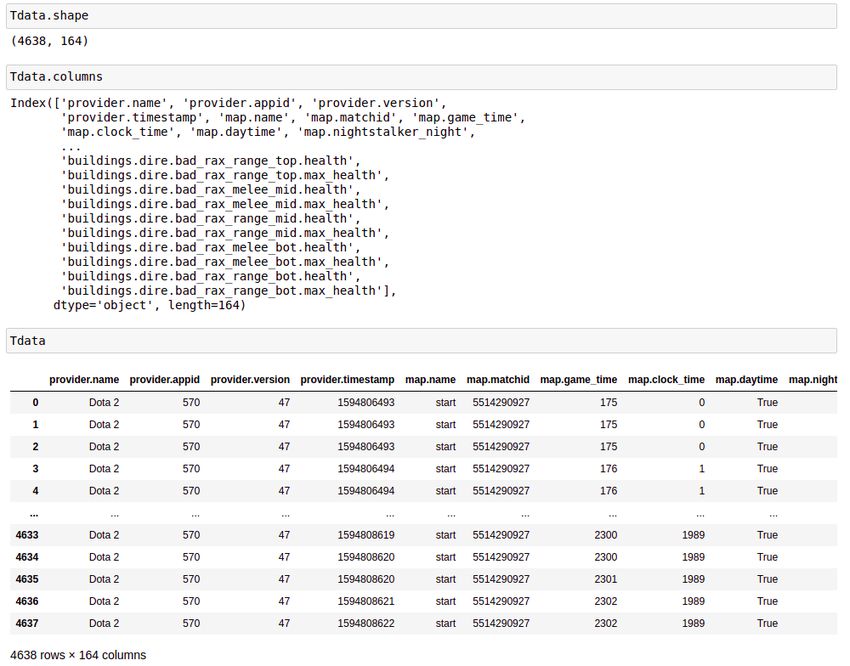
3

   Conley and Perry were the first to demonstrate the impor-         •   The need for the novel theoretical approach is important
tance of information from the draft stage of the game with               to implement most reliable models.
Logistic Regression and k-Nearest Neighbors (kNN) [2]. They           • Authors have not thought of developing their own data
got 69.8% test accuracy on an 18,000 training dataset for                collection tool.
Logistic Regression, but it could not capture the synergistic         • Authors only limited with source codes while players
and antagonistic relationships between heroes inside and be-             are not scientists to use codes, thus there is a need for
tween teams. To address that issue, the authors used kNN with            developing user-friendly GUI.
custom weights for neighbors and distance metrics with 2-fold         Hence our contribution is filling the knowledge gap in the
cross-validation on 20,000 matches to choose d dimension           discussed researches and proposing our novel approaches to
parameters for kNN. For optimal d-dimension = 4 they got           bring more light to the Esport’s Dota 2 win prediction scientific
67.43% accuracy on cross-validation and 70% accuracy on            area.
50,000 test datasets [2].
   The article [10] was also taken into consideration, where                  IV. DATA C OLLECTION AND A NALYSIS
authors discussed the comparison of several ML models: Naive
Bayes classifier, Logistic Regression chosen to replicate the         Identifying the player’s reaction, movements, real-time in-
results of the previous works on their collected datasets and      teractions could reveal more about the player’s results over
Gradient Boosted Decision Trees, Factorization Machines and        time. Therefore, it is essential to track such significant infor-
Decision Trees were chosen for their ability to work with spare    mation as the game progresses; the D2API python library is
data. AUC, and Log-Loss measured the quality of prediction         useful tool. For example, the following command in python:
(Cross-Entropy) on ten-fold cross-validation, the result of           • import d2api

AUC was 70% in XGBoost and 68% in LogRess and Naive                   • api = d2api.AP IW rapper(api key = ”Y our Steam

Bayes, the results compared in three normal, high, very high             T oken”)
skill sets. Kuangyan Song, Tianyi Zhang, Chao Ma [11] have         could give us match details when we have the id of the played
tried logistic regression to predict the winning side of Dota 2    match.
games based on hero lineups. They collected data using an API         • match details = api.get
provided by the game developer. The results were illustrated          • match details(Y ou M atch ID)
using training and testing errors, and a conclusion has been       will load that many details in the variable or the same api.get
made.                                                              heroes() can give the details about the match hero. In practice,
   Paper [7] used the replays in Dota 2 was tested in different    it was not possible to store in a file in preferred format. For this
classifiers . These articles and our research are in completely    particular case, we tried to observe other players’ data, and it
different concerning methods. In contrast, we have the ML          was not our expectation while we were planning to investigate
models, and they have the other methods to analyze their           and view changes of data variable features of our games and
project.                                                           extract data in the ”CSV” format for further research purposes.
   The interesting article [1] used the ARMA model for                The idea about writing our codes and integrating between
investigating time series of change in the health of hero          Anaconda and Steam gaming platform was our predominant
also implemented feature exploration analysis; they achieved       priority. We discovered the game state integration (GSI) where
slightly greater than 80% accuracy in predicting the sign of       it could help developers pull data from live Dota 2 games.
significant changes in health and reasonably accurate results      Python programming language has been selected by our side
with linear and logistic regression models.                        as a programming language for the development of the data
   The paper [4] predicted match results with xpm, gpm, kpm,       collection tool. We have created a tool that returns us results
lane efficiency, and solo competitive rank, authors compared       of real-time data in CSV, JSON, and TEXT files. We have
SVM and NN. The [3] discussed zone changes, team members           experimented with a quite a lot of our games and successfully
distribution, and time series methods. They concluded that         collected real-time data using Python as a back-end server. The
MOBA teams behaviour is applicable to team skills. [9]             idea of implementing is vital in researching player’s predictive
was from the HSE university researchers did consider game          machine learning and deep learning models or general analysis
statistics and True Skills, which is the similar to Elo rating     of players throughout the game. Our practical experiments
for chess and they have done for CSGO and Dota 2 with              show that we have developed a tool for collecting data from
AUC, recall, precision values and compared the results. Wang,      the Dota 2 MOBA game. The importance of this part of the
W. demonstrated predicting the match outcome depending on          work is that many researchers want to implement different
the hero draft, with the help of neural networks on GPU,           applications and models for Esports. In contrast, their models
and logistic regression methods with hero drafts [13]. Yifan       could differ, but the tool for collecting data will remain very
Yang, Tian Qin, and Yu-Heng Lei tried to predict the matches       beneficial for everyone who has a curiosity in in-game and
using logistic regression with replay of data and improved their   real-time data collection. Thus, this section can also help
accuracy from 58.5% to 71.5% [14].                                 researchers and our models by providing a ready and reliable
   From the previous researches, we have found the following       real-time data collection tool. The codes are available at our
shortcomings:                                                      Github Repository.1
   • There is a need for developing deep learning models for
      better accuracy prediction.                                    1 https://github.com/KodirjonAkhmedov/Real-Time-Data-Collection-Dota-2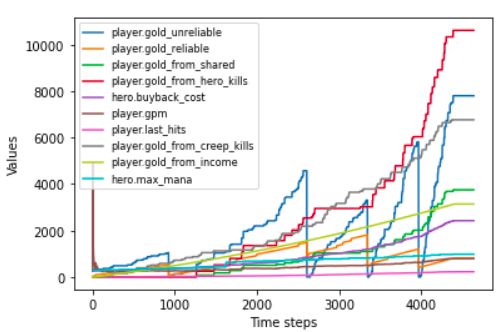
4

A. Game State Integration (GSI) in Dota 2                               •   In the initial step, we define a class called real-time
   Game State Integration (GSI) links the game events that are              Dota 2 parser. Parser of Dota 2 in real-time takes as
happening with computer, and it is an advantageous method                   input a JSON request and has as output a CSV file.
for tracking the real-time data of the playing game. To be                  Following that, we define a dictionary for buildings that
more precise, in the case of Dota 2, game state integration                 contains information about buildings, and a function for
has been developed using Python and required configuration                  that variables will be saved all the values and keys pairs
files by provided by Valve corporation. Configuration file                  given by JSON file to create a dictionary.
was the one we need to put inside installed folder of the               •   In the second step, we took the seven GSI values and
Dota 2 in our device, for example, in Linux directory                       their keys, namely, Provider, Map, Player, Hero, Building,
has following path address: /home/test/.steam/debian −                      Abilities, and Items.
installation/steamapps/common/Dota2beta/game/Dota/                      •   In the third step, we save a list of values and column
cf g/gamestateintegration, where we need to specify our                     names for each arrived request in the dictionary but
.cfg file inside configurations files of the game. The GSI                  not buildings because we will save the building values
consists of an end point section setting which was done for                 separately and update information about buildings in each
CS:GO but we have created our own endpoint setting for                      post request.
Dota 2 using the Valve’s website.2 :                                    •   In the fourth step, we save the tracked data to the CSV
   • ”uri” which represents the server and port which
                                                                            data. Initially, we create CSV file in our current directory.
      the game will make post request to this uri:                          If it exists, then we renew the data and start writing a new
      http://127.0.0.1:8080                                                 CSV file. An important part to notice there are two cases
   • ”timeout” ”5.0” The game expects an HTTP 2XX
                                                                            when our server starts, let us explain with Dota 2 state:
      response code from its HTTP POST request, and the                     the Dota 2 has game states: “pre-game”, “in-progress”
      game will not attempt submitting the following HTTP                   and “post-game,” and we define them in our condition
      POST request while a previous request is still in flight.             when we have these two “pre-game” and “in-progress,”
      The game will consider the request to be timed out if                 conditions, then our server starts writing real-time data
      a response is not received within so many seconds and                 of the game.
      re-heartbeat next time with the whole state omitting any          •   In this fifth step, we define Server Handler by defining
      delta-computation. If the setting is not specified, then a            several functions of set response and doget and dopost
      default short timeout of 1.1 sec will be used.                        which we will get the size of the data and get the data
   • ”buffer” ”0.1” Because multiple game events tend to
                                                                            itself, and we will use the real-time parser that we have
      occur one after another very quickly, it is recommended               defined earlier.
      to specify a non-zero buffer. When buffering is enabled,          •   In the sixth step, we begin to write on three different data
      the game will collect events for so many seconds to report            files: JSON, CSV, and TEXT in each step by making a
      a more significant delta. Setting 0.0 is to disable buffering         post request.
      completely. If the setting is not specified, then default         •   In the final seventh stage of our work, we define the
      buffer of 0.1 seconds will be used.                                   HTTP request starting and stopping points where the
   • ”throttle” ”0.1” For high-traffic endpoints, this setting
                                                                            server works until the user terminates it manually by their
      will make the game client not send another request for                kernel inside their environment. In our case was Jupyter
      at least this many seconds after receiving the previous               Notebook’s stop kernel button. However, this process has
      HTTP 2XX response to avoid notifying the service when                 been integrated with the Graphical User Interface section,
      the game state changes too frequently. If the setting is not          and there is no need to interact with python code. Only
      specified, then a default throttle of 1.0 sec will be used.           start, stop and view buttons enable us to track data easily.
   • ”heartbeat” ”0.5” Even if no game state change occurs,
                                                                      C. Data features
      this setting instructs the game to request so many seconds
      after receiving the previous HTTP 2XX response. The                Once we tracked the data we started learning the exciting
      service could be configured to consider a game as offline       features and their importance in our machine and deep learning
      or disconnected if it did not get a notification for a          models. The data collection tool enabled us to collect more
      significant period exceeding the heartbeat interval.            than real time 160 data features. Lists of game state integration
                                                                      are following, ”buildings”, ”provider”, ”map”, ”player”,
                                                                      “hero”, ”abilities”, ”items”, ”draft”, ”wearables” where the
B. Real-time data collection and Steam integration
                                                                      data has been joined to those main game states including:
   For Steam platform integration and for collecting data, there         • “Player”represents a person who is playing the game and
is a need to launch Dota 2 game from the Steam gaming                      his ability to play the game.
platform. Here the server is the python where it works as the            • “Hero” represents the player’s choice of hero for the
“third party” between the game and the computer to enable us               game and hero statistics during the game.
to store the data inside the computer directory. The following           • “Abilities” represents the hero’s list of abilities used or
quick steps can describe the process:                                      how they fluctuated over the time.
  2 https://developer.valvesoftware.com/wiki/Counter-Strike: Global      • “Items” represents the hero’s items and their usage over
Offensive Game State Integration                                           time.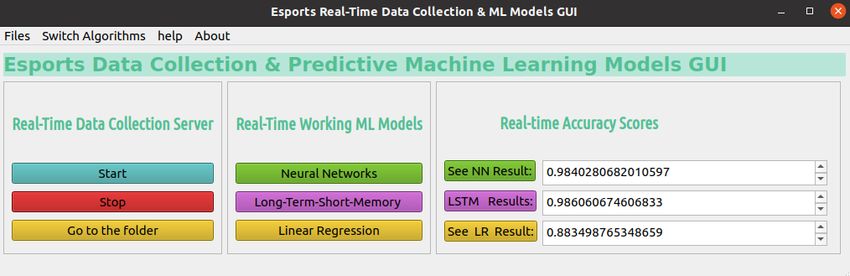
5

Fig. 2.   Player gold change for one particular game during the game   Fig. 3. Chosen fixed independent features’ change throughout the game in
                                                                       line plot.

   •  “Buildings” represents “Dires” or “Radiants” towers
      (bottom, middle, and top) towers’ statistics.                                     V. T HEORY AND A LGORITHMS
   • “Provider” represents what is the game which name that               There has been a hypothesis for predicting the final match
      is currently in process and what is the game’s id Etc.           result using different techniques and analyses that lacks some
   • “Map” represents the current map, and map states such             decent and easy mechanisms. This section will describe our
      as does the winner exists or the map is paused Etc.              novel approach, and how the method and algorithms we have
It is noteworthy that, the columns of our collected data are           tried could be differentiable and important in prediction. As we
fixed in all of the games. On the contrary, the rows of the            have seen in our previous section, we have developed a real-
data are in ascending order depending on the game progress.            time data collection tool using Python as a server for Dota
For instance, if the gamers play the game more time, the data          2 for model implementations, which means our theories and
capacity will be more, and the row of the data will be greater         algorithms will be based on our collected data. Depending
in length compared to games that are finished in a short period        on our data, we developed our models initially simple linear
of time.                                                               regression, then the neural network and long short-term mem-
                                                                       ory were trained and calculated the accuracy scores of the
                                                                       models. Moreover, so far, we have done sensitivity analysis
D. Sensitivity analysis                                                on features and their importance. We defined that player.gold
    Before starting the analysis on the game data features,            feature represents the success of the player. With that in
we need to extract the statistical data from more than 160             mind, we developed a new raw dataset by composing highly
features, not all the values are in numerical. More precisely,         correlated x independent features to target y and predicted
the collected data could have data types, objects, and integers;       multi-forward steps. We introduced them as L (time-lagged
therefore, we need to get only the numerical values of data to         correlation) and d (multi-forward steps).
fit in our model. Thus, we have taken data features whose data
values are either ’int16’, ’int32’, ’int64’, ’float16’, ’float32’,
                                                                       A. Time-lagged correlation and multi-forward step prediction
or ’float64’, extracted statistical data could change depending
on how long the game takes place.                                         The method we propose in this paper is dependent on the
    Let us define the target variable as y and some inde-              time-lagged correlation to rows (L) and multi-forward steps
pendent variables as x. Based on our scientific hypothesis,            (d). Those parameters can manually be adjusted by users, for
we have taken the variable that primarily symbolizes the               example, to predict 20 steps ahead of the game while our real-
player’s success during the game, that is PLAYER.GOLD,                 time data is being collected; users can set the d = 20, then
the distribution of the target variable for one game can be            the models will give the results accordingly. Likewise, users
seen in Figure 2. Gold is the currency used to buy items or            can edit the time-lagged correlation L to define the number of
instantly revive a hero. Gold can be earned from killing heroes,       composing rows. Let us describe both parameters in detail:
creeps, couriers, buildings, additional enemies that only stay            • Multi-forward step prediction (d) - represents the num-
still in some specific corners of the team’s map side, or by                ber of steps ahead of predicting the game. The parameter
taking bonuses that appear at certain places on the map. It is              plays a crucial role in defining a model’s bounds and con-
also passively gained periodically throughout the game. For                 structing raw data described in the following subsection
the input parameter x, we defined ten fixed features with the               during the preprocessing period.
most considerable correlation to our target variable, Figure 3            • Time-lagged (L) - represents the number of joining rows,
illustrates those ten input features’ distribution over the game.           imagine the user is tracking data, and user will have
                                                                            initial data which our data tracker is collecting. Imagine
6
TABLE I several reasons why some models did better compared to
M ODEL CONSTRUCTION PROCESS USING INDEPENDENT VARIABLES others. All models and Graphical User Interface were imple-
Vector of features x1 x2 x3 x4 x5 ... xm mented using Python in Linux Operating System.
x(1) * * * * * * *
x(1) * * * * * * *
x(1) * * * * * * * A. Machine Learning models and their parameters
x(1) * * * * * * * Three machine learning models have been chosen:
... * * * * * * *
x(L) * * * * * * *
x(L+1) * * * * * * * • Linear Regression is a supervised machine learning
... * * * * * * *
algorithm used to predict values within a continuous
x(NRow-d) * * * * * * *
range. The idea of the regression problem is dependent
on our predicting target variable. The dependent variable
each row of that data as variable x, which has columns is player gold and this parameter is not stable during
of independent variables x1 , x2 , ..., xn and target y then the game, and there are very good linear correlations
depending on the L, let us set L = 3, we create a among certain features therefore, the regression problem
new dataset by composing three rows of the x in one has been chosen to predict. We built a linear regression
value defined as X in a single row, after that three rows model by splitting our constructed datasetX and
composed, we join next three rows and process continues datasetY into train and test data, Test size has a 20%
until (number of rows(N Row) − (L + d − 1)). In the partition, and the rest was dedicated to the training part.
case of target variable y, we add that multi-forward step We fit the model and take the prediction value from our
prediction d to the time-lagged number and write that regressor. The experiments have been done for different
value to the new dataset and create a raw dataset based datasets, and results were compared in the experiments
on parameters. section.
• Neural Networks one of the leading models in time-
B. Data construction using model parameters series forecasting and Esports. Working with artificial
We construct new data set using model parameters time- neural networks, we could acquire better results due to
lagged (L) and multi-forward step ahead prediction (d), its ability to train the model through the hidden layers,
independent features, target, start indexing, and get our final where each layer takes the input data and processes in
working data set, consider Table 1 then we have the following the activation functions and passes to the successive
data set: layer that can reduce its loss function with forward and
backward propagation where biases and weights will be
updated and adjusted back and forth during the training
X(1) | y(L + d)
X(2) | y(L + 1 + d) process until the number of epochs unless and until the
loss value is completely reduced can lead to achieving
X(3) | y(L + 2 + d)
Dataset =
better model performance.
X(4) | y(L + 3 + d)
... ... ...
X(N Row − d − L + 1) | y(N Row) • Long Short-Term Memory (LSTM) is a type of recur-
rent neural network (RNN). The output from the previous
where, step feed as an input and the other inputs for the next step
X(1) = (x(1), x(2), . . . , x(L)) and process continues. In LSTM, nodes are recurrent, but
X(2) = (x(2), x(3), . . . , x(L + 1)) all have an internal state. The node uses the internal states
X(3) = (x(3), x(4), . . . , x(L + 2)) as a working memory space that enables information flow
X(4) = (x(4), x(5), . . . , x(L + 3)) over many time steps. Input value, previous output value,
... and the internal state are all used in the node calculations;
X(k) = (x(k), x(k + 1), . . . , x(L + k − 1)) the results of the calculations are not only the output
... value but also used to update the states. Neural networks
Eventually, we have datasetX with composed independent have parameters that determine how the inputs are used
variables and datasetY with the target variable. The shape of in the calculations, but LSTM has the parameters known
our data are entirely depend on the game but for this particular as gates that control the node’s information. LSTM nodes
case, datasetX is 3833 rows and 70 columns, and datasetY are rather complicated than regular recurrent nodes, mak-
consists of 3833 rows and a column with a target. ing them learn complex interdependencies and sequences
of the input data that results in better outcomes.
VI. M ETHODOLOGY AND E XPERIMENTAL S ETUP Several metrics were used to evaluate the performance of
In this section, we will enumerate the languages and pro- the all models. For the accuracy of the linear regression model,
grams used in the research, present the metrics and model we have used the Sklearn library and calculated the R2 but
parameters, describe the implementation of our machine and we took final accuracy score as adjusted R2 , while NN and
deep learning models, and compare the different models and LSTM models accuracy scores were taken as R2 .7
Why adjusted R2 , when we have more input variables or
predictors are added to a regression model it may surge the
R2 value, which entice model’s markers to add even more.
This is called over-fitting and result in unexpected high R2 .
Whereas, adjusted R2 is used to identify how trustworthy the
correlation and how much is identified by the addition of input
features. R2 adjusted accuracy score is evaluated using the sum
of squares error (SSE) and the total sum of squares (SST):
SSE
R2 = 1 −
SST
where, X
SSE = (ytest − ypredicted )2
X
SSE = (ytestmean − ytest )2
then,
2 N −1
Radjusted = 1 − (1 − R2 ) ∗
N −p−1
where, p is a number of input features and N is a number of
rows. Fig. 4. Illustration of Neural Network architecture.
For tuning the optimizers, we chose Adam in NN and LSTM
models. We used Adam because it is a replacement opti- of the LSTM model. Bearing in mind that, we always have
mization algorithm for stochastic gradient descent for training to give a three-dimensional array as an input to the LSTM
deep learning models. Adam combines the best properties of network, the first dimension represents the samples, the second
the AdaGrad and RMSProp algorithms. We used the Adam dimension represents the time-steps, and the third dimension
parameters with learning rate = 0.01, beta1 = 0.9, and represents the number of features in one input sequence. We
betta2 = 0.999, which were the standard values for the Adam imported the LSTM model from TensorFlow Keras layers, and
optimization for better performance. The loss function of the the different architecture of the LSTM has been tested several
LSTM was chosen as the same MSE as the neural network. times, and when the accuracy score performed better results,
The model has been trained over 100 epochs since it can we chose that architecture as the final working architecture
update weights and biases of the long training process during demonstrated in Figure 5.
100 epochs, while one epoch means that the optimizer has
used every training example once. The batch size was 64,
which fits the model in the fastest way possible and returns
the output while training with batch size equals to one will take
many hours to train our models; therefore, we took the normal
value of batch size and evaluated the model performances. The
number of total parameters for LSTM training was 622,209,
and there were no non-trainable parameters. As for NN, there
were a total of 438,913 with 436,225 trainable parameters and
2,688 non-trainable parameters.
B. Architectures of NN and LSTM
We have tested several architectures for the Neural Network
model and calculated the accuracy score for each particular
experiment, and we have concluded choosing the architecture
that returned us the best performance of the models. We used a
sequential model where we can add layers easily. We imported
different types of layers to use in our models from the Keras
library such that: In our neural networks architecture there are
four layers which is performed in Figure 4.
In the LSTM model, we used the same sequential model. We Fig. 5. Illustration of LSTM architecture.
standardized the xtrain, ytrain, xtest, ytest with standard
and mean and standard deviation as we did in NN. When
splitting, we used standard 20% testing to 80% training VII. R ESULTS OF THE E XPERIMENTS
respectively. In comparison with neural networks, we need This section will describe the result of all tests and ex-
to reshape the input for enabling the correct working process periments that we have done using our models, theory, and8
algorithms. We would to show the outcomes of the working TABLE IV
models and their comparisons in different situations. Overall T ESTING OUR MODEL ON 10 DIFFERENT NEW GAME DATA SETS AND
ACCURACY SCORES ARE FOLLOWING : WHEN D =20, L=15 WITH 10 FIXED
the experiment process took the final six months of the project INPUT FEATURES ON ALL EXPERIMENTS
period where we were mainly involved in the experiments with
Models Exp1 Exp2 Exp3 Exp4 Exp5 Exp6 Exp7 Exp8 Exp9 Exp10
different players and collecting their gaming data.
LR 0.81 0.69 0.75 0.72 0.84 0.82 0.96 0.87 0.85 0.87
NN 0.87 0.82 0.87 0.79 0.88 0.88 0.97 0.92 0.91 0.92
LSTM 0.92 0.91 0.91 0.88 0.91 0.92 0.98 0.96 0.94 0.94
A. Real-time data collection experiments and results
Real-time data collection tools were tested in more than
TABLE V
100 games, and all the data has been collected and trained T ESTING OUR MODEL ON 10 DIFFERENT NEW GAME DATA SETS AND
on the models and evaluated the match results. Figure 6 ACCURACY SCORES ARE FOLLOWING : WHEN D =20, L=15 WITH 10
demonstrates the CSV format data that has been collected HIGHLY CORRELATED INPUT FEATURES ON ALL EXPERIMENTS
using our tool. The experiments were done on different values Models Exp1 Exp2 Exp3 Exp4 Exp5 Exp6 Exp7 Exp8 Exp9 Exp10
of the L and d where we predicted the low time steps then LR 0.80 0.75 0.78 0.70 0.67 0.80 0.96 0.82 0.87 0.88
NN 0.90 0.88 0.86 0.78 0.86 0.87 0.96 0.83 0.90 0.92
we increased multi-forward steps respectively, we can see in LSTM 0.94 0.94 0.88 0.83 0.92 0.90 0.98 0.92 0.90 0.93
Table II comparison of three models accuracy performances.
Table III describes the increasing d multi-forward steps and
fixed L time-lagged correlation experiments on three models. representations for our consideration, Q-Q plots for viewing
the distributions and bar plots and comparison in the separate
and merged plots were used to analyse the performances. We
can see the plots for different model performances for linear
regression in Figure 8.
Linear Regression Results
First, let us consider linear regression results. In Figure 7,
we have performed Q-Q plot of the linear regression to see
the distribution, and as we can see, the distribution is almost
skewed-right. we have achieved accuracy scores depending on
the multi-forward prediction parameters, which for the worse
case in linear regression 69% but on average 82% respectively.
Neural Network In the next experiment, we have tested our
neural networks model’s prediction results. The experiment
results show better performance for neural network implemen-
tation comprising 88% of average accuracy score for the same
data set used in linear regression, which is 6% higher accuracy
score than the LR model.
Fig. 6. Illustration of real-time CSV data collected for a Dota 2 game. We can see some outliers in the data at the beginning and
the end of the data set. Considering we are working with
large values, we could have such extremum points despite
TABLE II standardization, but there was no considerable impact on the
ACCURACY SCORES COMPARISONS OF PREDICTIVE MODELS
model performance. In the case of neural networks, both
Models d=2, L=5 d=10, L=7 d=15, L=10 d=20,L=15 d=25, L=20
LR 0.98 0.93 0.90 0.90 0.88
NN 0.99 0.94 0.93 0.93 0.91
LSTM 0.99 0.95 0.94 0.95 0.94
TABLE III
ACCURACY SCORES COMPARISONS OF PREDICTIVE MODELS WITH FIXED
L=15 AND INCREASING MULTI - FORWARD STEPS
Models d=30 d=40 d=50 d=60 d=70 d=80 d=90 d=100
LR 0.86 0.92 0.74 0.67 0.64 0.68 0.67 0.70
NN 0.90 0.92 0.90 0.89 0.93 0.86 0.94 0.95
LSTM 0.93 0.98 0.92 0.91 0.98 0.96 0.95 0.92
B. Graphical visualization of results
We have performed graphical visualization of our results of
predicted and actual values using different types of graphical Fig. 7. LR Q-Q plot of the quantiles9
Fig. 10. LSTM Q-Q plot of quantiles
Fig. 8. Plot of the difference between predicted and actual values of Linear
Regression model
tion while NN showed us slightly decreased prediction based
on our experiments (Figure 11).
Fig. 9. Line plot of true sorted (orange) and predicted sorted (blue) values
of our target using NN
Fig. 11. Comparison of three models’ on d = 20 multi-forward steps future
prediction of target with L = 15 time-lagged correlation.
predicted and actual values are almost on the same points,
representing the high accuracy score with slight non stable
values (Figure 9). C. Discussion of the results among compared models
Long Term Short Memory Results The third experiment Results show that we have achieved considerably decent
based on LSTM model, In LSTM model the data for the accuracy scores in all of the models, and the models we tried
experiment was the same. The results in this model performed in some sense gave us a fulfillment which we have attained
a much better average accuracy score than NN and LR, to see the performance of several models. Initially, we were
93% accuracy compare to 82% for LR and 88% for NN concerned about the accuracy, but after several experiments,
respectively, which means Long Short-Term Memory results we had a firm belief that the accuracy fluctuates over the range
are 11% higher than the Linear Regression model. Reason for of datasets. However, the range does not drop much from 70%
such a significant change is that in the LSTM model, biases despite altering several parameters of the model and testing on
and weights are updated during the training process over the varying data collected by our data collection tool.
epochs much sufficiently compared to other two counterparts. For example, in deep learning models, LSTM and NN, We
There are still some outliers in the prediction such that we deduced that using Neural Networks could give better accuracy
have seen some predicted values below the actual values of than the linear regression model. Moreover, we found that if d
the target at some points but this model performed perfectly, and L increase, accuracy decreases but not below 80% based
Figure 10 represents Q-Q plot of quantiles. on our tests, where we have tested with the same dataset
Despite experimenting on models accuracy performance, we and increasing multi-forward steps, and measured accuracy
tested future predictions of our target variable with multi- scores, which showed us LSTM also did better performance
forward steps d where future values are predicted on three over Linear Regression and Neural Networks almost in all of
models and compared. We have verified that future prediction the ten experiments except there was better performance in
values of the target was close to its previously gained values. NN when we had chosen fixed composing rows and multi-
LSTM and LR were quiet ambitious to have increased predic- forward steps, for example, the first experiment they both had10
the same performances (Table II), but overall, the LSTM was • GUI has three main sections: Data-Collection, Ml models,
the best compared to the other two models due to its rather and Results.
complicated nodes, making it learn complex interdependencies • GUI has nine buttons and three text browsers to view
and sequences of the input data that results in better results. model performances.
The experiments also included with optimal fixed L model • The first part: data-collection, has “Start,” “Stop,” and
parameter and predicting increasing d multi-forward steps such “Go to the folder” buttons. Once the game starts, click
that we tested from 30 to 100 steps prediction (Table III). on it, and it will start collecting real-time data. We can
We have deduced that Linear Regression can be significantly view current data in the “Go to the folder.” This button is
affected with increase of d where it showed low performance, made to make sure that data is there and to show whether
while NN and LSTM models could handle long steps ahead it is working. Once the game finishes safely close the
prediction with accuracy not lower than 85%. application and enjoy using collected data.
Our findings of real-time data collection aided us in im- • The second part: Consists of machine learning models
plementing machine learning models. Data consists of more that are three models: Linear Regression, Neural Net-
than 160 columns and more rows depending on game time. work, Long Term-Short Memory in order to use them,
The applications of our current discussion are essential in click on the name of the models and wait sometimes
evaluating performance of machine learning models Dota 2 while the two deep learning models need time to train
match outcome prediction. In terms of the data collection over the 100 epochs whereas, Linear Regression will do
process, the real-time data collection python script could ease the quick training.
the job of most of the researchers to have ready tool for • The third part: results that give us accuracy scores.
their models and implement such machine learning models Once a model has done its part, click one of the (See
for their different research to enhance the field of the research. NN/LSTM/LR Result) buttons, and you can get real-time
There are some limitations, such as research needing further model performances next to the models in a text box.
development considering more parameters and bringing some • To close the GUI, click x safely and finish the work.
more methods and approaches which we considered in long-
term goals with grants, and publications. B. Backend connection with data collection and models’ codes
VIII. R EAL TIME GUI USING P Y Q T For the backend connection of the GUI, we have used the
Once we have the working model and data collection libraries of the PyQt widgets, QApplication, QMainWindow,
tool, how can we make the work more user-friendly was QPlainTextEdit, QtCore, QtGui, and Tkinter together with the
the primary question for us? We wanted the users to click file dialog. Those all the libraries enabled us to implement
on the buttons and evaluate the accuracy scores of the the backend implementation process of the tool. For each
models based on their choice, and collect the data of their model and data collection section, we linked the main UI,
games. The main purpose of this section is to reduce the for example, if pushButton1 .clicked.connect(button name
interaction with source codes and interact with the graphical of the GU I). Similarly all the other subsections of the push
user interface and evaluate everything using our GUI. For buttons were connected.
that reason, we thought of creating GUI and connecting The next stage of the process was creating functions for
our source codes in the backend. There were some more the .py file reading process and integrating them into our
options for doing this task. For example, between web-based GUI. Overall, nine functions were created such that data
and desktop-based GUI, we thought that the desktop-based collection start a simple os library to read .py file and for
software is a good option, where we found a handy tool stopping the collection sys.exit() was connected. In the
which enables programmers to create user interfaces called case of the models, the same procedure for data collection
PyQt, that is a set of Python bindings for The Qt Company’s was implemented with os library. However, each model has
Qt application framework and runs on all platforms supported one additional function which is responsible for reading the
by Qt, including Windows, macOS, Linux, iOS and Android. results, which means after the run stage of the model, it
PyQt6 supports Qt v6, PyQt5 supports Qt v5, and PyQt4 returns us TXT file and stores it in a directory then this
supports Qt v4. The bindings are implemented as a set of TXT with results inside was read and performed in the text
Python modules and contain over 1,000 classes. browser with ui.textBrowser.setT ext(f ile name). The
process was repeated for the other two models, and this stage
We created the GUI using the PyQt designer application for has been completed successfully. The final working GUI was
the Linux operating system. Initially, we had several ideas for tested over the game. We can see an example of our games
the creation of the user interface, but finally, we have made a in Figure 12, the data has been collected, and the models’
tool that will be easy to interact with, the instruction of how accuracy scores have been evaluated.
to use the tool explained in the following subsection.
A. Instruction of the tool IX. C ONCLUSION
In this section, we will go through each step of the usage In conclusion, all these results suggest that we have
of our GUI for data collecting and evaluating the models’ built efficient machine learning models from the supervised
performances, let us see each step in the following stages: linear regression model to deep learning models of Neural11
[5] Juho Hamari and Max Sjoblom. What is esports and
why do people watch it? Internet research, 2017.
[6] Victoria J Hodge, Sam Michael Devlin, Nicholas John
Sephton, Florian Oliver Block, Peter Ivan Cowling, and An-
ders Drachen. Win prediction in multi-player esports: Live
professional match prediction. IEEE Transactions on Games,
2019.
[7] Filip Johansson and Jesper Wikstrom. Result prediction
Fig. 12. Example of working GUI with the accuracy scores of the models
on the right bottom by mining replays in dota 2, 2015.
[8] Kaushik Kalyanaraman. To win or not to win? a pre-
diction model to determine the outcome of a dota2 match.
Networks, and Long Short-Term Memory were implemented Technical report, Technical Report. Technical report, Univer-
to predict game outcomes of Dota 2. It can be stated that sity of California San Diego, 2014.
using recent approaches, we defined one of the possible [9] Ilya Makarov, Dmitry Savostyanov, Boris Litvyakov, and
ways to achieve our goals. Moreover, with the help of data Dmitry I Ignatov. Predicting winning team and proba- bilistic
collection, we successfully implemented our algorithms and ratings in “dota 2” and “counter-strike: Global offensive” video
investigated essential variables in the Dota 2 game. games. In International Conference on Analysis of Images,
Social Networks and Texts, pages 183–196. Springer, 2017.
Though the experiments run, we have achieved accuracy [10] Aleksandr Semenov, Peter Romov, Sergey Korolev,
scores depending on the multi-forward prediction parameters, Daniil Yashkov, and Kirill Neklyudov. Performance of ma-
which for the worse case in linear regression 69% but on chine learning algorithms in predicting game outcome from
average 82% while in the deep learning models hit the drafts in dota 2. In International Conference on Analysis of
utmost accuracy of prediction averagely ranging from 88% Images, Social Networks and Texts, pages 26–37. Springer,
for NN to 93% for LSTM respectively. We have seen that the 2016.
LSTM model performed better over the other two models in [11] Kuangyan Song, Tianyi Zhang, and Chao Ma. Predict-
several experiments for flexible occasions of different games. ing the winning side of dota2. Sl: sn, 2015.
Besides, we have tested dataset on increasing multi-forward [12] Nanzhi Wang, Lin Li, Linlong Xiao, Guocai Yang, and
steps, and measured accuracy scores, which showed us LSTM Yue Zhou. Outcome prediction of dota2 using machine learn-
also did better performance over Linear Regression and ing methods. In Proceedings of 2018 International Conference
Neural Networks respectively. The performance of the NN on Mathematics and Artificial Intelligence, pages 61–67, 2018.
was instead relatively better than the linear regression, in [13] Weiqi Wang. Predicting multiplayer online battle arena
which LR was the model with low performance. (moba) game outcome based on hero draft data. PhD thesis,
Dublin, National College of Ireland, 2016.
Besides, we had experimented with several steps ahead [14] Yifan Yang, Tian Qin, and Yu-Heng Lei. Real-
predictions, as we can deduce that when we have fewer steps time esports match result prediction. arXiv preprint
ahead prediction and time-lagged correlation, we have high arXiv:1701.03162, 2016.
accuracy scores, and vice versa. The graphical user interface
section was also designed for the sake of user experience and
we illustrated some examples.
X. R EFERENCES
[1] ZachCleghern,SoumendraLahiri,Osman Ozaltin,and
David L Roberts. Predicting future states in dota 2 using
value-split models of time series attribute data. In Proceedings
of the 12th International Conference on the Foundations of
Digital Games, pages 1–10, 2017.
[2] Kevin Conley and Daniel Perry. How does he saw me?
a recommendation engine for picking heroes in dota 2. Np, nd
Web, 7, 2013.
[3] Anders Drachen, Matthew Yancey, John Maguire, Der-
rek Chu, Iris Yuhui Wang, Tobias Mahlmann, Matthias Schu-
bert, and Diego Klabajan. Skill-based differences in spatio-
temporal team behaviour in defence of the ancients 2 (dota
2). In 2014 IEEE Games Media Entertainment, pages 1–8.
IEEE, 2014.
[4] Petra Grutzik, Joe Higgins, and Long Tran. Predicting
outcomes of professional dota 2 matches. Technical report,
Technical Report. Stanford University, 2017.You can also read


