Local Action Plan EUniverCities ULSG Delft - Urbact
←
→
Page content transcription
If your browser does not render page correctly, please read the page content below
Local Action Plan EUniverCities ULSG Delft
1. Introduction to EUniverCities

Early 2012, the city of Delft launched the EUniverCities Network: a cooperation of primarily mid-sized
European cities and their universities. The main premise is that, if local governments and universities
are to further develop in technological, economic, social, and cultural spheres, there must be more
and improved cooperation between these local governments and universities.

Shortly after establishing the network, a project proposal was submitted under the European Union's
URBACT Programme. Spring 2012, the proposal was approved. Following that, the process was
launched and participating cities could work in close collaboration, share knowledge and experience,
learn from one another, and advise and encourage each other through Peer Reviews.

The following cities have worked together on the project: Delft, Aachen, Aveiro, Ghent, Lecce,
Linköping, Lublin, Magdeburg, Tampere, and Varna.

All of these cities held their own Peer Review meeting and received feedback from their European
colleagues that was then used to improve cooperation between city and university at the local and
regional level.

At the local level, each city created an URBACT Local Support Group (ULSG), consisting of important
stakeholders. Representatives of these stakeholders met on a regular basis to determine what issues
were important to Delft. They were also actively involved in visiting other project cities. In addition to
the direct involvement of the Delft University of Technology (DUT ) and The Hague University of
Applied Sciences, students from Delft actively contributed.

The following stakeholders participated in the Delft ULSG: City of Delft, Delft University of
Technology, The Hague University of Applied Sciences, (Student) Housing Corporation DUWO, OBS
Railway Area Development Agency, YES!Delft Students, ORAS Student Association.

2. Problem analysis
If the significance of DUT is taken into consideration, there can be no other conclusion than that the
city and DUT are natural partners for each another. Good collaboration between administrators and
co-workers is indispensable for monitoring and improving quality of life, the level of public facilities,
and the scientific climate in Delft. In many circumstances, other parties are also involved, including
Institutes of Applied Sciences, student organizations/interest groups, housing corporations, OBS
Railway Area Development Agency, business owners, etc. By involving other stakeholders in the
discussion, the most important topics can be addressed.

A key to success in the international “battle for brains” is the ability to attract and accommodate
highly educated talent. The number of international students and doctoral candidates at DUT is still
growing and contributing to the institution's international profile and scientific achievements. This
international appeal is also reflected throughout the city. To support this growing group of
knowledge workers, sufficient and comfortable housing is required.

Delft's urban environment is an excellent testing ground for new technologies, services, and
concepts. The idea of Living Labs can contribute to the marketing and valorisation of future products.
The Delft University of Technology, the Hague University of Applied Sciences, YES!Delft, and various
                                                                                                            2
other organizations have shown an interest in Living Labs. The circumstances and conditions in the
city must be suited to the implementation of Living Labs.
The Joint Strategic Cooperation Agenda, agreed upon in July 2014, by the City of Delft and DUT,
provides the basis for collaboration. It describes the topics and methods to be used that the city and
university will act upon in the coming years.
The key question in this LAP is:
In what specific ways do the City of Delft and DUT form a partnership to address the “battle for
brains”?
Sub-questions in this LAP are:
- Does the Joint Strategic Cooperation Agenda between the City of Delft and DUT have the right
content and structure to address the “battle for brains”?
- How is collaboration organized between the city and other institutions of higher education in Delft?
- What living facilities for knowledge workers are lacking in Delft?
- What other facilities can be offered to knowledge workers to properly accommodate them in Delft?
- What measures should be taken to facilitate, execute, and promote the Living Labs concept?
33. Introduction to Delft
Delft is located in the middle of the Randstad, the beating heart of the Netherlands, a well-organized
country with a highly educated population average. Delft stands for a modern Europe, with rapid
connections to the entire world, both physically, with Schiphol and Rotterdam-The Hague Airports
nearby, as well as through many international networks, alliances, and enterprises.
Delft is a city steeped in centuries of history. Despite its extraordinarily rich history, Delft is always
looking to the future. In Delft, “Creating history” means to look to the world with an open heart and
mind, technologically as well as culturally. With leading learning institutes such as TNO, DUT, Science
Park Technopolis Delft, and renowned museums and galleries, a charming nightlife, and a highly
educated, internationally-oriented public, Delft is a city with a vibrant community and an
astonishingly beautiful historic city centre. This is how Delft continues to make history.
Delft excels in the areas of research, knowledge, and innovation. Delft plays a leading role in various
technological sectors and is among the world's leaders in medical technologies, clean technologies
(industrial biotechnology and water and delta technology), and the creative industries. Knowledge
and creativity come together in the fields of nanotechnology, ICT, aeronautics, and spaceflight
technology. The creative industries in Delft create the right conditions for a unique synergy, allowing
these research fields to overlap. Delft is committed to strengthening the cross-over between, inter
alia, design and technology to accelerate Dutch innovation.
Key sectors are:
● Water – and Delta Technology
● Industrial (white) Biotechnology
● ICT
● Sustainable Energy & Climate
● Nano & Micro Technology
The many high-quality educational institutes in Delft continue to support the growth of professionals
and scientists. The close collaboration between institutes of higher learning, research institutes, and
the business community, not to mention the city government, make Delft an excellent location for
innovative entrepreneurs. Also noteworthy here are Delft's efforts in implementing a continuous
learning track in the field of technology. First, primary school-aged children are encouraged to
explore their interests in technology at the Science Centre (a technology and science exhibition and
research centre), while secondary school-aged children are encouraged to attend “Technasium”
schools (an education movement for secondary education students in which science and technology
are central). Delft has also recently started a vocational training programme in technology as well as
a “High-Tech Centre” and “Betafactory” (building environments for education projects).
4Statistics as at 1 January 2014
Number of residents 100,000
Number of residents of international origin 12,000
Labour force 45,000
Highly educated labour force 23,000
Number of employees in knowledge economy 16,400
Number of expats 6,500
Number of students at DUT 18,800
Number of students at The Hague University
of Applied Sciences, InHolland University of
Applied Sciences, UNESCO-IHE 3,400
Number of foreign students 3,500
Number of dwellings 48,500
4. Cooperation between City and University
Delft University of Technology was founded in 1842 as the Royal Academy for the education of civil
engineers. Its name was then changed to the Polytechnic School and again to the Institute of
Technology and finally, since 1986, to its current appellation. The core of DUT is its campus, situated
in the south-eastern quarter of the city, which houses the education and research facilities, library,
main assembly hall, as well as student housing and a growing number of businesses.
5Without the DUT and its nearly 19,000 students, Delft would be a different city altogether. The city
and university are intertwined in a variety of ways: students are omnipresent given that they live,
study, go out, relax, work, and help create the atmosphere. With its student party STIP, the university
has a political representation and even has a municipal executive on the city's board. Together with
the municipal government, other governments, and businesses, DUT is investing in accessibility,
quality of life, business climate, facilities, and culture. The University of Technology is the city's
largest employer, with a workforce of around 5,000. Its numerous engineering graduates offer
technical consulting services through their own or private firms, or work for municipal organizations.
The cooperation between the city and the university is becoming ever more intertwined and
therefore more important. This is reflected in DUT's agenda-setting in the form of Delft Research
Initiatives and study programmes. Increasingly, there is a joint approach to municipal tasks by and for
the city. Both for the city as well as for DUT, it is important to tackle big societal challenges. In Delft,
the focus is on 1) scarcity of energy and resources, 2) climate change and 3) population ageing.
Cooperation creates great opportunities here.
Joint Strategic Cooperation Agenda
In July 2014, TU Delft's executive board and the municipal board of the City of Delft agreed upon an
agenda for strategic cooperation. The agenda stems from a shared perception that, in the
international struggle to attract talent to university cities, success is influenced by the degree to
which university and city work hand-in-hand. Investment in attracting and sustaining talent
encourages, for example, innovative SMEs (small and medium-sized enterprises) to settle in or
around Delft. This gives added value to the city given that the innovation and knowledge economy
create jobs and opportunities for everyone in Delft. It also spurs the development of the southern
wing of the Randstad as a knowledge-economy powerhouse.
The Joint Strategic Cooperation Agenda consists of the following three pillars:
1. Ecosystem for Science and Economy
2. The City as Campus and the Campus as City
3. A Shared Regional Agenda
1. Ecosystem for Science and Economy
Objective: Knowledge economy x 2
● Knowledge infrastructure – institutes, labs, etc.
● Valorisation – entrepreneurship and knowledge transfer to SMEs
● Red carpet for innovative SMEs. Come together to attract and establish innovative
entrepreneurs in Delft
● Work for all Delft residents; TU Delft as socially responsible organization
● In the city, it is clear that the knowledge economy creates jobs at all levels
6● Testing ground for new technology: Green Village, Smart City, etc.
● TIC Delft (Technological Innovation Campus Delft) network as unifier of the Triple Helix
● Programme office as shared organization
2. The City as Campus and the Campus as City
1. Living Campus – The City as Campus
● Co-creating a plan for scarce facilities, such as housing and office space
● Instead of competing, working together to attract entrepreneurs
● Using pop-ups and events, like the International Festival of Technology
2. Accessible campus and city
● By 2017, Delft will have the most accessible campus
● Overcome possible obstacles in advance
3. Sustainable Campus in Sustainable Delft
● Working together toward an energy-neutral Delft in 2050
● The campus and the city: Testing ground for sustainable technology
3. A Shared Regional Agenda
Knowledge is not location-specific. Due to the constantly changing environment, universities and
learning institutes must work with one another. This cooperation leads to expansion,
interdiscipilinarity, cross-overs, and new innovations. At the regional level, DUT is involved in a
Strategic Alliance with the University of Leiden and the Erasmus University Rotterdam. Delft’s broad
technological studies, Leiden’s comprehensive university, and Erasmus University Rotterdam’s more
specialised programmes combine to create great opportunities for added value for education,
research, and valorisation. Together, they amount to more than just the sum of their parts.
In the Strategic Alliance, partnerships are linked to broad societal challenges. This also means
cooperation in Europe. Cooperation directly affects international competitiveness throughout the
region.
The Delft University of Technology, in coordination with other universities in the western region of
the Netherlands, has played a substantial role in both Smart Specialisation Strategy and the ERDF
Programme 2014-2020; “Opportunities for West 2”. To secure ERDF funds, significant collaboration
will be required between HEIs, local and regional governments and SMEs in the coming years. Ideally,
end-users of a specific product or programme (such as Living Labs) will also be involved. To this end,
ideas are currently being processed.
Board Consultations
Delft’s municipal board of directors and DUT’s executive board conduct regular consultations. These
consultations take place twice a year and are administratively prepared. The meetings are strategic in
character and deal with topics concerning campus development, accessibility, quality of life,
promoting and partnering with the business community, regional development, regulation, lobbying,
and cooperation in Europe.
7Programme Office – Delft Technology Partners
The Programme Office – Delft Technology Partners was founded to achieve common governance
with respect to key strategic dossiers. Through creating a more dynamic ecosystem for technological
innovation, the intention is to double the knowledge economy in Delft by 2030 (indicators include
the number of knowledge workers, business start-ups, and patents). This ties in with DUT's
valorisation policy, the municipal knowledge economy policy, and the Delft Technological Innovation
Campus programme.
Main objective:
Creating an optimal business climate for technology firms and learning institutes, wherein
exchange of technological knowledge and talent are central to economic growth.
Key elements are: accessibility for outside world, visible, resolute, and managed by a steering
committee.
Further specific objectives are:
- Ushering in businesses and institutions
- Maintaining, establishing, and facilitating them
- Connecting all technologically innovative parties in the city with one another and with
Innovation Quarter (the regional development organization, started in 2014)
- Marketing and publicising the results achieved in Delft
The Programme Office – Delft Technology Partners will run for four years and will have its first
evaluation late 2015/early 2016.
5. Collaboration between the City and the Universities of Applied Sciences
Two applied sciences universities house a campus in Delft: The Hague University of Applied Sciences
and InHolland University of Applied Sciences.
The Hague University of Applied Sciences
While The Hague University of Applied Sciences’ main campus is located in The Hague, it has a
branch in the far north-western corner of DUT’s campus. This branch, opened in 2012, is packed with
smart and innovative technologies: it uses solar panelling, windmills, and heat pumps to save energy;
energy storage takes place in the ground; and energy is generated from the rooftop car park.
Students make use of these installations during their studies: they monitor and observe energy
consumption at the Netherlands' most sustainable school building.
Students completing a technological course at The Hague University of Applied Sciences mostly study
in Delft: several programmes of the Academy for Technology, Innovation & Society Delft and the
Academy for ICT & Media are housed here and 2,000 students are enrolled.
8The Hague University of Applied Sciences focuses on three areas of innovation
- Health Technology
- Sustainable Mobility
- Climate Building and Environment
Inholland University of Applied Sciences
Inholland is a general applied sciences university with locations in the western region of the
Netherlands. Its Delft campus, situated next to The Hague University of Applied Sciences, offers
courses in technology, design, and computer science, as well as agriculture, horticulture, veterinary
science, and life sciences. Aeronautical engineering is an important field of study for the region
(aeronautical technology firms in Delft and Leiden, ESA/ESTEC in Noordwijk) and it attracts a
considerable number of international students. There are 1,000 students enrolled at Inholland.
The Delft University of Technology collaborates extensively with applied sciences universities with
regard to technological research and projects. In this respect, there is a “cross-pollination” taking
place between integral research, practical application, and industry.
Missing Link?
While the City of Delft and DUT regularly come together for strategic planning sessions involving
directors as well as lower-ranking officials, this kind of relationship is still lacking between municipal
government and directors at the applied sciences universities. Recently, Delft began administrative
talks with The Hague University of Applies Sciences. The city is in an excellent position to serve as
contractor, including when it comes to issues that have social impact. As described below in this LAP,
The Hague University of Applied Sciences is engaged in the development of ‘Nieuw Delft’ (New Delft,
regenerating the railway area) through the development of the Living Lab concept.
In November 2014, Delft and The Hague University of Applied Sciences held initial talks about
possibilities for cooperation. With respect to the innovation axes mentioned above, cooperation is
already taking place.
Agreements reached during the first talks
1. Investigating the usefulness of regular talks between the municipal board of directors and the
university's executive board.
2. The Hague University of Applied Sciences invites the municipal government to serve as
principal on diverse (societal) issues.
3. Implementing a platform surrounding the use of open data between the municipal
government and the university.
96. Priority topics in Delft: Hospitality and Living Labs
As part of the EUniverCities project ('How can we improve cooperation between city and
university?”), Delft has chosen to focus on two topics:
A. Hospitality
B. Living Labs
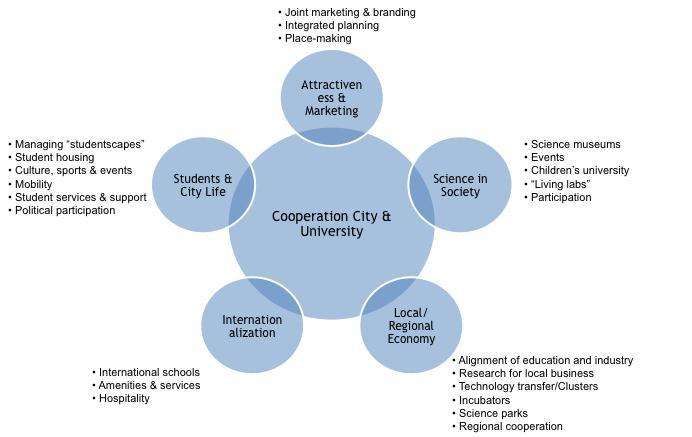
These touch upon various subjects within the EUniverCities Flower Model and are examined in
greater detail in this Local Action Plan.
Picture 1: EUniverCities Flower Model
This section focuses on Delft's central topics, Hospitality and Living Labs. For each topic, the primary
initiatives are described first. These involve various interested parties in Delft. Feedback Delft
received from its peers during the closing conference of the EUniverCities project, 18-20 March 2015,
is then examined.
Finally, new initiatives in Delft that have either been adopted by other partner cities, or have served
as inspiring examples, are examined.
10A. Hospitality
When choosing a location where to study, the quality of education, the city atmosphere and
available facilities are all important for students. Students prefer a city where they can feel “at
home” and enjoy themselves. The same applies to international companies and their employees.
Comfortable and attractive living and working conditions are important.
To be an attractive residential and business city for both students and international workers, Delft
needs to offer an excellent range of facilities. Quality and diversity of housing, shopping, nightlife,
culture, social services, healthcare, etc. must cater to their needs. For newcomers who are unfamiliar
with the Dutch language, information in English (or other common language) should be available.
In the Local Action Plan, emphasis is placed on three elements:
1. Offering attractive accommodation for (international) students
2. Keeping students connected after graduation
3. Good reception and orientation for expats
Housing for International Students
When it comes to welcoming newcomers, good housing is essential. While the dormitory is not the
main objective of the study abroad/international experience, it is an important part of an exchange
student’s life and shapes how the student will look back on his/her time in the Netherlands. Negative
experiences with housing will also influence the image one has of life in the city and this can impact
one’s decision to stay or re-locate when one’s studies are complete. Word-of-mouth advertising also
influences decision-making among prospective international students.
Around 14,000 students live in Delft, of which at least 3,000 come from abroad. Nearly 60% of the
students live in rooms/apartments owned by housing corporations and the rest live in private rented
houses or apartments, shared or otherwise (landlords, student house). Housing corporation DUWO
specialises in student housing, and houses around half of all the students, including the majority of
international students, in Delft. Due to the growth in the number of domestic and international
students, the main focus in recent years has been the addition of more student accommodations.
In the context of the “battle for brains,” it is critical that, in addition to offering affordable rooms,
there is more investment in facilities and atmosphere. International students need a place where
they can meet each other and meet Dutch students.
International Student House
Research shows that a communal space is important for many students, serving as a source for
contact, entertainment, and support. DUWO estimates that thousands of students in Delft are
lacking a living room, a place of their own in the city, where they can enjoy their privacy or invite
others to join them, for example, for dinner, to play darts, or watch a movie – a space where they
11meet others not only from their own culture, but also from all other parts of the world (including the
Netherlands and Delft itself).
This has led to the idea of creating an International Student House (ISH), located between the DUT
campus and the city centre, to serve as a “stepping stone” with around 2,000 m2 of special facilities
for international students in Delft, but open for the entire (student) community. This would include
features such as:
- conference space
- large communal space with café and terrace
- multi-purpose space for debates, presentations, film screenings, etc.
- study and workspace(s), e.g. for language courses
- office space and conference rooms for (international) student groups (DISS, AEGEE, VAAD etc.),
student doctors with travel desk and others
- small-scale commercial spaces
It is critical that this facility, along with its activities programme, be a group effort on the part of
students, DUT the municipality, and DUWO, so that the ISH will optimally achieve its objectives:
1. a good reception and support for international students: feeling “at-home”
2. a meeting and exchange of cultures and ideas
3. a positive memory of their time in Delft: word-of-mouth!
The intention is expressly not to compete with existing initiatives and areas. It should rather be an
enhancement, specifically oriented toward the students' living environment and free time (leisure,
gaming, debating, dining, fitness, etc.).
Primary actions:
- Further development and planning for ISH: achieving physical realisation
- Exploring the possibility of housing facilities and activities from Delft inside the ISH (e.g. Expat
project team operations office, DUT’s International Office, shared programmes from Night of the
Enterprises, the DISS’ Career Event, and the “Introduction to Delft” for new international students
and visitors).
Keeping students connected after graduation
After completing their studies, students enter the job market and start a family. This group, known as
“knowledge workers”, are essential to the local and regional economy. The municipal government is
putting an effort into drawing more graduates from DUT and the vocational/trade schools in Delft to
stay connected with the city. To date, this initiative has not been entirely successful.
Delft’s share of knowledge workers in the labour force has grown more slowly than that of other
university cities in the Netherlands. This has to do with the housing market, which consists primarily
of social housing and relatively few private housing or rentals. For recent graduates and those who
are new to the workforce, housing is in short supply. Additionally, available housing is relatively
expensive, small, and of low quality. Even for those knowledge workers in the 28-35 age group, there
are too few options and the available houses do not provide good value for money. The housing
12markets in Rotterdam and The Hague are both larger and more diverse. Promising, however, is the
fact that an increasing number of knowledge workers seem to view the ‘Spoorzone/Nieuw Delft’ as
an ideal residential location. This opportunity should be better exploited.
Connect the Knowledge Worker
The municipal government, in cooperation with HEIs, research institutes, commerce, and knowledge
workers, has developed an action plan to connect more knowledge workers with Delft: the “Connect
the Knowledge Worker” programme. This plan operates on the “city=campus, campus=city”
principle. The programme aims to increase the provision of facilities, both inside the city centre as
well as on-campus, through location-specific “stepping stones” (train station > city centre > DUT
Noord (North) Campus).
The action plan consists of long-term goals and ambitions (2014-2017) and eight concrete and
tangible short-term actions (2014-2015). The actions are focused on living, working, and facilities.
The primary actions are:
- Campus-plus: arrangements with Woonbron, DUWO, and other student housing corporations on
how to encourage students to re-locate to other parts of Delft after their studies are finished.
- Creating “fixer-uppers”, for example, by making depreciated real estate available to students. This
might especially be of interest to students of architectural engineering and industrial design, to
use as a study or personal project.
- Developing housing construction for knowledge workers, both through individual contracting as
well as through corporations, in the ‘Spoorzone/Nieuw Delft’ area.
Visit http://www.delft.nl/Bedrijven/Stad_van_innovatie/Kenniswerkers for a complete overview of
actions and latest developments (in Dutch only).
Good reception and orientation for expats
With its University of Technology, applied sciences universities, high-level research institutes, and
specialised businesses, Delft has a strong international orientation. In addition to the number of
international students, which is growing every year (3,500 in 2014), there is also a large expat
population living in Delft. In 2014, there were 3,000 expats working in the private sector and at
institutes for higher learning in Delft.
Students are primarily welcomed and served by their individual educational institute. For specific
issues, they are referred to the appropriate agency. In this respect, DUWO provides (temporary and
long-term) housing, the International Office is responsible for the correct residence permits and
visas, and the city government handles the official address registration.
In 2009, Delft, together with partners, launched the Expat Project Team.
Expat Project Team
Since 2009, Delft has pursued a proactive policy in which the municipal government, DUT, applied
sciences universities, TNO, Deltares, UNSECO-IHE, IKEA, DUWO, Woonbron, Grotius College, and
healthcare organizations all form part of the Expat Project Team. In joint consultation, plans have
been drawn up and implemented. These plans relate to:
131. Education and childcare
2. Housing
3. Expat website and Expat Desk
4. Social activities
5. Employment
6. Healthcare
The Expat Project Team aims to continue activities over the coming years in the six areas listed
above, but also wants to achieve standards of quality and professionalism to better accommodate
expats. To that end, a long-term action plan has been compiled.
Key actions:
- Set up a (salaried) implementation office
- Explore modes of cooperation between commercial and non-commercial service providers, e.g. to
expand the Expat web portal
- Cooperation with other cities in the region, to complement and strengthen each other. In the
regional context, streamline administrative processes for residence permits with the Dutch
Immigration and Naturalization Service (IND)
- Develop investment programmes with a suitable range of facilities to meet the needs of the
projected expat community growth (2015-2020)
- Dutch language school to offer a short programme for international schoolchildren to help them
integrate into the Dutch school system
141.1 Feedback from peer cities and their local stakeholders on Hospitality
General remarks on hospitality in Delft: English signs, maps, clear information, available and
affordable housing, feeling connected, a truly international atmosphere, fun factor, safety and
security, a landlord that listens, availability of working and study spaces, good connections (internet
and transport), integration with locals, contact beyond the economic transaction, feeling at home.
But on the downside also: lack of cultural and artistic scene, gender-unbalance.
Ideas for improvement of Hospitality are:
- Adapt the city more to foreigners, e.g. through international signposting, also in public transport,
and installing big screens in the city with information and events announcements in English.
- At city hall, create a welcome desk for foreigners and ease administrative duties.
- Integration of foreign students must take place on the social, cultural and economic level, and
housing can be an instrument to bring that ideal closer.
- Set up a mentoring programme with students (‘buddies’) or companies: let companies adopt an
international student and introduce them into Delft and the Dutch business world.
- Promote interaction by matching the supply and demand of peoples skills/capacities and needs, e.g.
via a “matching app” that can cluster the needs of foreign students and locals.
- With regard to the International Student House the main remarks can be summarized as: quality of
housing and offer of facilities are high, good location between city centre and the campus.
But peer cities criticize the nature of the building where living is just for international students;
mixing and integrating students in the Dutch society should be stimulated more. Call the ISH a
“multicultural” house rather than international house.
151.2 Stakeholders analysis
Table 1.1
Stakeholder interest analysis
Issue Hospitality
Stakeholders Interest and how Capacity and Possible action to Ownership
affected by the motivation to address
issue bring change stakeholders
interest
Primary Stakeholders
● City of Delft
City of Delft Being an attractive Provide a service Evaluate and improve ● Delft University of Technology
city for talent and oriented existing programme ● TNO – Netherlands
being capable of programme for (tailor made); Organization for Applied
attracting the students and Offer an attractive Scientific Research
brains requires a knowledge-workers environment for ● International major companies
need for a variety entrepreneurship and SMEs
of services to
students and
knowledge-workers
● Delft University of Technology
Delft University International Create an attractive Offer high quality ● City of Delft
of Technology competition for biotope to attract education;
talented students, talented students, Offer high quality
knowledge- researchers and research;
workers, their companies Offer innovative job
families and tech opportunities at PhD
companies level and beyond;
Offer international
living and working
environment;
Arrange connections
between companies
and scientific
research and
researchers
● The Hague University of
The Hague International Create an attractive Offer high quality Applied Sciences
University of competition for biotope to attract education; ● High Tech Centre
Offer cross- ● SMEs
16Applied Sciences talented students talented students disciplinary teaching
and project
cooperation;
Offer job
opportunities after
graduation
● DUWO
(Student) Students and Local and national Create quality ● Delft University of Technology
Housing knowledge-workers agreement to housing; ● The Hague University of
Corporation need housing create a minimum Create affordable Applied Sciences
DUWO number of new housing; ● City of Delft
student housing Set up an
facilities International House
as meeting place and
place to live
● OBS
OBS Railway New train station Train Station Spatial Develop new housing ● City of Delft
Area as main gateway to Development Plan and office space; ● Delft University of Technology
Development the city; operational Develop new ● The Hague University of
Agency New train station sustainable mobility Applied Sciences
area as attractive assets;
living and working Create attractive
environment green and leisure
spaces
● YES!Delft Students
YES!Delft Create career Promote innovative Offer ● SMEs
Students opportunities for entrepreneurship entrepreneurship
DUT students among DUT training, skills,
students lectures, excursions,
working space;
Liaise with network of
entrepreneurs
● YES!Delft Incubator
YES!Delft Create career Promote innovative Offer ● City of Delft
Incubator opportunities for entrepreneurship entrepreneurship ● Delft University of Technology
DUT students among DUT training, skills, ● SMEs
students lectures, excursions, ● Investors
working space;
Find appropriate
office space for
expanding startups
(and keep them in
Delft);
Liaise with network of
entrepreneurs
● ORAS
ORAS, students Have good living Deliberations with Co-create decisions ● Students
and study facilities DUT decision that support and ● Delft University of Technology
17for students makers improve students’ ● City of Delft
lives ● DUWO
Secondary Stakeholders
● Inholland University of Applied
Inholland International Creating an Offer high quality Sciences
University of competition for attractive biotope education; ● SMEs
Applied Sciences talented students to attract talented Offer cross-
students disciplinary teaching
and project
cooperation;
Offer job
opportunities after
graduation
● ROC Mondriaan (VET)
ROC Mondriaan Prepare skilled Create good Offer quality ● High Tech Centre
(VET) students for future education education; ● SMEs
labour market environment; Offer job ● City of Delft
Connect to opportunities after
Education Pillar in graduation
the city (i.e.
technology
education at all
school levels)
● Delft Marketing
Delft Marketing Responsible for city Focus on tourists Signposting and ● City of Delft
marketing and announcements in
hospitality issues English
● SMEs
Business Create career Create an attractive Offer (international) ● City of Delft
opportunities for biotope to attract job opportunities for ● Chamber of Commerce
students; talented students; graduates;
Interaction with Create new Develop and provide
DUT to develop businesses based on suitable office space
new products and new technologies
services;
Create inspiring
environment for
entrepreneurship
● Media/Press
Media/Press News coverage Publish inspiring Articles and news ● City of Delft
and positive news items addressing
items about city life target groups
18B. Living labs
Traditionally Living Labs are referred to as ‘a user-centred, open-innovation ecosystem, often
operating in a territorial context (e.g. city, agglomeration, region), integrating concurrent research
and innovation processes within a public-private-people partnership. The concept is based on a
systematic user co-creation approach integrating research and innovation processes. Through co-
creation and experimentation in real life use cases Living Labs come to life.’
(https://en.wikipedia.org/wiki/Living_lab)
Developing new technologies and conducting research is one thing; applying them or releasing them
into the market is another. YES!Delft is a renowned start-up workspace in Delft with clean rooms;
DUT has its own laboratories; Deltares has access to its own water basin to simulate waves.
Increasingly, proposals are being made to use the urban space to experiment with rolling out new
technologies, systems, products, and applications. For certain purposes, the compact cityscape in
Delft is very well suited, though it is less useful for projects requiring a lot of open space. Moreover,
city laws, regulations, and management also pose limitations to some of the possibilities in this area.
How might the city facilitate other projects?
Europe promotes the development of Living Labs/Testing Grounds, particularly those that contribute
to the solution of widespread societal problems. A coordinated Living Labs effort can help various
parties in the community take steps toward developing their ideas and concrete products. This could
lead to market introduction and maybe even make Made in Delft a concept.
High-Tech Centre
Delft’s High-Tech Centre (HTC) is a vibrant hub where study is attractive and innovation is accessible.
In the HTC, vocational training at MBO-level 4 works hand-in-hand with the business community on
educational programmes, applied research, and developing human capital, with a focus on top-sector
high-tech systems and materials. This sector is heavily concentrated in the province of South Holland
and Delft and is important to commerce in general, throughout the Netherlands. HTC is working to
strengthen technical training in the curricula for VMBO/MBO (Dutch vocational training institutions)
and HBO (Higher Education Institutes for Applied Sciences).
The High-tech Systems and Materials top sector is known for its rapid (technological) developments
and its international orientation. The demands on personnel are ever increasing: good workmanship
is more important than ever. Additionally, this sector is a powerful enabler for other sectors
(agriculture and food industries, energy, sustainability, security, communications).
Key actions in the High Tech Centre are:
- Training in mechanics and electronics at the MBO-4 level, targeting students who combine the
latest knowledge with outstanding skills and continuous learning tracks (VMBO/MBO/HBO). The
programme is developed in close collaboration with experts from participating companies.
- Accessible workspace with state-of-the-art machinery and equipment, used by companies (for
developing prototypes, innovation projects, and client demos) and by multi-disciplinary teams of
students and teachers for innovation projects.
- Opening up of various partners' high-tech facilities to businesses and research institutes.
- Making technological studies more attractive (increasing enrolment) and generating more
exposure for associated high-value technological firms.
19Testing Grounds Website
As host to the knowledge economy, Delft provides opportunities – both physically and in terms of
organization – to test innovations in a real urban environment in the Living Lab testing grounds.
Testing grounds – or pilot projects - allow research and development to take place outside the
laboratory. They are often developed in collaborations between businesses, research institutes,
governments, and users.
The close cooperation between research institutes, the private sector, and the city, make Delft an
excellent location for innovative enterprises to launch pilot projects. Individuals, businesses, or
institutions which have made an innovative discovery, but are still working on preparing it for
production, are encouraged to start a pilot project. Many initiatives benefit from Delft's strengths,
such as sustainable energy, sustainable transportation, water and delta technology.
Visit http://www.proeftuinendelft.nl for details on pilot projects currently in progress in Delft (Dutch
only).
Actions:
- Contribute to the vision and strategy for Living Labs in Delft
- Launch new pilot projects in Delft
- Work toward better regulating Living Labs
- Maintain, promote, and expand the website
‘Nieuw (New) Delft Railway Area’
The area around the train station in Delft is being redeveloped and is gaining a new image. Since the
beginning of 2015, trains pass through a 2.3 km-long tunnel rather than cross the city. At the end of
2015, a new municipal office will be opened along with new houses for residents. Nearly 500 new
student homes will be completed, along with commercial spaces and public green spaces. The area is
becoming an innovative, sustainable environment for living, working, travel, and transportation alike.
The Hague University of Applied Sciences has been invited by the city to serve as a temporary tenant
and pioneer in the effort to develop the area. For courses at the Academy for Technology, Innovation
& Society Delft, this provides the opportunity to carry out activities on-site using a Living Lab. In co-
creation with businesses, research institutes, governments, and users, the Lab gives a space for
prototyping and testing innovative products, services, and business models. At the same time, these
operations provide real solutions for real issues. As a result of the close involvement of
entrepreneurs and other stakeholders, the knowledge, through innovation or otherwise, quickly and
organically finds its way to the market and to society. The planned Learning Lab will focus on issues
affecting the urban environment in ‘Spoorzone/Nieuw Delft’.
Actions:
- Contributing through the Learning Lab environment to planning and development in the Nieuw
Delft Railway Area.
- Through on-site studies, (future) residents and users become interested in participation to realise
the new area's potential
- Carrying out project (research topics) in the field of semi-permanent construction (e.g. flexible
construction forms, re-usable materials), sustainability (construction, energy supply, mobility),
health and care (apartments, buildings, individuals).
20H/Betafactory
As part of the Academy for Technology, Innovation & Society at The Hague University of Applied
Sciences in Delft, the H/Betafactory facilitates partnerships that are necessary for achieving success
in education and commerce. Entrepreneurship and achieving innovation are at the centre of their
work. H/Betafactory functions as a testing and development environment across a range of projects.
This prototype workspace of around 1,200 m2 is located within walking distance of the Delft campus,
has its own management, and is generally open 24/7 to students. In the hall, there are various
machines for practical applications, as well as a number of partnering businesses.
Actions:
- Connect H/Betafactory with the High-Tech Centre
- Involve H/Betafactory in the development of the Nieuw Delft Railway Area
The Green Village
The Green Village is a demonstration site to discover, learn, and show how to solve society’s urgent
challenges, mainly in the fields of sustainable energy and housing. Focus is on generating innovative
power to set horizons for a new, sustainable, green and circular economy.
The initiative will be built as a temporary village for a period of approximately 10 years. It is based on
the principles of the circular economy: all materials and equipment will be owned by a resource
company. This company will eventually take back all materials and re-use them in other projects or
products. The Green Village will grow and change over time. It will be a place where you can see and
experience new technologies and systems. It offers and shows amazing possibilities, technologies,
products and systems that will contribute to a green environment.
The first visible and tangible result of the Green Village is the Pret-à-Loger house. Developed by
students, this energy-neutral and low-carbon house of the future won a second prize at an
international contest in Paris 2014.
The “fixer-upper” housing options named above as part of the “Connect the Knowledge Worker”
programme (see Hospitality section) can benefit from knowledge generated through the Green
Village.
Actions:
- Green Village facilitates development possibilities for Living Lab in the area of sustainable energy
and construction.
- Use communication to profile the Green Village at various levels (local, regional, national,
European) as a valuable Living Lab showcase.
- Seek European funding, e.g. through ERDF, HORIZON2020, INTERREG, etc.
21Smart Cities
Cities change. New rules and requirements for air quality, energy consumption, space management,
traffic, and transportation lead to changes in the cityscape. Its usage and the city atmosphere
change, but so do the city's facilities, its accessibility, and liveability.
The Smart Cities concept offers solutions to build future proof and resilient cities and helps them face
the grand societal challenges ahead. Topics pertaining to energy efficiency, climate, and
transportation are fully addressed, with a focus on new ICT-applications.
TNO has developed an interactive (digital) Smart Cities tool to model the effect of changes and
decisions in a given policy area on other domains. This tool is part of a wider approach to make Delft
more manageable and leads to a better integration of city policies.
Delft is working on initiatives to make the city more sustainable, more energy-efficient, and more
secure. Not only in Nieuw Delft, but also in other places around the city, experiments are being done
with materials, methods, and designs, such as ‘het Mobiliteitshuis’ (the Mobility House), ‘de
Vrachtfiets’ (the Freight Bike), and ‘Groenblauw’ (Greenblue).
Actions:
- Make necessary policy adjustments subsequent to Smart Cities tool (TNO) testing and as follow-
up to the Delft Smart City report
- Develop initiatives in Delft in the area of Smart Cities, and/or combine efforts, among others, with
het Mobiliteitshuis, de Vrachtfiets, Groenblauw
- Following Expression of Interest focus on participating in Call for Proposals: European Innovation
Partnership on Smart Cities and Communities (EIP-SCC)
2.1 Feedback from peer cities and their local stakeholders on Living Labs
General remarks on Living Labs in Delft: experimental environment, involvement of real end
users/citizens, equipment and facilities, test new ideas in real time, output of new products that
address a real need, a co-creative entrepreneurial approach, realizing dreams, pushing boundaries,
room for making mistakes, theory meets praxis.
Positive remarks on Living Labs are:
- There are a number of well-functioning living labs in place (climate change, flood protection, green
technology), and they deliver concrete results.
- Living labs are important for students to gain concrete research and design experience in a real life
setting
- There is a good collaboration culture between academia and large technology and (construction)
companies, and they manage to set up complex projects together.
More negative connotations are:
- The participation in living labs is mainly confined to academics and students. And even the number
of students involved is too low. Do citizens also play a part?
22- Living labs are places for experimentation, but often legislation stands in the way of doing things
alternatively. The government (local and national) is insufficiently able to provide the necessary
regulatory space.
- Living labs in Delft are very much technology focused. This might lead to a technology push
approach and insufficient attention for the human behaviour aspects.
- Where is the role of the municipality in the living labs? There are many urban challenges and
problems yearning for a living lab set-up.
Some ideas for improvement are given:
- Use living labs to forge communities of students and other interested and involved citizens and
organizations in Delft.
- Besides technology-oriented living labs, also set up social experiments that might bring people
closer together or achieve other social goals. Collaboration with social sciences, humanities, political
sciences from Leiden and Rotterdam universities is required.
- Consider the entire city as an “innovation platform” (like Tampere does).
- Turn the International Student House into a living lab, not just to test technology but also to foster
social experiments, e.g. via different types of setting, test new types of equipment.
2.2 Stakeholders analysis
Table 2.1
Stakeholder interest analysis
Issue Living Labs
Stakeholders Interest and how Capacity and Possible action to Ownership
affected by the motivation to address
issue bring change stakeholders
interest
Primary Stakeholders
23● City of Delft
City of Delft The city as Living Economic and Offer spaces, ● Delft University of
Lab showcase of Investment facilities, services to Technology
new technologies Programme; foster Living Labs; ● The Hague University of
Support to Address deregulation Applied Sciences
initiatives ● Inholland University of
Applied Sciences
● Delft University of
Delft University of Prepare for the Offer study and Engage in and Technology
Technology future economy learning support DUT ● City of Delft
and society via opportunities initiatives in this field,
addressing for students e.g. Green Village/
European Grand where new Bouwcampus
Societal Challenges; technologies (Building campus)
Connect study and can be tested; (funding)
employment Showcase
opportunities for innovative
students who want concepts
to work with new
technologies
● The Hague University of
The Hague University Connect study and Offer study and H/Betafactory; Applied Sciences
of Applied Sciences employment learning Learning Labs in ● OBS Railway Area
opportunities for opportunities Nieuw Delft Railway Development Agency
students who want for students Area ● City of Delft
to work with new where new ● High Tech Centre
technologies technologies
can be tested;
Showcase
innovative
concepts
● DUWO
(Student) Housing Testing of new Owner of Test new ● Delft University of
Corporation DUWO technologies can several technologies in Technology
help reduce thousand student housing ● The Hague University of
building and student projects Applied Sciences
maintenance costs housing; ● YES!Delft (Students)
and improve Concrete plans
sustainability e.g. for building
International
Student House
● OBS Railway Area
OBS Railway Area Urban area under Strong focus on Possible links and Development Agency
Development Agency development which financial issues, cooperation with The ● The Hague University of
offers opportunities but important Hague University of Applied Sciences
for experiments and as facilitating Applied Sciences ● City of Delft
showcasing party
24● YES!Delft Students
YES!Delft Students Support and train Business Facilitate Living Lab ● SMEs
DUT students in environment, opportunities for and ● Delft University of
becoming incubator, by student startups; Technology
entrepreneur(ial)s; facilities, Extension of network
Showcase new programmes with other local
technologies and players in education
products in the city field and business
sector
● YES!Delft Students
YES!Delft Incubator Support and train Business Extension of network ● SMEs
DUT students in environment, with other local ● Delft University of
becoming incubator, players in education Technology
entrepreneur(ial)s; facilities, field; ● The Hague University of
Showcase new programmes Support to YES!Delft Applied Sciences
technologies and 2 building ● Inholland University of
products in the city Applied Sciences
● ORAS
ORAS, students Inform DUT Representation Communication ● Students
students about of students in about Living Lab ● Media/press
entrepreneur university opportunities in Delft
opportunities policy matters
Secondary Stakeholders
● Inholland University of
Inholland University Connect study and Offer study and Explore possible Applied Sciences
of Applied Sciences employment learning contribution to the ● OBS Railway Area
opportunities for opportunities development of the Development Agency
students who want for students Nieuw Delft Railway ● City of Delft
to work with new where new Area
technologies technologies
can be tested;
Showcase
innovative
concepts
● ROC Mondriaan (VET)
ROC Mondriaan (VET) Prepare skilled Create good Develop High Tech ● City of Delft
students for future education Centre; ● High Tech Centre
labour market environment; Offer quality ● SMEs
Connect to education;
Education Pillar Offer job
in the city (i.e. opportunities after
technology graduation
education at all
school levels)
25● TNO – Netherlands
TNO – Netherlands International Develop and Engage in and Organization for Applied
Organization for research in applied test new showcase new Scientific Research
Applied Scientific technology technologies initiatives ● City of Delft
Research and Smart
Cities tools
● Green Village/
Green Village/ Research on Test facility; Share knowledge; Bouwcampus
Bouwcampus innovative Bring together Implement new ● Delft University of
sustainable and relevant sustainable Technology
low-carbon housing construction technologies in ● City of Delft
construction companies; construction industry ● SMEs
Build
knowledge
platform
● SMEs
Business New product and The sector Employment
service needs talented opportunities for
development and motivated talented students;
employees; Promote new
Make profit products and services
(=business
promotion)
● Investors
Financial institutions New product and Return on Participate financially
service investment in Living Labs;
development Exposure
● Media/Press
Media/Press News coverage Publish Articles and news ● City of Delft
inspiring and items addressing ● Delft University of
positive news target groups Technology
items about ● The Hague University of
technological Applied Sciences
and sustainable ● Inholland University of
innovations in Applied Sciences
Delft
263. Best practices and inspiration learnt from other partner cities
An important aspect of the URBACT project is learning from each other through best practices and
inspirations. Delft has taken on a number of practices from other cities and is examining some
further.
Night of the Enterprises
During the URBACT project meeting in Aachen (September 2012) the “Nacht der Unternehmen”
(Night of the Enterprises) was presented. This evening programme gives students a peak behind the
curtains at companies in Aachen and the surrounding region. In addition to a big business fair, there
are hop-on/hop-off busses that stop at various companies. This event was implemented in a
modified form in Delft in 2013 and 2014. Given that there are a number of business fairs, the idea of
the evening bus tours was adopted.
Companies in Delft are opening their doors to present themselves to prospective employees.
Students can sign up in advance online for a specific bus, e.g. a high-tech bus that stops at three high-
tech firms, or an ICT-bus, etc. The event targets (international) students looking for internships,
research contracts, starter positions, as well as young professionals who are hoping to find their first
job in everything that makes the technology sector so interesting. Students and companies get to
know each other better, forging connections for future relationships.
For an impression of the event, visit: https://www.youtube.com/watch?v=uL-vVs33HdE
Action:
- Evaluation of the event, followed by possible handover to DUT, student groups, or companies
Demola
In Tampere, universities and a large number of stakeholders developed an innovative way to let
mixed student teams work, as part of their curriculum, on real-life projects in the city where they
live. An intermediary organization called Demola (‘New factory’) was set up, to define assignments
around actual problems and challenges defined by local organizations. Demola is a collaboration
between the city, its universities, and a number of other local stakeholders. The Demola organization
collects research questions and challenges from a variety of organizations in Tampere (companies,
hospitals, government agencies, NGOs, etc.). It publishes the assignments on a website, including the
type of skills that are asked for. Students are invited to subscribe to a project. Demola assembles
student teams to address the projects, and offers a range of support and training activities for the
student teams. Demola is an internationally recognized best practice programme that has been
copied in various other cities.
Action:
- Newly investigate the viability of (aspects of) Demola in Delft
Consultation for Entrepreneurs
Every Friday afternoon, the Tampere University of Technology (TUT) offers walk-in consultation time
for entrepreneurs. Those who come can present their plans and ideas for product development. The
conversations help to determine what chances and possibilities exist for collaboration with the TUT.
Researchers and professors help with testing feasibility and, where applicable, collaborating.
Action:
- Research into the viability and desirability of this initiative in the context of Delft
27You can also read


