Local Disaster Management Plan - Local Disaster Management Group V3.0 January 2014
←
→
Page content transcription
If your browser does not render page correctly, please read the page content below
Local Disaster Management Group

Local Disaster Management Plan
                V3.0 January 2014

    Prepared under the provisions of the Queensland Disaster Management Act 2003

                        Controlled Copy Plan No: MASTER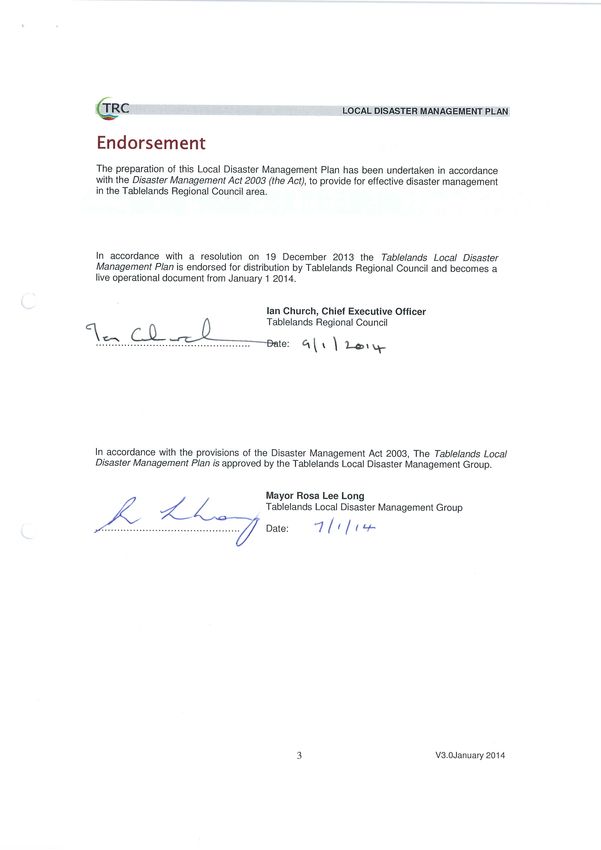
LOCAL DISASTER MANAGEMENT PLAN

Foreword
Despite its idyllic lifestyle, the Tablelands Region is vulnerable to both natural and non-natural
disaster events. Whilst such events are relatively infrequent, their potential to significantly disrupt
social, economic and environmental systems highlights the importance of having effective and
coordinated disaster management arrangements in place.               In accordance with legislation,
Tablelands Regional Council has established a Local Disaster Management Group (LDMG) to
assist with this function.

Tablelands Regional Council provides a diverse range of services to the community of the
Tablelands. In recognition of the importance of these services and the commitment to their
continued delivery, Council has included disaster management issues and mitigation strategies in
its Corporate Plan and implements a program of Business Continuity Management to ensure
continued delivery of essential services during disruptive events.

It is recognised that all of us need to be resilient in the face of disaster. It is unrealistic to expect
one community, one agency or one level of government to be able to respond and recover
effectively from the magnitude of such disasters.        Effective disaster management requires a
collaborative approach with responsibilities shared by individuals, families, communities and all
levels of government.

In the event of a disaster affecting the region, Council will coordinate the response and manage
the impacts within its administrative boundaries in accordance with the Local Disaster
Management Plan, which provides a framework for multi-agency response and recovery
operations.    Council is committed to ensuring available resources are deployed and will
endeavour to provide a high level of support for people affected by disasters by ensuring a
coordinated effort by all levels of government and non-government entities.

The Local Disaster Management Plan, supported by a range of functional and specific plans
outlines the disaster management system in operation, the arrangements for the coordination of
multi-agency resources and specifies the roles and responsibilities of partner agencies. The
Local Disaster Management Plan is a dynamic, risk-based document that is subject to continuous
review ensuring its content reflects current legislation, the region’s risk profile, and learning
from disaster events both within and outside of the region to ensure the region is capable of
responding to and recovering from any disaster event which may occur.

Mayor Rosa Lee Long

                                                   2                                  V3.0 January 2014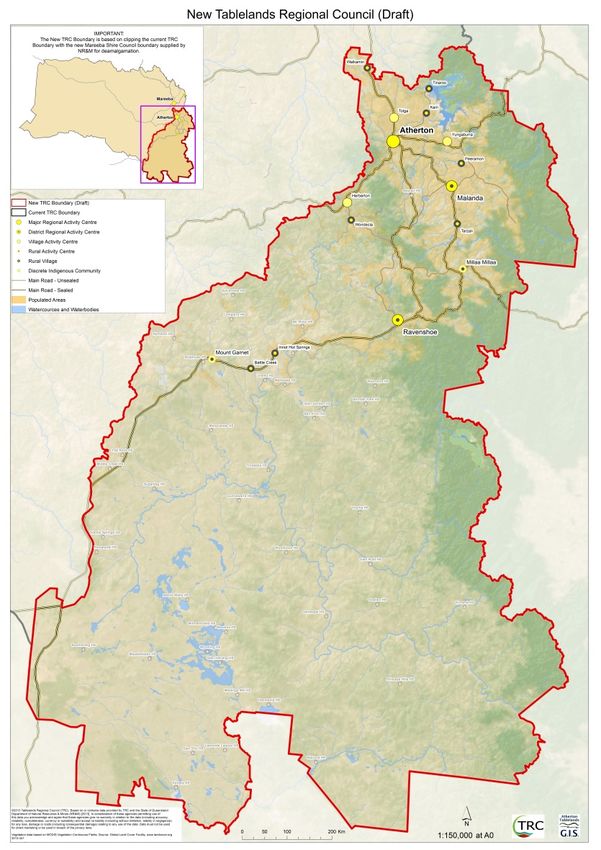

LOCAL DISASTER MANAGEMENT PLAN

Endorsement
The preparation of this Local Disaster Management Plan has been undertaken in accordance
with the Disaster Management Act 2003 (the Act), to provide for effective disaster management
in the Tablelands Regional Council area.

In accordance with a resolution on 19 December 2013 the Tablelands Local Disaster
Management Plan is endorsed for distribution by Tablelands Regional Council and becomes a
live operational document from January 1 2014.

                                       Ian Church, Chief Executive Officer
                                       Tablelands Regional Council

………………………………………….                      Date:

In accordance with the provisions of the Disaster Management Act 2003, The Tablelands Local
Disaster Management Plan is approved by the Tablelands Local Disaster Management Group.

                                       Mayor Rosa Lee Long
                                       Tablelands Local Disaster Management Group

……………………………………….                       Date:

                                               3                              V3.0 January 2014
LOCAL DISASTER MANAGEMENT PLAN

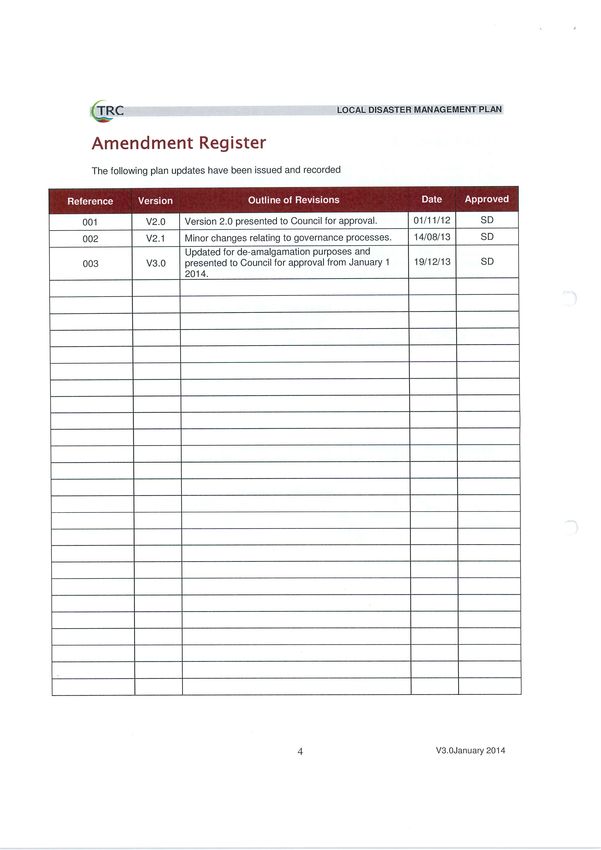
    Amendment Register
    The following plan updates have been issued and recorded

Reference     Version                  Outline of Revisions                 Date      Approved

  001           V2.0    Version 2.0 presented to Council for approval.     01/11/12      SD
  002           V2.1    Minor changes relating to governance processes.    14/08/13      SD
                        Updated for de-amalgamation purposes and
  003           V3.0    presented to Council for approval from January 1   19/12/13      SD
                        2014.

                                                  4                           V3.0 January 2014
LOCAL DISASTER MANAGEMENT PLAN

                                                                     Contents
Foreword ............................................................................................................................................2

Endorsement......................................................................................................................................3

Amendment Register........................................................................................................................4

Contents .............................................................................................................................................5

Section 1: Administration & Governance......................................................................................8
   Authority to Plan ..............................................................................................................................................8

   Purpose ..............................................................................................................................................................8

   Objectives..........................................................................................................................................................8

   Scope..................................................................................................................................................................9

   Structure of the Local Disaster Management Plan .................................................................................. 10
   Operational Sub Plans ..................................................................................................................................... 10
   Specific Disaster Plans .................................................................................................................................... 10

   Review and Renew Plan .................................................................................................................................11

   Document Control ..........................................................................................................................................11

   Distribution..................................................................................................................................................... 12

   Disaster Management Structure in Queensland ...................................................................................... 13

   SDMG Disaster Management Strategic Policy Framework ..................................................................... 13

   District Disaster Management Arrangements.......................................................................................... 14

   Local Disaster Management Arrangements.............................................................................................. 14

Section 2: Tablelands Local Disaster Management Group (LDMG)........................................ 15
   Establishment ................................................................................................................................................. 15

   Functions of the LDMG ................................................................................................................................. 15

   Membership .................................................................................................................................................... 16
   LDMG Executive .............................................................................................................................................. 17
   Agency Roles & Responsibilities..................................................................................................................... 17

   LDMG Sub-Groups.........................................................................................................................................24

   LDMG Task Groups........................................................................................................................................25

   Meetings ..........................................................................................................................................................28

   Reporting.........................................................................................................................................................28
   Linkages to TRC Corporate Plan ....................................................................................................................29
   TRC Disaster Management Strategic Direction - Priorities ...........................................................................29

                                                                                   5                                                         V3.0 January 2014
LOCAL DISASTER MANAGEMENT PLAN

Section 3: Disaster Risk Assessment........................................................................................... 31
   Risk Assessment ............................................................................................................................................ 31

   Community Context ......................................................................................................................................32
   Geography ........................................................................................................................................................32
   Climate & Weather ...........................................................................................................................................33
   Population.........................................................................................................................................................34
   Social Support Infrastructure ...........................................................................................................................36
   Community Preparedness & Capacity ............................................................................................................36
   Industry ............................................................................................................................................................. 37
   Critical Infrastructure ........................................................................................................................................ 37
   Essential Services............................................................................................................................................38
   Medical Facilities ............................................................................................................................................. 40
   Proposed Future Development ....................................................................................................................... 41

   Hazards............................................................................................................................................................ 41
   Storms & Cyclones........................................................................................................................................... 41
   Wildfire ..............................................................................................................................................................42
   Flooding ............................................................................................................................................................42
   Dams.................................................................................................................................................................43
   Epidemic / Pandemic .......................................................................................................................................43
   Pest & Animal Diseases ..................................................................................................................................43
   Earthquakes .....................................................................................................................................................44
   Major Infrastructure Failure .............................................................................................................................44
   Hazardous Materials Incidents ........................................................................................................................45
   Regional Events impacting on TRC area........................................................................................................45
   Cost to the Community of Disaster Events.....................................................................................................45

   Risk Treatment Plan ......................................................................................................................................46

Section 4: Capacity Building .........................................................................................................47
   Community Awareness.................................................................................................................................47

   Training ...........................................................................................................................................................47

   Exercises..........................................................................................................................................................48

   Post-Disaster Procedures ............................................................................................................................48

Section 5: Concept of Operations................................................................................................50
   Concept of Operations - Response Strategy............................................................................................50
   Activation ..........................................................................................................................................................50
   Disaster Declaration.........................................................................................................................................52
   Local Disaster Coordination Centre ................................................................................................................53
   Warning Notification and Dissemination .........................................................................................................53

                                                                                    6                                                        V3.0 January 2014
LOCAL DISASTER MANAGEMENT PLAN

   Media Management .........................................................................................................................................54
   Financial Management.....................................................................................................................................54
   Impact Assessment..........................................................................................................................................54
   Resupply........................................................................................................................................................... 55
   Accessing Support and Allocation of Resources ........................................................................................... 55
   Operational Reporting......................................................................................................................................56
   Hazard Specific Arrangements........................................................................................................................56

   Concept of Operations - Recovery Strategy.............................................................................................59
   Activation of Recovery Arrangements.............................................................................................................59
   Functions of Recovery .................................................................................................................................... 60
   Recovery Sub Plan .......................................................................................................................................... 61

Annexure A: Distribution List .......................................................................................................62

Annexure B: Tablelands LDMG Contact List ..............................................................................64

Annexure C: Definitions, Abbreviations & Acronyms ..............................................................65

                                                                                  7                                                        V3.0 January 2014
LOCAL DISASTER MANAGEMENT PLAN
Section 1: Administration & Governance
Authority to Plan
The Tablelands Local Disaster Management Plan is prepared under the provisions of s. 57 of the
Disaster Management Act 2003.
Purpose
This plan has been prepared by the Tablelands Local Disaster Management Group to detail the
arrangements within the Tablelands Regional Council area to plan and coordinate capability in
disaster management and disaster operations.
The overall purpose of the plan is to:
Save life, protect critical infrastructure and property and safeguard the environment.
Identify and assess hazards and take measures to mitigate or eliminate risk.
Serve the local community at the time of disaster whilst protecting the safety and well
being of personnel involved in the disaster and people that live, work and travel within the
region.
Contain the disaster, prevent escalation and ensure speedy mobilisation and coordination
of resources.
Ensure liaison with partner agencies and establish appropriate structures to ensure
effective planning and a coordinated approach to response and recovery operations.
Ensure sufficient and timely information is provided to warn the public of the disaster and
the necessary advice or information on the self-help actions they can take to protect
themselves.
Protect Council's strategic goals and reputation by maintaining critical service functions
and normal services at an appropriate level to ensure the impact on the community is
minimised.
Restore normality as far as practicable as rapidly as possible in a structured manner.
Lead long-term comprehensive recovery, involving social, economic, infrastructure and
environmental reconstruction and rehabilitation.
Regularly educate, train and exercise staff in disaster management procedures.
Evaluate the response and recovery effort to learn lessons and to apply best practice
gained from the experience of ourselves and others in dealing with major civil disasters.
Objectives
The objective of the Tablelands Local Disaster Management Plan is to facilitate the
implementation of effective and efficient disaster management strategies and arrangements
including:
the development, review and assessment of effective disaster management for the
Tablelands Regional Council area including arrangements for mitigating, preventing,
preparing for, responding to and recovering from a disaster
compliance with the State Disaster Management Group’s (SDMG) Strategic Policy
Framework ; the State Disaster Management Plan; the Local Disaster Management
8 V3.0 January 2014LOCAL DISASTER MANAGEMENT PLAN
Guidelines; and any other Guidelines relevant to local level disaster management and
disaster operations
the development, implementation and monitoring of priorities for disaster management for
the local government area.
Scope
This plan details the arrangements necessary to undertake disaster management within the
Tablelands Regional Council local government area (see map below).
9 V3.0 January 2014LOCAL DISASTER MANAGEMENT PLAN
Structure of the Local Disaster Management Plan
The Local Disaster Management Plan (LDMP) is an overarching document that details the
structure, management arrangements and governance provisions which underpin the process. It
gives an overview of the arrangements in place for dealing with disasters and sets out the role of
the LDMG from the initial notification through the various stages of response and recovery until
the disaster event is brought to a close. The plan is designed to be flexible so it can be adapted
to any disaster event affecting the region to ensure an integrated, coordinated and timely
response.
Operational Sub Plans
This document is complemented by Operational Sub Plans which are designed to expand on
information contained in the LDMP by providing detailed information for the activation and
operation of specific functions. Operational sub plans are designed to operate on a stand alone
basis or as part of a wider response integrating seamlessly with other functional and specific
disaster plans. A generic Recovery Sub Plan has also been developed which will be tailored to
the specific disaster as required.
Activation of the Local Disaster Management Group (LDMG)
Activation & Operation of the Local Disaster Coordination Centre
Public Information & Warnings
Evacuation
Evacuation Centre Management
Impact Assessment
Logistics
Financial Management
Community Support
Public Health
Resupply Operations
Transport
Recovery
Specific Disaster Plans
Specific Disaster Plans are also available which document the detailed arrangements for dealing
with specific types of disaster events e.g. Emergency Action Plans for Dams. Other legislation
and the results of the Disaster Risk Assessment for the region determine that specific
arrangements are required for particular hazards. Hazard specific plans have been prepared for
the following:
Tinaroo Dam Emergency Action Plan
This plan is prepared by Sunwater detailing arrangements for emergencies that may arise as a
result of the operation of the dam on behalf of the Local Disaster Management Group. A copy is
held in the Local Disaster Coordination Centre.
Wild River Dam Emergency Action Plan
This plan is prepared by Tablelands Regional Council detailing arrangements for emergencies
that may arise as a result of the operation of the dam on behalf of the Local Disaster
Management Group. A copy is held in the Local Disaster Coordination Centre.
10 V3.0 January 2014LOCAL DISASTER MANAGEMENT PLAN
Crooks & Wyndham Dam Emergency Action Plan
This plan is prepared by Department of the Environment & Resource Management detailing
arrangements for emergencies that may arise as a result of the operation of the dam on behalf of
the Local Disaster Management Group. A copy is held in the Local Disaster Coordination Centre.
Koombooloomba Dam Emergency Action Plan
This plan is prepared by the Stanwell Corporation detailing arrangements for emergencies that
may arise as a result of the operation of the dam on behalf of the Local Disaster Management
Group. A copy is held in the Local Disaster Coordination Centre.
Malanda Lion Factory Emergency Plan
This plan is prepared by the Lion Factory detailing arrangements for emergencies that may arise
as a result of on site operations. A copy is held in the Local Disaster Coordination Centre.
Review and Renew Plan
The Local Disaster Management Plan will be reviewed on at least an annual basis in accordance
with s.59 of the Disaster Management Act to ensure changes in legislation, personnel,
organisation, risk profile or other changes are incorporated.
The Local Disaster Management Plan and Operational Sub Plans will be reviewed as follows:-
April - June LDMG & Sub Groups review and amend (as required) the LDMP.
July Draft plans submitted to full Local Disaster Management Group for
acceptance or amendment.
August Reviewed plans submitted to Council for approval (if necessary).
September Updated plan submitted to District Disaster Management Group for
information.
The Local Disaster Management Plan and associated Sub Plans will also be reviewed following
any activation of the plan or following any exercises to test the effectiveness of the plans.
The annual review process will incorporate any recommendations arising from the annual
assessment of the plan by the District Disaster Coordinator.
If at any time, it becomes apparent that an urgent amendment or review of the plan is required for
operational effectiveness, then such a review must be implemented expeditiously.
Document Control
The Local Disaster Management Plan is a controlled document. The owner of the document is
the Tablelands Regional Council Local Disaster Coordinator (LDC). Any proposed
amendments to this plan should be forwarded in writing to:
Sarah Dean, Local Disaster Coordinator
PO Box 154
Atherton, QLD 4883
Email: disastermanagement@trc.qld.gov.au
11 V3.0 January 2014LOCAL DISASTER MANAGEMENT PLAN
The LDC may approve inconsequential amendments to this document. Any changes to the
intent of the document must be approved and endorsed by Tablelands Regional Council.
A copy of each amendment is to be forwarded to those identified in the distribution list. On
receipt, the amendment is to be inserted into the document and the Amendment Register at the
front of the document updated and signed. It is the responsibility of all plan holders to ensure
their copy remains up to date, that amendments are incorporated quickly and recorded on the
amendment sheet and that any restricted data is destroyed appropriately.
The Local Disaster Coordinator is responsible for distributing amendments and will retain the
master copy together with supporting documentation.
Distribution
This plan has been distributed to various individuals and organisations in accordance with the
distribution list at Annexure A.
A downloadable version of this document is available to members of the public free of charge at:
Website: www.trc.qld.gov.au/disaster-management
Reference copies of this document are available to members of the public at:
Council Service Centres: Atherton, Herberton & Malanda.
Libraries: All TRC Libraries
Visitor Information Centres: All TRC Visitor Information Centres.
Members of the public can download a free version of this plan from Councils website at
http://www.trc.qld.gov.au/sites/default/files/Tablelands%20Local%20DM%20Plan%20V2%20Octo
ber%202012%20MASTER.pdf
Members of the public can also request a printed copy of the LDMP. A nominal fee of $5.00 will
be charged to cover the printing costs.
12 V3.0 January 2014LOCAL DISASTER MANAGEMENT PLAN
Disaster Management Structure in Queensland
The Queensland Disaster Management Arrangements are based upon partnership arrangements
between Local and State Governments and operate on four distinct levels; Local Government,
Disaster District, State Government and Australian Government.
These arrangements enable a progressive escalation of support and assistance through each tier
as required. If a Local Disaster Management Group (LDMG) requires additional resources to
manage the event, they are able to request support through the District Disaster Management
Group (DDMG). If District resources are inadequate, requests for assistance can be passed to
the State Disaster Management Group (SDMG). When State resources are inadequate,
Australian Government support can be obtained through the Attorney General's Department.
SDMG Disaster Management Strategic Policy Framework
The State Disaster Management Group Disaster Management Strategic Policy Framework is
based on 8 key elements:
Research
Policy & Governance
Risk Assessment
Mitigation
Preparedness
Response
Relief and Recovery
Post-Disaster Assessment
The Tablelands LDMG is committed to working within the provisions of the State Disaster
Management Strategic Policy Framework and ensures disaster management and disaster
operations in its local government area are consistent with this framework by:
13 V3.0 January 2014LOCAL DISASTER MANAGEMENT PLAN
ensuring a comprehensive, all hazards, all agencies approach by achieving the right
balance of prevention, preparedness, response and recovery
supporting the mainstreaming of disaster preparedness and mitigation into relevant areas
of activity of government, non-government, small business and corporations
aligning disaster risk reduction, disaster mitigation, disaster resilience and climate change
adaptation policy and actions with international and national reforms
promoting a transparent, systematic and consistent approach to disaster risk assessment
and management, based on the Australian/New Zealand Standard AS/NZS ISO
31000:2009 Risk management – Principles and guidelines
recognising the commitment of stakeholders and the need for collaboration across all
levels of government, community, industry, commerce, government owned corporations,
private and volunteer organisations, and local communities in all aspects of disaster
management
emphasising building and maintaining sincere relationships, trust, teamwork, consultative
decision-making and shared responsibilities among stakeholders
promoting community resilience and economic sustainability through disaster risk
reduction.
District Disaster Management Arrangements
Tablelands Regional Council is in the Mareeba Disaster District which also includes the Local
Government areas of Mareeba Shire Council, Etheridge Shire Council and Croydon Shire
Council.
The District Coordinator is the Queensland Police Service (QPS) Inspector for the Mareeba
Disaster District. The Mareeba Disaster District is within the Tablelands Patrol Group area of
Queensland Police Service’s area of responsibility.
The LDMG Representative on the District Disaster Management Group (DDMG) is the Mayor of
Tablelands Regional Council in her capacity as Chairperson. The Deputy Chairperson of the
LDMG attends this meeting as proxy for the Mayor when unavailable. The Local Disaster
Coordinator is an advisor to the DDMG.
If the Representative changes, Tablelands Regional Council will as soon as practicable, inform
the Executive Officer of the State Group, and the District Disaster Coordinator of the District
Group, of the new appointment.
Guidelines exist for the operation of District Disaster Management Groups.
Local Disaster Management Arrangements
The management of a disaster at the community level is conducted by the Local Disaster
Management Group, who is responsible for the development and implementation of the Local
Disaster Management Plan and associated Sub Plans.
For further details see Section B: Tablelands Local Disaster Management Group.
14 V3.0 January 2014LOCAL DISASTER MANAGEMENT PLAN
Section 2: Tablelands Local Disaster
Management Group (LDMG)
Establishment
Tablelands Regional Council has established a Local Disaster Management Group (LDMG) in
accordance with s. 29 of the Disaster Management Act. Guidelines exist for the operation of
Local Disaster Management Groups.
Terms of Reference for the LDMG are available at: \\Trc.local\data\Atherton\Pccommon\084
Sarah Dean\Disaster Management Groups\Local Disaster Management Group (LDMG)\Terms of
Reference
Functions of the LDMG
In accordance with s. 30 of the Disaster Management Act, the Tablelands Local Disaster
Management Group has the following functions for the Tablelands Regional Council area:
To ensure that disaster management and disaster operations in the area are consistent
with the State group’s strategic policy framework for disaster management for the State;
To develop effective disaster management, and regularly review and assess the disaster
management;
To help the local government for its area to prepare a local disaster management plan;
To identify, and provide advice to the relevant district group about, support services
required by the local group to facilitate disaster management and disaster operations in
the area;
To ensure the community is aware of ways of mitigating the adverse effects of an event,
and preparing for, responding to and recovering from a disaster;
To manage disaster operations in the area under policies and procedures decided by the
State group;
To provide reports and make recommendations to the relevant district group about
matters relating to disaster operations;
To identify, and coordinate the use of, resources that may be used for disaster operations
in the area;
To establish and review communications systems in the group, and with the relevant
district group and other local groups in the disaster district of the relevant district group,
for use when a disaster happens;
To ensure information about a disaster in the area is promptly given to the relevant
district group;
To perform other functions given to the group under this Act;
15 V3.0 January 2014LOCAL DISASTER MANAGEMENT PLAN
To perform a function incidental to a function mentioned above.
Membership
In accordance with s. 33 of the Disaster Management Act, Tablelands Regional Council has
appointed persons it considers has the necessary expertise and experience to be a member of
the Tablelands LDMG. All members have been selected based on their ability to assist the
LDMG with all aspects of disaster management including prevention, preparation, response and
recovery.
The Tablelands LDMG has also considered which agencies are required to act in an advisory
capacity to the LDMG based on experience gained from previous operations, exercises and
assessments.
The composition of the Tablelands LDMG has been agreed by Tablelands Regional Council as
follows:
POSITION ORGANISATION DISASTER MANAGEMENT STATUS
ROLE
Mayor Tablelands Regional Council LDMG Chairperson Executive Member
Councillor Tablelands Regional Council LDMG Deputy Chairperson / Member
Recovery Chairperson
Senior Advisor Disaster Management Tablelands Regional Council Local Disaster Coordinator Executive Member
Chief Executive Officer Tablelands Regional Council Deputy Local Disaster Deputy
Coordinator
Deputy CEO & GM Organisational Tablelands Regional Council Tablelands Regional Council Member
Services Department Liaison Officer
GM, Infrastructure & Maintenance Tablelands Regional Council Tablelands Regional Council Member
Liaison Officer
GM Community & Regional Planning Tablelands Regional Council Tablelands Regional Council Member
Liaison Officer
Sergeant Queensland Police Service QPS Liaison Officer Member
Area Director West Queensland Fire & Emergency QFES Liaison Officer (EMQ) Member
Services
Inspector (Urban Operations) Queensland Fire & Emergency QFES Liaison Officer (QFRS) Member
Services
Inspector (Rural Operations) Queensland Fire & Emergency QFES Liaison Officer (RFSQ) Member
Services
Officer in Charge (Atherton) Queensland Ambulance QAS Liaison Officer Member
Service
Manager Occupational Health & Queensland Health QH Liaison Officer (Medical Member
Safety Services)
Manager Regulatory Services Tablelands Regional Council Environmental Health Liaison Advisor
Officer
Manager Community Services Tablelands Regional Council Human-Social & Community Advisor
Resilience Liaison Officer
Industry Recovery Officer Queensland Dairy Farmers Economic Liaison Officer Advisor
Organisation
Environmental Health Officer Queensland Health QH Liaison Officer (Public Advisor
Health)
Media & Communications Officer Tablelands Regional Council Media & Communications Advisor
Officer
Community Development Officer Tablelands Regional Council Recovery Coordinator Advisor
16 V3.0 January 2014LOCAL DISASTER MANAGEMENT PLAN
ATGIS Coordinator Tablelands Regional Council ATGIS Support Officer Advisor
Regional Operations Manager Ergon Ergon Liaison Officer Advisor
Area General Manager – FNQ Telstra Telstra Liaison Officer Advisor
Principal Engineer DEWS Dam Liaison Officer (Crooks, Advisor
Wyndham & Ibis)
Manager Water, Wastewater & Waste Tablelands Regional Council Dam Liaison Officer (Wild Advisor
River)
Service Manager Sunwater Dam Liaison Officer (Tinaroo Advisor
Falls)
Site Manager Stanwell Corporation Dam Liaison Officer Advisor
(Koombooloomba)
DETE Regional Manager Department of Education, DETE Liaison Officer Advisor
Training & Employment
Each member of the LDMG is required to identify a deputy to undertake the role in their absence.
Deputies to LDMG members are appointed by signed notice (Form DM13) with approval of the
LDMG Chairperson. A Local Disaster Management Group Contact List is held separately (see
Annexure B).
LDMG Executive
There are many instances where the physical or virtual (teleconferencing, etc) meeting of all
members of the Local Disaster Management Group will be neither possible nor necessary for the
effective implementation of this Plan. (It is a legislative requirement that a meeting of the LDMG
involves 50% + 1 of the membership).
Accordingly, the Disaster Management Executive is established to expedite processes as
appropriate. The Local Disaster Management Group authorises the Disaster Management
Executive to make initial response operational decisions on its behalf.
The Disaster Management Executive has an exclusively operational response function, and will
not at any time replace the policy decision-making role of the Local Disaster Management Group.
The Disaster Management Executive comprises the Chairperson and the Local Disaster
Coordinator of the Local Disaster Management Group (or their respective deputies, as
applicable).
Agency Roles & Responsibilities
Tablelands Regional Council
Tablelands Regional Council services are critical to the livelihoods of residents and fundamental
to the success of Council. All Council services have designated responsibilities in disaster
management which reflect their legislated and / or technical capability. The key role of Council is
to maintain normal services (as far as possible) via Business Continuity Management and to
maintain a disaster response capability. The role and responsibilities of services of Tablelands
Regional Council are detailed below.
17 V3.0 January 2014LOCAL DISASTER MANAGEMENT PLAN
TRC Service Role & Responsibilities
COMMUNITY & REGIONAL PLANNING
Community Development Officers to proactively support
prevention, preparation, response and recovery initiatives to
enhance community resilience.
Maintenance of a property register which gives details of all
assets owned and managed by Council including a description
of the facilities available.
Arranging for the emergency securing of Council owned
premises and repair and maintenance of all Council owned
buildings.
Make arrangements to open and secure Council buildings as
required. Arrange for the emergency cleaning of premises as
dictated by the response and recovery efforts.
Ensure all Libraries and Visitor Information Centres are kept
Community Services informed of the disaster response and recovery phases so that
they are able to act as an information hub to members of the
public in affected communities.
Provide advice in relation to aerodromes.
Protection of heritage and important cultural artefacts where
appropriate.
Facilitate access to culturally appropriate social and
psychological support for adults and children affected by
disaster.
Mobilize trained Housing Support Officers to assist residents
to deal with their immediate housing needs following disaster.
Support to residents in Aged Housing Facilities owned by
Tablelands Regional Council.
Advise on issues relating to cultural heritage sites.
Maintain reasonable standards of health in the region and
advise on public health measures to be implemented including
measures to control the spread of infectious diseases.
Monitor and advise on satisfactory standards of hygiene and
the provision of water and sanitation at Evacuation Centres
and other buildings used in the disaster.
Provide advice and guidance on food safety matters and
assess food premises and declare affected food as fit or unfit
for human consumption.
Regulatory Services Provide advice and guidance on vector and vermin control.
Advise on methods available for the control and disposal of
pollution and toxic materials and other environmental
protection methods including sampling and monitoring.
Building Inspectors to ensure dangerous structures are made
safe using enforcement powers where necessary.
Arrange for the collection, holding and disposal of stray
animals and to organize kennel arrangements for pets bought
to Evacuation Centres in liaison with the RSPCA.
Weed spread prevention and communication.
Ensure future development takes account of hazards e.g.
Regional Planning preventing building homes in flood plains.
Provide advice in relation to mapping prepared for flood risk
18 V3.0 January 2014LOCAL DISASTER MANAGEMENT PLAN
and wildfires as part of the planning scheme.
ORGANISATIONAL SERVICES DEPARTMENT
Providing workplace health and safety advice in relation to
employees and volunteers working on behalf of the Council for
the duration of the disaster including accident investigation
where appropriate and in conjunction with other agencies
when necessary.
Ensure staff welfare and well being requirements are met as
far as possible for the duration of the disaster event.
Organisational Development
Ensure availability of the Employee Assistance Programme
(EAP).
Implement occupational health services and arrangements to
provide confidential psychosocial debriefing and counselling
support to staff as required.
Ensure staff records are accessible and that contact details,
next of kin details and other information is kept up to date.
Providing information and communications technology advice,
GIS and spatial data support and support to the Local Disaster
Coordination Centre (LDCC) to ensure an effective response.
Arranging for additional telephone facilities, computers and
Knowledge & Systems mobile phones, etc. at appropriate locations as required.
Ensuring that relevant data is secured and stored
appropriately to preserve documentary evidence.
Liaising with other relevant agencies on communications
issues.
Establishing and operating a disaster helpline facility to ensure
accurate advice and information is given to the public.
Ensure relevant information is displayed on Council's website
Customer Services and the Facebook and Twitter sites remain up to date during
the response and recovery effort.
Ensuring front counters are maintained at an appropriate level
throughout the response and recovery phase.
Ensuring Councillors understand their legislative requirements
and legal obligations in disaster management.
Assist LDCC Officers with the interpretation of policy and
Corporate Services procedure and with immediate problem solving and analysis.
Assisting with conflict resolution and the resolution of any
complaints received during the response and recovery phase
of a disaster.
Controlling, tracking and accounting for all monies expended
in the disaster response and recovery phases.
Maintaining a petty cash inventory to ensure the availability of
immediate cash sums for the purchase of equipment,
supplies, etc.
Establishing separate accounts as necessary to deal with
expenditure incurred on the disaster.
Finance Services
Providing support and guidance to Officers who are
responsible for preparing applications under the rules of the
Natural Disaster Relief & Recovery Arrangements (NDRRA)
for cost recovery if applicable.
Coordinating and organising the administration of any appeal
funds that are established.
Arrange opening and staffing of Stores as required and make
19 V3.0 January 2014LOCAL DISASTER MANAGEMENT PLAN
available resources for use in a disaster.
Ensure adequate supply of fuel stocks and ensure appropriate
distribution methods are available.
Advise on existing corporate suppliers and potential
alternative suppliers for the procurement of resources during
the response and recovery phases of disasters.
Assist as required with the coordination and acquisition of
resources from neighbouring authorities and / or other areas in
the event of mutual aid being invoked.
Dealing with claims with the Council’s insurers to ensure that
appropriate costs are recovered as far as possible.
INFRATRUCTURE SERVICES
Maintain a safe supply of drinking water as far as reasonably
practicable and advise on emergency measures to be taken.
Maintain sewerage operations at an appropriate level and
advice on emergency measures to be taken.
Maintain the waste transfer stations at an appropriate level
throughout the disaster response and recovery operations.
Water & Waste
Provide specialist advice on the collection, recycling and
disposal of waste including hazardous waste and materials.
Prepare and advise on Emergency Action Plans for Council
owned referable dams.
Coordinate damage reports of water, sewerage and waste
critical infrastructure.
Maintenance of the highway network including emergency
closures and diversions.
Coordinate damage reports of roads infrastructure and provide
advice on temporary and more permanent highways
reinstatements and repairs.
Create diversions and detours as necessary.
Ensure sand and sandbags are available as required and
source emergency stocks where appropriate.
Implementation of a priority system for the removal of fallen
Construction & Maintenance
trees that block the highway and fallen trees on Council
owned land.
Assisting with clear up operations as required e.g. flood
clearance, storm damage, chemicals / hazardous materials,
etc.
Record flood heights and extents as far as possible during the
response so surveyors can later collect relevant data.
Capture detailed photographic records for potential NDRRA
claims.
Advise on plant and fleet availability and suitability. Arrange
for the provision and / or hire of items as required.
Providing maintenance and servicing of plant and equipment
(including on site breakdown) where appropriate.
Ensure critical infrastructure e.g. roads, storm water
infrastructure, etc. is designed to an appropriate level to
Infrastructure Support Services
adequately mitigate risk as far as reasonably practicable.
Deploy surveyors following flooding events to record flood
height and extent data.
Project management of civil works required under NDRRA to
ensure requirements are met.
Maintain stockpiles of materials to assist in the response and
20 V3.0 January 2014LOCAL DISASTER MANAGEMENT PLAN
recovery effort e.g. premix, sand, gravel, etc.)
DEPARTMENT OF THE CEO
Take a proactive role in the promotion of disaster prevention
and preparedness initiatives in relation to economic
Economic Development
development of the region.
Lead the Economic Recovery Sub Group as required.
Being the primary contact for all media inquiries in relation to
any event which results in the activation of the disaster
management system within the Tablelands area.
Preparing accurate media releases based on local operations.
Dealing with enquiries from all media sources.
Maintaining a working log of all media releases and significant
contacts with media sources.
Coordinating and managing all media interviews.
Liaising closely with members of the LDMG to gather
Media & Communications
information.
Maintaining a current contact register of media organisations.
Ensuring all media releases are approved by the chairperson
or the Local Disaster Coordinator of the LDMG.
Monitoring media broadcasts and newspapers to ensure
accurate reporting and follow-up to correct any misleading
reporting.
Arranging a media briefing area at the disaster coordination
centre.
Partner Agencies
Organisations involved in disaster management have designated responsibilities which reflect
their legislated and / or technical capability and authority with respect to hazards, functions and /
or activities of disaster management. The role and responsibilities of organisations involved with
the Tablelands LDMG are detailed below.
Further details on the role and responsibilities of State Agencies and organisations in disasters
can be found in the State Disaster Management Plan which aims to ensure a whole of
government approach by ensuring the accountabilities of all State agencies have been
addressed.
Agency Role & Responsibilities
Functional lead agency for warnings as an agency within the
Department of Community Safety
Review, assess and report on the effectiveness of disaster
management by the State at all levels, including the State
Disaster Management Plan and district and local plans.
Queensland Fire &
Establish and maintain arrangements between the State and
Emergency Services – Office
Commonwealth on disaster management issues.
of Emergency Management
Ensure that disaster management and disaster operations
within the State are consistent with the State’s policy
framework, plans, and guidelines.
Ensure that persons performing functions under the Act in
relation to disaster operations are appropriately trained.
21 V3.0 January 2014LOCAL DISASTER MANAGEMENT PLAN
Provide advice and support to the SDMG, DDMGs and
LDMGs in relation to disaster management and disaster
operations.
Coordinate reception operations.
Administer NDRRA relief measures.
Perform the following responsibilities in support of disaster operations:
Develop, maintain, monitor and continuously improve the
State’s disaster management arrangements and systems
Ensure the availability, maintenance and operation of the
SDCC
Manage resupply operations
Coordinate, support and manage the deployment of State
Emergency Service resources
Coordinate, support and manage the deployment of EMQ
Helicopter Rescue resources
Primary agency responsibility for terrorism
Provide executive support to the State group.
Coordinate the disaster response operations for the State
group if a QPS officer is appointed as a State Disaster
Coordinator.
Preserve peace and good order.
Prevent crime.
Maintain any site as a possible crime scene.
Queensland Police Service Provide a Disaster Victim Identification capability.
(QPS) Conduct traffic control, including assistance with road closures
and maintenance of road blocks.
Coordinate evacuation operations.
Coordinate search and rescue operations.
Manage the registration of evacuees and associated inquiries
in conjunction with the Australian Red Cross.
Provide security for damaged or evacuated premises.
Respond to and investigate traffic, rail and air incidents.
Coronial investigations.
Primary agency for structural fires, road accident and for
chemical / hazardous materials (HazMat) related incidents.
Coordinate the disaster response operations for the State
group if a QFRS officer is appointed as a State Disaster
Coordinator.
Provide control, management and pre-incident planning of
fires (structural).
Queensland Fire & Provide rescue capability for persons trapped in any vehicle,
Emergency Services - Urban vessel, by height or in confined space.
Operations Rescue of persons isolated or entrapped in swift water /
floodwater events.
Provide advice, chemical analysis and atmospheric monitoring
at chemical / HazMat incidents.
Provide mass and technical decontamination capabilities
under State Biological Disaster and State Radiological
Disaster response.
Provide Urban Search and Rescue (USAR) capability for
building collapse events.
22 V3.0 January 2014LOCAL DISASTER MANAGEMENT PLAN
Support the Queensland Hazardous Materials Incident
Recovery Plan.
Support the Queensland Coastal Contingency Action Plan -
Chemical Spill Response Plan (a supporting plan of the
National Marine Chemical Spill Contingency Plan, and
National Marine Oil Spill Contingency Plan).
Provide Impact Assessment, and intelligence gathering
capabilities.
Provide logistical and communications support to disasters
within capabilities.
Primary agency for bushfire and primary production vegetation.
The Rural Operations of the QFRS is a separate arm
Queensland Fire &
that looks after the Rural Fire Service that specifically
Emergency Services - Rural
includes the Fire Warden system as well as the volunteer rural
Operations
brigades.
Provide control, management and pre-incident planning of
fires (bushfires).
Provide, operate and maintain ambulance services.
Access, assess, treat and transport sick and/or injured
persons.
Protect persons from injury or death, during rescue and other
related activities.
Coordinate all volunteer first aid groups during major
emergencies and disasters.
Provide and support temporary health infrastructure where
required.
Queensland Ambulance Collaborate with Queensland Clinical Coordination Centre in
Service (QAS) the provision of paramedics for rotary wing operations.
Participate in search and rescue, evacuation and victim
reception operations.
Participate in Health Facility evacuations.
Collaborate with Queensland Health in mass casualty
management systems.
Provide Disaster, Urban Search and Rescue (USAR),
Chemical Hazard (Hazmat), Biological and Radiological
operations support with specialist logistics and specialist
paramedics.
Assisting the community to prepare for, respond to and
recover from an event or disaster
Public Education
Rescue of trapped or stranded persons (see State Rescue
Policy)
Search operations for missing persons
Emergency repair/protection of damaged/vulnerable buildings
Queensland Fire &
Assistance with debris clearance
Emergency Services - SSES)
First Aid
Traffic Control
Short term welfare support to response agencies
Assistance with impact assessment
Assistance with communications
Assistance with lighting.
23 V3.0 January 2014LOCAL DISASTER MANAGEMENT PLAN
Functional lead agency for health services and Primary agency
for Pandemic Influenza, Biological and Radiological
Incidents.
Coordinate the disaster response operations for the State
group if a Queensland Health officer is appointed as a State
Disaster Coordinator.
Protect and promote health in accordance with Health
Services Act 1991 and Public Health Act 2005.
Provide Clinical and State-wide and Forensic services support
for disaster response and recovery.
Provide human-social support for response and recovery.
Queensland Health Provide appropriate pre-hospital on-site medical and health
support.
Coordinate aero-medical tasking in partnership with QAS
throughout the State.
Provide state representation at the Australian Health
Protection Committee.
Ensure a whole-of-health emergency incident management
capability to prevent, respond to, and recover from any event.
Provide appropriate public and community health risk and
preventative measures information.
Provide health emergency incident information for media
communications.
Advice regarding industry-specific effects of any potential
disaster event
Industry Representatives
Advice on the response assistance that industry can provide,
via specialist resources, manpower etc
LDMG Sub-Groups
To assist the Tablelands Local Disaster Management Group meet its statutory requirements for
operational planning, it has established 6 permanent Sub Groups. The Terms of Reference for
each LDMG Sub Group are held at \\Trc.local\data\Atherton\Pccommon\084 Sarah Dean\Disaster
Management Groups\Local Disaster Management Group (LDMG)\LDMG Sub Groups.
Social Support Services Sub Group
The key function of this Sub Group is to plan and coordinate the provision of social support during
the response and recovery phases to meet the basic needs of people affected by disaster by
ensuring comprehensive plans and procedures exist to meet welfare requirements.
The Terms of Reference details the role and responsibilities for this Sub Group as well as
meeting schedules, plan requirements, etc.
Economic Sub Group
The key function of this Sub Group is to assess the impact of a disaster event on the economy
and to coordinate the provision of financial management support, and industry assistance during
planning, response and recovery activities.
24 V3.0 January 2014You can also read


