LOYALIST ENGAGEMENT SURVEY - AUGUST 2021 - Protocol, Policing, and Politics - Let's Talk Loyalism
←
→
Page content transcription
If your browser does not render page correctly, please read the page content below
Let’s Talk Loyalism   Loyalist Engagement Survey

LOYALIST
ENGAGEMENT
SURVEY
2018 Policing, and
Protocol,
Politics

AUGUST 2021
Let’s Talk Loyalism

                                                   1
Let’s Talk Loyalism                                     Loyalist Engagement Survey

                          CONTRIBUTING AUTHORS

                                 Kellie-Anne Shaw
                                  Moore Holmes
                                  Stacey Graham

                        First published on 30th August 2021

 “This society believed it was looking towards a new future, yet we consistently find
                         ourselves being dragged backwards.”

                                    David Ervine

                           Let’s Talk Loyalism
                  Communicating Loyalism, Enabling Change

                                                                                        2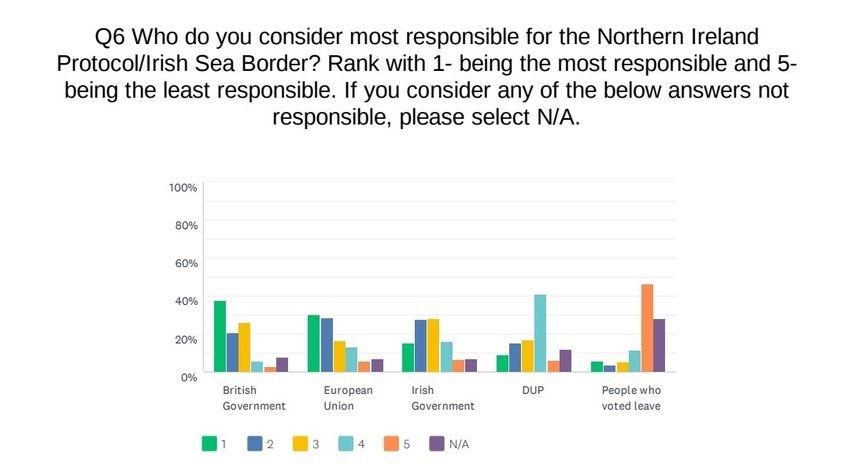
Let’s Talk Loyalism                Loyalist Engagement Survey

Contents

Foreword by Stacey Graham                         4-5

About Let’s Talk Loyalism                         6-7

Executive Summary                                 8-10

Survey Results with Key Findings                  11-23

Method                                            24-25

Survey Results and Commentary                     26-43

                                                                3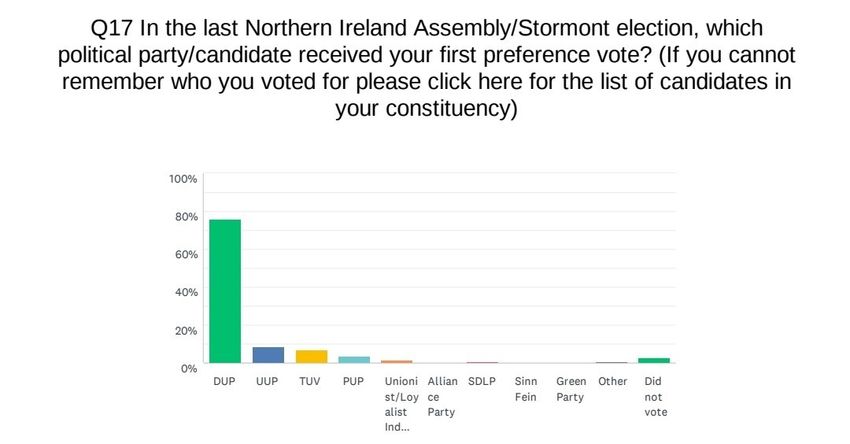
Let’s Talk Loyalism                                                    Loyalist Engagement Survey

Foreword
By Stacey Graham

When people don’t listen carefully to others, they can easily make assumptions — too often the wrong
assumptions — about what a community stands for, what is important to them, what their needs are
and how we best meet those needs.

Think about a time you felt misheard and misunderstood by somebody. Did you defend yourself?
Correct them? Or even disengage? Regardless of your response, you likely didn’t feel comfortable or
happy with the outcome.

It can be frustrating to feel like you’re being ignored, or that your opinion is being disregarded, and you
begin to wonder if people really care or are interested in what you’re saying.

The feeling that no one is listening can be widely felt amongst Loyalist working class communities. Time
and time again, our voices aren’t being heard by politicians and policy makers, and even when we are
being ‘listened’ to, it is often through a filter; a filter of the listeners own needs or views which can often
distort what they are hearing. This has led to increased feelings of alienation and marginalisation.

The alienation and marginalisation of Loyalists has been compounded by the absence of any ‘peace
dividend’ and consequently, as a new political and societal order is established, Loyalist communities
are effectively left behind.

In recent months, I have seen a hardening of attitudes. I don’t know how many times I’ve heard;

“I’ll not be voting; they don’t represent me.”
“Nobody cares about us; no one is listening.”
“Look at the state of our areas; we are being left to rot.”

Loyalists are a people who are proud of our community, our identity, and our culture. What will it take
for those in power to understand the realities of what is happening on the ground? One would wonder,
are they simply out of touch or just blatantly ignorant?

Now, think how it feels to be heard and understood — you can relax; you want to open up; you feel
more trusting.

                                                                                                            4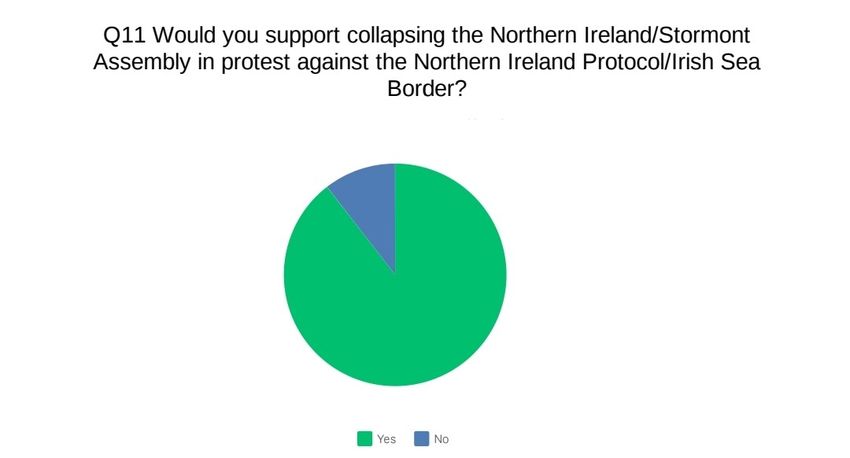
Let’s Talk Loyalism                                                Loyalist Engagement Survey

If the issues we are facing are to be addressed successfully and to create an environment of trust and
understanding; we need to listen to the voices of the people themselves. We need to regard people as
active agents with their own concerns which should be respected and listened to. Decision makers must
be capable of acting when the demands of our community changes especially when the assumptions
about what is needed does not reflect the real needs.

I recognise effective engagement and communication is a reciprocal process. It is also up to us as a
community to make sure we communicate correctly. By using surveys and drawing on data about what
we really think, really want, and really care about; we can give our community an authentic voice and
begin a process of change.

In all that we do, Let’s Talk Loyalism strives to initiate positive change within the Loyalist community.
We are an advocacy group comprised of genuine people that want to communicate the collective
concerns of our community.

Together we must challenge the status quo and take action to tackle these issues once and for all. Those
in power can no longer cover their ears and look the other way.

                                                                                                      5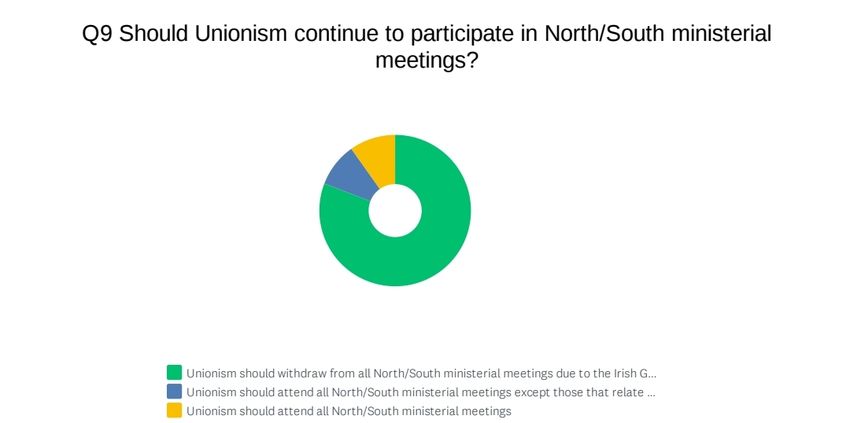
Let’s Talk Loyalism                                                Loyalist Engagement Survey

About Let’s Talk Loyalism
Who we are?
Let’s Talk Loyalism is a volunteer-based advocacy group which aims to articulate Loyalist perspectives
and initiate positive change for the Loyalist community.

The initiative was launched in February 2021 by a small number of young Loyalists. Founding members
believe the Loyalist community is often “misrepresented and misunderstood,”1 therefore Let’s Talk
Loyalism aspires be a vehicle through which Loyalists can have their voice heard.

Let’s Talk Loyalism aims to:

      i.   Educate, empower, and equip the next generation of Loyalists by articulating Loyalist
           perspectives in a rational and influential way.
     ii.   Promote the advantages of Northern Ireland being and remaining an integral part of the United
           Kingdom.
    iii.   Investigate and expose issues of injustice, inequality and disadvantage impacting on Unionist
           and Loyalist communities.
    iv.    Research, recommend, and lobby for policy change which positively impacts the Loyalist
           community and Northern Ireland.
     v.    Implement valuable initiatives focused on addressing needs within the Loyalist community.
    vi.    Build relationships and engage with communities, community groups, media, political parties
           and other bodies in Northern Ireland and the wider United Kingdom.
    vii.   Challenge outdated and inaccurate stereotypes of the Loyalist community. We will highlight
           talent, positive work and success within Loyalist communities.

Let’s Talk Loyalism is divided into four action areas:

       - Perspectives (Let’s Talk)
           A soapbox for Loyalism consisting of a variety of contributors articulating their perspectives on
           current affairs.
       - Broadcasts and Events (Let’s Broadcast)
           Videos, interviews, podcasts, panel discussions and other organised events.
       - Publications (Let’s Research)
           Reports, qualitative and quantitative research, surveys, letters, and statements.

1
    https://letstalkloyalism.co.uk/welcome-to-lets-talk-loyalism
                                                                                                          6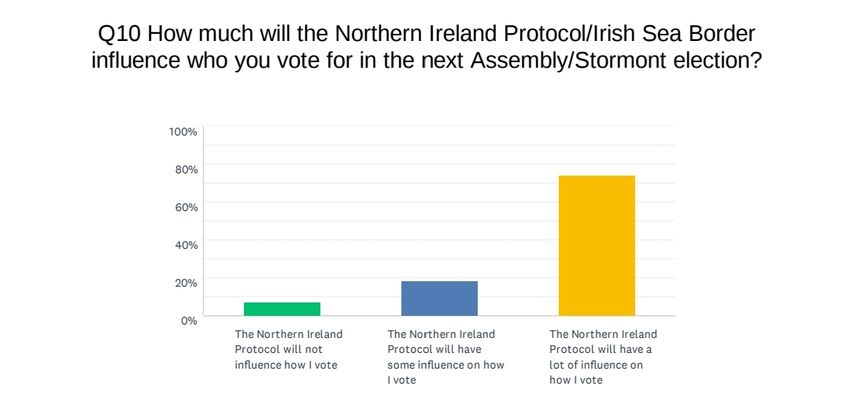
Let’s Talk Loyalism                                                   Loyalist Engagement Survey

   - Initiatives (Let’s Initiate)
       Initiatives and projects which positively impact the Loyalist community.

Since Let’s Talk Loyalism launched publicly in May of this year, we have published nine articles from
various contributors such as Julie-Anne Corr-Johnston, Jamie Bryson and Glenn Millar.

We have also produced video interviews of Stacey Graham and created a short interview piece with
residents in Tiger’s Bay during the Tiger’s Bay bonfire stand-off this year.

We have hosted online panel discussions on the Northern Ireland Protocol with high profile guests
including Baroness Kate Hoey, TUV leader Jim Allister, UUP leader Doug Beattie and DUP MP Sammy
Wilson.

The “Loyalist Engagement Survey: Protocol, Policing, and Politics” is the first in a series of online surveys
that Let’s Talk Loyalism intend to publish. Upcoming surveys will aim to ascertain Loyalist perspectives
on housing, education, employment, culture and legacy in Northern Ireland.

You can follow Let’s Talk Loyalism and read about the work we do on our website and social media
channels.

Website: https://letstalkloyalism.co.uk/

Twitter: https://twitter.com/talkloyalism?lang=en

Facebook: https://en-gb.facebook.com/Lets-Talk-Loyalism-107914618004741/?ref=page_internal

                                                                                                           7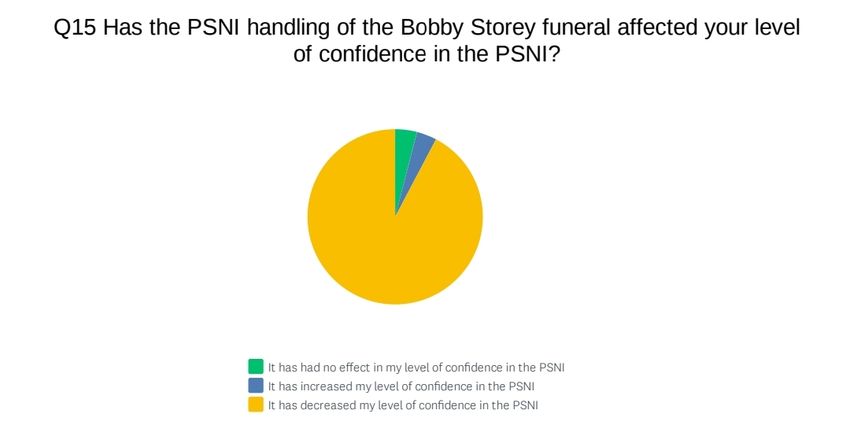
Let’s Talk Loyalism                                                       Loyalist Engagement Survey

Executive Summary
What are the key findings?
Let’s Talk Loyalism’s “Loyalist Engagement Survey: Protocol, Policing and Politics” was created to
ascertain Loyalist perspectives pertaining to the Northern Ireland Protocol, the Police Service of
Northern Ireland, Loyalist voting intentions and to gauge support for the Belfast/Good Friday
Agreement.

The survey contained 19 questions and was completed by 1020 respondents.2 Questions were
subdivided into four main categories; About you; Protocol; Policing; and Politics. The survey was hosted
by SurveyMonkey and all respondents completed the survey online.

The survey was circulated through social media platforms and directed toward individuals and groups
within the Loyalist community. The survey was shared with several cultural and social organisations,
charities, and sports clubs to ensure the breadth of the Loyalist community had an opportunity for
input.

The survey is an authentic representation of Loyalist perspectives. However, because the survey is not
weighted, the respondents’ profile shows some imbalances. Most respondents were middle-aged,
male and either from County Antrim, County Armagh or County Down.

More input from young people aged 18-24, females, and respondents living in County Fermanagh,
County Tyrone and County Londonderry would produce more balanced and representative results.

Survey results also overrepresented Loyalist voters. Only 2.55% of respondents “Did not vote” at the
last Northern Ireland Assembly Election. Voter/non-voter imbalance is to be expected however, for
those unlikely to vote at an election, are equally unlikely to participate in an online survey.

A full comprehensive listing of survey results can be found in the “Summary Results with Key Findings”
section on Page 11. A condensed list, as part of the Executive Summary, is provided below. The
summary of results below has been selected by the authors and are referred to as “Key Findings.”

2
    On three questions between 1-6 respondents did not answer. All respondent data is provided below.
                                                                                                           8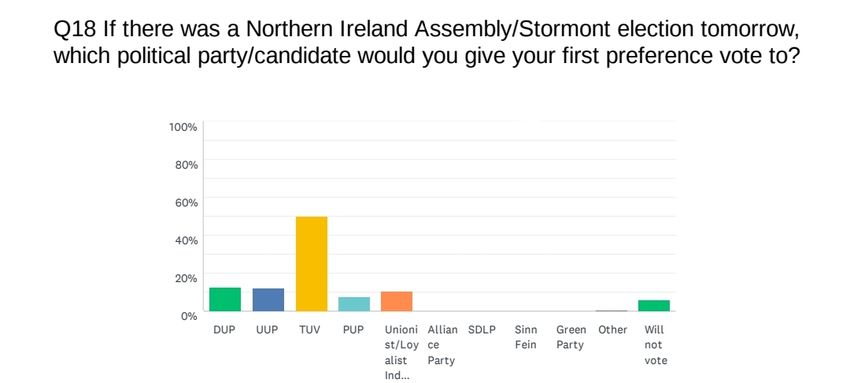
Let’s Talk Loyalism                                                Loyalist Engagement Survey

Key Findings
Loyalist perspectives on the Northern Ireland Protocol
-     Almost all Loyalists (98.3%) view the Northern Ireland Protocol as a threat to Northern Ireland’s
      position within the United Kingdom.
-     9 out of 10 Loyalists (91%) want the Northern Ireland Protocol abolished. Only 7.7% would prefer
      it was amended to “make it tolerable.”
-     The Northern Ireland Protocol will have “a lot of influence” on how 3 out of 4 Loyalists (74.2%) vote.
-     Most Loyalists (91.5%) think the Northern Ireland Protocol risks a return to violence in Northern
      Ireland. 8.54% think it does not.
-     8 out of 10 Loyalists (80.8%) think political Unionism should withdraw from “all North/South
      ministerial meetings due to the Irish Government playing an integral role in creating the Northern
      Ireland Protocol.”
-     More Loyalists support attending all North/South ministerial meetings (9.8%) than the current DUP
      approach of only not attending North/South meetings which pertain to the Northern Ireland
      Protocol. (9.4%)
-     89.5% of Loyalists support collapsing the Northern Ireland Assembly in protest against the Northern
      Ireland Protocol.
-     Loyalists consider the British Government primarily, but not exclusively, responsible for the
      Northern Ireland Protocol. The European Union are considered the second most responsible, the
      Irish Government third, the DUP fourth, and people who voted Leave in the 2016 Referendum fifth.
- When asked to rank in order of responsibility, over 70% of Loyalists consider the Irish Government
      within the top three most responsible for the Protocol (14.9% considered IG 1 st most responsible,
      27.6% considered IG 2nd most responsible, 28.1% considered IG 3rd most responsible).
-     11.8% of Loyalists think the DUP do not share any responsibility for the Northern Ireland Protocol.
-     Over half (55.8%) of Loyalists would support and attend a protest in the Republic of Ireland over
      the Northern Ireland Protocol. 32.8% would support it but not attend, meanwhile 11.4% would not
      support it at all.

Loyalist perspectives on Policing in Northern Ireland
-     93.1% of Loyalists believe the PSNI discriminates or treats the Loyalist community unfairly.
-     94.8% of Loyalists believe the Republican community are given “preferential treatment” by the
      PSNI.
-     92.3% of Loyalists said the PSNI handling of Bobby Storey’s funeral has decreased their confidence
      in the PSNI.
-     9 out of 10 (91.7%) Loyalists think the Chief Constable of the PSNI should resign.

                                                                                                          9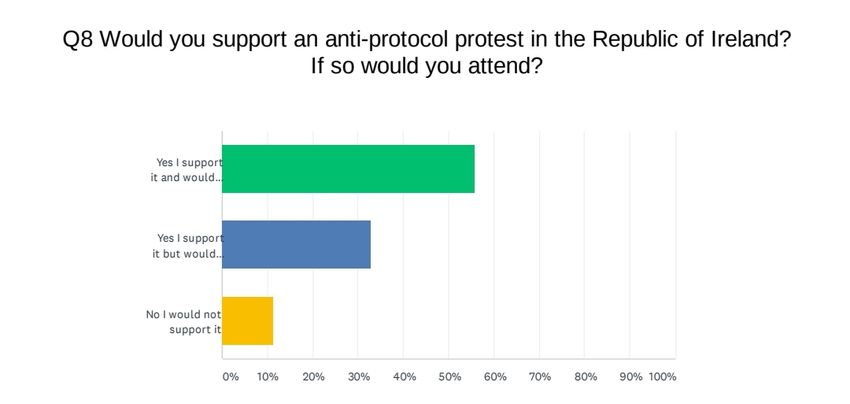
Let’s Talk Loyalism                                                Loyalist Engagement Survey

Loyalist perspectives on Northern Ireland Politics
-     If there was a Northern Ireland Assembly Election tomorrow, the TUV would be most popular party
      receiving 50% of Loyalist first preference votes. The DUP would be the second most popular party
      receiving 12.7% Loyalist first preference votes. The UUP would not far behind in third receiving
      11.9% Loyalist first preference votes. The PUP would be the fourth most popular party receiving
      7.2% of Loyalist first preference votes. 10.7% of Loyalist would vote for an independent candidate
      as their first preference.
-     3 out of 4 (75.9%) Loyalists voted DUP as their first preference at the last Northern Ireland Assembly
      Election. Only 12.7% of Loyalists say they would vote DUP as their first preference if there was a
      Northern Ireland Assembly Election tomorrow. This represents a 63.2 percentage point decrease in
      first preference votes for the DUP from Loyalists.
-     If there was a Northern Ireland Assembly Election tomorrow, more Loyalists would vote UUP
      (+3.5pp) and PUP (+3.9pp) as their first preference than at the previous election.
-     Half of Loyalists (50%) would vote TUV as their first preference if there was a Northern Ireland
      Assembly Election tomorrow. That represents a 42.7 percentage point increase from the last
      Northern Ireland Assembly Election.
-     1 in 10 Loyalists would vote for an independent Unionist/Loyalist candidate if there was a Northern
      Ireland Assembly Election tomorrow.
-     A substantial majority of Loyalists (86.5%) are anti-agreement and would vote against the
      Belfast/Good Friday Agreement given the opportunity. 13.5% of Loyalists would vote for it.

                                                                                                        10
Let’s Talk Loyalism Loyalist Engagement Survey
Survey Results with Key Findings
What did the survey ask and how did respondents answer?
Survey results have been categorized into four sections: respondent profile, protocol, policing, and
politics. The results of each section are summarised below:
Respondent Profile
Who completed the survey?
What is your age?
18-24 58 5.69%
25-34 178 17.25%
35-54 454 44.51%
55+ 332 32.55%
Total: 1020
What is your gender?
Male 887 86.96%
Female 133 13.04%
Total: 1020
Where do you live?
Antrim 621 60.88%
Armagh 127 12.45%
Down 178 17.45%
Fermanagh 10 0.98%
Londonderry 40 3.92%
Tyrone 44 4.31%
Total: 1020
Would you describe the area in which you live as rural or urban?
Rural 314 30.78%
Urban 706 69.22%
Total: 1020
11Let’s Talk Loyalism Loyalist Engagement Survey
Protocol
Loyalist opinion on the Northern Ireland Protocol:
Does the Northern Ireland Protocol threaten Northern Ireland’s position within the United
Kingdom?
Yes 98.33% 1,003
No 1.67% 17
Total: 1020
What would you like to see happen to the Northern Ireland Protocol/Irish Sea Border?
Nothing, it should remain as it is 1.27% 13
Change it to make it tolerable 7.65% 78
Abolish it entirely 91.08% 929
Total: 1020
12Let’s Talk Loyalism Loyalist Engagement Survey
How much will the Northern Ireland Protocol/Irish Sea Border influence who you vote for in the
next Assembly/Stormont election?
The Northern Ireland Protocol will not influence how I vote 7.25% 74
The Northern Ireland Protocol will have some influence on how I 18.53% 189
vote
The Northern Ireland Protocol will have a lot of influence on how I 74.22% 757
vote
Total: 1020
Do you think the Northern Ireland Protocol/Irish Sea Border risks a return to violence in Northern
Ireland?
Yes 91.46% 932
No 8.54% 87
Total: 1019
13Let’s Talk Loyalism Loyalist Engagement Survey
- Almost all Loyalists (98.3%) view the Northern Ireland Protocol as a threat to Northern Ireland’s
position within the United Kingdom.
- 9 out of 10 Loyalists (91%) want the Northern Ireland Protocol abolished. Only 7.7% would prefer
it was amended to “make it tolerable.”
- The Northern Ireland Protocol will have “a lot of influence” on how 3 out of 4 Loyalists (74.2%) vote.
- Most Loyalists (91.5%) think the Northern Ireland Protocol risks a return to violence in Northern
Ireland. 8.54% think it does not.
What Loyalists believe Unionist leaders should do about the Northern Ireland Protocol:
Should Unionism continue to participate in North/South ministerial meetings?
Unionism should withdraw from all North/South ministerial 80.78% 824
meetings due to the Irish Government playing an integral role in
creating the Northern Ireland Protocol/Irish Sea Border
Unionism should attend all North/South ministerial meetings except 9.41% 96
those that relate to the Northern Ireland Protocol/Irish Sea Border
Unionism should attend all North/South ministerial meetings 9.80% 100
Total: 1020
14Let’s Talk Loyalism Loyalist Engagement Survey
Would you support collapsing the Northern Ireland/Stormont Assembly in protest against the
Northern Ireland Protocol/Irish Sea Border?
Yes 89.51% 913
No 10.49% 107
Total: 1020
- 8 out of 10 Loyalists (80.8%) think political Unionism should withdraw from “all North/South
ministerial meetings due to the Irish Government playing an integral role in creating the Northern
Ireland Protocol.”
- More Loyalists support attending all North/South ministerial meetings (9.8%) than the current DUP
approach of only not attending North/South meetings which pertain to the Northern Ireland
Protocol. (9.4%)
- 89.5% of Loyalists support collapsing the Northern Ireland Assembly in protest against the Northern
Ireland Protocol.
15Let’s Talk Loyalism Loyalist Engagement Survey
Who Loyalists consider most responsible for the Northern Ireland Protocol:
Who do you consider most responsible for the Northern Ireland Protocol/Irish Sea Border? Rank
with 1- being the most responsible and 5- being the least responsible. If you consider any of the
below answers not responsible, please select N/A.
1 2 3 4 5 N/A
British Government 37.55% 20.59% 26.27% 5.49% 2.65% 7.45%
383 210 268 56 27 76
European Union 30.00% 28.24% 16.27% 12.94% 5.39% 7.16%
306 288 166 132 55 73
Irish Government 14.90% 27.75% 28.14% 16.18% 6.27% 6.75%
152 283 287 165 64 69
DUP 9.02% 14.80% 17.16% 41.08% 6.18% 11.76%
92 151 175 419 63 120
People who voted leave 5.69% 3.73% 4.80% 11.27% 46.47% 28.04%
58 38 49 115 474 286
Total: 1020
16Let’s Talk Loyalism Loyalist Engagement Survey
Would you support an anti-protocol protest in the Republic of Ireland? If so, would you attend?
Yes I support it and would attend 55.78% 569
Yes I support it but would not attend 32.84% 335
No I would not support it 11.37% 116
Total: 1019
- Loyalists consider the British Government primarily, but not exclusively, responsible for the
Northern Ireland Protocol. The European Union are considered the second most responsible, the
Irish Government third, the DUP fourth, and people who voted Leave in the 2016 Referendum fifth.
- When asked to rank in order of responsibility, over 70% of Loyalists consider the Irish Government
within the top three most responsible for the Protocol (14.9% considered IG 1 st most responsible,
27.6% considered IG 2nd most responsible, 28.1% considered IG 3rd most responsible).
- 11.76% of Loyalists think the DUP do not share any responsibility for the Northern Ireland Protocol.
- Over half (55.8%) of Loyalists would support and attend a protest in the Republic of Ireland over
the Northern Ireland Protocol. 32.8% would support it but not attend, meanwhile 11.4% would not
support it at all.
17Let’s Talk Loyalism Loyalist Engagement Survey
Policing
Treatment of both the Loyalist and Republican community:
Is the Loyalist community discriminated against and treated unfairly by the PSNI?
Yes 93.14% 950
No 6.86% 70
Total: 1020
18Let’s Talk Loyalism Loyalist Engagement Survey
Is the Republican community given preferential treatment by the PSNI?
Yes 94.80% 967
No 5.20% 53
Total: 1020
- 93.1% of Loyalists believe the PSNI discriminates or treats the Loyalist community unfairly.
- 94.8% of Loyalists believe the Republican community are given “preferential treatment” by the
PSNI.
Bobby Storey funeral and PSNI confidence:
Has the PSNI handling of the Bobby Storey funeral affected your level of confidence in the PSNI?
It has had no effect in my level of confidence in the PSNI 4.02% 41
It has increased my level of confidence in the PSNI 3.73% 38
It has decreased my level of confidence in the PSNI 92.25% 941
Total: 1020
19Let’s Talk Loyalism Loyalist Engagement Survey
Do you think the Chief Constable of the PSNI should resign?
Yes 91.67% 935
No 8.33% 85
Total: 1020
- 92.3% of Loyalists said the PSNI handling of Bobby Storey’s funeral has decreased their confidence
in the PSNI.
- 9 out of 10 (91.7%) Loyalists think the Chief Constable of the PSNI should resign.
20Let’s Talk Loyalism Loyalist Engagement Survey
Politics
Voting history and voting intention:
In the last Northern Ireland Assembly/Stormont election, which political party/candidate received
your first preference vote? (If you cannot remember who you voted for please click here for the
list of candidates in your constituency)
DUP 75.98% 775
UUP 8.43% 86
TUV 7.25% 74
PUP 3.33% 34
Unionist/Loyalist Independent 1.37% 14
Alliance Party 0.10% 1
SDLP 0.29% 3
Sinn Fein 0.00% 0
Green Party 0.10% 1
Other 0.59% 6
Did not vote 2.55% 26
Total: 1020
21Let’s Talk Loyalism Loyalist Engagement Survey
If there was a Northern Ireland Assembly/Stormont election tomorrow, which political
party/candidate would you give your first preference vote to?
DUP 12.71% 129
UUP 11.92% 121
TUV 50.05% 508
PUP 7.19% 73
Unionist/Loyalist Independent 10.74% 109
Alliance Party 0.20% 2
SDLP 0.20% 2
Sinn Fein 0.00% 0
Green Party 0.20% 2
Other 0.69% 7
Will not vote 6.11% 62
Total: 1015
- If there was a Northern Ireland Assembly Election tomorrow, the TUV would be most popular party
receiving 50% of Loyalist first preference votes. The DUP would be the second most popular party
receiving 12.7% Loyalist first preference votes. The UUP would not be far behind in third receiving
11.9% Loyalist first preference votes. The PUP would be the fourth most popular party receiving
7.2% of Loyalist first preference votes. 10.7% of Loyalist would vote for an independent candidate.
- 3 out of 4 (75.9%) Loyalists voted DUP as their first preference at the last Northern Ireland Assembly
Election. Only 12.7% of Loyalists say they would vote DUP as their first preference if there was a
Northern Ireland Assembly Election tomorrow. This represents a 63.2 percentage point decrease in
first preference votes for the DUP from Loyalists.
- If there was a Northern Ireland Assembly Election tomorrow, more Loyalists would vote UUP
(+3.5pp) and PUP (+3.9pp) as first preferences than at the previous election.
22Let’s Talk Loyalism Loyalist Engagement Survey
- Half of Loyalists (50%) would vote TUV as their first preference if there was a Northern Ireland
Assembly Election tomorrow. That represents a 42.7 percentage point increase from the last
Northern Ireland Assembly Election.
- 1 in 10 Loyalists would vote for an independent Unionist/Loyalist candidate if there was a Northern
Ireland Assembly Election tomorrow.
Loyalist support for the Belfast/Good Friday Agreement:
If there was a vote on the Belfast/Good Friday Agreement today would you vote for or against it?
For 13.51% 137
Against 86.49% 877
Total: 1014
- A substantial majority of Loyalists (86.5%) are anti-agreement and would vote against the
Belfast/Good Friday Agreement given the opportunity. 13.5% of Loyalists would vote for it.
23Let’s Talk Loyalism Loyalist Engagement Survey
Method
How did we do it?
This study was carried out by Let’s Talk Loyalism with the objective of assessing opinion from the
Loyalist community on the Northern Ireland Protocol, Policing and Politics.
Activists held a meeting and concluded that the most suitable way to gauge this opinion and conduct
research was by designing and distributing a short online questionnaire. It was agreed that an online
survey would:
I. Gather a large amount of information in a shorter period of time compared to other methods
of primary data collection unlike observation as a research method.
II. Allow members of the sample group to remain anonymous unlike for instance interviews or
focus groups.
III. The results allow for straightforward analysis given the large amount of quantitative data
gathered.
When considering the survey values the creators established a core set of values to guide best practice.
Members were consistently guided by and adhered to the following principles:
I. Confidentiality
Survey administrators have no knowledge of how any individual respondent answered the
questionnaire as is established practice for this type of research.
II. Anonymity
No personal or identifiable information was collected from survey answers. The questionnaire did
contain an ‘About You’ section, however, these were generic representative questions such as age,
gender, location, and geographical region. This data enabled us to break statistics down into variables
based on answers selected. Participants did not have the opportunity to omit these questions.
III. Loyalist Participants
The survey was intended to be completed by individuals from Northern Ireland who identify as being
Loyalist. This is an important annotation as the questions are designed to gauge perspectives from only
the Loyalist community.
24Let’s Talk Loyalism Loyalist Engagement Survey
IV. Authenticity
The reason behind this survey was to evaluate how Loyalists consider the aforementioned issues in
Northern Ireland. By verifying or disproving notions, we believed we could authentically identify how
this community thinks and feels regarding the Northern Ireland Protocol, Policing and Politics. For this
reason, the questions were devised to be non-presumptuous.
To reach our target audience as outlined above we made the following decisions:
- Research was hosted by Survey Monkey using an online questionnaire and was active on 17th
August 2021 opening at 1pm and closing at 7.30pm.
- Invitations containing the online survey link were sent out by Let’s Talk Loyalism members.
Invitations were sent to individuals within the community, and cultural, social, historical and
community groups to be completed by individuals within said groups. These invitations were sent
out by Facebook, SMS and WhatsApp. The intention behind not sharing the survey publicly was to
avoid having the survey exposed outside of the target audience for the reasons already explained
above.
- The survey contained 4 sections titled: About You, Northern Ireland Protocol / Irish Sea Border,
Policing and Politics. It included 19 questions and took approximately 3 minutes to complete.
- The questionnaire contained various formats of questions: yes/no, multiple choice and ranking.
- A total of 1020 surveys were completed and all surveys have been used for the results.
25Let’s Talk Loyalism Loyalist Engagement Survey
Survey Results and Commentary
What did the survey say?
Let’s Talk Loyalism is proud and excited to publish the findings of our first online survey called ‘Loyalist
Engagement Survey: Protocol, Policing, Politics.’
The objective of the survey was to ascertain Loyalist perspectives pertaining to the Northern Ireland
Protocol, the Police Service of Northern Ireland, Loyalist voting intentions and the Belfast/Good Friday
Agreement.
The survey contained 19 questions and was made using SurveyMonkey. Circulation began online on
Tuesday 17th August 2021 at 2pm. Within hours, to the surprise of Let’s Talk Loyalism members, the
survey account reached maximum capacity for respondents and therefore had to officially close on the
same evening.
A total of 1020 respondents completed the survey. It was exclusively circulated through social media
platforms WhatsApp, Facebook and Twitter, and deliberately targeted individuals and organisations
within the Loyalist community, such as cultural and community groups, charities and sports clubs.
Respondent Profile
Loyalist respondents to the survey were mostly middle-aged. Just under half (44.5%) were aged
between 34-54, whereas a further 32.6% were over 55. In total, over three quarters of respondents
(77%) were over 34 years old.
A substantial number of respondents were young adults aged 24-34 (17.3%), however under 6% were
aged 18-24. That means only 58 from 1020 respondents born after the signing of the Belfast Agreement
in 1998. This survey would be more representative if it had greater input from young people in Loyalist
communities.
Another identity category in need of greater representation in this survey is female. Of the 1020
respondents 133 of them were female (13%) and 887 were male (87%). This shows an imbalance
between male and female engagement.
26Let’s Talk Loyalism Loyalist Engagement Survey
Although this discrepancy is partly explained by a predominantly male membership of the cultural
organisations the survey was distributed to, future research efforts will prioritise achieving greater
balance in respect of gender and consider a weighted approach.3
Three out of five respondents were from County Antrim (60.9%), suggesting a majority of respondents
are likely based in Belfast. Respondents from County Down (17.5%) and County Armagh (12.45%) made
up most of the remaining respondents. 94 from 1020 respondents derived from County Fermanagh
(1%), County Tyrone (4.3%) and County Londonderry (3.9%).
The survey has considerable participation from Loyalists who live in both rural and urban areas. This
was deliberately asked as to conduct comparative analysis between Loyalists living in the countryside
alongside responses from those living in a city. 69.2% of respondents classed themselves a living in an
urban area whereas the remaining 31.8% said they were from a rural area.
The majority of Loyalists who completed this survey are voters. 97.4% of respondents stated they voted
at the last Northern Ireland Assembly Election.
On average around 40% of the electorate often do not turn out to vote, and evidence suggests that the
number is significantly higher within Unionist and Loyalist communities.4
Although this denotes an underrepresentation of Loyalist non-voters, it is somewhat understandable
that those who are not willing to come out to vote in elections are equally less likely to take part in an
online survey.
Let’s Talk Loyalism will endeavor to achieve a more balanced representation right across the Loyalist
community in future projects.
In the development and distribution of additional surveys, and in any other consultative exercises
which ascertain Loyalist perspectives on critical issues, Let’s Talk Loyalism will specifically target
females, young people, and non-voters respectively.
3
While monitoring data from the survey when it was active, Let’s Talk Loyalism members became aware of a widening
gender imbalance in respondents. Members resolved to directly target female Loyalist organisations to achieve greater
input. Unfortunately, maximum capacity for respondents had been reached within a number of hours of the survey being
launched which meant efforts to redress this imbalance could not be executed to full effect.
4
Pg3, https://www.liverpool.ac.uk/media/livacuk/research/heroimages/The-University-of-Liverpool-NI-General-
Election-Survey-2019-March-20.pdf
27Let’s Talk Loyalism Loyalist Engagement Survey
Protocol
The Protocol section of the survey contained eight questions. The questions can be divided into three
sub-categories. Questions about Loyalist opinion of the Northern Ireland Protocol; what Loyalists
believe Unionist leaders should do about the Northern Ireland Protocol; and who Loyalists consider
most responsible for the Northern Ireland Protocol.
Loyalist opinion of the Northern Ireland Protocol
The most uniform response to any of the survey questions pertained to the Protocol threatening
Northern Ireland’s position within the United Kingdom.
It will come as no surprise that against the backdrop of civil unrest, sporadic grassroots protests, and
major political criticism, a comprehensive 98.3% of Loyalists believe the Northern Ireland Protocol
threatens Northern Ireland’s position within the United Kingdom.
Loyalists are demonstrably looking at the Northern Ireland Protocol through a constitutional lens and
determine it to pose a threat to Northern Ireland’s constitutional future.
When asked what one would like to see happen to the Northern Ireland Protocol 91% of Loyalists want
to “abolish it entirely,” whereas under 8% think it should be changed “to make it tolerable.”
This confirms the popular “Protocol must go” messaging often heard from members of the Loyalist
community and reiterated by Unionist politicians.5
While a small section of the sample would prefer to see amendments to the Northern Ireland Protocol,
the overwhelmingly dominant sentiment currently within the Loyalist community is one which
demands its total abolition.
The only path currently available to permanently disapply parts of the Northern Ireland Protocol is
found in Article 18 “Democratic Consent” of the Northern Ireland Protocol.
Article 18 provides the Northern Ireland Assembly with “an opportunity for democratic consent in
Northern Ireland for the continued application of Articles 5-10 of the Northern Ireland Protocol.”6 The
5
https://www.belfasttelegraph.co.uk/news/northern-ireland/dup-delegation-tells-lord-frost-that-ni-protocol-must-
go-40468365.html
6
Article 18, paragraph 1, Revised Northern Ireland Protocol. Available at
https://assets.publishing.service.gov.uk/government/uploads/system/uploads/attachment_data/file/840230/Revised
_Protocol_to_the_Withdrawal_Agreement.pdf
28Let’s Talk Loyalism Loyalist Engagement Survey
first democratic exercise on the Northern Ireland Protocol by Members of the Legislative Assembly will
take place in 2024.
This means, if all goes to schedule, those elected at the next Northern Ireland Assembly election will
vote on the continued application of the Northern Ireland Protocol.
Within this context, as one would perhaps expect, nearly 3 out of 4 (74.2%) Loyalists stated the
“Northern Ireland Protocol will have a lot of influence on how I vote” at the next Stormont election. 7
This is not to say the Northern Ireland Protocol would not have had an influence in the absence of a
vote on the Northern Ireland Protocol, but it is likely there is significant corroboration.
18.5% said the Northern Ireland Protocol would have “some influence,” while 7.3% said it would have
“no influence.”
According to these results, one can state with reasonable confidence that the Northern Ireland Protocol
will play an instrumental role in Loyalist voters’ decision-making at the next Northern Ireland Assembly
election.
What Loyalists believe Unionists leaders should do about the Northern
Ireland Protocol
Respondents were also asked about what action political Unionism should take in response to the
Northern Ireland Protocol.
Respective questions evaluated Loyalist opinion on the prospect of collapsing the Northern Ireland
Assembly and political Unionism’s continued participation in North-South Ministerial Meetings.
Both questions returned substantial majorities in favour of political Unionism collapsing the Northern
Ireland Assembly “in protest against the Northern Ireland Protocol” (89.5%) and withdrawing from
North-South Ministerial Meetings “due to the Irish Government playing an integral role in creating the
Northern Ireland Protocol.” (80.7%)
Support for the DUP’s current stance of limited non-attendance to North-South Ministerial Meetings
which relate to the Northern Ireland Protocol was the least popular approach (9.4%), fractionally
behind Unionism continuing to “attend all meetings” (9.8%).
7
This is not to say the Northern Ireland Protocol would not have had an influence on Loyalist voting, in the absence of a
Northern Ireland Assembly vote on the Northern Ireland Protocol, but it is likely there is significant corroboration.
29Let’s Talk Loyalism Loyalist Engagement Survey
Who Loyalists consider most responsible for the Northern Ireland Protocol
Most Loyalist respondents, as expected, consider the British Government primarily, but not exclusively,
responsible for the Northern Ireland Protocol.
When asked to rank in order of responsibility who is most responsible for the Northern Ireland
Protocol, nearly 40% of respondents put the British Government first. The most common ranking
thereafter placed the European Union second most responsible, the Irish Government third most
responsible, the DUP fourth most responsible and “people who voted Leave” in the 2016 Referendum
fifth most responsible.
Since the publication of the Revised Northern Ireland Protocol in October 2019 Loyalists have been
intensely critical of the Prime Minister for negotiating it and the British Government for supporting it. 8
Loyalists renamed the Withdrawal Act, of which the Northern Ireland Protocol is a part of, “The Betrayal
Act,”9 as many protested at how the Prime Minister, who promised Unionists and Loyalists alike that
an Irish Sea Border would not happen over his dead body had now in fact agreed to one.10
A “Non-Applicable” option to exclude any of the choices was provided to allow respondents the
opportunity to absolve each option of responsibility if they wished to do so.
28% selected non-applicable for “people who voted Leave” whereas 11.7% exercised the same option
for the DUP. The reverse reading of this statistic suggests nearly 9 out of 10 Loyalists believe the DUP
share a portion of responsibility for the Northern Ireland Protocol.
Most of the blame however is shared by the British Government, the European Union, and the Irish
Government. Over 70% of respondents placed the Irish Government within the top three most
responsible for the Protocol (1st 14.9%, 2nd 27.6%, 3rd 28.1%).
Hostile attitudes toward the Irish Government is further demonstrated by Loyalist support and
willingness to attend a protest in the Republic of Ireland because of the Northern Ireland Protocol.
8
https://www.belfasttelegraph.co.uk/news/northern-ireland/loyalists-gather-at-con-club-to-discuss-brexit-act-of-
betrayal-38616918.html
9
https://www.heraldscotland.com/news/17983902.loyalists-northern-ireland-will-not-tolerate-boris-johnsons-
betrayal-act/
10
https://www.itv.com/news/utv/2020-08-13/irish-sea-trade-border-over-my-dead-body-says-johnson
30Let’s Talk Loyalism Loyalist Engagement Survey
Protests have been taking place in Northern Ireland regularly throughout the year and when asked if a
protest was to take place south of the border over half of respondents (55.7%) said they would support
and attend it. Just under a third would support a protest but not attend, meanwhile 11.4% did not
support it.
This is consistent with some of the public commentary made by Loyalists such as Jamie Bryson and Jim
Wilson.11 Loyalist criticism of the Irish Government has led to considerations and conversations about
taking protests to the Irish Republic, and according to the survey over half of Loyalists may be willing
to attend.
One popular criticism of the Irish Government’s involvement in creating the Northern Ireland Protocol,
is former Taoiseach Leo Varadkar’s alleged use of the threat of Republican violence for political gain.12
Former Vauxhall MP Baroness Kate Hoey said, “the threat of IRA bombs was unfortunately used by
Taoiseach Varadkar as political leverage which led to the Protocol.”13
As a consequence of accepting Varadkar’s concerns, the Northern Ireland Protocol was agreed in part
to “avoid a hard border,”14 and by implication avoid the possibility of a return to violence.
However, the results of this survey show that the very agreement which sought to avoid a return to
violence may in fact do more to encourage it.
A huge majority (91.5%) of Loyalist respondents answered “yes,” when asked if the Northern Ireland
Protocol risks a return to violence.
11
https://www.irishnews.com/news/northernirelandnews/2021/06/16/news/loyalists-entitled-to-hold-dublin-
protest-2356844/
12
https://www.irishnews.com/news/northernirelandnews/2021/06/30/news/claim-that-former-taoiseach-leo-
varadkar-used-threat-of-violence-to-influence-eu-leader-angrily-dismissed-2372320/
13
https://www.express.co.uk/news/politics/1429747/brexit-news-leo-varadkar-kate-hoey-northern-ireland-protocol-
IRA-terror-eu-trade-update
14
Article 1 Objectives, paragraph 3, Revised Northern Ireland Protocol. Available at
https://assets.publishing.service.gov.uk/government/uploads/system/uploads/attachment_data/file/840230/Revised
_Protocol_to_the_Withdrawal_Agreement.pdf
31Let’s Talk Loyalism Loyalist Engagement Survey
Policing
For the “Policing” section of the survey we asked Loyalist respondents four questions. The first two
questions referred to PSNI treatment of both the Loyalist and Republican communities; and the second
two questions concerned the PSNI’s handling of the Bobby Storey funeral and the tenableness of the
current Chief Constable, Simon Byrne.
Allegations of two-tier policing resurfaced with extra vigor in the aftermath of the controversial Bobby
Storey funeral in June 2020.15
At the peak of the Covid pandemic, Sinn Fein organised a publicly attended funeral for IRA anarchist
Bobby Storey which commanded over 2000 Republicans onto the streets of Belfast.16
PSNI handling of the funeral came under intense scrutiny with allegations of bias toward Sinn Fein and
members of the wider Republican community.
Loyalist respondents reflected this viewpoint when asked, “Is the Republican community given
preferential treatment by the PSNI?” A conclusive 94.8% of Loyalists responded “Yes.”
Conversely, when asked, “Is the Loyalist community discriminated against and treated unfairly by the
PSNI?” A marginally fewer, but equally decisive majority (93.8%) responded “Yes,” again.
Both questions illuminate the double-edged nature of two-tier policing allegations. For it is abundantly
clear, according to the results in this survey, that Loyalist respondents do not just consider the
Republican community to be treated preferentially by the PSNI, but simultaneously the Loyalist
community feel they are treated unfairly by the same police force.
After the Public Prosecution Service cited police engagement with funeral organisers as among the
reasons why prosecution would likely fail, all Unionist Party leaders demanded the Chief Constable,
Simon Byrne’s resignation.17
They argued the PSNI’s handling of Bobby Storey’s funeral had created a “crisis of confidence in police
service.”18
15
https://www.belfasttelegraph.co.uk/news/northern-ireland/perception-of-two-tier-policing-over-bobby-storey-
funeral-must-be-addressed-39852476.html
16
https://www.irishnews.com/news/northernirelandnews/2021/06/26/news/fall-out-from-bobby-storey-funeral-
caused-a-political-furore-for-almost-a-year-2367839/
17
https://www.irishnews.com/news/northernirelandnews/2021/04/03/news/unionists-calls-for-chief-constable-to-
stand-down-branded-kneejerk--2277014/
18
https://www.bbc.co.uk/news/av/uk-northern-ireland-56584608
32Let’s Talk Loyalism Loyalist Engagement Survey
It should be said that criticism of the PSNI approach to Storey’s funeral was by no means exclusive to
the Loyalist community. Yet given long-standing allegations of two-tier policing from Loyalists, it was
confirmation to many what they had previously claimed.
Without prior analysis, it is hard to say how much confidence Loyalists had in the PSNI before the Bobby
Storey funeral. Nonetheless, results showed that 92.3% of Loyalists now had decreased level of
confidence in the PSNI following the Bobby Storey funeral debacle. Claims of a “crisis in confidence,”
according to this survey, are well founded.
More than a year has passed since the funeral took place and it has been nearly five months since a
period of intense pressure from Unionist leaders publicly declaring Byrne’s position as untenable.
However, results show demand for the Chief Constable to step aside has not subsided. A widespread
majority of Loyalist respondents think the Chief Constable should step aside (91.7%).
Despite independent reports proclaiming an “unbiased”19 PSNI approach to Bobby Storey’s funeral,
their management of the affair has critically damaged confidence in the force and many still consider
the Chief Constable should resign.
19
https://www.bbc.co.uk/news/uk-northern-ireland-57134874
33Let’s Talk Loyalism Loyalist Engagement Survey
Politics
Included in the politics section of the survey were three questions about voting history at the last
Northern Ireland Assembly election, voting intention if there was a Northern Ireland Assembly Election
tomorrow, and Loyalist support for the Belfast/Good Friday Agreement.
Voting history and intention
Both questions regarding voting history and intention are best analysed alongside one another for
comparative results and to demonstrate any change in voting preference. Respondents were first asked
which political party received their first preference vote in the 2019 Northern Ireland Assembly
Election. The second comparative question asked if there was a vote “tomorrow,” which
party/candidate would receive your first preference vote? Increase or decrease in voting preference
per political party reasonably indicates popularity within the Loyalist community and priority voting if
there was a snap election.
Results to both questions are highlighted in the Figure 1.
Figure 1.
Answer choice 1st Pref at last NI Assembly 1st Pref if NI Assembly % Change
Election Election were tomorrow
DUP 75.9% 12.7% - 63.2pp
UUP 8.4% 11.9% + 3.5pp
TUV 7.3% 50% + 42.7pp
PUP 3.3% 7.2% + 3.9pp
Independent 1.4% 10.7% + 9.3pp
Unionist/Loyalist
Did/Will Not Vote 2.6% 6.1% + 3.5pp
An analysis of the six answers referred to in Figure 1. has been provided below. Each analysis discusses
the results but also provides commentary on contextual challenges and insight into each answer.
34Let’s Talk Loyalism Loyalist Engagement Survey
Democratic Unionist Party
The task before new DUP leader Jeffrey Donaldson is far from straightforward. Poor election results
and fractious leadership challenges demonstrate an ongoing decline in public support and internal
divisions within the party.
Electoral losses in both the 2019 Local and General Election signals a worrisome trend for the DUP.
Despite enjoying a 1 percentage point increase in first preference vote share, the party returned 8
fewer seats in the Local Election.
As for the Westminster election, a 5.4 percentage point vote share decrease in combination with
electoral pacts between Pro-Remain candidates was enough for the DUP to lose two Members of
Parliament and fail to make an expected seat gain in North Down.
Donaldson will be hopeful he can steer the DUP toward better electoral performances but voting
intention data thus far suggest that things could go from bad to worse.
A LucidTalk poll in May of this year indicated support for the DUP had halved since the Westminster
elections of 2019.20 After the appointment of Poots as leader, surveys showed support dropped a
further 3 percentage points. This survey’s results tell a similar story.
If there was an NI Assembly Election tomorrow only 12.7% of Loyalist respondents would give their
first preference vote to a DUP candidate. This is a substantial drop-off from the 3 out of 4 (75.9%)
Loyalist respondents who voted for a DUP candidate as their first preference at the last NI Assembly
Election.
In total, according to this survey, if there was an NI Assembly Election tomorrow, the DUP would suffer
a massive 63.2 percentage point decrease in first preference votes from within the Loyalist community.
The DUP have certainly made a persuasive and effective case against the Northern Ireland Protocol.
Which in turn perhaps makes it all the more confusing for those that agree with them, that they have
not taken more drastic and robust action to stifle its implementation and success.
20
https://www.belfasttelegraph.co.uk/news/northern-ireland/belfast-telegraph-opinion-poll-northern-irelands-
changing-political-landscape-as-support-for-parties-revealed-40453232.html
35Let’s Talk Loyalism Loyalist Engagement Survey
The DUP have made numerous threats in response to the Northern Ireland Protocol. Party leader
Jeffrey Donaldson MP, has threatened to cease implementing checks; 21 to collapse the Northern
Ireland Assembly;22 and walk away from all North-South institutions.23 DUP MP Sammy Wilson even
threatened to wage “guerilla warfare”24 on the Northern Ireland Protocol.
Until any of these threats materilise however it is hard to envisage how the DUP can recover support
within the Loyalist community.
Ulster Unionist Party
Former military man and new leader Doug Beattie MLA will be hopeful that the UUP can increase their
vote share in any upcoming election.
A more progressive outlook together with fresh appointments, such as former PUP Councilor Julie-
Anne Corr-Johnston25, will engender optimism within UUP quarters that they can increase support from
the Loyalist community. Feedback from this survey suggests that some of that optimism is justified.
If there was an NI Assembly Election tomorrow, the UUP would make slight but significant first
preference gains within the Loyalist community, compared to their first preference vote share in the
last NI Assembly Election.
8.4% of Loyalist respondents named a UUP candidate as a first preference on their ballot paper in 2017,
whereas 11.9% would do so if there were an NI Assembly Election “tomorrow.” This shows a small
increase in first preference vote share by 3.5 percentage points.
Overall, a 40% increase in first preference votes will be good news to UUP hopefuls. Yet when
compared to TUV gains it could alternatively be viewed as underwhelming. With DUP votes seemingly
up for grabs, and with so much ground for the UUP to recover within Loyalist communities, a 3.5
percentage point increase could otherwise indicate a missed opportunity.
The UUP have also been hugely critical of the Northern Ireland Protocol. In an opinion piece for the
Irish Times in May, UUP leader Doug Beattie said, “as a unionist I cannot sit idly by and watch the Belfast
21
https://www.belfasttelegraph.co.uk/news/northern-ireland/dup-ministers-may-refuse-to-conduct-ni-protocol-
checks-if-changes-unacceptable-warns-donaldson-40682672.html
22
https://www.belfasttelegraph.co.uk/news/northern-ireland/dups-donaldson-slammed-for-claims-he-will-risk-
stormont-collapse-over-ni-protocol-protest-40421774.html
23
See previous.
24
https://www.irishtimes.com/news/ireland/irish-news/dup-declares-guerrilla-warfare-on-northern-ireland-protocol-
1.4497441
25
https://www.irishnews.com/news/politicalnews/2021/06/02/news/julie-anne-corr-johnston-joins-uup-2342279/
36Let’s Talk Loyalism Loyalist Engagement Survey
Agreement be undermined with a border in the Irish Sea between Northern Ireland and the rest of the
UK.”26
The party have published a “Practical Solutions”27 paper and have been involved in negotiations with
the European Union and British Government representatives to voice their concern.
However, as shown by this survey, the majority of Loyalists want political unionism to go a step further
and withdraw from North-South ministerial bodies and collapse the NI Assembly if necessary. Both of
which the UUP do not support.28
Traditional Unionist Voice
Jim Allister’s outspoken role in criticising the Northern Ireland Protocol has undoubtedly struck a
favourable chord with members of the Loyalist community. His attendance at public protests and
prominent role in a judicial review of the Northern Ireland Protocol presents him as a leading figure in
the fight against it.
This, at the same time of periods of intense criticism and internal turmoil within the DUP, has developed
a window of opportunity for TUV popularity growth at the DUP’s expense, with the potential to evolve
into electoral gains.
It remains to be seen however if the TUV can position itself as a viable Unionist alternative. Recent
defectors from the DUP have chosen to sit as independents, or join the UUP, instead of finding a home
in Allister’s party. An interesting contrast to the defectors the DUP enjoyed when the UUP lost of
support after signing the Belfast Agreement.
Nonetheless, previous polls have shown support for the TUV is growing and it is of little surprise that
this survey’s results demonstrate much the same pattern, if not on an even larger scale.29
7.3% of Loyalist respondents gave their first preference vote to the TUV at the last NI Assembly Election.
If there was an NI Assembly Election tomorrow half of Loyalists (50%) would vote TUV as their first
preference. A gain of 42 percentage points signals a monumental growth in support for the TUV within
the Loyalist community.
26
https://www.irishtimes.com/opinion/doug-beattie-i-want-to-promote-a-progressive-and-inclusive-unionism-with-a-
welcoming-approach-1.4579236
27
https://uup.org/assets/images/UUP%20NI%20Protocol%20solutions%20paper.pdf
28
https://www.belfasttelegraph.co.uk/news/northern-ireland/stormont-on-brink-of-collapse-but-we-will-work-to-
save-it-vows-new-uupleader-doug-beattie-40434450.html
29
https://sluggerotoole.com/2021/02/01/the-twin-surges-of-the-alliance-party-and-the-tuv-threaten-to-redraw-
northern-irelands-electoral-map/
37Let’s Talk Loyalism Loyalist Engagement Survey
Clues as to why exactly Loyalists are enticed by Allister’s party may be gleaned in respondents’ answers
to some of the other survey questions.
Loyalist respondents were overwhelmingly in favour of Unionist withdrawal from North-South
ministerial meetings and collapsing the Assembly in protest against the Protocol. As early as January
2021 TUV’s Allister was directly called for “freezing” North-South institutions,30 and when talking about
whether the Assembly could collapse in resistance to the Northern Ireland Protocol, Allister pointedly
remarked, “so be it” at a protest in Newtownards.
Support for the TUV is all the more interesting considering Loyalists have often criticised the party for
having a cold and disapproving attitude toward members of the Loyalist community.
At the time of writing, there has never been a publicly reported meeting between Jim Allister and the
Loyalist Communities Council. Whether that speaks to an official TUV position is unclear. It certainly
stands in contrast however to reported meetings between the LCC and the DUP,31 and the willingness
expressed by that of the UUP.32
Nonetheless, Allister has been both complimentary and critical of Loyalist protests against the Northern
Ireland Protocol. One such protest carried a banner that stated, “Peace or Protocol,” to which Allister,
when asked, described as “inappropriate.”33 Overall however, he praised the work of grassroots
Loyalists, saying “by their peaceful protests, social media platforms and engagement, grassroots
Loyalists are streets ahead of politicians.”34
Allister has been consistently calling for the very action Loyalists want to see. The longer the DUP decide
to go in a different direction, the longer it may sustain or perhaps further increase popularity growth
for the TUV from within the Loyalist community.
Progressive Unionist Party
The PUP is often referred to as the only political party in Northern Ireland which primarily self-identifies
as Loyalist and avows to uphold Loyalist values.
30
https://www.belfasttelegraph.co.uk/news/northern-ireland/jim-allister-northern-ireland-should-freeze-co-
operation-with-republic-40018454.html
31
https://www.bbc.co.uk/news/uk-northern-ireland-56201532
32
https://www.belfasttelegraph.co.uk/news/northern-ireland/uups-beattie-would-ask-loyalist-communities-council-
when-they-will-disband-if-he-becomes-leader-40412273.html
33
https://www.irishnews.com/paywall/tsb/irishnews/irishnews/irishnews//news/northernirelandnews/2021/06/22/ne
ws/tuv-leader-jim-allister-has-condemned-a-threatening-loyalist-banner-2362744/content.html
34
https://tuv.org.uk/grassroots-loyalists-doing-more-against-protocol-than-many-politicians/
38You can also read


