Making Room for Wolf Recovery: The Case for Maintaining Endangered Species Act Protections for America's Wolves
←
→
Page content transcription
If your browser does not render page correctly, please read the page content below
Making Room for Wolf Recovery:
The Case for Maintaining Endangered Species Act Protections for America’s Wolves

                                                                    Wildlife for 2
                                                                  g                5Y
                                                                in
                                                            v

                                                                                   ea
                                                         Sa

                                                                                     rs

                                                    Amaroq Weiss, Noah Greenwald, Curt Bradley
                                                                   November 2014
I.      Executive Summary                              southern Rocky Mountains, Grand Canyon, Cascade
                                                             Mountains in Washington, Oregon and California,
In 2011 the U.S. Fish and Wildlife Service removed           the Sierra Nevada and the Adirondacks are all places
Endangered Species Act protections for wolves in the         that could support wolf populations. According to
northern Rocky Mountains and western Great Lakes,            the studies, these areas are capable of supporting a
arguing that wolves were recovered in those regions          minimum of 5,000 wolves, which would nearly double
and the states could be trusted to manage them. But          the existing wolf population.
all of the states with substantial wolf populations have
enacted aggressive hunting and trapping seasons that         Recovering wolves to these additional areas is
are intended to drastically reduce wolf populations. To      necessary to ensure the long-term survival of gray
date these hunts have resulted in the killing of more        wolves in the lower 48 states and enrich the diversity
than 2,800 wolves. The deaths of so many wolves              of U.S. ecosystems that have lacked the gray wolf
have contributed to declines in wolf populations of          as a top predator for decades. At last count the three
9 percent in the northern Rockies and 25 percent in          existing wolf populations combined include only
Minnesota. Given increased efforts to kill wolves            roughly 5,400 wolves, which is below what scientists
in many states, these declines can be expected to            have identified as the minimum viable population
continue and likely increase.                                size necessary to avoid extinction. Considering that
                                                             populations are now declining and isolated at several
Despite the nightmare that state management of wolves        scales, doubling the population by facilitating wolf
has been, the Fish and Wildlife Service has proposed to      recovery in additional areas is needed to secure the
remove protections for gray wolves in the remainder of       future of gray wolves in the U.S.
the lower 48 states, excluding a small portion of Arizona
and New Mexico, where the Mexican gray wolf struggles        Studies following reintroduction of wolves to
to survive. The agency argues that growth of populations     Yellowstone National Park have documented that
in the northern Rockies and Great Lakes is sufficient        wolves as top predators play pivotal roles in shaping
to consider the species recovered and to remove              the structure and function of ecosystems, benefitting
Endangered Species Act protections.                          a wide range of species, including beavers, songbirds,
                                                             grizzly bears, foxes, bison, pronghorn and more.
In this report, we make the case that the job of
recovering wolves is far from complete by:                   Gray wolves are also a substantial draw for people from
                                                             around the world. Millions of people have traveled to
  •        Identifying and mapping suitable habitat not      Yellowstone from around the world to see the gray
           currently occupied by wolves;                     wolves reintroduced in 1995 and 1996, and polls
  •        Documenting dispersals of wolves to this 		       consistently show that a broad majority of the American
           habitat;                                          public supports the recovery of gray wolves, including
  •        Detailing the limitations of current 			          to new areas where they don’t currently occur.
           management plans;
  •        Highlighting the important roles wolves play in
           ecosystems.

Gray wolves currently occupy less than 10 percent of
their historic range and a fraction of currently suitable
habitat. To identify and map unoccupied, suitable wolf
habitat in the United States, we used 27 studies that
model wolf habitat in different regions to create a single
map. Based on this analysis, there is up to 530,000
square miles of suitable wolf habitat in the United
States, only roughly 171,000 square miles of which is
occupied, demonstrating that wolves currently occupy
only about 30 percent of existing suitable habitat. The
                                                             Wenaha pack male courtesy ODFW                            1
                                                             Cover photo by Chris Smith / Flickr
II.     Introduction                                     The agency is now proposing to remove protections
                                                            for wolves across the lower 48 excluding a portion
Gray wolves once occupied the majority of North             of the range of the Mexican gray wolf in Arizona and
America, excluding perhaps only the driest deserts and      New Mexico (FWS 2013). This proposal disregards
the southeastern United States, where the red wolf occurs   that there are only roughly 5,400 wolves in portions
(FWS 2013). Scientists estimate that pre-European           of the Midwest (~3,700 wolves), northern Rockies
settlement there may have been as many as 2 million         (~1,670) and Southwest (~80) (FWS 2013), and the
wolves in North America (Leonard et al., 2005). During      states are actively working to reduce populations.
the late 19th century and early 20th century, state and     Moreover, wolves occupy just a fraction of their
local bounties reduced wolf numbers. From 1915              historic range, less than 10 percent, and only a small
through mid-century, the U.S. government exterminated       portion of existing suitable habitat. Indeed, multiple
wolves from the United States and Mexico (Seton, 1929;      researchers have modeled extensive suitable habitat
Young and Goldman, 1944). By 1967, when wolves              for wolves in the Northeast, Pacific Northwest,
were protected under a precursor to the Endangered          southern Rocky Mountains, California and elsewhere.
Species Act, they had been reduced to fewer than 1,000      To describe the full extent of suitable habitat available
wolves in northeastern Minnesota (FWS 2009).                for further recovery of wolves, we reviewed literature
                                                            estimating existing wolf habitat, created composite
With protection, wolves began to see some recovery,         maps of all known wolf habitat in the lower 48,
but only in portions of their former range where the        quantified unoccupied habitat, and estimated the
U.S. Fish and Wildlife Service (FWS) developed              minimum number of wolves that could occur in this
recovery programs. Wolves were originally protected         habitat. We also quantified and mapped wolf dispersal
as four subspecies -- the northern Rockies wolf,            events over the past 30 years. In the following
eastern wolf, Mexican wolf and Texas wolf (FWS              discussion, we present the results of these analyses,
1978). Recognizing that these subspecific designations      further discuss the history of efforts to remove
were potentially invalid, FWS consolidated protection       protections for wolves, including discussion of the
for gray wolves to the species level in 1978, including     current proposal, and provide a rationale for not
the entire lower 48 states (Ibid.) The agency, however,     walking away from wolf recovery now.
never developed a national strategy to recover wolves
in the lower 48 in line with expanded protection.              III.    Studies Estimating Wolf Habitat in the
Instead it completed recovery plans that had already                   United States
been started in 1978 for three of the four purported
subspecies, excluding the Texas wolf.                       We reviewed 27 studies that modeled potential wolf
                                                            habitat in the lower 48 states and used the composite
With recovery programs in place, including                  results to estimate and map the full range of potential
reintroduction of wolves in portions of the northern        unoccupied wolf habitat and the number of wolves that
Rocky Mountains, wolves began to grow in number             could be supported in the lower 48 (Appendix A). The
and expand their range in the northern Rockies and          studies modeled wolf habitat across the western United
western Great Lakes states. Mexican wolves were             States, the upper Midwest and the Northeast (Appendix
also reintroduced to a portion of the Southwest, but        B). This likely encapsulates a majority of existing wolf
their numbers have grown slowly. In 2003 FWS began          habitat in the United States excluding the range of the
moving to delist wolves in the northern Rockies and         red wolf in the Southeast. But there may be additional
western Great Lakes, and after multiple rounds of           habitat in North and South Dakota and other areas that
litigation in which the agency was repeatedly found         should be the subject of additional modeling.
not to have followed best science, were successful in
removing protections in both regions in 2011 (FWS           Predictive modeling parameters used in the studies
2011ab). Since delisting, all states in the northern        consisted of road density (26 studies), human
Rockies and western Great Lakes have instituted             population density (20 studies), prey density (20
aggressive hunting and trapping seasons intended to         studies) and land cover/use (16 studies). Some
drastically reduce wolf populations.                        studies used additional parameters including
                                                                                                                        2
land ownership (11 studies), livestock density (7          and the Sierra Nevada in California. In the northeastern
studies), slope or elevation (5 studies), climate or       United States, thousands of square miles of terrain
snowfall (4 studies), surface water availability (4        spanning upstate New York and portions of Vermont,
studies), and prey accessibility or availability (3        New Hampshire and Maine were identified as capable of
studies). Two studies used soil depth or hydrology         supporting a wolf population. And some studies indicate
(Appendix C).                                              the lower peninsula of Michigan could support wolves.

     Figure 1. Suitable gray wolf habitat in the contiguous United States as identified in 14 modeling studies.

Past modeling of wolf habitat has accurately predicted
wolf occupancy in both the northern Rockies and            According to our mapping, there are approximately
Midwest, suggesting modeling can accurately convey         530,000 square miles of suitable wolf habitat in the
potential wolf habitat. We used 14 of the 27 studies to    lower 48, of which roughly 171,000 square miles are
create a composite map of wolf habitat for the lower       currently occupied, meaning wolves have recovered
48 states (Figure 1). We did not use all of the studies    to only roughly 30 percent of known suitable habitat.
because in some cases they represented different           Although not all studies estimated the number of wolves
modeling iterations for the same areas by the same         that could be supported, those that did suggest that at
authors, and in others there was insufficient spatial      least another 5,000 wolves could populate the Northeast,
information to allow mapping.                              southern Rockies, West Coast and Southwest, nearly
                                                           doubling the existing population and creating a network
Reviewed studies identified extensive wolf habitat in      of interconnected populations bolstering genetic security.
regions where wolves have not yet recovered. In the
western United States, this includes the central and           IV.     Wolves Are Dispersing Into Areas of
southern Rocky Mountains in both Colorado and Utah,                    Suitable Habitat and Need Endangered
the Grand Canyon and surrounding areas in northern                     Species Act Protections to Survive
Arizona, the Olympic Peninsula in Washington, the
Cascade Mountains in Washington, Oregon and California     Not only is there extensive suitable habitat in other
                                                                                                                        3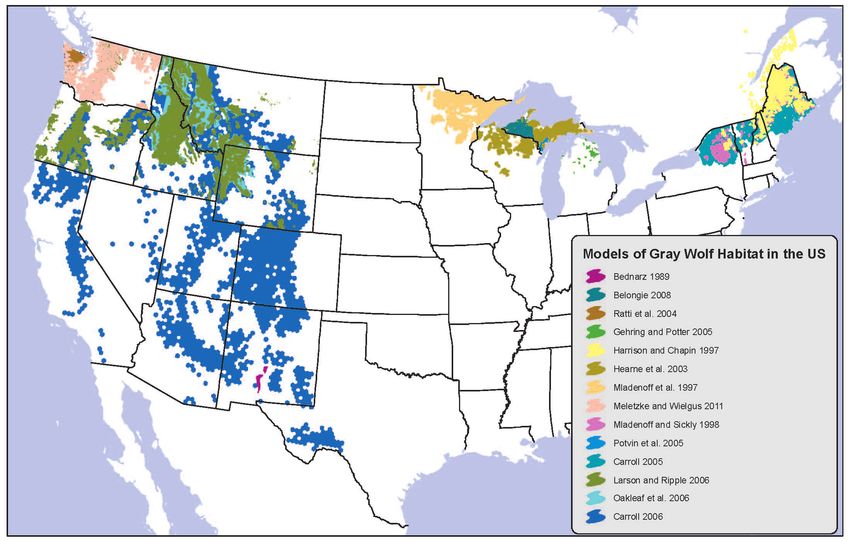
regions of the country, but
wolves are dispersing into
this habitat. Wolves can
travel substantial distances
traversing diverse landscapes
when leaving their birth-
packs to seek mates and
territory of their own (Mech
and Boitani, 2003). The
most-recent and well-known
example is that of wolf OR-
7, who traveled more than
4,000 miles after dispersing
from his birth pack in
northeastern Oregon to travel
to California and back into
Oregon repeatedly during
2011-2014. He recently
found a mate, with whom
he has denned and produced
pups in southwestern Oregon
just north of the California
border. In order to quantify
and visually display these                                               Figure 2. Dispersals by wolves to locations outside
dispersal events, we tabulated all known wolf dispersals                 of core federal recovery areas, 1981-2014.
between 1981 and 2014 in which wolves dispersed
to areas and states outside of existing core recovery
                                                           areas that support source populations and in areas to
areas (Appendix D). The dispersals we tabulated were
                                                           which wolves are dispersing.
reported in newspaper stories, agency reports and other
sources, and for each dispersal event we attempted to
                                                               V.      Recovery of Wolves to Additional Areas is
obtain a point of origin and endpoint. We identified
                                                                       Required by the Endangered Species Act
56 dispersal events in total, with an average dispersal
distance of 264 miles. This data shows that wolves have
                                                           Unlike previous endangered species statutes, the
and will continue to move into suitable habitat on the
                                                           Endangered Species Act does not simply require
West Coast, southern Rocky Mountains and Northeast,
                                                           recovery of species to the point that they are not at
where they need protection if they are going to survive
                                                           risk of global extinction. Indeed, the primary purpose
and establish populations (Figure 2). Indeed, with
                                                           of the Act is to conserve the ecosystems upon which
protections under the Endangered Species Act, wolves
                                                           endangered species depend (16 U.S.C. § 1531(b)).
were able to move into Oregon and Washington from
                                                           Significantly, the Act defines an endangered species as
both the northern Rockies and British Columbia and
                                                           any species in danger of extinction in all or a significant
form fledgling populations.
                                                           portion of its range (16 U.S.C § 1532(6)). This
                                                           means that a species need not be at risk of extinction
Our data also shows dispersal events steadily
                                                           everywhere to qualify for protection, but rather only
increased from 2000 to 2011, when populations were
                                                           in a significant portion of range. Accordingly, it also
steadily growing with endangered species protections
                                                           means that species cannot be considered recovered
in place, and appear to have since declined now that
                                                           until no longer endangered in any significant portion of
all states with substantial wolf populations have
                                                           range. As demonstrated by the 27 studies we reviewed,
enacted aggressive hunting and trapping seasons,
                                                           wolves remain absent or at very low numbers over
leading to population declines (Figure 3). This further
                                                           significant portions of their historic range where there
highlights the need for continued protection both in
                                                                                                                         4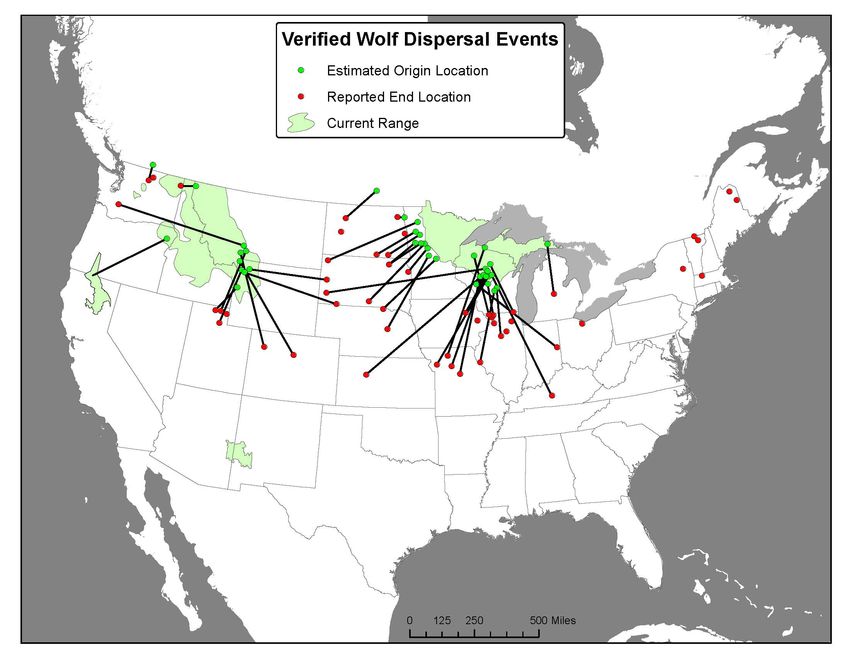
Figure 3. Annual gray wolf dispersal events to areas and states outside of federal core recovery areas.

is extensive remaining habitat, including the Northeast,     numbered 1,691 in the northern Rockies, 3,669 in
southern Rocky Mountains, West Coast and elsewhere.          the western Great Lakes, and 83 in the Southwest.i
For this reason alone, wolves remain an endangered           According to the above studies, which collectively
species that continues to need the protections of the        examined hundreds of species, all existing wolf
Endangered Species Act.                                      populations are below minimum population sizes
                                                             considered necessary to ensure long-term survival.
   VI.      Existing Wolf Populations Are Not
            Viable in the Absence of Additional              Of further concern, wolf populations in both the
            Population Expansion                             northern Rockies and Great Lakes are declining
                                                             in response to aggressive hunting and trapping
The existing wolf populations in the northern Rocky          seasons enacted by individual states. In the northern
Mountains, western Great Lakes and Southwest are             Rockies, the last population count showed a 9 percent
below minimum viable population sizes sufficient             decline since federal delisting and in Minnesota,
to ensure their survival (Shaffer, 1981; Reed et. al.,       the population declined by an estimated 25 percent
2003, Traill et al. 2007). In an analysis of 102 species     between 2008 and 2012.ii If these population declines
including the gray wolf, Reed et al., (2003) estimated       continue, risk to wolf populations will only increase.
a mean and median minimum viable population of
7,316 and 5,816 individuals respectively, concluding         Existing wolf populations are also below levels
that long-term persistence of wild populations               considered necessary to avoid genetic inbreeding. A
of animals, such as wolves, requires 7,000 adult             number of studies have concluded that an “effective”
individuals. Likewise, Traill et al., (2007) combined        population size of 500 individuals is necessary to avoid
results from studies on 212 species, including the
                                                             i
gray wolf, finding that the median minimum viable               For northern Rockies see: http://www.fws.gov/mountain-prairie/
                                                             species/mammals/wolf/annualrpt12/; for western Great Lakes see
population was 4,169 individuals.                            http://www.fws.gov/midwest/wolf/aboutwolves/WolfPopUS.htm.
As of the end of 2013, the existing wolf populations         ii
                                                                See: Ibid. and www.mndnr.gov/wolves
                                                                                                                                 5
OR-11 courtesy ODFW

the effects of genetic inbreeding (Soule and Wilcox,             VII.    Recovering Wolves to Additional Areas
1980; Frankel and Soule, 1981; Soule, 1986; Franklin                     Is Necessary for Healthy, Functioning
and Frankham, 1998). Effective population size is                        Ecosystems
defined as the number of breeding individuals, rather
than total individuals, translating into a total population   The loss of large carnivores is a global problem with
of 2,500-5,000 individuals to maintain a total of 500         broad ecological consequences. Because of their
breeding individuals (Frankham, 1995). Gray wolves            position at the top of food chains, large carnivores play
in North America have already lost substantial genetic        an inordinate role in shaping the structure and function
diversity because of the severe reduction in their overall    of diverse ecosystems (Estes et al. 2011, Ripple et
historical numbers and range and further losses could         al., 2014). According to Ripple et al. (2014), nearly
lower survival and reproduction further endangering           two-thirds (61 percent) of large carnivore species
wolves (Leonard et al., 2005).                                are considered threatened by the IUCN and most (77
                                                              percent) are declining. The extirpation of the gray wolf
Loss of genetic diversity due to small population             across most of the American landscape is no exception
size and historic declines is compounded by the               to this pattern and as elsewhere around the world, loss
isolation of existing wolf populations (Soule, 1980).         of a top predator like the gray wolf has resulted in a
The Mexican gray wolf, for example, is isolated from          number of rippling ecological consequences that have
all other wolf populations and the population in the          negatively impacted a broad range of species. This can
Greater Yellowstone ecosystem is largely isolated             be inferred largely by studies showing positive trends
from other wolves in the northern Rockies. This lack          in a broad range of species following reintroduction of
of connectivity further increases the potential for           wolves in the northern Rockies.
loss of genetic variation over time. Restoring wolves
to additional suitable habitat would create more              Studies following reintroduction of wolves to
opportunity for connectivity between populations.             Yellowstone National Park documented that wolves
It would also increase the likelihood that wolves             had a profound and transformative impact on the
dispersing from currently existing wolf populations           landscape that benefitted a wide variety of species. In
would be able to find other wolves with whom to               particular, the reintroduction of wolves resulted in a
mate, and thus contribute genetically to the health of        dramatic decrease in elk numbers and also potentially
adjacent populations.                                         forced them to move more (Barber-Meyer et al., 2008,

                                                                                                                          6
Diamond pack female courtesy WDFW
Ripple and Beschta, 2012). Reduced elk browse in survival of pronghorn antelope fawns due to reduced
turn has led to recovery of woody species, such as predation by coyotes (Berger et al., 2008). Carcasses
cottonwood, aspen, willow and serviceberry (Ripple of elk killed by wolves provide food for a host of other
and Beschta, 2012). This has fostered many beneficial scavenger species, including but not limited to grizzly
ecosystem changes, from providing crucial nesting and bears, black bears, coyotes, eagles, ravens, magpies
roosting sites for songbirds, to enhancing root strength and hundreds of species of beetles (Smith et al., 2003).
and thereby protecting streams from soil erosion, Wolf-kills may also provide a buffering effect against
to providing food and building sources for beavers climate change for carrion-feeders that depend on
whose dams then create cool, deep ponds needed carcasses for food. As warming temperatures result in
by juvenile fish, and finally to facilitating growth of decreased winter severity, and thus a decreased die-off
berry-producing shrubs that provide food for grizzly of vulnerable animals that would otherwise succumb
bears and other animals (Ripple and Beschta, 2004; to harsh weather, wolf-kills will provide the carcasses
Hebblewhite et al., 2005; Weiss et al., 2007; Eisenberg scavengers need to survive (Wilmers and Getz, 2005).
et al., 2013, Hollenbeck and Ripple, 2008, Ripple et
al., 2013). The ecosystems of the southern Rocky Mountains,
Colorado Plateau, Grand Canyon, Cascade Mountains,
Wolves prey on wild ungulates which are the most Adirondack Mountains, Sierra Nevada and elsewhere
vulnerable due to factors such as age, injury or ill- would all benefit from the return and recovery of
health, allowing greater numbers of healthier, more the gray wolf. It is not enough to restore the wolf
robust, and more alert animals to survive and pass to small fragments of its historic range. Instead,
on their genes (Stahler et al, 2006). Wolves may also large carnivores like wolves should be restored to
prevent the spread of diseases among prey species population levels allowing them to once again be
by culling sick animals before they infect others “ecologically effective” – that is, a population that
(Wild et al., 2005). Wolves view coyotes as territorial has enough individuals and a wide enough geographic
competitors and in some parts of Yellowstone wolves distribution so that not just the species’ existence has
have greatly decreased the coyote density. This has been reestablished but, also, its essential role in nature
led to increases in numbers of foxes and increased (Soule et al., 2003; Carroll et al., 2006.)
7be pregnant.) In Wyoming, wolves were designated
VIII. Maintaining Federal Protections for a predatory animal that can be killed at anytime by
Wolves Is Essential Because States Cannot nearly any means, including killing pups in dens, in
Be Trusted to Conserve Existing Wolf nearly 85 percent of the state and designated the rest
Populations or Protect Wolves Dispersing to of the state outside of Yellowstone and Grand Teton
Other Areas National Parks, a trophy game area, where hunting of
wolves was permitted. This management was found
Following removal of Endangered Species Act to be inadequate by a federal court in September,
protections in the northern Rockies and western 2014 and Endangered Species Act protections were
Great Lakes, all of the states with substantial reestablished, stopping the 2014-2015 hunt and killing
wolf populations enacted aggressive hunting and of wolves in the predatory zone.
trapping seasons designed to drastically lower
populations, and indeed population declines are In Minnesota, the state had promised in its state
occurring. In the three years since protections were wolf plan that there would be no hunting or trapping
removed, nearly 3,000 wolves have been killed of wolves for five years post delisting, but instead
through state-sanctioned “harvest” seasons. The instituted wolf hunting and trapping immediately
killing of so many wolves in such a short time following delisting. To date, at least 650 wolves
directly reflects the negative prejudices towards have been killed and the population declined by
wolves held by powerful minorities in all of these 25 percent between 2008-2012. Starting in 2012,
states. These prejudices were the primary cause Wisconsin authorized wolf-hunting and trapping
of the extirpation of the wolf across significant that has to date resulted in killing of 374 wolves
portions of its range and highlight why wolves with a goal of reducing the population by more
continue to need federal protections and a national than half to 350 wolves from over 800. Wolves
recovery plan. are allowed to be hunted and trapped with the use
of hounds, night-hunting by artificial lights, and
Worse still, anti-wolf policies appear to be getting baiting, despite overwhelming public opposition
more severe in most states where protections have to any of these practices.iv Michigan’s governor
been removed. In Idaho, for example, wolf hunting in 2013 signed a bill allowing its state department
is allowed year round, including during breeding of natural resources to institute hunting of wolves
season and has resulted in the death of at least 1,000 despite citizens having collected over a quarter
wolves and reduced the state’s wolf population by of a million signatures to place a no-wolf-hunting
around 23 percent from its 2008 peak. This not being measure on the election-season ballot; a second
enough, the Idaho Department of Fish and Game in signature-collecting effort has resulted in a second
January 2014 hired a bounty hunter to pack into the ballot measure to overturn the newly-signed wolf-
Frank Church-River-of-No-Return Wilderness where hunting law, but a pro-hunting ballot measure was
he killed nine wolves; has sent U.S. Department of just passed by the legislature. Because the no-wolf
Agriculture/Wildlife Services’ airborne sharpshooters hunting ballot measure must be decided by the
into the Clearwater National Forest where 48 wolves voters in the November election, Michigan wolves
have been killed in six operations; and Gov. Butch have received a temporary reprieve and there will be
Otter this spring signed into law a bill that establishes no wolf-hunting season in Michigan this year. But if
a wolf-control board and provides over $600,000 the no-hunting measure does not pass, the legislative
annually to kill most of Idaho’s remaining wolves.iii bill will go into effect in March meaning Michigan’s
In Montana, the state wildlife commission nearly wolves will once again be facing legal harvest and
doubled the number of wolves that can be killed by certain death. Finally, in South Dakota, the state
an individual hunter or trapper in 2013 compared passed a law that classifies wolves in the eastern half
to 2012, and extended the wolf-killing season of the state as “varmints” that can be shot on sight.
through the middle of March (when wolves would
iii
See: http://gazers.com/previously-endangered-wolves-can-now- iv
Wisconsin Department of Natural Resources 2013 wolf
exterminated-idaho/ hunting and trapping regulations; The Political Environment,
April 12, 2013
8IX. Conclusion
In its rush to remove federal protections for gray wolves in most of the lower
48, the U.S. Fish and Wildlife Service relied on the states to adequately manage
and conserve the species. As these examples above demonstrate, however,
state management of wolves has been a political, rather than a science-based,
endeavor. In the three years states have had wolf-management authority, nearly
3,000 wolves have been killed from hunting and trapping, sanctioned by state
policies that fail to adequately consider the long-term viability or need for
further recovery of wolves.
The Service’s plan to now remove federal protections throughout most of the
remaining lower 48 states and allow states to fully manage wolves not only
jeopardizes the future of existing wolf populations it also makes it nearly
impossible for dispersing wolves to make their way to adjacent states to
establish new populations of wolves.
To achieve true, long-term, sustainable, recovery of the gray wolf, federal wolf
protections should be maintained and recovery plans developed, with the goal of
restoring connected, resilient, ecologically-effective wolf populations wherever
suitable wolf habitat exists. Formation of a recovery team made up of the many
highly-qualified wolf biologists and other scientists could ensure that considerable
recent science is brought to bear and ultimately produces a scientifically and
legally defensible recovery strategy that specifies the conditions under which
wolves are downlisted and ultimately delisted in all or portions of the species’
range. Restoring wolves to these areas would fulfill the ESA’s mandate to recover
threatened or endangered species throughout all significant portions of their
ranges and to conserve the ecosystems upon which they depend.
Yellowstone wolf by doublejwebers / Flickr
Bibliography
9Bibliography
Barber-Meyer, S.M., Mech, L.D. & White, P.J. 2008. Elk calf survival and mortality following wolf restoration
to Yellowstone National Park. Wildlife Monographs, 169, 1–30.
Berger, K.M., Gese, E.M., and J. Berger. 2008. Indirect effects and traditional trophic cascades: a test involving
wolves, coyotes, and pronghorn. Ecology 89(3): 818–828.
Carroll, Carlos, Phillips, M.K., Lopez-Gonzales, C.A. and Nathan H. Schumaker. 2006. Defining recovery goals
and strategies for endangered species using spatially- explicit
population models: the wolf as a case study. Bioscience 56:25-37.
Eisenberg, C., Seager, S.T. and D.E. Hibbs. 2013. Wolf, elk, and aspen food web relationships: Context and
complexity. Forest Ecol. Manage. (2013), http://dx.doi.org/10.1016/j.foreco.2013.01.014
Estes, J.A., Terborgh, J.A., Brashares, J.S., Power, M.E., Berger, J., Bond, W.J., Carpenter,
S.R., Essington, T.E., Holt, R.D., Jackson, J.B.C., Marquis, R.J., Oksanen, L., Oksanen,
T., Paine, R.T., Pikitich, E.K., Ripple, W.J., Sandin, S.A., Scheffer, M. 2011. Trophic
downgrading of planet Earth. Science 33, 301–306.
Frankel, O. H. and M. E. Soule. 1981. Conservation and Evolution. Cambridge University Press, New York,
NY.
Frankham R. 1995. Effective population size/adult population size ratios in wildlife: a review. Genetical
Research 66: 95-107.
Franklin, I. R. and R. Frankham. 1998. How large must a population be to retain evolutionary potential? Animal
Conservation 1: 69-70.
Hebblewhite, M., C.A. White, C.G. Nietvelt, J.A. McKenzie, T.E. Hurd, J.M. Fryxell, S.E. Bayley, P.C. Paquet.
2005. Human activity mediates a trophic cascade caused by wolves. Ecology 86(8):2135-2144.
Hollenbeck, J., Ripple, W.J., 2008. Aspen patch and migratory bird relationships in the Northern Yellowstone
Ecosystem. Landsc. Ecol. 22, 1411–1425.
Leonard, J.A., C. Vila, and R.K. Wayne. 2005. Legacy lost: genetic variability and population size of extirpated
U.S. grey wolves (Canis lupus). Molecular Ecology. 14(1): 9-17.
Mech, L.D. and L. Boitani. Editors. 2003. Wolves: behavior, ecology and conservation. University of Chicago
Press. Chicago, IL.
Reed, D. H, J. J. O’Grady, B. W. Brook, J. D. Ballou and R. Frankham. 2003. Estimates of minimum viable
population sizes for vertebrates and factors influencing those estimates. Biological Conservation 113: 23-34.
Ripple W.J. and R.L. Beschta. 2004. Wolves and the ecology of fear: can predation risk structure ecosystems?
BioScience 54(8):755-766.
Ripple W.J. and R.L. Beschta. 2012. Trophic Cascades in Yellowstone: The first 15 years after wolf
reintroduction. Biological Conservation 145: 205–213
10Ripple, W.J., Beschta, R.L., Fortin, J.K., and Robbins, C.T. 2013. Trophic Cascades from Wolves to Grizzly
Bears in Yellowstone. Journal of Animal Ecology, doi: 10.1111/1365-2656.12123.
Ripple, W.J., Estes, J.A., Beschta, R.L., Wilmers, C.C., Ritchie, E.G., Hebblewhite, M., Berger, J., Elmhagen,
E., Letnic, M., Nelson, M.P., Schmitz, O.J., Smith, D.W., Wallach, A.D. and A.J. Wirsing. 2014. Status and
ecological effects of the world’s largest carnivores. Science 343, 1241484.
Seton, E.T. 1929. Lives of Game Animals, Vol. 1: Cats, wolves, and foxes. Doubleday and Doran Co., New
York.
Shaffer, M.L. 1981. Minimum population sizes for species conservation. BioScience 31: 131-134.
Smith, Douglas W., R. 0. Peterson, and D. B. Houston. 2003. Yellowstone after wolves. Bioscience. 53(4):330-40.
Soule, M. E. and B. A. Wilcox. (Eds.) 1980. Conservation Biology, an evolutionary-ecological perspective.
Sinauer, Sunderland, MA.
Soule, M. E. (1980). “Thresholds for survival: maintaining fitness and evolutionary potential.” Conservation
biology: an evolutionary-ecological perspective, M. E. Soule and B. A. Wilcox, eds., Sinauer Associates,
Sunderland, MA. 151-169.
Soule, M. E. 1986. (Ed.) Conservation Biology, the science of scarcity and diversity. Sinauer, Sunderland, MA.
Soule, M., Estes, J., Berger, J., and C. Del Rio. 2003. Ecological Effectiveness: Conservation Goals for
Interactive Species. Conservation Biology, 17(5): 1238-1250.
Stahler, D. R., D. W. Smith, and D. S. Guernsey. 2006. Foraging and feeding ecology of the gray wolf (Canis
lupus): Lessons from Yellowstone National Park, Wyoming, USA. Journal of Nutrition. 136: 1,923s-1,926s.
Traill, L. W., Corey J. A. Bradshaw, and Barry W. Brook. 2007. Minimum viable population size: a meta-
analysis of 30 years of published estimates. Biological Conservation 139: 159-166.
U.S. Fish and Wildlife Service. 1978. Reclassification of the Gray Wolf in the United States and Mexico, with
Determination of Critical Habitat in Michigan and Minnesota. Federal Register, V. 43(47): 9607-9615.
U.S. Fish and Wildlife Service. 2009. Final Rule to Identify the Western Great Lakes Populations of Gray
Wolves as a Distinct Population Segment; Final Rule to Identify the Northern Rocky Mountain Population of
Gray Wolf as a Distinct Population Segment; and To Revise the List of Endangered and Threatened Wildlife.
Federal Register, V. 74(62): 15069-15123.
U.S. Fish and Wildlife Service. 2011a. Reissuance of Final Rule To Identify the Northern Rocky Mountain
Population of Gray Wolf as a Distinct Population Segment and To Revise the List of Endangered and
Threatened Wildlife. Federal Register, V. 76(87): 25590-25592.
U.S. Fish and Wildlife Service. 2011b. Final Rule Revising the Listing of the Gray Wolf (Canis lupus) in the
Western Great Lakes. Federal Register, V. 76(249): 81666-81726.
U.S. Fish and Wildlife Service. 2013. Proposed Rule Removing the Gray Wolf (Canis lupus) from the List of
Threatened and Endangered Wildlife and Maintaining Protections for the Mexican Wolf (Canis lupus baileyi)
by Listing it as Endangered; Proposed Revision to the Nonessential Experimental Population of the Mexican
Wolf. Federal Register, V. 78(114): 35664-35719.
11Weiss, A.E., Kroeger, T., Haney, J.C. and N. Fascione. 2007. Social and ecological benefits of restored wolf
populations. Transactions of the 72nd North American Wildlife and Natural Resources Conference. Pp. 297-
319.
Wild, M. A., M. W. Miller, and N. T. Hobbs. 2005. Could wolves control chronic wasting disease?
Second International Chronic Wasting Disease Symposium. http://www.cwd-info.org/pdf/2005-cwd-
symposiumprogram.pdf.
Wilmers, C. C., and W. M. Getz. 2005. Gray wolves as climate change buffers in Yellowstone. PLoS Biology.
3(4):e92.
Young, S.P. and E.A. Goldman. 1944. The Wolves of North America. American Wildlands Institute,
Washington, D.C. Pp. 1-385.
Federal Endangered Species Act. 16 U.S.C. §1531-1544.
12APPENDIX A: Wolf Habitat Modeling Literature Reviewed
Bednarz, J.C. 1989. An evaluation of the ecological potential of White Sands Missile Range to support a
reintroduced population of Mexican wolves. Endangered Species Report No. 19. U.S. Fish and Wildlife Service,
Albuquerque, NM. 96 pp.
Belongie, Cole. 2008. Using GIS to Create a Gray Wolf Habitat Suitability Model and to Assess Wolf Pack
Ranges in the Western Upper Peninsula of Michigan. Volume 10, Papers in Resource Analysis. 15pp. Saint
Mary’s University of Minnesota Central Services Press. Winona, MN.
Bennett, L.E. 1994. Colorado gray wolf recovery: A biological feasibility study. Final Report. U.S. Fish and
Wildlife Service and University of Wyoming Fish and Wildlife Cooperative research unit, Laramie, Wyoming,
USA. Available at: http://babel.hathitrust.org/cgi/pt?id=umn.31951p00672031a;view=1up;seq=146
Carroll, C. 2003. Wolf viability in the Northeastern United States and Southeastern Canada: A summary of new
research with implications for wolf recovery. Richmond, VT: the Wildlands Project. Special Paper No. 5
Carroll, Carlos. 2005. Carnivore Restoration in the Northeastern U.S. and Southeastern Canada: A Regional-
Scale Analysis of Habitat and Population Viability for Wolf, Lynx, and Marten (Report 2: Lynx and Marten
Viability Analysis). Wildlands Project Special Paper No. 6.
Richmond, VT: Wildlands Project. 46 pp.
Carroll, C., Noss, R.F., Schumaker, N.H., and P.C. Paquet. 2001. Is the return of the wolf, wolverine, and grizzly
bear to Oregon and California biologically feasible? In Large Mammal Restoration. Ecological and Sociological
Challenges in the 21st Century. Maher, D.S., Noss, R.F. and J.L. Larkins (Eds.) Island Press. Washington,
Covelo, London.
Carroll, C., Phillips, M.K., Schumaker, N.H. and D.W. Smith. 2003. Impacts of Landscape Change on Wolf
Restoration Success: Planning a Reintroduction Program Based on Static and Dynamic Spatial Models.
Conservation Biology. Vol. 17(2): 536–548.
Carroll, C. , Phillips, M.K. and C.A. Lopez-Gonzales. 2004. Spatial Analysis of Restoration Potential and
Population Viability of the Wolf (Canis lupus) in the Southwestern United States and Northern Mexico,
Prepared for the Turner Endangered Species Fund.
Carroll, Carlos, Phillips, M.K., Lopez-Gonzales, C.A. and Nathan H. Schumaker. 2006. Defining recovery goals
and strategies for endangered species using spatially- explicit
population models: the wolf as a case study. Bioscience 56:25-37.
Gehring, T.M. and B.A. Potter. 2005. Wolf Habitat Analysis in Michigan: An Example of the Need for Proactive
Land Management for Carnivore Species. Wildlife Society Bulletin, Vol. 33, No. 4 (Winter, 2005), pp. 1237-
1244.
Harrison, D.J. and T.B. Chapin. 1997. An Assessment of Potential Habitat for Eastern Timber Wolves in the
Northeastern United States and Connectivity with Occupied Habitat in Southeastern Canada. A summary report
and position paper prepared for the Wildlife Conservation Society.
13Hearne, D., Lewis, K., Martin, M., Mitton, E. and C. Rocklen. 2003. Assessing the Landscape: Toward a Viable
Gray Wolf Population in Michigan and Wisconsin. School of Natural Resources and Management, University of
Michigan.
Houts, M.E. 2001. Modeling Gray Wolf Habitat in the Northern Rocky Mountains. Department of Geography.
University of Kansas.
Houts, M.E. 2003. Using logistic regression to model wolf habitat suitability in the northern Rocky Mountains.
World Wolf Congress, Banff, Alberta.
Johnson, T.B., Noel, D.C. and Ward, L.Z. 1992. Summary of Information on Four Potential
Mexican Wolf Reintroduction Areas in Arizona. Technical Report 23, Nongame and Endangered Wildlife
Program, Arizona Game and Fish Department. October.
Larsen T. and W.J. Ripple. 2006. Modeling gray wolf (Canis lupus) habitat in the Pacific Northwest. Journal of
Conservation Planning. Vol 2: 17-33.
Maletzke, B.T. and R.B. Wielgus. 2011. Development of wolf population models for RAMAS© analysis by the
Washington Department of Fish and Wildlife. In Press.
Mladenoff, D.J. and T.A. Sickley. 1998. Assessing potential gray wolf restoration in the northeastern
United States: A spatial prediction of favorable habitat and potential population levels. Journal of Wildlife
Management, V. 62: 1-10.
Mladenoff, D.J., Sickley, T.A., Haight, R.G. and A.P. Wydevan. 1995. A Regional Landscape Analysis and
Prediction of Favorable Gray Wolf Habitat in the Northern Great Lakes Region. Conservation Biology, Vol. 9,
No. 2 (Apr., 1995), pp. 279-294.
Mladenoff, D.J., Haight, R.G., Sickley, T.A. and A.P. Wydevan. 1997. Causes and Implications of Species
Restoration in Altered Ecosystems. BioScience, Vol. 47, No. 1 (Jan., 1997), pp. 21-31.
Mladenoff, D.J., Sickley, T.A. and A.P. Wydevan. 1999. Predicting Gray Wolf Landscape Recolonization:
Logistic Regression Models Vs. New Field Data. Ecological Applications, 9(1), 1999, pp. 37– 44.
Oakleaf, J.K., Murray, D.L., Oakleaf, J.R., Bangs, E.E., Mack, C.M., Smith, D.W., Fontaine, J.A., Jimenez,
M.D., Meier, T.J. and C.C. Niemeyer. 2006. Habitat Selection by Recolonizing Wolves in the Northern Rocky
Mountains of the United States. Journal of Wildlife Management 70(2):554-563.
Paquet, P.C., J.R. Strittholt and N.L. Stauss. 1999. Wolf reintroduction feasibility in the Adirondack Park.
Conservation Biology Institute, Corvallis, OR.
Potvin, M.J., Drummer, T.D., Vucetich, J.A., Beyer, Jr., E. and J.H. Hammill. 2005. Monitoring and Habitat
Analysis for Wolves in Upper Michigan. The Journal of Wildlife Management, Vol. 69, No. 4 (Oct., 2005), pp.
1660-1669.
Ratti, J.T., Weinstein, M., Scott, J.M., Wiseman, P.A., Gillesberg, A.M., Miller, C.A., Szepanski, M.M., and
Svencara, L.K. 2004. Feasibility of wolf reintroduction to Olympic Peninsula, Washington. Northwest Science
78:1-76.
14Sneed, Paul G. 2001. The feasibility of gray wolf reintroduction to the Grand Canyon ecoregion. Endangered
Species Update; Vol. 18(4). pp. 153-158.
Wydevan, A.P., Fuller, T.K., Weber, W. and K. MacDonald. 1998. The Potential for Wolf Recovery in the
Northeastern United States via Dispersal from Southeastern Canada. Wildlife Society Bulletin, Vol. 26, No. 4,
Commemorative Issue Celebrating the 50th Anniversary of “A Sand County Almanac’’ and the Legacy of Aldo
Leopold (Winter, 1998), pp.776-784.
15APPENDIX B: Predicted Wolf Habitat Area and Wolf Populations
# of Wolves
Suitable Wolf Habitat Region Could
Reference Study Region Method Study Location (mi2) Support
Bednarz 1989 Southwest LANDSAT White Sands Missile Range, NM 996 32-40
Belongie 2008 Midwest GIS Overlay, Expert MI’s Upper Peninsula 4,846 -
Ranking
Bennett 1994 S. Rockies Unweighted Ranking CO 12,000 - 25,000 407 – 814
Carroll 2003 Northeast PATCH ME (2025) - 1,030
NH (2025) - 68
NY (2025) - 338
VT (2025) - 50
Carroll et al. 2001 West Coast GIS Index OR & CA 48,494 -
Northeast OR 100
Southwest OR and Northern CA 190 – 470
Carroll et al. 2003 S. Rockies - - >1,000
Carroll et al. 2004 Southwest PATCH Blue Range AZ/NM, Grand Canyon, 17,390 - 24,131 3,166
AZ, Mogollon Rim, AZ, San Juans,
CO, Vermejo/Carson, NM, UT
Carroll et al. 2006 Western U.S. - 233,081 -
Gehring and Potter 2005 Midwest Per Mladenoff et al. 1995 MI 849-1,634 40 – 105
Harrison and Chapin Northeast ARC Info and GIS ME 17,064 -
1997 NY 5,644 -
NH 1,773 -
VT 954 -
MA 20 -
ME & NH - 488
Adirondacks, NY - 146
Hearne et al. 2003 Midwest MI & WI - >1,000
Houts 2001 N. Rockies Logistic Regression Central ID, GYE, Western MT 27,751 -
Houts 2003 West Coast Logistic Regression OR & WA 9,730 -
N. Rockies Central ID, GYE, Western MT 117,000 -
Johnson et al. 1992 Southwest AZ 14,099 -
Larsen and Ripple 2006 N. Rockies Logistic Regression OR, ID, MT, WY 26,448 1,450
16APPENDIX C: Predictive Modeling Parameters Used in 27 Wolf Habitat Suitability Models for the Lower 48 United States
Road density
Human density
or disturbance
Land
cover/use
Land
use/owner
Prey density
Prey
accessability
Prey
availability
Livestock
density
Climate or
snowfall
Slope or
elevation
Soil depth /
hydrology
Surface water
availability
Reference
Bednarz 1989
Belongie 2008 x x x x
Bennett 1994
Carroll et al. 2001 x x x x x
Carroll et al. 2003 x x x x
Carroll et al. 2004 x x x x x
Carroll et al. 2006 x x
Carroll 2003 x x x
Carroll 2005 x x x x x x
Gerhing and Potter 2005 x
Harrison and Chapin 1997 x x x
Hearne et al. 2003 x x x
Houts 2001 x x x x
Houts 2003 x x
Johnson et al. 1992 x x x x x x x
Larsen and Ripple 2006 x x x x x x x
Maletzke and Wielgus 2011
Mladenoff and Sickly 1998 x x
Mladenoff et al. 1995 x x x x x
Mladenoff et al. 1997 x x x x
Mladenoff et al. 1999 x
Oakleaf et al. 2006 x x x x x x x
Paquet et al. 1999 x x x x x
Potvin et al. 2005 x x
Ratti et al. 2004 x x x x x x
Sneed 2001 x x x x x x
Wydevan et al. 1998 x x x
17APPENDIX D: Tabulation of Dispersing Wolves, 1981-2014
Estimated
Estimated Dispersal
Reported End Origin Distance
Date Location Location (mi) Outcome Source
Licht, D.S. and S.H. Fritts. 1998. Gray Wolf (Canis lupus) occurrences in the Dakotas. U.S.
Brown County, Shot and
3/15/81 Minnesota 139 Fish and Wildlife Service. Jamestown, ND: Northern Prairie Wildlife Research Center Online.
South Dakota killed
Accessed at: http://www.npwrc.usgs.gov/resource/mammals/wolves/index.htm
Licht, D.S. and S.H. Fritts. 1998. Gray Wolf (Canis lupus) occurrences in the Dakotas. U.S.
Dickey County, Shot and
10/13/85 Minnesota 154 Fish and Wildlife Service. Jamestown, ND: Northern Prairie Wildlife Research Center Online.
North Dakota killed
Accessed at: http://www.npwrc.usgs.gov/resource/mammals/wolves/index.htm
Licht, D.S. and S.H. Fritts. 1998. Gray Wolf (Canis lupus) occurrences in the Dakotas. U.S.
Harding County, Shot and
6/4/86 Unknown 349 Fish and Wildlife Service. Jamestown, ND: Northern Prairie Wildlife Research Center Online.
South Dakota killed
Accessed at: http://www.npwrc.usgs.gov/resource/mammals/wolves/index.htm
Licht, D.S. and S.H. Fritts. 1998. Gray Wolf (Canis lupus) occurrences in the Dakotas. U.S.
Brown County, Shot and
11/10/89 Minnesota 158 Fish and Wildlife Service. Jamestown, ND: Northern Prairie Wildlife Research Center Online.
South Dakota killed
Accessed at: http://www.npwrc.usgs.gov/resource/mammals/wolves/index.htm
Licht, D.S. and S.H. Fritts. 1998. Gray Wolf (Canis lupus) occurrences in the Dakotas. U.S.
McIntosh County, Shot and
2/27/90 Minnesota 185 Fish and Wildlife Service. Jamestown, ND: Northern Prairie Wildlife Research Center Online.
North Dakota killed
Accessed at: http://www.npwrc.usgs.gov/resource/mammals/wolves/index.htm
Licht, D.S. and S.H. Fritts. 1998. Gray Wolf (Canis lupus) occurrences in the Dakotas. U.S.
Walsh County, Shot and
2/2/90 Minnesota 29 Fish and Wildlife Service. Jamestown, ND: Northern Prairie Wildlife Research Center Online.
North Dakota killed
Accessed at: http://www.npwrc.usgs.gov/resource/mammals/wolves/index.htm
Licht, D.S. and S.H. Fritts. 1998. Gray Wolf (Canis lupus) occurrences in the Dakotas. U.S.
Mountrail County, Manitoba, Shot and
2/27/91 167 Fish and Wildlife Service. Jamestown, ND: Northern Prairie Wildlife Research Center Online.
North Dakota Canada killed
Accessed at: http://www.npwrc.usgs.gov/resource/mammals/wolves/index.htm
Licht, D.S. and S.H. Fritts. 1998. Gray Wolf (Canis lupus) occurrences in the Dakotas. U.S.
Grant County, Shot and
12/1/91 Minnesota 126 Fish and Wildlife Service. Jamestown, ND: Northern Prairie Wildlife Research Center Online.
South Dakota killed
Accessed at: http://www.npwrc.usgs.gov/resource/mammals/wolves/index.htm
18Licht, D.S. and S.H. Fritts. 1998. Gray Wolf (Canis lupus) occurrences in the Dakotas. U.S.
Tripp County, Shot and
12/22/91 Minnesota 329 Fish and Wildlife Service. Jamestown, ND: Northern Prairie Wildlife Research Center Online.
South Dakota killed
Accessed at: http://www.npwrc.usgs.gov/resource/mammals/wolves/index.htm
Licht, D.S. and S.H. Fritts. 1998. Gray Wolf (Canis lupus) occurrences in the Dakotas. U.S.
Dunn County, Shot and
1/6/1992 Unknown 213 Fish and Wildlife Service. Jamestown, ND: Northern Prairie Wildlife Research Center Online.
North Dakota killed
Accessed at: http://www.npwrc.usgs.gov/resource/mammals/wolves/index.htm
Maine Wolf Coalition. Wolves in the Northeast. Accessed at:
Shot and http://mainewolfcoalition.org/wolves-in-the-northeast/; New York Times. 1996. Signs Suggest
Aug-93 Northeast Maine Unknown Unknown
killed1 a Return Of Timber Wolf to Maine. Accessed at:
http://www.nytimes.com/1996/12/22/us/signs-suggest-a-return-of-timber-wolf-to-maine.html
Boyd County, Western Great Shot and U.S. Fish and Wildlife Service. 2011. Revisiting the Listing of the Gray Wolf in the Western
1994/95 300
Nebraska Lakes DPS killed Great Lakes. Federal Register, Vol. 76, No. 249.
Maine Wolf Coalition. Wolves in the Northeast. Accessed at:
Shot and http://mainewolfcoalition.org/wolves-in-the-northeast/; New York Times. 1996. Signs Suggest
Nov-96 Eastern Maine Unknown Unknown
killed a Return Of Timber Wolf to Maine. Accessed at:
http://www.nytimes.com/1996/12/22/us/signs-suggest-a-return-of-timber-wolf-to-maine.html
Maine Wolf Coalition. Wolves in the Northeast. Accessed at:
Shot and http://mainewolfcoalition.org/wolves-in-the-northeast/; Urbigkit, C. 2007. Wolf killed in
Nov-98 Glover, Vermont Unknown Unknown
killed Vermont. Pinedale Online! Accessed at:
http://www.pinedaleonline.com/news/2007/10/WolfkilledinVermont.htm
Harding County, Western Great U.S. Fish and Wildlife Service. 2011. Revisiting the Listing of the Gray Wolf in the Western
2001 400 Killed
South Dakota Lakes DPS Great Lakes. Federal Register, Vol. 76, No. 249.
Maine Wolf Coalition. Wolves in the Northeast. Accessed at:
http://mainewolfcoalition.org/wolves-in-the-northeast/; Nearing, B. 2011. A century later, the
Shot and
Dec-01 Day, New York Unknown Unknown wild wolf returns: Animal shot a decade ago hints at the arrival of predator in New York.
killed (MC)
Times Union. Accessed at: http://www.timesunion.com/local/article/A-century-later-the-wild-
wolf-returns-2222681.php
Pend Oreille
Northwestern Moved into Wiles, G.J., H.L. Allen, and G.E. Hayes. 2011. Wolf conservation and management plan for
Feb-02 County, Unknown
Montana B.C. Washington. Washington Department of Fish and Wildlife, Olympia, Washington. 297 pp.
Washington
19Michigan Department of Natural Resources. 2008. Michigan Wolf Management Plan. Wildlife
Ironwood,
Outside of Trenton, Division Report No. 3484. Accessed at:
Gogebic Shot and
10/23/02 Grundy County, 470 http://www.michigan.gov/documents/dnr/Draft_Wolf_Management_Plan_030708_227742_7.
County, killed
Missouri pdf; Beringer, J. Personal communication with Jeff Beringer, Resource Scientist, Missouri
Michigan
Department of Conservation. May 9, 2013.
University of Illinois. 2013. Wildlife Directory: Gray Wolf (Canis lupus). Accessed at:
Henry, Marshall Shot and http://web.extension.illinois.edu/wildlife/directory_show.cfm?species=wolf; Kath, J.A. 2013.
Dec-02 Wisconsin 200
County, Illinois killed (MC) Personal Communication with Joseph A. Kath, Endangered Species Manager, Illinois
Department of Natural Resources. May 15, 2013.
U.S. Fish and Wildlife Service. 2003. Status of Gray Wolf Recovery, Weeks of 3/28 to 4/04,
Spalding, Greeley Western Great Shot and
12/15/02 350 2003. Weekly Report, Gray Wolves in the Northern Rocky Mountains. Accessed at:
County, Nebraska Lakes DPS killed
http://www.fws.gov/mountain-prairie/species/mammals/wolf/WeeklyRpt03/wk04042003.htm
Trapped and
Yellowstone Hollenhorst, J. 2002. Wolf Capture in Utah Ignites Controversy. KSL-TV. Accessed at:
2002 Morgan, Utah 240 released in
NP http://web.ksl.com/dump/news/cc/local/wolf_return.php
Yellowstone
Southwest (SW 1/4 Wisconsin Department of Natural Resources. 1999. Wisconsin Wolf Management Plan.
Jackson
Sec. 10, T19N, Madison, Wisconsin. Accessed at: http://dnr.wi.gov/files/pdf/pubs/er/er0099.pdf;
2003 County, 428 Found dead
R13E) Randolph http://www.predatormastersforums.com/forums/ubbthreads.php?ubb=showflat&Number=8926
Wisconsin
County, Indiana 1
Northwest
U.S. Fish and Wildlife Service. 2004. News Release: Preliminary Necropsy Results For Gray
I-70, 30 mi west of corner of Killed by
6/7/04 446 Wolf Found Dead Near Denver, Colorado. U.S. Fish and Wildlife Mountain-Prairie Region,
Denver, Colorado Yellowstone motor vehicle
Lakewood, Colorado. Accessed at: http://www.fws.gov/mountain-prairie/pressrel/04-43.htm
NP
Upper
Lower Peninsula, U.S. Fish and Wildlife Service. 2011. Revisiting the Listing of the Gray Wolf in the Western
Oct-04 Peninsula, Unknown Killed
Michigan Great Lakes. Federal Register, Vol. 76, No. 249.
Michigan
University of Illinois. 2013. Wildlife Directory: Gray Wolf (Canis lupus). Accessed at:
Chain O'Lakes
Killed by http://web.extension.illinois.edu/wildlife/directory_show.cfm?species=wolf; Kath, J.A. 2013.
2/17/05 State Park, Lake Wisconsin Unknown
motor vehicle Personal Communication with Joseph A. Kath, Endangered Species Manager, Illinois
County, Illinois
Department of Natural Resources. May 15, 2013.
U.S. Fish and Wildlife Service. 2011. Revisiting the Listing of the Gray Wolf in the Western
Great Lakes. Federal Register, Vol. 76, No. 249; University of Illinois. 2013. Wildlife
Directory: Gray Wolf (Canis lupus). Accessed at:
New Canton, Pike Central Shot and http://web.extension.illinois.edu/wildlife/directory_show.cfm?species=wolf; Young, C. 2006.
Dec-05 300
County, Illinois Wisconsin killed Wild wolf killed in Pike County Illinois. Wolf Saga. Accessed at:
http://wolfsaga.blogspot.com/2006/02/wild-wolf-killed-in-pike-county.html; Kath, J.A. 2013.
Personal Communication with Joseph A. Kath, Endangered Species Manager, Illinois
Department of Natural Resources. May 15, 2013.
20Maughan, R. 2006. Wolf hit on I-90 near Sturgis, SD last April was a Yellowstone area wolf.
Sturgis, South Yellowstone Killed by Wolf Report 8-15-2006. Accessed at: http://www.forwolves.org/ralph/sturgis-wolf.htm; Stark,
Apr-06 300
Dakota NP motor vehicle M. 2007. Yellowstone wolf hit near Sturgis. The Billings Gazette. Accessed at:
http://helenair.com/news/article_cee1229e-ec91-575c-a7ea-30287aac9b33.html
Maine Wolf Coalition. Wolves in the Northeast. Accessed at:
North Troy, Shot and http://mainewolfcoalition.org/wolves-in-the-northeast/; Urbigkit, C. 2007. Wolf killed in
Oct-06 Unknown Unknown
Vermont killed Vermont. Pinedale Online! Accessed at:
http://www.pinedaleonline.com/news/2007/10/WolfkilledinVermont.htm
Northern U.S. Fish and Wildlife Service. 2007. Rocky Mountain Wolf Recovery 2006 Annual Report.
2006 Tremonton, Utah Rocky Unknown Killed C.A. Sime and E.E. Gangs, eds. USFWS, Ecological Services, 585 Shepard Way, Helena,
Mountain DPS Montana. 59601. 235 pp.
Maine Wolf Coalition. Wolves in the Northeast. Accessed at:
Shelburne, Shot and http://mainewolfcoalition.org/wolves-in-the-northeast/; Reitz, S. 2008. Rare Gray Wolf
Oct-07 Unknown Unknown
Massachusetts killed Appears in Western Massachusetts. National Geographic News. Accessed at:
http://news.nationalgeographic.com/news/2008/03/080305-AP-wolf-return.html
University of Illinois. 2013. Wildlife Directory: Gray Wolf (Canis lupus). Accessed at:
Western Great Shot and http://web.extension.illinois.edu/wildlife/directory_show.cfm?species=wolf; Kath, J.A. 2013.
2/19/08 Lena, Illinois Unknown
Lakes DPS killed (MC) Personal Communication with Joseph A. Kath, Endangered Species Manager, Illinois
Department of Natural Resources. May 15, 2013.
"Coastal B.C.
and NE B.C.,
NW Alberta, or
Okanogan County, Wiles, G.J., H.L. Allen, and G.E. Hayes. 2011. Wolf conservation and management plan for
2008 reintroduced Unknown Unknown
Washington Washington. Washington Department of Fish and Wildlife, Olympia, Washington. 297 pp.
populations in
central ID and
GYE”
Coastal/Southe U.S. Fish and Wildlife Service. 2011. Rocky Mountain Wolf Recovery 2010 Interagency
Jul-08 Twisp, Washington rn British Unknown Unknown Annual Report. C.A. Sime and E.E. Bangs, eds. USFWS, Ecological Services, 585 Shepard
Columbia Way, Helena, Montana, 59601.
University of Illinois. 2013. Wildlife Directory: Gray Wolf (Canis lupus). Accessed at:
Kane County, Shot and http://web.extension.illinois.edu/wildlife/directory_show.cfm?species=wolf; Kath, J.A. 2013.
2009 Unknown Unknown
Illinois killed (MC) Personal Communication with Joseph A. Kath, Endangered Species Manager, Illinois
Department of Natural Resources. May 15, 2013.
South of Killed by The Southwest Environmental Center. 2011. Lone wolf travels 3,000 miles before being
South of Meeker,
Apr-09 Bozeman, 400 Compound poisoned. Accessed at: http://www.wildmesquite.org/news/lone-wolf-travels-3000-miles-
Colorado
Montana 1080 being-poisoned/071511
21Pend Oreille Northwestern
Wiles, G.J., H.L. Allen, and G.E. Hayes. 2011. Wolf conservation and management plan for
May-09 County, Montana/north Unknown Unknown
Washington. Washington Department of Fish and Wildlife, Olympia, Washington. 297 pp.
Washington ern Idaho
Bellevue, Butterworth, S. 2013. Personal communication with Scott Butterworth, District Manager,
Shot and
Mar-10 Sandusky County, Unknown Unknown Wildlife District Two, Ohio Department of Natural Resources. May 14, 2013.;
killed
Ohio http://www.toledoblade.com/StevePollick/2010/03/19/Wolf-shooting-piques-curiosity.html
Shot and Linnell, M. 2013. Personal communication with Mike Linnell, State Director, Utah, USDA-
Jul-10 Rich County, Utah Unknown Unknown
killed Wildlife Services. May 10, 2013.
Northern Shot and
Cache County, Love, C. 2010. Wolf Range Expands into Utah. Field and Stream. Accessed at:
2010 Rocky Unknown killed in
Utah http://www.fieldandstream.com/blogs/hunting/2010/07/wolf-range-expands-utah
Mountain DPS Idaho
12 miles northeast Jerek, J. 2013. DNA shows hunter-shot canine from October to be wandering wolf. Missouri
of Carrolton, Western Great Shot and Department of Conservation. Accessed at: http://mdc.mo.gov/newsroom/dna-shows-hunter-
2010 Unknown
Carroll County, Lakes DPS killed (MC) shot-canine-october-be-wandering-wolf; Beringer, J. Personal communication with Jeff
Missouri Beringer, Resource Scientist, Missouri Department of Conservation. May 9, 2013.
Two packs
Northern U.S. Fish and Wildlife Service. 2012. Northern Rocky Mountain Wolf Recovery Program
Western established
2011 Rocky Unknown 2011 Interagency Annual Report. M.D. Jimenez and S.A. Becker, eds. USFWS, Ecological
Washington outside of
Mountain DPS Services, 585 Shepard Way, Helena, Montana, 59601.
NRM DPS
University of Illinois. 2013. Wildlife Directory: Gray Wolf (Canis lupus). Accessed at:
Southeast Jo
Shot and http://web.extension.illinois.edu/wildlife/directory_show.cfm?species=wolf; Kath, J.A. 2013.
2011 Daviess County, Unknown Unknown
killed (male) Personal Communication with Joseph A. Kath, Endangered Species Manager, Illinois
Illinois
Department of Natural Resources. May 15, 2013.
University of Illinois. 2013. Wildlife Directory: Gray Wolf (Canis lupus). Accessed at:
Southeast Jo Shot and
http://web.extension.illinois.edu/wildlife/directory_show.cfm?species=wolf; Kath, J.A. 2013.
2011 Daviess County, Unknown Unknown killed
Personal Communication with Joseph A. Kath, Endangered Species Manager, Illinois
Illinois (female)
Department of Natural Resources. May 15, 2013.
Hillsboro, North Shot and Associated Press. 2011. Federally protected gray wolf shot in North Dakota. Twin Cities
Jan-11 Unknown Unknown
Dakota killed (MC) Pioneer Press. Accessed at: http://www.twincities.com/news/ci_17555251
Beringer, J. Personal communication with Jeff Beringer, Resource Scientist, Missouri
Clinton County, Western Great Shot and Department of Conservation. May 9, 2013; Leonard, J. 2012. Gower man unknowingly bags
Oct-11 Unknown
Missouri Lakes DPS killed (MC) wolf. News-Press Now. Accessed at: http://www.newspressnow.com/sports/outdoors/
article_917229af-fbd3-5ba4-9386-05f9e928cec9.html
22You can also read


