Modelling the Impact of Magnetic Storms on Planetary Environments - Souvik Roy and Dibyendu Nandy CESSI, IISER Kolkata
←
→
Page content transcription
If your browser does not render page correctly, please read the page content below
Modelling the Impact of Magnetic Storms on
              Planetary Environments

Souvik Roy and Dibyendu Nandy
CESSI, IISER Kolkata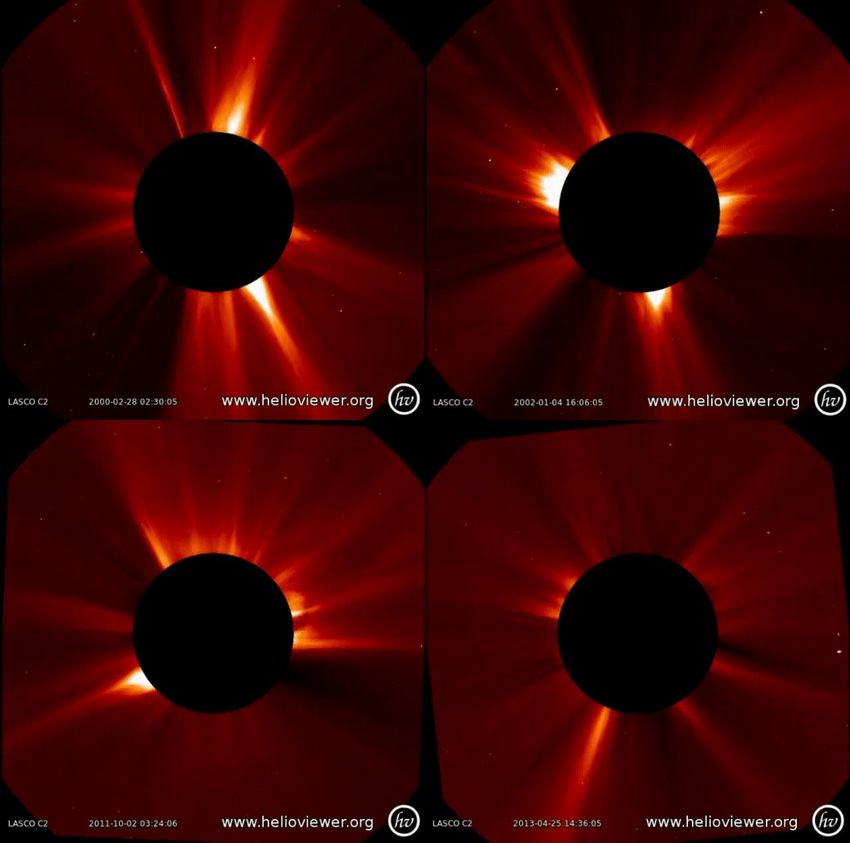
Overview of this Presentation
• The physics of star-planet interactions.
      -- CESSI – Star Planet Interaction Module (CESSI-SPIM)

• Modelling of the flux rope.
    -- Interplanetary coronal mass ejection and SPIM

• Results
     -- Temporal evolution of magnetosphere and magnetopause
     -- Virtual satellite observations
     -- Magnetospheric current systems
     -- Mass flows
     -- Helicity Injection

• Concluding remarks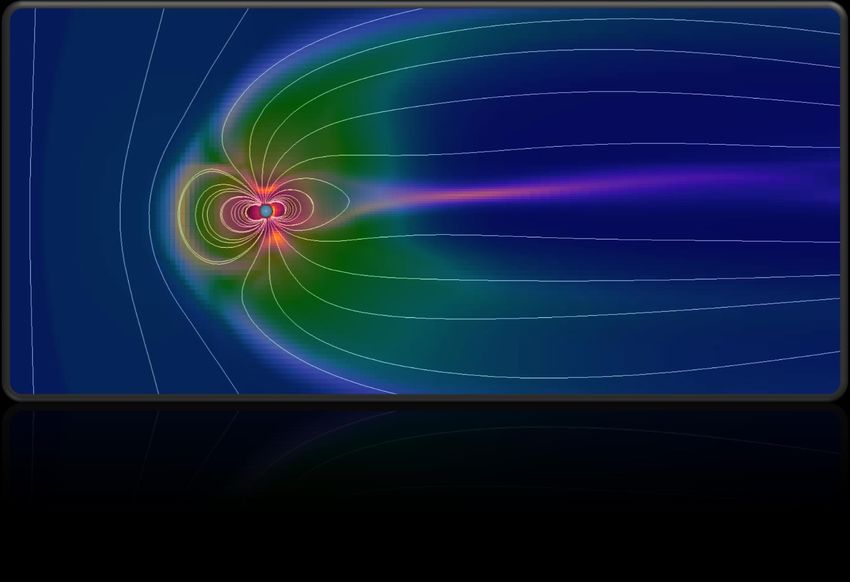
• Aurora formation [Liou et al. 1998]

• Space weather variations [Schwenn 2006; Pulkkinen 2007]

• Geomagnetic storms [Dal Lago et al. 2006]

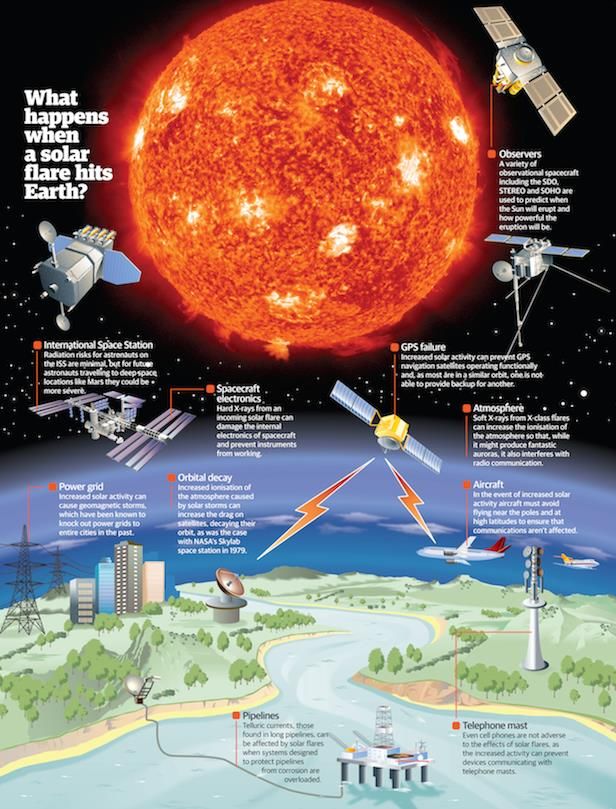
• Effects on satellites and space missions [Kumar 2014]   https://www.spaceanswers.com/news/effects-of-massive-solar-storm-to-
                                                          bombard-earth-through-to-saturday-predict-experts/
CESSI Star Planet Interaction Module
            The Physics: Astrophysical Magnetohydrodynamics

Assumptions:
•   “Far out” earth-like planet
•   Intrinsic dipolar planetary magnetic field
•   Stellar wind as magnetised shock             Simulated on PLUTO V4.3
•   Non-relativistic, compressible,
•   Adiabatic fluid: Gamma = 5/3
•   High Magnetic Reynolds number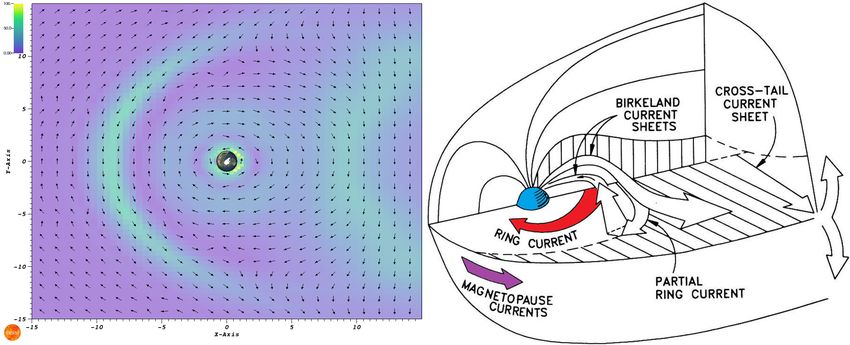
CESSI Star Planet Interaction Module

  •   Srijan Bharati Das et al 2019 ApJ 877 80
  •   Basak and Nandy 2021 MNARS 502 3

CME eruption events on (Left) 31/08/2012, (Middle-Top) 27/02/2000, (Right-Top) 04/01/2000, (Middle-Bottom)
02/10/2011, and (Right-Bottom) 25/04/2013. Data source: AIA304 (left), SOHO LASCO C2 (others). Image courtesy:
                                  Helioviewer. (https://www.helioviewer.org/)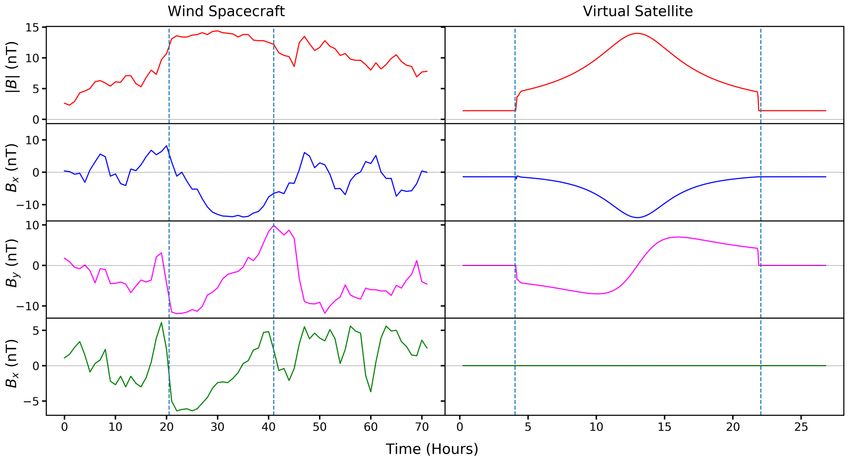
Modelling a Interplanetary Coronal Mass Ejection Associated
                         Flux Rope
                     • Cylindrical Gold-Hoyle (GH) flux rope with
                       no axial curvature

                     • Flux rope expansion is assumed negligible
                       during computation

                     • Flux rope central axis is normal to ecliptic
                       plane, core passes through Earth

                     • Initial magnetosphere is in a dynamical
                       steady state – computed by CESSI-SPIM

                     • At t = 0, shock wave crosses the left
                       boundary followed by the ICME.
Time Evolution of The Magnetosphere

Deformation of the Magnetosphere
Dynamic Pressure   Magnetic Pressure

Virtual Satellite Observation of the ICME
          A fixed point in space, measuring B with time

 L1                                                                              100
Point                                                                            REarth

                                            Data source: https://spdf.gsfc.nasa.gov/index.html
Mass Loss, Mass Gain Wind Box (REarth): 10 X 10 X 10
Ring Current and DST index

                                           Disturbance storm time (DST)
                                        index gives information about the
                                        strength of the ring current around
                                            Earth caused by Solar Wind
                                                      particles

Negative DST
Index

 Weaker
 Geomagnetic
 Field

   Higher Ring
   Current

                                      Data source: https://spdf.gsfc.nasa.gov/index.html
Helicity injection in Magnetotail
Concluding remarks
• In-situ observations support CESSI-SPIM results and make it a more important
  tool to probe and predict space weather conditions in future.

• Solar wind forcing leads to a steady and dynamic magnetosphere and ICME is
  a perturbation to the steady-state. The day-side magnetopause is pushed
  further towards the Earth by the Interplanetary Coronal Mass Ejection (ICME)

• Magnetic helicity of the flux rope distorts the shape of the magnetosphere and
  magnetotail current system. Current enhancement around Earth and
  magnetotail during the geo-storm.

• ICME comparatively enhances the in and outflow rate of mass around Earth.
  The mass-loss rate is comparatively high when the core is passing.

• In-situ DST index measurement correlates with current enhancement inside
  magnetopause. Flux ropes can inject helicity in the magnetotail.
You can also read


