MODULAR AND CONNECTED PRODUCTION
←
→
Page content transcription
If your browser does not render page correctly, please read the page content below

MAGAZINE
                                                                                                  2/2020

             SPOTLIGHT

             MODULAR
             AND CONNECTED
             PRODUCTION
                            Explore the paradigm shift
                            in the process industries
                            p. 8

C I R CU L A R ECO N O MY   T H E AC H E M A D I G I TA L H U B   T H E AC H E M A CO N G R ESS
Reuse, remanufacture,       Dive into digital                     Discover megatrends
recycle and more            theme worlds                          in the process industries
p. 4                        p. 19                                 p. 20
ACHEMA MAGAZINE // 2 / 2020 CONTENT
CONTENT
CIRCULAR ECONOMY FUTURE PRODUCTION:
MODULAR, CONNECTED AND SMART
Water Energy
CO₂
BI
O
LO
GI
C
CA
HE
LD
M
E
IC
CO
CO
AL
MPO
MB
RE
C YC
RE
UST
SITIO
CY
LING
ION
CLE
N
nergy Energy
REUSE
Small
RE molecule
MAN RE
UFACTU Anorganic
resources
EXT
E N D L I F E S PA N
Water Large
molecule
Material
4 8
Energy
TRENDS SPOTLIGHT THE SHOW
4 Circular economy 8 Future production 18 ACHEMA 2021 goes hybrid
Reuse, remanufacture, Modular, connected Enjoy the show on-site
recycle and more and smart and online
6 Get into the loop 12 Perfect process harmony 19 Diving into digital theme
And we need more than just Modular plants are as complex worlds
one to make the economy as a symphonic orchestra The Digital Hub at
sustainable ACHEMA 21 focuses on
17 Four questions to four trending topics
Nils Weber, Managing Director
INSTAGRAM
of NAMUR 20 Spotlight on...
@ACHEMAofficial
...the ACHEMA Congress and
TWITTER: its Highlight Sessions
@ACHEMAworldwide
LINKEDIN: 22 Join the race....
www.achema.de/linkedin ...to win the ACHEMA 2021
FACEBOOK: start-up award
www.achema.de/facebook
NEWSLETTER:
www.achema.de/subscribe
2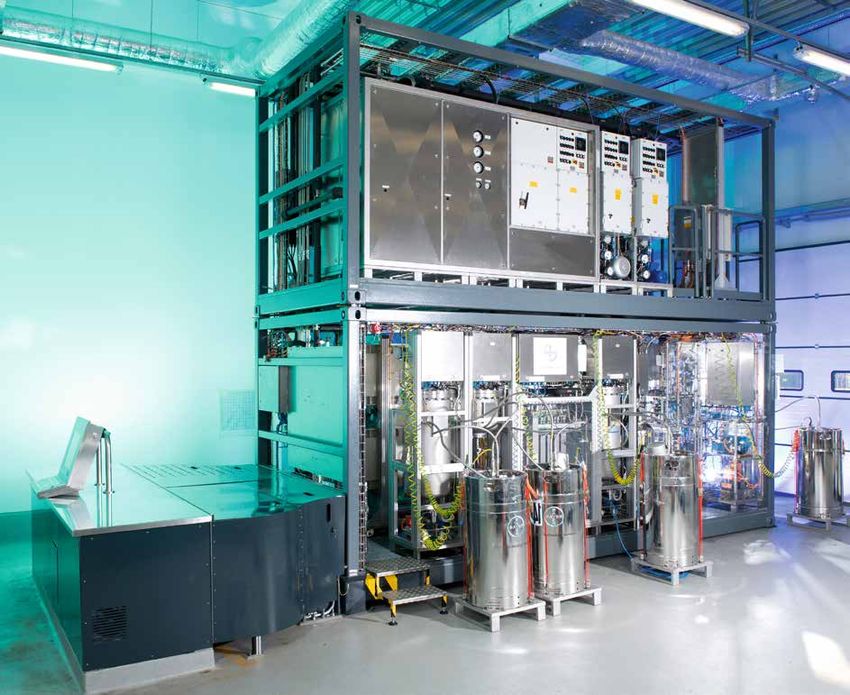
CONTENT ACHEMA MAGAZINE // 2 / 2020
EDITORIAL
SPOTLIGHT ON....
THE ACHEMA CONGRESS
Dear readers,
Keeping distance, washing hands fre-
quently, wearing a face mask – we have all
had to adopt a new lifestyle very quickly
that conforms to the COVID-19 pandemic.
Granted, it’s not much fun, but it works.
It works so well that we are sticking to the
date of ACHEMA 2021. We are convinced
that ACHEMA can be successfully held in
coronavirus mode – although we certainly
hope that we will already be in post-corona
virus mode come June next year. All over
20
the world, the trade show business has
restarted with no ill e
ffects. We have put a
lot of thought into our health and safety
concept to make ACHEMA as exciting and
inspiring as ever while keeping you safe.
Learn the details on page 18.
PEOPLE RESEARCH MEETS PRACTICE The process technology world will cer-
tainly take longer to change from monolith-
24 The American way of doing 26 Well advised with ic batch plants to modular and connected
ACHEMA artificial intelligence production. The paradigm shift required for
Memories of Alan Morris, AI supports plant operators this change is no less groundbreaking,
ACHEMA representative for in the process industry however. Designing a process in modules
the US and Canada takes an entirely different mindset.
28 A common good We are looking forward to meeting the
The trend to data sharing great minds pioneering modular production
and set the stage at ACHEMA 2021 with
30 Food for thought the corresponding focal topic. Join them,
What about the popcorn?
discuss with them, spar with them and
make inspiring sustainable connections.
31 Meet the community
32 Imprint
2 Content Yours,
3 Editorial
Marlene Etschmann
Editor-in-Chief
3
ACHEMA MAGAZINE // 2/2020 TRENDS
CIRCULAR ECONOMY Water
Recycling schemes are in place in many
countries, and for some materials such as
glass or paper they are widely accepted
and work well. But to achieve a true and
comprehensive “circular economy”, a lot
remains to be done – and soon.
Energy
REUSE
RE
MAN RE
UFACTU
EXT
E N D L I F E S PA N
Water Large
molecule
DIGITALISATION
Digitalisation and the circular Material
economy go hand in hand: Predictive
maintenance can lead to an extended
lifespan of equipment and plants –
the first step to keeping products
in the value chain for as long as
possible. Big data a pplications help
to find the most efficient pathways
for material and energy usage. Thus,
digital methods are key to unlocking
the full potential of circularity.
Energy
4
TRENDS ACHEMA MAGAZINE // 2/2020
Energy
ENERGY
CO₂ While matter can in principle be kept
in the cycle, the whole cycle depends
on energy as a driver. In order to make
the concept sustainable, this energy
cannot come from within the cycle,
i.e. not from gas or oil, but has to be
provided from the outside – mainly
BI by the sun. The required amounts
of energy add up to awe-inspiring
numbers. Energy efficiency therefore
O
remains a major goal for the process
LO
industry.
GI
C
CA
HE
LD
M
E CO
IC
CO
AL
MPO
MB
RE
C YC
RE
UST
SITIO
CY
LING
ION
CLE
N
Energy
Small
molecule
Anorganic
resources
WATER
No process industry without water -
whether as part of the product,
solvent, medium or cooling agent.
Water is part of every step in the
production cycle. As water resources
are valuable and scarce, closing
water cycles goes along with
closing material cycles. Similar to
the concept of a material-oriented
circular economy, water can be
circulated in one process, one plant
or over a whole industrial site.
5
ACHEMA MAGAZINE // 2/2020 TRENDS
GET INTO THE LOOP!
“Closing loops” might sound simple and like nothing new – is has been working for glass and
paper for decades. But thinking bigger calls for new concepts – and making loops smaller.
THE CIRCULAR
ECONOMY PLATFORM
AT ACHEMA 2021:
I
_ Sustainable chemistry
f strictly applied, the concept of a circular This is obvious for some metals or rare _ Industrial water
economy goes far beyond the handling earth elements, but limitations also apply _ Bioeconomy
of products or the recycling of materials. to other resources like carbon. We might _ Raw materials
It calls for a holistic view – the biggest feel that carbon is available in abundance, _ Energy and climate
conceivable loop is the one that is limited but we would rather limit the amount of car-
by planetary boundaries. Although this bon that resides as oxidized carbon in the are topics that move the ACHEMA
perspective might not be the best starting atmosphere. Thus, climate change does community across all industries.
point for applicable concepts, it provides not limit the amount of existing carbon, For the first time, there is now a
the most striking argument for why a circu- but it limits the amount of carbon we can dedicated stage, exhibition and net-
p.4–5: Illustration: MPM; Icons: Noun Project; p.6–7: BsWei / iStockphoto; Icons: Noun Project
lar economy is mandatory with regard to convert from oil, gas or biomass to CO₂. working area for all topics “circular”.
human survival: resources are limited. On a more regional scale, resources are Visit the Circular Innovation Zone in
Short of mining on extraterrestrial celestial even more limited, and this applies not Hall 6.2. to meet people, ideas and
bodies, we have to work with what is here. only to valuable metals or elements, but technology and to make inspiring
also to fresh water, which has also to be sustainable connections.
considered when speaking about closing
loops. — ACHEMA.DE/CIRCULARINNOVATION
MARK YOUR Reusing what has already been collect-
ed instead of letting it dissipate is not only
CALENDAR necessary due to environmental and sus-
16 JUNE 2021: tainability concerns, but also economically been used and reprocessing it to something
viable: The available primary sources re- new without any loss of quality or value.
ACHEMA Highlight Session quire ever more effort because they are not This sounds simple, but the decision
Closing the loop with chemical easily accessible or contain low amounts about which path to follow requires the
recycling: potentials and challenges of the desired materials. Exploration and consideration of many factors. A thorough
processing thus become ever more costly. holistic life cycle analysis can indicate
_ Prof Alexander Van Herk, Closing loops and implementing a whether closing a loop really is economi-
Agency for Science, Technology circular economy is thus not only at the top cally and ecologically feasible and should
and Research (A*STAR) of the agenda for national governments, always be the first step when thinking
the EU and the UN, but also of high interest about where to close the loop. •
_ Dr Andreas Kicherer, Director to companies who want to ensure a sustain-
Sustainability Strategy, BASF able supply of resources for their plants.
— KATHRIN RÜBBERDT
All there is to do is collecting what has kathrin.ruebberdt@dechema.de
6
TRENDS ACHEMA MAGAZINE // 2/2020
WHERE TO CLOSE?
What sounds simple is in fact a multi-layered concept: Loops can be closed at different
stages, leading to a concentric scheme rather than one big cycle. As a rule of thumb,
the smaller the circle, the less effort and resources are required to retain the value.
Repair / refit / remanufacture: Looking from the product perspective, these are
the smallest loops. A piece of equipment can be repaired or updated so that it can
be used even in a changing processing environment. One example for this is to fit
an “analogue” compressor or mixer with data retrieval components in order to
make it “smart” and usable in a more digital environment. This is a very important
point for refitting brownfield plants. Another possibility would be to reassemble
the modules of a pump to meet new requirements rather than buying a whole new
pump.
Recycling: If a product or piece of equipment has reached the end of its lifespan,
the next opportunity to close a loop is recycling. This means that the product is
broken down into its components or, more drastically, the material is melted down
or otherwise reshaped without affecting its chemical composition. While this is a
well-established and proven process for glass, many metals and some other products,
the case of plastics highlights its limits. They arise from several challenges at
different points in the recycling system: Recycling requires sophisticated collec-
tion and sorting systems, demanding elaborate logistics. This becomes more
complicated the more varieties of a material are on the market or, even worse,
combined in a composite material. While glass bottles differ mainly by colour,
“plastic” can consist of a plethora of different materials that need to be correctly
sorted to allow for recycling without loss of quality. Every impurity can cause
problems in the process.
Chemical recycling: One work-around for this is chemical recycling. This process
which is currently much discussed with regard to the use of bio-based waste
streams and plastics relies on breaking down the material chemically, resulting in
small molecules such as monomers, oils and syngas. The range of waste streams
that can be processed is wide and reaches from used cooking oils to polymers.
They are broken down by pyrolysis, for example. The steps that follow are very
similar to the processing of natural gas or fossil oil – a big advantage because it
can be integrated into existing production landscapes. The downside is that this
cycle is rather wide and contains many steps, each requiring resources and
especially energy, first for breaking down, then for rebuilding the material.
Combustion: While CO₂ resulting from “thermal recycling” is also a small carbon
molecule, it is much more difficult to convert back into materials. Thus, combustion
should be restricted to waste streams that can not be recycled otherwise. Biology
offers one way for CO₂ usage by photosynthesis; another way is CO₂ capture and
usage, which mainly relies on renewable hydrogen and sophisticated catalytic
processes. The cycle is even wider than chemical recycling, and the energy demand
especially is much higher.
7
ACHEMA MAGAZINE   //   2/2020   SPOTLIGHT

FUTURE
PRODUCTION –
MODULAR,
CONNECTED
AND SMART

8

SPOTLIGHT                                                          ACHEMA MAGAZINE   //   2/2020

Making chemicals and pharmaceuticals at an industrial scale
takes a lot of everything – raw materials, water, time and
energy in the form of electricity, oil or gas. Industry has been
working hard for decades to reduce its use of resources.
Modular production is the Swiss-army-knife technology to
accelerate this even further and make chemical production
more sustainable.

                                                                                              9
ACHEMA MAGAZINE // 2/2020 SPOTLIGHT
FAST, FLEXIBLE, FEASIBLE
The speciality chemicals market demands ever-more adapted products. Processes need to
be developed quickly, and production facilities designed as flexibly as possible. At the same
time, they should consume minimal energy and raw materials to keep the CO₂ footprint light.
One a
pproach to meet all these objectives is modular production.
p.10: Photo: Invite GmbH, p.11: Photo: Dr Alexander Möller; p. 8–17: Illustration: MPM Material from fullvector, Comauthor, elenabsl, MicroOne, AKrasov, macrovector / Adobe Stock
T
wo essential aspects play together (SCADA) system. The control of the indi c ontrol system to achieve a uniform look
in modularisation. The process vidual components of the module is and feel. For this to work, standardised
equipment must be subdivided into encapsulated in the service supplied by data exchange formats are required, such
modules, and the automation technology the module builder. as the XML-based DEXPI format for describ-
needs a modular structure. In combination, ing the module structure.
this results in a paradigm shift in process THE CONDUCTOR FOR THE MODULAR
development away from unit-operation- PROCESS PLANT HOW TO GET THE PROCESS DATA?
based engineering to services provided The Process Orchestration Layer coordi- Since the process steps are encapsulated
by modules. Instead of individually inte- nates the interaction of the individual in the services of the modules, the question
grating the feed valves, the temperature modules and integrates the modules into of how the process data can be made avail-
control unit, the stirrer and the required the overall plant. In this way, new modules able for other Industry 4.0 applications
sensor technology into the automation of a can be quickly integrated into an existing arises, for example advanced analytics.
stirred tank, there is a kind of printer driver plant, as only one element needs to be The answer is NAMUR Open Architecture
for the module, the Module Type Package added in the automation system. Even the (NOA), which makes this data available
(MTP). The MTP interface provides the integration into the user interface is via a second channel without affecting
“mixing” service, which receives the para simplified by the MTP, as the elements to process control.
meters of the mixing process from the be displayed are included. The design
Supervisory Control and Data Acquisition of the visualisation is specified by the FLEXIBILITY THROUGH STANDARD
MODULES – HOW TO TO FIND THE RIGHT
MODULE
By using standard modules, more flexible
production is possible. The modules can
be combined to suit the respective process
and can be quickly integrated into the
automation through the interface. In the
planning phase, the requirements are for-
mulated and suitable modules are identified
in a module database. This database can
consist of the existing module park, but
may also contain modules available from
suppliers. Even if not all the required pro-
cess steps can be mapped using existing
modules, a partially modular structure
can still save a considerable amount of
time in plant planning, construction and
automation and thus shorten the time to
market. The repeated use of equipment
also offers significant cost advantages.
MODULES IN PROCESS DEVELOPMENT –
BATCH TO CONTINUOUS
If standard modules are used, correspond-
ingly smaller and scalable continuously
_ World’s first pilot plant composed of interoperable modules. operated equipment can be used in pro-
10SPOTLIGHT ACHEMA MAGAZINE // 2/2020
On the automation level, it is much more DR ALEXANDER MÖLLER
complex to define possible services for the
MTP than to program a basic operation
once. However, the services are provided
Dr Alexander Möller
by module suppliers. They can reuse the coordinates projects at
programming service for similar modules, DECHEMA on modular
which relativises the cost on their side. production, artificial
Nevertheless, there is a shift of the intelligence and
digitalisation in the
programming effort from the operator
process industry.
to the supplier.
cess development. Continuous processes THE LEAP INTO COMPREHENSIVE — D R ALEXANDER MÖLLER, DECHEMA e. V.
alexander.moeller@dechema.de
are usually much more efficient than batch APPLICATION
processes. A pilot phase is necessary to A large number of suppliers already offer — ENPRO-INITIATIVE.DE/ENPRO/EN/
transfer batch results from the laboratory equipment with MTP. The major automation
to a continuous process. It is costly and is, suppliers have also integrated MTP func-
therefore, often avoided resulting in pro- tionality into their systems, and pilot
duction processes being run in inefficient projects at users’ sites have been imple-
batch modes. With the use of continuously mented. From these initial approaches,
operated laboratory equipment, this pilot it is now necessary to shape modular
phase can be significantly reduced or even production for the future. •
completely eliminated.
COSTS OF MODULAR SYSTEMS –
A STRATEGIC DECISION
With modular systems, processes can be
developed more quickly, and the use
of continuous apparatus ensures high effi-
ciency. This results in a noticeable cost
advantage – but only over the service life
of the equipment; the initial investment
costs are higher than with conventional
plant design. If the modules are to be reused,
they cannot be designed for specific para
meters, but must cover a larger parameter
space. These costs are amortized by multi-
ple use of the modules, and the design
can be reused as well. Investment costs,
however, are credited to the current project
and not to optional processes that may
be possible in the future. This requires a
strategic decision for the concept of the
modular plants to enable the implementa-
tion independent of individual projects.
Over time, further cost advantages will
also arise because if a module park is
gradually built, the production site will
become more flexible.
11ACHEMA MAGAZINE // 2/2020 SPOTLIGHT
MODULAR PRODUCTION:
PERFECT PROCESS HARMONY
Smaller batches, individual products – the chemical industry has to adapt to the wishes
of its customers. It does so by making its production plants more flexible and modular.
T
he chemical industry is one of the and preparing it for the next product costs and automation engineers are working to
economic sectors in Germany that both time and money. agree on standards, methods, models and
consume the most energy. Basic Both could be saved if the production procedures. A modular plant can be oper-
chemicals such as hydrochloric acid are plants were modular in design. To move ated efficiently only if the modular units
already being produced in a very energy- around and exchange plant components are intelligently interconnected, coordinated,
efficient way because large-scale plants as required, just like children do with their controlled and regulated – just as a
are operated continuously. However, of- colourful plastic building blocks, is the symphony can sound perfect only if all the
ten only a few tons of fine chemicals and dream of all engineers. musicians in the orchestra arrive to the
active pharmaceutical ingredients are concert on time and play the right notes at
needed per year. They are therefore pro- CONNECTION, COORDINATION, CONTROL the right time. Both are highly complex
duced in multi-product plants in batch Unfortunately, the reality of the process processes, and that is why engineers have
operation. Shutting down such a plant industry is not quite as simple as a nursery. borrowed a term from music for their own:
after production, cleaning it thoroughly Plant operators, module manufacturers orchestration. •
12SPOTLIGHT ACHEMA MAGAZINE // 2/2020
SETTING THE BEAT IN PROCESS
AUTOMATION
F
or engineers, orchestration much more modular and flexible to
ANDREAS STUTZ
means the systematic methodol- provide plant operators with exactly the
ogy for combining individual pro- functions they need to orchestrate their
cess equipment assemblies and their modular plant, concentrated within one
services to create a production specifi- single workbench. First concepts in Andreas Stutz is a
research engineer
cation that can be run and executed. products will be shown at ACHEMA
at Siemens AG in
In an industrial plant, orchestration is 2021! Karlsruhe and
done by what is known as the Process Flexible production is, with respect, co-author of the
Orchestration Layer. Depending on the still a long way off. Flexible production standard of the
application, orchestration can be carried systems require a degree of adaptability Module Type Package
concept.
out using various methods. Common to that will be achieved more and more in
all is that they use the Module Type the future. On the way there, Siemens is — ANDREAS STUTZ (M. SC.), SIEMENS
Package concept. This defines the com- actively participating in the standardisa-
— andreas.stutz@siemens.com
mon language used by the Process tion work with countless partners. In ad-
Orchestration Layer and process equip- dition, Siemens supports its customers
ment assemblies. In music, these are in the introduction and implementation
the notes. The Process Orchestration of the standard in its overall portfolio for
Layer sets the beat for the individual original equipment manufacturers and
equipment assemblies. It retrieves the plant operators. With COMOS, SIMATIC
functionalities currently required in the TIA Portal and the S7-1500, as well
individual process equipment assem- as SIMIT, we offer an integral solution
blies at the right time. In the Module Type
Package, these are referred to as services,
for planning, engineering and testing
modular process units.
“The Process
which are started, parameterised, With COMOS, the new web-based Orchestration Layer
paused and stopped by the Process SIMATIC PCS neo or SIMATIC eBR or Op-
Orchestration Layer. Center Execution for pharmaceuticals/ sets the beat
THE FUTURE IS MODULAR
chemicals, we also offer a wide range of
options for implementing the Process
for the individual
The requirements and functions of Orchestration Layer. In summary, we equipment
p.13: Photo: Andreas Stutz
the Process Orchestration Layer vary offer products and services over the
depending on the industry and applica- entire life cycle for process equipment assemblies.”
tion. Therefore, future systems of the assemblies and modular plants.
Process Orchestration Layer will be
13ACHEMA MAGAZINE // 2/2020 SPOTLIGHT
PLUG-AND-PLAY FLOW
MEASUREMENT THANKS TO MTP
T RALF HAUT
he water meter in your basement package conforming to VDI/VDE/NAMUR
is a rather simple example of a guideline 2658. The MTP semantically
flow meter; in the process industry, captures, models and communicates the
these need to conform to significantly system’s properties and capabilities.
Ralf Haut is the Technical
higher demands. They can cope with The Semodia MTP control engine can be Manager in the KROHNE
liquefied gas at –200 °C as well as with used on any field device. This means Group’s Global Chemi-
2000 litres per hour of viscous tomato that an OPTIMASS 6400 as a module is cal Industry Division.
paste and are also fully digitalised. In now able to provide the Human Machine He holds a degree as
process engineer and
addition to the classic 4.20 mA/HART Interface and certain services via the
worked in a number of
signal, they also communicate via manufacturer-independent Module Type roles for companies including
common protocols such as Modbus, Package. The effort of signal-based Bayer, Siemens and Honeywell.
Foundation Fieldbus, Profibus as well integration is eliminated; instead, the
as Profinet and even Bluetooth. module can now be integrated quickly
Until now, there was no manufacturer- and efficiently and play its part in the
independent standard for the integration
of modules; hence flow meters had
plant orchestra.
The joint contribution of KROHNE and
“The module can
now be integrated
p.14: Photos: Krohne Messtechnik, Ralf Haut
to be manually integrated into the IT Semodia significantly increases both the
quickly and effi-
environment of the respective plant. In efficiency of modular process plants at
some cases, this involves a great deal all levels of their architecture and the
of effort, which is why KROHNE engineers
are now cooperating with the company
overall resource efficiency in the process
industry.
ciently and play its
Semodia. Semodia’s MTP control engine part in the plant
orchestra.”
encapsulates the intelligence of the
Coriolis OPTIMASS 6400 mass flow
— RALF HAUT, KROHNE MESSTECHNIK
meter and describes it in a module type r.haut@krohne.com
_ The OPTIMASS 6400 mass flow meter is
ready to be integrated into modular plants.
14SPOTLIGHT ACHEMA MAGAZINE // 2/2020
MODULAR PRODUCTION: FROM
SHOW FLOOR TO SHOP FLOOR
A
leather cloth for cleaning the Hehlen in Lower Saxony, Germany. There, comparable quantity of liquid retanning
inside of a saxophone needs to the process has been tested under real- agent. The waste is fully recycled, leaving
be smooth and supple, while life production conditions and devel- no residues and generating no emissions.
the leather for a cello case must be sturdy oped to market readiness. To bring the This approach also eliminates any of
and waterproof. Transforming rawhide container-sized production modules to the costs involved in transporting the
into leather bespoke for a particular commercial scale, LANXESS has now materials to recycling companies or for
application takes a lot of high-tech joined forces with the Swiss Hüni AG for disposal.
chemistry in the tannery. At ACHEMA their expertise in plant engineering and LANXESS has been producing leather
2018, the model of a pilot facility for construction of the modules; LANXESS chemicals for over 100 years. Hüni AG
manufacturing leather chemicals was will contribute its chemical process designs and manufactures drums and
presented as part of the special exhibi- engineering and application expertise. process automation systems for the
tion “Process INDUSTRY 4.0: The Age In the modular process, shavings from leather tanning and processing indus-
of Modular Production”. Now the plant leather production will be recycled in the tries. The pilot plant was sponsored by
is going to market. tannery directly on-site used to produce the German Federal Ministry of Education
The pilot plant for in-situ production retanning agents in a fully automated and Research (BMBF) as part of the
of a retanning agent had been run since manner. At a medium-sized tannery, there ReeL research project (resource-efficient
November 2017 by LANXESS at, and are around one to two tonnes of shavings manufacture of leather chemicals).
together with, the Heller Leder tannery in per day. These can be used to produce a
15ACHEMA MAGAZINE // 2/2020 SPOTLIGHT
FACTS AND FIGURES
MARKET POTENTIAL
CHEMICAL AND
FUEL AND POWER CONSUMPTION*
PHARMACEUTICAL FALLS 24% SINCE 1990
INDUSTRY Fuel and power consumption in the EU chemical* industry
Millions of tonnes of oil equivalent
2016 2030
212.80 280.79
Global investment
-24 %
(bn €)
0.2 3.5
Modular measurement and process automation equipment
(bn €)
Source: CEFIC Report, ZVEI estimates Source: CEFIC facts&figures 2020
TOTAL ENERGY CONSUMPTION* IN THE EU
p.16: Illustration: NikWB, davooda, Artco / Adobe Stock; p.17: Photo: Nils Weber
CHEMICAL INDUSTRY BY SOURCE
52.7 million tonnes of oil equivalent (2017)
2x
36 %
Gas
0.6 %
30 % Solid fossil fuels
Electricity 0.1 %
Renewables and biofuels
14 %
Oil and petrolium products* 0.1 %
Non-renewable waste
Renewable and biofuels energies
consumption* in the EU chemical industry 13 %
more than doubled since 2000. Heat
Source: CEFIC facts&figures 2020 * Chemicals including pharmaceuticals Source: CEFIC facts&figures 2020
16SPOTLIGHT ACHEMA MAGAZINE // 2/2020
4 QUESTIONS TO
Nils Weber
Managing Director of NAMUR – User Association
of Automation Technology in Process Industries
How did modularisation start?
_ WEBER: The first major initiative in When will I be able to approach a manufac-
Germany/Europe was the F3 Factory project – turer and order a modular chemical plant?
lexible fast and future factory. The EU _ WEBER: This is a very good question –
funded the project for four years starting in maybe in ten or fifteen years? Both parties,
2009, and all the important global players manufacturers as well as users, need to
were already on board: Bayer, BASF, Evonik, be enthusiastic about new technologies.
Ehrfeld Mikrotechnik, Buss-SMS-Canzler Both sides need to have a common under-
and many more. standing of “we want to missing move this
The INVITE research company then built topic forward together”. Perhaps some
a technology centre as part of the project. people are still hesitating because certain
Small modular plants on a container scale standards are missing. Internationally valid
were developed – these were the very first standards are often drivers that manu
forerunners. The concepts are now further facturers wait for because only then do
advanced, and first industrial prototypes “Open standards they have a r easonable basis for their
for data transfer
are already available. This has led to the development.
concept of Module Type Package, which is I believe that a lot more needs to happen
now the focus of much attention.
are a key issue in in people’s minds. We should take the
IT industry as an example; It has shown a
What role does NAMUR play?
_ W E B E R : We have represented the
modularisation.” path forward on how openess can be a
benefit for all instead of thinking in silos. •
interests of the process industry in the field NILS WEBER
of automation technology since 1949. For
— QUESTIONS ASKED BY MARLENE ETSCHMANN
some years now, we have been working
together on the modularisation of automa- — NILS WEBER
nils.weber@bayer.com
tion with ZVEI, the VDMA trade association Forum (OPAF), but not in the sense of a
VtMA, BioPhorum and the ProcessNet module with defined interfaces, open — NAMUR.NET
initiative of DECHEMA and VDI. We are standards and interoperability. We are far
very eager to have open standards instead ahead of the field in Germany and Europe.
of proprietary interfaces as this is the The potential has been recognized here, ABOUT NILS WEBER
prerequisite for the user to combine and a large number of companies and
modules from different manufacturers. manufacturers are working on the topic –
many more than elsewhere. If you look at NILS WEBER has been Managing Director of
How is modularisation viewed outside different industrial sectors, biotechnology NAMUR since April 1, 2020. After training as
Europe? is way ahead in terms of modularisation. a chemical technician, he studied chemical
_ W E B E R : China and India are white engineering in Magdeburg with a focus on
Single-use units for fermentation and
instrumental analysis. During his time at
spots on the map, as far as I know. Some downstream processing can be purchased Bayer and INVITE, he was active in the field of
developments in the US have come to my ready-configured, but unfortunately not process analysis technology with increasing
attention, like the Open Process Automation with open interfaces. responsibility, most recently as Principal Expert.
17ACHEMA MAGAZINE // 2/2020 THE SHOW
ACHEMA 2021 GOES HYBRID
Experiencing technology hands-on and talking with experts in person are at the core of ACHEMA,
and will be in 2021, too. However, during the coronavirus pandemic, ACHEMA consistently relies on
a hybrid form: An unforgettable and safe trade-show experience on-site, including smart additions
with digital offers.
W
e have used the past few months and a sense of new beginning in the strict observance of extensive health &
to discuss and plan intensively process industry. One hundred years in, safety concepts does. Trade show halls –
with the industry about the ACHEMA is, therefore, more important than especially those in Frankfurt – belong
changing conditions. One thing is clear: ever and is one of the cornerstones to get to the safest indoor places during this
Our society has a fundamental need to the business of our community going again. pandemic. The air volume within the halls
connect, and the desire for personal meet- For this, we are ready to welcome you in is large and is constantly exchanged with
ings has been significantly strengthened Frankfurt: Germany has opened its doors to fresh air. Wider hall aisles, an overall looser
by social distancing. Many issues can be all trade show attendees from abroad even stand allocation as well as professional
solved digitally, but nothing replaces in times of COVID-19. Trade show attendees crowd management provide plenty of
personal meetings and exchanges on-site. from all over the world can easily enter space to hold your business discussions
Germany, as they are considered business risk free. Contact surfaces and sanitary
A UNIQUE OPPORTUNITY travellers with an urgent need to travel. facilities are disinfected regularly and
For us, as organizers, it is a pleasure and All ACHEMA attendees from countries intensively, and we provide hand sanitizer
an honour to serve our communities; to outside of the EU must provide just simple stations all over the fairgrounds. Contact-
help them explore, advance and share best proof of their participation in the trade less access control, electronic tickets,
practices and new ideas across sector show when applying for a visa or when and contactless payment methods contrib-
boundaries, nations and continents and entering Germany. ute to the protection of ACHEMA exhibitors
boost their business. Particularly in these and visitors. Attendee data is personalized
times, it is our obligation to signal that SAFE AND HEALTHY ON SITE to allow for contact tracing, if necessary.
things are starting up again. ACHEMA offers We now see that strict travel restrictions
unique opportunities to spread confidence are not containing SARS-CoV-2, but the INFORMED AND INSPIRED FROM REMOTE
Independent of current developments,
we have our community covered with a
STREAMING LIVE range of hybrid offerings. Many of the
AND ON DEMAND
WORLDWIDE talks will be streamed live and on demand,
NETWORKING increasing the reach and extending the life
of the unique ACHEMA program content;
digital showrooms will expand the ACHEMA
exhibition presence with comprehensive
HEALTH AND
multimedia, contact and interaction
SAFETY MEASURES
formats; and the new matchmaking will
offer extended lead-generation potential,
OPEN pre-qualified contacts, tailor-made recom-
BORDERS mendations and measurable interactions –
before, during and after ACHEMA.
ACHEMA as a hybrid event will continue
to be the world’s most important meeting
place for the process industry and beyond. •
TAILOR-MADE
MATCHMAKING
— DR BJÖRN MATHES
Bjoern.mathes@dechema.de
+49 69-7564-365
18THE SHOW ACHEMA MAGAZINE // 2/2020
DIVING INTO DIGITAL
THEME WORLDS
The Digital Hub premieres at ACHEMA 2021, and its unique concept focuses on
four trending themes in the digitalisation of the process industry
WHAT TO EXPECT AT THE ACCESS POINTS:
ENGINEERING & OPERATIONS: LOGISTICS & SUPPLY CHAIN:
As a cognitive amplifier, artificial intelligence Compared to discrete manufacturing and trans-
enables engineers and plant operators to gain portation, the logistics and supply chain in the
a deeper understanding of the process and chemical and pharmaceutical industries is
supports process optimisation. In addition, far more complex. The demands on the quality,
modular plant concepts offer the flexibility availability, safety and sustainability of
to react to a rapidly changing market products are high and constantly increasing.
environment. Digitalisation, new systems and intelligent
solutions are the natural consequence of
p.18: Illustration: aklionka / Adobe Stock; p. 19: Icons: Eucalyp, ProSymbols, Vectors Market, Creative Stall / Noun Project
meeting these challenges and optimising
and securing supply chains.
CYBER SECURITY: DATA INTEGRATION & MANAGEMENT
While the increasing interconnectivity within Digitalisation requires the use of machine-
and between companies has many advantages, readable data. Standards and exchange formats
the importance of cyber security is also rising. form the basis for data use in the process
It is essential to protect both internal IT and industry. The integration of sensors and a
OT against external access. Find out how cyber growing number of IIOT devices also require an
attacks on your company can be averted. open architecture. Learn how comprehensive
data integration and the management of large
amounts of data can work.
T
he ACHEMA Digital Hub will bring perations, cyber security, data integration
o that cross-link the entire digital solution
digital innovations in the process & management and logistics & supply portfolio on display at ACHEMA. Every
industry to the big stage. Being the chain management. exhibitor can hashtag their solutions to
12th exhibition group in the ACHEMA Imagine manufacturer-independent appear as an entry in the ACHEMA
line-up, it serves as open invitation to the overview exhibitions and additional stages catalogue and app. •
digital ecosystems catering to the chemical presented by DECHEMA in cooperation with
industry. In addition to exhibition space industry experts from leading organisations
and centre stage, four Access Points are to promote peer-to-peer learning and — ANDREAS KONERT
andreas.konert@dechema.de
the heart of the concept. They are dedicated networking. In addition, the theme worlds
to the current hot topics engineering & of the Access Points serve as hashtags — ACHEMA.DE/DIGITALHUB
19ACHEMA MAGAZINE // 2/2020 THE SHOW
SPOTLIGHT ON…
How do the game changers in the process industries affect your
business? Discover answers at the ACHEMA Congress.
W
hat are true game changers for essions. This brand-new format is
S
the process industries? It’s cer- designed to not only provide participants
tainly hard to judge in advance. with food for thought, but encourage
Many trends are not only caused by tech- discussions even more than “conven
nological developments, but also by tional” presentations: MEGATREND: CIRCULARITY
factors such as economic conditions – oil Outstanding international speakers Highlight session
prices, shifts in global economic power, a and seasoned practitioners present their Closing the loop with chemical
virus that freezes whole economies – or opposing poles of visions. The potential, recycling: Potentials and challenges
cultural changes – the consumer’s craving but also the barriers and downsides, of Running around in circles may not
for SUVs or “fast fashion”. But there are novel technologies are exposed and be the best way to move forward,
some scientific and technological devel- stimulate discussion between speakers but it is highly desirable when dealing
opments that have the potential to and the audience. The highly interactive with plastics, i.e. carbon-based
significantly change the way the process and compact format ensures that a multi- polymers. Closing the loop solves
industry works. tude of aspects can be discussed. Every two problems at once: The depen
The ACHEMA Congress sets the spotlight ACHEMA participant should mark these dency on fossil resources is reduced,
on four of these trends in its Highlight sessions in their calendar! • and plastic waste no longer litters
the environment, but is treated as
a valuable raw material. So far,
however, plastics recycling has been
limited by purity and quality specifi-
Photos: Paulista, Irina, lassedesignen, Thomas / Adobe Stock; Icons: mynamepong, lastspark / Noun Project
cations that in turn have required
sophisticated collection and sorting
systems. Chemical recycling seems
to offer a way out, especially for
MEGATREND: BIOLOGISATION plastics that cannot be directly recy-
Highlight session cled due to their purity: instead of
Recruiting cells for chemical burning the plastics and thus using
production: Novel biological the energy they contain, the material
production systems is broken down radically into its
Companies like Genomatica are most basic components, monomers,
revolutionising the way chemicals or even further into synthesis gas.
are produced. Supported by advanced These can again be the building
analytics and high-throughput blocks for new high-quality products.
research and development pro Is this the “missing link” to close
cesses, they are true biological the cycle?
mega-factories, creating a steady
stream of novel biological production
systems. With an increasing
knowledge about the workings of
metabolism and enzymes, there
seems to be no limit to what can
achieved – or is there?
20THE SHOW ACHEMA MAGAZINE // 2/2020
MEGATREND: RENEWABLE ENERGY
Highlight session
Hydrogen as a game changer within
process industries
Gold rush, oil rush, hydrogen rush?
After the enthusiasm of the the ’80s,
the hydrogen buzz seemed to have
died down – only to experience a BEYOND LECTURES:
stunning revival in recent years.
With the increasing supply of renew-
ACHEMA ACTIVITIES
able energy and the urgent need to
bring down CO₂ emissions, hydro-
gen presents itself as the natural
link for sector coupling and the ideal
reagent for chemical production. In
principle, we are set for a green and
clean future – if we solve a couple of
challenges such as the scale-up of
electrolysers or the logistics needed ACHEMA INNOVATION CHALLENGE
for a “hydrogen economy”. Digitalisation offers new perspec-
tives and approaches to mastering
the challenges in process engineer-
ing. Experience at ACHEMA how
ideas b ecome innovations. In an
innovative competition, we want to
find solutions for current and future
problems. Be inspired by creative
and new solutions for the process
industry that emerge from the
field of digitalisation.
MEGATREND: DIGITALISATION
Highlight session BATTLE OF THE BEST:
Artificial intelligence – Data What are the best concepts and
utilization for advanced processes solutions for specific industry
and product development challenges? In this new competition,
There is no shortage of data in the solution providers have the opportu-
process industries, but how can this nity to pitch their best solutions and
treasure grove be exploited? Artifi- products for a selected challenge.
cial intelligence is able to process Be part of the jury at ACHEMA
tremendous amounts of data and and vote live to decide who will be
draw conclusions much faster than awarded in this competition.
any engineer could do. Recognising
patterns, drawing deductions, mak- Watch out for more information on
ing predictions – can AI replace the these and other interactive formats
human brain? Or is intelligence in the run-up to ACHEMA and during
more than a machine can ever learn? the show at achema.de!
21ACHEMA MAGAZINE // 2/2020 THE SHOW
JOIN THE RACE
Founding a company is a marathon, not a sprint. And somewhere along the way, a supply
station might be a welcome sight – such as the ACHEMA Start-up Award.
T
he starter’s gun for the ACHEMA to the competition. All will receive expert
Start-up Award went off in 2015:
Three winners (at the time from
feedback; the best will be invited to pitch
to the jury in early 2021. Up to 10 prospec-
YOUR COMPANY –
three different categories) went on the tive founders or young entrepreneurs have JOIN THE RACE!
track towards entrepreneurial success. The the chance to exhibit at ACHEMA 2021,
next three winners joined them in the race where “the best of the best”, the top three, Submit your business plan
in 2018. The track record is impressive: will be announced as the winners of by 30 November
Five are still on a growth path, and the the ACHEMA Start-up Award 2021. • at achema.de/start-up_award
series of awards and distinctions they
share between them exceeds the space
available here. Four of them have announced
— KATHRIN RÜBBERDT
significant investment over the past years kathrin.ruebberdt@dechema.de
of seed-financing organisations and/or
corporate investors.
Now it’s your turn to go to the starting
block: Until 30 November, founders and
young start-ups from Germany and beyond
are invited to submit their business plan
2020:
EUR 3.4 mn
investment
by corporate
investors
“We make
the energy
transition “Efficiency
work” is the “Wherever
benchmark” ions flow”
Illustration: mapichai / Adobe Stock
VO LT E R I O N
WAT T T R O N
IONERA
T EC H N O LO G I ES
22THE SHOW ACHEMA MAGAZINE // 2/2020
2017:
Red Herring
Top 100
2018:
EIT Climate-KIC
European
Cleantech Top 30 2018:
Deutscher
Rohstoffeffizienz-
Preis
2019:
Major investment
by Boysen Abgas-
technik
2020: 2019: 2019:
Deutscher Handelsblatt: 7digit seed
Innovationspreis Future Engineering financing by
für Klima und Award HTGF & partners
Umwelt
2020:
Investment
by BayBG &
partners 2020:
Extension of
product range:
Vitalising mask
spray with mint and
lemon scents
“Chemical
Sensing “Flavor-on-
Technology” Demand”
PLASMION
4GENE
23ACHEMA MAGAZINE // 2/2020 PEOPLE
PORTRAIT
THE AMERICAN WAY OF DOING
ACHEMA
Alan Morris has been the first point of contact for customers from the US and Canada for 22 years
and shares his experience.
Your history with ACHEMA reaches back Engineering Magazine at McGraw-Hill. Can you remember the first time entering
over more than three decades. How long We had a lot of European advertisers, many the exhibition halls?
exactly? of whom exhibited at the ACHEMA. So the _ I remember that I was amazed at the
_ A L A N M O R R I S : My first contact with ACHEMA was very useful: we could see size of things and feeling absolutely
ACHEMA was actually as an exhibitor in them all in one place. In 1998, I became a dwarfed by the tall ceiling of hall 8 and the
1988. At the time, I was publisher of Chemical representative and have been for 22 years. multi-story, spaceship-style displays. It
Photos: Alan Morris
24PEOPLE ACHEMA MAGAZINE // 2/2020
was quite an eye opener, a real spectacle of discussion, but it’s another thing to see Please complete the following sentences:
equipment displays. that same technology at work in the exhibi- 1) If I wasn’t the representative
tion. The Congress also draws a core of for ACHEMA, I would like to be ...
What is different from ACHEMA today from technology people from the companies that Elon Musk – just kidding, but I like his
when you think back two or three decades? then get exposure to the equipment and to entrepreneurial spirit and super intelligence.
What has changed? the vendors in the in the exhibition. I’ve been so lucky to be the representative
_ ACHEMA has definitely become more That’s another difference between shows for the ACHEMA and to have my own
modern with the information flow. I remem- in the US and Europe: In the US, we have business after working in the corporate
ber the heavy printed hardcover catalogues: only just begun to develop more of an world for several decades.
several volumes, each weighing more educational bend to these events. In the
than a kilo. What a relief when they were past, we depended too much on the trade 2) A first-time visitor to ACHEMA should
replaced by electronic media in 1997! show to attract a technical audience take care to ...
Of course, the equipment has changed, when it could have been done much better _ wear really comfortable shoes! The first
too. Things have gotten so much more with a robust set of sessions. time I went to the ACHEMA back in the
digital, and they are really progressing 80s as an exhibitor, I had fancy Italian
along the lines of automation and environ- How do you explain ACHEMA to a thin-soled shoes, and I had to buy a new
mental concerns. prospective customer who has never pair after two days. Most of the floors
heard of it? - are carpeted, but you are on concrete a
You just said the equipment has become _ I try to convey the excitement of the lot nonetheless.
more digital. So has the whole world of ACHEMA and the enormity of it. Then I The other thing I tell people: don’t come
communication. Why do we still need a explain how many birds they can kill with alone! It’s a long day being in the halls
place where we can touch the equipment – just one stone. Maybe you’re looking for a from 9:00 in the morning till 6:00 at night,
can’t we just do it over the internet? new representative in a part of the world seeing people, talking to people, on your
_ I suppose we’re trying to be more that’s new to you. Maybe you’ve sold in the feet all the time. Bring some help and
digital, especially in times of COVID-19, US for many years and now you’re looking share that responsibility.
but I think there’s great value in physical to export. You’re going to not only see
presence. What better way to learn than to customers, but also your competition. That’s 3) I am looking forward to ACHEMA 2021
actually see and experience the equipment a big change for Americans who don’t want because ...
and the technology? At ACHEMA, so much to exhibit near their competition. They _ the 2021 show is my last ACHEMA. I am
of the equipment is operating live, and you usually get over it quickly and learn that if sad, but excited, too, because I look for-
get to see the whirring action, the filling, you’re not there, you’re sort of conspicuous ward to seeing my friends, my customers
mixing, blending and packaging. That’s in your absence. and my fellow representatives the last time
not possible over the internet. in a while.
What challenges have you encountered
Trade shows in the US are supposedly over the last two decades in your role as
— MARLENE ETSCHMANN
quite different. How would you explain ACHEMA representative for the US and marlene.etschmann@dechema.de
the ACHEMA to someone from North Canada?
America? _ With the COVID-19 pandemic, this year
_ It is hard to convey the enormity of is a difficult time, and I hope it will be
ACHEMA. The shows in the United States resolved by summer 2021. ACHEMA and
have downsized pretty much because our DECHEMA always do the best job of prepar-
industrial bases have somewhat diminished ing for infectious diseases – I remember
in the last 20 years. Along with that, a lot SARS 2003 and the swine flu 2012.
ALAN MORRIS
of people who used to go to shows have Apart from these awful things, I witnessed
been downsized. So, the ACHEMA is a place a change in the American way of doing
where you have a lot more buyers, all in one business. We have been content to sell Alan Morris has a B.A. in Jour-
place and from all over the world, whereas domestically for a long time because we nalism from the University
of South Carolina and has
in the US the shows are a lot smaller. had robust domestic m arkets and enough
served in several industry
buyers. This changed about 20 or 30 years association positions.
How do you feel about the Congress? It is ago, when Americans became exporters During his time as pub-
seen as an important part of ACHEMA. by necessity. Competition got fierce when lisher of Chemical
_ I’m a big believer in this idea of the our markets downsized and the world came Engineering magazine, he
launched the ACHEMA Show Daily newspaper,
two being married, it makes for a great to us. The challenge is g etting people to
which continues today. With his company
learning experience. It’s one thing to hear think outside of our borders, think about Morris Marketing, he has represented ACHEMA
about something in a session or a panel an international show for the first time. in the US and Canada since 1998.
25ACHEMA MAGAZINE // 2/2020 RESEARCH MEETS PRACTICE
WELL ADVISED WITH
ARTIFICIAL INTELLIGENCE
Can plant operators, engineers and process developers of
chemical production plants be supported by self-learning
systems? Within the research project KEEN, various AI-based
applications for the process industry are developed.
P
lanning and operating chemical AI-based modelling. Among other things,
and biotechnological processes is the use of machine learning, which is a
becoming increasingly complex. subtopic of artificial intelligence, will be
Humans need support for their decision investigated. The functionality of machine
making, and they get it with a system based learning is in principle comparable to
on artificial intelligence (AI). Currently, AI human learning. Humans use examples
methods are implemented in the process from their experience to differentiate and
industry within the project KEEN – “Artificial cope with complex requirements. A self-
Intelligence Incubator Laboratories in the learning machine learns from data and can
Process Industry”. The project is funded by make decisions and predictions based
the German Federal Ministry for Economic on this data. These predictions can support
Affairs and Energy; it connects 20 industrial the plant operator, the engineer as well
and scientific institutions and is divided as the process developer in their activities.
into three thematic areas: AI-based optimi- Artificial intelligence acts as a cognitive
zation, AI-based engineering of plants and amplifier.
OPERATING PLANTS SAFER AND MORE
EFFICIENTLY
A concrete application in the process in-
dustry is to support operating personnel of
chemical plants with AI-based control and
assistance systems. These are developed
“Artificial by technical universities (TU) in Dresden,
Dortmund and Berlin, Germany, and others. RECOGNIZING HAZARDS FASTER
intelligence can They use models that have been developed Artificial intelligence is also to be used in Illustration: lembergvector / Adobe Stock; photo: © Urbas
from historical sensor data and simulations the planning of conventional and modular
be used as a of complex models. These models recognize process plants. For example, it is used for
cognitive amplifier.” critical plant conditions and predict the
future behaviour of a plant. The learning
the Hazard & Operability (HAZOP) analysis,
which must be provided for the approval and
process can be supervised or unsupervised. operation of a plant. The AI-based system
P R O F L EO N U R B A S
With an unsupervised learning process, learns from existing HAZOP data, heuristics
a model is developed from data without a and literature data. This accelerates the
specific target via pattern recognition. preparation of risk assessments, as is cur-
Based on the models, the performance and rently demonstrated for existing laboratory
safety of the plants is to be improved by plants at the Laboratory of Equipment De-
the use of control algorithms as well as by sign of TU Dortmund, Germany. The results
the support of the plant operator being will contribute to the acceleration of
able to intervene on time and efficiently. approval planning, the introduction of
26RESEARCH MEETS PRACTICE ACHEMA MAGAZINE // 2/2020
PREDICTING
DATA
Artificial intelligence
can fill the gaps in
incomplete material ANALYSING SUPPORTING
databases and predict
substance data. PROCESSES OPERATORS
Models learn from Self-learning systems
historic sensor data are there to support the
and simulations of plant operator if he
complex models. has to intervene in the
process.
ing by the responsible persons. Otherwise,
there is a risk that users will not accept the
methods or the use of AI-methods does
not do justice to operator responsibility.
Artificial intelligence will expand the scope
of action of humans when used correctly
as a c ognitive amplifier. •
new processes and the training of the oper- For modelling, physical knowledge, such — PROF LEON URBAS
leon.urbas@tu-dresden.de
ators. Thus, the engineer is supported with as substance data and physical laws, is
an intelligent tool for plant development. integrated into machine learning methods. — KEEN-PLATTFORM.DE
The corresponding algorithm is developed
PREDICTING SUBSTANCE DATA by KEEN partners in Kaiserslautern, Germany
For the process developer, knowledge of [Fraunhofer Institute for Industrial Mathe- PROF LEON URBAS
material data for process simulation is fun- matics (ITWM) and TU Kaiserslautern].
damental. Today’s material databases are
extensive, yet incomplete. Artificial intelli- THE FOCUS IS ON PEOPLE
Leon Urbas directs the Chair
gence methods predicting substance data When scientists and developers consider of Process Control Systems
open up a whole new perspective. This works various use cases, they always ask them- Engineering at Techni
similarly to portals that suggest movies to selves how well end users can understand sche Universität Dresden.
their users based on movies they have al- AI-based solution and decision proposals. His research focuses on
the digital transformation
ready watched: You watched “Harry Potter” – The new AI methods should be comprehen-
of the process industries.
you might also like “The Lord of the Rings”. sible and contribute to better understand-
27You can also read


