Natural history of three freshwater turtle species within two logging reserves in Sabah, Malaysian Borneo
←
→
Page content transcription
If your browser does not render page correctly, please read the page content below
SALAMANDRA 57(2): 251–262
                                               Bornean freshwater turtle natural history
                                                                                                           SALAMANDRA
15 May 2021       ISSN 0036–3375                                                                           German Journal of Herpetology

                     Natural history of three freshwater turtle species
                 within two logging reserves in Sabah, Malaysian Borneo

                  Sami Asad1,2,5, Julsun Sikui3, Belleroy Binjamin4 & Mark-Oliver Rödel1,5

            ¹) Museum für Naturkunde Berlin, Leibniz Institute for Evolution and Biodiversity Science, Invalidenstr. 43,
                                                           10115 Berlin, Germany
                   ² Institute of Biology, Freie Universität Berlin, Königin-Luise-Str. 1–3, 14195 Berlin, Germany
                    )

                        3)
                           Forest Research Centre, Sabah Forestry Department, 90009, Sandakan, Sabah, Malaysia
                              4)
                                 Universiti Malaysia Sabah, Jalan UMS, 88400 Kota Kinabalu, Sabah, Malaysia
                     5)
                        Berlin-Brandenburg Institute of Advanced Biodiversity Research (BBIB), Berlin, Germany

                                  Corresponding author: Sami Asad, e-mail: sami.asad@mfn.berlin

                                              Manuscript received: 26 November 2020
                                             Accepted: 28 February 2021 by Edgar Lehr

      Abstract. Asian freshwater turtles are severely threatened by overharvesting for local and international trade. Whilst some
      research exists on their occurrence in market places, basic studies on their natural history are scarce. Effective conserva-
      tion action requires an understanding of both the threats to a species and its ecology. Our research aims to elucidate some
      basic aspects of the natural history of three freshwater turtle species: Notochelys platynota, Heosemys spinosa and Dogania
      subplana in Sabah, Malaysian Borneo. We collected opportunistic turtle data within two logging concessions from 2017
      to 2019, and conducted dedicated turtle sampling via Visual Encounter Surveys (VES) along rivers in 2019. These data
      were used to determine population characteristics, habitat associations/separation, movements, recapture rates, breeding
      behaviour, and parasitism. We obtained 157, 40 and 13 records of N. platynota, D. subplana and H. spinosa, respectively.
      Roughly equal adult/juvenile ratios were detected in two species, whereas adults predominated (2.6:1) in N. platynota.
      Both N. platynota and H. spinosa exhibited similar sex ratios, with significant sexual dimorphism (males larger than fe-
      males) in N. platynota. Notochelys platynota and D. subplana were significantly associated with wider streams compared
      to H. spinosa, whilst D. subplana were significantly associated with higher relative siltation than N. platynota. Recapture
      rates of N. platynota were low (N = 12), with recaptured N. platynota movements ranging from 10–489 meters. High rates
      of parasitism by freshwater leeches (Placobdelloides siamensis) were identified in N. platynota (41% of VES detections, N =
      50), whilst 30% of H. spinosa were infested with ticks (N = 3). The effects of high parasitism on N. platynota require further
      study, however we observed a large breeding population of N. platynota in the logging reserves examined. Habitat sepa-
      ration between these three species at fine spatial scales, via stream width and siltation, likely permits their co-occurrence
      along the same stream networks. We recommend the protection of heterogeneous stream networks to improve effective
      conservation measures for these species.
      Key words. Testudines, Notochelys platynota, Heosemys spinosa, Dogania subplana, population dynamics, habitat separa-
      tion, parasitism, recapture rates.

                         Introduction                                  tle conservation action, surprisingly little is known con-
                                                                       cerning the natural history of most species in the wild. The
Asian freshwater turtles are currently suffering massive re-           majority of recent studies have focused on market surveys
gional declines, mostly driven by unsustainable harvesting             and quantifying the scale of the international trade, par-
for the international food and pet trade (Cheung & Dudg-               ticularly in China (Cheung & Dudgeon 2006, Gong et al.
eon 2006, Gong et al. 2009). Whilst China constitutes the              2009, Van Dijk 2000). As a result, little data on basic pop-
largest trade market, Southeast Asia is the primary source             ulation dynamics, habitat associations, and natural history
of harvested turtles, which due to the region’s high turtle            are available for many species. This is primarily attributed
diversity and local endemism is a major cause for con-                 to the difficulties in sampling freshwater turtles due to their
cern (Bour 2008, Rhodin et al. 2017). Overharvesting is                scarcity, low detectability, and occurrence in difficult-to-
exacerbated by habitat disturbance/loss, urbanisation and              survey aquatic habitats. Most ecological turtle studies from
hydro-electric dam development in the region (Van Dijk                 the region have therefore either focused on the population
2000). Despite the pressing need for Asian freshwater tur-             dynamics of more common/widespread species (Schoppe
© 2021 Deutsche Gesellschaft für Herpetologie und Terrarienkunde e.V. (DGHT), Germany
Open access at https://www.salamandra-journal.com                                                                                      251
Sami Asad et al.
2008), or provide overviews of turtle diversity (Ibrahim et and measurements, ii) habitat associations/separation, iii)
al. 2018). This is particularly troubling in areas with high recaptures and movements, iv) parasitism rates and possi-
turtle diversity and land conversion rates. ble predation attempts, and v) possible breeding behaviour
The island of Borneo contains twelve understudied and hatchlings.
freshwater turtle species and is subject to some of the high-
est land conversion rates in Asia (Struebig et al. 2015).
More than half of these turtles species are classified as Materials and methods
Threatened by the IUCN (Rhodin et al. 2017). Three of
these, the Spiny hill turtle Heosemys spinosa (Gray, 1831), Data for this project were collected both incidentally dur-
Malayan flat-shelled turtle Notochelys platynota (Gray, ing a herpetofauna monitoring project (Asad et al. 2020,
1834), and the Malayan soft-shell turtle Dogania subplana Asad et al. 2021) and from dedicated turtle sampling with-
(Geoffroy Saint-Hilaire, 1809), are harvested through- in the Deramakot and Tangkulap Forest Reserves (Fig. 1).
out Borneo for local food markets (Jensen 2006, Jensen The reserves comprise hilly, lowland dipterocarp forests
& Das 2008a, Walter 2000) and the international trade, (50–350 m a.s.l) at varying stages of regeneration follow-
predominantly with China (Cheung & Dudgeon 2006, ing reduced-impact (Deramakot) and conventional selec-
Gong et al. 2009). As a result, N. platynota and H. spino tive logging (Tangkulap). Herpetofauna monitoring cov-
sa are listed as Vulnerable and Endangered, respectively, ered 39 stream and 11 terrestrial sites (100 metres in length
whilst the relatively common D. subplana is listed as Least each) in both reserves, surveyed using Standardized Visual
Concern by the IUCN. These species occupy small stream Transect Survey (SVTS) methods. Eight Visual Encounter
networks in forested habitats throughout Southeast Asia Survey (VES) sites (1100–2850 metres in length) were used
(Lim & Das 1999). Dogania subplana and H. spinosa are for dedicated turtle sampling in Deramakot only. Stream
purportedly found within clear fast-flowing hill streams, and terrestrial transects were visited on 3–17 occasions
whereas N. platynota is associated with shallow, slow–flow- between March and June in 2017, 2018 and 2019, where-
ing, sandy-bottomed streams (Ibrahim 2018, Lim & Das as three visits to dedicated turtle VES sites occurred be-
1999). As most freshwater turtle studies focus on larger wa- tween March and June 2019. Stream/terrestrial transects
ter bodies, species occupying smaller watercourses are of- were surveyed at 3.3 m per minute, whereas VES sampling
ten understudied. involved greater survey speeds (20–40 m per minute). All
In the present study, we used incidental observations data were collected by two observers between 18:30 and
made over three years and dedicated turtle sampling in 23:30 hrs. In both survey types, all freshwater turtles were
one year to elucidate factors relating to the natural histo- identified to species level following Lim & Das (1999). Ad-
ry of these three freshwater turtle species. Specifically we ditionally, GPS location, time of capture, sex, adult/juve-
provide data for: i) population characteristics: detections nile status, curved carapace/straight plastron lengths, par-
Figure 1. Map of (A) Location of Sabah, Malaysian Borneo, in Southeast Asia, (B) Location of the Deramakot and Tangkulap Forest
Reserves in Sabah, (C) Location of our Visual Encounter Survey (VES) river sites and Standardized Visual Transect Survey (SVTS)
stream transect locations in both reserves.
252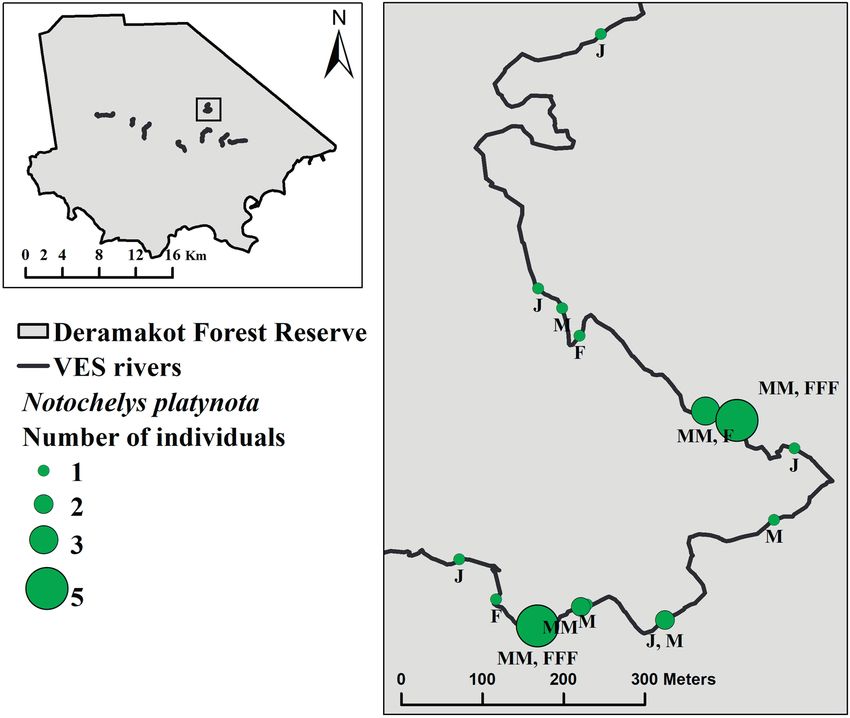
Bornean freshwater turtle natural history
asite burden, and behavioural observations were recorded. were high, whereas adult:juvenile ratios were more bal-
In order to avoid injuries, the soft-shelled turtles were nei- anced in D. subplana (adults: 21, juveniles: 19, ratio: 1.1:1).
ther measured nor sexed. Stream width was measured at all The male:female ratio in both hard-shelled species was
turtle capture locations, whilst stream depth and siltation fairly balanced in N. platynota = (males: 61, females: 41, ra-
were recorded during VES only. Stream widths and depths tio: 1.2:1) and H. spinosa (males: 3, females: 3, ratio: 1:1).
were recorded as the widest distance between banks and Significant sexual dimorphism was recorded in N. platy
deepest points of the river where a turtle was located. We nota (curved carapace: W = 213.5, p < 0.0005 and plas-
visually assessed siltation in the stream within a 2 m radius tron: W = 211.5, p < 0.0005), with males being larger (N =
of the turtle’s location, classified as 0–25, 26–50, 51–75 and 58, curved carapace: 295.2 ± 25.8 mm, plastron: 224.6 ±
76–100% siltation cover. 33.5 mm) than females (N = 49, curved carapace: 221.5 ±
Analysis of variation in female and male carapace/plas- 44.4 mm, plastron: 175.2 ± 17.4 mm) (Fig. 2). Heosemys
tron lengths was conducted using unpaired two-sample spinosa curved carapace and plastron length was larger in
Wilcoxon tests. Kruskall-Wallis tests were used to deter- males (N = 3, 199.2 ± 43.9 mm, 165.2 ± 4.3 mm) than in
mine if significant variation exists between stream widths females (N = 3, 168 ± 39.9, 138.3 ± 24.1), however sample
for all three species, followed by unpaired two-sample Wil- sizes were too small to confirm significant sexual size di-
coxon tests between species. Unpaired two-sample Wilcox- morphism (Fig. 2).
on tests were used to determine whether significant varia-
tion exists between N. platynota and D. subplana siltation
and stream depth. To determine if significant variation in Habitat associations/separation
parasite prevalence occurred between adults/juveniles and
females/males we conducted Chi-square tests of independ- We found significant differences between the stream dy-
ence. All analyses and subsequent graphs were produced namics associated with each species. Both N. platynota
with the software R version 4.0.2 (R Core Team 2019). and D. subplana occurred in large to moderately sized
streams (N. platynota = 154, streams = 15, stream width:
452.5 ± 160 cm; D. subplana = 39, streams = 13, stream
Results width: 390 ± 182 cm), whereas H. spinosa were associat-
Population characteristics: ed with significantly smaller, narrower streams (H. spinosa
detections and measurements = 9, streams = 5, stream width: 124.7 ± 60.8 cm) (Fig. 3).
Furthermore, compared to N. platynota and D. subplana,
Between March 2017 and June 2019, we recorded 210 ob- H. spinosa were generally detected in more sloped and
servations of the study species, with most detections oc- rocky streams. Notochelys platynota and D. subplana oc-
curring during the dedicated VES turtle sampling (N = cupied streams of similar width and depth, but differed
159). Notochelys platynota was by far the most common- in their associations with stream siltation (Fig. 3). Doga
ly detected species over both the three-year study period nia subplana was significantly positively associated with
and during the dedicated turtle sampling (N = 157 and 127, more heavily silted streams (D. subplana = 30, streams =
respectively), followed by D. subplana (N = 40 and 30) 7, siltation: 64 ± 26%) than N. platynota (N. platynota =
and H. spinosa (N = 13 and 1). Adult:juvenile ratios in this 127, streams = 8, siltation: 50 ± 19%) (Fig. 3). Furthermore,
population of N. platynota (adults: 112, juveniles: 45, ra- D. subplana was frequently found burrowing in heavy sil-
tio: 2.6:1) and H. spinosa (adults: 9, juveniles: 4, ratio: 1.8:1) tation deposits (Fig. 4A).
Figure 2. Plastron and curved carapace length of female and male Notochelys platynota and Heosemys spinosa. Sample sizes of each
turtle species and the results of unpaired two-sample Wilcoxon tests for N. platynota are provided.
253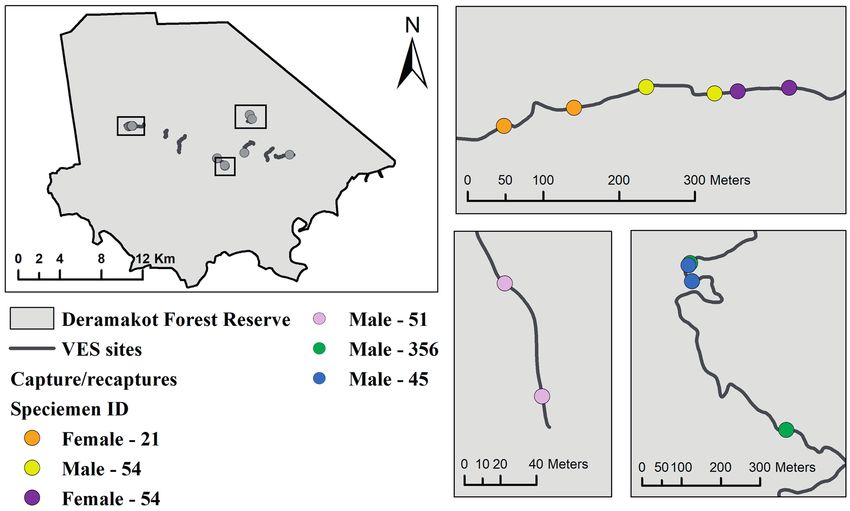
Sami Asad et al.
Table 1. Notochelys platynota and Heosemys spinosa recapture and movement data. Sex/life history stage, curved carapace and plastron
lengths are given for all recaptured individuals, including curved carapace and plastron lengths for specimens recaptured > 180 days
after the initial capture.
Days until Length at recapture
Sex/life Length (mm)
Species recaptures Total movement (mm)
stage (metres)
Carapace Plastron 1st 2nd Carapace Plastron
Notochelys platynota Male 290 210 45 – 47 – –
Male 310 235 1 356 489 317 242
Juvenile 73 61 42 260 10 90 67
Female 150 117 27 – 30 – –
Female 215 172 21 – 96 – –
Female 211 164 24 – 14 – –
Male 304 218 51 – 66 – –
Male 281 213 54 – 90 – –
Female 235 194 54 – 68 – –
Heosemys spinosa Male 223 169 9 53 10 – –
Terrestrial observations of all three species were rare, within 10–489 m of initial capture locations within the
with one observation of N. platynota and D. subplana same rivers (Table 1). Whilst the mean straight-line dis-
each, and three terrestrial observations of the same tance between captures was 101 ± 148.6 m, the high stand-
H. spinosa individual. The N. platynota and D. subplana ard deviation is the result of a single 489 m movement
observations were made separately along a main road by a large male (curved carapace: 310, plastron: 235 mm)
with the respective individuals appearing to be crossing between 2018 and 2019 (Fig. 5). During this period (357
it on their way to aquatic habitats. The H. spinosa was re- days), this male’s curved carapace and plastron length
captured at the same location along an old logging trail had increased by 7 mm. Only one juvenile (curved cara-
on three occasions within two months. pace: 73, plastron: 61 mm) N. platynota was also recap-
tured in both 2018 and 2019, within 10 m of the initial
capture location. This juvenile’s curved carapace length
Recaptures and movement had increased by 17 mm and its plastron length by 6 mm.
All remaining recaptures occurred within a period of 1–2
Using the unique markings on the plastra of N. platynota months.
and H. spinosa, we were able to identify several subse- As recapture rates for N. platynota were low, reliable
quently recaptured individuals. We detected 145 individ- density estimates for the two reserves could not be in-
ual N. platynota, with twelve recaptures made of nine in- ferred. At two rivers however, recaptures of three and one
dividuals, and eleven individual H. spinosa, with three re- adult N. platynota respectively over the VES period al-
captures of one male (Table 1). The recaptured H. spinosa lowed for a rough estimation of density using the Lincoln-
was exclusively detected terrestrially, on an old logging Petersen estimator (Menkens jr. & Anderson 1988). This
trail, within 10 m of the original capture location over a indicated that these two rivers had a density of roughly
two-month period. Notochelys platynota recaptures were 4.3 and 7.8 adult turtles per kilometre, respectively.
Figure 3. Stream measurements at capture locations of the three turtle species, including stream depth, siltation, and stream width.
Sample sizes of each species and the results of Kruskal-Wallis tests and unpaired two sample Wilcoxon tests are provided.
254
Bornean freshwater turtle natural history
Parasitism and possible predation attempts 0.37, p = 0.54) or between males and females (Chi² = 0.09,
p = 0.75) were identified. However, juveniles exhibited a
Parasitism by freshwater leeches appeared to be common slightly higher leech prevalence than adults (44.7 and 38.3%
within this population of N. platynota, with leeches detect- respectively), and a we observed a slightly prevalence in
ed on the plastra of 41% of turtles recorded during VES males than females (40.8 and 35.1% respectively) (Fig. 6).
(N = 50; Figs. 4B, 6). No statistically significant variations The highest density of freshwater leeches was found on a
in leech prevalence between adults and juveniles (Chi² = large adult male (N = 15). Additionally, unidentified nema-
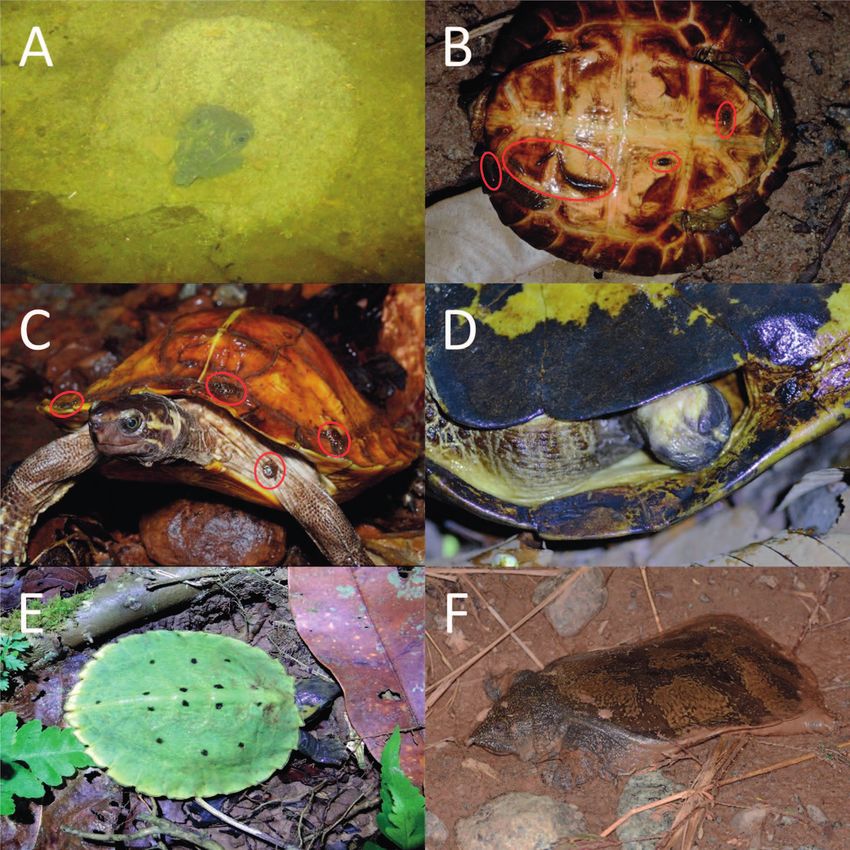
Figure 4. Photographs of notable turtle observations; (A) Dogania subplana submerged in the sand of a stream bed, in a possible
ambush or antipredation position (16 May 2019, 20:11 h); (B) parasitism of Notochelys platynota by freshwater leeches (likely Placo
bdelloides siamensis) circled in red (03 May 2019, 19:26 h); (C) parasitism of Heosemys spinosa by ticks (possibly an Amblyomma
species) circled in red (17 June 2019, 21:21 h); (D) Notochelys platynota with a missing left hind limb (08 April 2019, 19:46 h); (E) a
recent Notochelys platynota hatchling (curved carapace = 60 mm, plastron length = 38 mm) (31 March 2018, 22:03 h), (F) a Dogania
subplana individual on a main road away from water sources (11 September 2017, between 19:00 and 22:00 h).
255
Sami Asad et al.
todes were found in the faeces of five N. platynota (1 adult main roads, potentially attempting to cross these. Whilst
female, 4 juveniles). Whilst leeches and nematodes were such observations were infrequent, forestry staff members
not detected in D. subplana or H. spinosa, ticks were ob- and other researchers purportedly document the latter reg-
served on several H. spinosa (Fig. 4C). These ticks were ularly. Cyclemys dentata was detected twice in a moderately
found attached to the carapaces and necks of three individ- sized, slow, highly silted river.
uals (one female, male and juvenile), representing almost a
third of all detected H. spinosa.
During VES, we detected six N. platynota individuals Discussion
(four males and two females) with missing limbs, repre-
senting 5% of all N. platynota observed during these sur- Our study provides information on the population char-
veys (Fig. 4D). In all cases, one entire foot was missing, and acteristics, habitat associations/separation, recapture rates,
occasionally a significant portion of the respective leg, too. movements, parasitism, and possible breeding behaviour
for three freshwater turtle species within two logging con-
cessions in Sabah, Malaysian Borneo. Whilst data were
Possible breeding behaviour and hatchlings limited in some cases (Heosemys spinosa detections, Doga
nia subplana sexual identity/measurements, Notochelys
During VES, five observations of N. platynota in aggre- platynota recaptures), our results provide many novel and
gations were made on three survey occasions (28 April, previously unquantified findings concerning the natural
4 May and 16 May 2019). These aggregations consisted history of these species. As our study took place within
of 3–5 adults of both sexes, located within 3–20 metres of conventional selectively and reduced-impact logged for-
one another. Notably, during one survey (16 May 2019), ests, our results may not apply to turtle populations living
three such aggregations were documented on a single river in other undisturbed habitats. We are currently quantify-
(Fig. 7). Additionally, we recorded a number of juveniles, ing the effects of these logging types on N. platynota and
including thirteen hatchling N. platynota between March D. subplana populations in a separate publication.
and June in 2018 and 2019. Three hatchlings were recent,
with open plastra and bright green carapaces (Fig. 4E).
Population characteristics:
detections and measurements
Other freshwater turtles
Within our study site, Notochelys platynota was by far the
During our study, we detected two additional freshwater most frequently detected species (N = 157), followed by
species, Cuora amboinensis (Daudin, 1802) (N = 4) and Dogania subplana (N = 40), and with infrequent detections
Cyclemys dentata (Gray, 1831) (N = 2). Cuora amboinensis of Heosemys spinosa (N = 13). Whilst H. spinosa is listed as
were detected in small ponds, within swampy areas, and on Endangered and rarely encountered, D. subplana is listed as
Figure 5. Map of Notochelys platynota capture/recapture locations including sex and days until recaptures, and inset maps of recapture
locations with more than 30 metres from the initial capture point.
256
Bornean freshwater turtle natural history

                                                                   Least Concern and encountered more frequently through-
                                                                   out its range than the Vulnerable N. platynota (Ibrahim
                                                                   2018, Ibrahim et al. 2018, Lim & Das 1999). Whilst our data
                                                                   suggests that N. platynota is considerably more common
                                                                   within this area than D. subplana, this disparity in detec-
                                                                   tions could be linked to the burrowing habits and therefore
                                                                   possibly lower detection probability of D. subplana. Re-
                                                                   gardless, the high number of detections over the relatively
                                                                   short VES sampling period suggests a relatively large and
                                                                   stable population of N. platynota exists at our study sites.
                                                                      The high adult to juvenile ratio in N. platynota within
                                                                   our study site is typical of hard-shelled freshwater turtle
                                                                   species in other regions (Budishak et al. 2006, Mogol-
                                                                   lones et al. 2010, Spencer 2002). This is likely the result of
                                                                   low juvenile detectability and high juvenile/low adult mor-
                                                                   tality in long-lived hard-shelled species (Klemens 2000).
                                                                   Although sex was not identified in D. subplana, both hard
                                                                   shell species exhibited fairly balanced sex ratios. Whilst sex
Figure 6. Percentage of female, male and juvenile Notochelys       ratios are often askewed in unsuitable habitats (due to sex-
platynota individuals parasitized by freshwater leeches (likely    specific mortality), roughly balanced sex ratios indicate
Placobdelloides siamensis), including the number of parasitized/   suitable conditions and suggest no pressure is exerted on
total number of N. platynota individuals sampled during VESs.      one specific sex in this population (Budishak et al. 2006).

Figure 7. Map of all Notochelys platynota detections during a single VES survey (16 May 2019), including locations of aggregations,
and sex/life history stage of all detected individuals (male/female/juvenile).

                                                                                                                              257
Sami Asad et al.
As with previous studies (Brophy & Ernst 2004), we Our aquatic observations of N. platynota (N = 156) and
found significant sexual size dimorphism in N. platynota, D. subplana (N = 39), suggest a predominantly aquatic life-
with males being larger than females. The largest female style in concordance with the majority of the literature
(curved carapace: 321 mm , plastron: 243 mm) and male (Bour 2008, Ernst & Barbour 1989, Lim & Das 1999,
(curved carapace: 345 mm, plastron: 290 mm) were con- Manthey & Grossmann 1997, Nutaphand 1979, Rogner
siderably smaller than the maximum recorded for N. platy 1995). However, aquatic observations of H. spinosa (N = 10)
nota elsewhere (carapace length: 360 mm) (Lim & Das contradict many previous records. A range of activity pat-
1999). Although sexual size dimorphism in turtles usually terns have been reported for H. spinosa, including greater
favours larger females (Gibbons & Lovich 1990), larger terrestrial activity in juveniles (Ernst & Barbour 1989,
males occur in semi-aquatic, “bottom-walking” turtle spe- Rogner 1995), greater terrestrial activity in adults (Goetz
cies (Berry & Shine 1980). This conforms to our field ob- 2007), with some authors suggesting the species to be al-
servations of N. platynota behaviour and habitat associa- most entirely terrestrial (Bonin et al. 2007, Nutaphand
tions within our study site (see below). 1979). Although our total observations are limited (N = 13),
we believe the species to be at least semi-aquatic. However,
our lower number of detections compared to N. platynota
Habitat associations/separation and D. subplana, terrestrial recaptures, and the detection of
ticks on several H. spinosa (see Parasitism and possible pre-
Whilst our study species were all detected along the same dation attempts below) indicate a more terrestrial lifestyle
stream networks, there was significant variance in the fine- than the former two species. Future studies of H. spinosa
scale stream dynamics preferred by each species. Noto should therefore include surveys of terrestrial and stream
chelys platynota and D. subplana were associated with wid- habitats to quantify the relative utilisation of these by this
er streams than H. spinosa, whilst D. subplana was more little-known species.
frequently associated with higher siltation than N. platy
nota. Studies of co-occurring freshwater turtles in wetland
and riverine habitats on the Iberian Peninsula and the Recaptures and movement
Americas identified similar fine-scale separation between
aquatic habitat associations, yet significant co-occur- During our study we noticed that the plastral markings of
rence at coarse spatial scales (Anthonysamy et al. 2013, N. platynota and H. spinosa were unique to each individ-
Jaeger & Cobb 2012, Segurado et al. 2012). As with these ual. The majority of individuals captured were therefore
studies, separation between H. spinosa, N. platynota and photographed to allow individual recognition and iden-
D. subplana by fine-scale stream dynamics (namely stream tify recaptures. A single H. spinosa was recaptured on an
width and siltation), likely allows these species to occupy old logging road within 10 m of the initial capture location
the same stream networks without competition. Further- twice within two months. Previous research by Baizurah
more, our species likely increase separation by differences (2021) identified predominantly small-scale relocation by
in ecology, diet and behaviour. Notochelys platynota and radio-tracked H. spinosa in Sarawak, which is supported by
H. spinosa are predominantly herbivorous with occasion- the localized nature of our H. spinosa recaptures.
al predation and scavenging of carrion (Baizurah & Das Whilst the growth rates of two N. platynota captured
2020, Bonin et al. 2007, Ernst & Barbour 1989, Jensen in 2018 and 2019 were fairly high compared to other hard-
& Das 2006, Lim & Das 1999, Manthey & Grossmann shelled species (Budishak et al. 2006, Kennett 1996,
1997). Visible plant matter, including the flowers of fruit- Martins & Souza 2008), recaptured N. platynota moved
ing dipterocarp trees, was detected in the faeces of many relatively short distances compared to freshwater turtles
N. platynota during our study. Dogania subplana on the from Australia (Bower et al. 2012) and the USA (Rowe
other hand is more omnivorous (Bonin et al. 2007, Lim 2003, Rowe et al. 2009). As the individuals in our study
& Das 1999, Manthey & Grossmann 1997), and its were not radio-tracked, we cannot confirm whether this
large head and more posteriorly positioned eyes suggests was due to limited movements or small home-range size.
that molluscs likely constitute a large portion of its diet The single largest N. platynota movement over a 356-day
(Pritchard 2001). Several D. subplana were found slowly period (489 m) is dwarfed by movements of other riverine
moving through the submerged leaf litter deposits on the freshwater turtle species over shorter periods (Bower et
bottom of streams, potentially foraging for the freshwater al. 2012, Rowe 2003, Rowe et al. 2009). The low recapture
snails that occupy these microhabitats. Additionally, we rates for this species complicate matters further, as indi-
detected a large D. subplana individual underwater burr- viduals with high site fidelity/smaller home ranges should
ied in the substrate with only the nose, eyes and mouth be expected to be recaptured more frequently (Efford et
protruding (Fig. 4A), in what appeared to be an ambush al. 2016). Reduced recapture rates due to high mobility are
position, as is commonly reported in soft-shell turtles therefore questionable in this species. Low recapture rates
(Pritchard 2001). This could also have been anti-preda- due to high mortality are also unlikely in view of our de-
tion behaviour however as several D. subplana fled to the tection of many large adults. Low recapture rates are typi-
nearest sandy area and quickly burrowed beneath the sur- cal in freshwater turtles that experience relatively stable
face when disturbed. mortality/recruitment rates in other regions (Budishak
258Bornean freshwater turtle natural history
et al. 2006, Jensen & Das 2008b). The limited number of habits in H. spinosa compared to N. platynota and D. sub
N. platynota recaptures is therefore likely a result of fluc- plana.
tuations in individual/species detectability. Rainfall and The loss of limbs in 5% of the N. platynota detected dur-
seasonality have been identified as factors associated with ing VES and subsequent healing can possibly be attrib-
freshwater turtle activity and thus detectability in Austral- uted to predation attempts or/and inter-/intraspecific ag-
ia, the USA, and Brazil (Anthonysamy et al. 2013, Roe gression. Freshwater turtles in Borneo (and elsewhere) are
& Georges 2008, Rowe 2003, Rowe et al. 2009, Souza thought to be heavily predated upon as juveniles (Lim &
& Abe 1997). Furthermore, a study of freshwater turtles Das 1999). Whilst few species would be able to penetrate
in Sarawak, Malaysian Borneo, identified species-specif- the thick shell of an adult N. platynota, the limbs are rela-
ic activity associations with climatic variables (Jensen & tively unprotected and could be removed by a wide range
Das 2008b). Accounting for species detectability associa- of Borneo’s carnivorous species (Reptiles: Varanus salva
tions with climatic covariates will be essential for further tor (Laurenti, 1786), Mammals: Viviridae, Lutrinae, Sun-
studies seeking to quantify population dynamics and dis- da clouded leopard Neofelis diardi (G. Cuvier, 1823), Sun
turbance effects on N. platynota and other freshwater tur- bear Helarctos malayanus (Raffes, 1821) etc.). Aggressive
tle species. Additionally, tentative population density es- interactions including biting have been documented from
timates obtained from recapture data at two rivers, indi- various turtle species, e.g., between invasive Red-eared
cate a surprisingly low density compared to other river- sliders Trachemys scripta (Thunberg in Schoepff, 1792)
ine freshwater turtle species (Bower et al. 2012, Souza & and Spanish terrapins Mauremys leprosa (Schweigger,
Abe 1997). As recapture rates were low and detectability 1812) in Spain (Polo-Cavia et al. 2011), and between four
unknown, these numbers are likely a severe underestima- species of emydid turtles in the USA (Lindeman 1999).
tion. More research and dedicated capture-recapture stud- Furthermore, maiming following both male/male aggres-
ies are required to infer more reliable population density sion (Keevil et al. 2017) and aggressive sexual coercion
estimates. (Moldowan et al. 2020) has been documented in other
hard-shelled freshwater species. The latter may in some
cases result in high female wounding and lower survival
Parasitism and possible predation attempts (Golubović et al. 2018). Unfortunately, the cause of inju-
ries to the six N. platynota individuals can only be specu-
We detected high freshwater leech parasitism within the lated upon. However, as these wounds appeared to be old,
study population of N. platynota. Based on the presence healed, and the individuals in otherwise good condition,
of a distinct yellow dorsal stripe, we believe these fresh- the loss of limbs surprisingly does not seem to compromise
water leeches to be Placobdelloides siamensis (Oka, 1917), their health and survival.
which commonly parasitize freshwater turtles throughout
Southeast Asia (Chiangkul et al. 2018, Govedich et al.
2002). Whilst this may represent a new distribution record Possible breeding behaviour and hatchlings
for P. siamensis, specimens were not collected, and so their
identity cannot be confirmed. High parasitism by freshwa- The close proximity, mixed sex nature, and temporal fluc-
ter leeches is a well-documented occurrence in other fresh- tuation of the N. platynota aggregations we recorded sug-
water turtle populations in the USA (Readel et al. 2008, gest that this may have been some form of breeding ag-
Ryan & Lambert 2005). Within Southeast Asia, parasit- gregation. Whilst aggregations for basking and feeding
ism by Placobdelloides species has been recorded from nu- are common in freshwater turtles (Lindeman 1999, Polo-
merous chelonians throughout the region (Chiangkul Cavia et al. 2011, Rovero et al. 1999) such explanations
et al. 2018). Low variance in parasitism rates between sex appear unlikely due to the stable thermal environments
and age of N. platynota suggests both a widespread preva- and even distribution of plant matter within our study
lence of the parasite throughout the site, and similar hab- site. Spotted turtles Clemmys guttata (Schneider, 1792)
itat use and infection rates across sexes and age classes. are known to form site-specific breeding aggregations in
The negative effects resulting from high infection rates Georgia, USA (Enneson & Litzgus 2009). Unfortunate-
by Placobdelloides in this population is so far unknown. ly, more behavioural observations of N. platynota aggrega-
Whilst freshwater turtles infested with leeches are typically tions are required to confirm if these truly are groups of
healthy, heavy infection loads can compromise health and breeding individuals. Mating in Notochelys platynota was
have been associated with higher rates of haemogregarine only ever observed once (3 April 2019) at our site, with a
infections (Davis & Sterrett 2011). Quantifying the ef- male mounting a female underwater. Borneo experiences a
fects of leech parasitism on N. platynota survival should subtle dry season between May and November (Kitayama
therefore be considered in further research. et al. 2021), yet we detected female/male aggregations and
The ticks detected on a number of H. spinosa were likely hatchlings both before and during this period. Although
an Amblyomma Koch, 1844, species that commonly para- we found no evidence for seasonal breeding/hatchling pat-
sitizes freshwater turtles (including H. spinosa) through- terns, our four- to six-month sampling periods are insuf-
out Southeast Asia (Simmons & Burridge 2000). This tick ficient to confirm or deny a seasonal breeding pattern in
parasitism provides further indications of more terrestrial this species.
259Sami Asad et al.
Whilst breeding behaviour/hatchlings were not detect- Asad, S., J. F. Abrams, R. Guharajan, J. Sikui, A. Wilting &
ed in the two other species, an interesting incidental ob- M.-O. Rödel (2020): Stream amphibian detectability and
servation of a single D. subplana was made by the side of habitat associations in a reduced impact logging concession
a road (11 September 2017) (Fig. 4F). This large female ap- in Malaysian Borneo. – Journal of Herpetology, 54: 385–392.
peared to be crossing the road, and although its motives Asad, S., J. F. Abrams, R. Guharajan, P. Lagan, J. Kissing,
can only be speculated upon, soft-shell turtles in other ar- J. Sikui, A. Wilting & M.-O. Rödel (2021). Amphibian re-
eas are known to move over land to locate suitable egg-lay- sponses to conventional and reduced impact logging. – Forest
Ecology and Management, 484: 118949.
ing sites (Plummer 2007, Xinping et al. 2015).
Baizurah, S. N (2021). Autecology of the Endangered Spiny Hill
Turtle, Heosemys spinosa at Kubah National Park, Sarawak
(Borneo). – Unpubl. PhD thesis, Universiti Malaysia Sarawak.
Conclusion
Baizurah, S. N. & I. Das (2020). Heosemys spinosa (Spiny Hill
Turtle): diet. – Herpetological Review, 51: 831–832.
Our results elucidate important observations on the natu-
ral history of Notochelys platynota, Dogania subplana and Berry, J. F. & R. Shine (1980): Sexual size dimorphism and sex-
Heosemys spinosa in the wild. Adult/juvenile and male/ ual selection in turtles (Order Testudines). – Oecologia, 44:
185–191.
female ratios appear to be quite balanced in this popula-
tion (with the exception of N. platynota), and similar to Bonin, F., B. Devaux & A. Dupré (2007): Enzyklopädie der
Schildkröten. – Edition Chimaira, Frankfurt am Main.
turtle populations in other areas. Despite high parasitism
rates in N. platynota, we detected many large adults and Bour, R. (2008): Global diversity of turtles (Chelonii; Reptilia) in
recent juveniles indicative of a healthy, breeding popula- freshwater. – Hydrobiologia, 595: 593–598.
tion in the Deramakot Forest Reserve (despite the preva- Bower, D., M. Hutchinson & A. Georges (2012): Movement
lence of reduced-impact logging). Individual recognition and habitat use of Australia’s largest snake-necked turtle: im-
in this species indicated short, localized movements, which plications for water management. – Journal of Zoology, 287:
76–80.
may make these species particularly vulnerable to overhar-
vesting/site-level habitat disturbance. Most importantly, Brophy, T. R. & C. H. Ernst (2004): Sexual dimorphism, allo
we identified significant variation in the preferred stream metry and vertebral scute morphology in Notochelys platynota
(Gray, 1834). – Hamadryad, 29: 80–88.
dynamics of these three species within the same river sys-
tems, indicating a level of fine-scale separation via stream Budishak, S., J. M. Hester, S. J. Price &M. E. Dorcas (2006):
Natural history of Terrapene carolina (box turtles) in an ur-
width and siltation in their riverine habitats. It is for these
banized landscape. – Southeastern Naturalist, 5: 191–204.
reasons that the preservation of heterogeneous stream
habitats should be prioritized for the conservation of these Cheung, S. M. & D. Dudgeon (2006): Quantifying the Asian
turtle crisis: market surveys in southern China, 2000–2003.
freshwater turtle species. – Aquatic Conservation: Marine and Freshwater Ecosystems,
16: 751–770.
Chiangkul, K., P. Trivalairat & W. Purivirojkul (2018): Rede-
Acknowledgements scription of the Siamese shield leech Placobdelloides siamensis
with new host species and geographic range. – Parasite, 25: 56.
The authors would like to thank V. Vitalis, who provided in-
valuable assistance as a research assistant for the entirety of this Davis, A. & S. Sterrett (2011): Prevalence of haemogregarine
project. Additional thanks go to R. Guharajan and A. Wilting, parasites in three freshwater turtle species in a population in
whose assistance made this project possible. We thank the Sabah northeast Georgia, USA. – International Journal of Zoological
Forestry Department, particularly J. Kissing and P. Lagan, who Research, 7: 156.
facilitated access to the study site, field accommodation, and to a Efford, M., D. K. Dawson, Y. Jhala & Q. Qureshi (2016): Den-
wealth of data. For identification of the freshwater leech and ticks, sity-dependent home-range size revealed by spatially explicit
we thank P. Trivalairat and M. Takahashi, respectively. For capture-recapture. – Ecography, 39: 676–688.
funding the dedicated turtle sampling, we particularly thank the Enneson, J. & J. Litzgus (2009): Stochastic and spatially explic-
German Society of Herpetology and Herpetoculture (DGHT). it population viability analyses for an endangered freshwater
Additional funds were provided by Columbus Zoo, Auckland turtle, Clemmys guttata. – Canadian Journal of Zoology, 87:
Zoo, the Museum für Naturkunde Berlin, and the Leibniz Insti- 1241–1254.
tute for Zoo and Wildlife Research. We also thank the Sabah Bio-
Ernst, C. H. & R. W. Barbour (1989): Turtles of the World. –
diversity Council (SaBC) for granting us the access licence for on-
Smithsonian Institution Press, Washington DC.
site research; research permit number: JKM/MBS.1000–2/2 JLD.7
(63). Our manuscript benefitted greatly from the comments pro- Gibbons, W. & J. Lovich (1990): Sexual dimorphism in turtles
vided by P. Wagner and I. Das. with emphasis on the slider turtle (Trachemys scripta). – Her-
petological Monographs, 4: 1–29.
Goetz, M. (2007): Husbandry and breeding of the Spiny Turtle
References Heosemys spinosa (Gray, 1931) at the Durrell Wildlife Conser-
vation Trust. – Radiata, 16: 2–15.
Anthonysamy, W. J., M. J. Dreslik & C. A. Phillips (2013): Dis- Golubović, A., D. Arsovski, L. Tomović & X. Bonnet (2018):
ruptive influences of drought on the activity of a freshwater Is sexual brutality maladaptive under high population densi-
turtle. – The American Midland Naturalist, 169: 322–335. ty? – Biological Journal of the Linnean Society, 124: 394–402.
260Bornean freshwater turtle natural history
Gong, S.-P., A. T. Chow, J. J. Fong & H.-T. Shi (2009): The chelo- (Podocnemis expansa) in the Middle Orinoco River, Venezue-
nian trade in the largest pet market in China: scale, scope and la. – Chelonian Conservation and Biology, 9: 79–89.
impact on turtle conservation. – Oryx, 43: 213–216. Moldowan, P., R. Brooks & J. Litzgus (2020): Demographics
Govedich, F. R., B. A. Bain & R. W. Davies (2002): Placo of injuries indicate sexual coercion in a population of Painted
bdelloides stellapapillosa sp. n. (Glossiphoniidae) found feed- Turtles (Chrysemys picta). – Canadian Journal of Zoology, 98:
ing on crocodiles and turtles. – Hydrobiologia, 474: 253–256. 269–278.
Ibrahim, N.-S. (2018): Distribution and local knowledge of fresh- Nutaphand, W. (1979): The Turtles of Thailand. – Siam Farm
water chelonian in Terengganu with special emphasis on pop- Zoological Garden, Bangkok.
ulation size determination of Dogania subplana. – Unpubl. Plummer, M. V. (2007): Nest emergence of smooth softshell tur-
MSc Universiti Malaysia Terengganu. tle (Apalone mutica) hatchlings. – Herpetological Conserva-
Ibrahim, N.-S., B. Sham, N. Shafie & A. Ahmad (2018): Spe- tion and Biology, 2: 61–64.
cies diversity of freshwater turtles and tortoises in Tereng- Polo-Cavia, N., P. López & J. Martín (2011): Aggressive inter-
ganu, Malaysia. – Journal of Sustainability Science and Man- actions during feeding between native and invasive freshwater
agement, 1: 1–27. turtles. – Biological Invasions, 13: 1387–1396.
Jaeger, C. P. & V. A. Cobb (2012): Comparative spatial ecologies Pritchard, P. C. (2001): Observations on body size, sympatry,
of female painted turtles (Chrysemys picta) and red-eared slid- and niche divergence in softshell turtles (Trionychidae). –
ers (Trachemys scripta) at Reelfoot Lake, Tennessee. – Chelo- Chelonian Conservation and Biology, 4: 5–27.
nian Conservation and Biology, 11: 59–67.
R Core Team (2019): R: a language and environment for statisti-
Jensen, K. & I. Das (2006): Heosemys spinosa (Spiny Hill Turtle): cal computing. – R Foundation for Statistical Computing, Vi-
diet. – Herpetological Review, 37: 458. enna, Austria.
Jensen, K. A. (2006): Ecology and use of Asian Soft-shell Turtle Readel, A. M., C. A. Phillips & M. J. Wetzel (2008): Leech
(Amyda cartilaginea) with notes on other species. – Unpubl. parasitism in a turtle assemblage: effects of host and environ-
MSc Universiti Malaysia Sarawak. mental characteristics. – Copeia, 2008: 227–233.
Jensen, K. A. & I. Das (2008a): Cultural exploitation of freshwa- Rhodin, A. G., J. B. Iverson, R. Bour, U. Fritz, A. Georges, H.
ter turtles in Sarawak, Malaysian Borneo. – Chelonian Con- B. Shaffer & P. Van Dijk (2017): Turtles of the World: Anno-
servation and Biology, 7: 281–285. tated Checklist and Atlas of Taxonomy, Synonomy, Distribu-
Jensen, K. A. & I. Das (2008b): Observations on the influence of tion, and Conservation Status. – Chelonian Research Founda-
seasonality, lunar cycles, and weather condition on freshwater tion and Turtle Conservancy, Lunenburg.
turtle activity in Sarawak, East Malaysia (Borneo). – Asiatic
Roe, J. H. & A. Georges (2008): Terrestrial activity, movements
Herpetological Research, 11: 37–42.
and spatial ecology of an Australian freshwater turtle, Chelodi
Keevil, M., B. Hewitt, R. Brooks & J. Litzgus (2017): Patterns na longicollis, in a temporally dynamic wetland system. – Aus-
of intraspecific aggression inferred from injuries in an aquatic tral Ecology, 33: 1045–1056.
turtle with male-biased size dimorphism. – Canadian Journal
Rogner, M. (1995): Schildkröten 1–Chelydridae, Dermatemydi-
of Zoology, 95: 393–403.
dae, Emydidae. – Heidi Rogner Verlag, Hürtgenwald.
Kennett, R. (1996): Growth models for two species of fresh-
Rovero, F., M. Lebboroni & G. Chelazzi (1999): Aggressive
water turtle, Chelodina rugosa and Elseya dentata, from the
interactions and mating in wild populations of the Europe-
wet-dry tropics of northern Australia. – Herpetologica: 52:
an pond turtle Emys orbicularis. – Journal of Herpetology, 33:
383–395.
258–263.
Kitayama, K., M. Ushio & S. I. Aiba (2021): Temperature is a
Rowe, J. W. (2003): Activity and movements of midland paint-
dominant driver of distinct annual seasonality of leaf litter
ed turtles (Chrysemys picta marginata) living in a small marsh
production of equatorial tropical rain forests. – Journal of
system on Beaver Island, Michigan. – Journal of Herpetology,
Ecology, 109: 727–736.
37: 342–353.
Klemens, M. W. (2000): Turtle conservation. – Smithsonian In-
Rowe, J. W., G. C. Lehr, P. M. McCarthy & P. M. Converse
stitute Press, Washington, DC.
(2009): Activity, movements and activity area size in stinkpot
Lim, B. L. & I. Das (1999): Turtles of Borneo and Peninsular Ma- turtles (Sternotherus odoratus) in a southwestern Michigan
laysia. – Natural History Publications (Borneo) Sdn Bhd, Kota lake. – The American Midland Naturalist, 162: 266–275.
Kinabalu.
Ryan, T. J. & A. Lambert (2005): Prevalence and colonization
Lindeman, P. V. (1999): Aggressive interactions during basking of Placobdella on two species of freshwater turtles (Graptemys
among four species of emydid turtles. – Journal of Herpetol- geographica and Sternotherus odoratus). – Journal of Herpetol-
ogy, 33: 214–219. ogy, 39: 284–287.
Manthey, U. & W. Grossmann (1997): Amphibien & Reptilien Schoppe, S. (2008). The Southeast Asian Box Turtle Cuora am
Südostasiens. – Natur und Tier Verlag, Münster. boinensis (Daudin, 1802) in Malaysia. NDF Workshop Case
Martins, F. I. & F. L. Souza (2008): Estimates of growth of the Studies, WG 7-Reptiles and Amphibians.
Atlantic rain forest freshwater turtle Hydromedusa maximil Segurado, P., W. Kunin, A. Filipe & M. B. Araujo (2012): Pat-
iani (Chelidae). – Journal of Herpetology, 42: 54–60. terns of coexistence of two species of freshwater turtles are af-
Menkens jr., G. E. & S. H. Anderson (1988): Estimation of fected by spatial scale. – Basic and Applied Ecology, 13: 371–
small-mammal population size. – Ecology, 69: 1952–1959. 379.
Mogollones, S. C., D. J. Rodríguez, O. Hernández & G. R. Simmons, L.-A. & M. J. Burridge (2000): Introduction of the
Barreto (2010): A demographic study of the Arrau turtle exotic ticks Amblyomma humerale Koch and Amblyomma
261Sami Asad et al. geoemydae (Cantor)(Acari: Ixodidae) into the United States on imported reptiles. – International Journal of Acarology, 26: 239–242. Souza, F. L. & A. Abe (1997): Population structure, activity, and conservation of the Neotropical freshwater turtle, Hydromedu sa maximiliani, in Brazil. – Chelonian Conservation and Bio logy, 2: 521–525. Spencer, R.-J. (2002): Growth patterns of two widely distributed freshwater turtles and a comparison of common methods used to estimate age. – Australian Journal of Zoology, 50: 477–490. Struebig, M. J., A. Wilting, D. L. Gaveau, E. Meijaard, R. J. Smith, T. Abdullah, N. Abram, R. Alfred, M. Ancrenaz & D. M. Augeri (2015): Targeted conservation to safeguard a biodiversity hotspot from climate and land-cover change. – Current Biology, 25: 372–378. Van Dijk, P. P. (2000): The status of turtles in Asia. – Chelonian Research Monographs, 2: 15–23. Walter, O. (2000): A study of hunting and trade of freshwater turtles and tortoises (Order Chelonia) at Danau Sentarum. – Borneo Research Bulletin, 31: 323–336. Xinping, Z., H. Xiaoyou, Z. Jian, L. Jianhua & F. Zicheng (2015): Reproduction of captive Asian giant softshell turtles, Pelochelys cantorii. – Chelonian Conservation and Biology, 14: 143–147. 262
You can also read


