New Homes Delivery Plan - September 2018 - March 2023 - Sheffield City ...
←
→
Page content transcription
If your browser does not render page correctly, please read the page content below
New Homes Delivery Plan

          September 2018 – March 2023
Page 39
Delivery Plan Introduction and Context The Council has a vision for Sheffield to be the fairest city in the UK. Building the right homes and fixing our broken housing market is a key element of achieving that vision. Sheffield is a successful, prosperous and growing city with a growing demand for housing. These homes matter to us and we are producing a new ‘Homes for All’ Housing and Neighbourhoods Strategy in the autumn setting out the Council’s ambition for homes in the city to support strong neighbourhoods and to help people to feel safe, warm and well and, address the inequality divide. Our ambition is to use new housing to reduce inequality in Sheffield and provide more choice of good quality and affordable homes for all lifestyles who live in the city now, as well as people who wish to come and work in Sheffield in the future. Collectively the Council, public and private sector are presently building around 2,500 new homes each year. However, many of these are flats and homes for young people and young professionals so it is not addressing the need for new family homes in the city’s existing neighbourhoods. The city also has a Page 40 significant shortage of quality homes for older people and specialist accommodation for our vulnerable people and in many areas and it is becoming increasingly difficult to find the right type of accommodation in the areas where it is needed. The Council is committed to making sure that no one in the city should be living in a home that damages their health, residents feel safe and homes are affordable, so it is important that we use developable land in the city that is allocated for housing to address these shortfalls. This New Homes Delivery Plan is the pre-cursor to presenting the new Homes for All Housing and Neighbourhood Strategy in the autumn. The delivery plan aims to maintain the current level of homes being built through direct intervention and by enabling the public and private sector to deliver the homes we need. This will continue to support the Council’s intention to prioritise brownfield land to ensure that land that is allocated for housing is built out, particularly where land has been unused for many years. It sets out a programme for achieving over 2,000 new homes per annum ensuring momentum is maintained on a number of approved housing delivery programmes over the next 5 years and as part of a longer term pipeline. We will as part of this overall approach be developing a clear neighbourhood engagement plan to ensure that we are listening to the views of tenants and residents living in our neighbourhoods when catering for new homes and to ensure they are located in areas that will improve the quality of neighbourhoods and make them great places to live and work in. To sustain this level of delivery, the Council will continue to seek opportunities to work in partnership with the private sector to deliver the numbers required. We also believe that a range of homes like this supports the city’s economy by helping people into work especially those furthest away from the labour market, attracting and retaining businesses and their workforce. A good range of homes helps more people to share in the city’s growing economy.
The Council is in the process of developing its overarching strategic approach to create sustainable homes and neighbourhoods, and there will be a suite of
documents to support this - the Economic Strategy, Transport Vision, City Centre Plan, Green City Strategy, a new Local Plan and a Housing and
Neighbourhoods Strategy that will also provide the strategic direction required for the city in the future.
The Council has set out in this plan the commitment to support the building of over 2,000 new homes, including 725 new affordable homes a year for the
next 5 years. We expect all new developments to contain a reasonable level of affordable housing, unless there are exceptional circumstances preventing
this. The New Homes Delivery Plan aims to deliver a range of affordable housing solutions in all parts of the City. In large parts of Sheffield private developers
will be expected to contribute towards meeting this need by on-site provision or through financial contributions for building affordable homes on other sites.
The Council itself will have a key role in building affordable and specialist homes in all parts of the city, and we will work in partnership with developers to
look for opportunities to provide affordable housing on all sites. Delivering new homes boosts our opportunities to deliver affordable homes.
This New Homes Delivery Plan will also help us to be clear with Government on the city’s strategic priorities and seek to access external funding that supports
the city plans and the outcomes that we want to deliver.
The Government has revised National Planning Policy Framework that includes a Housing Delivery Test, to be introduced in November 2018. This test will
assess delivery over the previous 3 years and, where delivery has fallen below 95% of the local planning authority’s housing requirement over that period, the
Page 41
authority should prepare an action plan in line with national planning guidance. The action plan should assess the causes of under-delivery and identify
actions to increase delivery in future years. Our provisional assessment is that delivery in Sheffield over the period 2015-18 is likely to be 85-88% of the
housing requirement. The Sheffield Housing Delivery Plan is therefore the City Council’s response to the Government’s imminent requirement to produce an
action plan.
To deliver the scale and types of homes needed we will:
Identify the correct balance, quality and type of homes that will create successful and healthy communities across the city
Be clear on our priority housing locations; City Centre and Housing Zone, Upper and Lower Don Valley and the South East
Create a balanced city centre housing offer promoting mixed communities in some city centre neighbourhoods
Deliver new affordable homes, both for rent and ownership
Support citywide housing delivery programmes such as the Sheffield Housing Company and Council Stock Increase Programme
Make greater use of Council owned land and assets through disposal and acquisition
Work closely with Sheffield house builders and investors to provide a range of quality homes to support mixed tenure neighbourhoods and create new
neighbourhoods Cater for the following identified gaps in provision:
o homes in all tenures for people wanting to downsize
o homes for sale in the mid-market and above for couples and families wishing to progress through the market
o a range of affordable homes for sale and rent
o homes for older people and families in some city centre neighbourhoods
o specialist homes for older people and people with learning disabilities in all tenures
We want to work with partners in both the private and public sectors to increase house building across the city. This is because our homes matter to us. They
are the foundations of strong communities and, at a very basic level, they are a major factor in deciding whether we feel safe, warm and cared for. We want a
more inclusive and successful city, so we need an affordable choice of good quality homes for all. We will use new housing to reduce inequality in Sheffield,
not make it worse.
The key to delivering the actions above will be collaborative working between the Council, its partners and the Private Sector alongside better integration and
commissioning. The Council will be proactive in providing support and intervening as required to make sure that the programme for housing delivery is
balanced across the city. This delivery plan underpins the strategy, and clearly sets out the:
Page 42
Influence the number, types and We will make use of appropriate Focussed activity, expertise,
HOW
WHERE
WHAT
tenure of home delivered in the brownfield opportunties and increased SCC intervention in the
city to achieve a balanced housing focus on sites in the priority market to guide the desired build
market to support wider locations described in the new programme
economic and growth aspirations Housing Strategy1. Why we need a new housing delivery plan
1. The number of homes required vs The number of homes being delivered
The Sheffield Local Plan (pending adoption) is likely to set out a net new build housing target of between 1,975 and 2,425, including 725 new affordable
homes, a year (Target range set in the Strategic Housing Market Assessment 2013). We are therefore planning for a figure above 2,000 new homes per year
but acknowledge that Sheffield’s housing target will change as the Local Plan is developed, examined and adopted.
In order to hit targets we need to maintain the current delivery numbers, a significant increase on the previous levels of delivery. In summary:
Local Plan (pending) – Target for 2018 onwards = 2000+ homes per annum
Page 43
Actual Delivery 2005 – 2017 = Average (net) = 1,437 homes per annum
Actual Delivery 2016 / 17 = 2,248 homes
Forecast / estimated 2017 / 18 = 2, 200 homesHousing Delivery in Sheffield, 2005 - 2018 Gradual return to
2005-10 net new build target growth – up to
3500
of 1,425 per year consistently 2,248 in 2016/17
achieved
3000
2500
2000
Impact of
recession post-
1500
2008
1000
500
Page 44
0
2005/6 2006/7 2007/8 2008/9 2009/10 2010/11 2011/12 2012/13 2013/14 2014/15 2015/16 2016/17 2017/18
Gross New build Net New Build
1
2. The type, balance, quality and tenure mix of homes being built
House builders in the private sector are currently providing a too narrow range of house types and tenures.
Over the last five years there has been an average of 1560 (gross) new homes completed per year – the majority of which, 64%, were apartments or student
accommodation (50% apartments and 14% student accommodation) and 36% of completions were houses. The Council will work with both Universities to
develop a new Student Accommodation Strategy to shape this area of activity.
1
Gross Housing Completion figures for 2017/18 are estimated as the actual figure is still being calculated at the time of writingOf the homes delivered, 19% (or 302 per year) were affordable homes, including those secured through s106 affordable housing agreements, which is
significantly short of the city’s 725 per year affordable housing target.
Our evidence tells us that this delivery profile is not adequately meeting housing demand from families, older households and households needing specialist
accommodation. This delivery plan will address the delivery numbers, tenure and the type of home.
2. Local Housing Vision – What we need to deliver and where
This Delivery Plan is not just about building more homes; it is about building the right mix and balance of homes in the right places and building successful
and healthy communities. Through this delivery plan we aim to shape neighbourhoods and to create a more balanced housing offer that better meets local
housing need. Our intention is where possible to create more neighbourhoods where the additional homes support good health and reduce inequality. We
also intend for the additional homes to provide more choice to enable people to upsize and downsize their homes locally, as their needs change.
Page 45
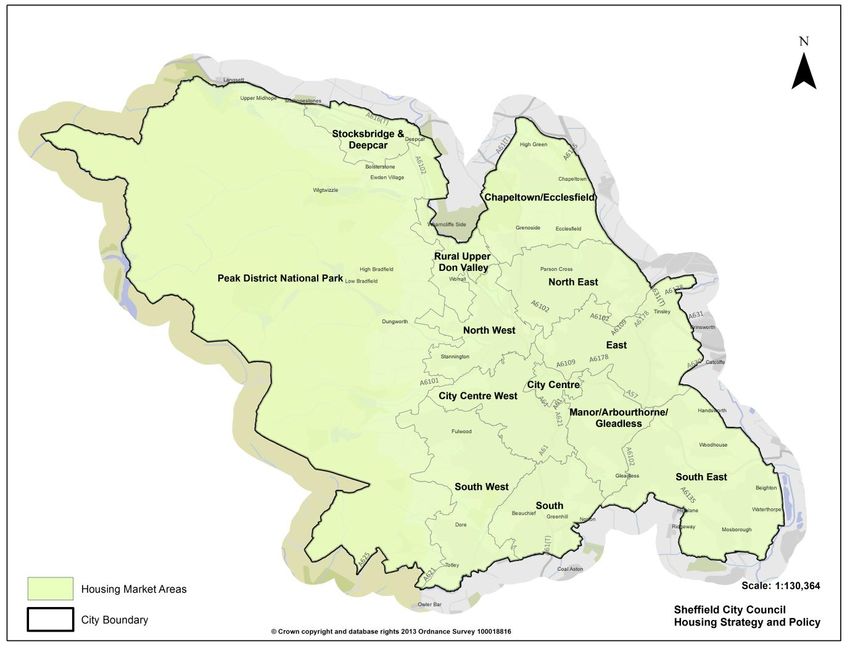
The city has 13 distinct Housing Markets Areas (HMA’s), each one having its own housing offer. These are shown in the map below.
The Council has a robust set of data that is used to review the existing housing offer in each market area and has identified local housing shortfalls along with
issues and challenges for housing delivery. This information will be used to guide the approach taken by the Council to deliver more new homes. The 13
HMAs provide an overview of the housing offer in these areas. Site specific developments and negotiations will be undertaken in line with a more detailed
knowledge of the conditions in that specific area.Page 46
3. Delivery Approach – How we will deliver

Over recent years the Sheffield housing market has delivered sizeable amounts of student accommodation in the city centre. The Council’s ambition is to
increase the levels of family type houses, general needs apartments and apartments aimed at families and older generations.

How we deliver through strategic Council intervention can provide mechanisms to guide the market to a different outcome.

The Council can drive and influence the timing and supply of new homes in the city in a number of ways:

          1.   By how it grants planning permission to private house builders
          2.   By supporting sites that have become stuck in the development process
          3.   By how it supports private house builders who have planning permission, but where delivery has stalled
          4.   Through its involvement with the Sheffield Housing Company to deliver homes at pace in specific areas
          5.   By how it develops its own land to build council housing through the HRA Stock Increase programme
          6.   By supporting landowners and developers with planning and infrastructure to free-up stuck sites
          7.   By investing in wider infrastructure to unlock sites and make developments more viable / attractive to the market
Page 47

In support of the themes above, a detailed operational plan for 2018 – 2023 sets out a range of actions linked to key outcomes and resources that underpin
how we will deliver. Details of this can be found in Appendix A.
Principles of Intervention - The Council’s interventions will be guided by the following principles.
The council will intervene where:
1 2 3 6
4 5
SCC wishes to influence The private sector is not The market is unwilling or Statutory powers are
The market will deliver but a It will accelerate delivery
development to create a meeting local housing unable to deliver (site higher quality scheme could be required to unblock sites
demand or need on or release new
coherent place and needs planning pemission, established through land in the private sector (CPO
brownfield sites
community has not started or has assembly, which can't be or statutory action)
stalled) achieved through the private
sector
In order to meet the targets set for numbers and locations, the Council must:
Increase its resource capacity to provide an efficient and effective housing delivery role,
Page 48
Develop a deliverable site pipeline to sustain the number of homes built per year and diversify the range of new homes,
Stimulate private sector and Council activity on residential sites to build new homes provide a balance of good quality house types and tenures that
address local housing need
Increase the capacity of the affordable housing programme and stimulate the private sector to provide more affordable homes for sale and rent
Establish long term investment programmes to develop brownfield land in priority housing areas
Consider alternative delivery models for affordable housing
The Council has a number of approved or proposed interventions including;
HRA funded stock increase programme (for the provision of new homes for rent, older persons and specialist housing and shared ownership)
Stuck sites programme
Sheffield Housing Company
Disposals Programme
Bids to the Housing Infrastructure Fund
Bids to the City Region
Bids for government grant funding such as the Shared Ownership and Affordable Homes Programme
Bids for estates regeneration funding to the Ministry of Housing, Communities and Local Government4. The case for Intervention
Current housing delivery estimates
Our future housing delivery estimate is informed by the Strategic Housing Land Availability Assessment (SHLAA).
This is the information source of all the possible land that could be used for housing development across the city. The Council’s current formal five-year
housing supply was published in the 2017 Interim Position Paper that is available at https://www.sheffield.gov.uk/content/sheffield/home/planning-development/housing-
land-sites.html .
To establish a firmer picture of housing delivery over the next 5 years we have applied a risk based assessment of sites within the SHLAA taking into account
the following;
Current planning permission status
Average build rates for developers
Page 49
Current site occupation and need for intervention
Site location and the concentration of sites
Existing site intelligence
Level of site assembly / infrastructure work required prior to build commencing
Current economic climate
We acknowledge that the rate of delivery cannot be forecast with absolute certainty as the demand for housing and the capacity of developers to deliver
housing will fluctuate. However, the risk based assessment provides the best possible estimate at this point in time and forms the baseline delivery figures
(below table) for housing delivery without Council intervention.Work Stream Year 1 Year 2 Year 3 Year 4 Year 5 5 Year Years 6-10 10 Year
2018/19 2019/20 2020/21 2021/22 2022/23 Total 23/24 - Total
27/28
Private Land
Planning - Full Permission Not Started 196 316 283 46 46 887 1,381 2,268
Planning - Full Permission Required 6 72 685 173 254 1,190 7,857 9,047
Private Construction Suspended 108 0 14 0 36 158 298 456
Private In Delivery 1,415 351 305 115 103 2,289 312 2,601
Property - Disposals/Acquisitions 0 0 0 0 0 0 294 294
Public Land
HRA Stock Increase Programme2 0 0 16 80 68 164 237 401
Planning - Full Permission Not Started 30 57 0 0 0 87 14 101
Planning - Full Permission Required 104 134 502 181 365 1,286 2,819 4,105
Property – Disposals 0 0 17 69 75 161 994 1,155
Page 50
Public In Delivery 44 44 44 43 0 175 0 175
Sheffield Housing Company 331 292 211 127 136 1,097 317 1,414
Grand Total 2,234 1,266 2,077 834 1,083 7,494 14,523 22,017
Windfall Sites 200 200 200 200 200 1,000 1,000 2,000
Grand Total (Including Windfall Sites) 2,434 1,466 2,277 1,034 1,283 8,494 15,523 24,017
Table 1- Risk tested Delivery Pipeline 2018 – 23 (Source: SCC Housing Growth Team)
The current housing delivery estimates shown in Table 1 fall short of the Council’s 2000+ per annum target showing that SCC intervention is justified to
increase the volume of new homes. In addition, intervention is also needed to increase the number of new houses and apartments for non-student use to
redress the imbalance in the types of homes (not just volumes). Key observations from the site review are, that the:
Pipeline is at risk of fluctuating below the target of 2000 per year, averaging 1400 per year and completions of apartments peak in 2020/21;
Majority of the new build capacity is in the private sector;
Sites with planning permission and to commence on site are significant with 42 sites generating a total capacity of 2268 homes;
Pipeline assumes that full planning permission will be secured for over 13,000 homes; and,
2
This only relates to new build Stock Increase Programme activity, it does not include S.106 purchases or Buy Back of former Right to Buys Council is bringing forward 1182 new homes itself through land disposals and building its own properties to rent and it is programmed to deliver 1414
through the Sheffield Housing Company.
Proposed delivery estimates with intervention
A number of key interventions have been identified to accelerate housing delivery by both the Council and private sector these include;
Adopting a strategic approach to priority areas
Accelerating the Councils New Build Stock Increase Programme
Investing in site enabling works prior to disposing of sites
Disposing of viable sites for private sector delivery with planning briefs to influence housing type
Strategic acquisitions in the city centre to assemble sites
Accelerating Sheffield Housing Company’s Programme
Page 51
Deliver physical infrastructure to unlock sites, subject to successful funding bids
Providing planning advice, guidance and support to help developers / investors through the process
Consider joint ventures where we want / need to influence the housing offer
Establish a proactive contact role to liaise with developers/ land owners providing support to unlock development
It is anticipated that by making these interventions housing delivery in the next 5 years can increase by 1934 homes bringing the average per annum over
2000 as shown in the Table 2 below.Work Stream Year 1 Year 2 Year 3 Year 4 Year 5 5 Year Years 6-10 10 Year
2018/19 2019/20 2020/21 2021/22 2022/23 Total 23/24 - Total
27/28
Private Land
Planning - Full Permission Not Started 220 506 318 81 81 1,206 1,062 2,268
Planning - Full Permission Required 6 224 889 249 343 1,711 6,620 8,331
Private Construction Suspended 108 0 14 0 36 158 298 456
Private In Delivery 1,415 351 305 115 103 2,289 312 2,601
Property - Disposals/Acquisitions 0 0 0 0 0 0 786 786
Public Land
HRA Stock Increase Programme3 0 191 194 165 228 778 271 1,049
Planning - Full Permission Not Started 30 57 0 0 0 87 14 101
Planning - Full Permission Required 104 134 676 299 104 1,317 1,038 2,355
Property - Disposals 0 15 47 217 313 592 1,570 2,162
Page 52
Public In Delivery 44 44 44 43 0 175 0 175
Sheffield Housing Company 331 292 211 145 136 1,115 652 1,767
Grand Total 2,258 1,814 2,698 1,314 1,344 9,428 12,623 22,051
Windfall Sites 200 200 200 200 200 1,000 1,000 2,000
Grand Total (Including Windfall Sites) 2,458 2,014 2,898 1,514 1,544 10,428 13,623 24,051
Table 2 – Delivery Pipeline with Increased Council Intervention 2018-23 (Source: SCC Housing Growth Team)
It is important to note that these interventions will not only accelerate housing delivery in years 1 to 5 - it will also secure future sites for development into
year 6 onwards as the acquisitions and site enabling work streams, in particular, are not expected to deliver units until after year 5. Whilst there is less
certainty in the figures for year 6 onwards (reflected in the current conservative estimate), due to the volatility of the market, intervening now will help to
create a more sustainable delivery pipeline and it is likely this will lead to increased numbers in years 6 to 10.
This plan will be updated on an annual basis as it is intended to be rolling programme of investment.
3
This only relates to new build Stock Increase Programme activity, it does not include S.106 purchases or Buy Back of former Right to Buys3,500
In order to intervene in the market and achieve the
increases in housing delivery illustrated in this chart and
the type, tenure and quality of housing required
3,000
additional resource will be required both in terms of
funding and staff time.
2,500
Investing resource into housing growth will also ensure
that Sheffield can better position itself when trying to
2,000
secure external funding from the Government and
private sector allowing all opportunities to be maximised
Without Intervention safeguarding the future success of the programme.
1,500 With Intervention
Further information on the type of intervention and
impact on delivery can be found in Appendix B.
1,000
Page 53
500
0
Year 1 Year 2 Year 3 Year 4 Year 5
2018/19 2019/20 2020/21 2021/22 2022/23The Benefits of intervention
We anticipate, with further investment:
The Council can unlock an additional 19 sites on publicly owned land, release 1,934 new homes into the 5 year pipeline and triple the volume of
homes it builds itself and in partnership with the private sector. Of which:
o The Council will build a further 614 more affordable new homes, through the HRA New Build Programme.
o A further 11 Council owned sites could be marketed to bring forward over 1064 new homes through the Council’s disposal programme.
Sheffield Housing Company can bring forward over 350 new homes
Strategic acquisitions will commence on a rolling programme in the city centre housing zone, we propose to concentrate on a number of key sites that
if assembled could unlock up to 2018 homes by 2028.
Provide the opportunity to work in partnership with Rotherham to develop the pipeline for the Sheffield/ Rotherham corridor which could achieve
over 18,000 homes over the next 20 -30 years
The pace of new build will be a combination of directly working with the private sector and making it easier for the private sector to get on and deliver
Page 54
new homes
Increased income to the Council from CIL, Council Tax and New Homes Bonus and capital receipts over the 5 year period of this plan
A greater supply and variety of houses to help balance the citywide shortfallsFunding and income
To address the shortfalls in housing types, achieve the increased rates of housing delivery to those detailed within Table 2, and fully realise the benefits of
increased income, there is a requirement for an additional investment of £25,265,000 over the Delivery Plan period (2018 – 2023). The breakdown of how
this funding will be invested is given below:
Expenditure (£000s) 2018/19 2019/20 2020/21 2021/22 2022/23 5 Year
Total
Housing Growth Team Costs £605 £744 £759 £774 £790 £3,671
HIF Activity £840 £122 £0 £0 £0 £962
Strategic Acquisitions £6,046 £1,598 £627 £0 £0 £8,272
Strategic Acquisitions Fees £174 £8 £363 £0 £0 £545
Site Enabling Works £300 £2,000 £5,438 £2,043 £2,043 £11,825
Site Enabling Commissioning and Fees £350 £350 £161 £161 £161 £1,182
Sub Total £8,315 £4,822 £7,349 £2,978 £2,994 £26,458
Page 55
Current Funding (£000s)
Housing Revenue Account £159 £159 £159 £159 £159 £793
GIF Funding (Sheffield Housing Company Client Team) £200 £200 £0 £0 £0 £400
Sub Total £359 £359 £159 £159 £159 £1,193
Net Costs / Funding Required £7,957 £4,464 £7,190 £2,820 £2,835 £25,265
Table 3: New Homes Delivery Plan (2018 – 2023) Budget
Expenditure is proposed to:
Fund the Housing Growth Delivery Team (2018 – 2023). To perform a pro-active contact role. This will bring forward the private sector pipeline; to
commission and deliver site enabling works to improve the viability of Council and privately owned sites; to contract manage existing and new
partnerships and to monitor and report monthly on the targets set in the plan beyond the 5 year plan.
Provide capacity to further develop options and feasibility studies for bid submissions. (2018 – 2020) There is potential for additional Housing
Infrastructure Funding (HIF) or other capital funding from Government. Resources are required to ensure capacity to develop proposals or engage
specialist expertise. Enable Strategic Acquisitions over a rolling 5 year programme (2018 – 2023) will assemble key brownfield sites in the City Centre to build a mixture of
apartments and houses and land acquisitions to increase the available land in the Affordable Housing Programme, where there is a shortfall in
provision.
To consider a fund to invest in/pay for site enabling works such as road, services infrastructure, remediation, ground clearance and preparation to
improve the viability of marginal sites. This is an opportunity to unlock private and public sites to provide balanced delivery programmes across the
city.
Housing Growth Delivery Plan Expenditure (£000's)
The adjacent chart illustrates the proportion of spend
across the programme highlighting that the majority
£1,182 Housing Growth Team Costs of the investment is identified for Strategic
Acquisitions, 31%, and Site Enabling works, 45% and
£3,671 £962
HIF Activity represents a total of 76% of the total investment as
Page 56
Capital.
Strategic Acquisitions
£11,825
£8,272
Strategic Acquisitions Fees
Site Enabling Works
£545 Site Enabling Commissioning and
Fees
The following tables show the projected income generated by housing delivery. The actual amount of income generated will be subject to housing market
conditions over the period. The income and delivery numbers are based on assumptions made from November 2017 and will be refined as the housing is
developed and actual income achieved which will be reported to Cabinet on an annual basis.Income generated by private sector developments without any SCC interventions.
Income (£000's) 2018/19 2019/20 2020/21 2021/22 2022/23 Total
New Homes Bonus £2,788 £5,733 £7,170 £9,445 £7,474 £32,609
Council Tax £2,487 £5,115 £6,397 £8,427 £9,156 £31,581
Community Infrastructure Levy £4,051 £4,822 £3,123 £2,790 £2,733 £17,519
Grand Total/Forecast Income £9,326 £15,670 £16,689 £20,661 £19,362 £81,708
Table 5: New Homes Delivery Plan (2018 – 2023) Budget
Income generated by private sector and existing SCC programmes.
Income (£000's) 2018/19 2019/20 2020/21 2021/22 2022/23 Total
New Homes Bonus £5,722 £6,892 £6,017 £5,972 £5,469 £30,072
Council Tax £2,876 £6,199 £8,200 £11,308 £12,686 £41,269
Community Infrastructure Levy £6,078 £9,629 £7,132 £7,142 £4,812 £34,793
Capital Receipt £0 £6,400 £9,900 £2,000 £0 £18,300
Page 57
Grand Total/Forecast Income £14,676 £29,120 £31,249 £26,423 £22,967 £124,434
Table 6: New Homes Delivery Plan (2018 – 2023) Budget
Income generated by privates sector, existing SCC programmes and additional interventions in this delivery plan.
Income (£000's) 2018/19 2019/20 2020/21 2021/22 2022/23 Total
New Homes Bonus £5,918 £7,048 £6,527 £7,163 £7,270 £33,925
Council Tax £2,876 £6,232 £8,953 £12,912 £15,003 £45,977
Community Infrastructure Levy £6,115 £10,331 £8,764 £8,267 £4,783 £38,259
Capital Receipt £750 £9,500 £9,900 £2,000 £795 £22,945
Capital Receipt from Strategic Acquisitions £0 £300 £1,500 £5,160 £1,950 £8,910
Grand Total/Forecast Income £15,659 £33,410 £35,645 £35,501 £29,801 £150,016
Table 7: New Homes Delivery Plan (2018 – 2023) BudgetThe ‘capital receipts from strategic acquisition’s’ shown in table 6 are based on the purchase, enhancement and disposal of a number of brownfield sites, as
approved by Cabinet in March 2018.
Indicative Income generation:
Comparative Income Generation (£000's) The indicative gross income generated for the Council is estimated
£40,000 to be £150,016,000. Sources of income are:
New Homes Bonus: income receivable from Government on
£35,000
a 4 year rolling basis, payment based on the net number of
new homes built.
£30,000
Council Tax generated and collected
Community Infrastructure Levy generated via the
£25,000
implementation of planning consents
Land receipts paid to the Council for the sale of
Page 58
£20,000 land/property.
£15,000 Income received will go into the Council’s Growth Investment Fund
which is established on the basis of an ‘evergreen’ fund whereby
£10,000
the returns from projects (New Homes Bonus or reward of capital
receipts) are reinvested into future projects which in turn generate
new returns. A proportion of the fund is set aside for ‘enabling’
£5,000
projects to support physical infrastructure schemes which generate
no immediate return but create a setting for investment and
£0
2018/19 2019/20 2020/21 2021/22 2022/23 support the Council’s corporate capital programme to bring forward
some of the Council’s other strategic projects. This programme will
Private Sector Only
provide some certainty of future income that will underpin the
Private and Existing SCC Programmes
Council’s medium term financial strategy.
Private, Existing SCC Programmes and New Interventions5. Measuring Success
The success of the New Homes Delivery Programme will be measured against these Key Performance Indicators. It will be the responsibility of the Housing
Growth Team to monitor and report on the success of the programme along with the Housing Growth Programme Group.
Page 596. Risks
There are ways that the Council can influence the housing market, to sustain a pipeline of viable residential sites and adjust the type, quality and number of homes that are
delivered in Sheffield. However, there are also a number of drivers that affect the housing market and people’s decisions to move, which the Council cannot change. The
key risks to the Housing Delivery Plan and mitigating action is set out below.
Risk Mitigation
1 Infrastructure required to unlock sites
City centre redevelopment opportunities are spread across the urban Creation of an Integrated Infrastructure Plan to identify priority projects and
core. Fragmented land use pattern means it is difficult to deliver a co- investment required to prioritise funding applications.
ordinated package of infrastructure necessary to support new
communities Continue to work with Government to establish a flexible single housing and
Lack of resource to co-ordinate proposals and lack of strategic funding infrastructure fund for Sheffield
means that future infrastructure solutions could continue to be
delivered in isolation and infrastructure solutions fail to impact We have submitted bids for Housing Zone status, Capacity Funding and for
positively on the attractiveness of local sites Housing Infrastructure Funding.
Page 60
Allocate resources to support appraisal work and bidding processes
2 Site viability
Council policy is to develop brownfield land. Previous industrial use Identification of priority sites pipeline, Diversifying the market to attract more
makes ground preparation costs higher than average house builders and introduction of pro-active contact role with landowners,
Potential declining land values/capital receipts may limit the Council’s agents and developers.
ability to invest
Local topography, hills and river basins often means that sites require Identifying and releasing sites for private sector development in a timely
bespoke ground remediation/scheme proposals manner balancing delivery and demand.
Property valuations may be prohibitive in newly emerging markets
Viability issues may impact on the quality of scheme achieved3 Brexit and housing market economy changes SCC continues to invest in the transformation of the City Centre, the Advanced
Continuing economic and political uncertainty in the run up to 2019, Manufacturing Park and Advanced Manufacturing Research Centre and HS2 to
further interest rate rises, falling real wages and weaker consumer. promote developer and investor confidence
Any limits on immigration could result in fewer construction workers
from overseas, development takes longer & extra building cost could be Monitoring of citywide housing delivery programme and provision of housing
passed onto buyers. market guidance to illustrate the types of homes needed in each housing
Fluctuations in house prices and potential market slowdown, impact market area.
expected to be region specific.
Persistent shortages of house building keep house prices rising faster Deliver a balanced programme to ensure delivery is aligned with market
than earnings on average. demand and capacity
Affordability for first time buyers and risk that buyers will need to save
longer to buy their first homes. Use the delivery programme to promote more capacity of SME developers and
builders
4 Private Sector delivery SCC to guide and support private sector to develop housing to meet identified
Private sector development does not provide the required breadth of needs in Housing Market Areas
housing need for Sheffield people
Developer decisions are influenced by labour and supply chain capacity, New programme to support enabling work and investment in sites to reduce
Page 61
ability to finance development, activity adjacent to the site and risk.
conditions of the local economy
Introduction of self-funded business models for the Council to invest in
Affordable Housing through HRA and s106 receipts.
Promotion of economic priorities such as the transformation of the city centre,
the Advanced Manufacturing Park and Advanced Manufacturing Research
Centre and HS2 to create the right environment for a buoyant housing market
Focus of resources in the City Centre, Lower and Upper Don Valley and the
South East to promote developer and investor confidence.
SCC recognises the importance of innovation in the housing market and will
promote Modern Methods of Construction on suitable sites.
Similarly, a diverse range of housing developers and builders will increase the
housing growth activity in the city and therefore it will be important to work
closely with Small to Medium Enterprises (SMEs) including Custom Build
developers to enable their development in the city too.7. Political and Executive Governance To deliver the new ambition will require strategic political leadership. This will be provided through the Strategic Capital Board and also the Place Growth Board (chaired by the Cabinet Member for Transport and Development) as the Cabinet Member lead for housing delivery. A Housing Growth Programme Group has been established. This group will be the single route for Housing Delivery activity and will ensure that the proposals set out in this delivery plan are monitored, risks are effectively managed and housing outcomes are delivered. This group will be responsible for presenting annual progress reports to the Council’s Cabinet and Cabinet will be asked to approve any amendments to the rolling 5 year Housing Delivery pipeline. Individual projects and programmes of work, such as site enabling, may be the subject of further executive decisions in accordance with the Leaders Scheme of Delegation and will follow the Councils capital approvals and reporting process that includes the Housing Growth Programme Group and the Capital Programme Group before ultimate approval by Cabinet. Page 62
Housing Growth Programme Group
   •Will ensure that the proposals set out in this delivery plan are monitored, risks are effectively managed and
    housing outcomes are delivered.
   •Provide regular updates and Business Cases for endorsement to Place Growth Board

             Capital Programme Group
             CPG is the Council's principle officer forum which reviews and endorses projects, prior to seeking Cabinet
             approval
             CPG may endorse to Cabinet and GIF funding requests with a value up to £500,000

                       Place Growth Board
Page 63

                       •Will consider recommendations made to it and if appropriate it will endorse these recommendedations for
                        consideration by SCB and/or Cabinet.
                       •Will respond with guidance to issues that have been escalated (within its delegations)

                                  Strategic Capital Board
                                  •The principle purpose of SCB is to articulate priorities, against which funding allocations will be made.
                                  •It considers the Business Case and if appropriate, endorses it for consideration by Cabinet
                                  •SCB must endorse all GIF funding requests for amounts over £500,000

                                            Cabinet
                                            •Cabinet will be asked to consider GIF investment into Housing Growth projects and willl be asked to consider
                                             and approve the rolling 5 year Housing Delivery activity.
APPENDIX A: Housing Delivery Activity Table
Activity
Activity Expected Delivery Expected Outcome
Period (years)
Planning
Completion of the Local Plan for the allocation and delivery of 1- 2 Increased sites available to developers and builders
new housing Accelerated housing delivery
Ensure information and systems for processing planning 1
applications are in place Influence the type, range and quality of new homes
Provide informal planning advice and pre application advice 1- 5
Page 64
Acquisition Unlock brownfield site
We will assemble land and consider joint land sales 2–5
Prioritise the acquisition of new homes to support the SCC 1–1 Increased family housing offer in the city centre
Housing Revenue Account new homes programme
Explore and acquire land in areas with high Affordable Housing 3-5 Increased affordable housing delivery
shortfalls to support the SCC Affordable Housing Programme
Infrastructure Infrastructure requirements mapped and prioritised
Develop an Integrated Infrastructure Plan to identify physical 2–5 Unlock stalled sites
infrastructure requirements that unlock housing development
Invest in feasibility work to identify infrastructure needs and 1-2 Provision of strategic infrastructure to ensure long
identify and secure funding opportunities term delivery of housing
Asset Disposal
Invest in the de-risking of sites which SCC bring to the market 1-5 Increased sites available to developers and builders
Dispose of sites with clear planning briefs to influence the type 1 -5
of homes to built Increased likelihood of influencing housing type and
Proactively promote our smaller sites to SME builders 1-5 rangeProvide one to one support to developers Ensure consistency of approach from SCC
SCC will work with the developer and co-ordinate SCC cross 1–5
departmental support to ensure timely delivery on sites which Private sector pipeline brought forward and
require planning permission, have planning consent but have yet accelerated housing delivery
to start or have stalled
Sign post developers and Registered Providers to funding and Influencing housing type and
partnering opportunities 1-5
Affordable Housing Clarity for Registered Providers, and developers
Publish guidance on affordable housing requirements in the local 1 about affordable housing requirements across the
area city
Create a single Affordable Housing Programme 1
Be clearer about on/off site section 106 developer contributions 1 Increased supply of affordable housing for sale and
Apply for external grants and continue to talk to Government 1–5 for rent, including specialist affordable housing
about funding flexibilities to increase the affordable housing schemes
pipeline
Develop a Council shared ownership model to retain Council 1-3
equity in land to meet housing need and maximise the number
Page 65
of affordable homes delivered using council resources
Explore and establish a new Site Enhancement/Enabling fund to 2–3
de-risk SCC owned land and private stalled sites that provide
affordable housing
Direct Delivery Increase the number of affordable homes delivered
Procure contractors, delivery partners and/or consortium to 1-5
deliver our Affordable Housing Programme and HRA Stock Directly influence housing types
Increase programmeAPPENDIX B: Council Interventions
Our interventions are grouped by the level of intervention required, guiding development is the most resource intensive (physical infrastructure/site
assembly) and where we want to influence the type of homes, the Council needs to stimulate the housing market, by marketing sites with development
briefs and investing in site enhancement works. The majority of our time resource, requiring minimum/no intervention will be in the private sector,
contacting land owners and developers, to identify the support developer’s need.
Deliver physical infrastructure subject to funding bids and Community Infrastructure Levy.
Assemble/invest in land and consider joint sales where we intend to change the housing offer.
Guiding Development
Explore scope for investment in land to provide affordable housing.
Page 66
Site enabling works to improve viability.
Intervention required to stimulate the market Procure a Contractor(s), Delivery Partner(s) or consortium to deliver homes
Market sites and properties with planning briefs in our disposal pipeline
Proactive contact with land owners/agents to identify what support is needed to unlock development
Market sites and properties with planning briefs in our disposal pipeline
Publish guidance on affordable housing required in local areas
No intervention required in the short term
Signpost developers and landowners to financial investors (Homes England, Home Building Fund)
Lead with Registered Private Providers of Social Housing to identify privately owned stalled sites that
can be unlocked with affordable housing investment
The table below provides a summary of current approved intervention and proposed additional interventionsCurrent Council Approved Intervention 2018 -2023 Additional Intervention 2018 -2023
Stuck Sites
The Council may take action to ensure that land and property owners invest in their
property where these assets are preventing residential development in the area. For
instance, if and where necessary, the Council may intervene using statutory powers
to encourage the owner to invest in essential works to protect, improve and
enhance the property and where the owner fails to improve their property the
Council will take direct action and recover costs from the owner.
Sheffield Housing Company Sheffield Housing Company
A joint venture between SCC and KGP (Keepmoat Great Places) set up in 2011 to For phases 4 and 5 the Company will need to secure relevant funding to ensure that
develop approximately 60 hectares of land and to build up to 2,500, high quality sites are viable and to commence on site within the 5 year Housing Delivery
new homes built for open market sale. This regeneration vehicle was set up to lift Programme. The Council will monitor delivery through active contract management
the quality of homes and wider environment and stimulate the new housing market of the Development Agreement
sufficiently to encourage other developers to build. There are a number of phases
Page 67
within the Sheffield Housing Company Programme which are underway.
Council Stock Increase Programme (detail in the Housing Revenue Account Business Affordable Homes Programme
Plan)
Our single affordable housing programme brings together affordable homes from
The approved programme has a target of 1,600 affordable homes and will be our Disposal Programme, new build by housing associations and s106 commuted
achieved through a mix of commissioned new build homes and property acquisitions sums.
(existing homes which are classed as long term empty and new build homes
purchased off plan). Increasing the number of new/replacement Council homes is a high priority. The
Council will increase the Council’s Stock Increase Programme by 600 to 1,600 new
Our intention through this programme is to provide a range of affordable homes to affordable homes by 2022/23. In 2018/19 we will be planning for a further 245 new
meet local shortfalls. Where appropriate, our approach will introduce new tenures homes on the South East of the city. The majority will be for older people and a
to help households who aspire for affordable home ownership and provide number of general needs housing.
important flow in the Affordable Housing sector to enable us to free up rented
accommodation. Council land has capacity for additional homes but the number of additional homes
delivered (on top of the approved programme of 1600 homes) is still dependent on
It will deliver 148 new units in the Adlington during 2018/19 area providing homes suitable site opportunities, the level of savings that can be made from the HRA, on
for older people to live independently and for people with learning disabilities. Our our borrowing capacity, any additional funding such as grant and use of s106
priority is to build then a further 3 new high quality older persons homes over the receipt’s. As a priority, we will establish the number of council homes that can benext few years and also create a new facility that offers ‘temporary accommodation’ built on council land and will develop a strategy for how additional homes can be
for people who need support at a vulnerable times. delivered.
Over 150 new build homes will be acquired ‘off plan’ this resource will be used to Our intention through this programme is to provide a range of affordable homes to
unlock stalled private sector sites. meet local shortfalls. Where appropriate, our approach will introduce new tenures
to help households who aspire for affordable home ownership and provide
important flow in the Affordable Housing sector to enable us to free up rented
accommodation.
Disposing of Council Land Disposing of Council Land
The approach towards disposal of land by the Council is increasingly flexible and Where key sites have viability issues we may choose to invest in enabling works
commercial when considering and approving the disposing of land for housing and through remediation, service diversions, physical infrastructure to decrease risk
mixed used schemes. The Council uses conditional contracts where appropriate to through our proposed enhancement/enabling fund. We will also proceed with joint
set out planning permission or start on sites expectations and create step in options land sales where it is beneficial to the Council and the land owner/developer.
for the Council on land we have disposed of, for marginal or innovative schemes
We have the scope to market a further 6 sites in the 5 year programme, which will
Page 68
deliver 431 new homes.
Physical Infrastructure
The Council has applied for Government funding to develop and produce an
Integrated Infrastructure Plan to identify and plan the physical infrastructure
required across the city.
Resources would be needed to fund the development of priority schemes in the
Neepsend, Penistone Road area to deliver infrastructure (flood protection, highway
works and strategic site assembly) that can’t be funded from housing development
and to unlock brownfield land for housing in the city centre.
Our expression of interest to the Housing Infrastructure Fund could unlock and bring
forward earlier delivery of up to 4,000 private sector built homes in the city centre.
Without infrastructure investment the pace of development up to 2035 would be
significantly lower.Strategic Acquisitions
The Council’s City Centre Plan contains details on the Council’s vision for the city
centre. In summary we will promote initiatives to broaden housing provision beyond
student flats and studios to include other growing market sectors.
Funding has been approved to facilitate acquisition and land assembly in our priority
locations, where the market is unable or unwilling to deliver homes that meet local
housing shortfalls and delivers our housing ambitions.
In the Lower Don Valley we will work with existing land owners to facilitate joint
land sales to promote the comprehensive redevelopment of key sites to transform
local housing markets e.g. the Attercliffe Canal side area has the capacity to build up
to 400 new homes. This is the first phase of the strategy to transform the Attercliffe
area, regenerating the Local Centre and canal side improvements.
Supporting the private sector
Page 69
An important element of this plan will include activity focussed at supporting sites in
housing priority areas where development has stalled and where development has
not commenced following the granting of planning consent.
The private sector will take the lead in delivering the majority of the new homes
within this plan. We initially forecast that:
Between 2018 and 2023 the private sector has the capacity to build 5364
new homes; and,
Beyond 2023 there is capacity for a further 9078 new homes for the private
sector to build.
However, the profile of private sites shows us that that almost two thirds of these
sites are not under construction.This page is intentionally left blank
You can also read


