ONE CENTURY OF ROYAL AFFAIRS: the communication between the Royal Household of Great Britain and of the Kingdom of the two Sicilies
←
→
Page content transcription
If your browser does not render page correctly, please read the page content below
ONE CENTURY OF
        ROYAL AFFAIRS: the
     communication between
         the Royal Household
       of Great Britain and of
      the Kingdom of the two
                       Sicilies
                           Martino Laurenzi
                              New Jersey, USA

38   00_POST HORN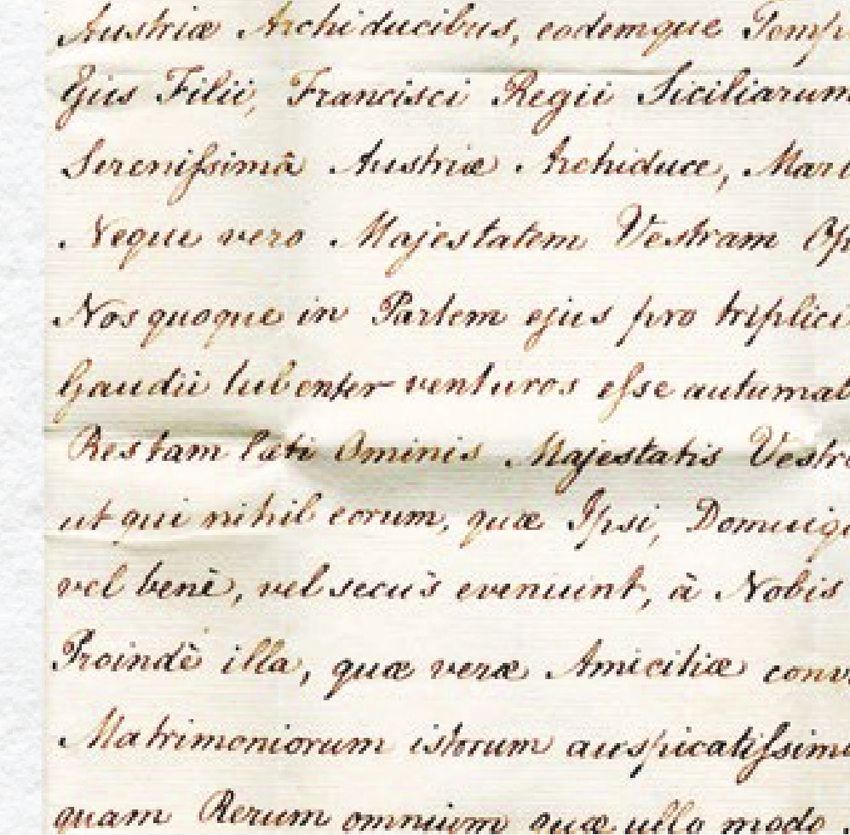
Few places in the world
can boast a rich past like the
south of Italy. In particular
Sicily, at the crossroads of
the Mediterranean sea, has
been home to many different
populations, falling under
different governance, including,
in chronological order, Phoenician,
Carthaginian, Greek, Roman,
Vandal, Ostrogoth, Byzantine,
Arab, Norman, the Holy Roman
Empire, Angevin, Aragonese,
Savoy, Austrian Hapsburg,
Bourbon, and finally Italian.
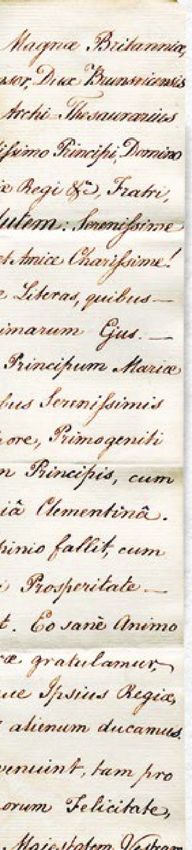
Fig. 1: Charles VI of Austria Holy Roman
                                                            Emperor 1685-1740.

               It is not difficult to understand why the study of the history of this land is among
               the most challenging and daunting of all. At this time it is appropriate to reassure
               (or to warn, depending on points of view) the reader about the scope of this
               short article, which will focus only on the period of the Bourbon domination, a
               little longer than 100 years. Far from addressing the complex issues of the real
               history, that which one reads about in the books of history, it will take a backroad
               approach, so to speak, to illustrate some of the formal yet personal issues affecting
               the lives of the members of the courts of Great Britain and of the Kingdom of the
               Two Sicilies using evidence from letters addressed to members of the royal Sicilian
               household. The historian will have to forgive the low-key approach, while the
               philatelist will have to live without any erudite dissertation of printings, watermarks
               or colour varieties. The postal historian however might - hopefully - find some
               interest in getting a less than usual exposure to the everyday life of kings, queens,
               princes and princesses, finding out first-hand about real friendships and court
               jealousies, intrigue, joy and sorrow, royal weddings and royal funerals. Being a
               modest student of postal history himself, the author has always been intrigued by
               the insights that can be contributed to the interpretation of ‘big’ history through
               the daily comments that can be gathered from the daily correspondence of small
               people. Here the writers are certainly not small people, but they are often talking
               about daily life events, which is why this material is interesting to the point of
               wanting to share it.

40   00_POST HORN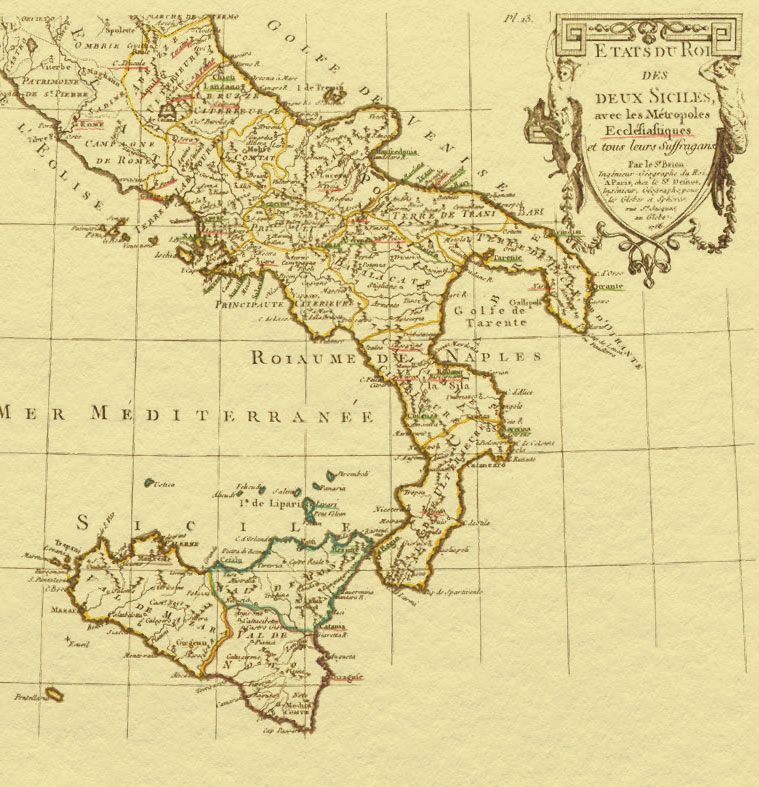
First one needs to take at least a cursory look at the
historical background of the events affecting the political
scene from the mid 18th Century to the mid 19thCentury,
which cannot be easily extricated from the backdrop of
the broader European scene.
The two separate kingdoms of Naples and of Sicily were
reunited in 1720 under the Austrian Emperor Charles VI.
In 1734, during the war of Polish Succession, Charles of
Bourbon, Duke of Parma (Fig. 3), son of Philip V of Spain
(Fig.2), took the Neapolitan and Sicilian crowns from the
Austrians. When in 1759, Charles became King Carlos III
of Spain he reassigned Sicily and Naples to his son, who
became Ferdinand III of Sicily and Ferdinand IV of Naples.
The Kingdom of the Two Sicilies remained under the
Bourbon line (Bourbon Two Sicilies) almost continually until
1860 with one only interruption during the Napoleonic
era. In fact Napoleon conquered the peninsular portion of
the kingdom during the War of the Third Coalition in 1806
and placed his brother Joseph Bonaparte (Fig.4) on the
throne of Naples as king. During those years Ferdinand
fled from Naples to Palermo, the capital of Sicily, his
other kingdom. Here the alliance he had previously made
with George III of the United Kingdom and Tory Prime
Minister the Earl of Liverpool saved him. The British
in fact protected Ferdinand and the island of Sicily
from Napoleonic conquest with the presence of Royal
Navy’s powerful fleet.
In 1808, as Joseph Bonaparte was given the crown
of Spain, Napoleon’s brother in law, Joachim Murat
(Fig. 5) had become the second Bonapartist king of
Naples. After the disastrous battle of Leipzig, Murat actually
switched sides for a while, abandoning Napoleon’s Grand
Army in an attempt to save his Neapolitan throne.
He eventually returned to Napoleon’s side, and together
with him he declared war on the Austrian Empire, leading
to the Neapolitan War in March of 1815.
At the Congress of Vienna that year the most vocal of
all Murat’s opponents was in fact the United Kingdom,
which had never recognised Murat’s claim to the throne
and moreover had been protecting Ferdinand in Sicily,
ensuring that he retained the Sicilian throne. Eventually
the Congress of Vienna restored King Ferdinand to his
throne, and to avoid further French attempts, it was
agreed that Ferdinand would reunite his kingdom under
a single crown. He thus became Ferdinand II of the Two
Sicilies. During the years that followed the Congress,
the unified Kingdom of the Two Sicilies maintained good

                                                                 41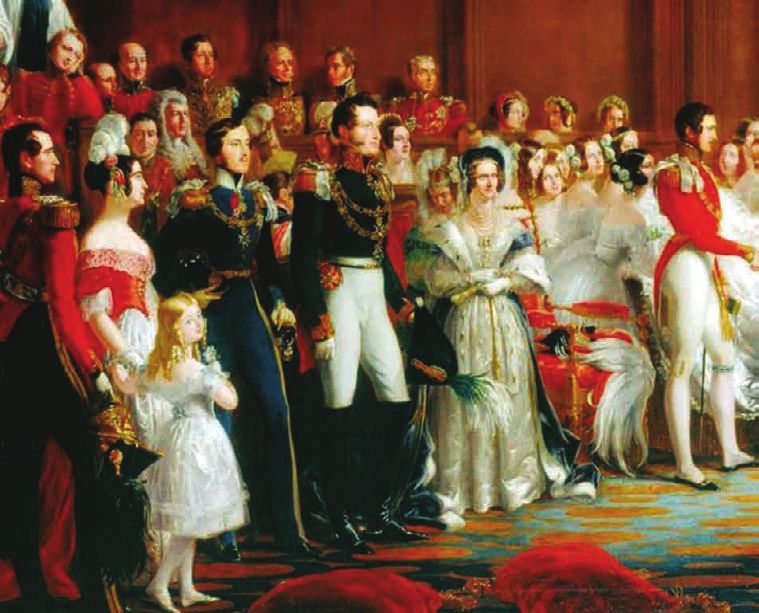
relations with Britain. The support against the Napoleonic
                    rulers that had been provided by the British was never
                    forgotten, and the interactions between the two courts
                    were intense and cordial.
                    The two countries exchanged some of their best
                    diplomats contributing to the maintenance of good
                    relations. However the post-Napoleonic era saw significant
                    changes in the European balance of power which affected
                    relations between Britain and Sicily as well.Between 1816
                    and 1848, Sicily experienced three popular revolts against
                    Bourbon rule, including the revolution of 1848, when the
                    island - but not the mainland - was fully independent of
                    Bourbon control for 16 months.
                    Among all the small Italian States created by the Congress,
                    the Kingdom of Sardinia took on itself a leading role in
                    exploiting the desire of national unity that had existed for
                    a long time, and that had been spurred on by the creation
                    of the Italian Republic during the years of the Napoleonic
                    era. Sardinia’s Prime Minister, Camillo Benso di Cavour (Fig.
                    6), was very active in promoting good relations with the
                    great powers, and in 1853 he managed to have Sardinia
                    become an ally to France and Britain in the war against
                    Russia (The “Crimean War”). The good will generated by
                    that alliance between Britain and Sardinia paid handsome
                    dividends over the long term, as it was instrumental in
                    obtaining British support for the unification of Italy under
                    the Sardinian crown. As part of the unification process,
                    in 1860 Sicily was invaded by a corps of volunteers, led
                    by Giuseppe Garibaldi, supported and secretly financed
                    by the Kingdom of Sardinia. They successfully conquered
                    the Kingdom of the Two Sicilies, and its territory was later
                    incorporated into the new Kingdom of Italy. The support of
                    the British Royal Navy to Sardinia was an important factor
                    in ensuring the success of the operations, which ultimately
                    led to the demise of the Kingdom of the Two Sicilies. In
                    an event-filled half a century, the British fleet had gone
                    from saving the throne of the Bourbons to helping to put
                    an end to it. The events that characterised that period are
                    the subject of scores of erudite books and treaties, and
                    the writer is certainly not in the position of adding much
                    to the many existing essays. However the review of some
                    of the correspondence between households - although
                    mostly formal and official - allows us to understand the
                    context and gives an insight into the actual feelings of the
                    writers. This review will only cover a few items, taken from
                    a recent publication to which readers are referred should
                    they be interested in the subject.

42   00_POST HORN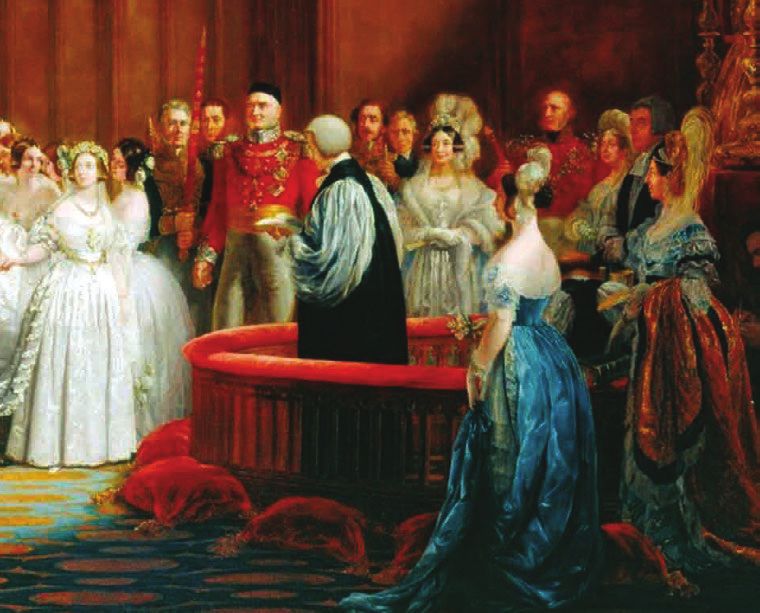
Fig. 2: Philip V of Bourbon         Fig. 4: Joseph Bonaparte      Fig. 7: King George I 1660-1727.
        King of Spain 1683-1746.         King of Naples 1768-1844.
                                                                        Fig. 8: King George II 1683-1760.
    Fig. 3: Charles III of Bourbon             Fig. 5: Joachim Murat   Fig. 9: King George III 1738 - 1820.
King of Naples and King of Spain          King of Naples 1767-1815.
                        1716-1788.
                                     Fig. 6: Camillo Benso of Cavour
                                                          1810-1861.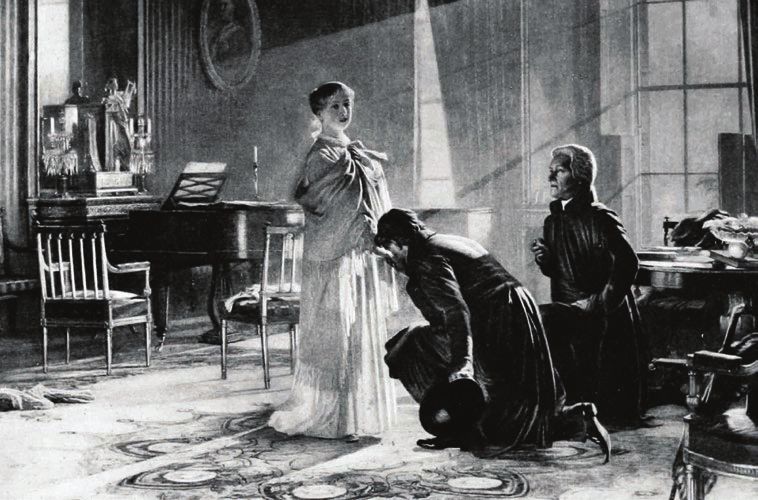
On the following pages we are presenting some items from the official correspondence addressed to the Court of the Two
                                                      th                                        th
Sicilies from Great Britain, from the middle of the 18 Century through to the middle of the 19 Century. They provide
an insight into the links between the two Courts and comprise both political and national issues as well as personal and
family ones. As such they help in better understanding this fascinating historical period.

The Stuart royal line became extinct with Queen Anne’s
death in 1714. After the death of her son William, just 11
years old, the Act of Settlement, passed by the Parliament,
determined that the crown should go to Protestant
descendants not married to Catholics, identifying in
Sophia of the Palatinate, a descendant of the Stuarts but
Protestant, the future ruling line. For this reason the next
king was George of Hanover, son of Sofia, born in Germany
and Protestant. He was preferred to a possible king born
in England but a Catholic, in adherence to the Anglican
schism begun centuries earlier by Henry VIII of Tudor.
Since then the royal family of the United Kingdom has
been predominantly German. At his death in 1727 George
I (Fig. 7) was succeeded by his oldest son, George II (Fig.8).
He too had been brought up with a German education,
and Hanover was as important to him as was the United
Kingdom. The first letter from this correspondence is
dated 26th of April 1743: George II from London writes to
Charles III of Naples and Sicily in support of his special
envoy. Probably this was a request to withdraw the army
that Charles III had sent in order to support the French
and Spanish troops, put under pressure by the British fleet.                                       Fig. 10: George II to Charles III
A few notes are here in order here.                                                                            on political issues.
The letters of the British Royals were transported by envoys

                                                                 Next is an example of the formal address panel on a letter
                                                                 from John Adolph II, Duke of Saxony-Weissenfels to his
                                                                 niece Maria Amalia (Fig. 12). Maria Amalia of Saxony (1724
                                                                 -1760) of the House of Wettin, daughter of Augustus III of
                                                                 Poland was the wife of Charles III and Queen of Naples and
                                                                 Sicily from 1738 to 1759, then Queen of Spain until her
                                                                 death in 1760. Of note in this letter (Fig. 13 - the only non-
                                                                 British letter in this review) is the incredible penmanship
                                                                 both on the panel and in the body of the letter, clearly not
                                                                 the Duke’s handwriting.

44      00_POST HORN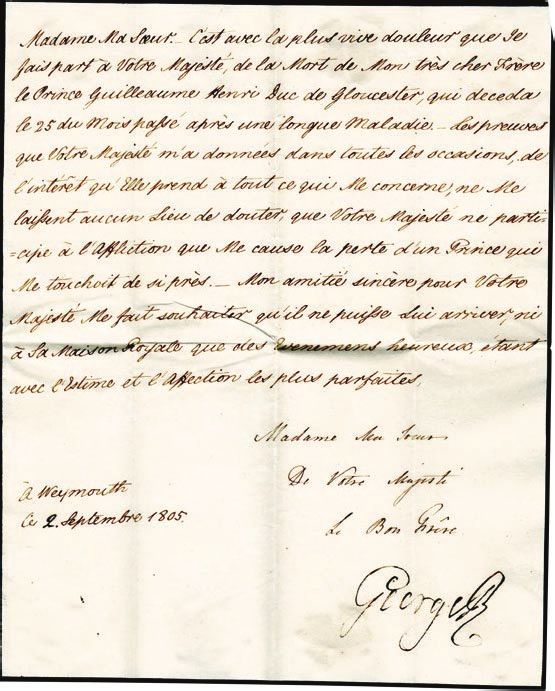
and therefore they do not carry any postage mark.
                                    This letter - as all others presented here - was written by a
                                    secretary, and the monarch only added a closing salutation
                                    and his signature. The language used was English, which
                                    was not King George’s preferred language. The languages
                                    used by royals in this century were English, French and
                                    sometimes Latin. The mother tongue of George II was
                                    German and that of Charles was Spanish. In some instances
                                    the address is very concise - like in this case - in some
                                    others it is a very formal panel, lengthy and convoluted.
                                    After the previous letter, politically oriented, the next goes
                                    into personal and family business. Dated 28th May 28th
                                    June 1743, George II writes to Charles III to congratulate
                                    him on the birth of his daughter Maria Isabella Anna (who
                                    died only six years later, in 1749), the third of the thirteen
                                    children that Carlo had by his wife Maria Amalia of Saxony.
                                    The letter was written in Hanover, the birthplace of George,
                                    where he faced the Franco / Prussian forces and defeated
                                    them at the battle of Dettingen only a few days later, on
                                    27 June 1743. Dettingen was the last time that a British
                                    monarch led his troops into battle. Notice the archival note
Fig. 11: George II to Charles III   added to the letter in Spanish (“Hannover 28 Mayo 1743 -
on family issues.                   Al Rey/ El Rey de Inglaterra/ Re.ca en 5 Julio”) - which was
                                    at the time the first language at King Charles’ court.

                                                               Fig. 12: Queen Maria Amalia of Naples
                                                                               and Spain 1724-1760.

                                                                            Fig. 13: Adolf of Saxony
                                                                            to Queen Maria Amalia.

                                                                                                45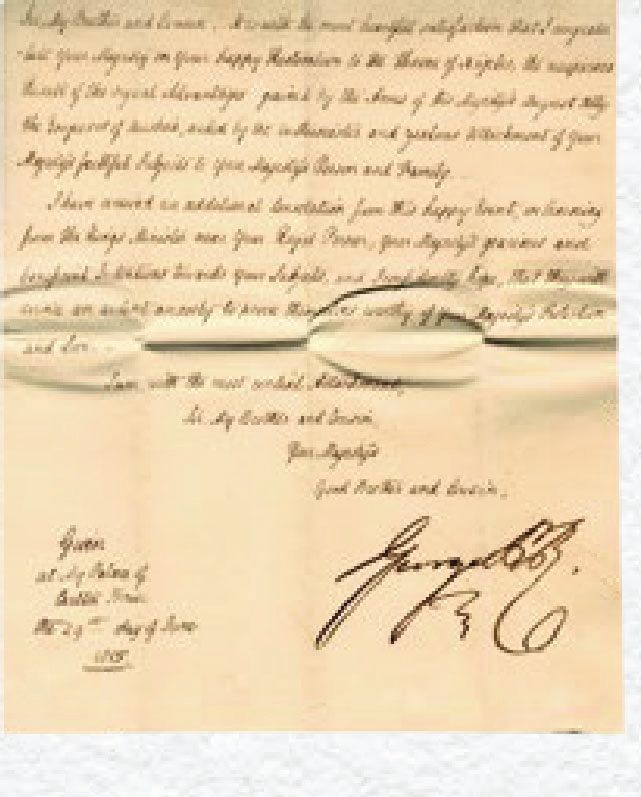
The next two letters presented were written on the 24th
                                                of September 1790: King George III (Fig. 9) - who had
                                                succeeded to the British throne from his grandfather
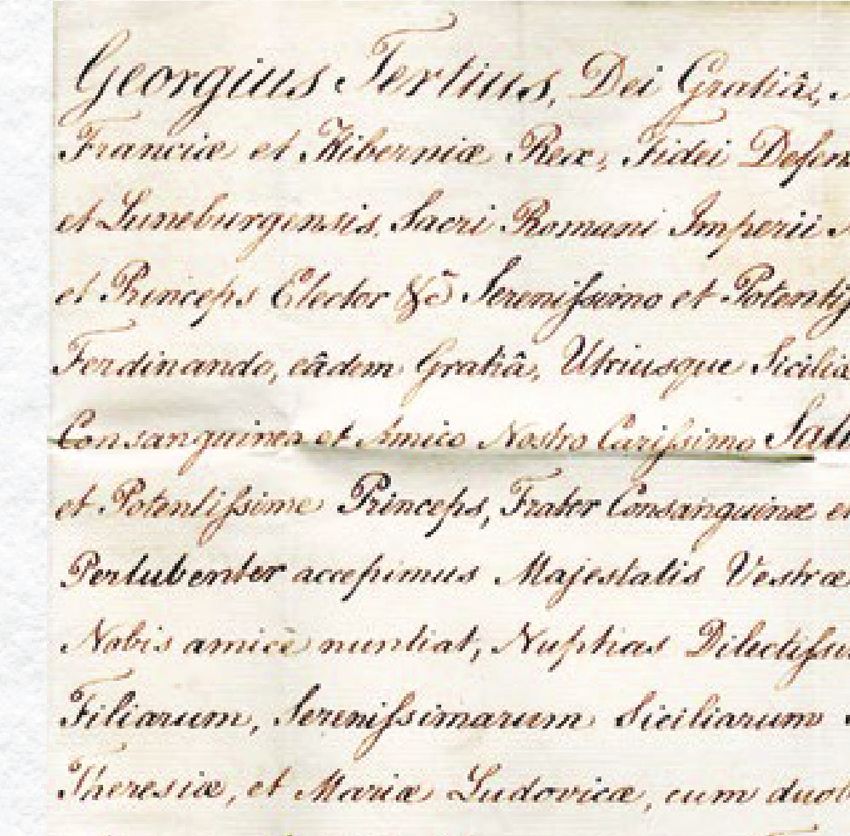
                                                George II in 1760 - signs his name in Latin to Ferdinand I -
                                                who in turn had succeeded his father in 1759 - about the
                                                wedding of his son the heir to the throne and of Ferdinand’s
Fig. 14: George III to Ferdinand I.             two daughters with members of the royal family of Austria
                                                (Fig. 14). The letter is certainly written by a secretary.
Right page:                                     Ferdinand I (1751-1825) was the son of Charles III and
Fig. 15: Queen Charlotte 1744-1818.             became regent of the thrones of Naples and Sicily in 1759 at
Fig. 16: Queen Charlotte to King Ferdinand I.   the age of nine, when his father became King of Spain.

46       00_POST HORN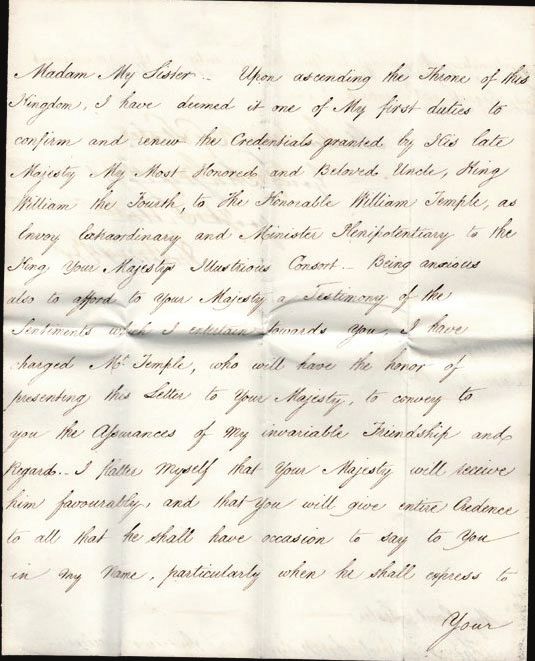
On that same day Queen Charlotte (Fig. 15), wife of King George III
also congratulated King Ferdinand I for the same triple marriage of his
son Francis, heir to the throne and two of his daughters, confirming
that this triple royal wedding - held in Naples on the 15th of August
1790 - was the centre of attention throughout Europe. Royal best
wishes were in fact received from the courts of Europe, including
France, where Louis XVI and Marie Antoinette were prisoners of the
revolution in the Tuileries. The wife of King Ferdinand I of Naples, Maria
Carolina, was the sister of Marie Antoinette; she gave eighteen children
to King Ferdinand. Both letters were written from St. James’ Palace, but
one should notice their different ‘feel’: the king’s is in Latin, and the address
panel is very formal (Serenissimo et Potentissimo Principi Domino Ferdinando Utriusque Siciliae
Regi & Fratri Consanguineo et Amico Nostro Carissimo”) while Queen Charlotte is writing in French
and her address panel is of the very simple type (A Monsieur mon Frere le Roi des deux Sicilies -
Fig. 16). The official letter of the King is countersigned by the Duke of Leeds, who served as Foreign
Secretary under William Pitt, while the Queen’s more private letter bears no countersignature.

                                                                                                   47
Fig. 17: George III to the Queen of Naples
about the death of his brother.
48 00_POST HORNFig. 18: The Prince Regent/King George IV. A much less formal letter from King George is
Fig. 19: The Prince Regent to the King of shown in Figure 17. This is in French, and it is
Naples after the Congress of Vienna.
addressed with a simple panel to the Queen
of Naples. It expresses the mourning for the
death of the king’s brother William Henry, Duke
of Gloucester and Edinburgh. In spite of the
somewhat formal tone, the pain of the king is felt,
and this is no surprise as William was very close
to the king. The letter was written in Weymouth,
a seaside resort that the king liked and where
he sojourned regularly as it helped him with the
symptoms of the disease that would eventually
have him labelled as the ‘Mad King’. By comparing this letter - written in 1805
- with the previous one written fifteen years earlier, one can see that the final
salutation is not in George’s handwriting anymore, and only the signature
appears to be the king’s original. After the death in 1810 of Princess Amelia, his
beloved daughter, the mental health of King George III worsened rapidly and
forced him to accept the ‘Regency Act’ of 1811.
This act conferred on his son the powers and title of Prince Regent, which he
maintained until his father’s death in 1820, the year in which he ascended
to the throne with the name of George IV. The decade from 1810 -1820 saw
some fundamental changes on the European scene, including the end of the
Napoleonic era and the return to the status quo of pre-Napoleon days, which
was formalised by the Congress of Vienna of 1815.
Figure 19 shows a letter that the Prince Regent wrote in June 1815, the
same month that the Congress had finished its work and had re-drawn the
borders of post-Napoleonic Europe. King Ferdinand I had the Kingdom of
Naples returned, which was unified with the Kingdom of Sicily with the name
of Kingdom of the Two Sicilies. The congratulations that the Prince Regent
expresses are a testimony to the real support that Britain had given
to King Ferdinand throughout the Napoleonic years. During that time it
was thanks to the presence of the Royal Navy that Napoleon could not
conquer Sicily, as it provided to Ferdinand’s court a safe haven in Palermo.
Notice that in spite of the political and formal nature of this letter, there is
no countersignature by the Secretary for Foreign Affairs on it, and that the
language is now English. The letter was written from the Palace of Carlton
House, which was the Prince’s own residence (note the endorsement “My
Palace”). Last but certainly not least note is that he signs as ‘George PR’,
where PR stands for Prince Regent and that the final salutation - as in most
of his official letters - appears not to be the Prince’s handwriting. This is not
surprising as George’s lifestyle was quite extreme, his habits decadent and his
conditions - including a severe form of gout - made it painful for him to hold a
pen in his hands.
49Going from big picture politics to very Fig. 20: The Prince Regent to King Ferdinand
about the death of the Princess of Wales.
personal issues, Fig. 20 shows the
letter with which the Prince Regent
informs King Ferdinand I of the death
of Charlotte, Princess of Wales (Fig. 21).
She was the daughter of the Regent
and of Caroline of Brunswick (Fig. 23),
his estranged wife, and his only
legitimate child. Charlotte who had
married Prince Leopold of Belgium,
died on November 6th 1817 delivering
a stillborn child. The letter mentions
that “…the melancholy event took
place at two and a half this morning”.
George’s feelings must have been
quite raw (Fig. 22) - he was very fond
of Charlotte - and the fact that he
was addressing this mournful event
just a few hours after it occurred is
quite surprising.
Upon the death of his father, king
George III, on January 29, 1820, the
Prince Regent finally ascended to the
throne as King George IV. Although
that shown as Figure 24 is another
mourning letter written only two
days after his father’s death, George’s
excitement on ascending to the
‘throne of this Imperial Kingdom’
is palpable, and conspicuous not
only through the words he uses but
also through the unusual length
of his autograph note, especially
considering the previously mentioned
Fig. 21: King George IV’s daughter
Charlotte the Princess of Wales.
Portrait by George Dawe about 1816
Fig. 22: The Prince Regent / King George IV.
‘A Voluptuary under the horrors of digestion’ George IV
(Prince Regent 1811-1820) when Prince of Wales,
showing his extravagance, grossness and selfindulgence.
Cartoon by James Gilray (1756-1815), published London 1792.
Fig. 23: King George IV’s wife Caroline of Brunswick 1768-1821
Portrait c. 1820 by James Lonsdale,
“Principal Painter in Ordinary to the Queen”.Fig. 24: The Prince Regent now King George difficulty that he had in holding
IV about the death of the King his father.
the pen. This is the first time that
he can finally drop the P from his
signature and sign as King (‘George
R’). The letter is countersigned by
Lord Castlereagh, Napoleon’s staunch
enemy, and a great supporter of
the Kingdom of the Two Sicilies;
it is possible that he might have
been the one inspiring the sincere
wishes in this letter for a continued
collaboration between the two
crowns.William Henry Duke of Clarence (1765 - 1837) (Fig. 25) was the third son of George III and younger brother of George IV. On the death of his brother, which occurred on the 26th of June, 1830, he became King of the United Kingdom and Hanover with the name of William IV. He was the last king and the penultimate British monarch of the House of Hanover. This letter (Fig. 26), written from Windsor Castle, served the purpose of introducing to the King of Naples the new British Envoy Lord Ponsonby, and it is a rare case where the person charged with the delivery is named in the letter; Lord Ponsonby’s mission was over by November of that same year. An intriguing question is raised by the correction of the last word of King William’s salutation: it appears as if the expression “your Majesty’s Good Friend” was changed to read “Your Majesty’s Good Brother”. There is no countersignature and the correction appears to be in the King’s own handwriting. Fig 25: King William IV. Fig 26: King William IV to the King of Naples re. the appointment of Lord Ponsonby. 52 00_POST HORN
Fig. 27: Queen Victoria to the Queen of       Fig. 28: 20th June 1837: the Archbishop of   On June 20, 1837, King William IV
Naples re. her ascending to the throne upon   Canterbury and Lord Conyngham announce
                                                                                           died, leaving no children that could
the death of her uncle King William IV.       to Victoria that she is now Queen.
                                                                                           inherit his titles. The crown passed
                                                                                           to the daughter of the deceased
                                                                                           younger brother of the last two kings,
                                                                                           the Duke of Kent. Her name was
                                                                                           Alexandrina Victoria, and she had
                                                                                           turned 18 years old only one month
                                                                                           before her uncle’s death. One week
                                                                                           after the event in this letter - written
                                                                                           from Kensington Palace where she
                                                                                           had been raised almost in isolation by
                                                                                           her mother - the 18 year old who had
                                                                                           chosen to be queen with the name
                                                                                           of Victoria informs her good sister the
                                                                                           Queen of the Two Sicilies about the
                                                                                           death of her uncle. Mourning letters
                                                                                           can also convey information about
                                                                                           important changes, and this one
                                                                                           (Fig. 27) is no exception.
Fig. 27: Queen Victoria to the Queen of Naples
re. her ascending to the throne upon the
death of her uncle King William IV.Fig. 29: Queen Victoria 1819-1901.
Fig. 30: Queen Victoria to the Queen of Naples
about her wedding to Prince Albert.
In fact “…upon ascending to the throne of this Kingdom”
Victoria also gives reassurance about her intention of
continuing the good relation between the two crowns,
and she confirms the choice of Britain’s envoy to Naples,
ie. William Temple, who was also the one who delivered
the letter.
Of interest here is the fact that the Queen is writing to the
Queen of Naples rather than to the King.
The initial years of Queen Victoria’s reign were fraught
with challenges.
Internally she had to overcome her mother’s
overpowering temperament, and externally she had to
deal with a public opinion disenchanted with the many
excesses and decadence that had characterised the
royalty of the first four decades of the century.
Her youth, her qualities and her personal situation
however helped her to overcome the initial difficulties,
and to turn public opinion around. An important help
came with her wedding to the Belgian Prince Albert of
Saxe-Coburg. The couple - so different from the previous
royals - inspired Britain and gave the country leadership
through their example.
55They were married in the Royal Chapel of St. James’ Palace in many areas, social, political and industrial, becoming on February 10th, 1840. the prominent world power. On the other hand the Their union was a happy one, cemented by real love, Kingdom of the Two Sicilies was caught in a negative and it is tempting to think that it is not by chance that spiral and by 1860 it ceased to exist, invaded, conquered the letter with which Victoria informs the Queen of and subjugated by Sardinia without a war ever being Naples about the “…event so important to me and to my declared. In spite of that, many battles and armed kingdom…” was written at Windsor Castle on February confrontations took place, which this time saw the Royal 14th. What is evident is that Victoria - now not yet 21 years Navy’s intervention against the Two Sicilies. The result old -was not away from her royal duties for too long, was that as of October 21st 1860 Naples and all the South but at the same time she was clearly not ignoring her were officially annexed to the North, and they became a private life. As a matter of fact her first child - Victoria province of the new kingdom of Italy. That put an end to the Princess Royal, future wife of Kaiser Frederick III the kingdom of Francis II - the last King of Naples - and of Germany - was born in November of 1840 - nine therefore to the correspondence used for this review. months after the royal wedding. The hope is that the reader who has had the patience to During the sixty-three years of the reign of Queen read this far has appreciated the unusual approach Victoria Great Britain experienced significant progress to history afforded by the analysis of these few letters.
Fig. 31: Prince Albert of Saxe Coburg .
Fig. 32: Queen Victoria in her wedding dress.
Fig. 33: February 10th, 1840: The Wedding
in the Royal Chapel of St. James.
You can also read


