Patient health records and confidentiality - Parliament.uk
←
→
Page content transcription
If your browser does not render page correctly, please read the page content below

BRIEFING PAPER
  Number 07103, 25 May 2018

  Patient health records and                                                                By
                                                                                            Elizabeth Parkin
  confidentiality
                                                                                            Inside:
                                                                                            1. Accessing and sharing patient
                                                                                               health records
                                                                                            2. Sharing confidential patient
                                                                                               information
                                                                                            3. Electronic health records
                                                                                            4. NHS data and cyber security

www.parliament.uk/commons-library | intranet.parliament.uk/commons-library | papers@parliament.uk | @commonslibrary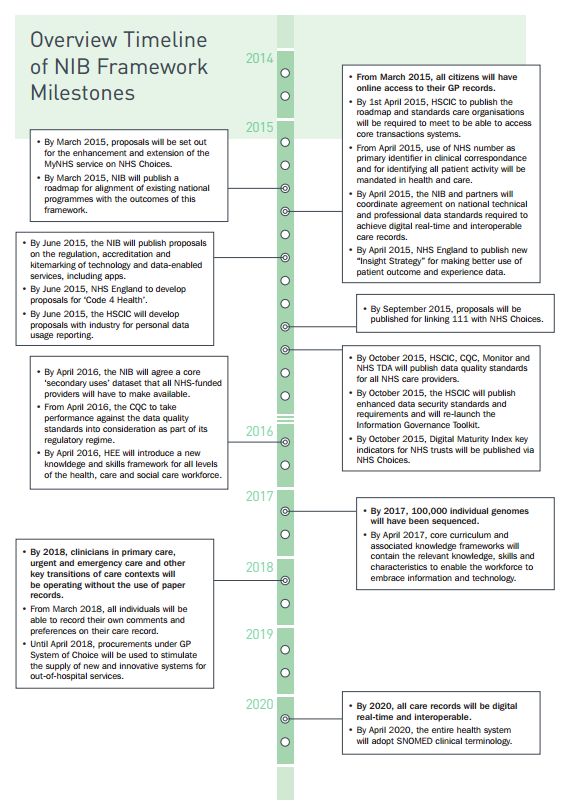
Number 07103, 25 May 2018   2

Contents
Summary                                                                             3
1.    Accessing and sharing patient health records                                  4
1.1   Charges to access records                                                     5
1.2   Limiting access to health records                                             6
1.3   Parental access to child health records                                       6
1.4   Access to deceased patients’ health records                                   7
2.    Sharing confidential patient information                                      8
2.1   NHS Digital guidance on confidentiality                                       9
2.2   National Data Guardian for health and care                                    9
      Caldicott principles                                                         10
2.3   National data opt-out programme                                              11
2.4   Legal and statutory disclosures of information                               12
      Disclosure of NHS data to the Home Office                                    13
2.5   Public interest disclosures of patient information                           14
2.6   Deceased patients                                                            14
2.7   Assessment of capacity to give or withhold consent                           16
3.    Electronic health records                                                    17
3.1   NHS ‘paper-free’ by 2020                                                     17
3.2   Summary Care Records                                                         20
4.    NHS data and cyber security                                                  21
4.1   National Data Guardian review (2016)                                         21
4.2   Government response (2017)                                                   22

Cover page image copyright: Attributed to:   And you haven’t been to your doctor
because? By Alex Proimos. Licensed under CC BY 2.0 / image cropped.
3 Patient health records and confidentiality
Summary
Individuals have a right to access their own health records, and in limited circumstances,
access to the records of other people. The Government has made a commitment that patients
should gain access to their health records within 21 days following a request. Access to health
records may also be granted in limited circumstances for relatives or in the case of deceased
patients.
This briefing describes how patients may request access to their records, and the
circumstances in which access to the records of others may be allowed, including new
requirements introduced by the EU General Data Protection Regulation (GDPR) and the Data
Protection Act 2018. It also describes statutory and public interest disclosures of patient
information; information sharing rules for people who lack mental capacity; and access to
information on hereditary conditions for relatives.
The Government has encouraged the NHS to make better use of technology, so that patients
can manage their own healthcare needs, whilst ensuring that data remains safe at all times. It
has also committed to making all patient and care records digital, real-time and interoperable
by 2020.
This briefing also outlines safeguarding arrangements for confidential patient information. In
2013, a review was carried out by the National Data Guardian for health and care, Dame Fiona
Caldicott, to ensure that there is an appropriate balance between the protection of patient
information and the use and sharing of information to improve care.
In 2016, a subsequent review by Dame Fiona Caldicott looked at data security and patient opt-
outs for the use of their data. Recommendations from this review led to a number of changes
in NHS data security policy, and the launch in May 2018 of a new national data opt-out
programme.
This briefing relates to the NHS in England, unless otherwise stated.
Contributing authors Alex Bate: Section 1 & 1.1Number 07103, 25 May 2018 4
1. Accessing and sharing patient
health records
In 2010, the Department of Health produced Guidance for Access to Health
Records Requests. This covered legislative basis for patients’ access to their
health records:
The Data Protection Act (DPA) 1998 – governs rights for living
individuals to access their own records. The right can also be
exercised by an authorised representative on the individual’s behalf.
The Access to Health Records Act 1990 – governs rights of access to
deceased patient health records by specified persons.
The Medical Reports Act 1988 – governs the right for individuals to
have access to reports, relating to themselves, provided by medical
practitioners for employment or insurance purposes 1
As of 25 May 2018, access to patient health records is also governed by the
EU General Data Protection Regulation (GDPR), enacted by the Data
Protection Act 2018. The new data protection legislation will also repeal the
1998 DPA. No new Departmental guidance on access to health records has
yet been published.
Under current legislation, individuals have a right to access their own health
records, and in limited circumstances, to access information about other
people. This right extends equally to all relevant records relating to living
individuals, including records held in the private health sector and health
professionals’ private practice records.
When an individual requests access to a health record, the request is
processed by a ‘data controller’, which could be a GP or the organisation
that a health professional is employed by.
Under the 1998 DPA, an individual was required to request access to their
health record in writing, although the 2010 guidance did set out a view that
requests could be made verbally where a patient was unable to submit a
written request. Under new data protection legislation there are no
requirements for a patient to request their records in any specific way.
Records must be provided in the same form that they were requested
(electronic, hard copy, verbal etc.), where it is practicable to do so.
The Information Governance Alliance (IGA) advises medical data controllers
that regardless of whether the request is made verbally or in writing, they
are required to check that the requestor is who they say they are. 2
GDPR also reduces that amount of time within which requested medical
records must be provided from 40 days to one month. However, as set out
in the 2010 guidance, the Government has made a commitment that health
1 Department of Health, Guidance for Access to Health Records Requests, February 2010,
page 8.
2 Information Governance Alliance, The EU General Data Protection Regulation: The Key
Points for GPs, March 20185 Patient health records and confidentiality
record requests should normally be handled within 21 days, despite the
longer legal time limit. 3
Hospital records are kept for a minimum of eight years after treatment and
GP records for a minimum of 10 years after a patient’s death. NHS
organisations should retain records in accordance with the retention
schedules outlined in Appendix Three of the 2016 IGA publication, Records
Management Code of Practice for Health and Social Care.
1.1 Charges to access records
Previously, under the Data Protection Act 1998 (DPA), data controllers of
health records could charge between £10 and £50 for an access request,
depending on where the records were held. However, since new data
protection legislation came into force on 25 May 2018, record holders are
no longer able to charge for accessing records.
The exception to this is where requests are ‘manifestly unfounded or
excessive’. In these cases, the data controller can charge a reasonable fee
to cover the administrative costs or refuse to act on the request. No specific
amount is set out in legislation, but the Data Protection Act 2018 allows for
the Secretary of State to make regulations with regards to maximum fee
levels.
However, the Government has said that insurance companies should
continue to use the Access to Medical Reports Act 1988 to obtain summary
medical reports required for underwriting purposes from GPs. The 1988 Act
allows GPs to charge reasonable fees for such reports.
A PQ answered in July 2018 explains the change:
The European Union General Data Protection Regulation (GDPR)
came into effect from 25 May, replacing the Data Protection Act
1998. Within the updated regulation is the right of access, which
gives individuals the right to obtain a copy of their personal data,
including, from a health perspective, copies of medical records.
Previously, under the Data Protection Act 1998, organisations were
able to make a charge for dealing with the administration required in
such a request. Under the GDPR, the ability in law to levy such
charges has been removed in most cases.
One exception to this principle is medical information required by
insurance companies for underwriting purposes. The right of access
under GDPR confers more personal information than is needed or is
justified for insurance underwriting. Accordingly, insurance
companies should instead use the established mechanism of the
Access to Medical Reports Act 1988 (AMRA) to obtain summary
medical reports from general practitioners (GPs). The AMRA allows
the GP to charge a reasonable fee to cover the cost of copying the
report. 4
3 Department of Health, Guidance for Access to Health Records Requests, February 2010,
page 10
4 PQ 162134 [on Medical Records], 12 July 2018Number 07103, 25 May 2018 6
1.2 Limiting access to health records
There are certain circumstances in which full access to a patient’s health
records may be denied. These include cases where the release of health
records is likely to cause serious harm to the physical or mental health of
the subject or another individual. Therefore prior to release, the data
controller should consult with either:
• The health professional responsible for the individual;
• Where there is more than one such health professional, the most
suitable professional;
• Where no such professional is available, one with the experience and
qualifications to advise accordingly. 5
Where records do disclose information related to another individual, the
data controller is not obliged to release the information, except in the
following circumstances:
• The third party is a health professional who has compiled or
contributed to the health records or who has been involved in the
care of the patient.;
• The third party, who is not a health professional, gives their consent
to the disclosure of that information;
• It is reasonable to disclose without that third party’s consent. 6
1.3 Parental access to child health records
The British Medical Association (BMA) has produced guidance on
confidentiality and the disclosure of health records. This explains that
children who are aged 12 or over are generally expected to have to have
capacity to give or withhold their consent to the release of information. In
Scotland, children aged 12 and over are presumed to have capacity to
consent, unless it is otherwise shown that they do not.
If a child has the capacity to give or withhold consent to the release of
information from their health records, health professionals should respect
their wishes. However, the guidance does state that every reasonable effort
must be made to persuade the child to involve parents or guardians:
Competent children
[…]
If the child is competent to understand what is involved in the
proposed treatment, the health professional should, unless there are
convincing reasons to the contrary, for instance abuse is suspected,
respect the child’s wishes if they do not want parents or guardians to
know. However, every reasonable effort must be made to persuade
the child to involve parents or guardians particularly for important or
life-changing decisions.
5 The Data Protection (Subject Access Modification) (Health) Order 2000, SI 2000/413.
Similar provisions are included in Schedule 3 of the Data Protection Act 2018.
6 Section 7(4), the Data Protection Act 1998 and the Data Protection (Subject Access
Modification) (Health) Order 2000, SI 2000/413. Similar provisions are included in section
94(6) of the Data Protection Act 2018.7 Patient health records and confidentiality
Children who lack capacity
The duty of confidentiality owed to a child who lacks capacity is the
same as that owed to any other person. Occasionally, young people
seek medical treatment, for example, contraception, but are judged
to lack the capacity to give consent. An explicit request by a child that
information should not be disclosed to parents or guardians, or
indeed to any third party, must be respected save in the most
exceptional circumstances, for example, where it puts the child at risk
of significant harm, in which case disclosure may take place in the
‘public interest’ without consent. Therefore, even where the health
professional considers a child to be too immature to consent to the
treatment requested, confidentiality should still be respected
concerning the consultation, unless there are very convincing reasons
to the contrary. Where a health professional decides to disclose
information to a third party against a child’s wishes, the child should
generally be told before the information is disclosed. The discussion
with the child and the reasons for disclosure should also be
documented in the child’s record. 7
There may also be instances where a relative may be provided access to
patient information (see section 2.5).
1.4 Access to deceased patients’ health records
Access to deceased patients’ health records is governed by the Access to
Health Records Act 1990.
Under the terms of the Act, someone will only be entitled to access a
deceased person’s health records if they are either:
• a personal representative (i.e. the executor or administrator of the
deceased person’s estate);
• someone who has a claim resulting from the death (this could be a
relative or another person)
Access to a deceased person’s health records may not be granted if a
patient requested confidentiality whilst they were alive. No information can
be revealed if the patient requested non-disclosure.
Disclosure may also not take place if there is a risk of serious harm to an
individual, or if records contain information relating to another person.
For further information on patient confidentiality relating to deceased
patients, see section 2.6.
7 BMA, Confidentiality and disclosure of health information tool kitNumber 07103, 25 May 2018 8
2. Sharing confidential patient
information
The NHS Constitution explains that patients have the right to privacy and
confidentiality, the right to expect the NHS to keep patient confidential
information safe and secure, and the right to be informed about how their
information is used. 8
Patients also have the right to request that their confidential information is
not used beyond their own care and treatment, to have their objections
considered, and, where their wishes cannot be followed, to be told the
reasons including the legal basis. 9
Policies on confidential patient data seek to strike a balance between the
protection of patient information, and the use and sharing of information
to improve care, such as for research purposes.
Patient information that is kept by health and social care providers must be
securely safeguarded. Patient-doctor confidentiality is considered one of
the cornerstones of medical practice. The BMA’s Confidentiality and
disclosure of health information tool kit states that:
Confidentiality is an essential requirement for the preservation of
trust between patients and health professionals and is subject to
legal and ethical safeguards. Patients should be able to expect that
information about their health which they give in confidence will be
kept confidential unless there is a compelling reason why it should
not.
Individuals may also expect that relevant health information is shared
among their care team to ensure high quality care, an integrated service
and a better experience for patients. The Health and Social Care (Safety and
Quality) Act 2015 introduced a legal duty for health and social care
professionals to share patient information where they consider that the
disclosure is likely to facilitate patient care and is in the patient’s best
interest. The BMA opposed the introduction of this requirement, arguing in
2015 that:
Health information sharing is governed by professional obligations to
share relevant information for effective patient care, underpinned by
patient consent. It is unnecessary to replace this with a statutory
framework without clear justification as to why it is needed and
which risks weakening confidentiality safeguards that currently
apply. 10
The sharing of anonymised patient information more widely can potentially
bring about improvements to patient care. For example, tracking and
analysis of patient health information can help with medical research and
with the design of more effective services. Information used in this way
must be anonymised and untraceable to individuals before it is released for
8 NHS England, NHS Constitution, page 8
9 NHS England, NHS Constitution, page 8
10 BMA, Health and Social Care (Safety and Quality) Bill, House of Lords, Committee stage,
13 March 20159 Patient health records and confidentiality
this purpose. NHS Digital is responsible for ensuring that data is suitable for
being used in this way.
2.1 NHS Digital guidance on confidentiality
NHS Digital (formerly the Health and Social Care Information Centre –
HSCIC) has a major role in implementing these recommendations. The
Health and Social Care Act 2012 contained a provision that NHS Digital has a
statutory duty to produce a Code of Practice for handling confidential
information covering “the practice to be followed in relation to the
collection, analysis, publication and other dissemination of confidential
information concerning, or connected with the provision of health services
or of adult social care in England”.
In September 2013, HSCIC published A guide to confidentiality in health and
social care, which set out the confidentiality rules that should be followed
in care settings run by the NHS or publicly funded adult social care services.
The guide was based on the Caldicott principles and incorporated the good
practice recommended by the Information Governance Review (see section
2.2).
The HSCIC guide set out five key principles for confidentiality:
• Confidential information about services users or patients
should be treated confidentially and respectfully
• Members of a care team should share confidential
information when it is needed for the safe and effective care
of an individual
• Information that is shared for the benefit of the community
should be anonymised
• An individual’s right to object to the sharing of confidential
information about them should be respected
• Organisations should put policies, procedures and systems in
place to ensure the confidentiality rules are followed 11
The review recommended that senior individuals are appointed to be
responsible for following confidentiality procedures, known as ‘Caldicott
Guardians’.
2.2 National Data Guardian for health and care
In November 2014, Dame Fiona Caldicott was appointed as the first
National Data Guardian (NDG) for health and care, to ensure patient trust in
the use of their data and to review the balance between the protection and
sharing of this data. The NDG’s terms of reference set out the three main
principles that guide the role:
• encouraging clinicians and other members of care teams to
share information to enable joined-up care, better diagnosis
and treatment
11 The guide is supported by a references document which provides more detailed
information for organisations and examples of good practice.Number 07103, 25 May 2018 10
• ensuring there are no surprises for the citizen about how their
health and care data is being used and that they are given a
choice about this
• building a dialogue with the public about how we all wish
health and care information to be used, to include a range of
voices including commercial companies providing drugs and
services to the NHS, researchers discovering new connections
that transform treatments, and those managing the services. 12
The 2017 Conservative General Election manifesto set out a commitment to
“put the National Data Guardian on a statutory footing to ensure data
security standards are properly enforced.” 13 This is currently being taken
forward through a Private Member’s Bill, the Health and Social Care
(National Data Guardian) Bill 2017-19, sponsored by Peter Bone MP. The
Bill will have its Committee Stage on 6 June 2018.
Caldicott principles
In 2013, Dame Fiona Caldicott led a review into information governance of
health data, Information: To Share Or Not To Share?
The Review set out seven revised principles to guide information
governance – known as the ‘Caldicott principles’:
1. Justify the purpose(s)
Every proposed use or transfer of personal confidential data within or
from an organisation should be clearly defined, scrutinised and
documented, with continuing uses regularly reviewed, by an
appropriate guardian.
2. Don’t use personal confidential data unless it is absolutely
necessary
Personal confidential data items should not be included unless it is
essential for the specified purpose(s) of that flow. The need for
patients to be identified should be considered at each stage of
satisfying the purpose(s).
3. Use the minimum necessary personal confidential data
Where use of personal confidential data is considered to be essential,
the inclusion of each individual item of data should be considered
and justified so that the minimum amount of personal confidential
data is transferred or accessible as is necessary for a given function to
be carried out.
4. Access to personal confidential data should be on a strict need-
to-know basis
Only those individuals who need access to personal confidential data
should have access to it, and they should only have access to the data
items that they need to see. This may mean introducing access
controls or splitting data flows where one data flow is used for
several purposes.
5. Everyone with access to personal confidential data should be
aware of their responsibilities
12 The National Data Guardian’s Panel: Terms of Reference, last accessed 25 May 2018
13 Conservative and Unionist Party, Forward, Together: Our Plan for a Stronger Britain and
Prosperous Future, May 2017, p8011 Patient health records and confidentiality
Action should be taken to ensure that those handling personal
confidential data — both clinical and non-clinical staff — are made
fully aware of their responsibilities and obligations to respect patient
confidentiality.
6. Comply with the law
Every use of personal confidential data must be lawful. Someone in
each organisation handling personal confidential data should be
responsible for ensuring that the organisation complies with legal
requirements.
7. The duty to share information can be as important as the duty to
protect patient confidentiality.
Health and social care professionals should have the confidence to
share information in the best interests of their patients within the
framework set out by these principles. They should be supported by
the policies of their employers, regulators and professional bodies.
The Caldicott Review also made 26 recommendations covering areas such
as patients’ access to electronic care records; information sharing among an
individual’s care team; opting-out of information sharing; and breaches of
information governance.
The Government published its Response to the Caldicott Review in
September 2013, and accepted in principle each of the 26
recommendations. The Government’s response outlined how these
recommendations will be implemented, and includes key commitments for
health and social care providers, NHS England and organisations such as the
Care Quality Commission (CQC).
2.3 National data opt-out programme
On 25 May 2018, NHS Digital launched the national data opt-out
programme, a tool that allows patients to choose to opt out of their data
being shared outside of the NHS. This is an online system, but a non-digital
alternative is provided for patients who cannot or do not want to use an
online system.
The national programme will replace the existing system of Type 1 and Type
2 opt-outs (as well as a number of local opt-out systems). Type 2 opt-outs,
where patients register with their GP to prevent their information being
shared with organisations outside the NHS, will be automatically converted
to the national data opt-out programme, and patients will be informed
individually.
Type 1 opt-outs, where patients register with their GP practice to prevent
their identifiable data leaving the practice for purposes beyond their
individual care, will continue to be respected until 2020 when the
Department of Health and Social Care will consult with the NDG on their
removal.
Although the opt-out tool was launched on 25 May 2018, health and care
organisations have until March 2020 to uphold patient choices.
The programme was originally planned to have been launched in March
2018, but was delayed to coincide with new data protection legislation
coming into force.Number 07103, 25 May 2018 12
The new system is based on a recommendation by the NDG, Dame Fiona
Caldicott, in the 2016 Review of Data Security, Consent and Opt-Outs. The
review was launched following the suspension of the national Care.data
programme, due to concerns over the opt-out system in place and over
patient confidentiality. 14 Following the review, the then Life Sciences
Minister George Freeman confirmed in July 2016 that Care.data was to be
closed. 15
The Government’s response to the NDG review confirmed that the national
data opt-out programme would not apply to information anonymised in
line with the Information Commissioner’s Office Code of Practice on
Anonymisation.
2.4 Legal and statutory disclosures of information
There are certain circumstances in which a health professional is required
by law to disclose medical information, regardless of patients consent. For
example, statutory disclosures are required under the following legislation,
although this is not an exhaustive list:
• Health Protection (Notification) Regulations 2010 – a health
professional must notify local authorities about any person suspected
of having a range of listed conditions, including food poisoning,
measles and tetanus.
• Abortion Regulations 1991 – a doctor carrying out a termination of
pregnancy must notify the Chief Medical Officer, giving the
individual’s date of birth and postcode.
• Reporting of Injuries, Diseases and Dangerous Occurrences
Regulations 2013 – deaths, major injuries and accidents resulting in
three days off work, as well as certain diseases and dangerous
occurrences, must be reported.
• Female Genital Mutilation Act 2003 – medical professionals must
inform the chief police officer for the area where they learn of or
suspect female genital mutilation of a girl aged under 18.
Additionally, some statues allow, rather than mandate, disclosure of
confidential information. For example, under the Children Act 1989,
disclosure is permitted to other organisations such as the police or social
services if there is a suspicion that a child is suffering, or is at risk of
suffering, significant harm. 16 Under section 261 of the Health and Social
Care Act 2012, NHS Digital is permitted to disclose information in certain
circumstances, including in connection with the investigation of a criminal
offence.
In contrast, some statutes require health professionals to restrict disclosure
of certain confidential information. For example, under the Gender
Recognition Act 2004, it is an offence to disclose protected information
such as a person’s gender history after that person has changed gender.
14 Care.data was a system to extract and link large amounts of patient data collected as
part of NHS care. Further background information on Care.data can be found in the
archived Commons Library briefing paper SN06781 (2014)
15 HCWS62, 6 July 2016
16 BMA, Confidentiality and disclosure of health information tool kit – Card 9: Legal and
statutory disclosures13 Patient health records and confidentiality
Patient confidentiality can also be overridden under section 251 of the NHS
Act 2006, which allows for the Secretary of State to set aside the duty of
confidentiality for the purposes of research, audit and other medical
purposes that are not directly related to a patient’s care. 17
Disclosure of NHS data to the Home Office
Section 261 of the Health and Social Care Act 2012 is the legal basis of a
Memorandum of Understanding (MoU) between the Home Office, NHS
Digital and the Department of Health, published in 2017. This allowed NHS
Digital to pass information about patients to the Home Office, where the
individual was suspected of an immigration offence.
Concerns were raised by organisations, including Public Health England,
that the passing of confidential information to the Home Office could deter
individuals from seeking healthcare, which could in turn impact on public
health. In light of these concerns, in January 2018, the Chair of the Health
Select Committee, Dr Sarah Wollaston MP, wrote to NHS Digital requesting
that they withdraw from the MoU. 18 A subsequent letter to the Committee
from the Government noted these concerns, but argued that there was no
cause for a significant change of approach. 19
During the Report Stage debate of the Data Protection Bill 2017-19, Dr
Wollaston proposed an amendment to the Bill, which would have meant
that NHS Digital could only share data when requested by a police force for
the investigation of a serious offence.
In response, the Digital and Creative Industries Minister, Margot James,
announced a change in approach:
The Government have reflected further on the concerns put forward
by my hon. friend (Dr Wollaston) and her Committee. As a result, and
with immediate effect, the data sharing arrangements between the
Home Office and the NHS have been amended. This is a new step and
it supersedes the position set out in previous correspondence
between the Home Office, the Department for Health and Social Care
and the Select Committee.
[…]
My right hon. Friend the Minister for Immigration is committed to
sending a copy of an updated MOU to the Health and Social Care
Committee shortly, but as I have indicated, the significant narrowing
of the MOU will have immediate effect. This commitment is
consistent with the intention underpinning new clause 12. 20
The amendment was withdrawn. A new MoU is expected to be shared with
the Health and Social Care Committee shortly.
17 HSCIC, A guide to confidentiality in health and social care, September 2013, page 21
18 Health Committee, Letter to Sarah Wilkinson, Chief Executive, NHS Digital, regarding
sharing of patient address information with the Home Office for immigration
enforcement purposes, 29 January 2018
19 Rt Hon Caroline Nokes MP, Minister of State for Immigration, Home Office, and Lord
O’Shaughnessy, Department for Health and Social Care, Letter regarding letter from the
Chair to NHS Digital on the Memorandum of Understanding with the Home Office, 23
February 2018
20 HC Deb 9 May 2018, cc756-758Number 07103, 25 May 2018 14
2.5 Public interest disclosures of patient
information
There are also exceptional circumstances in which a health or social care
professional may be obliged to share confidential patient information in line
with the ‘public interest’. The BMA describes this type of mandatory
disclosure:
Disclosures in the public interest based on the common law are made
where disclosure is essential to prevent a serious and imminent
threat to public health, national security, the life of the individual or a
third party or to prevent or detect serious crime. 21
Informed consent from the individual must always be sought first, but an
individual’s right to confidentiality can be overruled to protect the public
interest. 22
NHS Digital also provides guidance on sharing genetic information with
family members, where the diagnosis of a condition in the patient might
point to the likelihood of the same condition in a blood relative. In
circumstances where a patient refuses to give consent to share information,
disclosure might still be justified in the public interest. It recommends that:
Health and care professionals balance their duty to make the care of
the patient their first concern against their duty to help protect the
other person from serious harm. If practicable, health and care staff
should not disclose the patient’s identity in contacting and advising
others of the risks they face. 23
2.6 Deceased patients
There is still an ethical obligation to respect a patient’s confidentiality for
deceased patients. The Information Tribunal in England and Wales has held
that a duty of confidentiality applies to the health records of deceased
patients under section 41 of the Freedom of Information Act 2000. 24 The
Department of Health and Social Care, General Medical Council (GMC) and
other clinical professional bodies have also long accepted that the duty of
confidentiality continues beyond death and this is reflected in the guidance
they produce. 25
Under the terms of the Access to Health Records Act 1990, someone will
only be able to access a deceased person’s health records if they are either:
• a personal representative (i.e. the executor or administrator of the
deceased person’s estate); or
• or someone who has a claim resulting from the death (this could be a
relative or another person).
21 BMA, Confidentiality and disclosure of health information tool kit – Card 10: Public
interest
22 HSCIC, A guide to confidentiality in health and social care, September 2013, page 20
23 HSCIC, A guide to confidentiality in health and social care: references, page 25
24 BMA, Access to Health Records: Guidance for Health Professionals in the United
Kingdom, August 2014
25 Department of Health, Guidance for Access to Health Records Requests, February 2010,
page 1315 Patient health records and confidentiality
Access to a deceased person’s health records may not be granted if a
patient requested confidentiality whilst they were alive. No information can
be revealed if the patient requested non-disclosure. Disclosure may also be
prevented if there is a risk of serious harm to an individual, or if the records
contain information relating to another person.
The GMC sets out the circumstances in which information from a
deceased’s person’s health records should be disclosed:
Your duty of confidentiality continues after a patient has died.
There are circumstances in which you must disclose relevant
information about a patient who has died. For example:
• when disclosure is required by law
• to help a coroner, procurator fiscal or other similar officer
with an inquest or fatal accident inquiry
• on death certificates, which you must complete honestly and
fully
• when a person has a right of access to records under the
Access to Health Records Act 1990 or the Access to Health
Records (Northern Ireland) Order 1993, unless an exemption
applies
• when disclosure is necessary to meet a statutory duty of
candour.
In other circumstances, whether and what personal information may
be disclosed after a patient’s death will depend on the facts of the
case. If the patient had asked for information to remain confidential,
you should usually abide by their wishes. If you are unaware of any
instructions from the patient, when you are considering requests for
information you should take into account:
• whether disclosing information is likely to cause distress to, or
be of benefit to, the patient’s partner or family
• whether the disclosure will also disclose information about
the patient’s family or anyone else
• whether the information is already public knowledge or can
be anonymised or de-identified
• the purpose of the disclosure.
Circumstances in which you should usually disclose relevant
information about a patient who has died include:
• the disclosure is permitted or has been approved under a
statutory process that sets aside the common law duty of
confidentiality, unless you know the patient has objected
• when disclosure is justified in the public interest to protect
others from a risk of death or serious harm
• for public health surveillance, in which case the information
should be anonymised, unless that would defeat the purpose
• when a parent asks for information about the circumstances
and causes of a child’s death
• when someone close to an adult patient asks for information
about the circumstances of that patient’s death, and you haveNumber 07103, 25 May 2018 16
no reason to believe the patient would have objected to such
a disclosure
• when disclosure is necessary to meet a professional duty of
candour
• when it is necessary to support the reporting or investigation
of adverse incidents, or complaints, for local clinical audit, or
for clinical outcome review programmes.
Archived records relating to deceased patients remain subject to a
duty of confidentiality, although the potential for disclosing
information about, or causing distress to, surviving relatives or
damaging the public’s trust will diminish over time. 26
2.7 Assessment of capacity to give or withhold
consent
If a patient lacks the mental capacity to either give or withhold their
consent to disclosure of confidential information, medical information may
need to be shared with relatives, friends and carers to enable health
professionals to determine their best interests. The BMA advises that:
Where a patient is seriously ill and lacks capacity, it would be
unreasonable always to refuse to provide any information to those
close to the patient on the basis that the patient has not given
explicit consent. This does not, however, mean that all information
should be routinely shared, and where the information is sensitive, a
judgement will be needed about how much information the patient is
likely to want to be shared, and with whom. Where there is evidence
that the patient did not want information shared, this must be
respected. 27
Patients who may have a mental health condition do not automatically lack
this capacity. However, under the Mental Health Act 1983, qualifying
patients are entitled to support from an Independent Mental Health
Advocate (IMHA). Subject to certain criteria, section 130B of that Act
provides that, in order to provide help to a qualifying patient, IMHAs may
require the production of and inspect any records relating to the patient’s
detention or treatment in any hospital or to any after-care services provided
for the patient under section 117 of the Act. 28
26 General Medical Council, Ethical Guidance for Doctors: Managing and Protecting
Personal Information, last accessed 25 May 2018
27 BMA, Confidentiality and disclosure of health information tool kit – Card 7: Adults who
lack capacity
28 Code of Practice: Mental Health Act 1983, Chapter 2017 Patient health records and confidentiality
3. Electronic health records
3.1 NHS ‘paper-free’ by 2020
In a speech on 2 September 2015, the Health Secretary, Jeremy Hunt,
outlined the Government’s vision for the use of technology across the NHS.
The accompanying press release set out a timetable for reform:
Mr Hunt made clear that by 2016 all patients should be able to access
their own GP electronic record online in full, seeing not just a
summary of their allergies and medication but blood test results,
appointment records and medical histories. By 2018 this record will
include information from all their health and care interactions.
[…]
In addition, by the end of 2018 all doctors and nurses will be able to
access the most up-to-date lifesaving information across GP
surgeries, ambulance services and A&E departments, no matter
where a patient is in England. By 2020 this will include the social care
system as well. 29
NHS England’s Five Year Forward View (5YFV; October 2014), committed to
making all patients’ records ‘largely paperless’ by 2020. The 5YFV
committed the new National Information Board to publishing plans to
develop fully interoperable electronic health records so that patients’
records are largely paperless. Patients will have full access to these records,
and be able to write into them. They will retain the right to opt out of their
record being shared electronically. The NHS number, for safety and
efficiency reasons, will be used as an identifier in all settings, including
social care. 30
In November 2014, the National Information Board published Personal
Health and Care 2020: Using Data and Technology to Transform Outcomes
for Patients and Citizens: A Framework for Action. The framework set out
the Government’s policy for using information technology to improve the
delivery of healthcare and transform outcomes for patients and citizens, as
well as how better use of digital technology could benefit patients, reduce
care costs and improve patient safety. With regards to electronic health
records, the framework stated that:
In 2015, all citizens will have online access to their GP records and
will be able to view copies of that data through apps and digital
platforms of their choice. But it is essential that citizens have access
to all their data in health and care, and the ability to ‘write’ into it so
that their own preferences and data from other relevant sources, like
wearable devices, can be included. Patients won’t have the ability to
edit the entries their clinician has made but their comments will be
visible. This framework prioritises comprehensive access – with the
ability for individuals to add to their own records – by 2018. 31
[…]
29 Department of Health and National Information Board, Health Secretary outlines vision
for use of technology across NHS, 2 September 2015
30 NHS England, Five Year Forward View, October 2014
31 National Information Board, Personal Health and Care 2020, November 2014, page 21Number 07103, 25 May 2018 18
All patient and care records will be digital, real-time and
interoperable by 2020. By 2018 clinicians in primary, urgent and
emergency care and other key transitions of care contexts will be
operating without needing to use paper records. This will be achieved
by alignment of national technical and professional data standards
with regulatory and commissioning requirements. By April 2015,
building on the existing interoperability programme, the NIB, in
partnership with users and industry bodies, including the Foundation
Trust Network and the NHS Confederation, will coordinate
agreement on these standards and how they should be ‘hard-wired’
into commissioning and regulatory oversight. 32
The framework also stated that in April 2016 the Health and Social Care
Information Centre (now NHS Digital) would consult on ways of supporting
carers to access digital records. 33
As of January 2017, all local health and care systems have produced Local
Digital Roadmaps, setting out how they will achieve the ambition of ‘paper-
free at the point of care’ by 2020. 34
Further background information on electronic health records can be found
in the Parliamentary Office of Science and Technology (POST) briefing on
electronic health records (2016), which looks at the current use and
potential benefits of electronic health records, and challenges to
implementation, including IT systems and data security and privacy
The diagram on the following page shows a timeline of the National
Information Board’s key milestones 35:
32 National Information Board, Personal Health and Care 2020, November 2014, page 29
33 National Information Board, Personal Health and Care 2020, November 2014, page 31
34 NHS England, Local Digital Roadmaps
35 National Information Board, Personal Health and Care 2020, November 2014, page 5819 Patient health records and confidentiality
Number 07103, 25 May 2018 20

3.2 Summary Care Records
The NHS in England is also rolling out Summary Care Records (SCRs), which
are electronic health records containing essential information about a
patient, such as their medication, allergies and adverse reactions. Patients
can also choose to include additional information, such as long-term
conditions and specific communication needs.
The NHS Digital page on SCRs sets out their key functions:
        •       Professionals across care settings can access GP held
                information on GP prescribed medications, patient allergies
                and adverse reactions (SCR core functionality)
        •       Clinicians in urgent and emergency care settings can access
                key GP-held information for patients previously identified by
                GPs as most likely to present in urgent and emergency care)
                (SCR with additional information)
        •       Professionals across care settings made aware of end-of-life
                preference information (SCR with additional information) 36
Health and care professionals must have a smart card with the correct
codes to access an SCR. All usages must be logged, and a patient can make a
subject access request to see who has looked at their SCR. In addition,
professionals must seek a patient’s permission if they need to look at the
SCR. If they can't ask because the patient is unconscious or otherwise
unable to communicate, they may decide to look at the SCR because doing
so is deemed to be in the patient’s best interest. Patients can also opt out
of having a Summary Care Record. 37
As of December 2017, 98% of the population in England have a Summary
Care Record. In 2017, SCRs were used around 6.5 million times. 38
Rollout of SCRs also covers community pharmacies. As of October 2017,
96% of pharmacies in England had read access to SCRs, with 80% having a
secure NHS email account to contact GPs regarding patient encounters. 39

36   NHS Digital, Summary Care Records (SCR), last accessed 25 May 2018
37   For the opt-out process, see NHS Choices, Information about different types of health
     records, last accessed 25 May 2018
38   PQ 115038, 1 December 2017
39   PQ 107291, 19 October 2017
21 Patient health records and confidentiality
4. NHS data and cyber security
The Secretary of State for Health, Jeremy Hunt, stated in the foreword of
the 2017 Government report on data security, that using patient
information safely and securely, as well as protecting against data and
security threats “underpins our ambition of having a world class health and
social care system in the digital age.” 40
In response to the 2017 ‘WannaCry’ ransomware attack on the NHS, the
Public Accounts Committee highlighted the ongoing threat that
cyberattacks could pose to the security of patient data:
WannaCry was a financially motivated ransomware attack, and as
such relatively unsophisticated (it locked devices but did not seek to
alter or steal data). However, future attacks could be more
sophisticated and malicious in intent, resulting in the theft or
compromise of patient data. The Department and its arm’s-length
bodies accept that cyber-attacks are now a fact of life and that the
NHS will never be completely safe from them. 41
4.1 National Data Guardian review (2016)
A major review of NHS data security was carried out by the National Data
Guardian for health and care, Dame Fiona Caldicott, in 2016. The Review of
Data Security, Consent and Opt-Outs set out a number of recommendations
to improve security, including requirements for leaders of NHS
organisations to demonstrate responsibility for data security, harsher
sanctions from the Government for data security breaches, and allowing
the Care Quality Commission (CQC) to inspect NHS providers against their
data security standards.
The review also set out 10 data security standards that the NHS should
adhere to:
1. All staff ensure that personal confidential data is handled,
stored and transmitted securely, whether in electronic or
paper form. Personal confidential data is only shared for
lawful and appropriate purposes.
2. All staff understand their responsibilities under the National
Data Guardian’s Data Security Standards including their
obligation to handle information responsibly and their
personal accountability for deliberate or avoidable breaches.
3. All staff complete appropriate annual data security training
and pass a mandatory test, provided through the revised
Information Governance Toolkit.
4. Personal confidential data is only accessible to staff who need
it for their current role and access is removed as soon as it is
no longer required. All access to personal confidential data on
IT systems can be attributed to individuals.
5. Processes are reviewed at least annually to identify and
improve processes which have caused breaches or near
40 Department of Health, Your Data: Better Security, Better Choice, Better Care, July 2017
41 Committee of Public Accounts, Cyber-attack on the NHS, 28 March 2018, HC 787 2017-
19, para 19Number 07103, 25 May 2018 22
misses, or which force staff to use workarounds which
compromise data security.
6. Cyber-attacks against services are identified and resisted and
CareCERT security advice is responded to. Action is taken
immediately following a data breach or a near miss, with a
report made to senior management within 12 hours of
detection.
7. A continuity plan is in place to respond to threats to data
security, including significant data breaches or near misses,
and it is tested once a year as a minimum, with a report to
senior management.
8. No unsupported operating systems, software or internet
browsers are used within the IT estate.
9. A strategy is in place for protecting IT systems from cyber
threats which is based on a proven cyber security framework
such as Cyber Essentials. This is reviewed at least annually.
10. IT suppliers are held accountable via contracts for protecting
the personal confidential data they process and meeting the
National Data Guardian’s Data Security Standard. 42
4.2 Government response (2017)
In its 2017 response to the review, the Government accepted the
recommendations and standards, and confirmed that a new Information
Governance Toolkit was being developed to implement the data security
standards. This was launched in April 2018, as the Data Security and
Protection Toolkit.
The response expanded on standard number 6, noting that serious cyber-
attacks should be reported to CareCERT 43 immediately. It also confirmed
that harsher sanctions for malicious or intentional data security breaches
would be brought in by the new 2018 data protection legislation.
In addition to these requirements, as of 25 May 2018, under the Data
Protection Act 2018 and GDPR, NHS organisations are required to inform
the Information Commissioner’s Office within 72 hours of any personal data
breach. Patients whose data has been breached must also be contacted and
informed under the new data protection requirements.
Further NHS cyber security improvements were announced by the
Department of Health and Social Care in April 2018:
A new multi-million pound Microsoft package will ensure NHS
systems have the most up-to-date software with the latest security
settings.
The deal with Microsoft will ensure all health and care organisations
are using the latest Windows 10 software with up-to-date security
settings to help prevent cyber attacks.
Since 2017 the government has invested £60 million to address cyber
security weaknesses. A further £150 million will be spent over the
next 3 years to improve the NHS’s resilience against attacks. This will
42 National Data Guardian for health and care, Review of Data Security, Consent and Opt-
Outs, June 2016
43 NHS Digital’s Care Computer Emergency Response Team23 Patient health records and confidentiality
include setting up a new digital security operations centre to prevent,
detect and respond to incidents.
The centre will:
• allow NHS Digital to respond to cyber attacks more quickly
• allow local trusts to detect threats, isolate infected machines
and kill the threat before it spreads
Other measures to improve cyber security include:
• £21 million to upgrade firewalls and network infrastructure at
major trauma centre hospitals and ambulance trusts
• £39 million spent by NHS trusts to address infrastructure
weaknesses
• new powers given to the Care Quality Commission to inspect
NHS trusts on their cyber and data security capabilities
• a data security and protection toolkit which requires health
and care organisations to meet 10 security standards
• a text messaging alert system to ensure trusts have access to
accurate information – even when internet and email services
are down 44
These new measures came partially in response to the WannaCry
ransomware attack. At the time of the attack, 5% of the NHS estate was
using old software such as Windows XP, despite having been advised to
upgrade by the Department of Health since 2014. 45
44 ‘Plans to strengthen NHS cyber security announced’, Department of Health and Social
Care press release, 28 April 2018
45 Committee of Public Accounts, Cyber-attack on the NHS, 28 March 2018, HC 787 2017-
19, para 5-7About the Library
The House of Commons Library research service provides MPs and their staff with
the impartial briefing and evidence base they need to do their work in scrutinising
Government, proposing legislation, and supporting constituents.
As well as providing MPs with a confidential service we publish open briefing
papers, which are available on the Parliament website.
Every effort is made to ensure that the information contained in these publically
available research briefings is correct at the time of publication. Readers should be
aware however that briefings are not necessarily updated or otherwise amended to
reflect subsequent changes.
If you have any comments on our briefings please email papers@parliament.uk.
Authors are available to discuss the content of this briefing only with Members and
their staff.
If you have any general questions about the work of the House of Commons you can
email hcinfo@parliament.uk.
Disclaimer
This information is provided to Members of Parliament in support of their
parliamentary duties. It is a general briefing only and should not be relied on as a
substitute for specific advice. The House of Commons or the author(s) shall not be
liable for any errors or omissions, or for any loss or damage of any kind arising from
its use, and may remove, vary or amend any information at any time without prior
notice.
The House of Commons accepts no responsibility for any references or links to, or
BRIEFING PAPER the content of, information maintained by third parties. This information is provided
subject to the conditions of the Open Parliament Licence.
Number 07103, 25 May 2018You can also read


