Patient Selection for Personalized Peptide Receptor Radionuclide Therapy Using Ga-68 Somatostatin Receptor - PET/CT - Emory ...
←
→
Page content transcription
If your browser does not render page correctly, please read the page content below
Patient Selection for
Pe rs onaliz ed Pep t id e R ec ep t o r
Radionuclide Therapy Using
G a - 6 8 So m a t o s t a t i n R e c e p t o r
PET/CT
Harshad R. Kulkarni, MD*, Richard P. Baum, MD, PhD

 KEYWORDS
  Ga-68  PRRT  Somatostatin receptors

 KEY POINTS
  Neuroendocrine tumors (NETs) are malignant solid tumors originating from neuroendocrine cells
   dispersed throughout the body.
  Differentiated NETs overexpress somatostatin receptors (SSTRs), which enable the diagnosis using
   radiolabeled somatostatin analogues.
  Internalization and retention within the tumor cell are important for peptide receptor radionuclide
   therapy (PRRT). Use of the same DOTA peptide for SSTR PET/CT using 68Ga and for PRRT using
   therapeutic radionuclides like 177Lu and 90Y offers a unique theranostic advantage.
  This forms the basis for the role of 68Ga-SSTR PET/CT not only in patient selection for PRRT but
   also for prognostication, assessment of therapeutic response, and long-term follow-up after PRRT.

HOW DOES SUV RELATE WITH SSTR                              GEP-NETs using IHC. The preoperative 68Ga-
DENSITY?                                                   SSTR PET/CT was analyzed in 34 histologically
                                                           documented GEP-NET patients. A total of 44 sur-
PET imaging enables a semi-quantitative analysis           gical specimens were generated. Only lesions
of the tracer uptake with standardized uptake              greater than 1.5 cm on PET/CT were selected
values (SUVs).1,2 It is independent of the amount          to avoid partial volume effect on the semi-
of injected activity rather a function of time. Our        quantitative parameters. The IHC scores for
group (Kaemmerer and colleagues3) aimed to                 SSTR2A and SSTR5 correlated significantly with
clarify if there was a correlation between somato-         the SUVmax on the PET/CT, whereas only SSTR2A
statin receptor (SSTR) PET/CT, using the SUV as            IHC score correlated significantly with SUVmean
a parameter of the SSTR density in gastroentero-           and CgA staining as well as inversely with the
pancreatic (GEP-NETs) and/or its metastases,               tumor grade.
and the expression intensity of the 5 SSTR sub-               Miederer and colleagues4 compared a score of
types in surgically removed GEP-NET tissue, eval-          SSTR2 IHC with the in vivo SUV of preoperative
uated by immunohistochemistry (IHC). Therefore,            or prebiopsy 68Ga-DOTATOC PET/CT in 18 pa-
this study aimed to accurately quantify the SSTR           tients. They noted that negative IHC scores were
distribution of all 5 SSTR subtypes in different
                                                                                                              pet.theclinics.com

 THERANOSTICS Center for Molecular Radiotherapy and Molecular Imaging, ENETS Center of Excellence,
 Zentralklinik Bad Berka, Robert-Koch-Alle 9, 99437 Bad Berka, Germany
 * Corresponding author.
 E-mail address: harshad.kulkarni@zentralklinik.de

 PET Clin 9 (2014) 83–90
 http://dx.doi.org/10.1016/j.cpet.2013.08.015
 1556-8598/14/$ – see front matter Ó 2014 Elsevier Inc. All rights reserved.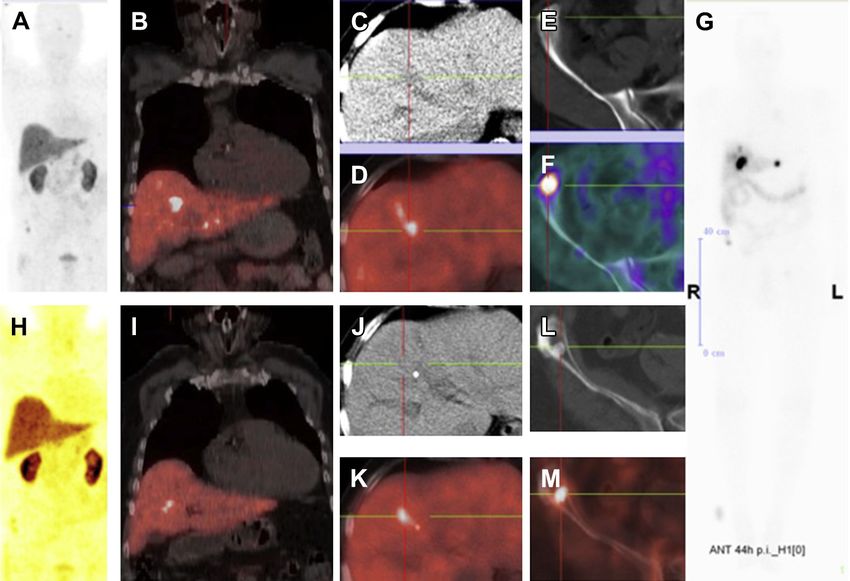
84        Kulkarni & Baum

     consistent with SUV values less than 10 and all             PET/CT provides in vivo histopathology by quanti-
     specimens with a score of 2 and 3 corresponded              fication of the SSTR expression (receptor density)
     with high SUVs (>15). They concluded that                   in NETs by the SUV measurement.3 Thus the way
     because there was a good correlation between                to personalized medicine starts with tissue sam-
     SSTR2-IHC scores and SUVs, SSTR2-IHC analysis               pling followed by histopathological analysis, which
     in patients missing a preoperative PET scan could           should consist of grading (ie, based on prolifera-
     indicate 68Ga-DOTATOC-PET/CT as method for                  tion rate Ki-67/MIB 1 index), staining for chromog-
     restaging and follow-up in individual patients.             ranin A, and synaptophysin, and quantification of
     Müssig and colleagues5 also showed the associa-            the SSTR density on tumor cells. Based on these
     tion of SSTR 2 immunohistochemical expression               data, the most appropriate peptide (DOTA-TOC/
     with 111In-DTPA octreotide scintigraphy and                 TATE, broad spectrum agonist, or an antagonist)
     68
        Ga-DOTATOC PET/CT in NETs. Boy and col-                  can be selected for SSTR PET/CT. The theranostic
     leagues6 measured the 68Ga-DOTATOC SUVmax                   advantage of using the same peptide allows for
     of normal tissues in 120 patients. Expression of            patient selection and also to predict the effective-
     SSTR subtypes 1 to 5 was measured indepen-                  ness of PRRT (depending on the strength of up-
     dently in pooled adult normal human tissue by               take) (Figs. 1 and 2). The determination of size
     real-time reverse transcriptase polymerase chain            on CT and MRI alone is not reliable enough
     reaction. SUVmax values exclusively correlated              because of the possibility of cystic degeneration
     with SSTR 2 expression at the level of mRNA.                of metastases. In addition, assessment of the tu-
                                                                 mor burden (localized disease vs distant metasta-
                                                                 ses) by SSTR PET/CT guides the therapeutic
     IMPACT OF 68GA-SSTR PET/CT ON
                                                                 options. For example, localized, bulky liver metas-
     MANAGEMENT OF NETS
                                                                 tases can be effectively managed by intra-arterial
     Peptide receptor radionuclide therapy (PRRT) is an          PRRT, although partial hepatectomy and hepatic
     effective treatment option for metastasized pro-            transplantation are also options. The amount of
     gressive well-differentiated NETs1. 68Ga-SSTR               radioactivity to be administered as well as the

     Fig. 1. A 66-year-old patient with well-differentiated, nonfunctioning NET of the pancreas, status post left pancre-
     atectomy, splenectomy, and also metastasectomy in segment 2 of the liver was referred for follow-up 68Ga-SSTR
     PET/CT after surgery, which revealed a single, very intensely SSTR-positive retrocrural lymph node metastasis
     with an SUV of 152. Based on this, he underwent 2 cycles of PRRT with 14 GBq 177Lu-DOTATATE. The very high re-
     ceptor expression and uptake of 177Lu and the resulting high dose delivered to the metastasis resulted in a com-
     plete remission according to molecular response criteria, after the 2 PRRT cycles. (A) Fused coronal 68Ga-DOTATATE
     PET/CT before therapy and (B) fused transverse image before therapy showing the lymph node metastasis with a
     circle and arrow, respectively. (C) MIP image of 68Ga-DOTATATE PET/CT after 2 therapy cycles and (D) corresponding
     fused transverse posttherapy image confirmed molecular complete remission, although a small lymph node (ar-
     row) is still noted on the CT, which remained stable in size over the next years of follow-up.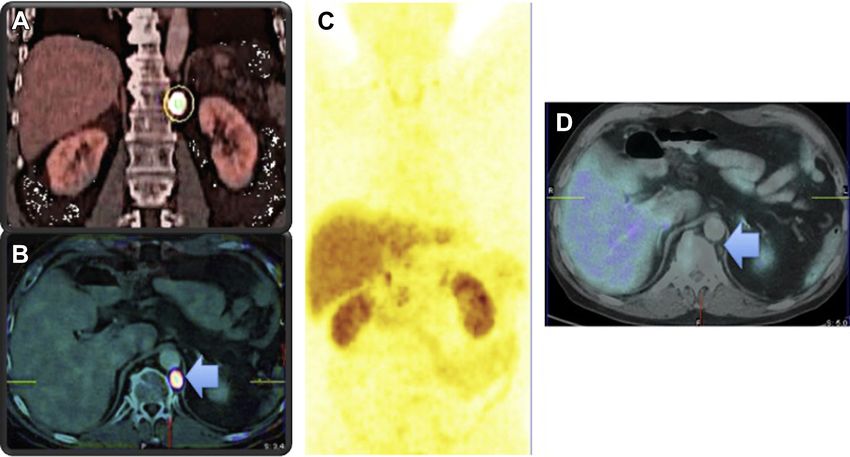
Patient Selection for PRRT Using Receptor PET/CT                    85

Fig. 2. A 56-year-old man with well-differentiated, nonfunctioning ileal NET status post surgery and 2 cycles of
PRRT with 90Y-DOTATOC (performed elsewhere) with complete remission of the hepatic metastases thereafter
was referred to the authors’ center 5 years after the second PRRT cycle with progressive disease and development
of hepatic and osseous metastases. He underwent 2 further cycles of PRRT with a total administered activity of 8
GBq 177Lu-DOTATATE, resulting in a good response of the hepatic metastases (near-complete remission) and of
the lesion in right iliac bone (partial remission). (A–F, 68Ga-DOTATATE PET/CT images before therapy; G, 177Lu-DO-
TATATE whole-body planar scan 44 hours post-PRRT1; H-M, 68Ga-DOTATATE PET/CT images after 2 PRRT cycles; A
and H, MIP; B and I, fused coronal images; C and J, transverse CT, and D and K, fused transverse PET/CT images of
liver; E and L, transverse CT, and F and M, fused transverse PET/CT images showing metastasis in the right ilium).

timing of PRRT using 177Lu- or 90Y-DOTATATE or             case of inadequate receptor expression is indi-
DOTATOC depends on - among other factors -                 cated for the selection of patients for local therapy
the semi-quantitative interpretation of 68Ga-SSTR          (radiofrequency ablation/trans-arterial chemoem-
PET/CT.                                                    bolization) of localized liver disease, and so on.
                                                              111
   Curative treatment of localized NETs is possible              In-octreotide has been considered to be the
by complete surgical resection of the primary tu-          gold standard for the diagnosis of NETs.7 How-
mor with accompanying regional lymph node me-              ever, there are several reasons to think that this
tastases. However, in advanced disease with                method will gradually become the “old” standard
metastases, palliative therapies can be adminis-           because the development of novel SMS ana-
tered, taking into account the tumor stage, size,          logues for labeling with 68Ga has revolutionized
localization, and degree of differentiation. The op-       the diagnostics of NETs by high specific targeting
tions available apart from PRRT are surgery, so-           and paved the way to theranostics. A recent meta-
matostatin (SMS) analogues, immunologic                    analysis showed its patient-wise pooled sensitivity
therapy (interferon), targeted therapy with kinase         to be 93% and specificity 91%.8 As early as in
inhibitors, radiofrequency ablation, and trans-            2001, Hofmann and colleagues9 had demon-
arterial chemoembolization as well as chemo-               strated that 68Ga-DOTATOC was superior to
                                                           111
therapy (in pancreatic NETs and fast-growing                   In-octreotide SPECT in detecting upper
grade 3 neuroendocrine carcinomas). Receptor               abdominal metastases. Similarly for the detection
PET/CT also helps in therapy stratification and,           of metastases in lungs, bone, liver, and brain
                                                           68
for example, excluding PRRT as a therapy option               Ga-DOTATOC PET/CT had a clear edge over
                                                           111
when chemotherapy or molecular therapy in the                  In-DTPAOC, shown by Buchmann and
86       Kulkarni & Baum

     colleagues.10 On a per patient basis, 68Ga-DOTA-      disease burden and quantifies the receptor density
     TOC PET (96%) was also found to be more accu-         on tumor cells. Therefore, the next step after pa-
     rate than CT (75%) and 111In-DOTATOC SPECT            tient selection is the planning of PRRT. Prasad
     (58%).11 Also regarding the sensitivity,12 68Ga-DO-   and Baum18 demonstrated the biodistribution of
     TATOC PET fared better than 111In-octreotide          68
                                                              Ga-DOTANOC in normal tissues and tumors,
     especially in detecting small tumors or tumors        which revealed a very wide variation (Table 1),
     bearing only a low density of SSTRs. In patients      emphasizing the importance of determining
     with equivocal or negative Octreoscan, 68Ga-DO-       SUVs for an accurate assessment of disease.
     TATATE PET/CT detected additional lesions and
     changed management of the disease, notably in
     36 patients (70.6%), who were subsequently            ADDITIONAL ROLE OF FDG PET/CT
     deemed suitable for PRRT.13 68Ga-DOTANOC
                                                           Well-differentiated tumors generally do not have
     PET/CT had a significant impact on the therapeu-
                                                           significant glucose hypermetabolism. 18F-FDG
     tic management, with incremental value over con-
                                                           PET/CT has a role in metabolically highly active
     ventional imaging (CT and EUS), affecting either
                                                           tumors and is recommended as a routine investi-
     stage or therapy in 50 of 90 (55.5%) patients.14
                                                           gation for the diagnosis and staging of G3 NETs
     The noteworthy and also the most frequent impact
                                                           (Fig. 3). However, 18F-FDG PET may also have a
     on management was either initiation or continua-
                                                           role in the assessment of prognosis before
     tion of PRRT. SSTR PET could also exclude 2 pa-
                                                           PRRT. A correlation between the proliferation
     tients from treatment with SMS analogues
                                                           rate and detection with 18F-FDG has been demon-
     because the lesions did not express SSTR and
                                                           strated. Severi and coworkers19 showed that
     could also avoid unnecessary surgery and the
                                                           FDG-PET evaluation is useful for predicting
     accompanying morbidity in 6 patients.
                                                           response to PRRT (using 177Lu-DOTATATE) in pa-
        In pulmonary NETs as well, 68Ga-DOTATATE
                                                           tients with grade 1/2 advanced NETs. In this study,
     was shown to have a definite incremental value
                                                           none of the PET-negative patients had progressed
     over 18F-FDG for typical bronchial carcinoids and
                                                           at the first follow-up examination after PRRT. On
     not in atypical carcinoids or higher grades of tu-
                                                           the other hand, grade 2 and PET-positive NET
     mors,15 Demonstrating the value of SSTR PET/
                                                           (arbitrary SUV cutoff >2.5) were frequently associ-
     CT for appropriate patient selection for PRRT,
                                                           ated with more aggressive disease. Indeed 32% of
     namely those with metastatic typical carcinoids.
                                                           the PET-positive patients with grade 2 NET did not
     The probability of the presence and/or develop-
                                                           respond to PRRT monotherapy, which led to the
     ment of concomitant GEP-NETs should also be
     borne in mind, which then could be handled in
     time with PRRT if necessary. SSTR PET/CT with
     68
        Ga should also therefore be used for the long-      Table 1
                                                                                       68
                                                            Variation of uptake on       Ga-SSTR PET/CT
     term follow-up of pulmonary NETs.16
        In a bicentric study, the role of 68Ga DOTANOC      Organ                                       Range
     PET/CT was found to be highly superior to 111In-
     Octreoscan and CT for the detection of an un-          Pituitary                                   0.8–7.6
     known primary (Cancer of unknown Primary               Thyroid                                     0.6–11.4
     [CUP]-NETs).17 The maximum SUVs of CUP-                Lung                                        0.2–1.8
     NETs were also compared with those of known            Liver                                       4.2–13.4
     pancreatic NETs and ileal/jejunal/duodenal NETs        Spleen                                      7.2–48.5
     (small intestinal NETs). Interestingly, the SUVmax     Adrenal                                     2.4–13.9
     of the previously unknown pancreatic NETs and
                                                            Kidney                                      4.1–21.5
     small intestinal NETs were significantly lower
     (P
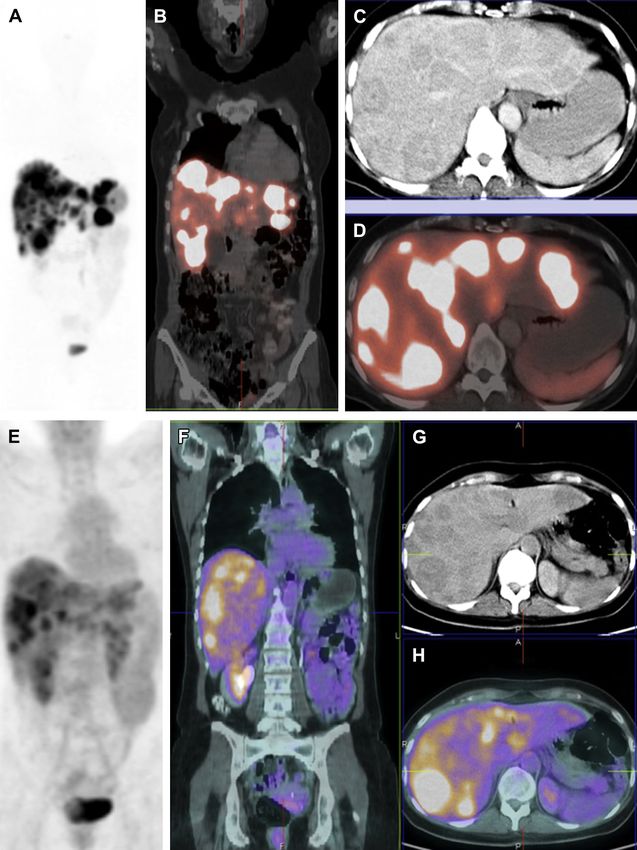
87 Fig. 3. A 45-year-old female patient with a poorly differentiated (G3), nonfunctional neuroendocrine carcinoma of the pancreas with extensive liver metastases. The proliferation rate (Ki-67) of the tumor was 40% with expression of chromogranin A, synaptophysin, and CD 56. She had undergone chemotherapy with Carboplatin and Etoposide, however, with poor results and progressive leucocytopenia. Both 68Ga-DOTATOC SSTR PET/CT as well as 18F-FDG PET/CTwere performed to assess the option of PRRTand to evaluate the prognosis, respectively. Despite a high grade of the tumor, there was a very high SSTR expression by the disseminated hepatic metastases, with an SUVmax of 71.7. No extrahepatic metastases were seen. Notably, 18F-FDG PET/CT showed a complete matched finding with glucose hypermetabolism of the liver metastases (SUVmax of 9.9). With high SSTR expression by the liver metastases, the indi- cation for PRRT was confirmed, which was further demonstrated by the high uptake of 177Lu-DOTATOC (after the first PRRT cycle) in the metastases. 68Ga-DOTATOC PET/CT: (A) MIP; (B) fused coronal PET/CT; (C) transverse CT; (D) fused transverse PET/CT. 18F-FDG PET/CT: (E) MIP; (F) fused coronal PET/CT; (G) transverse CT; (H) fused transverse PET/CT. 177Lu-DOTATOC whole-body planar image post-therapy: (I) anterior view; (J) posterior view.
88        Kulkarni & Baum

                                                            We presented preliminary results also indicating
                                                         a relationship between the radiation dose deliv-
                                                         ered to liver metastases and the molecular
                                                         response post-PRRT as measured by SSTR PET/
                                                         CT.21 Ninety-six liver metastases were analyzed
                                                         in 67 patients with well-differentiated NETs, under-
                                                         going PRRT with 4.8 to 7.5 GBq of 177Lu-DOTA-
                                                         TOC/-TATE followed by 5 whole-body planar
                                                         scintigraphies after therapy for dosimetry. Pre-
                                                         and posttherapy SSTR PET/CT with 68Ga-DOTA-
                                                         TOC/-TATE were performed to evaluate molecular
                                                         response to therapy. Liver metastases were
                                                         divided into 2 groups based on the response ac-
                                                         cording to molecular imaging criteria: partial
                                                         response (ie, 15% or more fall in SUVmax [group
                                                         1]) and progressive disease (ie, 25% or more in-
                                                         crease in the SUVmax [group 2]). Logarithmic in-
                                                         crease in molecular response was observed with
                                                         increasing mean absorbed dose to tumor. Doses
                                                         delivered (mean/median) to lesions showing a
                                                         therapy response (143 Gy/79 Gy) were signifi-
                                                         cantly higher than doses to lesions showing minor
                                                         progression or progressive disease (23 Gy/20 Gy).
                                                            Ezziddin and colleagues22 investigated the corre-
                                                         lation between the pretherapeutic tumor SUV in
                                                         68
                                                            Ga-SSTR PET/CT using DOTATOC, and the
                                                         mean absorbed tumor dose during subsequent
                                                         PRRT using 177Lu- DOTATATE; this was a retro-
                                                         spective analysis of 21 NET patients with 61 evalu-
                                                         able tumor lesions undergoing both pretherapeutic
                                                         68
                                                            Ga-DOTATOC-PET/CT and PRRT with 177Lu-
                                                         DOTATATE. The SUVs were compared with
                                                         tumor-absorbed doses per injected activity (D/A0)
                                                         of the subsequent first treatment cycle. There was
                                                         a significant correlation between both, SUVmean
     Fig. 3. (continued)                                 and SUVmax on the one hand, and the D/A0. Pancre-
                                                         atic origin and hepatic localization were associated
                                                         with higher D/A0. Chromogranin A level and Ki-67
     conclusion that these patients might benefit from   index had no influence on SUV or D/A0, whereas
     more intensive therapy protocols, such as the       high-SUV lesions resulted in high D/A0. The authors
     combination of chemotherapy and PRRT.               concluded that SSTR PET imaging may predict the
                                                         mean absorbed tumor doses, and therefore, could
     PRETHERAPEUTIC SUVS AND                             aid in selection of appropriate candidates for
     POSTTHERAPEUTIC RESPONSE                            PRRT. Keeping the dose-response relationship in
                                                         mind, this study indicates that the pretherapeutic
     Pauwels and coauthors20 assessed tumor dose-        SUVs could predict the response to PRRT. How-
     response relationship in 13 patients treated with   ever, a recently published study indicated a poor
     90
        Y-DOTATOC. Tumor volumes were assessed           correlation between SUV and the tumor dose, and
     by CT before and after treatment. Tumor dose        the linear regression analysis provided R2 values,
     estimates were derived from CT scan volume          which explained only a small fraction of the total
     measurements and quantitative 86Y-DOTATOC           variance. It was concluded that the SUVs derived
     imaging performed before treatment. A good          from 68Ga-SSTR PET/CT images should be used
     correlation was found between 86Y-DOTATOC           with caution for the prediction of tumor dose on
                                                         177
     dosimetry and treatment outcome. Importantly, a         Lu-PRRT, as there was a large intra- and interpa-
     tumor size reduction was always seen with a tumor   tient variability.23
     dose of more than 100 Gy, confirming a tumor           The role of 68Ga-SSTR PET/CT for the evalua-
     dose-response relationship in PRRT.                 tion of prognosis of NETs has been investigated.
Patient Selection for PRRT Using Receptor PET/CT 89
Table 2
Factors determining the Bad Berka Score for patient selection
Factor Means of Determination
Tumor grade Ki-67 index
Functional activity of the tumor/metastases Biomarkers, symptoms
Time since first diagnosis and previous therapies History
General status of the patient Karnofsky performance score or Eastern
Cooperative Oncology Group performance
status scale, loss of weight
SSTR density SUV on 68Ga-receptor PET/CT
18
Glucose metabolism F-FDG PET/CT
Renal functional assessment Creatinine and blood urea nitrogen
99m
Tubular extraction rate and elimination kinetics Tc-MAG3 scintigraphy
99m
Glomerular filtration rate Tc-DTPA
Hematological status Blood counts
68
Hepatic involvement and extrahepatic tumor Ga-receptor PET/CT
burden
68
Dynamics of the disease: doubling time, Serial Ga-receptor PET/CT
appearance of new lesions
In a study of 47 patients, SUVmax was demon- more, and a combined treatment with long-
strated to be significantly higher in patients with acting SMS analogues and radiolabeled SMS
pancreatic NETs and in those with well- analogues. This study thus demonstrated that
differentiated tumors.24 On follow-up, stable dis- SUVmax correlates with the clinical and pathologic
ease or partial response was observed in 25 features of NETs and is also an accurate prog-
patients, and progressive disease in 19 patients. nostic index.
Stable disease or partial response was associated Taking these factors into consideration, a
with a significantly higher SUVmax than was pro- scoring was devised at the ENETS Center of
gressive disease, the best cutoff ranging from Excellence, Bad Berka to appropriately select pa-
17.9 to 19.3. At univariate and multivariate anal- tients for personalized PRRT (influencing deci-
ysis, the significant positive prognostic factors sions on the activity to be administered, number
were well-differentiated NET, a SUVmax of 19.3 or of fractions, time between fractions etc.) This
score takes into account various clinical aspects
and molecular features, depending on the above-
mentioned prerequisites (Table 2).25
Indications/Prerequisites for PRRT
A multidisciplinary team of experienced special-
Well-differentiated NETs (G1 and G2) ists is required for the appropriate management of
patients with NETs. The success of personalized
SSTR expression
PRRT is determined by appropriate choice of pep-
Documented progression of disease with tide and radionuclide, kidney protection (lysine,
metastasis (in certain cases with high tumor arginine, and gelofusine), tumor and organ dosim-
burden without progression might also be
etry (posttreatment scans), and monitoring of
considered)
toxicity (follow-up). Above all, appropriate patient
Inoperability (however, also in neoadjuvant selection is the cornerstone of PRRT and presently
setting, to render an inoperable primary tu- 68
Ga-SSTR PET/CT using SMS analogues has an
mor operable)
unparalleled role.
For symptomatic improvement in functional
NET refractory to octreotide or lanreotide
REFERENCES
therapy
Karnofsky index 60% 1. Baum RP, Kulkarni HR, Carreras C. Peptides and re-
Normal renal function and hematological ceptors in image-guided therapy: theranostics for
status neuroendocrine neoplasms. Semin Nucl Med 2012;
42:190–207.90 Kulkarni & Baum
2. Keyes JW Jr. SUV: standard uptake or silly useless findings on 111In-DTPA-octreotide scintigraphy.
value? J Nucl Med 1995;36:1836–9. J Nucl Med 2010;51:875–82.
3. Kaemmerer D, Peter L, Lupp A, et al. Molecular im- 14. Ambrosini V, Campana D, Bodei L, et al. 68Ga-DOTA-
aging with 68Ga-SSTR PET/CT and correlation to NOC PET/CT clinical impact in patients with neuroen-
immunohistochemistry of somatostatin receptors in docrine tumors. J Nucl Med 2010;51:669–73.
neuroendocrine tumors. Eur J Nucl Med Mol Imag- 15. Kayani I, Conry BG, Groves AM, et al. A comparison
ing 2011;8:1659–68. of 68Ga-DOTATATE and 18F-FDG PET/CT in pulmo-
4. Miederer M, Seidl S, Buck A, et al. Correlation of im- nary neuroendocrine tumors. J Nucl Med 2009;50:
munohistopathological expression of somatostatin 1927–32.
receptor 2 with standardised uptake values in 16. Kaemmerer D, Khatib-Chahidi K, Baum RP, et al.
68Ga-DOTATOC PET/CT. Eur J Nucl Med Mol Imag- Concomitant lung and gastroenteropancreatic
ing 2009;36:48–52. neuroendocrine tumors and the value of gallium-68
5. Müssig K, Oksüz MO, Dudziak K, et al. Association of PET/CT. Cancer Imaging 2011;11:179–83.
somatostatin receptor 2 immunohistochemical ex- 17. Prasad V, Ambrosini V, Hommann M, et al. Detection
pression with [111In]-DTPA octreotide scintigraphy of unknown primary neuroendocrine tumors (CUP-
and [68Ga]-DOTATOC PET/CT in neuroendocrine tu- NET) using 68Ga-DOTA-NOC receptor PET/CT. Eur
mors. Horm Metab Res 2010;42:599–606. J Nucl Med Mol Imaging 2010;37:67–77.
6. Boy C, Heusner TA, Poeppel TD, et al. 68Ga-DOTA- 18. Prasad V, Baum RP. Biodistribution of the Ga-68
TOC PET/CT and somatostatin receptor (sst1-sst5) labeled somatostatin analogue DOTA-NOC in pa-
expression in normal human tissue: correlation of tients with neuroendocrine tumors: characterization
sst2 mRNA and SUV max. Eur J Nucl Med Mol Imag- of uptake in normal organs and tumor lesions. Q J
ing 2011;38:1224–36. Nucl Med Mol Imaging 2010;54:61–7.
7. Krenning EP, Kwekkeboom DJ, Bakker WH, et al. 19. Severi S, Nanni O, Bodei L, et al. Role of 18FDG
Somatostatin receptor scintigraphy with [111In- PET/CT in patients treated with 177Lu-DOTATATE
DTPA-D-Phe1]- and [123I-Tyr3]-octreotide: the Rot- for advanced differentiated neuroendocrine tu-
terdam experience with more than 1000 patients. mours. Eur J Nucl Med Mol Imaging 2013;40:881–8.
Eur J Nucl Med Mol Imaging 1993;20:716–31. 20. Pauwels S, Barone R, Walrand S, et al. Practical
8. Treglia G, Castaldi P, Rindi G, et al. Diagnostic per- dosimetry of peptide receptor radionuclide therapy
formance of Gallium-68 somatostatin receptor PET with (90)Y-labeled somatostatin analogs. J Nucl
and PET/CT in patients with thoracic and gastroen- Med 2005;46(Suppl 1):92S–8S.
teropancreatic neuroendocrine tumours: a meta- 21. Kulkarni H, Prasad V, Schuchardt C, et al. Peptide re-
analysis. Endocrine 2012;42:80–7. ceptor radionuclide therapy (PRRNT) of neuroendo-
9. Hofmann M, Maecke H, Borner R, et al. Biokinetics crine tumors: relationship between tumor dose and
and imaging with the somatostatin receptor PET ra- molecular response as measured by somatostatin re-
dioligand 68Ga-DOTATOC: preliminary data. Eur J ceptor PET/CT [abstract]. J Nucl Med 2011;52:301.
Nucl Med Mol Imaging 2001;28:1751–7. 22. Ezziddin S, Lohmar J, Yong-Hing CJ, et al. Does the
10. Buchmann I, Henze M, Engelbrecht S, et al. Com- pretherapeutic tumor SUV in 68Ga DOTATOC PET
parison of 68Ga-DOTATOC PET and 111In-DTPAOC predict the absorbed dose of 177Lu octreotate?
(Octreoscan) SPECT in patients with neuroendo- Clin Nucl Med 2012;37:e141–7.
crine tumors. Eur J Nucl Med Mol Imaging 2007; 23. Singh B, Prasad V, Schuchardt C, et al. Can the
34:1617–26. standardized uptake values derived from diagnostic
11. Gabriel M, Decristoforo C, Kendler D, et al. 68Ga- 68Ga-DOTATATE PET/CT imaging predict the radia-
DOTA-Tyr3-octreotide PET in neuroendocrine tumors: tion dose delivered to the metastatic liver NET le-
comparison with somatostatin receptor scintigraphy sions on 177Lu-DOTATATE peptide receptor
and CT. J Nucl Med 2007;48:508–18. radionuclide therapy? J Postgrad Med Educ Res
12. Kowalski J, Henze M, Schuhmacher J, et al. Evalua- 2013;47:7–13.
tion of positron emission tomography imaging using 24. Campana D, Ambrosini V, Pezzilli R, et al. Standard-
[68Ga]-DOTA-D Phe(1)-Tyr(3)-octreotide in compar- ized uptake values of 68Ga-DOTANOC PET: a prom-
ison to [111In]-DTPAOC SPECT. First results in pa- ising prognostic tool in neuroendocrine tumors.
tients with neuroendocrine tumors. Mol Imaging J Nucl Med 2010;51:353–9.
Biol 2003;5:42–8. 25. Baum RP, Kulkarni HR. THERANOSTICS: from molec-
13. Srirajaskanthan R, Kayani I, Quigley AM, et al. The ular imaging using Ga-68 labeled tracers and PET/CT
role of 68Ga-DOTATATE PET in patients with neuro- to personalized radionuclide therapy - the bad berka
endocrine tumors and negative or equivocal experience. Theranostics 2012;2(5):437–47.You can also read


