Pearson Edexcel Summer 2021 Update - Pearson qualifications
←
→
Page content transcription
If your browser does not render page correctly, please read the page content below
Pearson Edexcel Summer 2021 Update
Agenda
•   Key dates & deadlines
•   Our support
•   UK qualifications
•   International qualifications
•   Assessment materials

                                   © Pearson Education 2020   2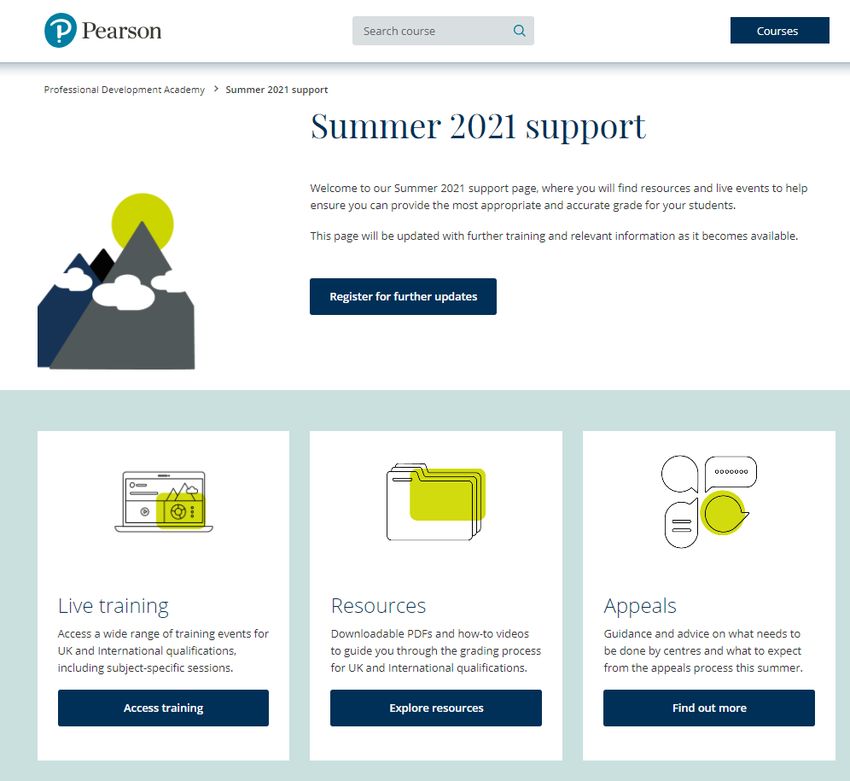
Context
•   Students will receive grades awarded and determined by teachers
•   Pupils will only be assessed on what they have been taught
•   No algorithm will be used
•   Teachers will be able to draw on a range of evidence when determining grades,
    including:
    •    the optional use of questions provided by exam boards
    •    mock exams
    •    coursework
    •    other work completed as part of a pupil’s course, such as essays or in-class
         tests
•   Exam boards have provided guidance for teachers on their websites
•   Teachers will submit grades to exam boards by 18 June
•   Results days for GCSE, A level and some vocational qualifications will take place on
    the 10 (GCE) & 12 (GCSE) August.

                                                                          © Pearson Education 2020   3
Timelines
• 26 March – UK JCQ Grade Descriptors
• 31 March – UK Additional Assessment Materials – mapping grids, mark schemes,
sets of questions (under padlock)
• 12 April – UK Marking Exemplification (Under padlock)
• 19 April – UK Grading Exemplification. Additional sets of questions publicly available
• 19 April – All UK general support on Pearson Professional Development Academy
(except Appeals)
• 26 April: Entry deadline for private candidates
• 30 April: Deadline for centre Quality Assurance Policy submission via proforma on
CAP (Centre Admin Portal)
• 26 May to 18 June: Teacher Assessed Grades Submission window opens via
awarding organisations’ respective portals
• 10 August: A/AS Levels and relevant Level 3 results
• 12 August: GCSE and relevant Level 2 results.
Key dates available on our website.
© Pearson Education 2020 4JCQ Guidance
JCQ Guidance on Determining Grades
•   On Friday 26 March the JCQ Guidance on Determining Grades was released.
•   This is the main guide that UK centres will need to follow as they arrive at grades for
    learners this summer.
•   Make sure you have downloaded the following from the JCQ website
    •    Editable Centre Policy
    •    Assessment Record Sheet
    •    Head of Department Checklist
    •    Grade Descriptors

•   We have shared the link on our website and provided a ‘Top 10 Important Things to
    Note’ interactive pdf.
•   The following slides summarise some of the key details.

                                                                            © Pearson Education 2020   6
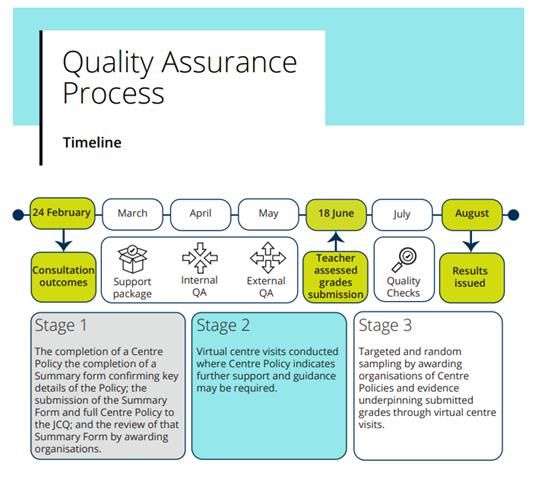
Quality Assurance Process
© Pearson Education 2020 7Quality Assurance Process
• The Quality Assurance process will support centres to construct appropriate
processes to underpin. the determination of grades. There are internal and external
elements to the process
• Internal Quality Assurance – Centre Policy
• Every centre must produce a Centre Policy; this can be done by choosing to adopt the pre-populated
template.
• Only one policy needs to be produced and submitted via the CAP which can be found on Edexcel Online.
• The policy must provide a summary of a centre’s approach to assessment and quality assuring the centre
determined grades they award to students, based on the evidence they have produced.
• For every centre, the Head of Centre is required to complete the Summary of Centre Policy form and to
upload the Centre Policy as an attachment prior to submission.
• Submission of the Centre Policy must be completed by April 30th 2021.
© Pearson Education 2020 8Guidance On Grading
• Heads of Centre should ensure that students have the opportunity to show the full
breadth of their knowledge and understanding in each subject based on what they have
been taught.
• It is important that grades represent a holistic, objective judgement based on evidence
of each student’s performance in each subject.
• Evidence should be used consistently across the class or cohort wherever possible.
• The evidence can be of different types and can come from across the course of study.
• Please make sure your teachers have seen and used the subject specific support
guides on our website and have accessed the Pearson Professional Development
Academy training resources.
© Pearson Education 2020 9Arriving at a grade
1. Consider what has been taught
2. Collect the evidence
3. Evaluate the quality of the evidence
4. Establish whether the proposed range of evidence is suitable
for all students
5. Assign a grade
The window for Teacher Assessed Grades submission opens via
the Pearson portal 26 th May – 18th June
© Pearson Education 2020 10Grade descriptors
Grade descriptors have been created for GCSE, AS and A level subjects. They describe
midgrade performance.
• A level: grade descriptors exist for Grades A, C and E. Characteristics of performance at the Grade
A/Grade B borderline are included.
• AS level: grade descriptors exist for Grades A, C and E only.
• GCSE: grade descriptors have been created at Grades 8, 6, 5, 4 and 2.
• The Ofqual descriptors for 8, 5 and 2 have been used as the starting point. Characteristics of
performance at the Grade 4/Grade 3 borderline are included
Each awarding organisation has created grading exemplification for each specification.
This were made available by each awarding organisation on April 19th. The grading
exemplification uses student responses from historical examination scripts (and other
sources) to illustrate midgrade performance in previous summer series in which exams
took place. The exemplification gives examples of the standards you will use to make
grade judgements.
© Pearson Education 2020 11Use of data
Use of Data
One source of data which is available to centres is tracking systems, that provide target
grades or predicted grades based on assessment inputs and data modelling. As the policy
direction is that the final grade is derived solely based on performances produced by
students, a grade derived based on a predicted trajectory or target grade is not permitted.
Used appropriately, data on historical student and centre performance can help support the
internal quality assurance process for assigning grades. The purpose of reviewing data on
past performance is not to attempt to determine a student or a centre’s outcomes this
summer, but as one source of evidence from examination series which operated as normal,
that can inform teachers’ professional judgement on the level of attainment achieved by their
students.
Centres should be aware of the distribution of grades awarded to students in previous June
series. However, grading judgements should not be driven by this data. Historical grade data
should only be considered after grading judgements have been made.
© Pearson Education 2020 12Additional Assessment Materials
• Awarding organisations’ existing assessment materials (including past papers and
examiners’ reports) will all be available as normal. In addition, the following
materials have been made available to centres:
• 31st March, additional assessment materials including sets of questions, mark
schemes and mapping grids; and
• 12th April, additional support materials including exemplar responses and links to
other information which will help with using and marking these assessment
materials.
© Pearson Education 2020 13Additional Assessment Materials
• The 2021 assessment materials are qualification-specific sets of questions covering key
knowledge, understanding and skills
• The materials are available for all GCSE, AS and A levels, with the exception of Art and
Design.
• They are drawn from a variety of examination questions and from a range of papers; they do
not cover any NEA components.
• The number, breadth and depth of the material will vary between subjects, and reflect the
characteristics of each qualification (e.g. where there is only one exam component there will
be fewer materials than for a subject which is usually assessed entirely by
examination). However, the assessments will draw on the equivalent of three series’ worth
of examination material, as a minimum.
• Support materials may also include:
• past examiners reports;
• marked examples of student work from past papers where they exist and support the
marking of student work;
• links to other information which will help with using and marking these assessment
materials.
© Pearson Education 2020 14Reasonable adjustments
• Special Educational Needs Co-ordinators (SENCOs), SEND leaders and assessors
have previously been advised to continue to process online applications as if
examinations were taking place this summer. This will formalise the arrangements for
the student’s assessments and will ensure consistency with the Equality Act 2010.
• The awarding organisations will continue to provide their usual support to centres with
advice and guidance on how to modify the additional assessment material resources
for use in classroom assessments. Awarding organisations recognise that the
additional assessment materials are being provided in a different way to past
examination material and that these may present an issue for some teachers with
visual impairments. In these cases, centres should contact the awarding organisations
who will aim to provide extra support and guidance.
© Pearson Education 2020 15Appeals
• The arrangements for awarding grades to students in summer 2021 include internal and external quality
assurance measures which aim to ensure that on results day student are issued with fair and consistent
grades that have been objectively reached.
• Sharing information with students about the evidence being used as part of a centre’s grade determination
process is important and should help to avoid issues that may otherwise arise when results are issued.
• Students will be able to appeal their grade.
• A student who is unhappy with their grade will first ask their centre to check whether an administrative or
procedural error had been made.
• Where a centre does identify an error in the grade submitted to the exam board, it can submit a revised grade
and a rationale for the board to consider. If the exam board is satisfied with the rationale, it will issue a revised
grade.
• Where a centre does not believe an error had been made, a student can ask the centre to appeal to the exam
board on their behalf. The centre will submit the student’s appeal to the exam board and provide the evidence
on which its judgement had been made; the exam board will consider whether, in its view, the grade reflected
an appropriate exercise of academic judgement.
• If the exam board judges that it did not, the exam board will determine the grade that the evidence would
support. The exam board will also check that the centre had followed its own process.
© Pearson Education 2020 16Communications and our support
Information and support
•   Our support, guidance and training sessions are available via the Pearson Professional Development
    Academy for Grading, Additional Assessment Materials, Appeals, Quality Assurance and Unconscious Bias.

•   There are downloadable guides, videos and pre-recorded and live events.

•   This support will be available from 31 March and will be expanded upon over the coming weeks and
    released in full for UK Qualifications by 19 April and for International Qualifications by the 4 May

•   Sign up to be the first to know when the training becomes available.

                                                                                            © Pearson Education 2020   18
Information and support
• Our full subject support guides can be found on our Summer
2021 support page
• There is also some helpful information available on the Ofqual
website.
• Sign up to receive regular qualification updates through our
Pearson Qualifications Bulletin.
© Pearson Education 2020 19Mock service for summer 2021
Key dates and deadlines
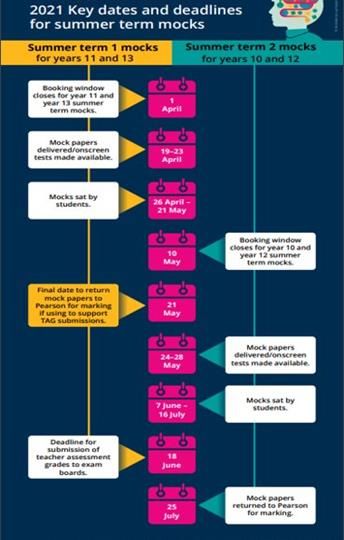
• A number of teachers have been in contact, to ask
about using the Mocks Service to support teacher
assessed grades for GCSE. We have created a
timeline with key dates and deadlines if you
are considering using the Mocks Service to support
your teacher assessed grades.
• Download key dates and deadlines for summer
2021 mocks.
• We’ve also created a short guide to using the Mocks
Service to inform the teacher assessed grades.
• Download your Guide to using the Mocks Service
summer 2021.
• Booking window and mock exam papers list.
© Pearson Education 2020 20Supporting students, parents and carers
• Take a look at our students, parents and carers web page. On here you'll find:
• a video and a letter from Hayley White, our Assessment Director, explaining how
students' grades will be determined this summer and the support we're providing
to schools and colleges.
• a link to a student timeline for summer 2021
• a feedback form, so students, parents and carers can get in touch should they
need further help and support
• a link to the Ofqual infographic that explains in a visual way how grades will be
awarded this summer.
• Plus, do encourage sign up to our Parents & Carers newsletter for the latest
information and support.
© Pearson Education 2020 21Summer 2021 subject specific information
You can also read


