Private Protection Initiatives in Mountain Areas of Southern Chile and Their Perceived Impact on Local Development-The Case of Pumalín Park
←
→
Page content transcription
If your browser does not render page correctly, please read the page content below
sustainability

Article
Private Protection Initiatives in Mountain Areas of
Southern Chile and Their Perceived Impact on Local
Development—The Case of Pumalín Park
Benedikt Hora
 Institute of Geography, Leopold-Franzens-Universität Innsbruck, A-6020 Innsbruck, Innrain 52f, Austria;
 benedikt.hora@student.uibk.ac.at

 Received: 1 March 2018; Accepted: 10 May 2018; Published: 15 May 2018

 Abstract: This paper aims to identify the socio-economic impacts perceived by the local community
 to be caused by Pumalín Park, one of the biggest and most remarkable private protected areas in
 Chile. In recent years, the Pumalín Park project has had a tremendous influence on the local economy
 by providing job opportunities for local entrepreneurs, protecting native forest and strengthening
 social awareness, particularly in the nearby town of Chaitén, which was stricken in 2008 by a volcanic
 eruption. The methods used were secondary data review, semi-structured interviews with key
 informants and questionnaires aimed at assessing the local population’s perception of the park’s
 contribution to their community. The results indicate that Pumalín Park plays an important role
 in local development, enhancing not only conservation of fragile mountain ecosystems, but also
 revitalizing the economic base of this rural and marginalized area of southern Chile.

 Keywords: Chile; Patagonia; private conservation; local development; foreign investment

1. Introduction
      In Chile, as in many other countries in Latin America and in the world, private conservation
significantly contributes to national protected areas [1–3]. According to the IUCN guidelines, Private
Protected Areas (PPAs) are defined as those “under individual, cooperative, NGO or corporate control and/or
ownership, and managed under non- profit or for-profit schemes [ . . . ] [where] the authority for managing the
protected land and resources rests with the landowners, who determine the conservation objective, develop and
enforce management plans and remain in charge of decisions, subject to applicable legislation” [4]. In Chile
this tendency towards private conservation has been observed since the beginning of the 1990s. These
initiatives are carried out by either foreigners or national citizens or non-governmental organizations
with different non-profit or for-profit goals, such as biodiversity conservation, bio carbon sequestration,
ecosystem services and ecotourism [5].
      Chile specifically has adopted a very neoliberal approach to their national economy. With the
beginning of the Pinochet regime in 1973, governmental institutions were diminished, and private
property rights were strengthened [6], promoting foreign investments in the primary sector as well
as land sales for conservation. Over the last three decades, this tendency was facilitated by three
factors: (i) the retreat of governmental institutions and the increase of NGOs managing protected
areas; (ii) the integration of conservation in market mechanisms as a characteristic of global neoliberal
capitalism; and (iii) leading conservation NGOs have developed relationships with corporations
copying their methods in areas such as marketing and receiving their donations [7]. Therefore,
valuable land is increasingly integrated in market mechanisms. Land with a high conservation value
is sold for ecotourism, or as payment for ecosystem services. Since the 1980s and mainly since the
2000s, NGOs have been cooperating with corporations and have allowed their activities to be viewed

Sustainability 2018, 10, 1584; doi:10.3390/su10051584                      www.mdpi.com/journal/sustainability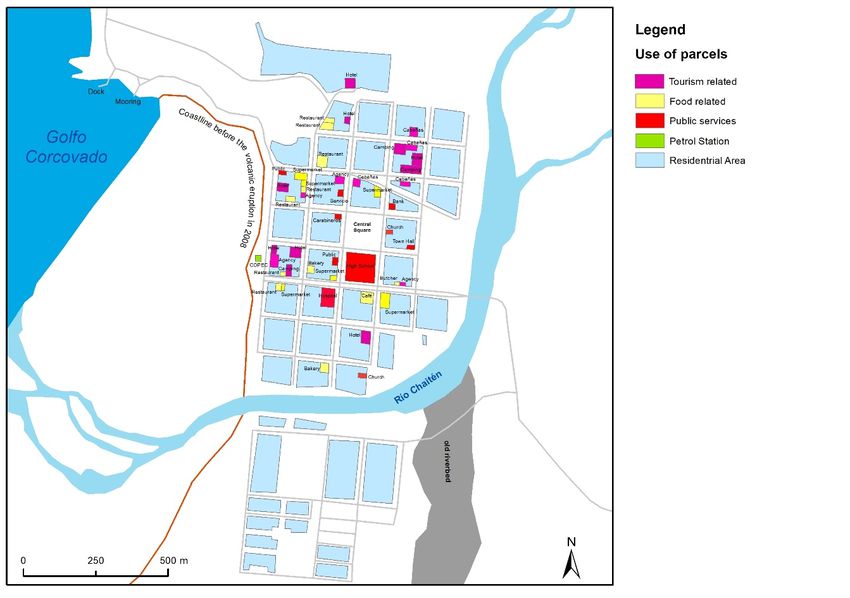
Sustainability 2018, 10, 1584                                                                                          2 of 22

     Sustainability 2018, 10, x FOR PEER REVIEW                                                                   2 of 22
as positive [8–10]. However, in Chile, formal recognition of PPAs is inhibited by a lack of implemented
regulations      [11].
      with corporations     and have allowed their activities to be viewed as positive [8–10]. However, in Chile,
      formal
       In Latin America,ofChile
               recognition     PPAsplays
                                     is inhibited by arole
                                            a special  lack in
                                                             of private
                                                                implemented    regulations
                                                                         conservation.   It [11].
                                                                                             is the only state with 2.2% of
            In Latin
its territory   underAmerica,
                         private Chile  plays amaking
                                 protection,    special it
                                                         role
                                                           oneinof
                                                                 private   conservation.
                                                                    the nations   with theIthighest
                                                                                             is the only state withof2.2%
                                                                                                      proportion      private
      of its territory
conservation       areas.under
                           Onlyprivate
                                 small protection,   making
                                         countries such        it one Rica
                                                           as Costa    of theand
                                                                              nations  with
                                                                                  Belize have theahighest
                                                                                                   biggerproportion     of of
                                                                                                           relative share
      private   conservation   areas.  Only  small countries   such   as Costa  Rica and Belize   have
their territory under private conservation [12]. 19.2% of Chile’s territory is protected in the Nationala bigger relative
      share of their territory under private conservation [12]. 19.2% of Chile’s territory is protected in the
Park System known as SNASPE (Sistema Nacional de Áreas Silvestres Protegidas del Estado) [12].
      National Park System known as SNASPE (Sistema Nacional de Áreas Silvestres Protegidas del
Furthermore, Chile has 308 Private Protected Areas, with an estimated area of 1,651,916 ha [13]. Figure 1
      Estado) [12]. Furthermore, Chile has 308 Private Protected Areas, with an estimated area of 1,651,916
shows    the distribution of public and private parks in Chile. In 2013, there were 308 private initiatives
      ha [13]. Figure 1 shows the distribution of public and private parks in Chile. In 2013, there were 308
in Chile.
      privateThere    is an evident
                initiatives in Chile. concentration    of these
                                      There is an evident          undertakings
                                                            concentration           inundertakings
                                                                             of these  southern Chile,     especially
                                                                                                      in southern       in the
                                                                                                                   Chile,
Los Ríos     (72 areas)
      especially   in the and  Los Lagos
                           Los Ríos         regions
                                    (72 areas)       (86Lagos
                                                and Los    areas).regions (86 areas).

                     Figure
                  Figure    1. Overview
                         1. Overview  ofofprivate
                                           privateprotected
                                                   protected areas
                                                             areas und
                                                                   undpublic
                                                                       publicprotected
                                                                              protectedareas in in
                                                                                         areas  Chile.
                                                                                                   Chile.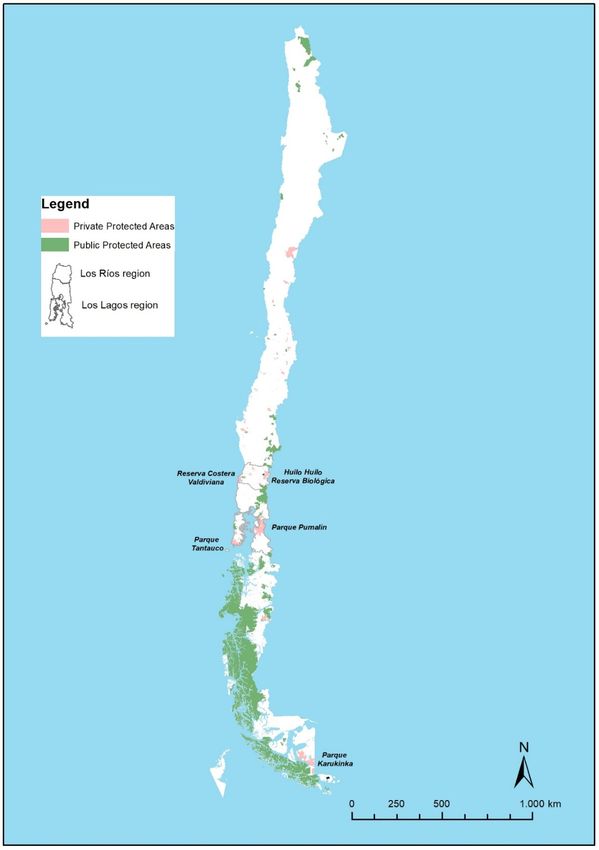
Sustainability 2018, 10, 1584                                                                                      3 of 22

     Private conservation areas are relevant in Chile because of two key factors: first, they are
considered as complementary, as the Chilean national park system does not cover all threatened
biomes of Chilean flora and fauna and are vulnerable to boundary problems with other land uses [14].
Secondly, private protected areas are considered to be a tool for promoting local development. Over
the past five years, the Chilean Ministry of the Environment has proposed changes in legislation
in order to transform these types of conservation projects into attractions, in order to use them as
an investment for tourism. Projects in rural areas and remote zones encouraged the development of
the local economy. Private protected areas were encouraged to apply for funding for environmental
conservation, improving public and private alliances [15]. According to [16,17] central and southern
Chile, where most of the private protected areas are located, is a conservation hot spot on a global scale.
The Valdivian Rain forest eco-region is one of only five temperate rainforests worldwide. The biome is
highly threatened because of large-scale logging, small-scale firewood extraction, forest fires, clearing,
salmon production and penetration of highways. The habitat of the threatened pudú (world smallest
deer) correlates with this biome [18]. This threat of land use change occurs more or less in all areas of
the biome, which is not under the protection of the national park system. However, the forests in the
fjord lands of Patagonia are less vulnerable as the population density is very low.
     In Table 1 the 15 largest private protected areas in Chile are shown by their size, regional location,
ownership and year of creation. The majority of these areas are located in the southern regions of
Chile and their creation took place from the early 1990s until 2013 with the Fundación Yendegaia in
Tierra del Fuego. The first to be implemented in Chile was Pumalín Park in 1991 of over 284.630 ha.
This park became a pioneer initiative, showing how PPAs could become important territorial figures,
leading not only to conservation but also to the transformation of an isolated locality such as Chaitén,
into one of the most well-known mountain destinations of southern Chile.

                                Table 1. The 14 biggest Private Protected Areas in Chile.

             Name                 Size (ha)      Region                       Owner                   Year of Creation
           Karukinka              291,510       Magallanes        Wildlife Conservation Society            2004
                                                               Fundación Pumalín (established by
        Parque Pumalín            284,630       Los Lagos                                                  1991
                                                                      Tompkins family)
     Comunidad Agrícola
                                  231,972        Atacama        Indigenous people of Huasco Alto           1997
    Diaguita Huascoaltinos
                                                                Fundación Futuro (established by
        Parque Tantauco           107,586       Los Lagos                                                  2005
                                                                       Sebastian Piñera)
    Reserva Biológica Huilo        89,934        Los Ríos                 Petermann family                 2000
                                                                    Conservación Patagonica
     Hacienda Chacabuco           763,849         Aysén                                                    2004
                                                                (established by Tompkins family)
        Reserva Costera
                                   50,440        Los Ríos           The Nature Conservancy                 2005
          Valdiviana
                                                                     Conservation Land Trust
     Fundacion Yendegaia           37,379       Magallanes                                                 2013
                                                                (established by Tompkins family)
      AAVC Caramávida              34,245         Biobío                  Forestal Arauco                    ?
     Comunidad Agrícola                                           Comunidad Agrícola Estancia
                                   31,570       Coquimbo                                                   2014
    Estancia Estero Derecho                                            Estero Derecho
                                                               Fundación Huinay (established by
    San Ignacio del Huinay         28,402       Los Lagos      Endesa S.A. with Pontifical Catholic        1998
                                                                   University of Valparaiso)
      Parque Tepuhueico            21,150       Los Lagos                    multiples                     1990s
                                                               Initiative of Adriana Hoffmann, was
   Comunidad Alto Huemul
                                   18,564       O’Higgins       funded by Sociedad Inmobiliaria            1996
     (Fundo Rayenlemu )
                                                                    Ecológica Alto Huemul S.A.
           Quinquen                17,966      La Araucanía    Mapuche community of Quinquén               1992
                                                  Source: author, 2018.
Sustainability 2018, 10, 1584 4 of 22
Private Protected Areas as Mechanism for Promoting Local Development
Ref. [19] stated that there are many reasons why PPAs play key roles, not only filling gaps in
national biodiversity conservation strategies, but also because they can bolster resource management,
enhance citizen participation, promote bottom-up management as well as be a lucrative investment
if they are linked to low-impact activities such as small forestry, organic agriculture or ecotourism.
According to [20,21] activities such as ecotourism allow economic value to be assigned to natural
resources, helping reduce social inequality; [11,21] added that these activities lead to economic
transformations at the local level. However, [22] mentioned that there is a lack of literature exploring
the social impact of private protected areas, and how they vary according to the different types of
ownership of PPAs, especially in ecotourism and their relationship with human well-being. According
to [23] little attention has been drawn to the function of PPAs in the promotion of sustainable
development, particularly in the context of the debate around the relationship between people and
protected areas. This situation is particularly sensitive in mountain areas, due to the fact that they
are often marginalized areas, where poverty alleviation remains a core challenge [24]. In this paper,
the authors suggest that investing in mountain areas is essential and could offer attractive opportunities
for investors interested not only in short-term gains, but also especially in long-term returns on their
contributions and enhancing local wellbeing. This could be one of the motivations of PPA owners.
Additionally, [25,26] hows in international studies that successful conservation and
socio-economic prosperity in the surrounding area are interdependent. Effective conservation involves
support and collaboration from the local governments and communities. In turn, this requires that
protected areas contribute to the economic well-being of the communities in which they are located.
For instance, in Brazil private conservation was investigated by [27] in the context of ecotourism and
conservation. In the study, it was shown that small private protection projects (Sustainability 2018, 10, 1584 5 of 22
forestry industry, a major activity over the last 30 years. At the same time, [3] conducted a comparative
study in the same region, considering different PPAs, which differ in size and types of ownership such
as Huilo Huilo (managed by Victor Petermann, a private entrepreneur), the Valdivian Coastal Reserve
(managed by NGO The Nature Conservancy) and the Oncol Park (managed by the forestry company
Forestal Valdivia). The study suggests that the social impact and consequences of PPAs facilitating
ecotourism development should be subjected to the same level of scrutiny that has been given to public
protected areas. PPA ecotourism ventures could improve the well-being of local inhabitants as well
as degrade it. If private protected areas reach a viable level, they could become an incentive for local
people with start-up capital and the willingness to engage in entrepreneurial endeavors.
Different parks have been investigated focusing on surrounding communities’ perceptions in
order to bring the study into a theoretical context. Among these were the Iron Gate Natural Park
in south-western Romania. Management recommendations for park administration are given and
the participation of local communities is recommended [30]. In the Prespes Lakes National Park in
north-western Greece the local population’s perception of the park was investigated. The need for
a new administration and management scheme with the participation of local communities in the
decision-making process was revealed. Results of this research show that the information derived from
a participatory process could help managers of protected areas resolve potential conflicts [31]. When
neighbors of the Ecuadorian National Park Machalilla were consulted about how they saw the park,
the majority held a variety of negative opinions. These opinions improved in residents with higher
education, knowledge about conservation issues and who belonged to a younger age group [32].
The Pumalín Project in Chaitén
The Pumalín project began in 1991, when the American conservationist, philanthropist and
businessman Douglas Tompkins bought a 17,000 ha plot of land in the Reñihué fjord, in order to protect
native temperate forests at risk of being logged. Douglas Tompkins, who was a passionate outdoors
man and founder of the North Face brand, visited Chile in 1963 the first time for mountaineering
activities. The idea of creating a larger protected area with full public access grew over the 1990s.
Therefore, an additional 283,279 ha of land was acquired, mainly, from absentee landowners. During
this time the park infrastructure was created; camping sites, walking trails, information centers and
other public facilities. The organization responsible for this was the Conservation Land Trust, with
Douglas Tompkins at the helm [11].
According to a CLT (Conservation Land Trust) report in 2002, US$ 5,000,000 were invested in
the purchase of the park. In 2000 the park received 12,700 visitors and annual operating costs were at
around US$ 1,000,000. The creation of Pumalín Park sparked a high degree of controversy in Chile.
The process of acquiring a large amount of Chilean territory was seen as foreign intervention in
national sovereignty by some political parties [33].
The legal status of Pumalín Park has varied over the years [34]:
• 7th of July 1997: An agreement was signed between Juan Villarzu, the Minister Secretary-General
of the Presidency at the time and Douglas Tompkins.
• 26th of April 2005: Resolution No. 1.625, in which legal personality was granted and the statutes
of the Pumalín Foundation and their amendments were approved.
• 19th of July 2005: Decree No. 1.137, designated Pumalín Park as a nature sanctuary.
288,689 ha of private estate named Pumalín Park ware granted legal status as a nature sanctuary
by president Ricardo Lagos. Since then, the area is protected under the National Monument Law,
which governs this category of protected areas.
Complementary to the park, the Tompkins Foundation has implemented different initiatives
to diversify the productive activities such as sustainable pasture and cattle management, organic
agriculture (e.g., meat, wool, berries, honey, and vegetables), also certified organic honey is producedSustainability 2018, 10, 1584 6 of 22
and distributed under the Pillán Organics label, not only in the local market “Puma Verde” in Caleta
Gonzalo, but also in Puerto Varas and also other cities throughout the country.
TheSustainability
most recent development
2018, 10, x FOR PEER REVIEWthat Pumalín Park experienced was its transfer from the 6 ofTompkins
22
Conservation Trust to the State of Chile, taking place during an official ceremony on the 29th of January
in 2018 withThe themost recent development that Pumalín Park experienced was its transfer from the Tompkins
former president Michelle Bachelet and Tompkins’ wife Kristine Tompkins. With this
Conservation Trust to the State of Chile, taking place during an official ceremony on the 29th of
official January
act the in creation of the Red de Parques Nacionales de la Patagonia Chilena was confirmed.
2018 with the former president Michelle Bachelet and Tompkins’ wife Kristine Tompkins.
Besides With
Pumalín
this official act theprivate
Park, other creationinitiatives
of the Redsuch as the Melimoyu
de Parques Nacionales dePark and the Patagonia
la Patagonia Chilena was Park will
be incorporated
confirmed.into the public
Besides Pumalín national parkprivate
Park, other system. All infrastructure,
initiatives such as the such as cafeterias,
Melimoyu Park andrestaurants,
the
Patagonia
camp sites, picnic Park will be
areas, incorporated
trails, signs and intotrail
the public national
markers, park
staff system.and
houses, All infrastructure, such as will be
other installations
donatedcafeterias, restaurants,
to the Chilean camp
state. The sites, picnic areas,
investment intrails,
the twosignsparks
and trail markers,
owned by staff houses, Conservation
Tompkins and other is
installations will be donated to the Chilean state. The investment in the two parks owned by
estimated at US$80,000,000 [35] (Figure 2).
Tompkins Conservation is estimated at US$80,000,000 [35] (Figure 2).
Figure 2. Timeline of Pumalín Park.
Figure 2. Timeline of Pumalín Park.
Understanding the effects of private conservation on local development is still scarce in Chile.
Understanding
Only a few casesthe effects
have beenof private
studied. conservation
This study aims toonfilllocal development
the gap is still
between existing scarce inabout
knowledge Chile. Only
the case studies (Rerserva Biológica Huilo, Parque Oncol, Valdivian Coastal Reserve)
a few cases have been studied. This study aims to fill the gap between existing knowledge about the case in the Los Ríos
Region [3,8,21].
studies (Rerserva Biológica Huilo, Parque Oncol, Valdivian Coastal Reserve) in the Los Ríos Region [3,8,21].
Furthermore, the research aims to better understand the perceived effects of the implementation
Furthermore, the research aims to better understand the perceived effects of the implementation
of Pumalín Park and its effects on the local development over the last 10 years on the town of Chaitén.
of Pumalín Park and
The research its effects
questions on paper
of the the local
are: development over theeffects
What are the perceived last 10ofyears onconservation
private the town ofinChaitén.
The research questions of the paper are: What are the perceived effects
relation to local and regional development? What are the advantages and disadvantages of private conservation
of the in
relationprivate
to localconservation
and regional development?
initiative to the local What are the advantages and disadvantages of the private
population?
conservation initiative to the local population?
2. Materials and Methods
2. MaterialsToand Methods
investigate how local people of Chaitén perceive Pumalín Park, and also how they value its
contribution and effects on local development, the following methods were used: Firstly, a review of
To literature
investigate how local people of Chaitén perceive Pumalín Park, and also how they value its
was carried out to find primary and secondary data to characterize the study area. These
contribution and effects
include topics dealing on local
with development,
conservation and theitsfollowing
effects on methods were used:
the environment Firstly,Latin
in a global, a review of
literature was carried
American out tocontext.
and Chilean find primary and secondary
Also, secondary databy
data elaborated tothe
characterize the study
Chilean government, sucharea.
as These
include Census statistics,with
topics dealing were conservation
acquired. Theseandinclude the Census
its effects of environment
on the 1992, 2002, 2011inand the most
a global, recent
Latin American
versioncontext.
and Chilean in 2017. Also, secondary data elaborated by the Chilean government, such as Census
Secondly, in order to gather primary data and conduct a survey to explore local perceptions of
statistics, were acquired. These include the Census of 1992, 2002, 2011 and the most recent version
the park and its impact on local development, two visits to Chaitén and Pumalín Park were carried
in 2017.out in January 2017 and 2018. During these visits the following methods of social qualitative networks
Secondly,
were used:in order tosemi-structured
(i) eight gather primary data andwith
interviews conduct a survey
stakeholders weretocarried
exploreoutlocal perceptions
in order to seek of the
park and its impact
their opinionson onlocal development,
the following main two visits
topics: to Chaitén economic
environmental, and Pumalín Park were
and social impactscarried
and out in
January 2017 and 2018. During these visits the following methods of social qualitative networks were
used: (i) eight semi-structured interviews with stakeholders were carried out in order to seek theirSustainability 2018, 10, 1584 7 of 22
opinions on the following main topics: environmental, economic and social impacts and challenges of
the Pumalín Project at the local level; also the future paths of the project’s development, considering
its transfer to the Chilean state. Three of the interviewees were working for the municipality of
Chaitén (the Secretary of Communal Planning, SECPLAN; one at Municipal Administration, one in the
Pumalín project, the Director of Land and Mapping Program, The Conservation Land Trust-Chile and
Conservación Patagonica), two were working in the accommodation business as well as two providers
of tourist services in Chaitén. The interviews were recorded and transcribed for further analysis.
Furthermore, a questionnaire was applied to local inhabitants (n = 82) in order to gather opinions
that can be analyzed statistically using the Likert scale. Different types of questions were addressed,
comprising three dimensions: economical, environmental and sociocultural. In total, 21 different
questions were asked (Appendix A). This questionnaire was applied in households, in the Junta de
Vecinos (neighborhood council) and restaurants and cafés within the city of Chaitén. These places
were located within 500 m of the main square. The southern part of Chaitén, which is now separated
from the rest of the city, was not considered, because of its isolation. The households were selected
randomly within this radius. In restaurants and cafés, the owners and local clients were consulted.
People who had lived in Chaitén over the past 10 years and who were over the age of 18 were allowed
to participate in this survey. The data was analyzed descriptively with Excel tools. The established
method was based on a study with similar aims carried out on marine protected areas. In this
research a mixed-method approach including interviews and household surveys were used in order
to examine perceptions of local population living near a marine protected area in the Andaman
coast of Thailand [36]. The demographic and socio-economic characteristics of the 2017 Census of
Chaitén correlate with the people who answered the questionnaire in terms of age and socio-economic
status [37]. Therefore, the results reach a high representability. Furthermore, the areas where the
questionnaire was applied were chosen considering that people of all socio-economic groups of Chaitén
could have been selected. The data was described using a univariate analysis. The questionnaire was
administered directly.
82 people answered the questionnaire. 52 of them were female and 30 were male; the average age
of the interviewee was 35 (the youngest interviewee was 18 and the oldest 62 years old). On average
they had lived in Chaitén for 18 years (min 2 years, max 62 years). The formal education of the subjects
was distributed as follows: elementary school: 20 people; high school: 36 people; university studies:
21 people. 5 people did not answer this question. The occupations were also inquired about. 15 of
them were students; 36 were contracted workers; 14 independent workers and 17 housewives. These
sociodemographic features correlate with the results of the Chilean Census of 2017. The census shows
that 72.8% of the population is aged between 16–65. Therefore, the bias of the sample can be described
as minor. Another small bias could be that the economically less dynamic part of Southern Chaitén
was not considered. Another limitation of the survey is the gender bias present in the questionnaire
because 52 (63%) of the interviewees were females and 30 (37%) were males. In the Census of 2017
59.5% were male and 40.5% were females.
Thirdly, the city was mapped using a map of Chaitén. This was necessary to show how
tourism-related businesses returned to Chaitén after the volcanic eruption in 2008. Finally, in order to
ensure the accuracy of the results, all collected data and information were analyzed and triangulated;
this method allows the mixing of data or methods so that diverse viewpoints cast light upon a topic [38].
Research Area
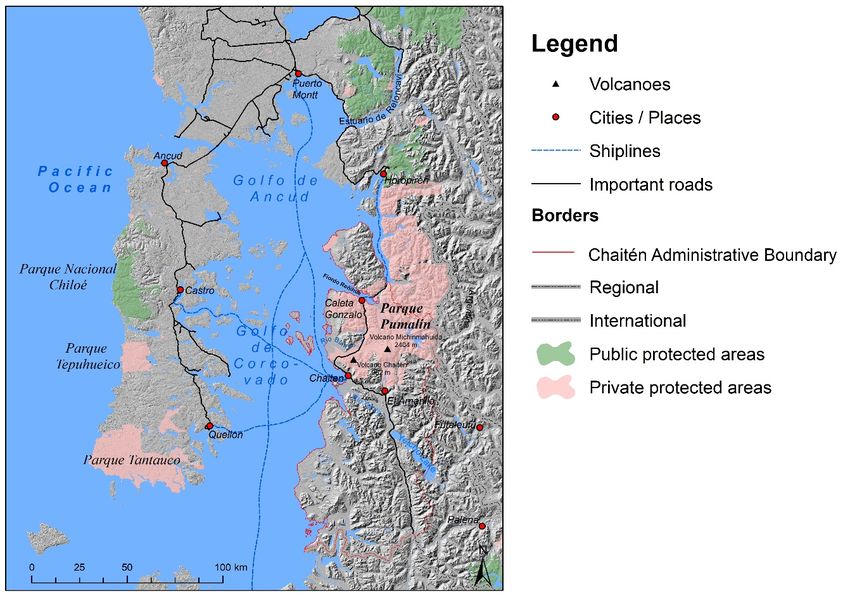
The area where Chaitén is now located (Figure 3) was not permanently inhabited during the 19th
century; the place is also called Chiloé Continental or Palena. In 1905 the first settlers arrived at the
future location of Chaitén when the Chilean Navy determined that the area was suitable for an inland
road connection. In 1921 three people from the archipelago of Chiloé built homes for themselves. They
were fishermen and loggers [39]. In 1933 another settler arrived and by 1940 Chaitén was officially
established as a city and municipality [40].Sustainability 2018, 10, 1584 8 of 22
In the ensuing years Chaitén served as the main transportation hub to places such as Futaleufú
and Palena. The Yelcho river was a channel for boats going to Yelcho lake, the Puerto Cardenas port
and from there on to Puerto Ramírez on the other edge of the lake. From there on the villages
Sustainability 2018, 10, x FOR PEER REVIEW 8 of 22
of
Futaleufú and Palena were reached by horseback. From 1946 onwards, the Chilean army established
the “Cuerpo
and from Militar
there de
on Trabajo” near theon
to Puerto Ramírez citytheofother
Chaitén,
edge of with
thealake.
workforce mainly
From there from
on the Chiloé,
villages of [39]
Futaleufú and Palena were reached by horseback. From 1946 onwards, the
who built a road connection from Chaitén to the Yelcho lake. In the 1980s the construction of the Chilean army established
the “Cuerpo
Carretera AustralMilitar
(Austral de Trabajo”
Highway) nearbegan.
the city This
of Chaitén,
meant with
an aimprovement
workforce mainly in from Chiloé, [39]
connectivity and an
who built a road connection from Chaitén to the Yelcho lake. In the 1980s the construction of the
increase of traffic, tourists and cargo [40]. In 1991 Douglas Tompkins bought plots of land near Chaitén
Carretera Austral (Austral Highway) began. This meant an improvement in connectivity and an
and began his private conservation initiative [10].
increase of traffic, tourists and cargo [40]. In 1991 Douglas Tompkins bought plots of land near
The eruption
Chaitén and began of thehis Chaitén
privatevolcano in 2008
conservation constituted
initiative [10]. a major interruption to events. On May
2nd a PlinianTheeruption
eruption of took
the place
Chaitén involcano
a volcano thatconstituted
in 2008 was assumed to interruption
a major be extinct. The entireOnpopulation
to events. May
of about
2nd5,000 residents
a Plinian eruption were
took evacuated to a security
place in a volcano radius oftoabout
that was assumed 30 to
be extinct. The50entire
km population
away from the
volcanoof on
about4 May5,000 and
residents
5 May.wereOn evacuated
May 12th to aChaitén
security radius of aboutby
was affected 30 atolahar.
50 km Theawayeconomic
from the loss
volcano on 4 May and 5 May. On May 12th Chaitén was affected
consisted of around US$12,000,000 in public buildings alone, which were insured. Clouds by a lahar. The economic lossof ash
consisted of around US$12,000,000 in public buildings alone, which were insured. Clouds of ash shut
shut down regional airports and forced the cancellation of hundreds of domestic flights and several
down regional airports and forced the cancellation of hundreds of domestic flights and several
international flights in Argentina and Chile [41]. The river Chaitén cut the town in half. From that
international flights in Argentina and Chile [41]. The river Chaitén cut the town in half. From that
point on, theon,
point southern part of
the southern partthe
of town became
the town became isolated. Most
isolated. Mostofofthe
thehouses
houses were destroyeddue
were destroyed duetoto the
weightthe
of weight
the ashes, which rained down on the rooftops.
of the ashes, which rained down on the rooftops.
Figure
Figure 3. 3.Pumalín
PumalínPark
Park and
andChaitén.
Chaitén.
In the years after the eruption and evacuation, the whole place was abandoned and property
Inwas
the seized
years after the eruption
and taken and evacuation,
to into government hands.the whole
After place
a few was
years of abandoned and property
uncertainty many former was
seized inhabitants
and taken returned
to into government hands.
to Chaitén. At After
first, they a few
came years of uncertainty
spontaneously many formerThen
and were unorganized. inhabitants
in
September 2010 authorities announced that Nueva Chaitén was to be re-established
returned to Chaitén. At first, they came spontaneously and were unorganized. Then in September on the same site,
and would announced
2010 authorities become the new thatcapital
Nueva of Chaitén
the municipality
was to ofbeChaitén. In Marchon
re-established 2011
thebasic
same services, suchwould
site, and
as drinking water and electricity were re-connected. After that, a master plan for the resettlement of
become the new capital of the municipality of Chaitén. In March 2011 basic services, such as drinking
the village was undertaken [42].
water and electricity were re-connected. After that, a master plan for the resettlement of the village
The population of Chaitén had stabilized during the 1990s. In 2002, 7,182 people lived in Chaitén,
was undertaken
the majority[42].
in the urban area. Other populated areas are Santa Lucia, El Amarillo and Santa Barbara.
The
Duepopulation of Chaitén
to the volcanic eruptionhad stabilized
in 2008 Chaiténduring the 1990s.
was completely In 2002,and
evacuated 7,182 people lived
depopulated in Chaitén,
because of
the majority in the urban area. Other populated areas are Santa Lucia, El Amarillo and Santa Barbara.Sustainability 2018, 10, 1584 9 of 22
Due to the volcanic eruption in 2008 Chaitén was completely evacuated and depopulated because of
healthSustainability
and security 2018, 10, x FOR PEER
concerns. REVIEW
Nevertheless, according to the recent census of 2017, 5,071 people 9 of 22
live in
2
Chaitén (Figure 4) and the population density is 0.6 hab/km , constituting a normal density for the
health and security concerns. Nevertheless, according to the recent census of 2017, 5,071 people live
southinofChaitén
Chile [43].
(Figure 4) and the population density is 0.6 hab/km², constituting a normal density for the
Nearly
south of68% Chileof[43].
the pre-disaster populace has returned. Over recent years tourist operators have
returned, Nearly
restaurants
68% ofare theopening again,
pre-disaster there are
populace hasfour different
returned. Overcamprecentsites
yearsand hostels,
tourist cabins,
operators have as well
as restaurants
returned, and cafés. Furthermore,
restaurants therethere
are opening again, are banks and
are four tourist camp
different agencies
sites(Figure 5). They
and hostels, are as
cabins, mainly
well as restaurants and cafés. Furthermore, there are banks and tourist agencies
for purchasing tickets for the ferries and busses. Also, you can buy day-tours to Pumalín Park, which (Figure 5). They are
can bemainly
visited for through
purchasing tickets for
different the ferriesTherefore,
entrances. and busses. it
Also,
canyou can buythat
be stated day-tours
Chaiténto Pumalín Park,offers
once again
goodwhich
servicescanto betourists
visited through different
and locals. The entrances.
prices areTherefore,
comparable it can
tobe stated
other that Chaitén
places once again
in Continental Chiloé.
offers good services to tourists and locals. The prices are comparable to other places in Continental
In contrast, the neighboring communes did not see a decline in the population because of the volcanic
Chiloé. In contrast, the neighboring communes did not see a decline in the population because of the
eruption. However, they were affected by traffic constraints and isolation. Their main access roads
volcanic eruption. However, they were affected by traffic constraints and isolation. Their main access
were roads
through Argentina during these events.
were through Argentina during these events.
8000
7000
6000
5000
4000
3000
2000
1000
0
1992
1993
1994
1995
1996
1997
1998
1999
2000
2001
2002
2003
2004
2005
2006
2007
2008
2009
2010
2011
2012
2013
2014
2015
2016
2017
Chaitén Futaleufú Palena
Figure 4. Inhabitants of Chaitén and its neighboring communes (Source: Census 1992, 2002, 2011,
Figure 4. Inhabitants of Chaitén and its neighboring communes (Source: Census 1992, 2002, 2011, 2017).
2017).
120000
100000
80000
60000
40000
20000
0
2016 2017
Passangers Small cars
Figure 5. Increase of transported passengers and cars between 2016 and 2017 [44].
Figure 5. Increase of transported passengers and cars between 2016 and 2017 [44].Sustainability 2018, 10, 1584 10 of 22
Data from the Naviera Austral shipping line, connecting Chaitén with the rest of Chile, shows
a significant increase of passengers over recent years in all connecting routes (Puerto Montt —Chaitén,
Quellón–Chaitén and the Ruta 7 Bimodal). In the high season months of January and February there
were 79,268 passengers and in 2017 there was a movement of 82,071 on all three connections combined.
The Ruta 7 Bimodal has the highest rate of movement of all three connections. In Figure 5 the increase
of passengers and small cars transported on these combined routes is displayed.
3. Results
3.1. Pumalín Park Catalyses the Local Economy
A large majority of the Chaiteninos agreed totally or moderately that Pumalín Park has helped
the region with its developing tourism industry (40% and 45%) (Table 2). With 38% and 36% agreeing
totally, people still highly agreed with the question: Is Pumalín Park able to improve economic activities
which are not related to tourism, such as services, handcrafts, fishing? The results show that the vast
majority of the people living in Chaitén see Pumalín Park as economically very positive. The statement,
as to whether Pumalín Park was able to attract other investments to the region, was also agreed with
by a majority (28% agreed totally and 34% agreed moderately).
These results coincide with the vision of the local government, which states in the master plan
that tourism is an opportunity for the economic and environmental development of Chaitén, because
of the wealth that tourism generates, the possibilities of articulation with other productive activities,
and its potential to increase the participation of local population in this activity. The great potential
of the commune makes it a quality tourist attraction, ready to position itself at regional, national and
even international levels. (Municipalidad de Chaitén 2016). An interviewee working in the municipal
administration said: “The park has been a key factor to activate the economy after the eruption of the
Chaitén volcano.” Furthermore, the Report for the Reconstruction Plan in 2009 recognizes Pumalín Park
as a strategic actor on a regional level. However, specific recommendations are not mentioned [45].
Nevertheless, the difficulty in coordinating long-term actions between the private sector and local
government is considered a challenge that should be addressed, and the creation of a public-private
coalition to support tourism as a key activity within the commune is a priority. Important action was
taken in 2015 when the National Service of Tourism (SERNATUR) developed a program to enhance the
formalization and registration of tourist services, the implementation of a promotion and marketing
plan, and a mechanism to facilitate technical assistance to identify new attractions in the area and other
types of tourism activities. The program was geared towards working with the Chamber of Tourism of
Chaitén and the Chaitén Tourism Corporation. In 2017, the process to declare the commune as ZOIT
(Touristic Interest Zone) began, bringing new opportunities for investors and local entrepreneurs.Sustainability 2018, 10, 1584 11 of 22
Table 2. Obtained results for the economic dimension (in %).
Has Pumalín Park
Has Pumalín Has Pumalín Is Pumalín
Has Pumalín Park Promoted the Economy Has Pumalín Has Pumalín Has Pumalín Park
Park Promoted Park Park and not
Generated Direct in Chaitén in Sectors Park Stagnated Park had a Positive
the Economy in Contributed to the State the
Employment for not Related to Tourism the Economic Contributed to Impact on the Price
Chaitén in the Attracting Driver of
the Inhabitants of Like Services, Development Improving Value of the
Tourism Investments to Development
Chaitén? Handicraft, Cattle in Chaitén? Income? Territory?
Sector? the Area? in the Area?
Farming, among Others)
Totally disagree 7 5 3 11 19 35 31 8
Disagree 7 3 8 3 16 30 21 10
Yes, a little 10 8 15 24 43 20 18 26
Yes, agree
39 40 38 34 8 8 15 23
moderately
Yes, agree
37 45 36 29 14 8 15 33
totally
Source: author, 2018.Sustainability 2018,
Sustainability 10, 1584
2018, 10, x FOR PEER REVIEW 12 of 22 12 of 22
The map in Figure 6 shows the services generated in Chaitén for locals and tourists. Tourism-
The map in Figure 6 shows the services generated in Chaitén for locals and tourists.
related services
Tourism-related suchsuch
services as accommodation,
as accommodation, agencies andhigh-end
agencies and high-end restaurants
restaurants have re-emerged in
have re-emerged
inChaitén.
Chaitén.AsAsa transportation
a transportation hub forfor
hub thethe
Carretera Austral,
Carretera Chaitén
Austral, Chaiténhashas
different agencies
different specializing
agencies
in boat and
specializing in air
boattickets
and airastickets
well as
as bus
well connections to places
as bus connections further
to places south.
further south.
Figure 6. Services
Figure for locals
6. Services for and tourists
locals in 2018 in
and tourists inChaitén.
2018 in Chaitén.
ToTothethe
question inquiring
question if Pumalín
inquiring Park wasPark
if Pumalín morewas
important
morethan the Chilean
important thanstate
theasChilean
the driver
state as the
ofdriver
employment, the majority disagreed or were indifferent (19% total disagree, 16% disagree
of employment, the majority disagreed or were indifferent (19% total disagree, 16% disagree and
43% indifferent). This opinion
and 43% indifferent). can be explained
This opinion because the
can be explained Chileanthe
because state is the biggest
Chilean state isemployer in employer
the biggest
this peripheral region; around 25% of the employed people in the commune work in public service
in this peripheral region; around 25% of the employed people in the commune work in public service
(Municipalidad de Chaitén 2016). This includes administrative work in the municipality and road
(Municipalidad de Chaitén 2016). This includes administrative work in the municipality and road
construction; for instance, maintaining the Carretera Austral and CONAF (Corporación Nacional
construction; for instance, maintaining the Carretera Austral and CONAF (Corporación Nacional
Forestal), the recently opened office of SERNATUR (Servicio Nacional de Turismo) among others.
Forestal), the
Furthermore, therecently opened office
police (Carabineros) of SERNATUR
and the (Servicioemployers.
military are important NacionalThese
de Turismo) among others.
jobs are stable
Furthermore, the police (Carabineros) and the military are important employers.
and have annual contracts, while the tourism sector has a high seasonality, due to the short summer These jobs are stable
and have
season annual contracts,
in Patagonia (Decemberwhile the tourism
to February). sector hasworking
An interviewee a high seasonality,
in municipaldue to the short summer
administration
season inthis
confirmed Patagonia (December to February). An interviewee working in municipal administration
observation.
confirmed
Finally, athis
quoteobservation.
by an administrative worker in the municipality emphasized the good relationship
between the city aof quote
Finally, ChaiténbyandanPumalín Park:
administrative worker in the municipality emphasized the good
relationship between
“The Pumalín thebeen
Park has city aofkey
Chaitén andfactor
economic Pumalín Park:
for the city of Chaitén after the eruption
and the aftermath of the Chaitén volcano. Without the employment and services generated
by“The Pumalín
the park, Park has been
the recuperation a key
of the towneconomic factor
would have beenfor the slower
much city of or
Chaitén after the eruption
impossible”.
and the aftermath of the Chaitén volcano. Without the employment and services generated
by the park, the recuperation of the town would have been much slower or impossible”.Sustainability 2018, 10, 1584 13 of 22
3.2. Pumalín Park Has Helped Conserve Valuable Native Forests
Different questions concerning the environmental impact of Pumalín Park were asked (Table 3).
72.5% agreed totally and 17.5% agreed moderately with the question: Has Pumalín Park contributed
to the conservation of flora and fauna?” The same percentages were received to the question: Has
Pumalín Park contributed to conserve local landscape? This high agreement of the Chaiteninos can be
explained due to the fact that the area’s native flora and fauna, now under protection of Pumalín Park,
was under permanent threat of land use change. These include logging of endangered native trees
such as the Alerce “Fitzroya cupressoides”, which can still be found in Pumalín Park [46].
In El Amarillo, where the main southern entrance of Pumalín Park is located, the Park
administration has given financial and logistic aid for the beautification of residential houses.
Additionally, El Amarillo has a store selling local products for tourists run by the Pumalín
administration. This small place some 25 km east of Chaitén had perfect conditions for developing
a small-scale tourist economy and visitor infrastructure. When the volcanic eruption shut down the
city of Chaitén, the Pumalín administration decided to move their offices to El Amarillo. This has led
to an upgrade of the housing structure, especially the facades. From El Amarillo there is a view to the
Michimahuida Volcano and the Tabiques Mountians. The community of El Amarillo is working with
the Pumalín Project to launch a variety of renewal efforts.
It is also important to mention that the good reputation of the Pumalín Project in environmental
issues is a result of the crucial role that Douglas Tompkins and the Pumalín Foundation played in
2006 against the construction and implementation of the hydroelectric megaproject Hidroaysén in
the Aysén Region. The campaign was called “Patagonia! Sin represas!” (Patagonia without dams!),
which advertised against the project [47]. The construction of 5 dams would have generated a total of
2750 megawatts (3,690,000 hp) with further capacity for 18,430 gigawatt-hours (66,300 TJ) on average
annually. The projected cost was estimated at US$32 billion (1.5 trillion Chilean pesos), making it the
largest energy project in the country’s history, but it would also have flooded 12,500 acres of pristine
territory that is increasingly popular as an ecotourism destination and it would have affected Pumalín
Park with the implementation of the transmission line. However, the tough opposition of different
sectors, such as environmental groups (e.g., Patagonia sin represas), NGOs, international experts and the
national community helped to stop it. In June 2014, the project was rejected by the Chilean government
due to its alleged environmental impacts (BBC 2014). Seen from a Chilean national interest perspective
and their demand for clean energy and developing the Aysen region economically, the alternative
to stopping these hydroelectric projects can be challenged. In 2008 only 18.3% of the hydroelectric
potential of Chile was harnessed and in the Austral region, where the project would be located, only
0.2% of the area is used [48].
An astonishing result was observed to the question: would the transition of Pumalín Park to
the Chilean state be a threat to environmental conservation? Here a majority of 45% agreed totally
and a 10% agreed moderately. Only a minority of 20% disagreed and 7.5% totally disagreed that the
transfer to the Chilean state would not be a threat to conservation. This reply can be explained by
the fact that the people of Chaitén do not believe that the government of Chile is able to maintain the
same quality of conservation and infrastructure as Pumalín Park is doing today. In fact, according
to [49], the land that Tompkins donated has an annual maintenance cost of close to $600 million of
Chilean pesos, a budget that must be assumed by the Chilean state to protect and care for the areas
in an appropriate manner. The infrastructure of Pumalín Park is of high quality, especially the camp
sites and their sanitary infrastructure. Furthermore, Chilean National Parks are often challenged
with border problems and land use conflicts [14]. On average in Chilean National Parks this kind of
infrastructure cannot be found at these low prices. Therefore, people fear that the quality of the park
infrastructure could decay. In 2018 it cannot be foreseen how the new administrators of the park will
cope with this challenge.Sustainability 2018, 10, 1584 14 of 22
Table 3. Results for the environmental dimension (in %).
Is Pumalín Park
Has Pumalín Park Has Pumalín Park Is Pumalín Park Doing a Is the Transfer of
Important for the
Contributed to the Contributed to the Good Job on the Pumalín Park to the
Conservation of Nature
Conservation of the Conservation of the Conservation of State a Threat to the
on a National and
Flora and Fauna? Local Landscape? Biodiversity? Conservation of Nature?
International Level?
Totally disagree 8 5 3 5 8
Disagree 0 0 3 3 20
Yes, a little 3 3 8 8 18
Yes, agree moderately 18 18 10 13 10
Yes, agree totally 73 75 77 72 45
Source: author, 2018.Sustainability 2018, 10, 1584 15 of 22
3.3. Pumalín Park Has Promoted Local Culture and Environmental Consciousness in the Area
The last section of the questionnaire asked the Chaiteninos about the sociocultural effect of Pumalín
Park (Table 4). They were asked if Pumalín Park has contributed towards placing further value on
nature and the local environment? A large majority of the Chaiteninos agreed or agreed moderately
(46% and 22%) with this question. This can be seen as evidence that Pumalín Park has shaped local
identity since its foundation. Different initiatives have helped improve the natural landscape and
cultural heritage in the area, for example through the promotion of environmental education projects or
fostering the discussion among the local population on the importance of environmental conservation.
A person working for Pumalín Park emphasizes the sociocultural dimension: “Before the park
was implemented the majority of the local population had no consciousness of the valuable flora and
fauna nearby. Before the park was implemented most people in the region saw the forest mainly as
a source of lumber and firewood and there was no sustainable forest management.”
In the beginning, in the 1990s and 2000s, many locals and Chilean politicians were skeptical
about the project [50], because private conservation was something new and for some people this
kind of protection initiative was considered an obstacle to economic development of the region and
a threat to national sovereignty. Today, the park is well integrated in the region and the local people
have a positive view of Pumalín Park. In the interviews with the different stakeholders in the public
administration and the private sector the same positive opinions about Pumalín Park were stated.
The questionnaire also asked if Pumalín Park had positive impact on public knowledge of the
area. Here a majority of 40% agreed totally and 28% agreed moderately. Furthermore, it was aske,
whether Pumalín Park had contributed to enhancing the natural and cultural heritage of the area.
Also, the vast majority of the Chaiteninos replied positively to this question. (46% agreed totally and
22% agreed moderately). The person associated with Pumalín Park stated that, before the Park was
implemented, the region had no tourist attractions nearby. After the volcanic eruption, the park
helped to re-establish the region, as it provided work for the people of Chaitén and the neighboring
communities. All these efforts have been recognized by international organizations. In January 2018,
the Chilean government received the Conservation Visionaries prize from the International Land
Conservation Network, because of the implementation of the Red de Parques de la Patagonia National
Park. This grants the region a high visibility and international recognition might attract more visitors
into the region [51].Sustainability 2018, 10, 1584 16 of 22
Table 4. Obtained results for the sociocultural dimension (in %)
Has Pumalín Has Pumalín
Has Pumalín Has Pumalín Park Has Pumalín Has Pumalín Park Has Pumalín Park
Park Has Pumalín Park Aad a
Park Contributed to Park Contributed to Contributed to the
Contributed to Park Divided Positive Impact
Contributed to Enhance the Natural Transformed Improve the Environmental
Strengthen the Local on the Public
Strengthen the and Cultural Heritage the Area Quality of Life of Education of the
Community Inhabitants? Knowledge of
Local Identity? of the Area? Negatively? the Community? Community?
Relations? the Area?
Totally disagree 3 5 5 49 38 8 11 29
Disagree 16 15 7 27 15 10 11 11
Yes, a little 39 20 20 17 35 15 14 34
Yes, agree
24 23 22 5 8 28 32 11
moderately
Yes, agree
18 38 46 2 5 40 32 14
totally
Source: author, 2018.Sustainability 2018, 10, 1584 17 of 22
4. Discussion
The research concentrated on the issue of private conservation and the perceptions of the local
population. Conservation can have strong effects on the neighboring population depending on their
economic participation and the social acceptance of conservation. Other studies [32,36] show different
results concerning the perception of nearby communities. Depending on environmental awareness,
and participation in management and services, the acceptance can vary significantly. Furthermore,
those studies show that younger people and those with higher income are more accepting. Studying
private conservation in Chile is of particular interest because of the significant increase of private
protected areas in the last three decades. Chile has a share of 2.2% privately conserved land, in contrast
to 18% of the territory that is protected in National Parks [14]. The phenomena of private conservation
and effects on regional development has already been investigated in the Los Ríos region in the Parque
Bíologico Huilo Huilo, Parque Oncol and the Valdivian Coastal Reserve [3,8]. In these cases, it was
shown that private administrators see local people as threats to forest conservation goals. However,
it was also shown that private conservation enhances self-governance through education programs.
The economic shift from forestry industry towards eco-tourism is a significant economic transition
on a regional level for the cases in the Los Ríos region. The findings suggest that social impact and
consequences of PPAs facilitating ecotourism should be given the same level of attention that was
given to the public protected areas. Pumalín Park represents a unique case which differs between the
already existing case studies in Chile. The transition was not from forestry but from existing native
forests, mainly Valdivian rainforests. In contrast to other cases, Pumalín Park is a key economic factor
for Chaitén; without its existence the recuperation from the volcanic eruption would have been far
more difficult. 45% of the local population agreed that the park helped develop the tourism sector in
the region. This seems obvious, as without the park and its services the attractions would be minor.
To the question: Is Pumalín Park, and not the Chilean state, the main motor of employment? People
reacted indifferently to negatively, because the majority of the people in Chaitén mainly work in
public services. In other cases, such as the Reserva Biologica Huilo Huilo the situation has no easy
comparison, because the population structure is different. In the case of Huilo Huilo most of the nearby
inhabitants extracted timber before the area was transferred to private conservation. As to whether
Pumalín Park should become a state park, the local population were mainly skeptical. The population
referred mainly to other parks run by the semi-private CONAF (Corporación Nacional Forestal), which
from their point of view has lower qualities in conservation and service. The stakeholders share this
point of view. This can be interpreted as a critique on the National Park system in Chile, which tends
to be underfinanced.
In general, it can be stated that Pumalín Park has a strong positive influence on local development.
However, the status quo of private conservation remains uncertain, because of the planned transition
of the park into the National Park system. Therefore, a comparative study in the future would allow
new insight of the perception by the people after the transition.
5. Conclusions
The case of the Pumalín Project is a good example of how a private protected area can help shape
the development of a region, and also contribute to parallel economic activities. In 1991 when Douglas
Tompkins started with this idea, private conservation and activities such as ecotourism were something
new and strange, especially in a country where economic growth was seen at that time as the only
way to achieve the goals of development and to fight poverty. Results of the investigation show that
27 years after the implementation, it is clear that Pumalín Park has changed this paradigm and other
possibilities for development arise as opportunities for rural marginalized areas that are rich in nature
and cultural landscapes such as the Patagonian fjord lands. The various initiatives developed by the
Tompkins Foundation over this period have shown that nature conservation and economic well-being
can coexist without restricting the local development.You can also read


