PRO-GROWTH TAX REFORM AND E-FAIRNESS - Arthur B. Laffer & Donna Arduin July 2013
←
→
Page content transcription
If your browser does not render page correctly, please read the page content below
PRO-GROWTH TAX REFORM
AND E-FAIRNESS
Arthur B. Laffer & Donna Arduin
July 2013
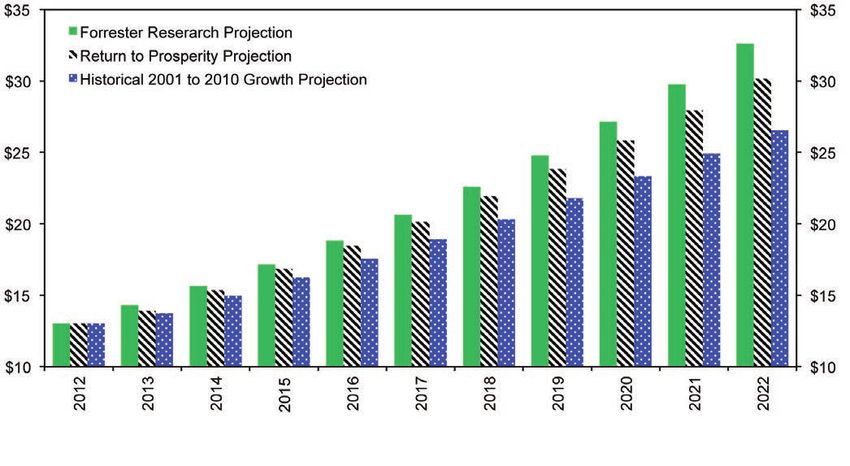
Table of Contents

Foreword............................................................................................................................. i

Pro-Growth Tax Reform & E-Fairness........................................................................ 1
     Summary and Conclusion...............................................................................................................................1

     E-Fairness and Fiscal Federalism..................................................................................................................5

     The Economic Consequences of a Declining Sales Tax Base and Rising Tax Rates.........................7

     Sales Taxes and the Internet: How We Got Here .................................................................................. 13

     The Internet Tax Advantage and a Pro-Growth Tax Reform ................................................................. 14

     The Theory and Evidence Supporting The Implementation of Pro-Growth
     Tax Systems .................................................................................................................................................... 16

     Applying Pro-Growth Lessons to the Problem of E-Fairness .............................................................. 19

APPENDIX I:
A Review of The Literature on Taxes and Economic Growth.............................. 29

End Notes........................................................................................................................ 34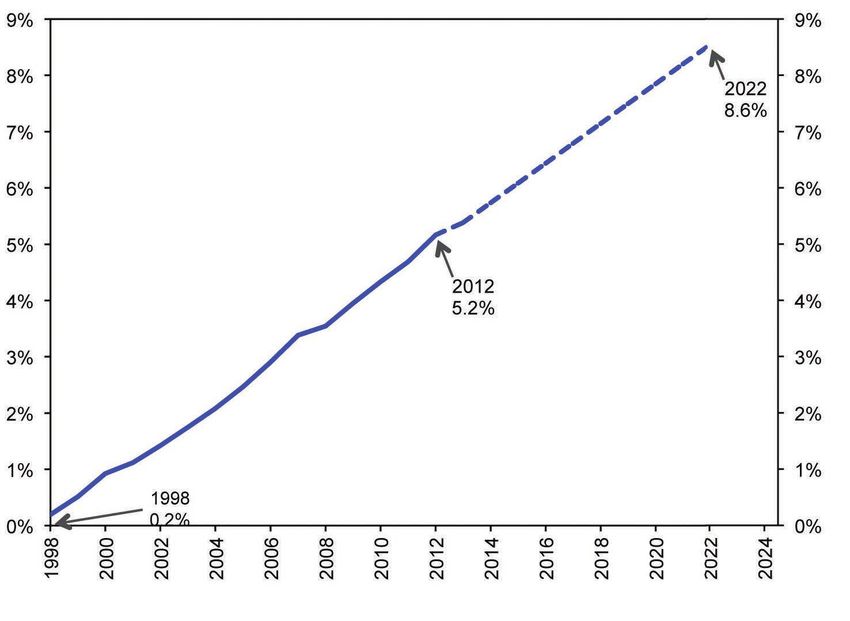
Foreword

By Colin Hanna                                               and to job creation. Furthermore, the collection of
                                                             owed but uncollected taxes would allow states to use
President, Let Freedom Ring
                                                             the additional revenue collected to lower the rates of
We believe that one of the economic fairness issues of       a far more economically damaging tax, the personal
our day is the fundamental imbalance embedded in our         income tax.
tax system that benefits online retailers at the expense
                                                             This approach will have tangible, positive economic
of small, brick-and-mortar store owners who serve our
                                                             effects for states that choose to pass the legislation
communities by creating jobs and supporting the local
                                                             into law. Predictably, savvy conservative governors are
economy. Our conservative principles inform our belief
                                                             already charting the correct course.
that the concept of e-fairness and the Marketplace
Fairness Act is the right way to close a punitive tax        In Wisconsin, Governor Scott Walker has signed into
loophole created by a Supreme Court decision                 state law a provision that would dedicate any revenues
handed down before Internet commerce became a                from e-fairness legislation—including the Marketplace
part of Americans’ everyday lives.                           Fairness Act—and invest them in income tax reductions.
                                                             Dr. Laffer finds that such legislation would increase
Dr. Arthur Laffer is one of the undisputed giants of
                                                             Wisconsin’s Gross State Product (GSP) by 2.17
conservative economic thought and the father of
                                                             percent over the next ten years, while creating 23,701
supply-side economics. He argues in Pro Growth
                                                             jobs for Wisconsinites over the same period.
Tax Reform and e-fairness—a study released in
conjunction with our organizations—closing the online        Not to be outdone, Governor John Kasich of Ohio
sales tax loophole is not only necessary to address a        signed similar legislation—on the same day! Laffer
fundamental inequity in the free market, but also could      projects an increase of 46,660 jobs in Ohio if
help drive us back to the kind of economic growth we         Congress enacts e-fairness legislation to trigger
saw between 1960 and 1999.                                   the Ohio income tax reduction. There is no doubt
                                                             that e-fairness combined with tax reform is a path to
Dr. Laffer and his co-author, Donna Arduin, point out
                                                             economic growth and job creation.
that online sales are in fact already subject to state and
local sales and use taxes. However, the vast majority        While Dr. Laffer finds that closing loopholes and
of taxpayers fail to remit the tax owed with their income    lowering tax rates could finally help us recover from
tax returns. Today’s system is confusing and inefficient,    the economic turbulence suffered from the 2008
and ultimately amounts to government’s thumb on the          financial collapse, there are other reasons this issue
free market scale.                                           is critical for our economy. It addresses a fundamental
                                                             unfairness to small businesses around the country.
The online loophole is economically destructive
because “sales taxes and other broad-based tax               Currently, Americans who buy goods online are legally
regimes with fewer loopholes and lower rates are the         required to self-report their purchases and remit the
least damaging taxes” to state and local economies           sales taxes owed on their tax return. As noted earlier,

                                                                                        Laffer Associates & Let Freedom Ring | i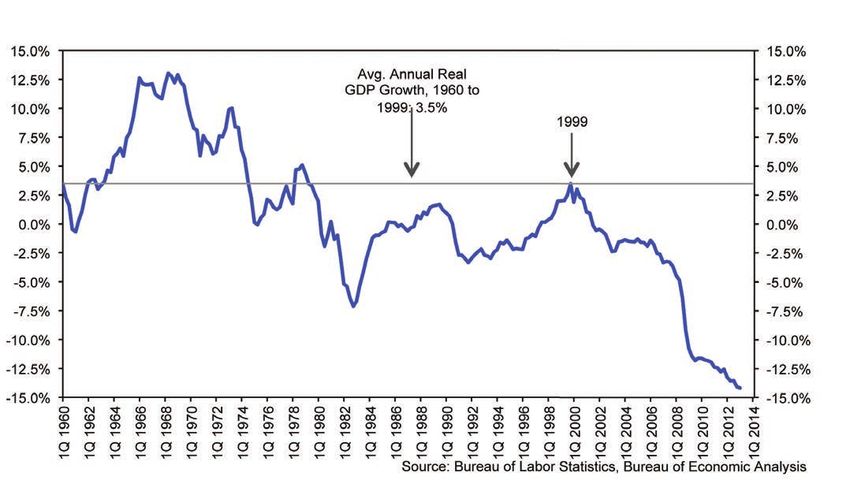
few do, giving online sellers a virtual subsidy of almost    Christian retailers are put at disadvantage because
 ten percent in some states. This special treatment           Internet-only companies are not required to collect
 runs counter to traditional free-market thinking, and        sales taxes. This un-level playing field has resulted
 does significant damage to our Main Street stores that       in staffing reductions and the closing of many of our
 employ millions of workers across the country.               independent Christian retailers over the past few years,
                                                              threatening the very existence of our membership and
Although we oppose plans to increase government
                                                              their ability to serve our Christian communities... As the
revenues by raising taxes, we fully support efforts
                                                              saying goes, a sale, is a sale, is a sale, and our sales
to fairly and uniformly enforce taxes already on the
                                                              tax collection policies should be the same regardless
books. Compliance with tax law is not an unnecessary
                                                             if an item was purchased online or through one of our
government intrusion; it is a fundamental principle of
                                                             members’ store fronts. Local independent businesses
fairness and pro-growth economics, as Dr. Laffer’s
                                                             are a more important economic generator for our
study proves with hard data. Most importantly,
                                                             communities than out-of-state businesses seeking
government shouldn’t be picking winners and losers
                                                             tax avoidance.” (Curtis Riskey, President of The
in the economy with the tax code—ending this practice
                                                             Association of Christian Retail, in a letter to Senator
will restore the basic tenets of the free market where
                                                             Roy Blunt, April 2012)
retailers compete on price and service, not on
government tax policy.                                       “Current policy gives remote sellers a price advantage,
                                                              allowing them to sell their goods and services without
 Many influential conservative leaders and thinkers are
                                                              collecting the sales tax owed by the purchaser. This
 as convinced as we are by the argument in favor of
                                                              price difference functions like a subsidy. It distorts
 e-fairness. Here’s what some of those leaders have
                                                              the allocation between the two forms of selling. The
 said:
                                                              subsidy from not collecting tax due means a larger
“If the advantage of tax-free Internet commerce               share of sales will take place remotely than would
 marginally closes out local industry, reforms are            occur in a free, undistorted market.” (Hans Kuttner,
 required... The mattress maker in Connecticut is             The Hudson Institute, “Future Marketplace: Free and
 willing to compete with the company in Massachusetts,        Fair,” May 2012.)
 but does not like it if out-of-state businesses are, in
                                                             The arguments in favor of this legislation are
 practical terms, subsidized; that’s what the non-tax
                                                             overwhelming. It is not only fair to level the playing field
 amounts to. Local concerns are complaining about
                                                             for our local small businesses, but Dr. Laffer’s study
 traffic in mattresses and books and records and
                                                             proves the concept is a crucial step towards greater
 computer equipment which, ordered through the
                                                             growth and job creation through lower tax rates across
 Internet, come in, so to speak, duty free.” (William F.
                                                             the board. We hope the House will follow the Senate’s
 Buckley, “Get That Internet Tax Right,” National Review
                                                             lead and pass e-fairness legislation that corrects the
 Online, 10/19/01)
                                                             current inequity and allows forward-thinking governors
“Unfortunately, due to a loophole caused by the 1992         the opportunity to lower tax rates and jumpstart
 Quill Supreme Court decision, our independent               economic growth in their states.

                                                              Colin Hanna

                                                                                          Laffer Associates & Let Freedom Ring | ii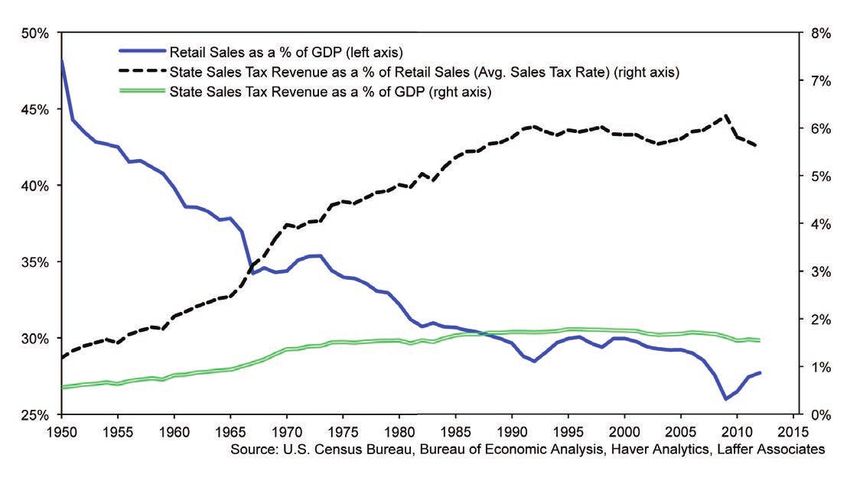
Pro-Growth Tax Reform
& E-Fairness

Summary and Conclusion                                             ``The 45 states with sales taxes could use the
The principles behind addressing the online sales                    additional revenues from the collection of taxes
tax loophole and enacting policies that will jumpstart               on remote sales already in the sales tax base
economic growth are straightforward:                                 to lower other tax rates and reduce far more
                                                                     burdensome taxes. This more efficient system
  ``While online and other remote sales are subject
                                                                     and lower taxes would, in turn:
    to state and local sales and use taxes, they are
    often inaccurately perceived as “tax free” because                êê Increase state prosperity and employment on a
    the taxes legally owed on these purchases go                         dollar-for-dollar basis resulting in the following
    largely uncollected by remote sellers due to a                       increases in gross state product (GSP) and
    Supreme Court ruling that pre-dates the Internet.                    state employment over a decade based upon
  ``Sales taxes and other broad-based tax regimes                        Internet sales as a percent of projected state
    with fewer loopholes and lower rates are the least                   retail sales in 2022.
    damaging taxes to state economies and state
    employment.

                                              Table 1
                   Impact to Gross State Product and Employment of Wisely Using
                     Additional Revenues from Taxing Internet and Remote Sales
 State    2022 Percentage Point Increase in    Additional GDP in      2022 Percentage Point Increase in        Additional
          10-year GSP Growth by Wisely Using   2022, $ billions       10-year Employment Growth by Wisely      Employment
          Additional Revenues from Taxing                             Using Additional Revenues from Taxing    in 2022
          Internet and Remote Sales                                   Internet and Remote Sales
 WA       4.63%                                $24.5                  1.48%                                    59,599
 HI       4.59%                                $4.9                   1.47%                                    13,417
 WY       4.17%                                $3.3                   1.33%                                    6,020
 NM       4.13%                                $5.0                   1.32%                                    15,070
 AR       4.13%                                $6.5                   1.32%                                    20,600
 LA       4.02%                                $17.6                  1.29%                                    35,513
 TN       3.98%                                $15.3                  1.27%                                    45,891
 SD       3.51%                                $2.2                   1.12%                                    6,578
 MS       3.44%                                $4.9                   1.10%                                    16,266
 AZ       3.38%                                $13.5                  1.08%                                    39,344
 NV       3.25%                                $7.0                   1.04%                                    18,388
 FL       3.03%                                $34.9                  0.97%                                    107,474
 MI       3.02%                                $12.7                  0.96%                                    44,109
 OK       2.98%                                $7.5                   0.95%                                    21,348

                                                                                                                  continued

                                                                                             Laffer Associates & Let Freedom Ring | 1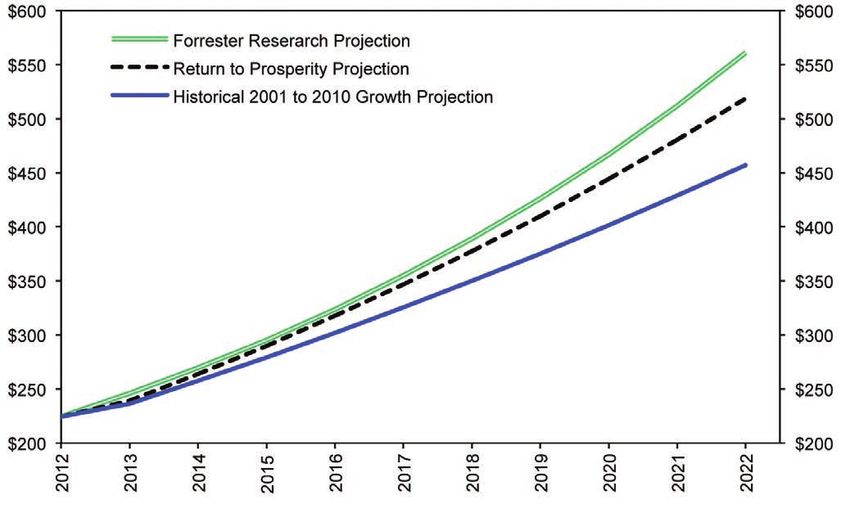
Table 1 cont.
State   2022 Percentage Point Increase in      Additional GDP in       2022 Percentage Point Increase in        Additional
        10-year GSP Growth by Wisely Using     2022, $ billions        10-year Employment Growth by Wisely      Employment
        Additional Revenues from Taxing                                Using Additional Revenues from Taxing    in 2022
        Internet and Remote Sales                                      Internet and Remote Sales
IN      2.97%                                  $11.2                   0.95%                                    32,388
KS      2.91%                                  $5.6                    0.93%                                    16,956
TX      2.87%                                  $62.9                   0.92%                                    155,882
CA      2.82%                                  $78.5                   0.90%                                    180,974
ND      2.76%                                  $2.2                    0.88%                                    5,073
GA      2.75%                                  $15.8                   0.88%                                    50,642
UT      2.74%                                  $5.9                    0.88%                                    16,961
AL      2.66%                                  $6.8                    0.85%                                    21,732
NC      2.66%                                  $17.6                   0.85%                                    47,206
IA      2.62%                                  $5.9                    0.84%                                    16,155
CO      2.60%                                  $10.1                   0.83%                                    28,200
NY      2.58%                                  $43.8                   0.82%                                    97,297
ID      2.51%                                  $2.3                    0.80%                                    7,633
NE      2.45%                                  $3.6                    0.78%                                    9,760
MO      2.44%                                  $8.2                    0.78%                                    26,612
OH      2.38%                                  $14.1                   0.76%                                    46,660
SC      2.33%                                  $5.4                    0.75%                                    19,757
ME      2.25%                                  $1.6                    0.72%                                    5,756
MN      2.22%                                  $9.0                    0.71%                                    24,760
KY      2.19%                                  $5.1                    0.70%                                    16,313
WV      2.17%                                  $2.2                    0.69%                                    6,414
WI      2.17%                                  $7.6                    0.69%                                    23,701
RI      2.00%                                  $1.5                    0.64%                                    3,790
NJ      1.97%                                  $13.2                   0.63%                                    32,933
PA      1.85%                                  $15.1                   0.59%                                    43,803
CT      1.76%                                  $5.5                    0.56%                                    12,791
IL      1.75%                                  $16.0                   0.56%                                    40,223
MA      1.53%                                  $8.3                    0.49%                                    20,570
MD      1.48%                                  $7.1                    0.47%                                    17,476
VT      1.43%                                  $0.5                    0.46%                                    1,970
VA      1.43%                                  $9.8                    0.46%                                    23,582
AK      1.21%                                  $1.1                    0.39%                                    1,995
MT      0.00%                                  $0.0                    0.00%                                    0
OR      0.00%                                  $0.0                    0.00%                                    0
DE      0.00%                                  $0.0                    0.00%                                    0
NH      0.00%                                  $0.0                    0.00%                                    0

                                 U.S. Total:   $563.2                                                           1,505,583

                                                                                              Laffer Associates & Let Freedom Ring | 2
Reinvigorating the U.S. economy should be the                             economic growth rate, we are currently close to 15%
top priority for federal and state leaders. After                         poorer than we would have been had the pre-2000
experiencing amazing real economic growth of 3.5%                         growth rate persisted. And, less national income
per year between 1960 and 1999, the economy’s                             compounds the federal and state governments’ fiscal
average annual growth rate has been only 2.2%                             problems. Slow growth leads to reduced tax revenues
since 2000. Without fundamental economic reforms                          and more poverty, which, in turn, leads to greater need
both large and small, the consequences of subpar                          for government support programs. And deficits can’t
economic growth will be dramatic. The simple                              go on forever.
arithmetic tells it all. Due to the drop in the country’s

                                              Figure 1
  Percent Difference between Real GDP per Adult and Real GDP per Adult 1960 to 1999 Trend1
                        (quarterly, 1Q-60 to 1Q-13, trend is 1960 to 1999)

Tax reforms that broaden the tax base and use the                         system. Broad tax bases reduce people’s opportunity
estimated increase in revenues (on a static basis)                        to engage in tax evasion and tax avoidance. When
to lower marginal tax rates can help revitalize the                       used in tandem, tax reforms that reduce marginal
U.S. economy and increase overall national wealth.2                       tax rates while broadening the tax base encourage
Lower tax rates reduce the economic distortions and                       economic growth while ensuring that the government
inefficiencies created by the current outdated tax                        receives the necessary tax revenues.

1. Real GDP per adult is $ per civilian non-institutional population 16 years old or over.
2. Arthur B. Laffer, “The Complete Flat Tax,” A. B. Laffer Associates, February 22, 1984. Arthur B. Laffer and Wayne Winegarden,
        EUREKA!, Pacific Research Institute, 2012.

                                                                                                           Laffer Associates & Let Freedom Ring | 3
Federal legislation can also empower states to purchases from out-of-state retailers. Worse, the
implement pro-growth tax reform. States that rely on tax distortion incentivizes consumers to use in-state
a low rate, broad-based consumption tax have been retailers as a showroom to evaluate purchases prior to
struggling with the problem of a declining sales tax ultimately buying the product from out-of-state Internet
base for many years. For states like Texas, Florida retailers. Such a practice reduces the need and costs
and Tennessee that have eschewed an income tax, for Internet sellers to put forth the effort to display
this declining base is particularly troubling. There are products. Thus, states are incentivizing residents to
several drivers behind this trend including inequities in burden in-state businesses with retailing costs, but
the application of state sales taxes (e-fairness); certain ultimately purchase their goods from out-of-state
states offering special exemptions to certain goods; businesses. Such incentives increase overall in-state
and the bias toward taxing goods and not services, retail costs and reduce overall in-state sales. It’s a
despite the service sector’s growing share of the lose/lose situation for in-state retailers.
national economy.
The practice of treating in-state and Internet retailers
E-fairness legislation addresses the inequitable differently has also accelerated the decline in states’
treatment of different types of retailers based on sales tax bases, particularly in light of the explosive
whether the retailer is a.) located in the state (either growth of Internet-based sales. As opposed to
a traditional brick and mortar store or an Internet/ effectively controlling government spending, however,
remote retailer with a physical presence in the state) the narrowing of the state sales tax base (as a result
or b.) an Internet retailer/remote seller that is solely of Internet sales estimated to be in the hundreds of
located in another state. In-state retailers collect the billions of dollars), has led to higher tax rates in some
sales tax that is owed at the time of purchase. Out-of- instances.
state retailers without in-state nexus are not obliged to
As with any pro-growth tax reform, the effective sales
collect the sales tax.
tax base should be broadened by treating out-of-state
When in-state residents purchase from out-of-state retailers on the same level playing field as in-state
retailers, they are legally required to report these retailers, and the marginal tax rate should be reduced
purchases and pay the sales taxes owed—typically such that the total static revenues for the government
referred to as a use tax. As you can imagine, few are held constant or reduced. If done properly,
people do. And just so you don’t go away surprised, expanding the state sales tax base by including
there are some in-state retailers who also evade their Internet sales could reinvigorate economic growth.
collection obligations and some out-of-state retailers
Addressing the e-fairness problem from a pro-growth
that do collect taxes. You may recall the story of
perspective creates several benefits for the economy.
former Tyco International Chairman Dennis Kozlowski,
An inequity is addressed—all retailers would be treated
who, among other things, evaded $2+ million in state
equally under state law.4 It also provides states with
and local sales taxes owed to New York by having over
the opportunity to make their tax systems more efficient
$10 million of paintings shipped to New Hampshire
and to increase competition amongst all retailers.
instead of to his home in Manhattan. 3
May the best business plan win, without government
This narrowing of the sales tax base has led to several picking winners and losers. As a consequence of
inefficiencies that, on balance, diminish potential job more state by state efficiencies, the overall economic
growth and growth in gross state product (GSP). growth incentives of the U.S. economy will be
This Internet exemption creates a tax-based price improved.
advantage that encourages consumers to make
3. Anemona Hartocollis, “Ex-Tyco Chief to Settle Tax Evasion Charges,” The New York Times, May 13, 2006.
http://www.nytimes.com/2006/05/13/business/13tyco.html?_r= 0
4. This has nothing to do with whether a sales tax or value-added tax (VAT) should be used.
Laffer Associates & Let Freedom Ring | 4E-Fairness and Fiscal Federalism state sales tax base, some of which comes from
Internet sales, has not been a means to control
Many of our closest friends believe that treating
government spending or taxes (Figure 2). The chart
all retail sales within a state—whether in-state or
below shows that states have increased taxes during
out-of-state, such as Internet based—as part of the
the very time periods when non-taxed Internet sales
appropriate sales tax base constitutes an overall tax
were expanding.
increase. It is clear from the data that the declining
Figure 2
State Tax Changes as a Percentage of Prior FY Tax Revenues5
Annual, Period: 1993 to 2012, $billions, calendar year changes to take effect
the following fiscal year
5. This chart shows the static effect of calendar year net state legislated tax changes on the following fiscal year’s revenues. For example,
the net tax increase of $3.8 billion shown for calendar year 2008 is the static effect on FY2009 revenues (July 2009 through June 2010
for most states). Source: National Conference of State Legislatures.
Laffer Associates & Let Freedom Ring | 5Declining sales tax bases have been exerting constant Rising tax rates, whether at the federal or state level,
pressure to raise marginal tax rates (see Figure 3). As are detrimental to national economic growth.
Figure 3 illustrates, the total state sales tax base has
With respect to the economic impact of the e-fairness
been in decline for many years. However, the declining
proposal, states should not use an expansion of
sales tax base has been more than offset by rising
the total sales tax base as an excuse to raise the
sales tax rates (e.g. higher marginal tax rates), which
overall tax burden. In fact, as Figure 3 illustrates, the
have had the effect of increasing sales tax revenues as
declining sales tax base has already encouraged
a share of gross state product. In fact, based on our
larger percentage rises in the state sales tax rates;
estimates of the states’ sales tax bases (retail sales
consequently, the correct economic policy would
as a percent of GDP), the total state sales tax base
be to expand the states’ sales tax bases, but reduce
is down 19.4% from 1970 to the present, while the
marginal tax rates elsewhere to keep total state
average state sales tax rate (state sales tax revenue
government revenues flat as a share of GSP. Simply
as a percent of retail sales) has increased 40.7% over
put, fixing inequities in the tax system, through such
the same time period. In other words, states have
measures as broadening the tax base, should not be
been increasing the marginal sales tax rate to offset
used to justify an expansion of the size of government.
the declining sales tax base and to increase total sales
tax revenues to around 1.5% of gross state product.
Figure 3
The Decline in the Estimated Sales Tax Base as a Percentage of Gross State Product
Has Encouraged Rising Average State Sales Tax Rates In Order to Increase Total Sales Tax
Revenues as a Share of Gross State Product
(All States, 1950 to 2012) i
Laffer Associates & Let Freedom Ring | 6Opposition to addressing the inequities inherent in As we describe below, states are already using Internet
Internet taxes has arisen because some states may use sellers to collect sales taxes where the retailers have
the problem of e-fairness as an excuse to raise their a nexus in the state. Furthermore, costs have been
state’s overall tax burden. However, the states do not an important justification for exempting out-of-state
need Washington D.C.’s permission to change their retailers. These costs have declined significantly
tax rates. Just look at recent tax increases in Illinois due to advances in technology. Legislation under
(an increase of the state’s income tax rate from 3% to consideration in Congress would lower the compliance
5% and an increase in the state’s corporate income costs further due to the requirement that states provide
tax rate as well), Minnesota (new personal income the necessary tax compliance software for Internet
tax bracket above $150,000 with a rate of 9.85% retailers. Due to the declining costs of compliance
starting in 2014), California (Governor Jerry Brown’s coupled with the large economic consequences
new 13.3% top personal income tax rate retroactive created by the current Internet tax exemption, there is a
to Jan 1, 2012 from Proposition 30), New York (raised strong case for out-of-state retailers to collect the state
top income tax rates), Maryland (raised top income sales taxes that are owed on purchases in the same
tax rates), Vermont, Massachusetts (Governor Deval manner as local retailers.
Patrick has proposed higher tax rates on high income
earners) or Connecticut (raised top income tax rates)
if you don’t believe us. These states know how to
The Economic Consequences of a
raise taxes, believe you me. Some states—such as
Declining Sales Tax Base and Rising
North Carolina, Kansas (cut the top state income tax Tax Rates
rate from 6.45% to 4.9%), Oklahoma (will cut the top The state sales tax burden, i.e. sales tax revenues
personal income tax rate from 5.25% to 5% effective as a share of GDP (see Figure 3), has been
2015), and Ohio (which recently repealed its estate concentrated on a declining sales tax base—retail
tax),—have been proposing pro-growth tax reforms. sales as a percentage of GDP (see Figure 3). Current
More importantly, governors in Wisconsin and Ohio purchasing trends (e.g. the growing market share of
recently signed into law budgets that earmark all Internet sales versus brick and mortar retail sales) will
revenue from e-fairness legislation towards reducing for sure continue if Internet sales remain effectively tax
income taxes in their state, a win-win scenario. exempt. Figure 4 shows the growth in e-commerce’s
Implementing different tax policies in different states share of the retail trade as estimated by the U.S.
is the essence of fiscal federalism—states should have Census.
the power to experiment with alternative approaches
Over the past 13 years, while the sales tax base
to fiscal policy. In other words, states should have the
has been shrinking, e-commerce has been steadily
right to be wrong.
growing. But clearly, factors other than e-commerce
The value of fiscal federalism does not diminish simply sales are at work as well. E-commerce sales account
because some states may implement policies that are for only a portion of the loss of taxable retail sales.
detrimental to economic growth, or in this case, use Linearly projecting out the current growth path of
the need to address an inequity in the application e-commerce, by 2022, 8.6% of all retail trade sales will
of the sales tax as an excuse to expand the size and be conducted via e-commerce, which is almost 60%
scope of government. Additionally, mistakes at the larger than total sales a decade prior.
federal level should not be justified because states
might exercise the freedom of fiscal federalism and, in
so doing, implement the right policy in the wrong way.
Laffer Associates & Let Freedom Ring | 7Figure 4
Rising E-Commerce Share of Retail Trade: E-Commerce as a % of Retail Trade
(All States, 1998 to 2012 actual, linear projection for 2013-2022)
Bruce et al. have produced a series of papers that e-commerce is expected to reach $530 billion in 2022.iv
estimate state and local sales tax losses arising Second, our analysis of trends in online retailing
from e-commerce for the District of Columbia and confirms the Bruce et al. and Forrester Research
45 states (remember there are five states without assessments, albeit at a lower 2012 estimate than the
general state sales tax: Alaska—which does have local Bruce 2012 estimate. Retail sales over the Internet
sales taxes—Oregon, Delaware, New Hampshire and represent a growing erosion of states’ sales tax base
Montana).ii Bruce et al. use both a baseline forecast projected out through 2022 (see Figure 4).
and an optimistic forecast for e-commerce growth. In
The basis for our estimate is the U.S. Census E-Stats,
the baseline case, they estimate that annual national,
which the U.S. Census uses to measure the electronic
state, and local sales tax losses on e-commerce
economy.v According to the U.S. Census, back in
would grow to $11.4 billion by 2012 for a six-year
1998, Internet retail sales held a trivial share of total
cumulative loss of $52 billion.iii According to Forrester
retail sales in the U.S. (around 0.2%). However, as
Research, U.S. online retail sales grew 12.6% in 2010,
Figure 4 illustrated, this share has been growing
reaching $176.2 billion. With an expected 9.6%
rapidly. Furthermore, the growth in market share
compound annual growth rate from 2010 to 2022, U.S.
Laffer Associates & Let Freedom Ring | 8over time has thus far very closely followed a linear Total state taxable sales are estimated to be $4.3
growth pattern of around 0.35 percentage points per trillion in 2012, based on quarterly data from the U.S.
year.vi While a constant percentage linear growth Census.vii Of these total sales, 5.2% (see Figure 4),
can’t last forever, it sure fits well over the recent past. or $224.4 billion were categorized as e-commerce. In
Some estimates are predicting faster growth. The order to determine the lost state sales tax revenues
aforementioned Forrester Research estimates predict through 2022 due to Internet taxable sales not being
a faster 9.6% compound annual growth rate, yet this taxed, we need to estimate the total Internet retail sales
is still not as fast as the growth in online sales may through 2022. We estimated the total U.S. Internet
actually turn out to be. sales tax base between 2013 and 2022 using three
different methods that are summarized in Figure 5:
There is also another estimate that we feel is both
``The average growth rate in total taxable retail
important and realistic. Since 2000, the U.S. has
sales ($4.3 trillion) between 2001 and 2010
gone through a period of decidedly bad economics—
(2.2% per year) coupled with the growth in the
tax increases, out-of-control government spending,
retail Internet market share of 0.35 percentage
regulatory overreach, damaged trade relations and
points per year (2022 number is 8.6%) yields
wildly expansive money creation. The consequence of
taxable Internet retail sales in 2022 of $460
these policy aberrations has been the decade plus-
billion,
long underperformance of the U.S. economy.
``Forrester Research estimated 9.6% average
With the political changes reflected in the states and growth in Internet sales applied to estimated
critical elections in 2014 and, of course, in 2016 as Internet retail sales through 2022, yielding
well, there is a significant possibility that the U.S. will additional taxable retail sales in 2022 of $560
return to sound economic policies, and, as a result, billion, and
economic growth will return to its pre-2000 rate. We
``An additional estimate based on a return to
will use a growth rate of 3.5%, which reflects the
prosperity being achieved in the U.S. economy
growth between 1960 and 1999 (see Figure 1) as an
over the period 2013 to 2022 (3.5% growth)
alternative projection of retail sales over the coming
yielding $520 billion in additional retail sales in
years.
2022.
Laffer Associates & Let Freedom Ring | 9Figure 5
Projected Retail Internet Sales
($ billions, 2012 Estimate, Projection from 2013 to 2022)
Based on current market trends and forecasts, we and services sold via the Internet were $8.6 billion
estimate that total Internet retail sales will grow from in 2010.ix Based on an average state sales tax rate
$224.4 billion to a range of $460 billion to $560 billion (state sales tax revenues ÷ retail sales) of 5.81%, this
by 2022. While these sales are potentially subject to equates to a national non-taxed Internet sales tax base
the state sales tax, the questions are (a) how many of $150 billion.x The $150 billion represents close to
of these sales are intended to be part of the sales 100% of the total estimated 2010 Internet retail sales
tax base, i.e. do they or do they not fit into categories base of $166 billion, based on the U.S. Census 2010
that are exempted even for in-state sales?; (b) how estimated Internet retail sales base.
many of these sales that are intended to be part of the
As an aside, it should be noted that Internet sales
sales tax base are not currently paying sales tax to the
are not the only category of remote sales leading
government; and, (c) what proportion of these non-tax
to the gap between theoretically taxable sales and
submitting taxable sales can be captured. There is
actual sales taxes paid. It is often the case that
also the question of how these sales would change if
non-electronic sales between states also go untaxed—
their tax status changes.
remember our Dennis Kozlowski story on page four.
Third, according to a National Conference of State In a study by Fox et al.,xi estimated uncollected taxes
Legislatures analysis, total uncollected taxes on goods
Laffer Associates & Let Freedom Ring | 10on non-electronic sales add up to $11.9 billion for Overall, in 2012 our estimates show that states are
2012 alone. currently losing $13 billion in potential sales tax
revenues due to Internet retailers not collecting sales
Apportioning total e-commerce sales to each state by
taxes on taxable sales. We estimate that these losses
its share of national retail sales, the estimated Internet
will grow to between $27 billion and $33 billion by
sales tax base multiplied by the appropriate state sales
2022 without corrective action.
tax rate provides an estimate of revenues that each state
can capture (see Figure 6.) To state the obvious, the As mentioned, there is an also enormous amount of
actual implementation of taxing Internet sales is far more taxes due, but not paid, on non-electronic remote sales.
complicated and less certain than our estimates imply. By our estimates of U.S. retail sales growth, according
Figure 6
Projected Retail Internet Sales Tax Revenues Lost
($ billions, 2012 Estimate, Projection from 2013 to 2022)xii
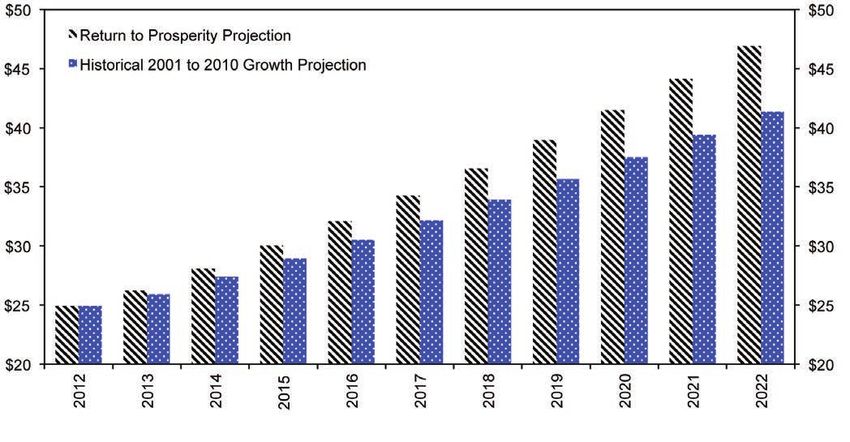
Laffer Associates & Let Freedom Ring | 11to the 2001 to 2010 average growth and the 1960 to remote sales. Without changes being made, we
1999 return to prosperity projections, we are currently estimate total uncollected sales taxes on e-commerce
losing a total of $25 billion in potential sales tax sales and non-electronic remote sales to grow to
revenue due to both Internet retail sales taxes going between $41 and $47 billion by 2022 (Figure 7.)
uncollected and unpaid use taxes on non-electronic
Figure 7
Projected Retail Internet and Remote Non-Electronic Sales Tax Revenues Lost
($ billions, 2012 Estimate, Projection from 2013 to 2022) xiii
Laffer Associates & Let Freedom Ring | 12Sales Taxes and the Internet: Sales taxes modify behavior amongst the many
How We Got Here counties in California. In evaluating Propositions A and
B in Orange County following its bankruptcy in 1994,
The current sales tax system creates an incentive for
we found that counties that raised their sales tax rates
residents to purchase goods over the Internet from
even by as little as ½¢ were documented to lose retail
out-of-state sellers rather than purchase goods from
sales to neighboring counties where rates did not rise.
in-state retailers. This incentive arises because many
Internet-based retailers do not collect state sales taxes, A study of Delaware by one of the authors back in the
whereas all in-state based businesses are required late 1970s found that Delaware’s high income tax and
to do so. Therefore, a resident who purchases $100 no sales tax policy combined with Pennsylvania’s high
worth of books at a local retailer must pay $106 for the sales tax and no income tax policy led to the not-so-
purchase—the $100 worth of books plus a $6 state surprising conclusion that Delaware had the highest
sales tax (assuming an average state sales tax rate of retail sales ratio to state gross state product in the
6% and ignoring any local sales tax add-ons.) That nation and Pennsylvania had the lowest ratio. It wasn’t
same resident can also purchase $100 worth of books until 1971 that Pennsylvania adopted the progressive
from an online retailer and not pay any sales tax at the income tax it now has.
time of purchase, even though the transaction occurs
in the same state from the resident’s perspective. The current Internet sales tax exemption goes back to a
While the resident is supposed to remit the $6 tax 1992 U.S. Supreme Court decision that reaffirmed the
(in the form of a use tax) to the state, pragmatically principles established in a 1966 case (National Bellas
speaking this rarely occurs. Hess.) In that 1992 decision, known as Quill v. North
Dakota, the U.S. Supreme Court ruled that retailers are
While we use the example of Internet sales, there are not required to collect “sales taxes in states where they
other circumstances where a state loses its sales tax. have no physical presence, such as a store, office, or
If someone buys something from an out-of-state seller warehouse.” (The legal term for this physical presence
and has the product shipped to his domicile, the out- is “nexus.”) Although the case dealt with a catalog
of-state seller will often forgo the sales tax. There are mail-order company, the ruling has subsequently been
even some circumstances where an in-state buyer from applied to all remote sellers, including online retailers.
an in-state seller asks to have the product shipped to The Court said that requiring these companies to
an out-of-state location. All of these should fall under comply with the varied sales tax rules and regulations
the Internet provisions. of 45 states and some 7,500 different local taxing
jurisdictions would burden interstate commerce.xv
For local businesses, these distortions mean tax
discrimination. And, there is evidence that these In Quill, the Court specifically noted that Congress
distortions change consumer behavior. For instance, has the authority to change this policy and could enact
Anderson et al (2009) found “…that the obligation to legislation requiring all retailers to collect sales taxes
collect sales taxes has a significant effect on customer without violating the Constitution. “Congress,” the
behavior.”xiv For the overall economy, these distortions Court determined, “is … free to decide whether, when,
mean that other state taxes are higher than they would and to what extent the States may burden interstate
otherwise need to be to support the same level of mail-order concerns with a duty to collect use taxes.”xvii
government expenditures. Due to this tax-created
incentive coupled with the higher than necessary taxes E-commerce via the Internet was a fledgling industry
in other areas, total economic efficiency is less than it back in 1992 when the Quill decision was made. In
should be. comparison, e-commerce is a major and growing sales
venue today. In a day when Google supports mobile
Laffer Associates & Let Freedom Ring | 13applications that calculate the best available deal According to New York State law, if even one of those
online, or in-person for an on-shelf item by scanning affiliates is in New York State, then an out-of-state
its Universal Price Code (UPC), it is safe to say retailer must collect sales tax on everything sold in the
that modern technology has rendered feasible the state, regardless of whether or not it is sold through
once seemingly burdensome task of calculating and the affiliate. This is an extension of an existing rule
remitting sales taxes for the country’s many state and that companies employing independent agents or
local jurisdictions .xviii Moreover, Amazon CEO Jeff representatives to solicit business must collect taxes
Bezos downplayed the possible threat to Amazon’s for the state.
edge against traditional stores if it should be forced to
States arguably now have a clearer path toward reform,
collect sales taxes in more states, noting that Amazon
and action on the state level is expected to continue or
already does at least half of its business in places
increase. These events have given momentum to the
where it collects sales taxes or something similar, such
federal effort to resolve the issue of collecting tax from
as Europe’s value-added tax. xix
online purchases, which is currently moving through
Importantly, the Supreme Court decision did not say Congress as of this writing.
that these transactions were not subject to the state
and local sales tax; only that the companies could not,
based on the burdens on interstate commerce at a
The Internet Tax Advantage and a
time when computers were not deployed throughout
Pro-Growth Tax Reform
the economy, be required to collect the sales tax on Taxes should be guided by the following principles as
behalf of the states and localities. The consequence expounded by economist Henry George well over 100
of this decision, however, is that the sales tax owed years ago: 6
on these transactions is rarely collected. Instead,
THE BEST MEANS of raising public revenues will be
consumers—either knowingly or unknowingly—are being
one that meets these conditions:
turned into tax evaders as a result of this decision.
1. It should bear as lightly as possible on
Whenever tax laws lead to widespread evasion, the
production—least impeding the growth of the
very fabric of voluntary compliance weakens. And,
general fund, from which taxes must be paid and
the tax revenue cost of this decision is growing. Yet
the community maintained.
Congress has so far chosen not to change the Quill
decision. 2. It should be easily and cheaply collected, and it
should fall as directly as possible on the ultimate
Currently, there are several states that require the payers—taking as little as possible from the
collection of sales taxes from online retailers. New people beyond what it yields the government.
laws being considered in many states are based on a
3. It should be certain—offering the least opportunity
different definition of what constitutes a presence in
for abuse and corruption, and the least
the state; as the New York Times reports, “it includes
temptation for evasion.
any Web site based in the state that earns a referral
4. It should bear equally—giving no one an
fee for sending customers to an online retailer. Out-of-
advantage, nor putting another at a disadvantage.
state retailers have hundreds of thousands of affiliates—
from big publishers to tiny blogs—that feature links to Such a tax system is a roadmap to improving the
its products.”xx In states like New York, where such economic incentives created by state tax systems.
legislation has been enacted, the laws cite thousands
of affiliates providing in-State addresses, although the The benefits of a pro-growth tax system include
addresses have not been verified.xxi increased economic opportunity at all income levels
6. Henry George, Progress and Poverty, New York: Robert Schalkenbach Foundation, 1998 (1879 repr.).
Laffer Associates & Let Freedom Ring | 14and greater tax revenue stability such that the revenue share of GDP peaked at 43%, fell to 11% in 1946,
boom-bust cycle is reduced. Tax systems that have and by 1948 it was down to 6.8%. Private real GDP
high tax rates or narrow tax bases or are overly- (e.g. GDP less government purchases) for the three
complicated discourage economic activity, and don’t years 1946, 1947, and 1948 grew at a 7.5% annual
collect much money either. rate and the unemployment rate stayed below 4%.
Federal government spending as a share of GDP was
Excluding e-commerce sales or a myriad of other
also cut by over four percentage points in the 1990s,
exclusions adopted by so many states inefficiently
from 22.9% in 1992 to 18.8% in 2000. Prosperity was
narrows the sales tax base and creates economic
everywhere. The reason that reduction in government
distortions by taxing similar economic activities
spending has led to increases in economic growth is
differently. The basis of our analysis is the observation
the simple fact that government spending is government
that people do not work and invest to pay taxes; they
taxation and lower taxes increase growth.xxii The
work and invest to earn an after-tax return. With
government doesn’t create resources, it redistributes
respect to sales taxes, the after-tax rate of return is
resources. To spend, the government first has to take.
higher on purchases without a sales tax than it is on
purchases with a sales tax. This maxim holds at the state level, too. States that
have high and/or increasing taxes relative to the
By allowing Internet-based sales taxes to be
national average experience relative declines in income,
uncollected at the retail level, the states’ sales tax
housing values, and population, as well as falling
base is being inefficiently narrowed as residents make
relative employment. Total spending is total taxation;
a greater amount of purchases from online retailers
therefore, broadening the state sales tax base without
to avoid the tax than they optimally would without the
reducing tax rates elsewhere would not provide the
existence of the tax distortion. Simply put, the current
same economic impact to a state’s business climate as
Internet tax advantage distorts the retail market against
would broadening the sales tax base and then lowering
“brick and mortar” retailers, and therefore creates
rates.
additional economic costs. As long as closing the
loopholes in the sales tax base is offset by lower rates, With respect to the Internet sales tax exemption, the
it’s a win-win for the economy. conclusion from this evidence is clear: the states
should ensure that taxable sales that occur via
Ending discrimination against local retailers and
e-commerce as well as other exemptions are effectively
creating a playing field void of government interference
brought into the sales tax base. Simultaneously, they
will have a noticeable benefit for retailers struggling
should use the increased tax revenues to reduce other
with the current inequity. But the ultimate economic
taxes that are more anti-growth.
impact of closing loopholes in the sales tax base
depends upon what is done with the extra static Due to the existence of the Internet tax distortion,
revenues generated. As Milton Friedman noted, taxes elsewhere are higher than necessary to support
government spending is taxation, pure and simple. current expenditure levels. Therefore, the ideal
Rising tax burdens are detrimental to economic growth. economic response is to create a dollar for dollar
Taxation reduces output, employment and production. reduction in the marginal rate of another tax to offset
It’s basic Economics 101. Historically there are many the higher tax burden created by closing the retail
examples of government spending coming down and sales tax distortions.
output growing.
The benefits of addressing this tax system inefficiency
After World War II, the U.S. cut government spending in this manner would be higher rates of economic
a lot. In 1944, for example, defense spending as a growth, increased prosperity across all income levels,
Laffer Associates & Let Freedom Ring | 15higher rates of business start-ups, rising property amount of consumption in response to an increase in
values, and less government revenue volatility, which income. With a static revenue tax change, there’s
enhances the ability of the Legislature to budget always a higher rate somewhere for any lower rate. The
accurately. Before estimating the potential economic substitution effect causes the changed behavior that
benefits from this proposed tax reform, it is important arises from changes in the relative costs of different
to review the theory behind why reforms that move goods or activities. For example, a switch in tax policy
state tax systems closer to a pro-growth tax system are that reduces the costs of good A compared to good
beneficial. B will provide incentives for people to consume more
of good A than good B. Those tax changes will also
incentivize producers to produce more of good A and
The Theory and Evidence Supporting less of good B. For good A, it’s a win/win; for good B,
The Implementation of Pro-Growth it’s a lose/lose.
Tax Systems
For any economic decision (i.e., work effort, saving,
High marginal taxes diminish the incentive for people
or investing), the marginal tax rate on the next dollar
to work and for investors to invest, thereby reducing
earned is crucial. To see why the marginal tax rate
the economy’s rate of growth. The current Internet
matters, imagine the work or investing incentives a
tax exemption is anti-growth. Higher marginal tax
person would face if the marginal tax rate on the next
rates are problematic because the driving force of the
dollar earned were 100 percent. Under this scenario,
economy is the incentive to engage in market activities.
every extra dollar a person earns would go straight
In both the long and short run, individuals and groups
to the government. Regardless if the tax rate on the
of individuals allocate resources according to the
previous dollar earned was zero, there is no incentive
after-tax rate of return—after all taxes, including income
for anyone to work, save or invest under such a punitive
taxes, general sales taxes, excise taxes, property taxes,
tax rate. Now imagine the work or investing incentives
and other taxes. If market activities are profitable, the
a person would face if the marginal tax rate on the
economy will concentrate on ever-increasing market
next dollar earned were zero. Under this scenario, the
successes. A similar dynamic holds for the overall
investor or worker would get to keep the full value of
tax burden. Excessive tax burdens transfer too many
the income or return that they earn. Obviously, the
resources from the private sector to the government
second scenario is more favorable to the worker or
sector, diminishing the overall efficiency of the
investor than is the first.
economy. Imagine, if you can, an economy comprised
solely of a collection of businesses run like the Post Any tax reform should increase the after-tax income for
Office or the Department of Motor Vehicles. It’s scary. the next dollar earned, raise the reward to work, and
thereby increase the cost of leisure—the cost of leisure
All transfer payments and tax rate changes are
can be measured by the amount of other consumption
composed of two economic effects. Economists
goods that people could purchase (e.g., a new car or
call these two effects the income effect and the
a high-definition TV) with the extra work effort. This
substitution effect. Changes in behavior that directly
opportunity cost to leisure increases following a
arise from changes in income or wealth are a result
decrease in the marginal income tax rate. Whenever a
of the income effect. The income effect of a transfer
good’s cost increases, rational people will economize
payment, for example, is positive for the recipient
on its use. These incentives are encapsulated by
and negative for the payer. For a tax rate change, the
the aforementioned substitution effect that induces
income effect for the seller and buyer is positive when
people to work more. Because the substitution effect
the rate is lowered and negative when the rate is
captures the trade-off between work and leisure, it is
raised. For example, people will tend to increase the
Laffer Associates & Let Freedom Ring | 16the marginal tax rate (the amount of extra consumption incentives that expand the tax base. The government
that a person must give up by not working) that is the will, consequently, share in the beneficial growth
appropriate incentive driver. impacts. The resulting growth in the economy, and
consequently the consumption base, will lead to a
Government revenues are not immune to the incentive
larger tax base and even larger revenues. Growing
drivers either. Individuals want to maximize their after-
revenues resulting from higher economic growth
tax income. It is clear that the government will raise
will enable future lawmakers to lower tax rates and
no revenue by levying a zero percent tax on income;
encourage still greater economic growth.
the government takes none of the income earned,
so government revenues are zero. Similarly, the Tax policies that increase the incentive to produce,
government can expect to raise no revenue by levying invest and innovate will attract industries and
a 100 percent tax on income; there is no incentive for entrepreneurs. Increased economic growth, income
anyone to work, so taking 100 percent of nothing is and employment follow. Tax reform should reduce the
still nothing. The higher tax rates are, the less taxable penalty for additional work, savings, and investment
activity there is, and going from zero tax to a 100 and subsequently encourage increased economic
percent tax rate maps out total tax revenues. This activity.
effect (i.e. the Laffer Curve Effect) incorporates the
Real world illustrations of this theory can be seen in
economy’s dynamic realities and importantly illustrates
the relative economic performance of those states with
that government revenues are never raised by as much
a lower overall tax burden, as estimated by the Tax
as the marginal tax rate is increased, and sometimes
Foundation, compared to those states with a higher
are even reduced when tax rates rise.
overall tax burden. Those states that imposed a lower
Government revenues can be significantly enhanced overall tax burden in 2010 experienced higher rates of
when tax reforms lead to positive growth-enhancing economic growth between 2001 and 2010 (see Table 2).
Laffer Associates & Let Freedom Ring | 17Table 2
Nine States with Lowest 2010 State & Local Tax Burdens as a Share of Personal Income vs.
Nine States with Highest 2010 State & Local Tax Burdens as a Share of Personal Income
(Growth in Performance Metrics from 2000 to 2010)
State State & Local Tax Burden as Gross State Product Population Nonfarm State & Local
a % of Personal Income* Payroll Tax Revenue
Employment
Alaska 7.0% 84.1% 13.7% 13.9% 166.8%
South Dakota 7.6% 59.0% 8.0% 10.2% 48.9%
Tennessee 7.7% 44.3% 11.5% 2.8% 46.8%
Louisiana 7.8% 77.0% 1.6% 8.0% 48.4%
Wyoming 7.8% 110.2% 14.2% 19.2% 131.3%
Texas 7.9% 67.3% 20.6% 18.3% 65.6%
New Hampshire 8.1% 39.6% 6.2% 4.7% 53.1%
Alabama 8.2% 46.7% 7.5% 4.3% 41.1%
Nevada 8.2% 66.3% 34.0% 18.7% 74.0%
9 States with Lowest 7.8% 66.1% 13.0% 11.1% 75.1%
State & Local Tax
Burden**
U.S. Average** 9.5% 51.1% 9.8% 6.5% 49.8%
9 States with Highest 11.3% 40.7% 4.7% 3.0% 41.8%
State & Local Tax
Burden**
Maine 10.3% 39.1% 3.9% 1.5% 37.0%
Massachusetts 10.4% 38.4% 3.1% 1.5% 39.2%
Minnesota 10.8% 43.4% 7.6% 3.3% 34.1%
Rhode Island 10.9% 45.4% 0.2% 1.2% 41.0%
Wisconsin 11.1% 38.5% 5.9% 1.3% 31.5%
California 11.2% 42.3% 9.9% 1.9% 43.8%
Connecticut 12.3% 35.4% 4.8% 4.0% 36.8%
New Jersey 12.4% 37.2% 4.4% 5.4% 55.6%
New York 12.8% 46.7% 2.1% 6.5% 56.8%
* State & Local Tax Burden is 2010 from the Tax Foundation and is tax burden as a share of personal income
** equal-weighted averages, D.C. not included
Source: Tax Foundation, Bureau of Economic Analysis, U.S. Census Bureau, Laffer Associates
Laffer Associates & Let Freedom Ring | 18In other words, the states with lower tax burdens from a national perspective—particularly the causes of
gained a growth advantage vis-à-vis all other states. economic depressions. For instance, Prescott (2002)
Such findings substantiate the theory presented above found:
and are consistent with the studies that have examined The United States is prosperous relative to France
the impact of income taxes on economic growth. In because the U.S. intratemporal tax wedge that
fact, many studies have found a negative relationship distorts the tradeoff between consumption and
between government spending and economic growth, leisure is much smaller than the French wedge. I
including: Barro (1991), Gwartney, Lawson, and will show that if France modified its intratemporal
Holcombe (1998), Laffer (1971), Laffer (1979), Landau tax wedge so that its value was the same as
(1983), Mitchell (2005), and Scully (2006). xxiii the U.S. value, French welfare in consumption
equivalents would increase by 19%. Consumption
Reviewing a few of these studies in detail, Poulson and
would have to increase by 19% now and in all
Kaplan (2008) directly examined the impact of higher
future periods to achieve as large a welfare gain as
average marginal state taxes on economic growth, and
that resulting from this tax reform.
found that:
…differences in tax policy pursued by the states The United States is prosperous relative to Japan
can lead to different paths of long-run equilibrium because production efficiency is higher in the
growth. Regression analysis is used to estimate the United States. In the United States, total factor
impact of taxes on economic growth in the states. productivity is approximately 20% higher than in
Japan. If Japan suddenly became as efficient in
The analysis reveals that higher marginal tax rates
production as the United States, its welfare gain in
had a negative impact on economic growth in
consumption equivalents would be 39%.
the states. The analysis also shows that greater
regressivity had a positive impact on economic Prescott found that tax policies matter because taxes
growth. States that held the rate of growth in impact the incentive to work, innovate, and accumulate
revenue below the rate of growth in income capital. Countries whose tax policies discriminate
achieved higher rates of economic growth. against any of these factors of production discriminate
against economic growth. Countries that impose
The analysis underscores the negative impact of
significantly onerous tax policies (such as the labor
income taxes on economic growth in the states.
taxes in France or the tax discrimination against
Most states introduced an income tax and came
productivity in Japan) risk “economic depressions,”
to rely on the income tax as the primary source of
according to Prescott. States should certainly learn a
revenue. Jurisdictions that imposed an income tax
lesson from Prescott’s findings.
to generate a given level of revenue experienced
lower rates of economic growth relative to A series of studies on the impact of differential levels of
jurisdictions that relied on alternative taxes to taxation on the growth rates of various states illustrates
generate the same revenuexxiv that states with relatively uncompetitive state tax
systems experience slower economic growth. Becsi’s
Nobel Laureate Edward Prescott used a Growth
(1996) analysis also focused on whether state and
Accounting framework to measure the impact of taxes
local taxes affect relative state economic growth.
on the economy.xxv Growth Accounting decomposes
The study finds that relative marginal tax rates
the drivers of growth into three primary factors:
have a statistically significant negative relationship
labor, capital and technology. Prescott used this
with relative state growth averaged for the period
decomposition to evaluate the impact of taxes on
from 1961 to 1992…Reestimating the regressions
labor, capital and technology on economic growth
Laffer Associates & Let Freedom Ring | 19You can also read


