Public Information Session-Realignment Study 2020 Presentation of Process and Timeline June 18, 2019
←
→
Page content transcription
If your browser does not render page correctly, please read the page content below
-Public Information Session-

      Realignment Study 2020
Presentation of Process and Timeline

           June 18, 2019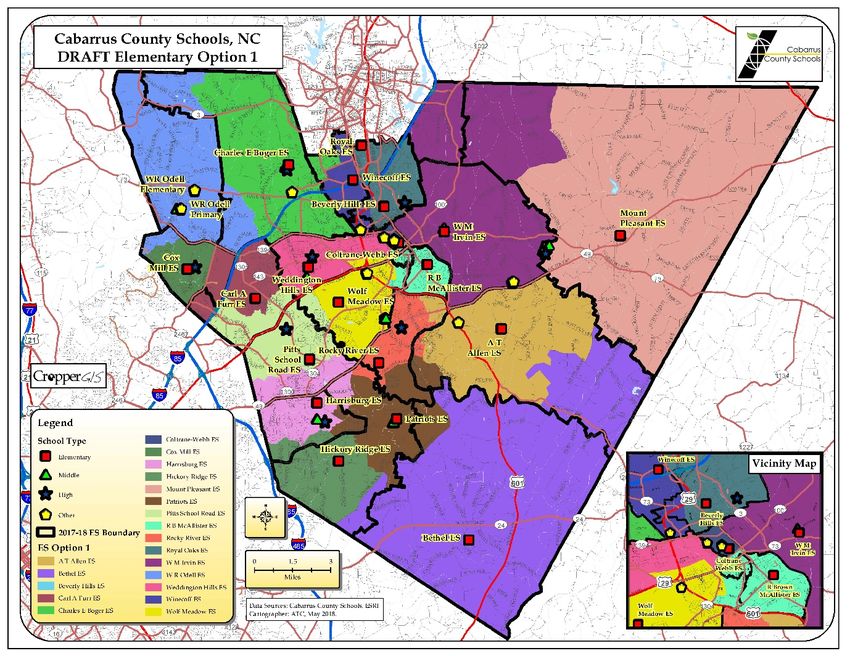
Welcome and Introductions
Who We Are
The Company

             Cropper GIS Consulting, LLC
             K-12 school planning is our business and our passion. Our specialty
             is school realignment.

             Cropper works with K-12 school districts to:
Who We Are

              • develop realignment plans,
              • facilitate community engagement,
              • research, map and write demographic studies,
              • prepare long-range facility master plans,
              • author site feasibility studies,
              • conduct & publish housing impact and yield factor studies, and
              • provide GIS implementation & training.

                      Cropper GIS is an ESRI Authorized Business Partner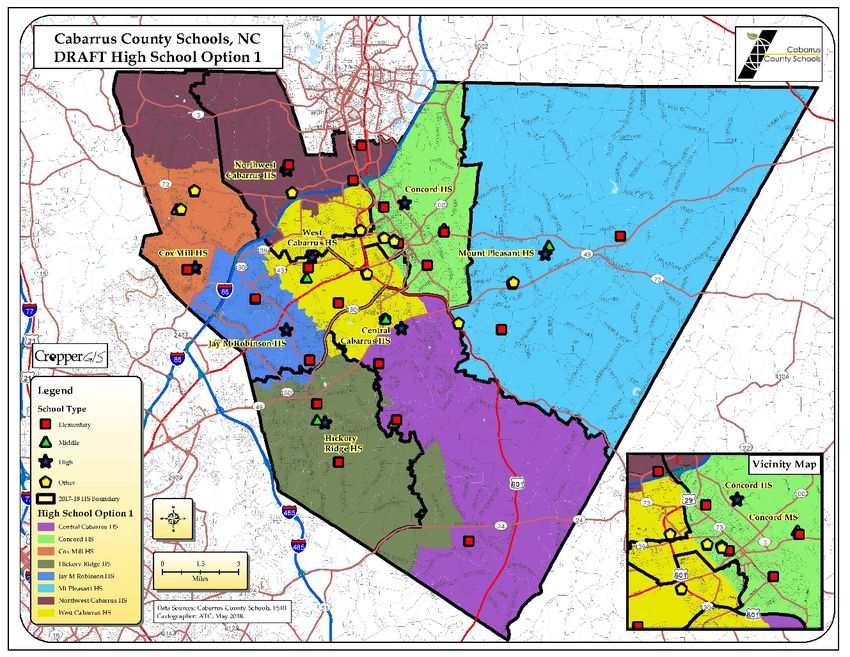
The Company

             Recent Projects:
                • Cabarrus County Schools, NC
                • Union County Public Schools, NC
Who We Are

                • Brunswick County Public Schools, NC
                • Frederick County Public Schools, MD
                • Richmond Public Schools, VA
                • Henrico County Public Schools, VA
                • Alexandria City Public Schools, VA
                • Frederick County Public Schools, MD
                • Baltimore County Public Schools, MD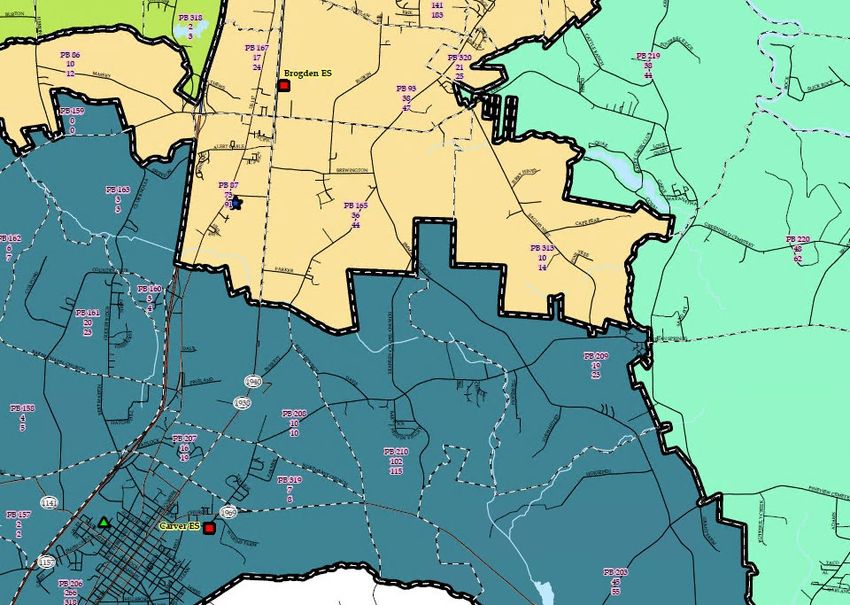
Matthew Cropper
             • 20 years experience providing GIS mapping and analysis services to
               school districts and other clients.
Who We Are

             • Manages and Facilitates K-12 realignment and facility planning
               projects across the U.S.

             • Expert consultant for U.S. Department of Justice, Civil Right’s
               Division

             • Published numerous papers about using GIS in master planning
               and educational planning.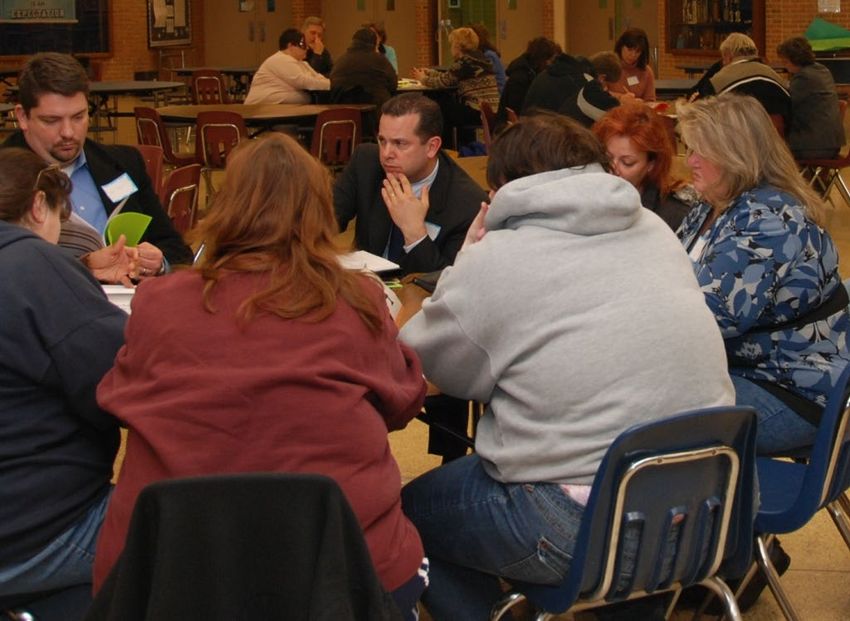
Why We’re Here
1.   Wayne County Public Schools (WCPS) are reconstructing Meadow Lane
     Elementary School:
        a) Meadow Lane Elementary School will have a 700 student capacity

2.   Maximize efficient use of existing classroom space, especially at the
     elementary level, in light of the k-3 class size reduction mandate.

3.   These factors necessitate a comprehensive look at attendance boundaries.

4.   The implementation of these boundary changes are expected to take effect
     the Fall 2020 (2020-21) School Year.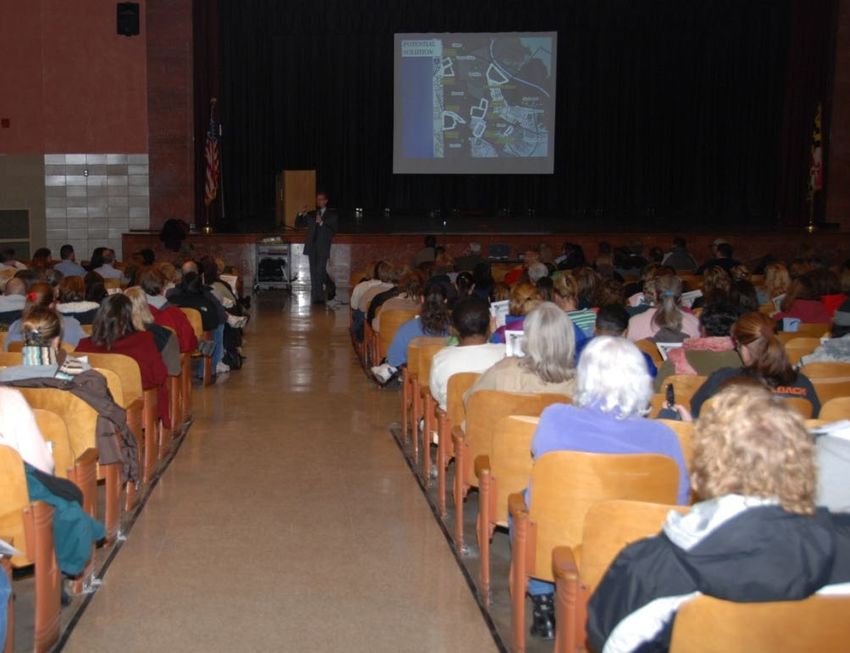
Project Objectives

                 1.   To explore and develop realignment options through a
                      community-based process.
Why We’re Here

                 2.   Focus on developing options that best meet the WCPS realignment
                      criteria.
Realignment Study

                 Cropper GIS Consulting were hired by the district to facilitate and
                 manage the project. Our firms are tasked to:
Why We’re Here

                   A. Develop supporting materials to help facilitate the study.

                   B. Facilitate a community-based process of developing an
                      elementary school realignment plan.

                   C. Empower the community throughout the process.

                   D. Leverage expertise to develop logical, efficient, and effective
                      student realignment options with the committee.
Realignment Criteria

                  The Wayne County Public Schools has a set of criteria to follow when
Rules to Follow

                  evaluating elementary school realignment options. These are rules to
                  follow when considering any potential attendance zone adjustment.

                  The realignment committee will be oriented on these criteria and will
                  follow them as best as possible as they consider realignment options.
Realignment Criteria
•Balance school facility utilization
•Make every effort to have equitable utilization (where
possible) across the district and in accordance with school
capacities and funded allotment ratios in accordance with state
law. Make efficient use of available space.
Rules to Follow
•Account for future growth
•Allow for increasing attendance in high growth areas.
•Close Proximity
• Students should be assigned to the school within the closest
proximity to their homes where possible.
•Establish clear feeder patterns and continuity
• Make every effort to establish a clear feeder pattern system
(especially from middle school to high school), although it may
be necessary to split an elementary school to feed to two or
more middle schools. Make every effort to divide a large
enough population so students can continue to the next level
with familiar faces.Realignment Criteria
•Allow for highest-grade at current school grandfathering
•Allow for students who will be in the exit grade in the first
school year of realignment to stay at their current school,
however, transportation will not be provided for these students.
•Minimize impact on students
Rules to Follow
•Attempt to minimize the amount of students impacted when
making boundary adjustments.
•Consider economic, cultural, and ethnic diversity
•Ensure schools are inclusionary, diverse, and not adversely
affected by realignment decisions.
•Make every effort to establish contiguous zones
•Avoid creating zones that are not connected to the primary
attendance zone, where possible.Realignment Criteria
•Maximize busing efficiencies in
transportation of students
•Make every effort to account for
Rules to Follow
transportation (school bus and car
rider), parent commuting patterns,
balance busing travel time, and costs.
•Use major roads and natural boundaries wherever feasible to
define attendance zones
•Minimize the amount of students who need to cross major
intersections and other barriers to maximize the safety and
security of students, and optimize transportation efficiency by
containing bus routes within natural boundaries wherever
possible to avoid traffic delays and late arrivals.Project Approach
Four Project Phases
                   Cropper has identified four phases of a community-driven realignment
                   study for WCPS:

                   1.   Data Collection
Project Approach

                   2.   Data Analysis / Assimilation
                   3.   Options Development
                   4.   Committee and Public engagement
1. Data Collection
• School District–
• Geocoded enrollment databases by address.
• Maps of current boundaries and schools
• School facility information
• Projected enrollment
• City / County Sources– Base GIS data (address pts,
municipalities, subdivisions, existing and planned
road networks, etc.)2. Data Analysis / Assimilation
• All data was incorporated into Geographic Information Systems
(GIS) to enable quick, accurate, and efficient analysis, and also to
help facilitate realignment options.
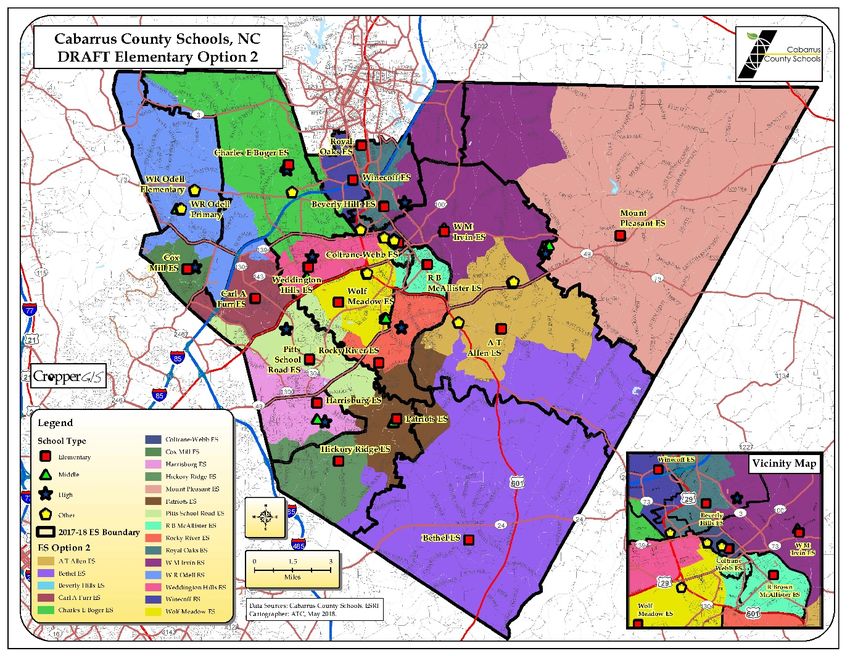
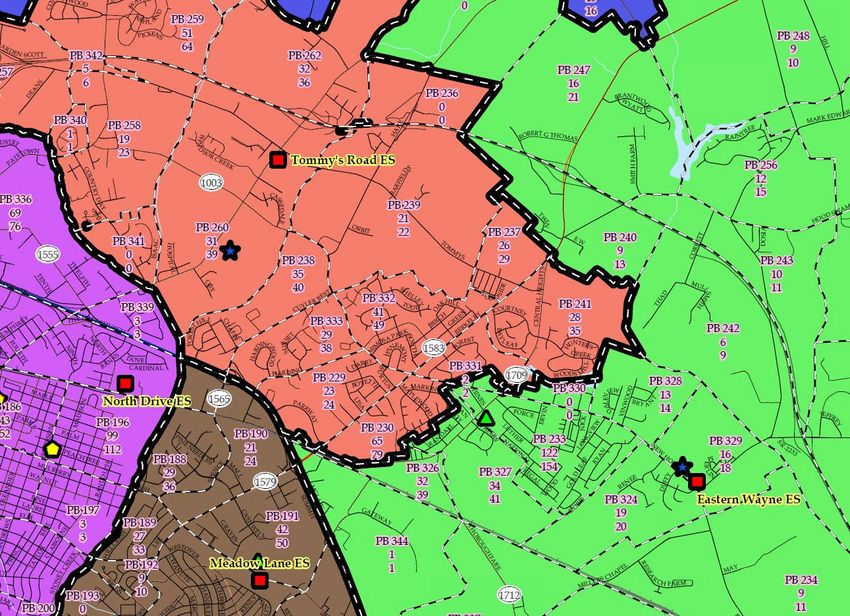
Project Approach2. Data Analysis / Assimilation The use of planning blocks were created to help the committee and public obtain an understanding of the impact on moving an area one way or the other. Key data have been analyzed by these planning blocks, such as total number of students living within each block.
2. Data Analysis / Assimilation

The use of planning
blocks have been
created to help the
committee and
public get an idea of
the impact of
moving an area one
way or the other.
Key data have been
analyzed by these
planning blocks,
such as total
number of
elementary school
students
2. Data Analysis / Assimilation:
                                     Background Report
Each committee member will be provided with a background report.
The report expands the extensive knowledge each committee and
public member already has about Wayne County.

 The background report helps
 committee members share a
 message with the community
 that is consistent and accurate.

                                                              16
2. Data Analysis / Assimilation
Online Map
• An online map has been developed to further inform the committee
and public on the work of the committee.
• Current zones and options can be viewed on the map.
• Other features can be turned on/off on the map, including planning
blocks.
• Map is customizable, and can/will be updated during the process to
show new options along with other information requested by the
committee.
• Site can be viewed on any device, including mobile devices and tablets
(with internet connection).
• Site address is:
www.croppermap.com/waynecounty3. Options Development
To expedite the process and
empower the community, it
is best to begin with a series
of baseline realignment
options.
Baseline options will
shared with the
committee at their 1st
meeting.3. Options Development
Options will be developed
with WCPS realignment
criteria in mind.
The committee have the option to
modify or disregard the baseline
options, or create new options. All
with a focus on the realignment
criteria.4. Committee and Public
Engagement
The most important factor when working on a realignment study is
to keep all lines of communication open.
Project Approach4. Committee and Public
Engagement
The district has formulated a 30-person committee to work on developing
realignment options.
Project Approach
The realignment committee was established by the school board and
district administration, and consists of a diverse group of stakeholders
from across the school district.
Volunteer members of the public, School Board, and Staff members will
serve on the committee, with a focus on developing a recommendation
that best meets the needs of ALL students in Wayne County.
Remember that the committee is one method to engage the public. Any
member of the public is welcome to observe the work of the committee at
their meetings, in addition to other avenues to provide input/feedback.Review of Timeline
Process & Timeline for Realignment Study
March '19 April '19 May '19 June '19 July '19 Aug. '19 Sept. '19 Oct. '19 Nov. '19
Data Collection
Data Analysis / Assimilation
Internal Logistics Planning with district
Grade Cohort Adjustment Feasibility Testing `
Background Report Development
Baseline Options Development
Public Information Session #1: Present Project Process, Criteria,
Timeline, and Realignment Objectives to Community. Information
meeting to public, without public comments.
6/18
We are here
Planning Team Meeting 1
6/19
- Review Background Data, Introduce Baseline Options
Planning Team Meeting 2
7/8
- Discuss Background Data & Baseline Options, Q&A
Planning Team Meeting 3
- Options Development, Prepare for Public Information Session #2 8/1
Public Information Session #2: Present Preliminary Realignment
8/19
Options to Community for Comment/Feedback
Planning Team Meeting 4
9/16
- Review public input, modify options
Planning Team Meeting 5
10/14
- Finalize Recommendations & Prepare for Board Presentation
Presentation of Final Recommendations to the Board of Education 11/25How can you participate?
Members of the public have the opportunity to participate in the process in
                       many ways:
                         • All materials shared with the committee will be made available on the
Public Participation

                           Realignment Study webpage, located at www.wcpsrealignment.com

                         • The realignment web-page contains a feedback form that allows the
                           public to provide any feedback regarding the process at any time. This
                           information will be shared with the committee, and will be made public.

                         • The Public Input Session on August 19, 2019 is designed to share with the
                           public the DRAFT options that are under consideration, and to solicit
                           feedback on the options from you. At this meeting, we will be presenting
                           the options and allowing you to review large maps and discuss your
                           thoughts with the committee and/or consultants.
Thank you for your time and we look
forward to working with the public on this
important process!You can also read


