Quarterly Market Update - Fidelity Institutional Asset ...
←
→
Page content transcription
If your browser does not render page correctly, please read the page content below
LEADERSHIP SERIES FOURTH QUARTER 2019

Quarterly
Market Update
PRIMARY CONTRIBUTORS

Lisa Emsbo-Mattingly                    Jake Weinstein, CFA
Director of Asset Allocation Research   Research Analyst, Asset Allocation Research

Dirk Hofschire, CFA                     Ryan Carrigan, CFA
SVP, Asset Allocation Research          Research Analyst, Asset Allocation Research
Table of Contents
1.   Market Summary

2.   Economy/Macro Backdrop

3.   Asset Markets

4.   Long-Term Themes
Market Summary
Global Monetary Easing Amid Trade and Growth Headwinds

                                                                                                                                   SUMMARY
    During Q3, the Federal Reserve and other central banks eased monetary policy in an effort to counter flagging
    global-growth momentum. However, further escalation of the U.S.-China trade conflict continued to weigh on
    confidence, and it remains unclear whether monetary easing alone is sufficient to catalyze economic
    acceleration. The mature global business cycle continues to warrant smaller cyclical allocation tilts.

                                                             MACRO                               ASSET MARKETS

      Q3 2019                  • Monetary policymakers lowered interest rates,   • Government bond yields continued to drop, and
                                 but global growth remained tepid.                 global equity prices were range-bound.

                               • The U.S. is firmly in the late-cycle phase.     • Late-cycle phases typically exhibit higher
     OUTLOOK
                                                                                   volatility along with a more asymmetric risk-
                               • Improvement in China’s economy has stalled.       return profile.
                               • Global policy support remains insufficient to   • Wide dispersion of outcomes warrants smaller
                                 reaccelerate global growth.                       allocation tilts than earlier in the cycle.
                               • The global liquidity backdrop remains           • Prioritize diversification amid significant
                                 challenged despite Fed rate cuts.                 uncertainty.
                               • U.S.-China trade policy uncertainty is an
                                 ongoing drag on corporate confidence.

    Diversification does not ensure a profit or guarantee against a loss.
4
Less Risky Assets Led During Mixed Quarter of Performance
SUMMARY
With lackluster global growth and increased policy uncertainty, the continued drop in government bond yields
during Q3 spurred gains across less risky bond categories, gold, and interest rate-sensitive equity sectors such
as real estate investment trusts (REITs). Year-to-date returns for all major asset categories remained in positive
territory, with U.S. stock and bond markets registering strong gains.
Q3 2019 (%) YTD (%) Q3 2019 (%) YTD (%)
Real Estate Stocks 7.8 27.0 High Yield Bonds 1.2 11.5
Long Government & Credit Bonds 6.6 20.9 U.S. Mid Cap Stocks 0.5 21.9
Gold 4.5 14.8 Non-U.S. Small Cap Stocks -0.4 12.1
U.S. Corporate Bonds 3.0 12.6 Non-U.S. Developed-Country Stocks -1.1 12.8
Investment-Grade Bonds 2.3 8.5 Commodities -1.8 3.1
U.S. Large Cap Stocks 1.7 20.6 U.S. Small Cap Stocks -2.4 14.2
Emerging-Market Bonds 1.3 12.1 Emerging-Market Stocks -4.2 5.9
20-Year U.S. Stock Returns Minus IG Bond Returns since 1926
Annualized Return Difference (%)
14
12
10 Average since 1926: 5%
8
6
4
2 1.0%
0
-2
1946 1950 1954 1958 1962 1966 1970 1974 1978 1982 1986 1990 1994 1998 2002 2006 2010 2014 2018
Past performance is no guarantee of future results. It is not possible to invest directly in an index. All indexes are unmanaged. See Appendix for important index
information. Assets represented by: Commodities—Bloomberg Commodity Index; Emerging-Market Bonds—JP Morgan EMBI Global Index; Emerging- Market
Stocks—MSCI EM Index; Gold—Gold Bullion, LBMA PM Fix; High-Yield Bonds—ICE BofAML High Yield Bond Index; Investment-Grade Bonds— Bloomberg
Barclays U.S. Aggregate Bond Index; Non-U.S. Developed-Country Stocks—MSCI EAFE Index; Non-U.S. Small Cap Stocks—MSCI EAFE Small Cap Index; Real
Estate Stocks—FTSE NAREIT Equity Index; U.S. Corporate Bonds—Bloomberg Barclays U.S. Credit Index; U.S. Large Cap Stocks—S&P 500® Index; U.S. Mid
Cap Stocks—Russell Midcap Index; U.S. Small Cap Stocks—Russell 2000 Index; Long Government & Credit Bonds—Bloomberg Barclays Long Government &
Credit Index. Source: Bloomberg Finance L.P., Haver Analytics, Fidelity Investments Asset Allocation Research Team (AART), as of 9/30/19.
5Long-Running Style and Regional Equity Trends Persist
SUMMARY
Several extreme trends in relative equity performance continued to persist. The outperformance of U.S. growth
stocks versus value stocks has extended more than a decade, and U.S. equities have outpaced their foreign
counterparts for roughly the same time span. Meanwhile, the performance of U.S. minimum-volatility stocks has
benefited from declining bond yields and surpassed the broader equity market during the bull-market upswing.
U.S. Equity Style Relative Performance Equity Relative Performance
Value vs. Growth U.S. Min Vol vs. U.S. Broad Market U.S. vs. Rest of World
Log Return (Index 1929=100) Relative Return (Index: 2006=100)
500 200
450
180
400
350
160
300
250 140
200
120
150
100
100
50
0 80
2006
2007
2008
2009
2010
2011
2012
2013
2014
2015
2016
2017
2018
2019
1929
1939
1949
1959
1969
1979
1989
1999
2009
2019
LEFT: Source Fama/French Research Factors—High Minus Low. Shading represents the peak of the value versus growth equity style.
RIGHT: U.S. Min Vol: MSCI USA Minimum Volatility Total Return Index. US Broad Market: MSCI USA Total Return Index. US: MSCI USA
Total Return Index. Rest of World: MSCI ACWI ex USA Total Return Index, as of 9/30/19.
6Falling Government Bond Yields Around the World
SUMMARY
Government bond yields continued to decline amid concerns about global economic weakness, trade
confrontation, and low inflation. Yields on 10-year government bonds in Germany and Japan fell further into
negative territory. The drop in U.S. 10-year yields resulted from a decline in both inflation expectations and
real interest rates, with both measures decreasing to near multi-year lows.
10-Year Government Bond Yields 10-Year U.S. Treasury Bond Yields
5-Year Range 1 Year Ago 9/30/19 Inflation Expectations Real Yields Nominal Yield
Yield Yield
3.5% 3.75%
Q3 Yield Change (bps)
3.0% Breakevens -16
3.25%
Real Yields -16
2.5% Nominal Yield -32
2.75%
2.0%
2.25%
1.7
1.5% 1.7%
1.75%
1.0%
1.5%
1.25%
0.5% 0.5
0.75%
0.0%
-0.2
-0.5% 0.25% 0.2%
-0.6
-1.0% -0.25%
Sep-2015
Jan-2016
Sep-2016
Jan-2017
Sep-2017
Jan-2018
Sep-2018
Jan-2019
Sep-2019
May-2016
May-2017
May-2018
May-2019
Germany Japan UK U.S.
7 LEFT and RIGHT: Source: Bloomberg Finance L.P., Fidelity Investments (AART), as of 9/30/19.Economy/Macro Backdrop
Multi-Time Horizon Asset Allocation Framework

                                                                                                                           ECONOMY
    Fidelity’s Asset Allocation Research Team (AART) believes that asset-price fluctuations are driven by a
    confluence of various factors that evolve over different time horizons. As a result, we employ a framework that
    analyzes trends among three temporal segments: tactical (short term), business cycle (medium term), and
    secular (long term).

                                                                          DYNAMIC ASSET ALLOCATION TIMELINE
                       HORIZONS
                          Secular
                       (10–30 years)

     Business Cycle
                         (1–10 years)

                           Tactical
                      (1–12 months)

                                                                                 Portfolio Construction
                                                                   Asset Class | Country/Region | Sectors | Correlations

9   For illustrative purposes only. Source: Fidelity Investments (AART), as of 9/30/19
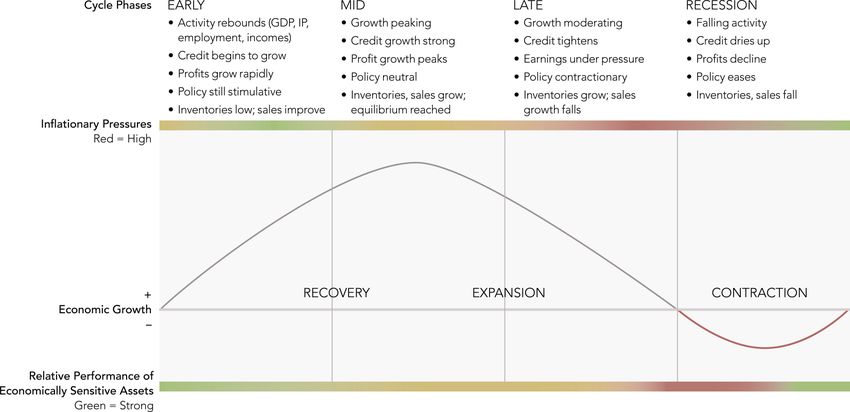
Mature U.S. and Global Business Cycles
ECONOMY
The global business cycle continues to mature, with the U.S. and most major economies in the late-cycle
phase. China’s economy has stabilized, but a reacceleration from its growth recession has remained elusive.
Overall, a global industrial and trade recession has shown few signs of abating, and it remains to be seen
whether policy easing measures will prove sufficient to stimulate a sustained global reacceleration.
Business Cycle Framework
Spain
Brazil, India, Australia, Canada
U.S., France, Japan,
South Korea, Mexico
UK
Germany, Italy
China*
Note: The diagram above is a hypothetical illustration of the business cycle. There is not always a chronological, linear progression among the
phases of the business cycle, and there have been cycles when the economy has skipped a phase or retraced an earlier one. * A growth
recession is a significant decline in activity relative to a country’s long-term economic potential. We use the “growth cycle” definition for most
developing economies, such as China, because they tend to exhibit strong trend performance driven by rapid factor accumulation and
increases in productivity, and the deviation from the trend tends to matter most for asset returns. We use the classic definition of recession,
10 involving an outright contraction in economic activity, for developed economies. Source: Fidelity Investments (AART), as of 9/30/19.Global Backdrop Weak Despite China’s Industrial Stabilization
ECONOMY
Sagging trade and industrial activity continued to weigh on global growth, with the share of major countries with
expanding manufacturing sectors dropping to its lowest level since 2012. This weakness occurred despite an
upturn in our diffusion index of China’s industrial production. For the first time in the past decade, China’s
stimulus measures and manufacturing upswing have failed to lift global trade and industrial activity.
Global Manufacturing Activity and China Industrial Production
AART China Industrial Production Diffusion Index Share of Global PMIs >50
Share
100%
90%
80%
70%
60%
50%
40%
30%
20%
10%
0%
2004
2005
2006
2007
2008
2009
2010
2011
2012
2013
2014
2015
2016
2017
2018
2019
AART China Diffusion Index represents share of components rising over last 12 months. Gray bars represent China growth recessions as defined
11 by AART. Source: ISM, Markit, China National Bureau of Statistics (official data), Haver Analytics, Fidelity Investments (AART), as of 8/31/19.China Key to Global Growth; Policy Proving Insufficient
ECONOMY
Unlike the late 1990s, in recent years China’s contribution to global growth has been greater than that of the
United States. China’s monetary and fiscal policy easing has helped stabilize industrial activity, but credit
growth stayed subdued, implying that high debt levels are inhibiting the policy response. U.S. trade uncertainty
remains another headwind, supporting our stance that material economic reacceleration is unlikely.
Contribution to Global GDP Growth China Credit and Property Market
China U.S. Total Credit Growth Housing Sales
Share Year-over-Year Year-over-Year
29%
30% 35% 60%
50%
25% 30%
22% 40%
30%
20% 25%
20%
15% 13% 20%
12% 10%
0%
10% 15%
-10%
5% 10% -20%
2007
2008
2009
2010
2011
2012
2013
2014
2015
2016
2017
2018
2019
1989
1991
1993
1995
1997
1999
2001
2003
2005
2007
2009
2011
2013
2015
2017
2019
LEFT: Five-year averages. Source: International Monetary Fund, Fidelity Investments (AART), as of 9/30/19. RIGHT: Gray bars represent China
growth recessions as defined by AART. Source: China National Bureau of Statistics (official data), Haver Analytics, Fidelity Investments (AART),
12 as of 8/31/19.European Growth Slumping as Trade Headwinds Persist
ECONOMY
Smaller and more open economies are most susceptible to global trade risk, but employment in many large
economies, including Germany, is highly influenced by trade. The impact of deteriorating global trade
conditions has begun to affect some European domestic economies, with consumer confidence and the
employment outlook in Germany deteriorating markedly over the course of 2019.
Employment Reliance on Foreign Trade German Labor Market and Consumer
Consumer Confidence Business Employment Plans
Share of Employment from Exports Index
30% 110 0
25%
105
20%
100
15%
95
10%
90
5%
0% 85 0
1999
2001
2003
2005
2007
2009
2011
2013
2015
2017
2019
Sweden
Canada
Mexico
U.S.
Germany
Japan
S. Korea
UK
China
LEFT: Share of domestic business sector employment sustained by exporting activities. Source: OECD, Fidelity Investments (AART), as of 9/30/19.
RIGHT: Shading represents Germany economic recession as defined by the Economic Cycle Research Institute (ECRI). Source: European
13
Commission, Ifo, ECRI, Haver Analytics, Fidelity Investments (AART), as of 9/30/19.U.S. Firmly in Late Cycle
ECONOMY
Late cycle often is characterized as the phase during which capacity constraints emerge and economic activity
peaks. Inflation rates are not always high, but tight labor markets tend to spur higher wage growth and more
restrictive monetary policy. Late-cycle trends are now well entrenched, with peaking profit margins, slower
employment growth, and an inverted yield curve. Credit, though, remains favorable versus previous late cycles.
INDICATOR CURRENT TREND LATEST READINGS
Labor markets tighter, wages higher
Employment/Wages Pace of improvement has stalled
than 2–3 years ago
Monetary Policy Fed policy tighter than 2–3 years ago Fed cut rates
Yield Curve Flattening Inverted
Credit Some tightening of lending standards Credit accessible, spreads tight
Corporate Profits Margins declining Earnings growth slightly positive
14 Source: Fidelity Investments (AART), as of 9/30/19.Healthy Labor Market and Consumer Typical of Late Cycle
ECONOMY
The U.S. economy remains supported by consumption, which represents around 70% of GDP. Historically,
consumer spending and employment growth stay positive during late cycle, typically not falling until the onset
of recession. Several leading indicators suggest the labor market is nearing peak levels, including consumers’
extremely favorable assessment of the job market, which tends to be most elevated just prior to recession.
Activity around Recessions (1948–2011) Consumer Assessment of Labor Market
Goods Consumption Employment
Conference Board Survey
Housing Business Investment
Index: 100 = Recession Onset Jobs: Plentiful Minus Hard to Get
60%
115 Recession
Onset t=0
40%
110
20%
105
0%
100
-20%
95
-40%
90
-60%
85 -80% 0
1968
1971
1974
1977
1980
1983
1986
1989
1992
1995
1998
2001
2004
2007
2010
2013
2016
2019
t-8 t-7 t-6 t-5 t-4 t-3 t-2 t-1 t t+1 t+2 t+3 t+4 t+5 t+6 t+7 t+8
Quarters
LEFT: Source: Bureau of Economic Analysis, Bureau of Labor Statistics, Haver Analytics, Fidelity Investments (AART), as of 9/30/19.
RIGHT: Shading represents U.S. economic recession as defined by the National Bureau of Economic Research (NBER). Source: Conference
15 Board, NBER, Haver Analytics, Fidelity Investments (AART), as of 9/30/19.U.S. Profit Margins Declining, Exposed to Global Cycle
ECONOMY
Over the past several years, corporate profit margins have declined from record levels due to higher wages
and other costs, which is typical during the transition to late cycle. The level of economy-wide profit margins
remains healthy. However, the earnings of large multi-national U.S. companies tend to follow the highly global
manufacturing cycle, whose weakness has been exacerbated by the U.S.-China trade conflict.
U.S. Economy Profit Margins U.S. Manufacturing and S&P 500 Earnings
Profits as a Share of GDP S&P 500 Profit Growth Y/Y ISM Manufacturing PMI
4-quarter average Year-over-Year Index,Inflation Firm While Tariffs Add Uncertainty to Outlook
ECONOMY
Core inflation has been generally stable at about 2% in recent years, but tariff hikes have lately pushed goods
prices upward, helping boost core CPI to a multi-year high. Tariffs also have negatively impacted demand—for
example, last year’s tariffs on washing machines both boosted prices and lowered consumption. The near-
term inflation outlook remains balanced amid uncertain trade policy and downside economic risk.
U.S. Inflation Tariff Impact on Household Appliances
Core CPI AART Estimate Price Consumption
Year-over-Year Year-over-Year
U.S. implements
2.5% 15% tariff on washing
machines
10%
2.3%
5%
2.0% 0%
-5%
1.8%
-10%
1.5% -15%
Jan-2014
Jan-2015
Jan-2016
Jan-2017
Jan-2018
Jan-2019
Jul-2013
Jul-2014
Jul-2015
Jul-2016
Jul-2017
Jul-2018
Jul-2019
Apr-2013
Apr-2014
Apr-2015
Apr-2016
Apr-2017
Apr-2018
Apr-2019
Apr-2020
Oct-2013
Oct-2014
Oct-2015
Oct-2016
Oct-2017
Oct-2018
Oct-2019
LEFT and RIGHT: Core CPI: Consumer Price Index excluding food and energy. Source: Bureau of Labor Statistics, Haver Analytics, Fidelity
17 Investments (AART), as of 8/31/19.Yield Curve Inversion Typical During Late Cycle
ECONOMY
Ten-year Treasury bond yields remained below 3-month Treasuries, keeping the yield curve inverted. Curve
inversions have preceded the past seven recessions and may be interpreted as the market signaling weaker
expectations relative to current conditions. The time between inversion and recession has varied considerably,
however, and the curve also has flashed two “head fakes” in which expansion lasted for at least two more years.
U.S. Treasury Yield Curve
10-Year Minus 3-Month Yield
Yield Spread
6%
5% Yield Curve Inversions
4% • Occurred before the last 7
recessions
3%
• Occurred twice without a
2% recession (1966,1998)
1% • Recessions started 4 to 21
months after inversion
0%
• Un-inversions often occurred
-1% prior to recession
-2%
-3%
-4% 0.1
1965
1968
1971
1974
1977
1980
1983
1986
1989
1992
1995
1998
2001
2004
2007
2010
2013
2016
2019
Shading represents U.S. economic recession as defined by the National Bureau of Economic Research (NBER). Source: Bloomberg
18 Financial L.P., NBER, Fidelity Investments (AART), as of 9/30/19.Rate Cuts Better for Risk Assets in Mid Cycle Versus Late
ECONOMY
Since 1984, the Fed has initiated seven monetary easing cycles through cuts to its policy interest rate. When
the rate cuts were started during the mid-cycle phase, they consistently boosted global equities and tightened
credit spreads over the next 12 months. Rate cuts beginning in late cycle, however, resulted in a broader range
of outcomes with negative average equity returns and wider credit spreads.
Equity Returns After Initial Fed Cut (1984–2007) Credit Spreads After Initial Fed Cut (1984–2007)
U.S. Emerging Market High Yield OAS
12-Month Returns Basis Points Change (12 Months)
60% 700
Maximum
50% 600
40%
500
30%
400
Average
20%
300
10%
200
0%
Minimum 100
-10%
0
-20%
-30% -100
-40% -200
Mid-Cycle Late-Cycle Mid-Cycle Late-Cycle
OAS: Option-Adjusted Spread, U.S: S&P 500 total returns. Emerging Market: MSCI Emerging Market total returns from 1988. High Yield: ICE BofAML
U.S. High Yield Index. Source: Standard & Poor’s, MSCI, Barclays Capital, Bloomberg Financial L.P., Fidelity Investments (AART), as of 9/30/19.
19Dovish Global Central Bank Shifts Offset by U.S. Treasury
ECONOMY
During Q3, global central banks eased policy by lowering interest rates, and the Fed ended its balance-sheet
drawdown while the ECB re-initiated QE. However, the global liquidity backdrop is much less favorable than
2016–17, with U.S. Treasury increases of cash held at the Fed offsetting recent central-bank accommodation.
Monetary policy may be showing its limitations, with a number of challenges blunting the effects of easing.
Central Bank Balance Sheets
G4 Central Banks U.S. Treasury Cash at Fed Challenges to Monetary Policy
• Large U.S. Treasury issuance Billions (3-Month Change)
Billions (12-Month Change)
• Lower bank reserves
$2,500 • Repo market dislocations -$2,500
$2,000 -$2,000
$1,500 -$1,500
$1,000 -$1,000
Estimate
$500 -$500
$0 $0
-$500 $500
-$1,000 $1,000
Jan-2014
Jan-2015
Jan-2016
Jan-2017
Jan-2018
Jan-2019
Jan-2020
Jul-2014
Jul-2015
Jul-2016
Jul-2017
Jul-2018
Jul-2019
Bars represent estimates: Federal Reserve and BOE keep constant balance sheet, European Central Bank (ECB) to purchase EUR20B per month, and
Bank of Japan to purchase at annualized rate of average purchases over last 12 months. Dashed line represents estimate of Treasury increasing cash
20 held at the Federal Reserve to $400 billion in the fourth quarter. Source: Haver Analytics, Fidelity Investments (AART), as of 9/30/19.U.S. versus China: Strategic Competition and Trade Conflict
ECONOMY
The U.S. and China raised the stakes again during Q3. Tariffs were pushed above 20%, on average, further
disrupting the world’s largest trading relationship and casting a shadow over corporate confidence in the
highly integrated global economy. While hope remained that a truce could avert additional planned escalation,
the deepening geopolitical rift makes a variety of other bilateral commercial issues less tractable.
U.S.-China Relationship Average Tariff Rates
U.S. Tariffs on Chinese Goods China Tariffs on U.S. Goods
30%
25%
Geopolitical Strategic Trade
Rivalry Competition 20%
Military IT Sector/ Consumer
Hegemony Advanced and Other
in Asia Industrials Goods 15%
10%
Industrial Tariffs/ 5%
Policy Issues Market Access
• IP protection
• Export controls
0%
• Investment restrictions
2017 2018 Sep-19 Oct-19 Dec-19
RIGHT: Shaded areas are announced changes as of 9/30/19. Source: Peterson Institute for International Economics, Fidelity
21 Investments (AART) as of 9/30/19.Outlook: Market Assessment
ECONOMY
Fidelity’s Business Cycle Board, composed of portfolio managers responsible for a variety of global asset
allocation strategies, believes global economic momentum has peaked and that trade-policy friction is
negatively influencing capital expenditures. While monetary policymakers around the world have shifted to a
more accommodative stance, some level of uncertainty about the effectiveness of the policy response remains.
Business Cycle Risks
U.S. firmly in late-cycle phase Monetary and trade policy uncertainty
China’s economic slowdown is weighing China’s uncertain outlook and policy
on the global economy response
Asset allocation implications
Current environment warrants smaller asset allocation
tilts and a diversified strategy
Policymakers’ shift to a more accommodative stance
may support global asset markets
Inflation-sensitive asset valuations appear attractive
though near-term inflation risks are muted
22 For illustrative purposes only. Diversification does not ensure a profit or guarantee against a loss. Source: Fidelity Investments (AART) as of 9/30/19.Asset Markets
ASSET MARKETS
    Defensive Equity and Fixed Income Sectors Led the Way
    In Q3, equity sectors and factor segments that typically are less cyclical and may benefit from lower interest
    rates led the equity markets: Utilities, real estate, consumer staples, and minimum-volatility stocks fared best.
    Treasury bonds and other less risky debt types were the top performers among fixed income sectors. Gold
    was the best-performing commodity segment. Emerging-market equities struggled.

                                                                  International Equities and Global
    U.S. Equity Styles Total Return                               Assets Total Return                                           Fixed Income Total Return
                                        Q3           YTD                                              Q3           YTD                                Q3     YTD
    Large Caps                         1.7%         20.6%         ACWI ex-USA                       -1.8%         11.6%         Long Govt & Credit    6.6%   20.9%
    Value                              1.2%         17.5%                                                                       Credit                3.0%   12.6%
                                                                  Japan                              3.1%         11.1%
    Growth                             1.1%         22.7%                                                                       Treasuries            2.4%   7.7%
                                                                  Canada                             0.5%         21.6%
    Mid Caps                           0.5%         21.9%                                                                       Aggregate             2.3%   8.5%
                                                                  EAFE Small Cap                    -0.4%         12.1%
    Small Caps                         -2.4%        14.2%                                                                       CMBS                  1.9%   8.6%
                                                                  EAFE                              -1.1%         12.8%
                                                                                                                                Agency                1.7%   6.0%
                                                                  Europe                            -1.8%         13.7%
    U.S. Equity Sectors Total Return                                                                                            Municipal             1.6%   6.7%
                                                                  EM Asia                           -3.4%         6.0%
                                                                                                                                MBS                   1.4%   5.6%
                                        Q3           YTD          Emerging Markets                  -4.2%         5.9%
                                                                                                                                TIPS                  1.3%   7.6%
    Utilities                          9.3%         25.4%         Latin America                     -5.6%         6.3%
                                                                                                                                EM Debt               1.3%   12.1%
    Real Estate                        7.7%         29.7%         EMEA                              -7.0%         5.1%
                                                                                                                                High Yield            1.2%   11.5%
    Consumer Staples                   6.1%         23.3%         Gold                               4.5%         14.8%         Leveraged Loan        1.0%   6.8%
    Info Tech                          3.3%         31.4%         Commodities                       -1.8%         3.1%          ABS                   0.9%   4.1%
    Communication Services             2.2%         21.7%
    Financials                         2.0%         19.6%         U.S. Equity Factors Total Return
    Industrials                        1.0%         22.6%
                                                                                                      Q3           YTD
    Consumer Discretionary             0.5%         22.5%
                                                                  Min Volatility                     3.3%         23.5%
    Materials                          -0.1%        17.1%
                                                                  Yield                              2.7%         14.5%
    Health Care                        -2.2%         5.6%
                                                                  Quality                            1.5%         18.3%
    Energy                             -6.3%         6.0%
                                                                  Value                              1.4%         16.8%
                                                                  Size                              -0.2%         16.5%
                                                                  Momentum                          -0.9%         19.1%

   EM: Emerging Markets. EMEA: Europe, the Middle East, and Africa. For indexes and other important information used to represent above asset
   categories, see Appendix. Past performance is no guarantee of future results. It is not possible to invest directly in an index. All indexes are
   unmanaged. Sector returns represented by S&P 500 sectors. Sector investing involves risk. Because of its narrow focus, sector investing may be
24 more volatile than investing in more diversified baskets of securities. Source: Bloomberg, Fidelity Investments (AART), as of 9/30/19.
ASSET MARKETS
Late Cycle: Less Favorable Risk-Return Profile
Typically, the mid-cycle phase has favored riskier asset classes, resulting historically in broad-based gains
across most asset categories. Meanwhile, late cycle has produced the most mixed performance results of any
business cycle phase. Another frequent feature of late cycle has been an overall more limited upside for a
diversified portfolio, although returns for most asset categories have, on average, been positive.
Asset Class Performance in Mid- and Late-Cycle Phases (1950–2016)
Stocks High Yield Commodities Investment-Grade Bonds
Annual Absolute Return (Average)
20%
10%
0%
Mid Cycle: Strong Asset Class Performance Late Cycle: Mixed Asset Class Performance
• Favor economically sensitive assets • Favor inflation-resistant assets
• Broad-based gains • Gains more muted
Diversification does not ensure a profit or guarantee against a loss. Past performance is no guarantee of future results. It is not possible to
invest directly in an index. All indexes are unmanaged. Asset class total returns are represented by indexes from the following sources: Fidelity
Investments, Morningstar, and Bloomberg Barclays. Fidelity Investments source: a proprietary analysis of historical asset class performance,
25 which is not indicative of future performance.ASSET MARKETS
Stocks’ Return Profile Less Favorable During Late Cycle
Historically, this phase of the business cycle has had implications for asset market forward returns. When the
U.S. economy has been in the mid-cycle phase, forward 12-month real returns have been generally positive,
displaying a favorable distribution skewed to above-average returns. But as expansion matures into late cycle,
the forward distribution of real equity returns has typically displayed a less favorable, more negative skew.
Subsequent Stock Market Returns Given Business Cycle Phase (1952–2018)
Late Mid
Frequency
4
3
2
1
0
-48% -43% -38% -33% -29% -24% -19% -14% -10% -5% 0% 5% 9% 14% 19% 24% 28% 33% 38% 43%
Total Return over the Next 12 Months
Past performance is no guarantee of future results. The above charts are density plots generated from the 12-month forward returns of a U.S. Equity
26 Index sourced from Fidelity Investments. Source: Standard & Poor’s, Fidelity Investments (AART), as of 9/30/19.ASSET MARKETS
Muted Inflation Expectations Relative to Recent History
Historically, the late cycle has often experienced rising inflation pressures, which has tended to enhance the
attractiveness of inflation-sensitive assets such as TIPS and commodities. Our near-term outlook for inflation
is relatively range-bound, but market expectations for inflation (represented by TIPS breakeven rates) are at
the lower end of their decade-long range, suggesting inflation protection is relatively inexpensive.
Relative Asset Performance by Cycle Phase (1950–2016) U.S. Treasury Breakeven Inflation Rates
Mid Late 10 Year LT Average (Since 1998)
Hit Rate
100% 2.8%
90% 2.6%
80%
2.4%
70%
2.2%
60%
2.0%
50%
1.8%
40%
30% 1.6%
20% 1.4%
10%
1.2%
0%
TIPS vs. Commodities vs. 1.0%
2009
2010
2011
2012
2013
2014
2015
2016
2017
2018
2019
IG Bonds U.S. Equities
Past performance is no guarantee of future results. It is not possible to invest directly in an index. All indexes are unmanaged.
TIPS: Treasury Inflation-Protected Securities. Hit Rate: frequency of one asset class outperforming another. Results are the difference between total
returns of the respective periods represented by indexes from the following sources: Fidelity Investments, Morningstar, and Bloomberg Barclays.
27 Fidelity Investments source: proprietary analysis of historical asset class performance, which is not indicative of future performance, as of 6/30/19.ASSET MARKETS
Expectations for Global Earnings Growth Convergence
U.S. earnings growth continued to decelerate during Q3, after receiving a boost from corporate tax cuts in
2018. Meanwhile, profit growth in non-U.S. developed and emerging markets stayed in negative territory during
the quarter. Forward estimates point to market expectations of a convergence of global profit growth in the
mid-single-digit range over the next 12 months.
Global EPS Growth (Trailing 12 Months)
U.S. DM EM
Change (Year-over-Year)
40%
30%
Forward
EPS
20%
10% 8.5%
7.8%
5.1%
0%
-10%
-20%
2012 2013 2014 2015 2016 2017 2018
Past performance is no guarantee of future results. DM: Developed Markets. EM: Emerging Markets. EPS: Earnings per share. Forward EPS:
28 Next 12 months expectations. Source: MSCI, Bloomberg Financial L.P., Fidelity Investments (AART), as of 9/30/19.ASSET MARKETS
Equity Valuations Mixed Relative to History
Continued rising stock prices in the U.S. moved equity valuations higher during Q3, pushing them further
above their long-term historical average. Price-to-earnings (P/E) ratios for Non-U.S. developed and emerging
markets remained below their long-term averages.
Global Market P/E Ratios
DM Trailing P/E EM Trailing P/E U.S. Trailing P/E Forward P/E
Ratio
30
25
Forward
P/E
20 DM Long-Term Average
U.S. Long-Term Average
U.S.
EM Long-Term Average
15
DM
EM
10
5
2004 2005 2006 2007 2008 2009 2010 2011 2012 2013 2014 2015 2016 2017 2018 2019
DM: Developed Markets. EM: Emerging Markets. Past performance is no guarantee of future results. It is not possible to invest directly in an index. All
indexes are unmanaged. See Appendix for important index information. Price-to-earnings ratio (P/E): stock price divided by earnings per share. Also
known as the multiple, P/E gives investors an idea of how much they are paying for a company’s earnings power. Long-term average P/E for Emerging
Markets includes data for 1988–2017. Long-term average P/E for Developed Markets includes data for 1973–2016, U.S. 1926–2017. Foreign
29 Developed—MSCI EAFE Index, Emerging Markets—MSCI EM Index. Source: Bloomberg Financial L.P., Fidelity Investments (AART) as of 9/30/19.ASSET MARKETS
Non-U.S. Equity and Currency Valuations Still Attractive
Using 5-year peak inflation-adjusted earnings, P/E ratios for international developed- and emerging-market
equities remained lower than those for the U.S., providing a relatively favorable long-term valuation backdrop
for non-U.S. stocks. After moving sideways during the first half of 2019, the U.S. dollar appreciated during Q3,
resulting in generally expensive valuations versus many of the world’s major currencies.
Cyclical P/Es Valuation of Major Currencies vs. USD
8/31/19 20-Year Range Last 12-Month Range 9/30/19
Price/5-Year Peak Real Earnings Valuation of Real Exchange Rates
20%
60
10% Expensive vs. $
50
40 0%
Cheap vs. $
30 -10%
20 -20%
10 -30%
0 -40%
EM
Mexico
Canada
Turkey
Japan
Spain
Brazil
U.S.
Germany
UK
DM
South Korea
China
Italy
France
Australia
Russia
Indonesia
Philippines
India
GBP JPY MXN CAD EUR CNY
DM: Developed Markets. EM: Emerging Markets. Past performance is no guarantee of future results. It is not possible to invest directly in an index. All
indexes are unmanaged. See Appendix for important index information. LEFT: Price-to-earnings (P/E) ratio (or multiple): stock price divided by
earnings per share, which indicates how much investors are paying for a company’s earnings power. Five-year peak earnings are adjusted for
inflation. Source: FactSet, countries’ statistical organizations, Haver Analytics, Fidelity Investments (AART), as of 8/31/19. RIGHT: GBP—British
pound; MXN—Mexican peso; JPY—Japanese yen; EUR—euro; CAD—Canadian dollar. Source: Federal Reserve Board, Haver Analytics, Fidelity
30 Investments (AART), as of 9/30/19.ASSET MARKETS
A High Equity Risk Premium Does Not Make Stocks Cheap
Plunging bond yields widened the gap between the equity earnings yield (reciprocal of the P/E ratio) and the
10-year U.S. Treasury bond yield—a measure of the equity risk premium (ERP). However, standalone valuation
metrics such as the P/E have a stronger relationship than the ERP to forward equity returns. The ERP, though,
may be better at identifying equity attractiveness relative to expected bond returns.
P/E Relation to Equities (1926–2019) Equity Risk Premium Relation to Equities
(1926–2019)
4-Quarter Forward S&P500 Average Return 4-Quarter Forward S&P500 Average Return
16% 16%
Correlation Correlation
1-year 10-year 1-year 10-year
0.4 0.6 0.2 0.3
12% 12%
Current
ERP: 3.8%
8% 8%
Current
P/E: 19.3
4% 4%
0% 0%
1 2 3 4 5 1 2 3 4 5
Quintile Quintile
Expensive Cheap Expensive Cheap
Price-to-earnings ratio (P/E): stock price divided by earnings per share. Source: Fidelity Investments, Robert Shiller, Standard & Poor’s,
31 Bloomberg Barclays, Haver Analytics, Fidelity Investments (AART), as of 9/3019.ASSET MARKETS
Business-Cycle Approach to Equity Sectors
A disciplined business-cycle approach to sector allocation can generate active returns by favoring industries
that may benefit from cyclical trends. Economically sensitive sectors historically have performed better in the
early and mid-cycle phases of an economic expansion. Meanwhile, companies in defensive sectors that have
more stable earnings have tended to outperform late in the cycle and, in particular, during recessions.
Business-Cycle Approach to Sectors
EARLY CYCLE MID CYCLE LATE CYCLE RECESSION
Sector
Rebounds Peaks Moderates Contracts
Financials +
Real Estate ++ --
Consumer Discretionary ++ - --
Information Technology + + -- --
Industrials ++ --
Materials + -- ++
Consumer Staples ++ ++
Health Care -- ++ ++
Energy -- ++
Communication Services + -
Utilities -- - + ++
Economically sensitive sectors Making marginal portfolio Defensive and inflation- Since performance is generally
may tend to outperform, while allocation changes to manage resistant sectors tend to negative in recessions,
more defensive sectors have drawdown risk with sectors perform better, while more investors should focus on the
tended to underperform. may enhance risk-adjusted cyclical sectors most defensive, historically
returns during this cycle. underperform. stable sectors.
Past performance is no guarantee of future results. Sectors as defined by GICS. White line is a theoretical representation of the business cycle as it
moves through early, mid, late, and recession phases. Green and red shaded portions above respectively represent over- or underperformance
relative to the broader market; unshaded (white) portions suggest no clear pattern of over- or underperformance. Double +/– signs indicate that the
sector is showing a consistent signal across all three metrics: full-phase average performance, median monthly difference, and cycle hit rate.
32 A single +/– indicates a mixed or less consistent signal. Return data from 1962 to 2016. Source: Fidelity Investments (AART), as of 9/30/19.ASSET MARKETS
Yields Fell Due to Lower Rates; Spreads Remained Tight
Modest inflation, flagging growth expectations, and the Federal Reserve’s dovish shift pushed bond yields
lower for the third quarter in a row. Credit spreads experienced some volatility but ended the quarter roughly
unchanged. Many fixed income categories have dropped to the bottom yield deciles relative to their own long-
term histories. Credit spreads also are generally below their long-term averages.
Fixed Income Yields and Spreads (1993–2019)
Treasury Rates Credit Spread Yield Percentile Spread Percentile
Yield Yield and Spread Percentiles
8% 100%
90%
7%
80%
6%
70%
60%
5%
60%
48%
4% 45% 50%
37% 37%
40%
3% 32%
30%
2%
20%
1% 7% 6% 6%
3% 10%
13% 0%
0% 0%
U.S. Aggregate MBS Long Gov/Credit Corporate Corporate Emerging-Market
Bond Investment Grade High Yield Debt
Past performance is no guarantee of future results. It is not possible to invest directly in an index. All indexes are unmanaged. See Appendix for
important index information. Percentile ranks of yields and spreads based on historical period from 1993 to 2019. MBS: mortgage-backed
33 security. Source: Bloomberg Barclays, Bank of America Merrill Lynch, JP Morgan, Fidelity Investments (AART), as of 9/30/19.Long-Term Themes
Performance Rotations Underscore Need for Diversification

                                                                                                                                                                                     LONG-TERM
    The performance of different assets has fluctuated widely from year to year, and the magnitude of returns can
    vary significantly among asset classes in any given year—even among asset classes that are moving in the
    same direction. A portfolio allocation with a variety of global assets illustrates the potential benefits of
    diversification.

    Periodic Table of Returns
     1999 2000 2001 2002 2003 2004 2005 2006 2007 2008 2009 2010 2011 2012 2013 2014 2015 2016 2017 2018 YTD                                                         Legend

      66%    32%    14%    26%    56%    32%    35%    35%    40%     5%    79%    28%     8%    20%    39%    28%      5%     21%     38%      0%     27%            REITs

      34%    26%     8%    10%    47%    26%    21%    33%    16% -20% 58%         27%     8%    19%    34%    14%      3%     18%     30%      -2%    23%        Growth Stocks

      27%    12%     5%     4%    39%    21%    14%    27%    12% -26% 37%         19%     4%    18%    33%    13%      1%     18%     26%      -2%    21%       Large Cap Stocks

      24%     8%     2%    -2%    37%    18%    12%    22%    11% -34% 32%         18%     4%    18%    32%    12%      1%     12%     22%      -3%    17%         Value Stocks

                                                                                                                                                                  60% Large Cap
      21%    -1%    -2%    -6%    31%    17%     7%    18%     7%    -36% 28%      17%     2%    16%    23%    11%      1%     12%     15%      -4%    16%
                                                                                                                                                                  40% IG Bonds

      21%    -3%    -4%    -9%    31%    11%     5%    16%     6%    -36% 27%      16%     2%    16%    19%     6%      0%     11%     15%      -4%    14%       Small Cap Stocks

                                                                                                                                                                 Foreign-Developed
      12%    -5%    -4% -15% 29%         11%     5%    12%     5%    -37% 26%      15%     0%    16%     7%     5%     -4%      9%     13%      -9%    13%
                                                                                                                                                                  Country Stocks

       7%    -9% -12% -16% 28%            9%     5%    11%     2%    -38% 20%      15%    -4%    15%     3%     3%     -4%      8%      9%     -11%    12%       High-Yield Bonds

                                                                                                                                                                 Investment-Grade
       3%    -14% -20% -20% 24%           8%     4%     9%    -1% -38% 19%         12% -12% 11%         -2%     -2%    -5%      7%      8%     -11%     9%
                                                                                                                                                                      Bonds
                                                                                                                                                                 Emerging-Market
      -1% -22% -20% -22% 19%              7%     3%     4%    -2% -43% 18%          8%   -13%     4%    -2%     -4%    -15%     3%      4%     -11%     6%
                                                                                                                                                                     Stocks

      -5% -31% -21% -28%           4%     4%     2%     2%    -16% -53%      6%     7%   -18%    -1%    -10% -17%      -25%     2%      1%     -14%     3%         Commodities

   Past performance is no guarantee of future results. Diversification/asset allocation does not ensure a profit or guarantee against loss. It is not possible
   to invest directly in an index. All indexes are unmanaged. See Appendix for important index information. Asset classes represented by: Commodities—
   Bloomberg Commodity Index; Emerging-Market Stocks—MSCI Emerging Markets Index; Non-U.S. Developed-Country Stocks—MSCI EAFE Index;
   Growth Stocks—Russell 3000 Growth Index; High-Yield Bonds—ICE BofAML U.S. High Yield Index; Investment-Grade Bonds—Bloomberg Barclays
   U.S. Aggregate Bond Index; Large Cap Stocks—S&P 500 Index; Real Estate/REITs—FTSE NAREIT All Equity Total Return Index; Small Cap
   Stocks—Russell 2000 Index; Value Stocks—Russell 3000 Value Index. Source: Morningstar, Standard & Poor’s, Haver Analytics, Fidelity Investments
35 (AART), as of 9/30/19.
Secular Trend: Peak Globalization
LONG-TERM
After decades of rapid global integration, economic openness stalled in recent years amid geopolitical shifts
and domestic political pressures in many advanced economies. Changes to global rules may pose risks for
incumbent companies, industries, and countries that have benefited the most from the rise of a rule-based
global order. These risks include greater uncertainty and lower productivity and corporate profit margins.
Trade Globalization
Secular Risks for Asset Markets
Global Imports/GDP
• Less rules-based and less market-
Ratio
oriented global system
25%
More Globalized • Higher political risk
• Inflationary pressures
20% • Pressures on productivity growth
and corporate profit margins
15%
10%
Less Globalized
5%
1961
1964
1967
1970
1973
1976
1979
1982
1985
1988
1991
1994
1997
2000
2003
2006
2009
2012
2015
2018
36 Source: International Monetary Fund (IMF), World Bank, Haver Analytics, Fidelity Investments (AART), as of 9/30/19.Secular Forecast: Slower Global Growth, EM to Lead
LONG-TERM
Slowing labor force growth and aging demographics are expected to tamp down global growth over the next
two decades. We expect GDP growth of emerging countries to outpace that of developed markets over the
long term, providing a relatively favorable secular backdrop for emerging-market equity returns.
Real GDP 20-Year Growth Forecasts vs. History
Developed Markets Emerging Markets Last 20 Years
Annualized Rate
10%
Global Real GDP Growth
9%
Last 20 years 20-year forecast
8% 2.7% 2.1%
7%
6%
5%
4%
3%
2%
1%
0%
Japan
Netherlands
Canada
Mexico
Colombia
Peru
Spain
Sweden
U.S.
Brazil
Germany
Turkey
South Africa
UK
Australia
Italy
France
South Korea
China
Indonesia
Russia
Thailand
India
Malaysia
Philippines
Past performance is no guarantee of future results. EM: Emerging Markets. GDP: Gross Domestic Product. Source: OECD, Fidelity Investments
37 (AART), as of 5/31/19.Slower U.S. Economic Growth Likely over the Long Term
LONG-TERM
Slower population growth and aging demographics provide a more challenging backdrop for U.S. growth over the
next 20 years. Labor force growth has continued to decelerate from its peak in the 1960s and ‘70s, and since 2000
nearly half of this growth came from immigration. Even if productivity rates reaccelerate, it will be difficult for the
U.S. to return to the roughly 3% real GDP growth average since World War II.
Real GDP Components 20-Year AART
Projections
Labor Force Productivity Real GDP
Labor Force Growth 0.5%
Year-over-Year Growth (20-Year Average)
Labor Market Productivity 1.2%
4.5%
Real GDP Growth 1.7%
4.0%
3.5%
Productivity Peak
3.0% (1949–1969): 3.0%
2.5%
2.2%
2.0%
Labor Force Peak
(1962–1982): 2.3%
1.5% 1.4%
1.0%
0.5% 0.8%
0.0%
1969
1971
1973
1975
1977
1979
1981
1983
1985
1987
1989
1991
1993
1995
1997
1999
2001
2003
2005
2007
2009
2011
2013
2015
2017
2019
38 Source: Bureau of Economic Analysis, Bureau of Labor Statistics, Haver Analytics, Fidelity Investments (AART), as of 6/30/19.Secular Rate Outlook: Higher Than Now, Lower Than History
LONG-TERM
Over long periods of time, GDP growth has had a tight positive relationship with long-term government bond
yields (yields generally have averaged the same rate as nominal growth). We expect interest rates will rise over
the long term to an average that is closer to our 3.7% nominal GDP forecast, but this implies that rates would
settle at a significantly lower level than their historical averages.
Nominal Government Bond Yields and GDP Growth
U.S. Secular Growth Forecast Historical Observations of Various Countries
10-Year Sovereign Yield (20-Year Average)
18%
16%
14%
12%
10%
8%
6%
4%
U.S. Next 20 Years Forecast Yield (3.7%)
2%
U.S. Current Yield (1.7%)
0%
0% 2% 4% 6% 8% 10% 12% 14% 16% 18%
GDP Growth (20-Year Average)
39 GDP: Gross Domestic Product. Source: Official Country Estimates, Haver Analytics, Fidelity Investments (AART), as of 9/30/19.Unintended Consequences of Extraordinary Monetary Policy
LONG-TERM
Starting in 2014, five major central banks, including the BOJ and ECB, enacted negative policy rates in an effort
to boost inflation, bank lending, and economic growth. In fact, the impact of negative rates in Europe and Japan
has run counter to the intended goals. Aging consumers raised savings rates amid lower interest income, bank
lending stayed weak as low loan rates pressured banks’ profit margins, and inflation remained well below target.
Negative Policy Rate Considerations Global Bank Stocks
Intended Central Unintended U.S. Japan Europe
Bank Goals Consequences Price Index: June 30, 2014 = 100
170
Stimulates savings 160
Stimulates
consumption (German consumers
increased savings rate) 150
140
Hurts bank margins,
Incentivizes reduces loan supply 130
bank lending (European/Japan banks
in doldrums) 120
110
Reduces debt Keeping weak firms alive, 100
service burden low productivity
90
80
Weakens Limited impact in a world of 70
currency low policy rates
Mar-15
Mar-18
Dec-15
Dec-18
Jun-14
Sep-16
Jun-17
Sep-19
Bank stocks represented by MSCI Financials Index at regional level in local currency. Source: Bloomberg Finance L.P., Fidelity Investments
40 (AART), as of 9/30/19.Secular Inflation: Risks on the Upside?
LONG-TERM
Recent decades of disinflation have dragged down many investors’ long-term inflation expectations.
Technological progress and aging demographics might help keep inflation low; however, we believe several
factors, including policy changes and “peak globalization” trends, could influence the secular path of inflation,
potentially causing inflation to accelerate faster than today’s subdued expectations.
U.S. Inflation Expectations vs. Fed Target Possible Secular Impact on Inflation
Fed Inflation Target 20-Year Inflation Swap PCE
Secular Possible Risks to
Year-over-Year (2-year moving average)
Factors Developments Inflation
3.0%
Fed targets higher inflation
Policy
2.5% More stimulative fiscal policy
Elderly people:
2.0% Aging
• Spend less (reducing demand)
Demographics
• Work less (reducing supply)
1.5%
Peak
More expensive goods/labor
Globalization
1.0%
Technological
More robots, Amazon effect
Progress
0.5%
2006
2007
2008
2009
2010
2011
2012
2013
2014
2015
2016
2017
2018
2019
LEFT: PCE: Personal Consumption Expenditures. Source: Bureau of Labor Statistics, Bloomberg Finance L.P., Fidelity Investments
(AART), as of 5/31/19.
41 RIGHT: Fed: Federal Reserve. Source: Fidelity Investments (AART), as of 6/30/19.Market Downturns Can Cause Investors to De-Risk
LONG-TERM
Data from millions of retirement plan participants can illustrate how investor behavior may change under
varying market conditions. During the past two bear markets, many long-term investors reduced allocations to
equities and took years to return to their prior equity contribution rates. Excessive focus on short-term market
volatility may hamper the ability to achieve the objectives of a sound, diversified, long-term investment plan.
Fidelity Plan Participants’ Contribution to Equities
S&P 500 Percentage of New Contributions to Stocks
Price Contributions
3000 85%
2800 83%
2600
81%
2400
79%
2200
2000 77%
1800 75%
1600 73%
1400
71%
1200
69%
1000
800 67%
600 65%
Jun-00
Jun-01
Jun-02
Jun-03
Jun-04
Jun-05
Jun-06
Jun-07
Jun-08
Jun-09
Jun-10
Jun-11
Jun-12
Jun-13
Jun-14
Jun-15
Jun-16
Jun-17
Jun-18
Jun-19
Shaded areas represent periods when the stock market (S&P 500 Index) fell by 20% or more peak to trough. Stock contributions: the
percentage of all new directed deferrals (contributions) into stocks by participants via the available investment options in defined contribution
plans administered by Fidelity Investments. Diversification does not ensure a profit or guarantee against loss. Standard & Poor’s, Bloomberg
42 Financial L.P., Fidelity Investments as of 6/30/19.Myopic Loss Aversion Prompts Risk-Averse Behavior
LONG-TERM
Myopic loss aversion describes a common bias in which greater sensitivity to losses than to gains is
compounded by the frequent evaluation of outcomes. Historically, investors who review their portfolios more
frequently have tended to shift toward more conservative exposures, as increased monitoring raises the
likelihood of seeing (and reacting to) a loss.
Impact of Feedback Frequency on Investment Decisions
Monthly Yearly
Bonds
Stocks 30%
41%
Stocks
Bonds
70%
59%
In a study, subjects were assigned simulated conditions that were similar to making portfolio decisions on a monthly or yearly basis.
Source: Thaler, R.H., A. Tversky, D. Kahneman, and A. Schwartz. “The Effect of Myopia and Loss Aversion on Risk Taking: An Experimental Test.”
The Quarterly Journal of Economics 112.2 (1997), used by permission of Oxford University Press; Fidelity Investments (AART), as of 9/30/19.
43Appendix: Important Information
Information presented herein is for discussion and illustrative purposes only and is not a Stock markets, especially non-U.S. markets, are volatile and can decline significantly in
recommendation or an offer or solicitation to buy or sell any securities. Views expressed are as response to adverse issuer, political, regulatory, market, or economic developments. Foreign
of the date indicated, based on the information available at that time, and may change based on securities are subject to interest rate, currency exchange rate, economic, and political risks, all
market and other conditions. Unless otherwise noted, the opinions provided are those of the of which are magnified in emerging markets.
authors and not necessarily those of Fidelity Investments or its affiliates. Fidelity does not
assume any duty to update any of the information. The securities of smaller, less well-known companies can be more volatile than those of larger
companies.
Information provided in this document is for informational and educational purposes only. To the
extent any investment information in this material is deemed to be a recommendation, it is not Growth stocks can perform differently from the market as a whole and from other types of
meant to be impartial investment advice or advice in a fiduciary capacity and is not intended to stocks, and can be more volatile than other types of stocks. Value stocks can perform differently
be used as a primary basis for you or your client's investment decisions. Fidelity and its from other types of stocks and can continue to be undervalued by the market for long periods
representatives may have a conflict of interest in the products or services mentioned in this of time.
material because they have a financial interest in them, and receive compensation, directly or Lower-quality debt securities generally offer higher yields but also involve greater risk of default
indirectly, in connection with the management, distribution, and/or servicing of these products or or price changes due to potential changes in the credit quality of the issuer. Any fixed income
services, including Fidelity funds, certain third-party funds and products, and certain investment security sold or redeemed prior to maturity may be subject to loss.
services.
Floating rate loans generally are subject to restrictions on resale, and sometimes trade
Investment decisions should be based on an individual’s own goals, time horizon, and tolerance infrequently in the secondary market; as a result, they may be more difficult to value, buy, or
for risk. Nothing in this content should be considered to be legal or tax advice, and you are sell. A floating rate loan may not be fully collateralized and therefore may decline significantly
encouraged to consult your own lawyer, accountant, or other advisor before making any in value.
financial decision. These materials are provided for informational purposes only and should not
be used or construed as a recommendation of any security, sector, or investment strategy. The municipal market can be affected by adverse tax, legislative, or political changes, and by
the financial condition of the issuers of municipal securities. Interest income generated by
Fidelity does not provide legal or tax advice and the information provided herein is general in municipal bonds is generally expected to be exempt from federal income taxes and, if the bonds
nature and should not be considered legal or tax advice. Consult with an attorney or a tax are held by an investor resident in the state of issuance, from state and local income taxes.
professional regarding your specific legal or tax situation. Such interest income may be subject to federal and/or state alternative minimum taxes.
Past performance and dividend rates are historical and do not guarantee Investing in municipal bonds for the purpose of generating tax-exempt income may not be
future results. appropriate for investors in all tax brackets. Generally, tax-exempt municipal securities are not
appropriate holdings for tax-advantaged accounts such as IRAs and 401(k)s.
Investing involves risk, including risk of loss.
The commodities industry can be significantly affected by commodity prices, world events,
Diversification does not ensure a profit or guarantee against loss. import controls, worldwide competition, government regulations, and economic conditions.
Index or benchmark performance presented in this document does not reflect the deduction of The gold industry can be significantly affected by international monetary and political
advisory fees, transaction charges, and other expenses, which would reduce performance. developments, such as currency devaluations or revaluations, central bank movements,
economic and social conditions within a country, trade imbalances, or trade or currency
Indexes are unmanaged. It is not possible to invest directly in an index. restrictions between countries.
Although bonds generally present less short-term risk and volatility than stocks, bonds do Changes in real estate values or economic downturns can have a significant negative effect on
contain interest rate risk (as interest rates rise, bond prices usually fall, and vice versa) and the issuers in the real estate industry.
risk of default, or the risk that an issuer will be unable to make income or principal payments.
Leverage can magnify the impact that adverse issuer, political, regulatory, market, or economic
Additionally, bonds and short-term investments entail greater inflation risk—or the risk that the developments have on a company. In the event of bankruptcy, a company’s creditors take
return of an investment will not keep up with increases in the prices of goods and services— precedence over the company’s stockholders.
than stocks. Increases in real interest rates can cause the price of inflation-protected debt
securities to decrease.
44Appendix: Important Information
Market Indexes Bloomberg Barclays U.S. Treasury Inflation-Protected Securities (TIPS) Index
(Series-L) is a market value-weighted index that measures the performance of inflation-
Index returns on slide 24 represented by: Growth—Russell 3000®
Growth Index; Large protected securities issued by the U.S. Treasury. Bloomberg Barclays U.S. Treasury
Caps—S&P 500® index; Mid Caps—Russell MidCap® Index; Small Caps—Russell 2000® Bond Index is a market value-weighted index of public obligations of the U.S. Treasury
Index; Value - Russell 3000® Value Index; ACWI ex USA—MSCI All Country World Index with maturities of one year or more. Bloomberg Commodity Index measures the
(ACWI); Canada—MSCI Canada Index; Commodities—Bloomberg Commodity Index; performance of the commodities market. It consists of exchange traded futures contracts
EAFE—MSCI EAFE (Europe, Australasia, Far East) Index; EAFE Small Cap—MSCI EAFE on physical commodities that are weighted to account for the economic significance and
Small Cap Index; EM Asia—MSCI Emerging Markets Asia Index; EMEA (Europe, Middle market liquidity of each commodity.
East, and Africa)—MSCI EM EMEA Index; Emerging Markets (EM)—MSCI EM Index;
Europe—MSCI Europe Index; Gold—Gold Bullion Price, LBMA PM Fix; Japan—MSCI Dow Jones U.S. Total Stock Market IndexSM is a full market capitalization-weighted index
Japan Index; Latin America—MSCI EM Latin America Index; ABS (Asset-Backed of all equity securities of U.S.-headquartered companies with readily available price data.
Securities)—Bloomberg Barclays ABS Index; Agency—Bloomberg Barclays U.S. Agency
Index; Aggregate—Bloomberg Barclays U.S. Aggregate Bond Index; CMBS (Commercial FTSE® National Association of Real Estate Investment Trusts (NAREIT®) All REITs
Mortgage-Backed Securities)—Bloomberg Barclays Investment-Grade CMBS Index; Index is a market capitalization-weighted index that is designed to measure the
Credit—Bloomberg Barclays U.S. Credit Bond Index; EM Debt (Emerging-Market Debt)— performance of all tax-qualified REITs listed on the NYSE, the American Stock Exchange,
JP Morgan EMBI Global Index; High Yield—ICE BofAML U.S. High Yield Index; Leveraged or the NASDAQ National Market List. FTSE® NAREIT® Equity REIT Index is an
Loan—S&P/LSTA Leveraged Loan Index; Long Government & Credit (Investment- unmanaged market value-weighted index based on the last closing price of the month for
Grade)—Bloomberg Barclays Long Government & Credit Index; MBS (Mortgage-Backed tax-qualified REITs listed on the New York Stock Exchange (NYSE).
Securities)—Bloomberg Barclays MBS Index; Municipal—Bloomberg Barclays Municipal ICE BofAML U.S. High Yield Index is a market capitalization-weighted index of U.S. dollar-
Bond Index; TIPS (Treasury Inflation-Protected Securities)—Bloomberg Barclays U.S. denominated, below-investment-grade corporate debt publicly issued in the U.S. market.
TIPS Index; Treasuries—Bloomberg Barclays U.S. Treasury Index.
JPM® EMBI Global Index, and its country sub-indexes, tracks total returns for the U.S.
Bloomberg Barclays ABS Index is a market value-weighted index that covers fixed-rate dollar-denominated debt instruments issued by emerging-market sovereign and quasi-
asset-backed securities with average lives greater than or equal to one year and that are sovereign entities, such as Brady bonds, loans, and Eurobonds.
part of a public deal; the index covers the following collateral types: credit cards, autos,
home equity loans, stranded-cost utility (rate-reduction bonds), and manufactured housing. MSCI All Country World Index (ACWI) is a market capitalization-weighted index designed to
measure the investable equity market performance for global investors of developed and
Bloomberg Barclays CMBS Index is designed to mirror commercial mortgage-backed emerging markets. MSCI ACWI (All Country World Index) ex USA Index is a market
securities of investment-grade quality (Baa3/BBB-/BBB- or above) using Moody’s, S&P, capitalization-weighted index designed to measure the investable equity market performance for
and Fitch, respectively, with maturities of at least one year. Bloomberg Barclays Long global investors of large and mid cap stocks in developed and emerging markets, excluding the
U.S. Government Credit Index includes all publicly issued U.S. government and corporate United States.
securities that have a remaining maturity of 10 or more years, are rated investment-grade,
and have $250 million or more of outstanding face value. MSCI Emerging Markets (EM) Index is a market capitalization-weighted index that is designed
to measure the investable equity market performance for global investors in emerging markets.
Bloomberg Barclays Municipal Bond Index is a market value-weighted index of MSCI EM Asia Index is a market capitalization-weighted index designed to measure equity
investment-grade municipal bonds with maturities of one year or more. Bloomberg market performance in Asia. MSCI EM Europe, Middle East, and Africa (EMEA) Index is a
Barclays U.S. Agency Bond Index is a market value-weighted index of U.S. Agency market capitalization-weighted index that is designed to measure the investable equity market
government and investment-grade corporate fixed-rate debt issues. Bloomberg Barclays performance for global investors in the emerging-market countries of Europe, the Middle East,
U.S. Aggregate Bond is a broad-based, market value-weighted benchmark that measures and Africa. MSCI EM Latin America Index is a market capitalization-weighted index that is
the performance of the investment-grade, U.S. dollar-denominated, fixed-rate taxable bond designed to measure the investable equity market performance for global investors in the
market. Bloomberg Barclays U.S. Credit Bond Index is a market value-weighted index of emerging-market countries of Latin America.
investment-grade corporate fixed-rate debt issues with maturities of one year or more.
MSCI Europe, Australasia, Far East Index (EAFE) is a market capitalization-weighted index
Bloomberg Barclays U.S. MBS Index is a market value-weighted index of fixed-rate that is designed to measure the investable equity market performance for global investors in
securities that represent interests in pools of mortgage loans, including balloon mortgages, developed markets, excluding the U.S. and Canada. MSCI EAFE Small Cap Index is a market
with original terms of 15 and 30 years that are issued by the Government National capitalization-weighted index that is designed to measure the investable equity market
Mortgage Association (GNMA), the Federal National Mortgage Association (FNMA), and performance of small cap stocks for global investors in developed markets, excluding the U.S.
the Federal Home Loan Mortgage Corp. (FHLMC). and Canada.
45You can also read


