Range expansion of a restricted lessepsian: westbound expansion breakthrough of Lagocephalus spadiceus Richardson, 1844 Actinopterygii: ...
←
→
Page content transcription
If your browser does not render page correctly, please read the page content below

BioInvasions Records (2018) Volume 7, Issue 2: 197–203
                             DOI: https://doi.org/10.3391/bir.2018.7.2.13
                                                                                                               Open Access
                             © 2018 The Author(s). Journal compilation © 2018 REABIC

    Rapid Communication

Range expansion of a restricted lessepsian: westbound expansion
breakthrough of Lagocephalus spadiceus (Richardson, 1844)
(Actinopterygii: Tetraodontidae)

Sotiris Kiparissis 1,2, * , Panagiota Peristeraki 2,4 , Kyriakos Tampakakis 2 , Ioannis Kosoglou 2 ,
Vangelis Doudoumis 3 and Costas Batargias 3
1
  Hellenic Agricultural Organization-DEMETER, Fisheries Research Institute of Kavala, 64007 Nea Peramos, Kavala, Greece
2
  Institute of Marine Biological Resources and Inland Waters, Hellenic Center for Marine Research, P.O. Box. 2214, 71300,
  Heraklion, Crete, Greece
3
  Department of Fisheries and Aquaculture Technology, Technological Educational Institute of Western Greece, Nea Ktiria,
  30200 Messolonghi, Greece
4
  University of Crete, Biology Department, Stavrakia, Heraklion, Crete, Greece
Author e-mails: skipariss@inale.gr (SK), notap@hcmr.gr (PP), kiritamp@hotmail.com (KT), melodias83@windowslive.com (IK),
edoudoumis@teimes.gr (VD), batc@teimes.gr (CB)
*Corresponding author
Received: 18 January 2018 / Accepted: 3 April 2018 / Published online: 11 April 2018
Handling editor: Stelios Katsanevakis

Abstract
The half-smooth golden puffer fish (Lagocephalus spadiceus) is a member of the Tetraodontidae family and one of the
earliest lessepsian fishes, originally reported in the Mediterranean during the early 1920s. Since then, the species has
extended its distribution from the Egyptian coasts to the Sea of Marmara yet remaining confined near the shore or to regions
adjacent to the coastline. In May 2016, a single specimen of L. spadiceus was fished in South Crete. This is the first time the
species has been recorded in the island and the first verified indication that the species is expanding its range westwards over
open-sea areas since its entrance in the basin. Thorough morphological and biological description as well as DNA
verification of the captured specimen is provided. This record, coupled with the recent first record in the Sea of Marmara,
may be an indication of a change in the expansion pattern of the species or of its population status.
Key words: alien marine fishes, lessepsian migration, pufferfish, Eastern Mediterranean, bioinvasions, Crete

Introduction                                                              undergone population declines due to overfishing
                                                                          (Matsuura et al. 2014). Yet, despite its commercial
The half-smooth golden puffer fish (Lagocephalus                          value, information on its biology and ecology is
spadiceus Richardson, 1844) is a member of the                            quite scarce (Tortonese 1986; Tuney 2016). Targeted
Tetraodontidae family which includes 184 species                          research on the species is limited and in most of the
distributed in tropical and temperate seas and fresh                      cases the species is examined along, or compared,
waters around the world (Matsuura 2015). It is a                          with other Lagocephalus species.
demersal shallow water fish of Indo-Pacific origin,                          Lagocephalus spadiceus is one of the oldest
found over various types of substrata but mainly                          lessepsian fishes and the first of the four Lagoce-
sandy and in depths ranging from 3 to 200 m but                           phalus species that have entered the Mediterranean
most frequently in depths less than 50 m (Matsuura                        via the Suez (Lagocephalus suezensis, Lagocephalus
et al. 2014; Tuncer et al. 2008). In the places of its                    sceleratus and Lagocephalus guentheri, being the
natural distribution it is harvested for human con-                       other three). It was originally reported in the early
sumption and in parts of its range it has likely                          1920s by Sanzo (1930) from a specimen caught in

                                                                                                                            197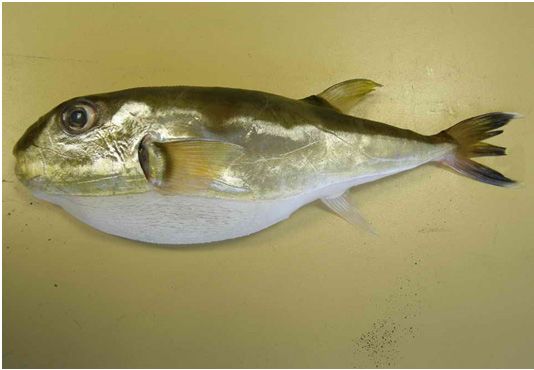
S. Kiparissis et al.

the Dodecanese islands. Since then, the species was
not reported again in any Mediterranean area until
the 50s when there were three new records: in
Iskenderun, Turkey (Kosswig 1950), NW of Samos,
Greece (Ananiadis 1952) and in the Israeli coasts
(Ben-Tuvia 1953). Thereafter, reports of the species
along the Levantine coastal areas either in profes-
sional fishing or in research cruses progressively
increased, yet, the majority of the reported cases
originated from a few localities, mainly from
Iskenderun and Mersin in Turkey. In 2008, there was
another record of this species from the Sea of
Marmara (Tuncer et al. 2008) which is the outermost
north expansion verified for this species. In May          Figure 1. The Lagocephalus spadiceus specimen caught in South
2016, a single specimen of L. spadiceus was fished         Crete. Photo by S. Kiparissis
in South Crete. This is the first time the species was
recorded in the island and the first verified indication
that the species is spreading westwards, crossing
over open-sea areas, since its entrance in the basin.
    In this paper, we present a thorough morpho-
logical and to the best possible extent biological
description of our specimen, providing all the
information that can be extracted from the exami-
nation of a single specimen. An important aspect of
the Tetraodontidae family is the ambiguity about the
taxonomy of its members. Notably, much confusion
occurs on the status of several species of the genus
Lagocephalus (L. spadiceus included), since classi-
fication at the species level has not been compre-
hensively reviewed (Matsuura et al. 2011; Matsuura
2015). For overcoming any identification ambiguities
and validate the specimen’s taxonomic status, DNA
sequencing has also been conducted. Due to the
small number of descriptions provided in the               Figure 2. Capture site (denoted by the star) of the Lagocephalus
literature for L. spadiceus and the variability of the     spadiceus specimen caught in South Crete at 60 m depth.
characters used as diagnostics, DNA sequencing
seems as the most reliable technique for verifying
the taxonomic identity of specimens of this genus.
    The description of our specimen from South Crete       All body measurements and counting of its meristics
adds to our knowledge on the biology and morpho-           were conducted while the fish was fresh. All
logy of the species, and provides further insight into     measurements were taken on the left side of the body
its range expansion, which, coupled with the recent        and represent the direct distances between points, in
record of northward expansion (Tuncer et al. 2008),        accordance to Hubbs and Lagler (1958). Apart from
may indicate an alteration of its population status.       the overall length measurements, which were
                                                           recorded to the nearest mm, all other measurements
                                                           were recorded to the nearest 0.1 mm with digital
Material and methods                                       callipers. Weight measurements were recorded to the
                                                           nearest 0.01 g. Upon completing the external mor-
Morphology examination
                                                           phology examination, the fish was dissected and
The specimen (Figure 1) was caught on May 27,              stomach distension and perivisceral fat deposits were
2016 in South Crete, at 60 m depth (Figure 2). It was      recorded before viscera were removed to examine
caught in the trammel nets of the professional fishing     the stomach and intestine contents. The degree of
boat “Tolmiros” and it was the only specimen of this       stomach distension and perivisceral fat deposits were
species in the particular catch. The fish was brought      ranked according to the subjective indices of Lebedev
to the laboratory the same day, where it was identified.   (1946) and Prozorovskaya (1952) respectively. Gonads

198
Westbound expansion range of Lagocephalus spadiceus
were examined for sex determination, and their Table 1. Description of the meristic characters of the Lagocephalus
spadiceus specimen caught south of Crete.
maturity stage was ranked according to Nikolsky
(1963). Finally, after extracting tissue for DNA Meristic parameters Counts
analysis, the specimen was preserved in 70° alcohol. Dorsal Fin rays 13
The voucher was deposited in the Natural History Anal Fin rays 11
Pectoral Fin rays 16
Museum of Crete, accredited with the collection
Caudal Fin rays 13
number: NHMC80.1.100.1.
DNA isolation and barcoding
Total genomic DNA was extracted from muscle the back similar to those described by Farrag et al.
tissue using the NucleoSpin® Tissue (Macherey- (2016) for Lagocephalus guentheri. There were two
Nagel), according to the manufacturer’s instructions. patches of spinules, one on the back and one on the
The DNA barcoding of the analyzed sample was belly, with the latter ending in the mid distance of
based on the PCR amplification of four loci sequences the edge of the pectoral fin and the anus. The
mtDNA markers (cytb, 12S rRNA, 16S rRNA and spinulose area on the back extends from the origin of
mtCOI), using the universal primers L14841/H15149 the inter-orbital space anteriorly, to shortly before
(Kocher et al. 1989), 12SAL/12SBH and 16SarL/ the outer margin of the pectoral fins posteriorly,
16SbrH (Palumbi et al. 1991) and FishF1/FishR2 ending in a conical shape with a pointy tip. The
(Ward et al. 2005), respectively. Briefly, 3 min of coloration of the caudal fin was dark olive to brown
denaturation (95 °C) followed by 35 PCR cycles of with a lighter hue at the origin of the fin, with the
1 min at 94 °C, 1 min at 54 °C (for the cytb, the 12S posterior half of both lobes darker and both ending
rRNA and the 16S rRNA gene) or 56 °C for mtCOI in white tips. The lower lobe had a whitish tint
and 1 min at 72 °C, with a final extension at 72 °C (Figure 1. The specimen lacked pelvic fins and
for 5 min. PCR reactions were carried out in 20 μl spines in all fins, as do all members of the
volume of reaction mixture, which included final Tetraodontidae family (Tortonese 1986).
concentrations of 1x reaction buffer (Kapa), 1 mM The total length of the specimen was 202 mm and
MgCl2, 0.5 mM dNTPs, 0.5 mM of each primer, weighed 159.31 g (eviscerated weight: 127.08 g).
0.5U μl of Taq (Kapa) and 1 μl of template DNA The meristics and the values of its morphometric
(~ 30–50 ng). The PCR products were purified by a parameters are summarized in Table 1 and Table 2,
PEG (Polyethylene glycol)-NaCl method (Sambrook correspondingly, where body and head measure-
et al. 1989). Both strands were sequenced using the ments are presented both as direct measurements and
BigDye Terminator v3.1 Cycle Sequencing Kit (PE as percentages of the standard length (SL) and head
Applied Biosystems) in a 3500 Genetic Analyzer length (HL), respectively.
(Applied Biosystems). All marker gene sequences Inspection of the gonads of the specimen showed
generated in this study were manually edited with that it was a mature female, with its light orange
Geneious 7.1.2. and have been deposited in the ovaries occupying about half of the abdominal cavity
GenBank under accession numbers KY130420– (degree 3 on Nikolsky’s scale). The stomach of the
KY130423. specimen was half distended (degree 3 on Lebedev’s
subjective stomach-distension index), while macro-
scopically there was no detectable fat deposition in
Results the abdominal cavity and on the viscera (degree 0 on
Morphological and biological description Prodorovskaya’s fat-deposition grading scale). The
of the specimen stomach contents were in the form of a shapeless
mass, with almost all ingested food digested and
The diagnostic characters of our specimen were in with only a few parts of the foraged organisms still
agreement with those described for the Tetraodontidae recognizable. The digested remains that still retained
family and the Lagocephalus genus by Tortonese a recognizable shape were identified as fish fin
(1986) and Matsuura (2001). Its meristics were in apparatuses and as parts of ophiuroid species.
accordance to those described by Golani et al. (2002)
for this species, except for the number of pectoral fin DNA sequence alignment and comparisons
rays, which, in our specimen were 16 compared to
the range of 17–18 described by these authors. The The query length of the amplified product was 329 bp,
coloration of the specimen was dark green-olive on 427 bp, 593 bp and 704 bp for the cytb, the 12S rRNA,
the back, silvery on the sides with a golden sheen the 16S rRNA and the mtCOI gene, respectively.
and white on the abdomen. There were dark bands on Based on the BLAST analysis of the datasets of the
199S. Kiparissis et al. Table 2. Morphometric data of the Lagocephalus spadiceus specimen caught south of Crete. Body and head measurements are also presented as percentages of total length and head length respectively. Morphometric Parameters Size (mm) %SL %HL Total Length (TL) 202 Fork Length (FL) 193 Standard Length (SL) 172 Head Length (HL) 51.2 0.30 Head Depth at the end of the gill slit 56.2 1.10 Head Depth at the middle of orbit 49.7 0.97 Head Width (HW) at gill slit 37.0 0.72 Head Width (HW) at orbits 24.3 0.47 Orbit Diameter (horizontal) 14.7 0.29 Orbit Diameter (vertical) 12.6 0.25 Eye Diameter 11.2 0.22 Inter-Orbital space 26.1 0.51 Pre-Orbital Length 22.6 0.44 Post-Orbital Length 22.7 0.44 Body Width at dorsal fin origin (BWd) 31.7 0.18 Body Depth (BD) measured at the dorsal fin origin 38.1 0.22 Pre-Dorsal Length 109.4 0.64 Pre-Anal Length 112.2 0.65 Caudal Peduncle Depth 9.5 0.06 Caudal Peduncle Length (end of anal base to end of SL) 47.4 0.28 Dorsal Fin Base Length 18.1 0.11 Dorsal Fin Length (posterior part of fin base to edge of lobe) 32.8 0.19 Pectoral Fin Base Length 16.7 0.10 Pectoral Fin Length (from dorsal insertion point to end of longest ray) 29.3 0.17 Anal Fin Base Length 13.3 0.08 Anal Fin Length 29.2 0.17 Caudal Fin Height (vertically extended) 42.6 0.25 four loci, it seems that the unidentified sample is separate species, provided the identifications have assigned as the species Lagocephalus spadiceus. In been correct, a difficult tusk considering their more details, the cytb sequence showed the highest morphological resemblance. similarity (98.5% and 97.6%) with two L. spadiceus specimens (KM667972 and KF781159, respecti- Discussion vely), the 12S rRNAsequence was identical with two L. spadiceus specimens (KM667972 and KF781140 There is a general agreement in the literature respectively), and the highest similarity for the regarding the ranges of the meristics of L. spadiceus. 16S rRNA gene was 99.7% and 99.3%, with two The counts in our specimen agreed with these L. spadiceus specimens (KM667972 and KT718804), descriptions (e.g. Ben-Tuvia 1953; Golani et al. respectively. Finally, the mtCOI sequence was identical 2002), the only exception being the number of with two L. spadiceus specimens (KM538373 and pectoral fin rays, which were 16 in our specimen KM538370, with coverage 663 bp/704 bp both of them) compared to the range of 17–18 given by other and most closely related with another L. spadiceus authors. Yet, a recent record from West India specimen (KM667972, with coverage 697 bp/704 bp). (Suvarna Devi 2016) has also delivered a count of 16 The remarkable morphological similarity of L. spadi- pectoral fin rays and these two exceptions indicate a ceus and L. guentheri (also stressed by the overlapping wider range of the number of pectoral rays that has of their meristics described in the present work), been described so far for the species, and one that raises justified concern. In our case, K2P distances overlaps with the corresponding range described for for the Lagocephalus genus sequences found in L. guentheri (Matsuura et al. 2011), a species very GenBank for the cytb gene suggested distinct sepa- similar to L. spadiceus which recently was reported ration of these two species (13.5% distance of our in the eastern Mediterranean (Farrag et al. 2016; specimen to L. guentheri). However, the authors Akyol and Aydin 2016). Another notable similarity consider that further and more elaborate compa- of our specimen with L. guentheri is the dark band risons of genetic material of more specimens are coloration pattern on the back, which was similar to necessary in order to validate the existence of two the pattern Farrag et al. (2016) and Matsuura et al. 200
Westbound expansion range of Lagocephalus spadiceus

(2011) described for L. guentheri. These similarities,     So, it would be only logical to expect the species to
added to those already described in the literature,        thrive after its entrance into the Mediterranean, if not
render L. spadiceus and L. guentheri morphologically       all around the basin, at least in the south-eastern
very similar, hence the difficulty in distinguishing       areas where the environmental conditions are closer
these two species and the substantive possibility of       to those of the areas of its origin. Paradoxically, even
misidentifications of the specimens caught in the          though the species spread swiftly after entering the
Mediterranean, as has also been suggested by Akyol         basin, moving east of the Nile Estuary to the north
and Aydin (2016) and Farrag et al. (2016). So, even        along the Levantine coastline and to the Aegean Sea,
though the taxonomy of these two species has been          it did not establish any foothold populations along its
described (Matsuura et al. 2011), it is the authors’       migration route for many decades. Even today, at
opinion that due to their close similarity, the            least ninety three years after its first detection, the
identified specimens of both species captured in the       only Mediterranean area known to hold a population
basin, should be examined (or perhaps reexamined)          of considerable size is the Iskenderun Bay and
more attentively. DNA sequencing will eventually           Mersin (SW Turkey) along with the neighboring
provide the necessary validation. In their recent          areas (Başusta et al. 2013; Gökçe et al. 2016). In all
publication, Zenetos et al. (2017) have synonimzed         the other areas of its distribution, even those closer
L. spadiceus with L. guentheri. However, up to date        to the Suez Canal, the species is rare or not abundant
evidence supports the opinion of two discrete species      (Bilecenoglu 2010). Moreover, in all these decades
(Matsuura and Satoh 2017) and no nomenclatural             of its presence in the basin and all along its
changes have yet been established.                         distribution range from the Egyptian coasts to the
   The coloration of our specimen’s caudal fin partly      Sea of Marmaras, the species has remained confined
differed from that described by Matsuura et al.            to near shore areas and has migrated only to regions
(2011) (dark yellow with the ventral one-third white       adjacent to the coastline, such as the Dodecanese
and with no white tips at the endings), a coloration       islands and Cyprus. The above suggests that other
description used by Farrag et al. (2016) as a diagnostic   parameters (biological or environmental) hindered
character. From our specimen, we understand that           its expansion. These parameters (or some of them)
there is a certain variation in the coloration of the      seem to have been lifted, since the species recently
caudal fin and in that respect it may not constitute a     recommenced its expansion progress as the two late
strong taxonomic character. Further descriptions           records reveal, the first from the Sea of Marmara in
from other fresh specimens, genetically verified, will     the north (Tuncer et al. 2008) and the second from
be useful in order to understand the extent of the         the island of Crete in the west (the present record).
coloration variability of this fin and to determine its    Considering this species’ expansion history, these
gravity as a diagnostic character. Regarding the diet      records constitute expansion breakthroughs, with the
of L. spadiceus, Naik and Jalihal (1998) have provided     latter constituting the first true westward migration
a detailed analysis, describing fish, crustaceans,         since it was advanced via open-sea areas, an unpre-
molluscs and algae as the groups that comprise the         cedented feature in its migration pattern as it has
diet spectrum of this species. The detection of            been unfolded so far.
ophiurids in the stomach of our specimen provides              Up to date, there have been another three reports
evidence that it forages on an even broader spectrum       that denote a westbound expansion of the species’
of organisms, a feature that can be advantageous to a      distribution, describing the species present in the
species that colonizes a new environment.                  coast of Tunisia (Charfi-Cheikhrouha 2004) in the
   Lagocephalus spadiceus is one of the earliest           Sallum Gulf, north-west coastline of Egypt (El-Haweet
lessepsian fishes. It passed through the Suez, decades     et al. 2011) and in the Ionian Sea (Lefkaditou et al.
before the salinity reduction of the Bitter Lakes          2010). However, while the report from Tunisia is an
facilitated the passage of the erythrean species through   obvious misidentification, which has also been
the Canal (Ben-Tuvia 1978; Bianchi and Morri 2003),        challenged by Enajjar et al. (2015), (the described
and before the global warming effect and the               meristics and the spinule distribution do no accord
operation of the Aswan dam altered the Mediterranean       with that of the species), the reference from the
environment in their favor (Bianchi and Morri 2003).       Sallum Gulf is not supported with any specimen
The rapidity with which L. spadiceus overcame the          description. The report from the Ionian is also
considerable salinity barriers (the high salinity of the   another case of misidentification as we have been
Bitter Lakes and the low salinity of the Nile estuary)     reassured (Lefkaditou, personal communication).
and its tolerance to the low winter Mediterranean          Thus the present record in Crete is the first verified
Sea temperatures indicates a very resilient species        evidence of a westbound expansion of this species in
and, thus, a strong candidate for rapid colonization.      the Mediterranean.

                                                                                                              201
S. Kiparissis et al.
Since there is limited knowledge of the biology Ben-Tuvia A (1978) Immigration of fishes through the Suez Canal.
Fishery Bulletin 76(1): 249–255
and ecology of this species, and no knowledge of the Bianchi CN, Morri C (2003) Global sea warming and “tropicalization”
species’ mode of adaptation in the Mediterranean of the Mediterranean Sea: biogeographic and ecological aspects.
whatsoever, we cannot make any safe assumptions Biogeographia 24: 319–327, https://doi.org/10.21426/B6110129
or speculations as to which parameters have been Bilecenoglu M (2010) Alien marine fishes of Turkey - an updated
review. In: Golani D, Appelbaum-Golani B (eds), Fish Invasions
altered to permit this new dispersion recommencement of the Mediterranean Sea: Change and Renewal. Pensoft
to areas beyond its distribution boundaries. Yet, Publishers, Sofia-Moscow, pp 189–217
since all evidence suggests the progressive change of Charfi-Cheikhrouha F (2004) Premieres observations de quatre
the Mediterranean environment, resulting to the especes de poisons allochtones a Rafrar (Nord-Est de la
Tunisie). Bulletin de l’Institut National des Sciences et
progressive tropicalization of the basin (Bianchi and Technologies de la Mer de Salammbo 31: 115–117
Morri 2003), we could ascribe these last findings to El-Haweet AE, Fishar MR, Geneid Y, Abdel-Moula E (2011)
the generation of more favorable conditions for the Assessment of fisheries and marine biodiversity of Sallum Gulf,
species, at least in the eastern part of the basin, Egypt. International Journal of Environmental Science and
Engineering 1: 21–34
permitting its expansion to areas formerly inaccessible Enajjar S, Hamida NBH, Saadaoui A, Bradai MN (2015) New data
due to unfavorable environment. In any case, these on puffer fish species (Osteichthyes: Tetraodontidae) occurring
two recent events of range expansion (to the north in Tunisian waters (central Mediterranean Sea). Marine Life 18:
and west) may portend a new era for this species’ 33–41
Farrag MMS, El-Haweet AAK, Akel El-S A, Moustafa MA (2016)
abundance and expansion in the East Mediterranean Occurrence of puffer fishes (Tetraodontidae) in the Eastern
regions. Mediterranean, Egyptian coast - filling in the gap. BioInvasions
The geographical distribution patterns of the non- Records 5: 47–54, https://doi.org/10.3391/bir.2016.5.1.09
indigenous species (NIS) are important background Gökçe G, Saygu İ, Eryaşar AR (2016) Catch composition of trawl
fisheries in Mersin Bay with emphasis on catch biodiversity.
information for understanding and describing the Turkish Journal of Zoology 40: 522–533, https://doi.org/10.3906/
dynamics of their dispersion. This type of infor- zoo-1505-35
mation is not sufficient for many of these species, a Golani D, Orsi-Relini L, Massutí E, Quignard JP (2002) CIESM
situation exacerbated by the NIS increasing influx Atlas of exotic species in the Mediterranean. Vol. 1. Fishes.
Briand F (ed), Monaco: CIESM, 254 pp
rates during the last decades (Bilecenoglu 2010). Hubbs CL, Lagler KF (1958) Fishes of the Great Lakes Region.
Additionally, frequent misidentifications (examples Bloomfields Hill: Cranbrook Institute of Science, Michigan, US,
for the Lagocephalus genus in Farrag et al. 2016), 213 pp
only obfuscate the general picture. In that respect, Kocher TD, Thomas WK, Meyer A, Edwards SV, Paabo S,
Villablanca FX, Wilson AC (1989) Dynamics of mitochondrial
the accuracy and validity of the distribution data are DNA evolution in animals: amplification and sequencing with
fundamental prerequisites and a more scrupulous conserved primers. Proceedings of the National Academy of
and painstaking effort must be embraced in order to Sciences of the United States of America 86: 6196–6200,
https://doi.org/10.1073/pnas.86.16.6196
accurately identify and describe NIS from captured Kosswig C (1950) Erythräische fische im Mittelmeer und an der
or deposited specimens. To that end, genetic analysis Grenze der Ägais. Syllegomena Biologica. Festchrift
proves a valuable tool. Kleinschmidt. Leipzig: Akademie Verlag, pp 203–212
Lebedev NY (1946) Elementary Populations of Fish. Zoologichesky
Acknowledgements Zhurnal 25: 121–135 [In Russian]
Lefkaditou E, Vassilopoulou V, Petrakis G, Peristeraki P, Kavadas S,
The authors wish to express their gratitude to Nikos Bibiris, who Politou CY, Kapantagakis A, Machias A, Papaconstantinou C
provided the specimen to the scientific team of HCMR, and also (2010) The effect of Lessepsian immigrants to the Hellenic
to Dr. Nikolaos Lampadariou for providing the map and valuable Fisheries. In: EastMed, 2010. Report of the Sub-Regional Technical
comments on the text. meeting on the Lessepsian migration and its impact on Eastern
Mediterranean fishery. Scientific and Institutional Cooperation
to Support Responsible Fisheries in the Eastern Mediterranean.
References GCP/INT/041/EC – GRE – ITA/TD-04. Athens, 138 pp
Matsuura K (2001) Tetraodontidae. In: Carpenter KE, Niem VH
Akyol O, Aydin I (2016) A new record of Lagocephalus guentheri (eds), FAO Species Identification Guide for Fishery Purposes.
(Tetraodontiformes: Tetraodontidae) from the north-eastern The Living Marine Resources of the Western Central Pacific,
Aegean Sea. Zoology in the Middle East 62: 271–273, Vol. 6, Bony Fishes, part 4 (Labridae to Latimeriidae), estuarine
https://doi.org/10.1080/09397140.2016.1226244 crocodiles, sea turtles, sea snakes and marine mammals. FAO,
Ananiadis C (1952) On the appearance of the fish Tetrodon Rome, pp 3954–3957
spadiceus (Rich.) in the Greek Seas. Proceedings of the Greek Matsuura K (2015) Taxonomy and systematics of tetraodontiform
Hydrobiological Institute of the Athens Academy 6(1): 73–74 [in fishes: a review focusing primarily on progress in the period
Greek] from 1980 to 2014. Ichthyological Research 62: 72–113,
Başusta A, Başusta N, Özer EI (2013) Length-weight relationship of https://doi.org/10.1007/s10228-014-0444-5
two puffer fishes, Lagocephalus sceleratus and Lagocephalus Matsuura K, Golani D, Bogorodsky SV (2011) The first record of
spadiceus, from Iskenderun Bay, Northeastern Mediterranean, Lagocephalus guentheri Miranda Ribeiro, 1915 from the Red
Turkey. Pakistan Journal of Zoology 45(4): 1047–1051 sea with notes on previous records of L. lunaris (Actinoptertgii,
Ben-Tuvia A (1953) Mediterranean fishes of Israel. Bulletin of the Tetraodontiformes, Tetraodontidae). Bulletin of the National
Israel Sea Fisheries Research Stations (Haifa) 8:1–40 Museum of Nature and Science. Series A 37(3): 163–169
202Westbound expansion range of Lagocephalus spadiceus
Matsuura K, Leis JL, Hardy G, Jing L, Liu M, Shao K (2014) Suvarna Devi S (2016) First record of the half-smooth golden puffer
Lagocephalus spadiceus. The IUCN Red List of Threatened Lagocephalus spadiceus (Richardson, 1845) (Tetraodontidae)
Species 2014, https://doi.org/10.2305/IUCN.UK.2014-3.RLTS.T19362 from west coast of India. Journal of Aquatic Biology &
2A2248751.en Fisheries 4: 152–155
Matsuura K, Satoh TP (2017) Redescription of Lagocephalus Tortonese E (1986) Tetraodontidae. In: Whitehead PJP, Bauchot
cheesemanii (Clarke 1897), a senior synonym of Lagocephalus ML, Hureaeu JC, Nielsen J, Tortonese E (eds), Fishes of the
gloveri Abe and Tabeta 1983, based on morphological and North-eastern Atlantic and the Mediterranean. UNESCO, Paris,
genetic comparisons (Actinopterygii: Tetraodontiformes: Tetra- Vol. III, pp 1341–1345
odontidae). Ichthyolgical Research 64: 104–110, https://doi.org/ Tuncer S, Aslan Cihangir H, Bilecenoglu M (2008) First record of
10.1007/s10228-016-0547-2 the Lessepsian migrant Lagocephalus spadiceus (Tetraodontidae)
Naik SD, Jalihal DR (1998) Biological observations on the in the Sea of Marmara. Cybium 32(4): 347–348
pufferfishes of south Konkan with special reference to the net- Tuney I (2016) Molecular identification of puffer fish Lagocephalus
damaging species Lagocephalus spadiceus (Osteichthyes, sceleratus (Gmelin, 1789) and Lagocephalus spadiceus
Tetraodontidae). Indian Journal of Marine Sciences 27(3-4): (Richardson 1845) from eastern Mediterranean, Turkey.
426–432 Fresenius Environmental Bulletin 25(5): 1428–1436
Nikolsky GV (1963) The Ecology of Fishes. Academic Press, Ward RD, Zemlak TS, Innes BH, Last PR, Hebert PDN (2005) DNA
London, 352 pp barcoding Australia’s fish species. Philosophical Transactions
Palumbi SR, Martin A, Romano S, Mcmillan WO, Stice L, of the Royal Society of London. Series B, Biological Sciences
Grabowski G (1991) The simple fool’s guide to PCR. University 360: 1847–1857, https://doi.org/10.1098/rstb.2005.1716
of Hawaii Press, Honolulu, 45 pp Zenetos A, Ҫinar ME, Crocetta F, Golani D, Rosso A, Servello G,
Prozorovskaya ML (1952) On the method of determining the fat Shenjar N, Turon X, Verlaque M (2017) Uncertainties and
content of the roach from the quantity of fat on the intestines. validation of alien species catalogues: The Mediterranean as an
Bulletin of the Institute of Fisheries USSR 1: 1–6 [In Russian] example. Estuarine, Coastal and Shelf Science 191: 171–187,
Sambrook J, Fritsch EF, Maniatis T (1989) Molecular Cloning, 2nd https://doi.org/10.1016/j.ecss.2017.03.031
ed. Cold Spring Harbor Laboratory Press, Cold Spring Harbor,
New York, 1626 pp
Sanzo L (1930) Plectognathi. Ricerche biologiche su materialli
raccolti dal Prof. L.Sanzo nella Campagna Idrografica nel Mar
Rosso della J.N. Ammiraglio Magnaghi 1923–1924. Memoria
Comitato Thalassographico Italiano 167: 1–111
203You can also read


