REBUILDING TOGETHER: NEW ZEALAND'S BUDGET 2020 - PETER VIAL, FCA CHARLOTTE EVETT, CA JOHN CUTHBERTSON, FCA KAREN MCWILLIAMS, FCA - CHARTERED ...
←
→
Page content transcription
If your browser does not render page correctly, please read the page content below

Rebuilding together:
New Zealand’s Budget 2020
                   Peter Vial, FCA
                Charlotte Evett, CA
            John Cuthbertson, FCA
            Karen McWilliams, FCA
Key links
• CA ANZ Budget 2020 commentary
           https://www.charteredaccountantsanz.com/news-and-analysis/news/2020-21-new-
           zealand-budget
• Budget 2020 speech
           https://treasury.govt.nz/sites/default/files/2020-05/b20-speech.pdf

• Budget 2020 document
           https://treasury.govt.nz/sites/default/files/2020-05/b20-wellbeing-budget.pdf

© Chartered Accountants Australia and New Zealand 2020
Budget 2020: Our 13 expectations
  Job retention                                          ✔
  Job creation                                           ✔/✕
  No tax increases                                       ✔
  No cuts in spending                                    ✔
  Quality infrastructure spend                           ✔
  Targeted support for business and households           ✔/✕
                                                               Level 3 is a
  Joint policy development with business and other       ✔/✕
                                                               waiting or a
  sectors
                                                               recovery room

© Chartered Accountants Australia and New Zealand 2020
Budget 2020: Our 13 expectations
  Enabling access to capital for business                ✕

  Digital expansion and addressing the digital divide    ✕

  Boosting productivity                                  ✕

  Continued commitment to lower emissions and            ✔
  improved environmental outcomes
  Investment in health                                   ✔

  Agile policy making                                    ?

© Chartered Accountants Australia and New Zealand 2020

New Zealand Budget 2020

© Chartered Accountants Australia and New Zealand 2020
COVID-19 Support
       Charlotte Evett, CA
Wage Subsidy Extension Scheme
• $3.2 billion targeted extension to current Wage Subsidy Scheme
• Applications open 10 June – 1 September 2020
• Apply through Work and Income after original subsidy comes to an end
• Open to employers, including self-employed eligible, now also includes pre-R&D start
           up firms
• Employers can not receive more than one COVID-19 payment for the same employee at
  the same time (Wage subsidy, Extension, Leave support)

© Chartered Accountants Australia and New Zealand 2020
Eligibility
• Actual or expected decrease in revenue of at least 50% for the 30 days before you apply,
           compared to the closest period last year
• Covers 8 weeks per employee from the date of application
• Paid in a lump sum at the same weekly rate as the Wage Subsidy
• Same rates as current scheme
                     • $585/full time employee (< 20 hours/week)
                     • $350/part time employee (>20 hours/week)

© Chartered Accountants Australia and New Zealand 2020
Declaration and Ethical Obligations
• Obligations under Current Wage Subsidy Scheme remain, such as:
• pass the subsidy on to your employees
• retain your employees for the duration of the subsidy
• do your best to pay your employees at least 80% of their normal pay
• take active steps to mitigate the impact of COVID-19 on your business.
• Payments remain subject to audit and review, and Ministers have signalled serious consequences for
abuse of the system.
• CA ANZ members are bound by the NZICA Code of Ethics, which requires integrity in all business
and professional relationships
© Chartered Accountants Australia and New Zealand 2020Small Business Support
• Business.govt.nz resource expansion $2.3m
• Cashflow tool
• Other support for small business
• Better for Business program $9.7m
• Business connect platform (COVID support) $3m
• Trans-Tasman e-invoicing initiative $12.5 million
• NZTE intensive support for exporters $32m over 4 years
© Chartered Accountants Australia and New Zealand 2020Government resources and information
Work and Income https://www.workandincome.govt.nz/covid-19/wage-
subsidy-extension/index.html
MBIE https://www.mbie.govt.nz/about/news/government-to-
increase-fmas-funding-and-levy-settings/
Business.govt.NZ https://www.business.govt.nz/covid-19/
Government COVID-19 https://covid19.govt.nz/
response
© Chartered Accountants Australia and New Zealand 2020Budget 2020 recognises tax
system well positioned to
support New Zealanders
through COVID-19
John Cuthbertson, FCAKey tax messages from the Budget
• Tax system has key role to play to support COVID-19 response and recovery
• Response phase – tax system to cushion impact on economy:
• Increasing cashflow to businesses; and
• Reducing compliance costs/pressure;
• Recovery phase – tax policy to help position economy for recovery:
• Supporting investment and job creation
• Core crown revenue expected to decline by 2% GDP by 2021/22 before returning to 29.4% in
2023/24
© Chartered Accountants Australia and New Zealand 2020Tax measure announced in Budget 2020
• $80m set aside to encourage business to develop new products by enabling them to claim tax
deductions for unsuccessful or abandoned assets –
• Provides incentive for business to innovate and invest;
• The detail will be important as to extent of coverage
“ While letting businesses write off tax for unsuccessful products might sound counter-intuitive to
some people, this is actually an important way of encouraging investment because it gives businesses
the confidence to have a go and take the risk. If it works, we all come out better off due to the
economic activity created by the ideas that come off” – Stuart Nash Minister of Revenue.
© Chartered Accountants Australia and New Zealand 2020What’s not in the Budget: Still to come: Announced & Law:
• Tax cuts • Deductions for • Building depreciation
unsuccessful /abandoned
• Tax increases assets • Temporary loss carry back
(2019 – 2021)
• Changes to GST rate • Permanent loss carry back
rules • Provisional Tax threshold
• ‘Helicopter money’ increase
• ‘same or similar business’
test for corporate loss • Low value asset write off
continuity
• UOMI remission
© Chartered Accountants Australia and New Zealand 2020Overview of the “Small Business Cashflow
Loan Scheme”
• One – off loan for SMEs (including sole traders/self-employed) impacted by COVID-19 who employ
50 or fewer FTE employees to provide assistance up to $100,000 –
• Maximum available loan = $10,000 + an additional $1,800 per FTE employee.
• Eligibility criteria –
• Same as for the wage subsidy scheme; Plus
• Requirement: to provide declaration that business is a viable business; that the money will be used for core
business operating costs; and to enter into a legally binding loan contract;
• The loan will be administered by Inland Revenue and will have the following terms –
• No interest if paid back within first year; otherwise
• Interest at 3% for a maximum term of 5 years (with no repayments required within first 2 years).
© Chartered Accountants Australia and New Zealand 2020Do homework before applying for SBCL
Required to enter into a loan agreement and sign a
Must be eligible and viable declaration that the business is viable:
• Read & understand loan terms & conditions – what
are the borrowers rights/obligations?
Viable = (more likely than not) that able to pay debts as they fall
due – have plan to ensure business remains viable within next 18
months – retain evidence to support declaration at time of loan
request.
Where not viable or ineligible, fail to make repayment, enter
Evidence of viability could include: into arrangement with creditors, transfer assets or cease
• A cash flow forecast for the short term; business – Event of default triggered (with the consequence
• A plan where revenue will come from in future market that):
conditions and a forecast of those revenues; • Outstanding loan balance immediately due and payable;
• Financial statements showing business has sufficient resources • Default interest will typically be charged (10%);
inclusive of SBCS loan to sustain itself; • Depending on the offence – subject to prosecution under
• Accountants assessment that business is viable and ongoing. the Crimes Act
© Chartered Accountants Australia and New Zealand 2018Environment, business,
infrastructure and education
Karen McWilliams, FCAEnvironment
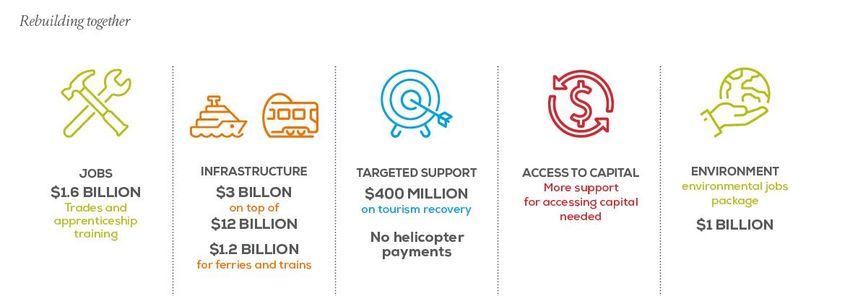
• Environmental Jobs package:
• $433m - Investment in regional
environmental projects
• $200m - Jobs for Nature Fund
• $315m Pest eradication and pest control
• $154m – new jobs enhancing biodiversity
• $500m - Funding to continue to support
Ministry for Primary Industries’
operations
© Chartered Accountants Australia and New Zealand 2020Business
• $216m for Kiwi exporters
• $150m loan fund for R&D intensive
businesses
• $41.1m in targeted, sector support –
construction, digital and agritech
© Chartered Accountants Australia and New Zealand 2020Infrastructure (and Transport)
• $3bn in COVID-19 Fund for
infrastructure
• Transport - $1.2bn including
replacement and improving
ferries and rail
© Chartered Accountants Australia and New Zealand 2020Education
• $1.6bn Trades and Apprentices Package
including:
• Māori Apprentices and Trades training -
$50m
• Nearly $1bn for education including:
• School Property Investment - $115m
• Funding for Early Childhood Education -
$292m
• Learning Support - $80m
© Chartered Accountants Australia and New Zealand 2020A Missed Opportunity?
Mental Health
Clean Tech / Just Transition
© Chartered Accountants Australia and New Zealand 2020Your Questions
This publication is intended to provide general information and is not intended to provide or substitute legal or professional advice. This publication has been prepared
so that is current as at the date of writing. You should be aware that such information can rapidly become out of date. You should not act, or refrain from acting, or
rely on any statement, view or opinion expressed in this publication. You should make and rely on your own inquiries in making any decisions or giving any advice. No
warranty is given as to the correctness of the information contained in this publication, or of its suitability for use by you. To the fullest extent permitted by law,
Chartered Accountants Australia and New Zealand (CA ANZ) is not liable for any statement or opinion, or for any error or omission contained in this publication and
disclaims all warranties with regard to the information contained in it, including, without limitation, all implied warranties of merchantability and fitness for a
particular purpose. CA ANZ is not liable for any direct, indirect, special or consequential losses or damages of any kind, or loss of profit, loss or corruption of data,
business interruption or indirect costs, arising out of or in connection with the use of this publication or the information contained in it, whether such loss or damage
arises in contract, negligence, tort, under statute, or otherwise.

© Chartered Accountants Australia and New Zealand 2020
You can also read


